Cling to What is Good

Romans 12

May 28

More than any other year, I have had conversations with other teachers about leaving our profession. If you have a teacher in your life, you’ve probably heard it before: low pay, no appreciation, kids are getting worse, and no support.  Teachers, by nature, are critical thinkers and problem solvers, which can also make them quick to complain.  Change their donuts to bagels in a staff meeting and a mutiny will form.  I do not say this as one who stands outside the circle.  I am equally guilty, although my frustrations are often internalized and turned into canker sores and headaches. For a reason I can’t quite pinpoint, it has been especially hard to keep my morale up these past nine months.  I took off every day I could this year because I just had to get away.  Not necessarily go on vacation, visit the doctor, or spend time with a chore.  I just straight up needed to walk away from my classroom because I could feel the souring of my attitude and the shrinking of my heart.  I admit it: there is a lot not to like about being a teacher, BUT, and this is a really big BUT (snicker), it is an unbelievably fun, challenging, and exciting profession.  If you place your focus on the good, it far outweighs the day-in-day-out demands and frustrations. The intrinsic compensations are great, and why, ultimately, teaching is consistently ranked as one of the most rewarding careers.

Now, I do have a pro-trip, a trick, a game changer when it comes to negativity towards your career, or being a parent, or living as a teenager, or any other stage or status in life.  It is delivered at the end of today’s reading in Romans 12: Do not be overcome by evil, but overcome evil with good.  What a simple solution.  If we’d only heard that earlier, right?  Don’t do bad stuff.  Don’t let the bad stuff get to you.  You may have picked up that my commentary is laced with sarcasm.  However, for much of the chapter, this is the theme: something bad happens, do something good in its stead. Man, is it hard.  I mean, how is it even possible? Why would I reward someone for being bad to me?  Why should I indulge in any situation which makes me feel stressed?

Love must be sincere. Hate what is evil; cling to what is good. Be devoted to one another in love. Honor one another above yourselves. Never be lacking in zeal, but keep your spiritual fervor, serving the Lord.  Romans 12:9-11

There is a bleak backdrop to living in this world. There is war, famine, and disease.  There is poverty, addiction, and abuse.  There are shooting sprees, abductions, and pandemics, and we’re only beginning to list the atrocities of the present evil age. There is an onslaught of badness of the baddest worstiness.  BUT, and this is a really big BUT, there is good, and that good stems from our Heavenly Father, and with that good, we are triumphant. We can love those who have enslaved us, show mercy to those who have betrayed us, enrich those who have stolen from us, and give peace to those who bring war to us.  And with that good, the goodness of God, we win.  BUT, this time a slightly smaller one, we have to be ready to change our thinking.

If it is possible, as far as it depends on you, live at peace with everyone. Do not take revenge, my dear friends, but leave room for God’s wrath, for it is written: “It is mine to avenge; I will repay,” says the Lord. – Romans 12: 18-19

Do not conform to the pattern of this world, but be transformed by the renewing of your mind. Then you will be able to test and approve what God’s will is—his good, pleasing and perfect will. – Romans 12: 2

We cannot be conformed to the pattern of diseased thinking.  Although it is an easy path to follow, it is poisonous and breeds destruction.  We have to be ready to reframe and reform every situation, our own dire circumstance, into God’s good, pleasing, and perfect will.  The arrows for this fight are fledged with praying for our enemies and those who persecute us.  I remember distinctly this year I was becoming increasingly frustrated with a student, when she shouted “Jesus Christ!” I responded by saying, “You can’t talk to Him right now because He’s busy talking to me about you.” Playfully intended, when I become frustrated with a student, an adult, family, or children, prayer is my weapon. Talking to God about it changes my heart and exposes my faults. As those who follow the Lord, we have the ability to test and prove what action we should take to demonstrate the Kingdom of God.  In the vast majority of cases, our fiery arrows are plunged with the fruit we bear when mangled and tangled amongst weeds and thorns. Don’t drop the ball. Hold on to to what is good!  Cling!  We must be stringent to live out His moral will (see: fruits of the Spirit, Galatians 5:22-23) even if it causes our situation to deteriorate further. That’s hard, but this is when our testimony truly begins. Enemies and spectators, like Paul, and his jailer, and the thief on the cross, are actively watching and it changes their hearts. Don’t give your complaint a shelter to live in; give your life, your action, your attitude as the testimony to the Father.

-Aaron Winner

Questions for Reflection and Discussion

  1. What are the problems with negative thinking – for you and for others? Is there an area in which you get stuck in negative, stinking thinking? What gems in Romans 12 can help change this mindset? Write them out. How can you begin retraining the brain (be transformed by the renewing of your mind)?
  2. What evil will you work to overcome? How? Pray for God’s leading and strength.
Roots

Romans 11

May 27

I have never really pondered the meaning behind the politically-charged term “grassroots.” I have only thought about it in the most basic of terms.   The people are basic, grass is basic, so as an organization or movement made up of basic people; this must be their connection. These past few weeks creating a garden in a space that was previously untamed ground has really changed the direction of my contemplation on this term. I had taken a great deal of time to till up the ground, remove the vegetation, make a raised bed, and amend the soil.  We sowed new vegetable seeds and waited.  And waited.  And WAITED. To our horror, we watched the most beautiful patch of grass within our entire yard form but not a single seed germinate and reach the surface.  Together my wife and I removed the newly formed grass, this time with great care to remove as much of the roots as possible. We sowed the seed again and waited. This time the vegetables plants grew alongside the grass.

This is when I began rethinking “grassroots.”  There is and was so much of it.  It was impossible to get rid of, to stamp out (at least for the novice gardener). The roots run in so many directions and are intertwined.  Momentarily getting rid of the green is possible, but the grass comes back stronger, greener, and flourishes even more from the pruning.  Culturally and politically, grassroots make a deep connection to this extended metaphor.  As regular folk, we can be part of big ideas or shared values with expectations that are entrenched and hard to amend or move.  However, we are not the root, we are just the greeny growth that thrives off the vine.

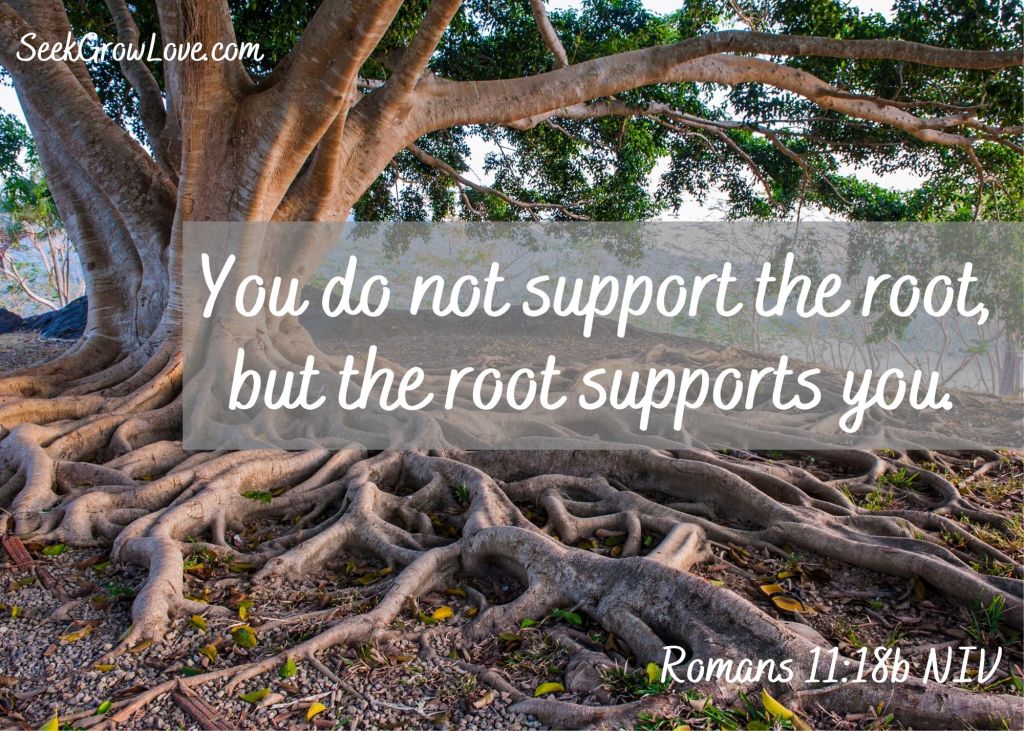
“Consider this: You do not support the root, but the root supports you.” – Romans 11:18b

I am the true vine, and my Father is the gardener. He cuts off every branch in me that bears no fruit, while every branch that does bear fruit he prunes so that it will be even more fruitful. You are already clean because of the word I have spoken to you.  Remain in me, as I also remain in you. No branch can bear fruit by itself; it must remain in the vine. Neither can you bear fruit unless you remain in me. – John 15:1-4

Romans 11 makes an ever deeper root connection (this is a pun, and you’ll see why in a moment).  In this case, the gardener is not a novice. Grafting branches onto a tree takes an experienced hand.  The metaphorical botanical in this passage is an olive tree. But why? Because they live an insanely long time. They are a millennial perennial. Additionally, the roots of an olive tree can grow deeper under the surface than above.  It is extremely hard to extinguish some of these species.  Impossible, when you consider the species specifically spoken about here: Jesus Christ.  His Father is the Gardener, He is the vine, and we are the branches. We are grafted by God into the Savior, which predates His arrival.  It is the oldest, deepest promise of God.  “After all, if you were cut out of an olive tree that is wild by nature, and contrary to nature were grafted into a cultivated olive tree, how much more readily will these, the natural branches, be grafted into their own olive tree!” Romans 11:24

No longer is there a single type of branch budding on the tree, but the Good Gardener has chosen a variety.  Each one is equal to the other because none can be supported without the vine.  This makes us all part of the same faith, intertwined in the same hope, which strengthens and flourishes the whole plant, (or body – 1 Corinthians 12)  These roots run from the origins of the universe and the branches are fruiting, growing, and reaching towards Kingdom Come.  Are you accessing the sap of the Spirit? Utilizing your provision to make fruit? Allowing the gardener to prune the dead bits? Tap into the power and the promise that most assuredly lies in the deepest root.

-Aaron Winner

Questions for Discussion and Reflection

  1. Reading Romans 11, what do we learn about the Gardener who grafts in branches? How would you describe Him? What is His purpose?
  2. How does the Doxology (an expression of praise to God, sometimes sung) in verses 33-36 tie in with the rest of the chapter?
  3. How is your grafting process going? How have the roots supported you? How are you getting along with the other branches?

Examining God’s Credit System

Romans 4

May 20

We often hear the phrase, “Faith without works is dead,” quoted from James chapter 2, in sermons and lessons about the importance of DOING. Now these are a wonderful set of verses, however, Romans 4 clarifies that works without faith are also dead. Our works, and the goodness of our works, are measured on a human scale; any good deed one might do could have any number of motives. God looks at the heart, not our outward performance, in order that we may be saved by grace and not by our own works. 

“And to the one who does not work but believes in him who justifies the ungodly, his faith is counted as righteous” Romans 4:5

Paul admits that Abraham’s works are impressive; he displayed his righteousness in the way he lived. However, his works alone were not what made him righteous in God’s eyes. God sees much more than we ever could. Abraham was promised that he would be the father of many nations because of his righteousness of faith, for it is true belief in our LORD that determines godly righteousness, and God saw that Abraham truly believed. 

This is such a beautiful thing, because this process of forgiveness and redemption and justification applied to Abraham “not just for his sake alone, but for ours also” (Romans 4:23-24). We are justified not by works, but by faith, because 1. our works could never cut it, and 2. our works are a faulty means of character assessment. Because God looks at our hearts to determine our righteousness, our hearts are what we need to keep in check. Don’t sully your good works with a hardened heart. Every good work we do should be done for the sake of serving our Father, and not for the purpose of serving our own selfish desires, greed, and self-centeredness. Good works need to sprout from a pure motive, or else it’s no longer a good work. I thank God that we, like Abraham, may be counted righteous by our faith, and hope that we all will strive to be just as intentional in our inward thoughts, emotions, and faith (what God sees) as we are in our outward actions, words, and works (what man sees). 

-Isabella Osborn

Discussion Questions:

  1. How do verses 5-8 give us hope? Who is justified under this blessing?
  2. If godly righteousness does not come through the law or works, but by faith, then why is it sometimes so hard to attain godly righteousness?
  3. How can you grow in godly righteousness? 

Wrong is Always Wrong

Romans 2

May 18

Have you noticed how much easier it is to condemn others for their actions than to condemn ourselves, and our own actions? Too often, we become critics of everyone around us – judging the way they live their lives, the words they say, the things they do – critics of everyone except ourselves. For this particular sin, a trap we all probably fall into from time to time, Romans 2 really hits hard. Paul over-emphasizes repeatedly that wrong is always wrong, and sin is always sin, no matter who does it, no matter your intentions or your justification. Yes, our God is a loving God, forgiving and merciful forever and always. But our God is also a just God, and He will judge each and every person accordingly. As Romans 2:3-4 expresses, just because we serve a God who is kind, patient and forgiving does NOT mean that you can get away with any evil deed, continuing to live in unrighteousness relying only on the idea that all will be forgiven. 

“Do you suppose, O man – you who judge those who practice such things and yet do them yourself – that you will escape the judgement of God? Or do you presume on the riches of his kindness and forbearance and patience, not knowing that God’s kindness is meant to lead you to repentance?” Romans 2:3-4

God’s abounding love and kindness is not a means to live however we desire, it’s a call to repentance, because He so wants us to live with Him in eternity, and if we truly want it as well, we would not continue living in sin, but repent and grow and strive to reach the very highest of our potential. We would strive to be just the tiniest bit worthy of His love and mercy. Because in all God’s perfection and all our imperfection, we are utterly incompatible. And yet He still loves us and desires a relationship with us, a relationship that lasts for all eternity. 

As we continue throughout this week, whenever we catch ourselves judging the actions of others, let us remember to instead look within ourselves. I pray that we may see through God’s eyes how we can improve and grow closer to who God made us to be, and ask forgiveness for our own sins, rather than judging the people around us for theirs. Let us obey the truth today for the sake of eternity, and not obey unrighteousness for the sake of today. “For those who are self-seeking and do not obey the truth, but obey unrighteousness, there will be wrath and fury… but glory and honor and peace for everyone who does good” (Romans 2:9-10).

-Isabella Osborn

Discussion Questions:

  1. If God has instilled in us a conscience, allowing us to discern right from wrong, (which according to Romans 2:15, He has) then why do we persistently live in sin?
  2. How should we move forward after acting in an unrighteousness, ungodly manner, in order to continue seeking everlasting life with God- living for Him and not for ourselves? 

One Goal

Acts 21

May 9

Unlike many Jewish leaders, James and the elders were not jealous of Paul’s success among the Gentiles.  But they were aware that not everyone was so accepting.  To head off problems, the elders asked him to pay the costs of men completing a vow.   Likely a Nazirite vow, this voluntary, temporary commitment to total dedication to God required extensive sacrifices, including a female lamb, a male lamb, unleavened bread, loaves of bread, crackers, oil, and a grain and drink offering.   

Paul wasn’t buying acceptance. In 1 Corinthians 9 he writes “19 Though I am free and belong to no one, I have made myself a slave to everyone, to win as many as possible. 20 To the Jews I became like a Jew, to win the Jews. To those under the law I became like one under the law (though I myself am not under the law), so as to win those under the law. 21 To those not having the law I became like one not having the law (though I am not free from God’s law but am under Christ’s law), so as to win those not having the law. 22 To the weak I became weak, to win the weak. I have become all things to all people so that by all possible means I might save some. 23 I do all this for the sake of the gospel, that I may share in its blessings.”  He had one and only one goal….to win others to Christ.  Let’s be as focused as Paul.

-Annette Osborn

Questions for Reflection and Discussion

  1. If people who knew you were to guess what your main goal was, what might they guess? Would they be right?
  2. How have you become “like others” (while remaining true to Christ’s law) in order to be able to share the good news with them?
  3. What group(s) of people would you want to be accepted by, so that they are willing to hear from you about Jesus Christ? How can you go about this mission?
  4. What was Paul willing to do, and willing to give up, in order to reach more people with the saving gospel? What are you willing to do, and willing to give up, for the same purpose?

Death

Acts 13

May 1

As a pastor, I try my best to get out and visit the sick and elderly. I feel a constant tension when visiting an elderly or really sick person that I want to pray for their healing but I also acknowledge that everyone I know will, probably, die. I have had people in my life who are Christians die at an old age. Many people would comment that when a person has grown old and had a full life that death was more acceptable.

There is something in our minds that feels better when a person grows old and has experienced all of life and then dies. We say that they have lived a full life.

In our chapter of the day Paul is being sent out on his first missionary journey. He is sent out by the elders of the Antioch church and he makes a significant statement about death. He is asked to give a word of encouragement in the synagogue in Pisidia. As a side note, I love how Paul is geared up and just already has something on his heart to share with this group. As the text reads Barnabas and Paul are asked and then Paul just stands up and goes. As someone who preaches most Sundays I love the idea of no outline, just God speaking to you and you speaking to people. Paul was a man who was hooked up to the well and out flowed the things that God put there.

Now back to get back on track … Acts 13.36 “For David, after he had served the purpose of God in his own generation, fell asleep and was laid with his fathers and saw corruption”

Paul says something implicitly about life that could be helpful for us. Paul says that David dies after he had served his purpose to God. Essentially after he had done what God wanted him to do David died. For some people this may seem like harsh treatment by God to his servant. Why wouldn’t God give David a long good life after how David served him? David gave his life to God. Shouldn’t God give David a retirement package? You know like 20 years where David could do what he wanted or do the things he hadn’t gotten to do because he was busy serving God.

I don’t think David was just living for the Kingdom. I think David’s primary motivation in this life was the glory of God. Once David had done what he was supposed to do for that purpose he died. You see this in elderly people quite often. As long as they have a purpose in life they continue to live but often when that purpose is removed their health tends to deteriorate. This could be part of how God made us.

I think we undervalue how great it is that we serve God according to a purpose that he gives to us. Purpose in this verse could also mean plan. God has had a plan for the world of redeeming it and glorifying it and making it new. The same way he has started this work of making things new by resurrecting Jesus and then started the process of making us new by giving us new hearts. We get to take part in God’s plan and purpose for this world that is millennium old and ends with everything made new and God properly glorified.

It feels all too fitting that once we have fulfilled our role in God’s purpose and plan that we would die. The intended purpose for our lives is God’s glory (Isaiah 43.7). It feels proper and good that when we fulfill our intended purpose that we would pass away whether that is young or old or somewhere in between.

I am not trying to be insensitive to people who have lost friends or family members young. I know that hurts and I’m sorry if you have. I’m trying/ hoping to reconcile life and death as a Christian.

-Daniel Wall

Questions for Reflection and Discussion

  1. What do you think God’s purpose was in David’s life? In Barnabas’s life? In Saul/Paul’s life? In yours?
  2. How might God be preparing for you to serve Him? Where to go? Who to talk to? What words to speak? How can you prepare yourself for what He wants you to do?

Stiff-Necked Stubborn People

Acts 7

April 25

Acts 7:51 – You stiff-necked people, with uncircumcised hearts and ears! You are just like your fathers: You always resist the Holy Spirit! (NIV)

Stiff-necked…bull-headed…stubborn…headstrong…obstinate…when we use these kinds of words to describe someone’s mindset, it’s never a compliment. 

For a brief moment, let’s put ourselves in the sandals of the Jewish leaders that Stephen is speaking to in Acts 7. They had the strongest of convictions. They truly believed that what they stood for, what they expected others to conform to, was to follow the Law given to Moses, rather than to submit to the teachings of Jesus. 

As believers we are also called to hold fast. To stand firm. To believe and not doubt. So what’s the problem?

The Jewish leaders were putting their faith in a system, rather than the Spirit of God. They believed that by following all the rules set forth in the Law, that they would be saved. Stephen is trying to convince them that instead, they need to submit to the Holy Spirit in order to be saved. 

Changing the way that you think about something, especially about a conviction you have, is not easy to do. But that’s exactly why we need to rely on God’s power instead of our own wills. The Holy Spirit is a gift given to us to soften our hearts; to transform our minds, to reveal truth. If we can be more committed to being sensitive to the messages God places in our inner beings, than we are dedicated to a system of rules and regulations, we can finally live the lives that God calls us to experience.     

It’s time to put aside your own system of beliefs. The abundant life starts with seeking God with all your heart.

-Bethany Ligon

Questions for Reflection and Discussion

  1. How would you describe the difference between being stubborn and standing firm?
  2. Can you think of a time when your convictions made you stiff-necked, and you missed (or nearly missed) an opportunity to be led by the Holy Spirit? If you can’t think of a specific time, what might it look like?
  3. What do we learn about Stephen in Acts 7? What do we learn about God in Acts 7? How can what we read in this chapter change our mindset and actions this week?

To God be the Glory

Acts 3

April 21

At the beginning of Acts 3, we find two disciples (Peter and John) endowed with the Holy Spirit perform a miracle. John and Peter told a lame man (Acts 3:2-8), who had been unable to walk since birth, to get up and walk…and the man did! Unused and weak legs were instantly transformed, and the man was healed. Not only was he able to walk, but his gratefulness could not be contained, and he leaped into the air and praised the LORD. That is why most miracles are performed so that God will get the glory.

Soon, however, the word of the supernatural occurrence got around. According to what Peter said, the crowd gave the two men credit for the healing. Instantly Peter corrected their error, “… When Peter saw this, he said to them: “Fellow Israelites, why does this surprise you? Why do you stare at us as if by our own power or godliness we had made this man walk?”

God is still in the miracle performing business. While we no longer have apostles with us today (those who physically walked with and were taught by Christ) we do have followers of Christ. Righteous men and women who believe God works miracles even today. When God does the impossible, it is always He that should be honored, never a man. The person used to do God’s will is simply that, one that God used.

Unfortunately, the Healer and the Changer of the impossible often gets forgotten. God seldom gets the glory for doing the incredible. People pray for healing or a bad situation to change.  It is changed, but God does not get the credit. Others believe that a certain “man of God” can change the situation. The preacher’s prayers are honored, and the man is sometimes revered as being responsible. Often little credit is given to God. The man, medicine, or objects are just the vehicles God uses. God is the only one that can change anything.

“When in doubt, give God the glory.”

-Andy Cisneros

Questions for Reflection and Discussion

  1. Does God do miracles today? How do you know?
  2. Do we still pray to Him expecting to be heard? Has God answered prayer in your life? As little as the answer to a prayer or request may be, it still is a miracle. Did you thank God for answering your request?
  3. How will you give God the glory?

Submit as our Lord Submits

John 5

April 2

I have noticed a common trend in people who have started their own business or way of life. One of the main motivations for them to begin was the ability to be their own boss. They can work at their own pace in their own way. They in a sense can excuse themselves from submitting to an authority above them. I am not accusing those who have done this of being sinful or doing the wrong thing. I am simply noting a human behavior that is core to us: we don’t always like to submit and sometimes our motivation to climb up in reputation or status is to excuse ourselves from the act of submission.

In light of this, I want to focus on something we see from Jesus in John chapter five. Jesus’ combination of position and attitude are profound and completely backwards to our way of operating. Who is Jesus? He is the one and only begotten son of God. He is the only man ever to live who never sinned in his life—he was quite literally perfect. He is the only man so far to have ever seen the full face of God. He is the only man who sits at the right hand of God. He is the man who is the dividing line between those who are in the kingdom of God and those who are not. So in light of this inconceivably high status and position, did he ever think he could excuse himself from submission to God? Well, let’s take a look at what he says in verse 19, “Truly, truly, I say to you, the Son can do nothing of his own accord, but only what he sees the Father doing. For whatever the Father does, that the Son does likewise.”

Here is the only man in existence who had every right to “excuse himself from submission” and do things his own way in our eyes. Yet, no one has ever submitted as completely and humbly as Jesus did. In fact, the only way he ever received that level of honor and power was through his act of submitting to Yahweh, God of the universe. Only through becoming lowly can you be raised on high!

Jesus is our Lord; what he does we must do. So, if he believes that he must submit himself completely to his Father and do only what he sees God doing, then we must submit ourselves completely to God too. Also, this act of submitting to God’s will in our life and dying to our own is not for God’s service at our expense. He is infinite, He has everything, there is nothing He could possibly gain from your service. So, what’s the point? Why submit and serve a God who doesn’t need serving? In all honesty, it is in your best interest. Submission to God is all about God but it is all for you. When a good and loving father tells his child to obey him, is it because he will benefit at the child’s expense, or is it because it’s in the best interest of the child? (I’ll give you a hint. It is in the best interest of the child.)

I encourage you to follow the example of our Lord Jesus today. He felt that he should submit himself completely to God, and we should too. Only through submission can we enter into God’s kingdom.

-Isaac Cain

Questions for Reflection and Discussion

  1. Read John 5 looking for everything you can find out about Jesus. Who does he say he is? What does he do? What is his relationship with God and with men?
  2. What is the danger in studying Scriptures but not accepting Jesus for who he says he is?
  3. Jesus said he did not seek his own will, but the will of the one who sent him (vs.30). How will you follow his example and lay aside your own will to do the will of your Heavenly Father?
  4. Choose a verse from John 5 to write out and post on your refrigerator or bathroom mirror. What does this verse mean to you?

“If I Perish, I Perish”

Esther 4

March 28

God calls His people to be bold and courageous, willing to face the forces of this world and even death if it comes to it. Since the beginning of humanity, the enemy has been set on destroying the people of God. The story of Esther is no exception to either of these truths. Esther was the Queen of King Ahasuerus (or Xerxes), the king of the Persian Empire. Previously in the book of Esther, we are introduced to a few important figures in the story: King Ahsuerus, Esther the Queen, Haman, an official of the king who hated the Jews, and Mordecai, her cousin who took her as his own daughter. Long story short, Haman devised a plan that would bring the targeting and killing of all the Jews in the land. For obvious reason, Mordecai and all the Jews were mourning and in great distress over this decree from the King for their execution!

That is when we see an amazing conversation between Mordecai and Esther with the help of some messengers going in and out of the King’s palace. (Mordecai was in mourning garments and thus was not allowed to enter.) As you read this conversation between Esther and Mordecai, remember the situation Esther is in. She is the beloved Queen of Ahasuerus, living in luxury and high status to one of the most powerful people in the world at that time. She is also a Jew herself and her King unknowingly ordered the decree of her people’s destruction! She had a choice to make, stay quiet and continue her way of life that was pleasant and full of material wealth, or risk her life in an attempt to save her people. The fact that she is even discussing what to do with Mordecai shows her heart. As the conversation continues, Mordecai says something of brilliant wisdom and faith towards God, “If you keep silent at this time, relief and deliverance will rise for the Jews from another place, but you and your father’s house will perish. And who knows whether you have not come to the kingdom for such a time as this?” Mordecai brings up a few excellent points. One, sometimes our worst course of action isn’t doing something evil, but not doing something good. Two, God loves his people and will bring them into salvation, no matter how messy or tragic things become. Three, recognize how your particular situation can be used by God to bring God’s kingdom on earth as it is in heaven. In response to this, Esther completely reveals what choice she is going to make, “I will go to the king, though it is against the law, and if I perish, I perish”. That is a claim of boldness for her God. That is a heart of love for Yahweh and her neighbor. That is what it looks like to live for the glory and worship of God!

What problems do you see around you? With whom do you have a strong relationship? What tools do you have at your disposal? What choices do you have to make? How will you rely on God to be bold and courageous while facing the struggles around you? I encourage you all today to look at the amazing example Esther set for us about what it means to be a child of God. Be willing to serve Him with such boldness that you are truly willing to say, “If I perish, I perish.” Be smart with the time, place, and resources God has put at your disposal. “Who knows whether you have not come…for such a time as this?” 

-Isaac Cain

Questions for Reflection and Discussion

  1. Give some examples of when the worst course of action isn’t doing something evil, but not doing something good. Are there any that come to mind from your own life? What did you do – or not do? Any good (and courageous) actions you wish you would have done?
  2. Do you have a Mordecai in your life – someone who helps break down the problem in front of you and helps you see your potential while challenging you and praying for you? To whom can you be a Mordecai?
  3. What were all of God’s people in Susa to be doing to support Esther? What were the results? Go ahead and read more from the book of Esther to see how God’s perfect timing and work in men’s hearts, along with Esther’s courageous actions saved the day. Have you ever tried calling out to God with fasting?
  4. How will you rely on God to be bold and courageous while facing the struggles around you?

And, that concludes our look into the Highlights of the Old Testament books of law and history (the first 17 books of the Old Testament). Tomorrow, we go back to the New Testament with a one-chapter-a-day look at the gospel of John which will lead us right into Resurrection Sunday. What will we learn about our Savior Jesus?