In our lives we all have dreams. We have plans and wishes that we hope and pray will come to pass someday.
Joseph is born, the son of Jacob, favored by his father over his other siblings. Jacob was the golden child if you think about it. He was hardworking, honest and kind. That is why his brothers hated him so much. Joseph reported his brothers wrong doings to his father, which made his brothers see him as a snitch. But the fact that their father, Jacob, loved Joseph more made their hatred even worse. Joseph was a young man of integrity, blessed by God with dreams of leadership and prosperity. These dreams and hopes brought jealously from his brothers. Because of this, his brothers set out to get rid of Joseph by selling him as a slave, where Joseph went through many hardships. Regardless of how tough things got for Joseph, he kept his faith, and God’s plan was brought to the light.
Even though Joseph’s brothers were in the wrong for their actions, Joseph also acted in pride when he went and talked about his dreams. We all have our short comings, but what matters is that we learn from them and let God rule our lives.
Joseph was called by his brothers, “the dreamer”. But because of their cruelty, he became a slave. He went through challenges. But because of Joseph’s faith, his struggles turned into blessing.
We can often be slaves to our temptations and sins. We get sidetrack by the things in our lives. The thing is, that when we really look at it, we choose what we let rule our lives. We have the power to move mountains with God on our side. God is working in us, our lives, and our world. Even in the struggles, he is working.
God has a plan for every one of us. That doesn’t mean it is going to be easy and without hardship. It does mean however, that we are going to receive God’s promises through our struggle, and it is going to be better than anything we ever expected or imagined.
-Hannah Eldred
Questions for Reflection and Discussion
What in your life are you struggling through, or what temptation are you facing?
How can you use your situation to grow?
What is your dream for your life? How do you think God can use that?
Tomorrow we will read more of Joseph’s account in Genesis 45.
There are many different times that different people in the Bible confess their true faith. At the beginning of Genesis 22, God tells Abraham to sacrifice his only son. We see Abrahams’s true faith when he doesn’t protest or complain. He just does what God told him to do. I for one am very jealous of his faith.
As Abraham was stretching out his arm to slay his son, an angel of the Lord called to him from heaven telling him to stop. Then, they heard a rustle from behind them and it was a ram. This shows us that God is with us and He will always provide a way. We just have to have faith like Abraham. I hope that we can all grow our faith in the near future and fully trust in Him.
-Nik Ransom (youth who attended reFUEL: North last month, and son of one of our writers two weeks ago)
Questions for Reflection and Discussion
Take a moment and think about what you love most in life. Would you be willing to give whatever it is if God told you to? Would you give it up with or without hesitation?
Abraham is known as a man of great faith. Why? What does James have to say about Abraham in the New Testament? (James 2:14-26) Is it possible to have great faith without action/deeds/obedience? How can we practice growing our faith?
Re-read the account of Abraham willing to sacrifice his son Isaac while knowing what you know of God’s sacrifice of His son Jesus. What similarities do you find? What differences? What does this say of God’s sacrifice and love for you?
Many of us know the story of Noah and the flood. The earth was full of sin. Noah was commanded to build an ark because God was going to wipe out all the earth. Animals came two by two to enter into the ark which Noah had built. It rained for 40 days and 40 nights. At some time Noah sent out birds to see if the land was dry. The dove returned with an olive branch or a freshly picked olive leaf, depending on what version of the Bible you are reading. Noah and his family and all the animals went off the ark. God promised to never destroy the whole earth with floods again and made the rainbow a sign of this promise. But, there is more to the story than just this.
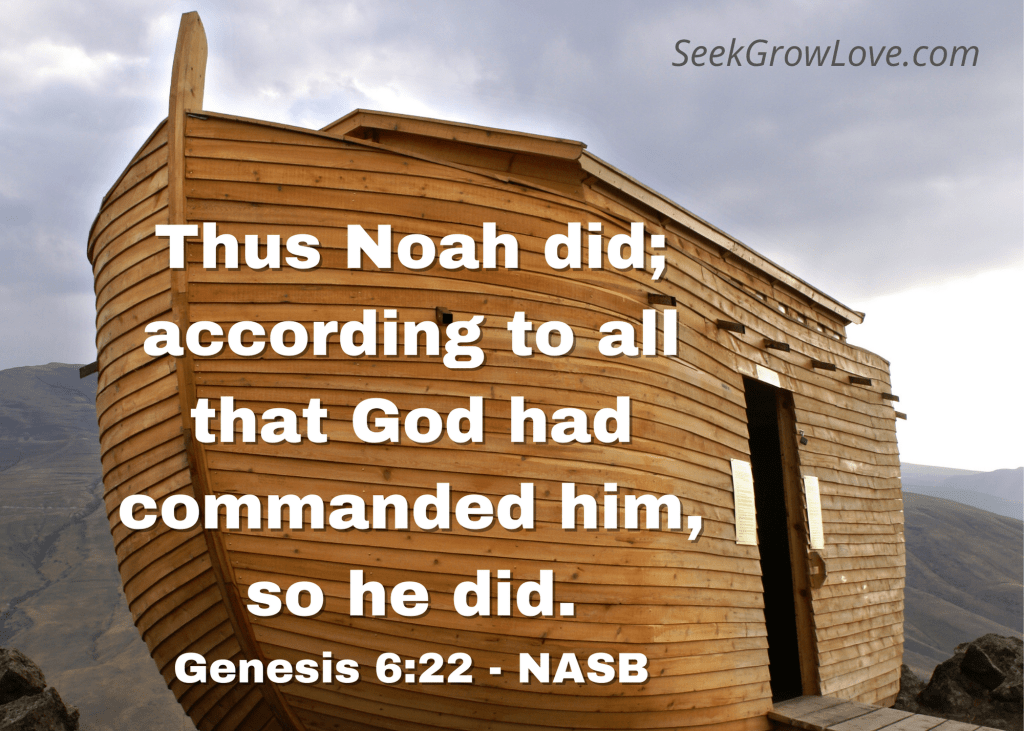
When we read the story of Noah and the flood, we see that Noah built the ark just as he was commanded. Have you ever taken the time to imagine what would have happened if Noah had just said no? What about if he had decided he would only take the animals he liked with him, leaving animals like mosquitoes, spiders, and snakes off the ark? What if he had decided he knew a better way to build an ark than the way God told him? But Noah didn’t. We are told in verse 22 that “Noah did; according to all that God had commanded him, so he did.”
Noah built the ark exactly as he was told. He built it out of gopher wood and covered it inside and out with pitch. Noah made the length, breadth, and height of the ark exactly as he had been commanded to do. He put the window and door at the exact location, which God had commanded him to. Noah did everything according to what God had commanded him.
Not only did Noah continue to do everything as God commanded, which is difficult enough by itself, he also did it all while the earth was filled with corruption. Noah spent years obeying God, building the ark, while he was living in a corrupt world. Not only did Noah build the ark while living in a corrupt world, he did it for many years, while the animals started coming to the ark, and the earth kept growing in its corruption.
We know that, in the end times, our world will be as corrupt as the world was in Noah’s time. Our world is already starting to look similar to Noah’s. We have to obey God while living in an evil world and continue doing so, overcoming whatever the world puts against us. The question is: When the time comes will you be able to obey God while living in a corrupt world, not losing faith, for years, just as Noah did?
-Kaitlyn Hamilton
Questions for Reflection and Discussion
Do a little research on the ark. Did it look like the photo above? What were the dimensions? Measure out what those dimensions would look like in your yard, neighborhood, church property or playground. You may find some interesting information online, including from the Ark Encounter site (a life-size ark museum Answers in Genesis built in Kentucky).
Since our 2022 SeekGrowLove reading plan only includes 105 of the BEST chapters from the Old Testament, tomorrow we will be jumping forward to Genesis 12, rather than finishing the rest of Noah’s story. But take a little time reviewing the rest of this account (through 9:17). What do we learn about God? What do you think God may have been thinking or feeling as he watched the destruction of the flood? What about as he watched the faithfulness of Noah and his family?
God probably isn’t asking you to build an ark, but what does He want you to do? What directions has he given you to follow as you work on the mission He has given? How well are you following those directions? What obstacles are in your way? How can you better deal with them in order to stay on track with God’s work? What rewards are there for sticking with His tasks, even when they are really difficult? What happens if you don’t? What will help you become a person known for doing what God asks of you?
I had an art teacher in elementary school who was used to students making mistakes, and at the start of a school year he would advise his students about the need to be careful in his classroom. He told us about the student who spilled a pot of melted wax on his pants. He told us about the student who was sliced with the paper cutter. He told us about the student who, having been warned that the pottery kiln remains hot long after it shuts off, chose to unlatch and open it to see how the artwork looked. Our teacher wanted to make sure we would not be harmed, and he used the damage that others had suffered to warn us. He knew about the risks, and his knowledge had been proven and tested.
I think that is part of the problem we see played out in Genesis 3. Adam and Eve were like inexperienced children, so unused to the risks they faced they would not take them seriously. And what could God point back to? No one had ever died, it seems, so saying that they risked dying may not have meant much to them. It even seems like somewhere along the way someone started trying to expand on the rules, not just saying the fruit wasn’t supposed to be eaten but that it wasn’t supposed to be touched. We don’t know whether Adam invented that idea in passing on the rule to Eve, or if Eve created that rule as a reminder for herself to keep herself mindful not to do what God said not to do. But making extra rules can just be a distraction from what God wants, they are hard to justify. When she looked at the fruit it seemed like the kind people could eat, which was totally beside the point – nobody ever said the reason people shouldn’t eat it was because it was poisonous. God entered into this situation like my art teacher if he had simply said “don’t touch these pieces of equipment in these ways” – and students would have invented reasons for why that mattered, and worked out their own solutions for how to avoid the problems they thought were the issues.
The whole scene with the serpent reminds me of someone getting dared. It isn’t how it is presented, but it is how it comes across. The nudging, suggesting ideas that wouldn’t have come into the mind otherwise, and like so many dares getting a person to cross lines into a bad idea.
I hate dares.
And the results of the situation are such incredible losses we can’t really understand them, because we are only used to the results. A world with death and suffering. A world with toil and sweat. One of the most disturbing is what happened to Eve, she had been created to be an appropriate helper for Adam. In chapter 1 they had been blessed and told to rule over the animals of the world. But by chapter three we are told that the man would seek to rule over the woman, and the desire of the woman would be for the man – perhaps meaning she would desire to return to the closeness and openness they previously had.
Happily, I see no rule requiring us to treat these words as a command. Just as farmers can use pesticides and herbicides rather than letting the struggles of the soil continue as they were originally set up, we can try to improve our situation as humans with each other. Jesus offers us a new pattern for living, based not on rule but on self-giving. The core promise of this passage is that a child would come who would allow changes to be made, breaking the head of the serpent. This is part of the classic “now and not-yet” that affects so much of what the Bible teaches, we know that the ultimate fulfillment is for later, but the start of what we have been offered is already with us and we can rejoice to have it.
-Daniel Smead
Questions for Reflection and Discussion
In what ways today does the Deceiver still use the line, “Did God really say…”? How are God’s words and commands being questioned, twisted and discarded?
What are your greatest temptations? What excuses have you used when you gave into them? Any blaming? How can you better fight the urge to give in to these or other temptations? What do you think would have happened if Eve would have taken her new questions raised by the serpent back to God before eating the fruit? How can God be a part of your fight against temptation?
In their guilt they tried to hide from God. Can you think of a time your guilt has led you to try to distance yourself from God, the church, your family or your Christian brothers and sisters? What was best for Adam and Eve when they were ashamed? What do you think is best for you?
How has the serpent attacked Jesus, the child prophesied? In what ways has Jesus already beat the serpent? What battle is yet to come – with what results? Which side will you be on?
This week has been rough. My daughter was sick; it’s been snowy and cold; my younger kids are in a “destroy-the-house-and-dad’s-sanity” kind of mood. To top it all off, these have not been easy devotions to write, and probably not easy to read. Judgements and woes, apocalypses and parables, betrayals, regrets and death.
But that’s not how the story ends.
If you’ve ever had the pleasure of watching Jesus Christ Superstar, a musical by Andrew Lloyd Weber, and if you’ve seen the original version, something is striking about the end. It ends with them burying Jesus after the crucifixion. The name of the final song is “John Nineteen:Forty One”, a sweeping and somber orchestral piece. That verse reads : “Now in the place where he was crucified there was a garden, and in the garden a new tomb in which no one had yet been laid.” It’s poetic and tragic and sad and moving and compelling.
But that’s not how the story ends.
Life can be hard. Sometimes it’s our kids or friends having a cold, which today means a “COVID scare”; but sometimes it’s our mom or dad diagnosed with something terminal. Some days are snowy and cold; sometimes a coldness creeps into our souls that shuts out the world around us. Sometimes our physical house is a disaster; sometimes our emotional home, the relationship within the walls, seem broken beyond repair.
But that’s not how the story ends.
On the first day of the week, two women who loved and cared for Jesus go to where his body was laid. They know the location, they were there when the door was sealed just days ago. But the body isn’t there. An angel, in the form of a man, says to them “Do not be afraid; for I know that you are looking for Jesus who has been crucified. He is not here, for He has risen, just as He said. Come, see the place where He was lying.” And they are told to go to Galilee, for that’s where they and all the disciples will see him. But before that, he greets them on the road. And he says “Do not be afraid; go and take word to My brethren to leave for Galilee, and there they will see Me.”
But that’s not how the story ends.
See, Jesus meets them in Galilee. And he gives them a command. In the Greek, the only command is “make disciples.” That is the commission we are given, given to every Christian since the resurrection until the last moment. Is what you are doing in life making disciples? Jesus says that they should make disciples by going, by baptizing, by teaching them. Those are indispensable parts of the commission. But it doesn’t mean “go on a mission trip and baptize and teach someone over there.” It means “whoever isn’t a disciple, go to them, love them, pray for them, if they accept the message baptize them, and then as they walk beside you in life teach them.” That’s the great commission.
But that’s not how the story ends.
Jesus tells them that he will be with you, WITH US, ALWAYS. He says he will not forsake us, even until the end of the age. That means that as long as this world endures, Christ is with us. There will be a day where we may not be alive, and we will sleep, awaiting resurrection. But Christ will bring a new age in.
But that’s not how the story ends.
Because the story doesn’t end.
Instead, because of the resurrection of Jesus to life, because God has shown with power that Jesus was the genuine article, the real deal, the true Messiah, then when he said that we who believe in him will have eternal life in his name, that is a guarantee we can trust. Those who follow Jesus begin their story now, will begin a new stage in the resurrection, but their story will continue on forever. We will truly be able to write our last chapter as “They lived happily, eternally, ever after.”
And that’s how our stories will start.
-Jake Ballard
Questions for Reflection and Discussion
Take a moment to think about, journal about, and pray about where you are in your story. Are things really good, and you are connected to your loved ones and God, thriving and growing closer together? Or is your story really difficult to read right now, much less live through? Are you asking the author of our stories to show you how HE reads your story? Would our life look different if we examined it from God’s eye? What would change because of the perspective? What would stay the same? How might this view alleviate your anxiety and worries?
The great commission should fill us with hope and purpose, not shame and guilt. Jesus has died so our sin, guilt, and shame might be nailed to the cross. Jesus is raised to empower his followers to make disciples for the good of the world. How can you start to fulfill the great commission today? Are you ready to change the world through the power of God? Do you believe that God wants and expects you to be radically fulfilling the calling to make disciples, no matter your age, your schooling, your gender, your race, or any other factors?
If you want the true beginning of your story to read “They lived happily, eternally, ever after…”, then will you accept Jesus as your Lord and Savior today? Will you repent of sin and trust that he has forgiven them? Will you trust that he will never leave you nor forsake you but will be with you “until the end of the age” and into the age after that?
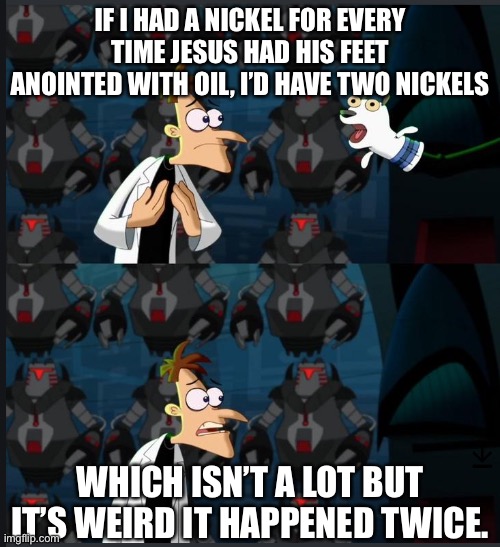
At this point in our reading, things start to get serious, so before we get into that I’d like to give you this meme for your sharing pleasure. I hope that you can enjoy the humor, because the stories and questions today should give us time to pause and think, to pray, and to trust in the grace of God.
We start with this meme because of the story in verses 6-13. While there are multiple proposed solutions to how many times Jesus was anointed (see note), at this point I lean to the idea that Jesus was anointed with oil in two different scenarios, the one recorded in Luke, and the one recorded in Matthew, Mark, and John. In Matthew a woman pours very costly perfume on Jesus, and the disciples were livid. “HOW MUCH GOOD COULD WE HAVE DONE WITH THAT MONEY?!” They all berate the woman. But Jesus recognizes the act of utter worship and adoration that this woman desired to give him.
When Jesus said “you always have the poor with you” was he saying that we shouldn’t give to the poor? After all, if we give to the poor person in front of us, won’t there be another the next day, right? For the latter question, yes there will always be another poor person. But for the first question, Jesus was referencing Deuteronomy 15:10-11 “Give generously to him, and do not let your heart be grieved when you do so. And because of this the LORD your God will bless you in all your work and in everything to which you put your hand. For there will never cease to be poor in the land; that is why I am commanding you to open wide your hand to your brother and to the poor and needy in your land.” Jesus wasn’t saying “don’t give” but instead “if you are so concerned about the poor, you will be able to give to them with OTHER gifts.” In fact, Judas was berating the woman because he would have had access to the funds for himself, as he stole money from the group. Maybe other disciples were upset that this woman was showing greater devotion for Jesus than they were willing to show. Jesus is, in effect, calling their bluff : “If you truly want to serve the poor, you’ll be able to do so the rest of your life. She is choosing to serve me now!”
The rest of the chapter is full of familiar stories that we remember during the Season of Lent, Passover and Easter/Resurrection Sunday every year.
Jesus at this time institutes the act of communion, a time to remember what Christ has done for us. To be fair, Jesus does not begin something new, but changes the focus of something ancient. Passover is a holy Jewish meal that signified God’s redemption of Israel from Egypt. Jesus says it’s no longer just about that. Now, this bread that was about fleeing slavery is about the body broken for us to free us from sin. The wine is now about the blood of Jesus spilt for the forgiveness of our sins.
Judas decided to betray Jesus and feigns offense when Jesus accuses the disciples there is a betrayer in their midst. Jesus knows what he has decided and is not fooled by his act. But we shouldn’t miss that Peter ALSO betrays Jesus. Judas desired money. Some postulate that Judas was trying to force Jesus and God to bring the Kingdom now. But whatever his motives, the betrayal was still evil and unjustified. But the betrayal of Peter was just as significant and just as thorough. Peter’s betrayal was fueled by self-preservation and fear. Both denied their Lord, their Savior… their friend.
Jesus is broken hearted by what is happening to him. He knows that the woman who anointed his feet just days before was preparing him for burial, but still he did not want to die. He asks God if he can be spared, not only from the pain of death, but the rejection he is about to receive from God on behalf of all people. Jesus is about to have all sin heaped on him. God is about to cut all ties from his Son, and their connection will be severed so sin can be destroyed. Jesus, in his love for all of us, decided to follow the plan of God. He decides that he will drink the cup of the wrath of God, so that those who trust in Christ will not have to drink that cup themselves.
While we began with a meme, we need to take time for serious remembrance of what Christ decided to do for us.
Let us remember the anointing and worship of the woman.
Let us remember the poor that Jesus calls us to serve.
Let us remember Jesus by taking communion as we are able.
Let us remember Peter and Judas so that we may not betray Jesus like they did.
Let us remember a savior who was willing to die for us, who was willing to take the cup of wrath, and was willing to do the will of God so that we may have grace and peace and life.
-Jake Ballard
Questions for Reflection and Discussion
Are we willing to anoint the feet of Jesus with everything we have? Are you willing to give extravagant worship to Christ that others call outrageous, because you know how you have been forgiven? How deep does your love and worship go?
Go back to yesterday’s question 3 (are you taking care of the least of these?) Ask yourself those questions again. Are you serving the poor, giving to them no matter how many there will be in the land? Or is your heart hardened by the reality of this world? Will you ask God to change your heart and make you love the poor?
Have you participated in the grace of communion recently? The next time you do, take a moment to reflect on the thousands of years that the faithful people of God have celebrated this meal and emblem, first as freedom from slavery in Egypt, and now, through Christ as freedom for slavery from sin. How does it make you feel that you participate in thousands of years of history along with all of God’s people?
In our sin, do we betray the savior who loves us? In what ways can we overcome the sin we have so we do not betray and deny our savior and lord?
Like the parable of the tenants from the previous chapter, the parable of the wedding banquet illustrates how God has and continues to call out to His people. Yet time after time they reject Him with many of His prophets dying at the hands of the Israelites. This is a bit of foreshadowing on Jesus’ part as the Jewish leaders would soon call for his death.
Although Jesus was speaking to the people of his own day and their situations, verses 11-14 could just as easily be directed at our current age. A fine dining restaurant today will provide the loan of a suit jacket during the meal and the king would have provided the loan of the required garments for his banquet. The man not accepting the clothes and refusing to answer the king are deliberate acts. Here we see, in parable form, a man standing boldly defiant before God. How often do we see people doing this same thing today?
As difficult as that is, what we find after the parable is where it gets really tricky, or rather where they get tricky. The Jewish leaders were constantly trying to trip up Jesus, to find some flaw or inconsistency in what he taught. Naturally, they failed every time.
A major issue that they had with Jesus as the Messiah and why they did not accept him as such goes back to their expectations. The Messiah was supposed to be this mighty king who would save them all from the oppression of the worldly rulers. They expected a return to the earthly kingdom of Israel while God’s plan for Jesus was to establish His heavenly kingdom here on earth.
Their question about paying taxes was a challenge to his supposed authority. It was kind of a, “If you are the king then we should be able to tell Caesar to take a hike.” How Jesus responded was probably the last thing they expected. It says that they were “amazed” and we might think, “Wow!” but it is just as likely that it was a disbelief, shaking of their head as they walked away.
There are a number of Scriptures that tell us that God sets each ruler in place for His purposes. Jesus makes clear that we give to the worldly rulers what is due to them – the material things that are of the world and will decay and be gone. He then says to give to, “God what is God’s.” What is God’s? Everything! Specifically? Our love, adoration, praise, worship, attention, focus, our faith, our very life. These things, what is God’s, will endure. These things matter.
Then a group that did not believe in resurrection tried to trick Jesus concerning marriage. It says that they were astonished by his answer. I think about them standing completely speechless with their mouths hanging open. What really prompted that reaction was his description of God, quoting from Exodus 3:6, “I am the God…” and the revelation that “He is not the God of the dead but of the living.” By adding that Jesus reminded them that God did not speak in past tense but in the present. He did not say, “I was.” This points to the resurrection, to new life.
The rivals to this group were probably very pleased to see them stupefied and stepped in with their own question. “Which is the greatest commandment?” Jesus quotes from Deuteronomy and Leviticus to beautifully sum up all of the Law. “Love the Lord your God” – the first four of the Ten Commandments are about our relationship with God. “Love you neighbor” the remaining six commandments are about our relationship with one another.
Each time they tried to trick Jesus, they failed. Jesus responds to every inquiry and deception with Scripture and they are said to be astonished, amazed, and in awe. Then it is Jesus’ turn. He asks whose son the Messiah is. Knowing that the Messiah would come from the line of David it is a no-brainer to say David. Jesus then reminds them of Psalm 110:1, “The LORD said to my Lord.” LORD is God – Yahweh who is speaking to David’s Lord, or one greater than David and not his son. This points to Jesus as the Son of God which shuts their mouths once and for all, “No one dared to ask him any more questions.”
Trickery is the weapon of the devil. It is used to cause doubts to rise. Trickery makes us question what we know and believe. We are bombarded constantly with misinformation and attempts to shift reality to fit feelings and desire. Jesus faced these same challenges and responded confidently with the truth contained in the Word of God. I pray that we all follow his example.
-Jeff Ransom
Questions for Reflection and Discussion
The best way to avoid bad situations is knowing how to recognize them. What subtle ways do you see people, corporations, etc. standing defiantly before God? The ungodly may use what points to God to deceive people. What evidence of this have you seen?
Remember that God places all authorities in place; from our parents, teachers, supervisors, politicians, etc. What are some things that we ought to give back to these authorities? I already mentioned what is God’s but what does that look like in your own life?
The truth in God’s Word, as I mentioned, is vital to staying true to God and not being deceived. What are some other ways that you can be prepared to defend against the trickery of the world? And remember to always temper your discernment with love.
This chapter begins with Jesus’ triumphal entry into Jerusalem and ends with two parables. Honestly, it seems like it is all over the place. But wait! God is going to reveal something amazing to us.
As Jesus enters the holy city, Matthew notes that prophecy has been fulfilled. God illuminated His plan of salvation through His many prophets over the years and it is all coming to pass (Isaiah 62:11, Zechariah 9:9). Even as the people are asking to be saved and shouting Jesus’ praise, they are reciting passages of the Old Testament (Psalm 118:25-26, Deuteronomy 18:15).
Then we get to the action sequence that we all know and love; Jesus flipping tables and kicking people out of the temple. Maybe it is because it seems so far out of his nature that we recall these verses so easily. Yet it is not outside of his nature. As a matter of fact, the anger he displayed in the temple was a reflection of his Father’s righteous anger. These people were defiling what was holy to God. Our Almighty God had, Himself, displayed such righteous anger in the past whenever man’s sins had gone too far. These men had certainly gone too far and Jesus was not going to stand for it.
Jesus was sure to reveal the motives behind his actions; he quoted from Isaiah and Jeremiah so that they would know their sins. In doing this they knew that, whoever this man might be, they were in the wrong. Additionally, Jesus welcomed the blind and lame in and healed them. Normally, they would not be allowed into the temple but Jesus invited them in. As children cried out, “Hosanna to the Son of David!” Jesus answered those who opposed him by quoting the Psalms. This seems to have quieted them for now.
Even in the midst of causing a fig tree to wither we find references to the prophets Isaiah and Jeremiah. Jesus speaks about prayer and faith but there is another lesson here. Even though the tree was full of leaves it would not bear fruit. It was already dead; it just did not know it. This is the ungodly, those who curse and reject God.
Jesus returns to the temple where things start to come together. The chief priests and elders of the people demanded to know by what, or rather whose, authority he did these things. Finally, we are getting to the point! But Jesus does not tell them. Why? Why are you doing this to us? Why will you not answer the question? It is simple; because they already knew but refused to admit it.
Throughout these verses Jesus’ authority was questioned. Every time they questioned him; Jesus answered with God’s Word. All that was written concerning him was unfolding right in front of them. This made the two parables in this chapter sting even more. As dumb as the chief priests and elders of the people were, they were smart enough to recognize that the father and landowner both reference God.
They should have also recognized themselves in the second son and the portrayal of the tenants. They have been tasked with leading God’s people but instead they sacrificed His ways for what would benefit them most now. They asked by whose authority and received the one answer that they dreaded most: God!
So what is this amazing thing that God is revealing to us? That Jesus was given all authority by God Himself? Well, yes! If you are asking yourself why this matters or what it has to do with you I want you to think about this, “All authority in heaven and on earth has been given to me. Therefore go and make disciples of all nations, baptizing them in the name of the Father and of the Son and of the Holy Spirit, and teaching them to obey everything I have commanded you. And surely I am with you always, to the very end of the age.” (Matthew 28:18-20).
God, our Heavenly Father, the Creator of the heavens and earth gave all authority to Jesus who in turn commanded us to do these things! That means that we do not witness to others by our own power or authority. That is a relief because I struggle every time to even open my mouth let alone know what to say to people. First, I feel uncomfortably self-conscious. How will they react or respond? What if they get angry, ridicule me, or even turn violent? Then, and I think this is the worst, I tend to go blank. I have no idea what to say or what I am even thinking at that point.
It is going blank that I used to worry about. Looking at my recent conversations though I realize that going blank is exactly what He wanted. It is when I go blank that God’s Word, which I have studied and stored up in my heart and mind, comes to the forefront. His Word, even when I do not have it memorized for perfect recitation, is always on the tip of my tongue. Of course, that means I have to actually read my Bible for God to bring it out in my life. Be prepared and willing to be led. Then we will be better able to recognize the authority which guides and drives us.
-Jeff Ransom
Questions for Reflection and Discussion
Are you prepared to give an answer for your faith? What is your story of redemption, how have you come to know God through His Son, Jesus? Is your faith tied to God’s Word?
How is your temper? Do you ever find yourself getting mad, frustrated, or angry at others whether for “good” reason or not? Did you know that the biggest difference between our anger and God’s is that His anger is tempered with love, grace, and mercy?
Have you submitted to the authority God gave Jesus? If you have not, why? What is keeping you from knowing the fullness of our heavenly Father’s love? If you have, what does actively submitting to His authority look like in your life?
Have you ever found yourself saying this very same thing? A coworker or classmate does not seem to be doing their share of the work but they get the same pay or grade as you, maybe even better. Maybe you say it when nothing seems to be going your way; car troubles, relationships fractured, bad grades, your sanity cracking. We all experience situations that make us want to scream at what we perceive as an unjust life.
But what makes one thing fair and another unfair?
In Jesus’ parable of the workers in the vineyard, everyone was paid the same. Is that not fair? The first workers agreed to a set amount, reasonable pay for a day’s labor. The other workers only agreed to work for what was right. They left it to the discretion of the landowner. In his generosity the most recent hires received what he had promised the original workers. Those who were hired first said nothing as the landowner began to dole out the money. Because of his generosity towards the newer workers, they expected more.
And that is the key concept that strains so many aspects of our life; what we expect. Our expectations make it difficult sometimes to see God answering our prayers or His hand actively working in our lives. Our expectations may set us up for failure in our schools, our jobs, our relationships with one another, and certainly in our relationship with God through Jesus. If our expectations are not met then, “I guess I did not really need to learn that,” “It will not matter in the ‘real’ world,” “I will just find a new job,” “I do not need anyone else.”
Our expectations, our limited understanding of all that is makes us think that God must have failed to answer our prayers, He is not here with us, He does not care. The reality is that could not be farther from the truth! God loves us all! He is with us in every moment but rarely how we would expect.
This parable has a double lesson to teach. The first is that God is just. God alone rightly discerns what is fair and unfair. The wages of sin is death (Romans 6:23). If we truly want life to be fair, we would all be dead the first time that we sinned. If that were the case, I doubt that humanity would exist and we would not even be here to debate the fairness of life.
God’s justice is tempered by His abundant love. In His love for us He is merciful and forgiving. Those who come to God through Jesus, will all receive the same wage when the days are done: eternal life and citizenship in God’s Kingdom, to be called His children!
This message is reiterated as Jesus addresses the request of James and John’s mother. They have an expectation of their place in God’s Kingdom and their mother wants assurance that it will be so; after all they were among the first disciples to be called by Jesus. Jesus answered this question through the parable before it could even be asked, and still it was asked.
The second lesson to learn from the parable takes us to Matthew 9:35-38 and 28:18-20. We are the workers, called to go out into all of the world and make disciples of all the nations. We have been given a task, a responsibility, a privilege to live our life for God and preach the Good News of His Coming Kingdom so that everyone would have the opportunity to choose to come to Him through Jesus, our savior!
This is not easy but it is immensely satisfying. What we do and say here in this age can open people’s eyes to see the glorious future our amazing God has planned for all who enter His vineyard. We may never give the physically blind back their sight but thanks to God’s love and power we can heal the spiritual blindness of those we encounter each day. Rely on God’s power, His plan, and His will. Trust in Him with all of your heart, soul, and mind and rejoice in knowing that the God of all creation will wipe away your tears and call you son or daughter!
-Jeff Ransom
Questions for Reflection and Discussion
What are your expectations of God as you pray? Do you have a preconceived notion of what an answered prayer looks like? Can you think of times when you missed His answer initially only to see it later on?
Do you see circumstances in your life as being unfair? Think about how they might be helping you to grow stronger in your relationship with others and especially with God through Jesus. It is difficult sometimes but how can you turn your view of these circumstances around? Our response to situations is often more powerful than the situation itself.
What does your work within the vineyard look like? How are you working to spread the Gospel message of salvation through Jesus and the Coming Kingdom of God? Is there someone specific that you can think of who is blind to God’s love? How can you help them to finally see?
“And looking at them Jesus said to them, “With people this is impossible, but with God all things are possible.”(Matt.19:26)
This is a verse we hear as encouragement incredibly often. From hearing someone reference it, to seeing it posted on social media. But until recently, I hadn’t dug into the meaning behind this verse.
This verse comes from the story of the rich young ruler- a story I had heard before, but never knew it’s correlation to Matt. 19:26. A young man approached Jesus and asked him what he must do to be saved. Jesus responds with, “Keep the Commandments”. After this, he asked Jesus which ones are the most important and Jesus responds with, “You shall not commit murder; You shall not commit adultery; You shall not steal; You shall not bear false witness. Honor your father and mother and you shall love your neighbor as yourself”(Matt.19:18, 19)
The man says he’s done all these things but he is still lacking, and asks what he must do, and Jesus responds to him by saying, “Give up your wealth.”
The man is much grieved by this, and Jesus tell his disciples that it is nearly impossible for a rich man to enter the kingdom. They ask, “Then how can one enter?” To which Jesus responded,
“With people this is impossible, but with God all things are possible.”
I believe this deeper understanding in context gives the verse a completely different connotation. It is that we are sinners, we are broken , and we are not worthy of the kingdom; but with God, and his amazing glory, we may enter.
-Julia Simon
Questions for Reflection and Discussion
How does wealth and material possessions get in the way of our relationship with God and even our salvation, or entrance into eternal life? What did the rich young ruler love most? What does Jesus say we ought to love? (in this passage and any others)
Besides wealth and things money buys, what else can get in the way? Is there anything you are holding onto too tightly, making it more important to you than entering the Kingdom of God?
What is impossible for people? Does this mean we should give up and not try to follow the commandments? What is possible for God? Does this mean everyone will enter eternal life regardless of what they have loved? Why or why not?
The disciples had given up much to follow Jesus and Jesus said they would be rewarded. What have you already given up? What might God be asking you to give up?







 Seek Grow Love