Refined or Destroyed

Zechariah 11-14

zechariah 13

Tuesday, April 25

The book of Zechariah brings a message of hope to the Israelites but also a dose of reality. The final chapters focus on two key elements: the coming Messiah and the Kingdom of God. Zechariah prophesies of a hope and salvation of the coming Messiah (Jesus, shepherd) but also of his rejection by the Israelites. He prophesies of a coming Kingdom where God will rule, but also the tribulation that will unfold for those that don’t believe.


Zechariah 13:7-9 says 7 “Awake, sword, against my shepherd,

against the man who is close to me!”

declares the Lord Almighty.

“Strike the shepherd,

and the sheep will be scattered,

and I will turn my hand upon the little ones.

8 In the whole land,” declares the Lord,

“two-thirds will be struck down and perish;

yet one-third will be left in it.

9 This third I will put into the fire;

I will refine them like silver

and test them like gold.

They will call on my name

and I will answer them;

I will say, ‘They are my people,’

and they will say, ‘The Lord is our God.’”


Powerful words from a powerful God.

Here are the three things I took from Zechariah 11 – 14:

  1. God has a plan – some of which has already unfolded (Jesus’s first coming and the Israelites rejecting him).
  2. His plan is still playing out and yet to unfold (Jesus’s second coming and the Kingdom established)
  3. You and I have a role in His plan. Part of that role is to accept and believe in God’s plan with the faith to live it out. John 3:16 says, “For God so loved the world, he gave his only begotten son, that whoever believes in him shall not perish but have eternal life.” Zechariah makes it clear that God has the plan.  It’s your choice to be a part of it or not. To be refined by fire or destroyed by fire is up to you. In the end I say, the Lord is my God.

-Elleigh Dylewski


(Photo Credit: http://w3ace.com/stardust/scripture/verse/Zechariah_13:9)
Thrown to the Lions

IMG_0031-1

Daniel 5-6                                            

In Chapter 6 of Daniel something very devious and disturbing occurs. After being selected as one of three administrators over Babylon by its new king, Daniel found himself in the crosshairs of the other overseers of the kingdom. They were jealous of the favor Daniel was finding in the eyes of Darius and that the king wanted to set Daniel over the whole kingdom.  This jealousy led to a conspiracy to get rid of Daniel. But how could they entrap such an upright guy? 

The satraps and administrators devised a plan to use Daniel’s devotion to God against him. They convinced the king to enact a law that would prohibit prayer of any kind to any person or god, other than Darius for thirty days. The punishment would be certain death, in the form of being thrown into a pit with hungry lions.

Daniel, in response to the ridiculous edict, went home and did the same thing he did everyday: prayed. He prayed three times everyday, not to Darius, but to the God of the universe, Yahweh.  In the middle of his prayers, a group of satraps and administrators went to Daniel’s house and caught him in the unlawful act. They turned him in. Despite trying everything he could, the king had no choice but to order to have Daniel thrown into the Lion’s den. 

The next morning Darius rushed to the den to see if Daniel was still alive. Not only was he alive, he didn’t have a scratch on him. God had spared him. He sent an angel to shut the mouths of the lions. The king was overjoyed and had Daniel pulled out. And, in a clear case of poetic justice, the men who tried to entrap Daniel are thrown to the lions to meet the same fate they had planned for Daniel.

The big point I want to draw from this particular story, and in this book as a whole, is Daniel’s consistency despite the changes in the world around him. Daniel lived his whole life in a place that was not his home, lived under the reign of several different kings, and he had people who were jealous of him and wanted him dead. Despite these things that were out of his control, Daniel was steadfast in his devotion to God and unwavering in his commitment to living right. 

The world we live in is constantly changing. Every four to eight years, we have a new president. What is popular today will be forgotten tomorrow (silly bands anyone?). What was socially acceptable a decade ago, is now taboo. What was once taboo is now celebrated. Society is in flux. Our devotion to God must not be. We may never live in a time when it is illegal to pray, but we do live in one where it is unpopular and becoming more so ever year. Our foundation must not be the shifting sands of the culture, but the Rock that never changes. It may get you thrown to the lions, but you’ll be in the favor of the one who made those lions. 

– Joel Fletcher

Ending on a Hopeful Note

 Today we are wrapping up the book of Ezekiel.

Ezekiel is, at times, quite difficult to read. Perhaps not as bad as Leviticus, but it is definitely one of the tougher Prophets to get through. The first two thirds of the book is about judgment (not a very happy subject). But you’ve made through that and arrived at the uplifting stuff about Israel’s restoration and their place in the Millennial Kingdom.

In Chapter forty-seven we read about a river that flows from the temple. When the water pours into the Dead Sea, it turns the salt water fresh. Fish will be in this river, and fisherman will stand on its shore, casting their nets, catching many different species of fish. Trees will grow along its banks, bearing fruit monthly. “Their fruit will serve for food and their leaves for healing.”

In Chapter forty-eight, the final chapter, we read about the division of the land among the tribes of Israel. A special portion of this land will be set apart for the LORD and be given to the priests and in its center will be a sanctuary for the LORD. There will also be a city, with twelve gates named after the tribes of Israel; this city will be called “the LORD is there.” Yahweh is there.

As has been already mentioned, Ezekiel is writing this book in a tumultuous time for the Israelites. They are in a hopeless state. Feeling forsaken and wondering if God will ever restore His people. The last fifteen chapters of Ezekiel offered the Israelites hope that God would indeed restore them. Ezekiel ends on a hopeful note: a city in the middle of the Promised Land named Yahweh is there. Those who were in a land that was not their own, suffering under the hands of great oppressor would have certainly been uplifted by such a promise from a God who shows He won’t forget His people.

We, too, serve that God who doesn’t forget and doesn’t break His promises. Even when you’re in the deepest, darkest, depths of depression have hope. Even when the world is crumbling around your feet, and it seems like it will never get better, know it will. Even when your doubts overtakes all other feelings you have, believe God is stronger. He has a plan. He’s made a promise. And He keeps His promises. One day we will be in God’s Kingdom and Yahweh will be there.

IMG_0026

Return of the Watchman

Ezekiel 32-33

Ezekiel 32-33 amber

Wednesday, March 29

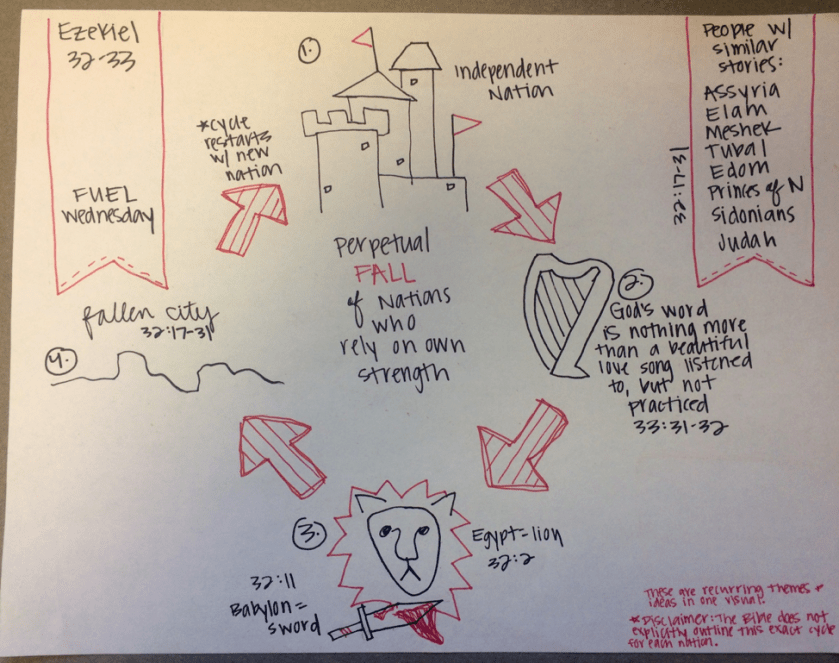
Ezekiel never fails to leave us with descriptive imagery and analogies.  Today is no exception, Ezekiel has left us a list of vivid images that reveal the plans for numerous groups of people.  The people of Assyrica, Elam, Meshek, Tubal, Edom, Princes of the North, Sidonians, Judah, and Egypt all fall to the sword of Babylon.  In the visual above, I have charted what this decline tends to look like.  NOTE: The Bible does not explicitly say that each of these groups fell in the same exact way; we do not know the details. However, we can say that each group of people did not follow God with their hearts and minds, which led to their fall from the sword of Babylon.


Ezekiel’s second calling as a watchman is also a significant event.   Thanks to Jeff Fletcher, we have a great recount of his first calling.  Once again, God uses repetition to stress the importance of the event. However, we can fall into an easy misconception that we as people are responsible for changing people and making them believe in the one true God and the hope we have in the eternal kingdom.  We cannot change people.  Only God through the work of the Holy Spirit can change our hearts and minds.  As shown through the example of Ezekiel as a watchman, we are responsible for planting seeds and illuminating the light of God.  We are called to holy lives, set aside from the world.  The Holy Spirit works in wondrous ways, bandaging wounds and changing hearts that we as humans cannot do.  It is our responsibility to share our faith and hope, but not our responsibility to change someone.  It can be frustrating not seeing the immediate results of our witnessing, but rest easy knowing God IS working!


I often find solace and motivation to keep on from Matthew 5:16:

“In the same way, let your light shine before others, that they may see your good deeds and glorify your Father in heaven”

May God bless you and your peers today as you share the Good News and hope we have in the return of our Savior!!

-Amber McClain

Some Hope for Your Hopelessness

Lamentations 2-3

lamentations 3

Friday, March 17


Lamentations 2 is recounting God’s anger, and in chapter 3 Jeremiah seems to be complaining that God is not listening to him. However, in spite of complaining, he does acknowledge that God gave the people grace in not dishing out as harsh a punishment as they deserved.


Despite the melancholy nature of the book, this portion of Jeremiah contains one of my favorite passages in all of scripture (ch. 3, v. 21-24):


“Yet I still dare to hope when I remember this: The faithful love of the LORD never ends! His mercies never cease. Great is his faithfulness; his mercies begin afresh each morning.”

This verse is displayed in our living room, scripted on a photo that we captured of a radiant sunset over Alaska’s Kenai Fjord during our honeymoon. I appreciate the daily visual reminder that God is always faithful, and that each day is a new start complete with His fresh mercies!


With all that Jeremiah was facing, I am encouraged that he still dared to hope. Have you ever dared to hope? Right now I am facing a difficult situation with an ailing loved one. For many months, I’ve experienced an exhausting cycle – hopelessness followed by a rush of hope (that has instead usually turned out to be a false alarm), followed by hopelessness, and then another chance to hope. And just when I tell myself that I am not going to hope again, I am presented with another opportunity to hope that I just cannot deny because life without hope, is, well, hopeless. Sometimes hope is all that keeps us going. Hope helps us cope with the difficulties in life. So will you “dare to hope”?


Ultimately, our hope as believers is in Jesus Christ and our future in the Kingdom with God. The meaning of my daughter’s name inspires my soul every time I think of it. Her first name is Maranatha, which means, “Come, Lord Jesus” (but most people know her as Mara), and her middle name is “Hope”, which we chose because the coming of Jesus our Lord is our hope as believers. Jesus knows that we will have trouble in this world, but he reminds us to “take heart! I have overcome the world!” Now THAT is something worth our hope!


Pray about what it is that God may be calling you to “hope” for. (Think about the injustices that came to your mind during yesterday’s devotion and how you hope the situation could be different). What actions do you need to take to allow yourself to hope? How can hope drive you to make a difference?


-Rachel Cain


(Photo Credit: https://dailyverses.net/lamentations/3/22-23)

Rejoice!

Isaiah 64-66

i64-wait

Saturday, February, 25

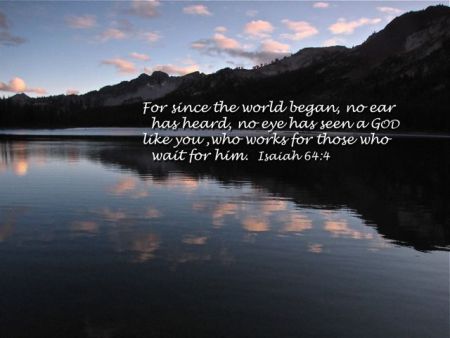
These 3 chapters follow a similar theme to the rest of the week. We are not perfect, and we all mess up, that is just in our nature, but there is so much hope for us. 64: 4-5 says, “For from of old men have not heard nor perceived by the ear, neither has the eye seen a God besides You, what God has prepared for him who waits for him. 5 You meet him who rejoices and works righteousness, those who remember You in Your ways…” God will meet us who rejoice! He will be with us. That is amazing.

Chapter 65 talks about creating new heavens and a new earth. Not only does this apply to the world, but it applies to us as well- he is making us new, when we ask to be his again. 65:17 says, “For, behold, I create new heavens and a new earth; and the former things shall not be remembered, nor come into mind.” God also calls us to rejoice! Verse 18 says, “But be you glad and rejoice forever in that which I create; for, behold, I create Jerusalem a rejoicing, and her people a joy.”

Again, chapter 66 talks about rejoicing with Jerusalem, that is such a simple command. Rejoice! God says. We can find something to rejoice about in almost any circumstance, because God is our God, who has not forsaken us, and he loves us. I challenge you to Rejoice!  In all things Rejoice!

-Jana Swanson

Some songs for today:

Your Name by: Paul Baloche https://www.youtube.com/watch?v=Z7CFr8w9z38

!0,000 Reasons by: Matt Redman https://www.youtube.com/watch?v=XtwIT8JjddM

Blessed Be Your Name by: Matt Redman https://www.youtube.com/watch?v=tTpTQ4kBLxA


(Photo Credit: https://dwellingintheword.wordpress.com/2013/03/26/1017-isaiah-64/)

HOPE

Isaiah 51-53

isaiah-51v6

Tuesday, February 21

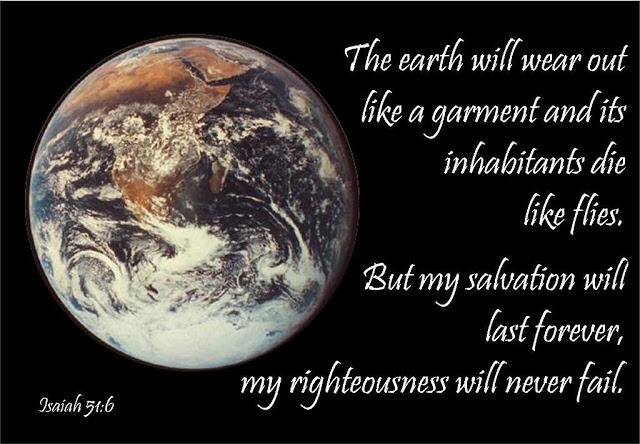
These three chapters go together much better than some of the other chapters, in my opinion, so they are easier to write about all together, instead of chapter by chapter. Again there is SO much hope in these chapters, you just have to know where to find it. Throughout these chapters, God is comforting his people, and reminding them that he is always there for them, that he always knows what is best for them, and that he always comes through on his promises. He reminded them, and is reminding through these words that we can look to our ancestors and the promises that he made to them. He reminds his people of what he did for Abraham and Sarah, by giving them children and promising Abraham many children-we are all known as children of Abraham. How super cool is that promise! God is still fulfilling the promise that he made to Abraham even though Abraham has been gone for many many many years. He later in 51 says that the heavens will vanish and the earth will diminish and the people will die, but there is more in store for us as believers. God’s salvation will last forever and his righteousness will never fail. This is an amazing promise that talks of the promise of the coming kingdom. 52 talks about the history of the people of Jerusalem. He talks about how his people were forced into Egypt as slaves-they were bought with no money, and with no money they will be freed, because God has always known what would happen and had a plan to get them to freedom, God knows our hearts, and he knew that we would all go down a path of destruction, just like Adam and Eve-this is in human nature. This is why God sent his one and only begotten son into the world- that we might live. God knows everything; he knows your heart and mine, and he put a plan in place thousands of years ago for us to be saved. We need to heed all of the warnings in Isaiah, but we also need to rejoice in the good news this book carries as well.

A song for today:

“This Is Love” by Aaron Winner

https://www.youtube.com/watch?v=rQbjSTo3lYc&list=PL0v5rBOVXt3yiPNooFzmz_JxdInamLeIK

-Devotion by Jana Swanson
(photo credit: http://hiswordinpictures.blogspot.com/2011/08/isaiah-516.html)

He’s Not Abstract

Psalms 103-105

psalm-103-2-940x705

Thursday, January 12

If you attend a church (and I encourage you to do so), you probably hear prayer requests and prayers. Sometimes, in the interest of time, I have been known to say prayers and thank God abstractly for “all the good you have done” or “for another day of life” or something along those lines. In many worship services, the songs we sing tend to reinforce that kind of language as we talk to God. As kids we learn “Jesus Loves Me” and “Zacchaeus”, but these songs, while teaching us Bible stories and abstract truths, don’t make life real.
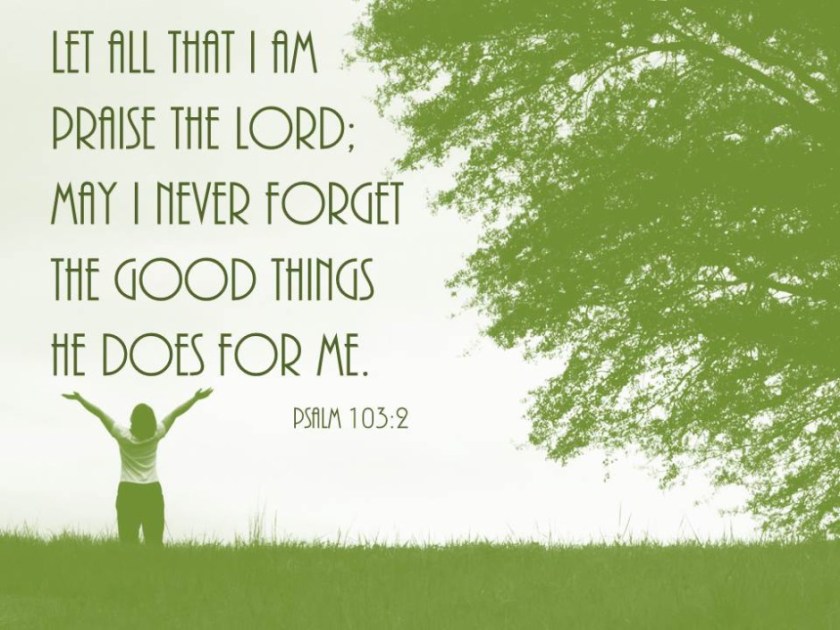
The psalmists don’t let things stay in the level of the abstract. They would think the way we think about theology is rather silly. We use big words like “omnipotent” (all-powerful) or “omni-benevolent” (all-good) to refer to God. The authors of psalms 103-105 are focused on the tangible ways God is working in the world, the concrete way he interacted, is interacting and will interact in creation. When you read psalm 104, the created order that is being displayed there is beautiful. It is a different look at creation, one that is intimate and yet shows God working in creation. He gives water even to a wild donkey. The dangerous and powerful leviathan is a work of God. The creation of trees and valleys all point to the wonder of the Almighty. Psalm 105 tells the work of God in the covenant people of Israel. The psalmist retells (probably with music) the great movement of God with Israel. The Exodus is such a significant moment, because God defeated the gods of the most powerful empire and proved that God is the only true God. He saved Israel and led them through the desert. In psalm 103, the author (David?) is speaking to his own soul when he says “He forgives all your sin”(3) and “he satisfies you with goodness” (5). The author is declaring his own story, that God saves him and gives him good things. Even though we are sinners, God takes care of us and makes sure we have all that we need.
The point is that when we praise God, there are times to tell of his “omni-“ qualities and there is a time to get down and talk about what he did. For me, God not only gives me love, but he has given me a wife that makes me laugh and makes my heart sing because she is wonderful in every way. He has given me a daughter that is fun, joyful and sweet. God gives me hope, and He assures me that though I have lost loved ones, that there will come a day that I will see them again. I praise God not just because he is loving or hope-giving in some abstract way, but because in my life and in the world God has clearly shown that he cares. He is a God that moves in concrete ways.
Live it Out Challenge: After you read the psalms, think of 7 concrete and specific ways God has worked in your life. Don’t make them abstract (“He loves me”) but make them concrete (“He has given me a wife and a daughter that mirror His love”). Make them about you, and take your time. Work and meditate on them all day if you need to.
-Jake Ballard
(Photo credit: http://www.spiritradio.ie/the-word-for-tuesday-psalm-1032/)

The-Kid-Who-Knows-Everything Answer

Job 18-21

job-19-25

Sunday, December 18

A teacher poses a challenging question in his class.  Most students begin to ponder, some begin to turn and whisper, some cross their fingers and hope they are not asked to contribute.  Not a single hand goes in the air.  The teacher repeats the question; this time, he says in a different way.  It doesn’t help.  Thoughts become more frantic.  Anxiety increases.  Some students begin to avoid eye contact.  At the moment that it seems that the teacher will start combing the class for a response, a lone hand ascends into the air.  It is that kid who knows everything. Thank you, that kid who knows everything! The teacher calls on her, and you are saved from having to answer the question.  All’s right with the world; you now can rest easy.


I have seen this scenario played out many times as both a student and a teacher.   No matter how difficult the question, it seems there is always one person in our lives who is prepared to answer it.  Whether it is at school, in your family, your circles of friends, or your work, there is always that one person (who very well may be you) that you turn to that has the experience, knowledge, or wisdom it takes to figure out life’s most difficult questions.


A passage in today’s text is like “that kid who knows everything.”  It  is the all-encompassing answer that holds God’s key and fundamental truth in which we can fix our hope. It stops us from over-thinking, stifles our anxiety, and helps us to take on, not avoid challenging situations, like:


  • When you are having trouble making sense of the world around you
  • When you feel like your prayers are not being answered
  • When you seek  “the reason” THIS is happening to YOU
  • When you lose someone or something you dearly love
  • When justice cannot be found
  • When we lose our health or happiness
  • When we face many other examples from Job 19:7-20


This is Job’s answers and ours:


Job 19:25-27 – “I know that my redeemer lives, and that in the end he will stand on the earth. And after my skin has been destroyed, yet in my flesh I will see God; I myself will see him  with my own eyes—I, and not another. How my heart yearns within me!”


It is not resignation.  It is not a cop-out.  It does not mean you stop seeking, studying, or pursuing.  It is the assurance and peace which you can rest and be guided in while you are waiting.

-Aaron Winner

Adam, Seth, Enosh … (I Chronicles 1-2)

Monday November 14


i-chronicles

Andrew Hamilton

The list of names continues, and a majority of the words in these first two chapters are name.  We have the list from Adam to Jacob in chapter 1, and then the tribes of Israel through the time of David.  There are many names in here that are familiar, and many that I don’t recognize at all.   What is the purpose of this genealogy?  Who wrote it?   Why was it written?  Who was it written for?  Why do I care?


Although scholars do not all agree about who wrote it, and we can’t know all the details about why it was written, both Jewish and Christian traditions provide the same possible answer.  The writing is credited to Ezra, as are the books of Ezra and Nehemiah.  1 and 2 Chronicles were written after the return from exile, probably during the rebuilding of Jerusalem.

God’s chosen people had been in exile for 70 years.  At least most of the people returning to Jerusalem  had never actually been in Jerusalem, and all they knew was the Babylonian captivity.  This book was probably written as a reminder and source of hope for God’s people.  The genealogy shows them where they came from, reminds them of their great ancestors, the growth of the Israelites into a great nation, and where they fit into God’s plan.


So, the hard question for me is still why do I care to read all of these names, most of which I can’t pronounce.  If we want to understand and learn from the Israelites, Gods chosen people, we need to understand what was important to them.  Their genealogy and history of their people was one of these important things to them.  It was used to show how they were all related together, and remind them of all the great people in the history of their nation.


As you read this, try to read every name.  Try to think about the names, and why the ones you know were important to the history of Israel.  Try to imagine going to your promised homeland that you had never been to, that was destroyed, that needed tons of work, and think how knowing your history would give you hope.

What do we use to give us hope?  What do we need to look at daily to remember the hope we have?