God’s True Purpose for You

Romans 11-13

Read these chapters carefully with discernment from the spirit of Christ in you.  They contain great and precious promises that we can claim as Christians.  These chapters give us instruction in who is the church, who is Israel and how to live in true fellowship with God and our fellow believers.  A whole book could be written on this section and not fulfill all that God intends for us to do and think.

Romans chapter 11 continues Paul’s appeal to his fellow Israelites to accept Christ. He sets in order the relationship of the nation of Israel in the Old Testament to the current relationship the church has with the Father.  God meant for Israel to be a national witness of Him to demonstrate grace and love to all the world.  If they had done the purpose they were called for the kingdom of God could have come when Messiah Jesus appeared in the world.  

Romans 11:11-12(NLT) Did God’s people stumble and fall beyond recovery? Of course not! They were disobedient, so God made salvation available to the Gentiles. But he wanted his own people to become jealous and claim it for themselves. 12 Now if the Gentiles were enriched because the people of Israel turned down God’s offer of salvation, think how much greater a blessing the world will share when they finally accept it.

Their rejection of the law and then of Christ himself causes their national purpose to be postponed to a future time.  God still has a special heart for those in Israel that loved God’s plan and were anticipating the coming of Christ and the establishment of the kingdom of God on the earth.  God has never changed in His devoted relationship with all people.  Those that truly seek Him with their hearts are rewarded for faith in every age and time.  Those that trust in the one true God have a pathway to the future kingdom.  

Romans 1:16-17(NLT) For I am not ashamed of this Good News about Christ. It is the power of God at work, saving everyone who believes—the Jew first and also the Gentile. 17 This Good News tells us how God makes us right in his sight. This is accomplished from start to finish by faith. As the Scriptures say, “It is through faith that a righteous person has life.”

In chapter 11 God shows us the true position and attitude we should have with the Old Testament saints and the New Testament church.  Paul writes by inspiration that we are part of the mighty tree of God built on the trunk that is Christ.  It grows from the root of promises made to Abraham, but then the nation of Israel is cut down to a stump.  Jesus is the new tree which grows from the root of promise to Abraham and patriarchs that continues until today.

Isaiah 11:1-5(NLT) Out of the stump of David’s family will grow a shoot—yes, a new Branch bearing fruit from the old root.

Romans 11:17-18(NLT) But some of these branches from Abraham’s tree—some of the people of Israel—have been broken off. And you Gentiles, who were branches from a wild olive tree, have been grafted in. So now you also receive the blessing God has promised Abraham and his children, sharing in the rich nourishment from the root of God’s special olive tree. 18 But you must not brag about being grafted in to replace the branches that were broken off. You are just a branch, not the root.

When Jesus is the new tree that grows from the stump of the nation of Israel, we the Gentiles are grafted onto the tree by God as it pleases Him.  We are an unnatural branch and even come from a tree which is not really an olive tree.  Look up “oleaster” on the internet to see what a poor branch we were before being grafted.  We weren’t even good olive branches.  God breaks us off the oleaster tree (a tree with no good fruit) and grafts us into the richness of the olive tree nation of Israel with Godly fruit.  Then the promises made to Abraham, Isaac and Jacob become available to us also.  This is a wonderful picture of the love that God has for us today joining us into His family.  

Isaiah 11:10(NKJV)  “And in that day there shall be a Root of Jesse,
Who shall stand as a banner to the people;
For the Gentiles shall seek Him,
And His resting place shall be glorious.”

Does this section change your thoughts about Israel and the church?

Are you more thankful for all God has done for you and me?

In Romans chapters 12 and 13 Paul gives us great encouragement to walk in this new life that we have.  Paul writes to instruct us how to please God and live with others.

Romans 12:1-2(NKJV) I beseech you therefore, brethren, by the mercies of God, that you present your bodies a living sacrifice, holy, acceptable to God, which is your reasonable service. 2 And do not be conformed to this world, but be transformed by the renewing of your mind, that you may prove what is that good and acceptable and perfect will of God.

God wills us to present our lives as a sacrifice of praise to Him.  We are not to be “stamped” into conformity with the world but to be “metamorphosed” into the Christ in us by changing our minds to hear the Word of God.  When we put the Word into our minds and hearts and act on it, we will be changed from the death and destruction of this world into people that are children of God with power to do good.  

Romans 13:8-10 Owe nothing to anyone—except for your obligation to love one another. If you love your neighbor, you will fulfill the requirements of God’s law. 9 For the commandments say, “You must not commit adultery. You must not murder. You must not steal. You must not covet.” These—and other such commandments—are summed up in this one commandment: “Love your neighbor as yourself.” 10 Love does no wrong to others, so love fulfills the requirements of God’s law.

How does Jesus fulfill all the requirements of the Mosaic Law?  

He did not do all the regulations of the Pharisees and scribes.  Rather Jesus points us to the righteous life-giving purposes of God.  When he loves God and is obedient to all God asked him to do Jesus is fulfilling God’s purpose for him.  That is acting in God’s true love.  When we are obedient to God and act in true love to Him and others, we also walk in the true purpose God has called us to live by.

Do we have to do the law of Moses today? 

What happens when we do not love others like Christ did?

Love in Christ, Tom Siderius

Zoned for Purity

Ezekiel 45-48

Devotion by Daniel Smead (Minnesota)

Have you ever read a description of an imagined society, perhaps Plato’s utopia ruled by philosophers, or some other example? Or, going a different route, has a child ever drawn a city and shown it to you, perhaps with a single hospital and a block of farmland off to one side – in fact, often most things set up as blocks right next to each other, rarely with any attention given to parking or railway stations.

Reading the last four chapters of Ezekiel, the third part of his final vision, reminded me of both these things. In today’s text the vision’s focus shifts to zoning: land set aside for the Temple, priestly and Levitical residences, the city of Jerusalem, property for princes, and land for the regular people. And in the last part of the book, land for each tribe. This is laid out down to the cubit, with right angles, like it might be in a child’s drawing. And the social groups are assumed to remain separated and balanced, as in proposals for utopian societies. Perhaps it isn’t meant to be treated as a practical description, but more to say “God has not forgotten anyone, and all will get what they need.”

The description of Israel’s society here emphasizes improvement, with comments like:

“My princes shall no longer oppress My people, but they shall give the rest of the land to the house of Israel according to their tribes” (45:8b). The powerful will not act for their own benefit, and all of the tribes would get what they needed, though in Ezekiel’s time most of the tribes were scattered – so the vision itself is promising the regathering of the tribes.

“You shall have just balances, a just ephah and a just bath. The ephah and the bath shall be the same quantity” (45:10-11a). This comment rebukes theft by cheating in business. Weights on sets of balance scales were used to calculate payments. By using differing sets of weights that looked the same, a merchant could vary which they used when buying or selling to unfairly benefit in every transaction.

Similarly, “ephah” and “bath” were supposed to be the same volume – apparently about 22 liters – just with one measuring dry goods like grain (that might be in sacks or baskets) and the other measuring liquids like oil or alcohol (perhaps kept in stone jars).

The last part of chapter 45, and chapter 46, contains more about God’s expectations for honorable and pure actions by the prince and the priests, which circles back to the Temple’s layout. Washing at the Temple had always required a great deal of water, brought there with difficulty. But here this issue of purifying water is reversed, it is not brought into the Temple but flows from it and will affect the nations.

“By the river on its bank, on one side and on the other, will grow all kinds of trees for food. Their leaves will not wither and their fruit will not fail. They will bear every month because their water flows from the sanctuary, and their fruit will be for food and their leaves for healing.” (47:12)

I have previously cited the estimate that the book of Revelation contains over five hundred references to other biblical texts which are not direct quotations. And, to save you looking it up, here is the similar language to Ezekiel 47:12 in Revelation:

“Then he showed me a river of the water of life, clear as crystal, coming from the throne of God and of the Lamb, in the middle of its street. On either side of the river was the tree of life, bearing twelve kinds of fruit, yielding its fruit every month; and the leaves of the tree were for the healing of the nations.” (22:1-2).

The two quotes share many details, but they also differ. In Ezekiel, for example, the water comes from under the wall of the Temple and then deepens to become a river. The Revelation text involves the huge New Jerusalem, while the “18,000” cubits of the city mentioned in Ezekiel 48:35 is a bit under six miles. Such issues are another reason to question whether the vision is to be taken as about the precise details of future events or themes of purity and redemption.

A message of purity and redemption for the exiles flows through the text. They were torn from their people and their land, forced even to hear about the destruction of their city and its Temple at a distance. They mourned in exile. But God intended to restore what was broken – including the people. God’s people had been broken long before, that is why the exile took place. Exile was part of the penalty God kept putting off generation after generation, though ultimately God’s words had to be fulfilled. But now God was again offering the people an opportunity to live as they should, interacting in purity, they and their princes, priests, and merchants. And no matter how many more times those relationships were damaged, God was committed to them being set right. God’s name was to be exalted, and the people who lived where God’s name dwelled needed to be purified, in keeping with that city being known as “ ‘The Lord is there.’ ” (Ezekiel 48:35b).

Reflection Questions

  1. What application do you see of the principles God applied to the conduct and attitudes of the exiles, in terms of your own life? How demanding do you perceive God as being, compared with how forgiving God is? What impact does the presence of Jesus in the situation have?
  2. Do you think anyone might be looking at you expecting that “the Lord is there”? (Perhaps this would be through an interpretation of Christians being the Temple, having the Holy Spirit in them, etc.) In what senses might that be a reasonable way to understand the text, and in what ways might it be unreasonable?
  3. Ought believers to take more encouragement or discouragement from the thought of the Holy Spirit being in their lives?

Spiritual Adultery

Ezekiel 13-15

Devotion by Pastor Jeff Fletcher – originally posted for SeekGrowLove on March 22, 2017, for Ezekiel 14-16.

Chapter 14 gives us a picture of the heart of God.  Elsewhere in the Bible it says that God is a jealous God.  God loves His people Israel as a husband loves his bride.  Israel turned away from God’s love, their hearts were no longer given to God.  God wants more than anything else to recapture the hearts of His people who deserted him to pursue idols.  God wants them to repent and turn back to Him.

God wants to have His people love Him exclusively.  He will not let them worship idols, yet still come to him for prophecy.  This would be similar to a woman who both goes to her lover but then comes to her husband as well.  God will have none of this, no two timing wife.  Israel must have a change of heart and that will only happen through judgment.  The prophets were not permitted to prophesy for people who were also consulting idols.  If the prophets did prophesy to those seeking idols, they too would be punished.

God tells Ezekiel that His judgment is certain and that no human being, no matter how righteous or faithful can stop that judgment.  He warns that even if such great men of faith as Noah, Daniel or Job sought to keep Israel from judgment that their righteousness would not be able to save Israel.

In Chapter 15 God promises to make Jerusalem as desolate and useless as a dried up vine that has been thrown into a fire.  Just as the vine will be totally consumed by the fire, so too, will Jerusalem be consumed by the fire of God’s judgment.

Chapter 16 is one of the most graphic passages in all of the Bible.  If the Song of Solomon was rated PG-13, Ezekiel 16 would probably be rated R or NC-17.  It is extremely disturbing to read.  God compares Israel to an unwanted, discarded child whom God rescued from its disgrace.  God later came along when Israel was old enough to be married, but she was naked and dirty.  God cleaned her up, covered over her nakedness, dressed her up like a princess and made her his bride.  Israel was blessed beyond imagination by God her husband.  But then, tragically, Israel turned to prostitution.  Here Idolatry is likened to a form of spiritual adultery.  Israel had brought great shame upon her husband.  In fact, she was worse than a prostitute in that she paid others her gold and silver to sleep with her.  It’s such a disturbing picture.  And it’s designed to give us a visceral reaction.  It’s a gut punch.

The fact that God must punish Israel for her spiritual adultery is not surprising.  Israel is only getting what they deserve.  What is surprising is that God is going to restore Israel.  Not because Israel deserves it now any more than it deserved it when God first cleaned her up and made her His bride.  God is doing it because God is faithful to His Covenant promises.  God made a promise to Abraham, Isaac, Jacob and their descendants, Israel.  God does not forget His covenant or break his promises.  God is filled with steadfast love for His people.

After punishing Israel, God will then make atonement for them.  He will cover over their sin and guilt and forgive them and take them back.  Then they will remember their vows and be ashamed of their guilt and will become a faithful wife and turn away from idols.

As Christians, we have been grafted into God’s family and we are now included as God’s bride.  Through Jesus Christ God has found us in our sin, cleaned us up and made us His own.  Are we sometimes guilty of idolatry?  Do we ever act unfaithfully toward God and give our hearts to someone or something else instead of God?  Remember, Jesus said that the greatest commandment is to Love God with all your heart.  God wants All your heart.  God is jealous when we give our hearts to another.  May Israel’s spiritual adultery remind us that we must give our hearts fully only to God and no one else.  Otherwise, God may have to win our hearts back the way he did Israel, and we can see how unpleasant that process was for them.  Let’s always keep our hearts faithful to God alone.

Reflection Questions

  1. What promises had God already made to the Israelite people?
  2. What must the people do to keep their side of the covenant promises with God?
  3. What can you do to give all your heart to God and avoid spiritual adultery?

Looking Back and Looking Ahead

Deuteronomy 1-2

A time of reflection and recap of events as the Israelites prepare to enter the Promised Land. “For the LORD your God has blessed you in all the work of your hands. He knows your going through this great wilderness. These forty years the LORD your God has been with you. You have lacked nothing. (2:7) They’ve LACKED NOTHING?! They probably didn’t agree with that, but it shows how God provided for them the basics, which is ample for a person. He literally gave them their daily bread.

Moses reminded them, “The LORD your God who goes before you will Himself fight for you, just as He did for you in Egypt before your eyes,and in the wilderness, where you have seen how the LORD your God carried you, as a man carries his son, all the way that you went until you came to this place. Yet in spite of this word you did not believe the LORD your God.” (1:30-32)

It’s amazing that we can do the same thing like the Israelites at times, cry out to get out of a difficult situation (Egypt), then afterwards when we’re out we complain again. But if they would’ve trusted that God would fight for them they could’ve been spared the long difficult 40 years. The wilderness was the ONLY way to get to the Promised Land, and their lack of trust made it even harder (and longer).

Not one of these men of this evil generation shall see the good land that I swore to give to your fathers, except Caleband Joshua who wholly followed the LORD.” (1:35) Even Moses wasn’t allowed to enter as the LORD was angry with him too (or, had been angry and was following through with consequences).

Despite failures and difficulties Moses pressed on with the people until his departure. This reminds me of parenting! It’s difficult and rewarding! One of my main parenting verses that encouraged me over the years, besides Deut. 6:4-7, is 1 Peter 4:12,

Above all, keep loving one another earnestly, since love covers a multitude of sins.

– Shalom y’all, Stephanie Schlegel 🙂

            (From Israel and Tennessee:)

REFLECTION QUESTIONS

1. Have you had to endure a difficult situation for years? How did God sustain you through it?

2. Is there an issue you’re dealing with that if you’d wholly trust God, the situation would be better? Are you taking matters into your own hands or trusting God with it?

3. Reflect over this last month how God’s provided for you and thank Him for it!

4. How does looking back better prepare the Israelites for looking ahead? How can it benefit you?

The Cure for Complaining?

Numbers 21-22 

Shalom from Tennessee! This is Stephanie Schlegel writing this week as we continue through the Bible. We lived in Israel for 25+ years where our five children were born and raised. So I’ll be adding in some extra thoughts and pictures from and about Israel. 🙂   

The first verse of Numbers 21 caught my attention as it still relates to today! The king of Arad fought against Israel and took some captives! :0 I’ve been reading the news of the current captives slowly being released and talk of what to do with Gaza. Surprisingly, three times in chapter 21 Israel fought against their enemies and destroyed their cities and took possession of them. For a LONG time Israel has had to contend with those against them, including up to today!

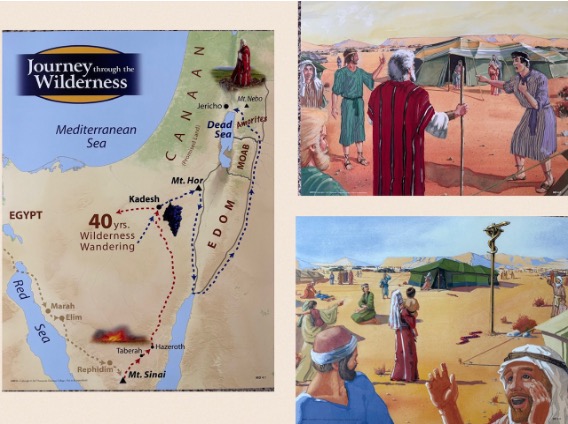
In their travels they got thirsty, hungry, and cursed the manna God provided for them! It also says they spoke against God and Moses, their leaders. Thus, God sent fiery serpents among them, in which many were bitten and killed. So they asked forgiveness, and that Moses would pray to God to remove them. 

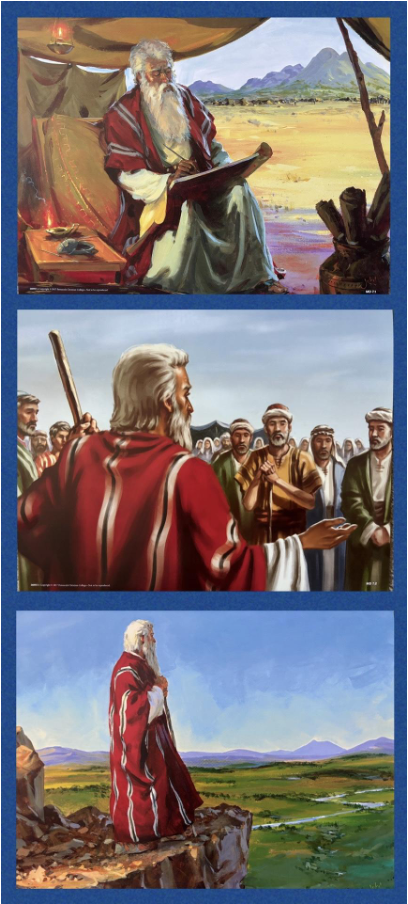
Included is a picture from the ABEKA Bible Flash-a-Card Series 3 of the life of Moses. These sets have many great pictures of Bible stories not normally seen in children’s books. We used them in our congregation’s children classes in Israel as they were taught in Hebrew. They’re great for home use as well for children and grandchildren. 

Complaining about what one eats is a good lesson for all ages! Bites from deadly snakes is a rough punishment in the desert. There was a period of time while raising our children that if they complained about the food I made for dinner then they’d be doing the dishes afterwards! The complaining stopped quickly! Actually, I wasn’t even sure if they liked what I made or not as they ate it with no comments. Haha! Occasionally, after a new recipe I’d let them vote after dinner on the count of three with a thumbs up or down (or sometimes in the middle), so I could get some feedback. 🙂

One of the teachers/moms in our children’s class in Israel made a “bronze serpent” on an upside down mop with paper twisted around the top of it and then covered with duct tape and spray painted it bronze.  It was a good visual aid for the kids! (I couldn’t find a picture of it since it was before the days of cell phones).

Jesus recalled this incident in John 3:14,15, “And as Moses lifted up the serpent in the wilderness, so must the Son of Man be lifted up,that whoever believes in him may have eternal life.” Thankfully, we can look to Jesus during troubled times and after we’ve failed and need forgiveness. May God help us not to complain but to repent and give thanks.

“So, whether you eat or drink, or whatever you do, do all to the glory of God.” 1 Cor. 10:31

-Stephanie Schlegel

REFLECTION QUESTIONS

1. What was the Israelites punishment for complaining? Did the punishment seem just or too harsh? What are some things that you’re complaining about that perhaps need to be addressed?

2. How does complaining against God, leaders, and food hurt us? What’s something we can do to change that?

3. The bronze serpent that they looked at to be saved eventually became an idol! Is there something in your life that has helped you that now has turned into a negative effect that maybe you should break away from? We can pray and ask God to show us and help us to turn from it.

A Kingdom of Priests

Exodus 19-21

Today’s reading is probably one of the most familiar passages in the whole Bible for it includes the Ten Commandments.  It is important to understand the context of these commandments.  God entered into a covenantal relationship with Abraham and Abraham’s descendants through Isaac and Jacob and Jacob’s sons who became the twelve tribes of Israel.  God promised to bless and provide for his people and in exchange His people promised to be faithful and obedient to God and worship God alone.

After 400 years of slavery, Israel has grown from 12 sons and their immediate family to millions of people.  These people, God’s covenant people, will be settling in a land where they will need to live in community.  They are no longer slaves.  They are now responsible to live in that community in peace and productivity.   They need help to know how to live together.  God provides His people with the structure of how to live together as God’s people.  The Ten Commandments and subsequently nearly 600 additional laws were all designed to help them be healthy and blessed representatives of God to the rest of the world.

God loves all people.  We must never falsely believe that God only loves certain people.  God considers all human beings His children and loves them all.  God wants to be in a right relationship with all of his children; however, many are disobedient and have no willingness to be in a relationship with God and many deny that God even exists.

So God needed to start with one group of people and prepare them to be a special, chosen people who would bring the knowledge of God to others.  Exodus 19:5-6 says, “Now if you obey me fully and keep my covenant, then out of all nations you will be my treasured possession. Although the whole earth is mine, you will be for me a kingdom of priests and a holy nation.”

Israel was to be a kingdom of priests and a holy nation.  A priest is one who helps connect people and God.  God would go on to designate priests in Israel to help the people connect with God, but His expectation for Israel was that the whole nation serve as priests to help other nations connect with God.  Because the whole nation was being set apart by God to be priests for the world, they needed to live holy or set apart lives.  There were behavioral expectations that they were to follow.  They had to  be exclusively loyal to God, they could not murder, steal, lie, cheat, they were to be respectful and honoring of parents and not misuse God’s name.

Now we are completing what God began in Israel.  Through Christ we have entered into a covenant with God.  We are now the covenant people, we are called to be a kingdom of priests and a holy nation.  That is the Church’s role.  And God expects us to live lives of holiness as we are set apart to serve God.  As you read through the many laws in the Old Testament, recognize that some applied very narrowly to the Nation of Israel and do not necessarily apply to us.  Dietary laws and sanitary laws were important in Israel at the time they were given but are no longer applicable.  However, some of the laws which pertain to morality have been reaffirmed by Jesus Christ for the Church.  In other words, as Christians we are free to eat pork and worship on Sundays, but we are not free to practice polygamy or murder.

God is truly a God of grace and mercy, but God is also a God who hates sin and punishes sin.  In this way we are still to live in fear of the Lord: Exodus 20:20 “the fear of God will be with you to keep you from sinning.”

Jeff Fletcher

(originally posted for SeekGrowLove on February 5, 2020)

Reflection Questions

  1. What are the duties and responsibilities of a holy nation/kingdom of priests? How would you rate how well/poorly Christians in your nation are doing this job? How would you rate how well/poorly you are doing this job? What can you improve upon this week?
  2. How can we mirror God’s grace and mercy? How can we remind the world (and ourselves) of God’s rule book and judgment? What is the problem with doing just one but not the other?
  3. What does it look like to live in fear of the Lord? Is this only an Old Testament concept or do we find it in the New Testament, too?

And , here is the February Calendar!

What’s in a Name?

Genesis 31-33

“What’s in a Name?” This famous quote from Romeo and Juliet implies that a name is simply and solely a name, that the true value lies in the person who bears the name – and, in the case of Shakespeare’s tragic play, that the person should be loved for who they are rather than hated merely for their family line. While I agree that the person who bears the name is more important than the name itself, I would also argue that names are very powerful and personal, as one thing that a person deeply owns forever. Referring to someone by name can have a profound effect on them. When we go to a restaurant, my husband makes a point to always speak to our servers by name as a way to connect with and respect them as a person rather than simply a service provider. 

What does your name mean? Mine (Rachel) means “ewe,” which seems appropriate since the biblical Rachel was a shepherdess. Rachel was the second – but favorite – wife of Jacob, who was known to be a trickster. While there is some discrepancy about the true meaning of his name, Jacob is commonly accepted to mean “supplanter,” and when you read his life story, you will see him live up to his name many times over. In today’s reading, we observed Jacob and Rachel duping her father (who had also deceived them! It must be a family trait on both sides!). Jacob gathered his family for the journey back to his homeland to reconcile with his brother Esau, from whom Jacob had swindled the birthright blessing many years before. Then Jacob found himself alone during the night, thrust into a wrestling match with God (or man or angel, as some translations indicate). Jacob persevered through a fierce fight, but before he would let his mysterious competitor raise the white flag, Jacob demanded to be blessed. 

The Wrestler’s response: “What is your name?” 

Full stop. Don’t you think this being knew Jacob’s name? Of course. But remember, Jacob had assumed a false identity when he masqueraded as Esau to hoodwink his father into giving him Esau’s birthright, and Jacob had continued in his shifty ways. Maybe Jacob needed to be reminded of who he was so he wouldn’t continue to swim aimlessly in the pool of his own deception. Perhaps the Wrestler wanted Jacob to ponder his delusive choices (which, frankly, had caused a concatenation of unfortunate events) and be a willing participant in God’s bigger, better plan despite his sketchy past – a fresh start as a new man changed by God’s grace. 

Jacob answered honestly with his given name and then was granted a new name with a new  meaning: “Your name will no longer be Jacob. Your name will now be Israel, because you have wrestled with God and with people, and you have won” (Gen 32:28). The Wrestler chose to keep his own name a secret, but he did leave Jacob/Israel with the requested blessing – and a bum hip, probably so he would be sure to never forget the experience. 

The meaning of the name “Israel” is disputed; some possibilities are, “he wrestles with God,” “a man seeing God,” “God perseveres.” Whatever the meaning, Israel indicates a closeness with God and a promise for a new nation. In recent chapters, we also read about Abram and Sarai receiving name changes to Abraham and Sarah to symbolize their new relationship and covenant with God. 

God is in the business of changing lives AND names! Did you know that we, too, will be given new names in the Kingdom? Passages in Isaiah (62:2, 65:15) and Revelation (2:17, 3:12) indicate that our names will be changed when we receive our inheritance of eternal life! How awesome will it be to bear names especially chosen for us by our Creator as we live with Him forever! 

-Rachel Cain

Reflections:

When you committed to join God’s mission, your name was written in the Lamb’s book of life. Enjoy this song about God changing us and writing our names on the Kingdom roster! (or click here if you want to see some of our own youth perform the same song in ASL at Ohio’s camp!)

Think of who you used to be, and how God has changed you – and continues to change you – into who He wants you to be. What areas of your life do you need to give over to him to allow that to happen? How can you use your story to encourage others? 

Land

Old Testament: Joshua 17 & 18

Poetry: Psalm 51

New Testament: 1 Corinthians 8

            It is obvious from reading the Old Testament and our reading in Joshua today that God talks about land as inheritance. A safe place for his people to dwell on the earth. Interestingly, He isn’t concerned about its financial value or acreage, interest, shiny jewel heirlooms, and all the rest that this world can throw at us as a concept of an inheritance.  In Joshua, after decades of Israelites wandering and fighting, a generation dying, and all the excitement of the years since they left Egypt, we finally see them coming into their land, getting particular boundaries and instructions tribe by tribe. A promise fulfilled. But, wait. . . who had been promised the land? Who is missing in action in these chapters?

            Well, one fellow comes to mind, and that is Abraham! I found myself wondering how many years had even passed since Abraham had been promised an inheritance of land figuring it had been “a while”. Umm…..a little history research clued me into the fact that it had been more than just “a while”. . . it had been more like 700 years!  In Joshua 17-18, Israelites are receiving their inheritance that had been promised 700 years before. As we await Jesus’s return, and our inheritance, it is encouraging to remember. . . God DOES fulfill His promises in His time, in His sovereign design.  

            In the article “The Land Promise to Abraham and His Descendants” written by Anthony Buzzard and used with permission here, I loved to see how the idea of “land” was referenced as part of an entire plot of the Bible. Centuries more have passed since Joshua entered the promised land, and the Israelites certainly did not stay on the straight and narrow or even keep possession of the land, but the promise of land to Abraham was never broken because it was more than an area of particular ravines, slopes, and springs we see in these chapters. I’d recommend the full article found at https://focusonthekingdom.org/land.pdf to anyone and have included a few highlights to reflect on here:

“The entire biblical drama hangs on this remarkable tension: Abraham and his seed have never yet inherited the land/earth. In fact Stephen in the sermon which cost him his life (Acts 7, the longest chapter in that book) explicitly says that Abraham did not inherit as much as a square foot of the promised land! But “God promised it to him and his descendants”

“The fascinating fact is that Abraham has until this day not received a square foot of his inheritance. Acts 7:5 is a marvelous “John 3:16” verse! The point to be gained is that Abraham and all the faithful who are now dead, sleeping the sleep of death (Ps. 13:3), must at the future return of Jesus rise from the sleep of death (1 Cor. 15:23) to receive their promised inheritance.”

“There is coming a brand new world order on earth, to be inaugurated at the return of Jesus, and we are urged by the Gospel, the one Gospel about the Kingdom (Mark 1:14-15), to prepare with all urgency for that coming event.”

And who else will inherit the land God has promised? Thankfully that answer is woven through scripture and can include us. “Blessed are the meek, for they shall inherit the earth.” (Matthew 5:5)

-Jennifer Hall

Questions:

  1. What do you like best about the idea that you can be an heir to the promised land?
  2. What encouragement do you find here in Joshua 17-18 seeing God fulfill promises in His time?
  3. How does the Biblical idea of receiving a perfect promised land after Jesus returns and the dead are resurrected contrast with some common beliefs of what happens after we die?

Who is Like the Lord?

Micah 1-2

Have you ever wondered, “what’s so special about Jerusalem?”

I mean, think about it. Maybe look at a map. That area has been hotly contested by kingdoms, empires, nations, world religions, and people groups since the dawn of time. Why? The reason for each group is a little different, but practically speaking, it’s the only strip of land that connects Europe, Asia, and Africa all together. Everything around it is pure desert. 

So Israel, since the days of Moses, has been an impossibly small tribe in an ocean of military conquests and empires. Over and over again, though, God had protected Israel and preserved their residence in the top real estate of the ancient world.

Until the days of Micah.

During the time of the Old Testament minor prophets, Israel had walked away from God and His protection. The northern half of the kingdom (which split off from Judah, the southern half)) was about to be destroyed by the kingdom of Assyria. Micah was pleading with his countrymen to return back to God and His protection before they fell to a similar fate.

Micah means “Who is like the LORD?” and his name fits the theme of his message perfectly. Chapter 1 is a call for Judah to start mourning for the fate that is sure to befall them. It’s also a reminder that all of this will happen because they turned away from their covenant to God (see our discussion on Amos 5 earlier this week). 

In chapter 2, Micah goes on and on about the many ways that his country has totally forgotten about their God. My favorite verse in this section is 2:7b: “Do not my words do good to him who walks uprightly?” In other words, God asks Judah, “if you were following my Word, wouldn’t you be so much better off?” And this is the lesson for the reader today: God’s Word is beautiful and practical. We don’t just learn about God in His words! We also find life, love and contentment in God’s words!

-Levi Salyers

Read or listen to today’s Bible Reading Plan passages at BibleGateway.com here – Micah 1-2 and Revelation 8

The Battles Fought and Still Fight

June 26     1 Chronicles 19-20 and Proverbs 26

David is still fighting battles and confronting the enemies around him.  When things still flare up in Israel today, I often think how LONG it has been happening for about 2,700 years! Battles and hatred from their surrounding enemies has actually been going on for a long time in Israel. It is actually “old news” to hear the continual fighting. In this battle, Joab led David’s army. He could see that the battle was against them this time. He encouraged his best men, “Be of good courage, and let us be strong for our people and for the cities of our God. And may the LORD do what is good in His sight.” (19:13) What encouraging words from the army captain. He did not encourage them to find strength in themselves or by their own might and power they could win, but to be STRONG for their people and the cities of God, and that God would do what was good in HIS SIGHT. When young Israeli men (like our 2 sons) and women are sworn into the Israeli army today, Joshua chapter 1 is read to them in Hebrew. I found these words to be very touching and encouraging to a young soldier. (By the way, ALL boys are required to serve 3 years after high school in the Israeli military and girls 2 years. So, they are not thinking about what college they are going to attend, but what division of the army they would like to go into. Girls are not required to do combat. Lots of a variety of tests are given to match them up to fitting tasks for them.) “Have I not commanded you? Be strong and of good courage; do not be afraid, nor be dismayed, for the LORD your God is with you wherever you go.” Joshua 1:9   What hope and encouraging words for the army of Israel, back then and today.  Like the schools, also their military is not anti-God or Bible.  How awesome that a whole chapter of the Bible is read at every soldier’s swearing into the Israeli army.  May they and we truly find our strength and courage in the God of Israel. 

Another battle was against the Philistines at Gath. Goliath was also from Gath. It is an ancient ruin still visible today as you can see in the drone picture that our son took. David’s brother, Jonathan killed a 24 finger and toed giant from Gath! We do not see any giants there today!

A picture containing sky, grass, outdoor, sheep

Description automatically generated

It is interesting to note the allusion to David, one of many sling throwers, in Proverbs 26:8. “Like one who binds a stone in a sling is he who gives honor to a fool.”  I understand this to mean that it is not fitting to praise a fool, like putting ammo in a gun except in this case it is a stone in a sling.  In conclusion, of todays and this week’s devotionals I hope you have a greater LOVE for the God of Israel, His Messiah Jesus, and beautiful Land of the Bible. 😊

~ Cayce Fletcher

Read or listen to today’s Bible reading at Biblegateway.com: Job 1-2 and 2 Corinthians 2 .