Me Against the World

John 15

John 15 19

Does it feel like some days everyone hates you?

We’ve all been there; we say or do something different and it blows up in our faces.
Sometimes, this is probably justified. When we say or do something bad, it may be good for the people in our lives to call us out. While there are many things wrong with political movements like #blacklivesmatter or #metoo, their goal is admirable: there ARE times when those in power, like police, need to be held accountable; there are some people who are victims of sexual assault and harassment that are afraid to speak out due to the backlash. While you have not done anything like those called out in these movements, I’m sure you’ve had moments when your friends turned against you when you did something to hurt a mutual friendship, or maybe bullied a kid. And we can see that this is justice, in a way. We feel like (and on some level, know) we deserve it.
But there are days when you say what you believe is truth and it backfires. There are days when you are asked what you believe and everyone around you mocks you and belittles you for it, or tells you that you are on a dangerous path for not agreeing with their view of God. There are days when you do the right and righteous thing, and it seems like people around you think you have done something terrible…
Jesus lets us know this won’t be uncommon. He teaches in John 15:18, “If the world hates you, understand that it hated Me before it hated you.” In our day, we can see this is true in a small scale. On some issues, we love people, but hate sinful actions performed. When a man believes that he can’t make a wedding cake for a gay couple, he is sued and taken to court. In many circles, he is considered a bigot. Very recently, another Christian political commentator gave a speech entitled “Men are not women.” That speech created a protest movement, and he was assaulted with liquid that smelled like bleach. While these are hotly charged political issues, both of these men were standing on what they believed were biblical, moral principles, and were hated for their views.
This is because we are not of the world. We don’t go along with the system the world offers. Christ calls us to live in love differently. One could argue that if these men had just lived like Jesus, then they wouldn’t have encountered any problem. Love wins, right? But Jesus points out that he is hated by the system of the world, AND HE WAS PERFECT. Christ lived a life full of grace and truth (John 1). But that did not endear him to the world.
When it seem the world is against you, stop and think:
Did I do something wrong? If so, fix it.
If not, is the world against you and it is not related to the Bible? Maybe it is wise to think about what they are saying.
However, if the world is against you and you are standing on Scripture, then stand strong. Don’t be shocked, because they first hated Jesus. Stand strong, in truth and love, and God will stand with you.
(For a throw back, watch this clip … https://www.youtube.com/watch?v=f_o6QHdIG4I // For some rock, listen to this … https://www.youtube.com/watch?v=3kiwluGZdJQ )
-Jake Ballard

The Spirit of God

JOHN 14

John 14 16

Today, we will continue what we started yesterday, what scholars call “The Upper Room Discourse.” Many people believe that the teaching of Jesus from John 13-17 were all taught to the disciples the night before he died. (They were in the upper room of a house, hence the name.) When Jesus speaks, he encourages the disciples to not be troubled. Though he will not be with them in person, he promises something else. What does he promise?
A counselor. (v16) The Spirit of Truth. (v. 17)
Jesus says that the Spirit will come, who will counsel the disciples and guide them into all truth.
What is the Holy Spirit?
This is a question that has perplexed theologians in Churches around the world for quite some time. Jesus says here that he will send the Spirit, and that he will come to be with his disciples. Is he the Spirit? No, because it’s clear in John that there is a difference between Jesus and the Spirit. And that same difference is found in verse 26 in regards to the Spirit and the Father. So the Spirit is something other than the Father and the Son. This have led some to conclude that the Spirit is a distinct person, being, or entity, but this is problematic, because in many ways the Spirit is described in non-personal terms. (Spirit comes from the Greek word πνευμα, meaning wind, breath or spirit.) It is poured out, given, and we are baptized into it. However, at the same time, the Book of Acts, and here in John, Jesus and his early followers listen to the Spirit deciding things and guiding and teaching.
So what is the Spirit? Another name for God or Jesus, or the power of God in action, or even a Person?
I don’t know.
For a long time, the words “I don’t know” made me terribly uncomfortable. They made me feel weak, like I wasn’t living up to my potential. (In truth, being a nerd AND a member of the CoG, I was getting social AND theological pressure to know everything.) However, I’ve come to know that I CAN’T know completely; the language about the Spirit is not about knowing and controlling but about submitting, relating and embracing. When the Spirit guides the disciples in the book of Acts, they submit, not ask what is guiding them. When Paul is encouraging his brothers and sisters to love in Corinth he writes “The grace of the Lord Jesus Christ, and the love of God, and the fellowship of the Holy Spirit be with all of you.” When the Spirit comes, the Spirit is coming from God and in the name of Jesus. Do I trust Jesus enough to allow whatever the Spirit is to effect me in such a way that the Spirit changes me?
As you read this language in John about Spirit and what the Spirit will do, don’t get lost in the weeds asking questions about what the Spirit is. At some point, there can be a time and place for that discussion. But today, right here and now, ask God to send that Spirit in the name of Christ into your life. When Jesus breathed on his disciples (John 20:22) and gave them his Spirit, when fire fell in Acts 2 and they were refilled in Acts 4, those disciples were more concerned about how God was going to help them live tomorrow. If you need the power of God on a Monday morning (or evening or night) what you need is to say with me…
“Lord I don’t know everything, but I know that I need your Spirit.”
And that is a prayer God will answer in the name of Jesus.
-Jake Ballard

Holy Week and Dirty Feet

John 13

John 13 14 (1)

Today is Palm Sunday. Your pastor probably talked about it, and the kids probably sang about. In the Christian tradition writ large, the names of the days of the week are used to express different stages of the auspicious moment. Palm Sunday kicks off everything as the day that the crowds celebrate Jesus and call him their king. Monday and Tuesday don’t have special names. Wednesday is called “Spy” Wednesday, signifying the betrayal of Judas to seek a time to sell out his master. Friday we call “Good”, not in that it is a happy occasion, but in that it was a day when the goodness of God was revealed and we were able to be saved. Holy Saturday comes next and then it is Easter/Resurrection Sunday.
Today, in John 13, we read what is traditionally associated with Maundy Thursday. Jesus takes off his outer garment and gets down and washes his disciples feet. To give context, in a culture where everyone walked it was dusty, baths were not as common as they are today and soap was less aromatic – touching feet would be gross. The disciples knew that the one who washed feet would be a servant. But Jesus, the master, the rabbi, the Christ, the King who was just regaled with Palm branches and crowds shouting his praise, is now quietly washing their feet. The disciples, being with him for at least 3 years are used to his weird antics and personal teaching style.
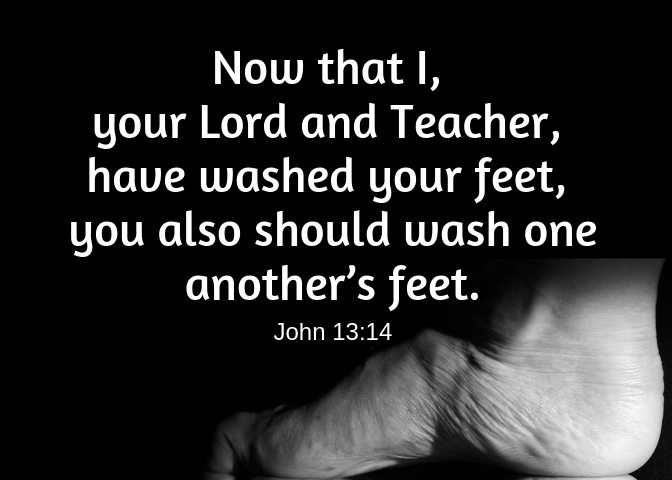
But Peter, never one to be silent, says “No way Jesus!” And who can blame him. The king doesn’t do the slaves’ work. The king has his slaves wash his feet. That’s how the world works. But Jesus lets Peter know that his kingdom works differently. The King serves, and the King’s advisors should serve, and future rulers should serve. If you want to be like Jesus, it’s not about being a King and being served. Jesus said “I did not come to be served but to serve and to give my life as a ransom for many.” He expects us to do the same. “So if I, your Lord and Teacher, have washed your feet, you also ought to wash one another’s feet. For I have given you an example that you also should do just as I have done for you.” (John‬ ‭13:14-15‬ ‭HCSB‬‬)
I’ve got a challenge. Actually DO it. Jesus gave us an example in this moment. Of course this means we should make ourselves servants and try to serve people everyday. But one way to make yourself humble is to grab your stinky younger siblings, or your mom or dad or grandparents or friend, and actually wash their feet. If you can, today or this week, actually get a group together and have the oldest person wash the next oldest person’s feet and down the line. It is a humbling experience. After you wash their feet and dry them off, pray for that person, and then pass the bucket and the towel until everyone has been washed. Then talk about the experience. Was it weird? Did you think it was OK? Do you think it made sense for Peter to feel a little weird? How would you react if Jesus tried to serve you?
Once you answer these questions and any others, read John 13:1-38. Remember that Jesus served people he knew would betray him and deny him; how much more should we serve those who we know love us: our friends, grandparents, aunts and uncles, moms and dads, brothers and sisters… even when they’re stinky.
Jake Ballard

God’s Timing: God’s Patience: God’s Love

2 Peter

2 Peter 3 9 (1)

I normally like to focus these devotions on verses we sometimes don’t pay too much attention to. 2 Peter sure has a lot of those verses. But today, I want to focus on a verse we have read a dozen thousand times.
The verse is, of course, 2 Peter 3:9 “The Lord does not delay His promise, as some understand delay, but is patient with you, not wanting any to perish but all to come to repentance.”
The Lord does not delay His promise. The promise of God is that the Kingdom will be restored to Israel and that sin will be eradicated on the earth. God is not slow in bringing that about. He is not delaying it just because he is putting it off. He is not waiting till the last minute by divine fiat alone. Instead, God is patient with US. With each and everyone one of us. He is waiting for us to come to him. He is waiting for us to repent, but he is also waiting for those who are far off. He is waiting for repentance to be found the world over. Why is he so patient, even now, 2000 years after Jesus walked the earth, 2000 years of church history and many hundreds of years of corruption and war and poverty and hate and greed and problems and sin even after the death of Jesus on a cross?
Because God doesn’t want any to perish. He does not want a single person to miss out on the promise of eternal life in the Kingdom, the gift given through Jesus. He doesn’t want any to perish, but he wants them all to come to repentance. Will they? No, this verse doesn’t say all will come to God. He does say that any who come to repentance, any who turn from the ways of sin to do righteousness, will not perish, but will experience true life.
I don’t have much more to add to that. If we remember this verse, lock it away, hide it in our hearts, it reminds us that God is love. That God cares about every person. That every person is a step away from salvation. That the time we have waited for Jesus is the patience of God made evident to a waiting world.
May we remember this verse and come to repentance to have life.
-Jake Ballard

Called into His Marvelous Light

1 Peter

1 Peter 2 9

It’s great to know why the author writes a book. Many times, it’s because they want to tell a story. It’s their story (in the case of auto-biographies) or someone else’s (biographies). It may be completely made up (fiction) or only slightly altered (based on a true story). But many books are not about stories but about themes. Some books are about the food we eat, or about the way economics work, or about a brief history of everything. Sometimes the authors never tell you WHY they are writing a book, sometimes it is the first thing they tell you. Anytime I read “I am writing this because” I take a sigh, because it allows me to finally figure out why they were trying to say all they are trying to say.
Peter gives us that when he wrote what would become 1st Peter. He says “I have written you this brief letter… to encourage you and to testify that this is the true grace of God.” He then gives the command “Take your stand in it!” Peter lets us know that he is hoping to encourage us and show us the true grace of God. I think he does this (being inspired is helpful too!) But I find the most encouraging passage in the book to be in 2:9-10. I think the passage should be written down in it’s entirety. Read it slowly and let it sink it.
But you are a chosen race, a royal priesthood,
a holy nation, a people for His possession,
so that you may proclaim the praises
of the One who called you out of darkness
into His marvelous light.
Once you were not a people,
but now you are God’s people;
you had not received mercy,
but now you have received mercy.
You are a member of a chosen race. You and the Christians in your community are not cosmic accidents but instead have been chosen by God.
You are a royal priesthood. You will rule with Christ in the coming Kingdom but you will also serve as a priest to bring worship to God.
You are a holy nation. There is not just you lost alone in a sea of disbelief, but there is an entire nation called to follow after God, who are holy, set apart of glory and honor at the end of days.
You are a people for his possession. God treasures you. He wants you because he loves you.
God has called you from darkness into his light. No longer are you unsure of where you will go, what will happen to you, or what the future holds. Instead, God sheds light on all these things. The future may still have moments of unknowing, but God will be beside you all the way, illuminating your steps.
You have become a part of God’s people; you have received mercy.
Read it again. While this letter has great theological truths, while it raises important issues between husbands and wives and Christians and their government, Peter was trying to encourage us through the knowledge of who we are!
Take courage in that you are precious and special to God.
-Jake Ballard
(I apologize for several days without a devotion.  That was my fault, due to many overlapping circumstances.  But, now we are back in business and looking forward to continuing this daily devotion.  May you be blessed by your time in His Word.                  FUEL Bible Devotions /Marcia Railton)