Devotion by Pastor Jeff Fletcher – originally posted for SeekGrowLove on March 25, 2017, for Ezekiel 22-23.
Throughout Ezekiel there are certain themes that keep circling back around: God’s judgment against Jerusalem, Israel’s unfaithfulness to God. In today’s reading we see another very graphic depiction of Israel’s immorality. This time, it’s the northern kingdom of Samaria and the southern kingdom of Judah. They are likened to two sisters who prostitute themselves. They again perform lewd acts shaming themselves before their neighbors. It’s very sad, indeed.
God searches for someone to help: “I looked for someone among them who would build up the wall and stand before me in the gap on behalf of the land so I would not have to destroy it, but I found no one.” God could find no one righteous to fill the gap and act as the mediator between God and His people.
We know the Gospel, the good news of Jesus Christ and God’s Kingdom. One day, Jesus would stand in the gap to keep God from destroying the earth. Jesus on the cross fills the gap between a holy God and a sinful people.
I hope that these devotions from Ezekiel will help you to see some important truths with greater clarity. God loves His people very much. God wants His people to be faithful and obedient. Some are and some aren’t. When His people are unfaithful, God brings calamity and judgment, in order to turn people’s hearts back to Him. It’s not the judgment that ultimately turn hearts, but it’s the fact that despite all of our wicked acts that deserve punishment, God is faithful to His promises and His steadfast love remains. Ultimately, it’s God’s mercy that leads us to repentance. May you know His love and His mercy through Jesus Christ, the man who did stand in the Gap for us.
Reflection Questions
What are the main themes of Ezekiel? How can we learn from them?
How does Jesus, a mediator to fill the gap, change the relationship between God and His people? How has it impacted your relationship with God?
Devotion by Pastor Jeff Fletcher – originally posted for SeekGrowLove on March 24, 2017, for Ezekiel 20-21.
In Ezekiel 20 God reviews Israel’s history. Over and over God provided for His people, over and over He warned them to get rid of their idols, keep His commands and observe His Sabbaths. Over and over Israel failed to obey God and experienced the consequences. Over and over God was compassionate and loving and forgave His people and restored them to blessings.
Israel has repeated this history again. They failed to get rid of idols, they failed to keep his commands and observe his Sabbaths, and now they were about to experience the consequences of their sins. God would once again treat them with mercy, not as their sins deserved and restore them to their land.
Ezekiel juxtaposes God’s promise to be merciful and restore His people with the threat that His judgment is coming and that both the evil and the good will be cut off from the land and the city and the temple. Yes, everyone will suffer the consequences of the evil behavior of some.
There is tension throughout Ezekiel. The wicked will suffer for their sins and the righteous will not suffer, except that at first they will suffer for the sins of others. Sometimes when God brings his judgment designed to bring people to repentance there is collateral damage. Good people suffer when bad people sin. It’s how it was then, it’s still how it is today. God’s salvation is coming, earth will one day be restored and made whole and good, but in the meantime, good people will suffer alongside the wicked. Christians are martyred in places like Pakistan and Syria. Christians sometimes suffer persecution in the United States. Trials may come to God’s people during times of judgment, but those who trust God and repent of their sins will be saved.
Reflection Questions
How often do we fall into the same cycle of disobedience that the Israelites followed for generations? What can be done to help break the cycle for you personally?
How does God’s mercy and justice coexist throughout Ezekiel and today?
What trials are you willing to persevere to avoid disobedience to God?
Devotion by Pastor Jeff Fletcher – originally posted for SeekGrowLove on March 23, 2017, for Ezekiel 17-19.
God used the King of Babylon, Nebuchadnezzar to enact His judgment against Israel. He carried off King Jehoiachin and 10,000 nobles to Babylon and installed Zedekiah to act as his vice regent or king in Jerusalem. The prophet Jeremiah warned Israel that this was God’s judgment and that the exiles would not return from Babylon until the people repented. But the people didn’t listen and false prophets gave Israel false hope that Babylon might soon fall. So Zedekiah broke his treaty with Nebuchadnezzar and made an alliance with Egypt. This led to a revolt against Babylon. Nebuchadnezzar crushed the revolt. Eventually, Jerusalem fell to Nebuchadnezzar and King Zedekiah and family were carried back to Babylon where they faced Nebuchadnezzar’s wrath. Zedekiah had his eyes put out and his sons were executed. Israel did not repent quickly nor easily, and because of her stubborn disobedience they continued to suffer.
In Ezekiel 17 God chose to use the allegory of an eagle plucking up the top of a cedar and then replanting it to depict His judgment against His people and to remind them of His power to build and His power to destroy.
In Ezekiel 18 God gives a very clear teaching to His people on the nature of sin, righteousness, judgement, repentance and forgiveness. Each person is responsible for their own actions. Parents are not held responsible by God for the sins of their children, and children are not held responsible by God for the sins of their parents. Each person is responsible for their own behavior. In the same way, you don’t get credit for your parents good behavior if you do bad. Each person is responsible for their own sin and will be judged accordingly.
There is good news imbedded in Ezekiel 18. God doesn’t take any pleasure in seeing wicked people die. God wants to see people who do evil turn away from their evil. God wants everyone to repent. If an evil person repents, God will not punish them. If a righteous person turns evil, they will be punished for their evil behavior. God is a God of both mercy and justice. He will punish unrepentant evildoers and he will forgive and restore those who repent of their evil. This chapter is best summarized in the final three verses: 30“Therefore, you Israelites, I will judge each of you according to your own ways, declares the Sovereign Lord. Repent! Turn away from all your offenses; then sin will not be your downfall. 31Rid yourselves of all the offenses you have committed, and get a new heart and a new spirit. Why will you die, people of Israel? 32For I take no pleasure in the death of anyone, declares the Sovereign Lord. Repent and live!
In Ezekiel 19, there is a lament for the end of the Messianic dynasty that came from David. Since the time of David, his descendants, beginning with Solomon reigned as Kings over Israel. But that has been brought to an end. There were no more descendants of David serving as the Lord’s anointed over Israel. Of course, we have the benefit of hindsight. We live on this side of the New Testament. After several hundred years of NOT having a descendent of David as King of Israel, one was finally born in Bethlehem and his name is Jesus. One day, Jesus will sit upon the throne and rule over not only Israel, but all the earth. In the meantime, we have a choice, we can turn away from our sins and turn to God, or we can face the judgment. Jesus Christ is God’s provision for our salvation. We go to him to get a new heart and a new spirit.
Reflection Questions
Why did God provide an allegory for the people in Ezekiel 17?
How often is suffering directly or indirectly an effect of disobedience to God or a lack of repentance?
Is it easier or harder to read, study, believe, and live out the Old Testament teachings now or before the New Testament was written? What are the advantages to each side? How can that impact how we read the Bible today and how should we respond?
Devotion by Pastor Jeff Fletcher – originally posted for SeekGrowLove on March 22, 2017, for Ezekiel 14-16.
Chapter 14 gives us a picture of the heart of God. Elsewhere in the Bible it says that God is a jealous God. God loves His people Israel as a husband loves his bride. Israel turned away from God’s love, their hearts were no longer given to God. God wants more than anything else to recapture the hearts of His people who deserted him to pursue idols. God wants them to repent and turn back to Him.
God wants to have His people love Him exclusively. He will not let them worship idols, yet still come to him for prophecy. This would be similar to a woman who both goes to her lover but then comes to her husband as well. God will have none of this, no two timing wife. Israel must have a change of heart and that will only happen through judgment. The prophets were not permitted to prophesy for people who were also consulting idols. If the prophets did prophesy to those seeking idols, they too would be punished.
God tells Ezekiel that His judgment is certain and that no human being, no matter how righteous or faithful can stop that judgment. He warns that even if such great men of faith as Noah, Daniel or Job sought to keep Israel from judgment that their righteousness would not be able to save Israel.
In Chapter 15 God promises to make Jerusalem as desolate and useless as a dried up vine that has been thrown into a fire. Just as the vine will be totally consumed by the fire, so too, will Jerusalem be consumed by the fire of God’s judgment.
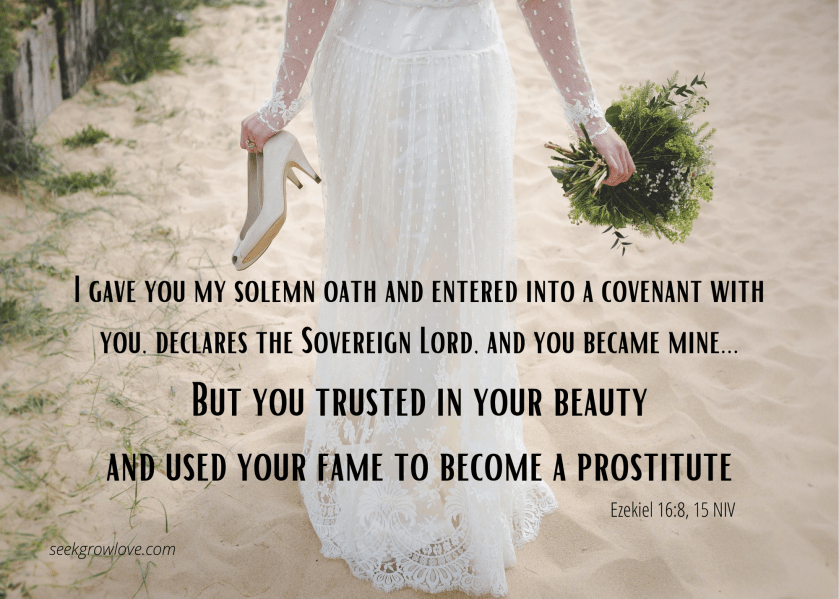
Chapter 16 is one of the most graphic passages in all of the Bible. If the Song of Solomon was rated PG-13, Ezekiel 16 would probably be rated R or NC-17. It is extremely disturbing to read. God compares Israel to an unwanted, discarded child whom God rescued from its disgrace. God later came along when Israel was old enough to be married, but she was naked and dirty. God cleaned her up, covered over her nakedness, dressed her up like a princess and made her his bride. Israel was blessed beyond imagination by God her husband. But then, tragically, Israel turned to prostitution. Here Idolatry is likened to a form of spiritual adultery. Israel had brought great shame upon her husband. In fact, she was worse than a prostitute in that she paid others her gold and silver to sleep with her. It’s such a disturbing picture. And it’s designed to give us a visceral reaction. It’s a gut punch.
The fact that God must punish Israel for her spiritual adultery is not surprising. Israel is only getting what they deserve. What is surprising is that God is going to restore Israel. Not because Israel deserves it now any more than it deserved it when God first cleaned her up and made her His bride. God is doing it because God is faithful to His Covenant promises. God made a promise to Abraham, Isaac, Jacob and their descendants, Israel. God does not forget His covenant or break his promises. God is filled with steadfast love for His people.
After punishing Israel, God will then make atonement for them. He will cover over their sin and guilt and forgive them and take them back. Then they will remember their vows and be ashamed of their guilt and will become a faithful wife and turn away from idols.
As Christians, we have been grafted into God’s family and we are now included as God’s bride. Through Jesus Christ God has found us in our sin, cleaned us up and made us His own. Are we sometimes guilty of idolatry? Do we ever act unfaithfully toward God and give our hearts to someone or something else instead of God? Remember, Jesus said that the greatest commandment is to Love God with all your heart. God wants All your heart. God is jealous when we give our hearts to another. May Israel’s spiritual adultery remind us that we must give our hearts fully only to God and no one else. Otherwise, God may have to win our hearts back the way he did Israel, and we can see how unpleasant that process was for them. Let’s always keep our hearts faithful to God alone.
Reflection Questions
What promises had God already made to the Israelite people?
What must the people do to keep their side of the covenant promises with God?
What can you do to give all your heart to God and avoid spiritual adultery?
Devotion by Pastor Jeff Fletcher – originally posted for SeekGrowLove on March 21, 2017, for Ezekiel 10-13.
“Elvis has left the building.” That’s what they used to say to the throngs of screaming fans after one of Elvis Presley’s concerts back in the day. They would rush Elvis out the back door into his waiting car or bus and whisk him off to safety. Hopefully, the fans would calm down after they knew he was no longer there… there would be no more encores for this performance.
In Ezekiel ten- YHWH has left the building. The building in question was the Temple of Jerusalem. Since the time of Moses and Aaron in the wilderness when Israel worshipped in the Tabernacle, to the time of Solomon and beyond, when they worshipped YHWH in the Temple of Jerusalem, YHWH was present with His people. They knew that there, in the holy of holies, the shekhinah glory of God was present with his people. Yes, there was a veil which separated the holy of holies from the rest of the temple, and only the high priest was permitted to enter into the presence of YHWH once a year to atone for the sins of the people, yet they could always look up to the tabernacle or later Temple atop Mt. Zion and know that God was with them. But no longer. Ezekiel saw a vision of God’s glory leaving the Temple. Because of their extreme disobedience and their worship of idols, God could no longer remain among his people. It was a time for judgment, and God had to leave. How sad that must have been for Ezekiel, to watch God leaving.
In Ezekiel eleven, judgment is proclaimed against Israel’s leaders. “You haven’t obeyed my laws” YHWH complains. “You’ve conformed to the standards of the nations around you.”
God is gracious, even in the midst of judgment, he promises to bring some of them back from exile and give them back the land which he had given to their forefathers. God promises to bring about change in their hearts. vs. 19 “I will remove their heart of stone and give them a heart of flesh.” God still loves His people and offers them hope in the midst of judgment. Ezekiel shared this vision with the exiles so that they would understand the consequences of their sins.
In Ezekiel twelve, God warns that even their ruler would be forced into exile. They kept hoping that this would happen in the distant future, but God assures them that judgment is coming soon.
In chapter thirteen, God turns his judgment from the leaders to the false prophets. These people told lies in the name of YHWH. They said “thus saith the Lord” when God didn’t say it. God condemns them for leading their people astray. They “whitewashed” over the truth about God’s coming judgment against sin and substituted their lies about a false peace. “you encouraged the wicked not to repent”. He blames the false prophets for the sins of the people, therefore, they will come under God’s harsh judgment.
Israel had a wonderful building in which to worship, they had clear rules to follow, they had leaders to teach them, they had priests to offer sacrifices, they had prophets to bring them words from God- and yet that wasn’t enough. They were not content to live as God’s holy and separate people and act as a witness to the rest of the nations around them. Instead, they worshipped the false gods of their neighbors, they ignored God’s laws, their prophets failed to warn them for their sins and assured them of false peace when God was preparing to bring his judgment. It seems not much has changed. One would be tempted to see the same kinds of things going on today. How many buildings today allow idolatry and false gods to be worshipped? How many people falsely claim to be speaking God’s word when they are instead peddling the words of men? Some days we might even wonder “has God left the building” when we follow the sinful standards of the world rather than remaining faithful to God’s holy word? We’d like to think judgment is far away just as they thought then… but perhaps it’s much closer than you might think.
Reflection Questions
Has there been a time when you have felt that God’s presence and glory has left?
Have you ever conformed too much to the standards of people around you?
According to Ezekiel 11, who qualifies to receive the heart transplant from stone to flesh, and who does not? What is the purpose and the result of this heart transplant?
Devotion by Pastor Jeff Fletcher – originally posted for SeekGrowLove on March 20, 2017, for Ezekiel 5-9.
This portion of Ezekiel is, admittedly, difficult to read. It’s a pretty graphic account of God impending judgment against the city of Jerusalem and his people, Israel. God tells Ezekiel to shave his head and beard. This would have been an act of mourning for most people, but it was double disturbing for Ezekiel, since he was a priest and normally forbidden from shaving his head or beard. Ezekiel was told to burn, take a sword to, and scatter his cut hair. This was to symbolize what was to happen to Israel. A few hairs were kept back, symbolic of the remnant who would not be destroyed.
God accuses his people, Israel, the chosen nation, of being worse than the other nations. They broke the law more than the nations that did not have the law. God was bringing his judgment against His own people. The description of the siege almost defies comprehension, including cannibalism of both parents and children. This was to serve as a warning to the other nations: if this is how God treats his own people for their idolatry, beware of what he will do to you.
In Ezekiel six God makes it clear that their judgement is upon them because of their idolatry. However, there is a remnant that will be spared and live in captivity and will come to repentance.
In Ezekiel seven, a special emphasis is made regarding their idolatrous attachment to gold and silver. This wealth that they turned to and fashioned into idols will be unable to save them from the coming judgment. All the money in the world can’t save you from judgment.
In Chapter eight Ezekiel has a vision of the temple in Jerusalem. This includes the “Idol of jealousy” which we discover is the pagan god Tammuz. Tammuz was the Sumerian god of food and vegetation. At the summer solstice there was a period of mourning as the people saw the shortening of days and the approaching drought. Sacrifices were made to Tammuz at the door of the Jerusalem Temple. This was an absolute abomination to Israel’s God, YHWH as He made it clear that He alone was to be worshipped as God (see Deuteronomy 6:4-5).
In Chapter Nine an angel is sent out to put a mark on all of the people of the city who did not commit idolatry and worship Tammuz. They would be spared. But then all those who did not receive a mark would be destroyed. This is reminiscent of the story of Exodus, when the doorposts of the Israelites were to be marked with the blood of the sacrificial lamb, and those with the mark were spared their firstborn sons dying when the Angel of Death passed over their houses. It also points to the future (See Revelation 13) when the beast will cause people to have a mark on their forehead or they would not be able to buy or sell. This is contrasted with those in Revelation 14 who have the name of God and of the lamb on their foreheads.
God is a God of love and mercy. God has provided a means for us to be rescued from the consequences of sin. There is a way for each of us to be spared the final judgment of God that is coming. Jesus Christ, the lamb of God is the only means by which we can escape judgment. Along with God’s mercy is His holiness. God will not allow sin and rebellion to continue on earth forever. A day of judgment is coming for all the earth just as it did for the nation of Israel. God tolerated their sin for only so long, and then came the time for judgment. Mercifully, God spared those who repented by placing His mark upon them. God has been tolerating sinful rebellion on earth, but a day is coming when He will destroy sin and sinners who have not repented and turned away from their sins and turned to him through Jesus Christ. Ezekiel’s harsh imagery should remind us that we must not forget that God’s wrath is coming from which we all need to escape, and we need to warn others. This won’t make us popular, but doing God’s will is seldom popular among the rebellious.
Reflection Questions
What idols are present in the world today? And in your life?
How does God’s love and mercy work with His justice?
Has popularity ever been an idol for you over God’s will? When have you chosen popularity over God’s will? When have you chosen God’s will over popularity?
Devotion by Pastor Jeff Fletcher – originally posted for SeekGrowLove (then named Grow16) on March 19, 2017 – the first time our daily Bible devotions site was reading through Ezekiel. Jeff has been a valued writer and top contributor for SeekGrowLove through the years and we look forward to sharing his words from God’s Word with you all week. Thank You, Jeff, for your faithful words over and over again!
Ezekiel was a priest in Israel during a tumultuous time in their history. The Northern kingdom had been decimated by the Assyrian empire and its people scattered and assimilated resulting in a complete loss in their identity as a distinctive people of God. The Southern Kingdom of Judah was now being systematically taken apart by the Babylonians. Ezekiel was among the early members of Judah’s elite leaders who were taken captive to Babylon. Ezekiel was now a priest living in a foreign land where he had no access to the temple of Jerusalem and the religious symbols that helped shape his life and give him meaning and purpose.
In today’s readings God comes to Ezekiel in a series of visions. These visions are recorded as a type of scripture known as apocalyptic- where something is revealed or unveiled. In addition to portions of Ezekiel there are apocalyptic passages in the books of Daniel, Isaiah and Joel. God reveals what is going to happen as He brings an end to the present age preparing the way for the age to come or coming Kingdom of God. You will notice some similarities between Ezekiel 1 and Revelation 1 and 4.
Ezekiel’s description sounds like something in a science fiction movie- 1:27-28 says: “I saw that from what appeared to be his waist up he looked like glowing metal, as if full of fire, and that from there down he looked like fire; and brilliant light surrounded him. Like the appearance of a rainbow in the clouds on a rainy day, so was the radiance around him. This was the appearance of the likeness of the glory of the Lord. When I saw it, I fell facedown, and I heard the voice of one speaking.”
Imagine if, for a brief instant, God permitted you to have a vision of himself in all of His glory. You would probably struggle to find the right words to communicate what you saw. So it is with Ezekiel. He is overcome by the glory of God and he falls on his face.
The whole of Ezekiel is surrounded by the image of a holy God. But God’s people, Israel, have been disobedient to God. Ezekiel is appointed by God to serve as his “watchman” (3:17) for the people Israel in captivity. His mission is to warn God’s people of their sins and to call them to repentance. Ezekiel 2:7-8: “You must speak my words to them, whether they listen or fail to listen, for they are rebellious. But you, son of man, listen to what I say to you.”
The job of a watchman is to stay awake, keep one’s eyes open, and warn if anything dangerous or illegal is taking place. It might also include a warning to those who are tempted to trespass. Ezekiel’s job was to warn God’s people about the consequences of their sins and the coming judgment of God. God tells Ezekiel essentially: “you need to warn the people about my coming judgment. If they don’t listen to your warning, then they will suffer the consequences, but if you fail to warn them, then I’ll hold you responsible for their sins.” God was letting Ezekiel know that he had a mission, to share God’s word with people. If the people didn’t listen or heed the warning, it was on them, but if he refused to give the warning it was on him.
As followers of Jesus Christ today, we are called to be priests in this world. Like Ezekiel, we are living in an age where much of Christianity has been decimated by a massive turning away from God and people are scattered and assimilated into the world resulting in a complete loss in their identity as a distinctive people of God. And like Ezekiel, we are to keep watch and issue warnings to the people of the world. As with Ezekiel, sometimes we will warn people and they won’t listen. If that’s the case, it’s on them. But if we fail to do our job and give the warning, then it’s on us. People won’t always like what we have to say- prophets and priests are sometimes labelled as intolerant and not very popular, but that should not prevent us from doing the work God has given us to be His watchmen to our generation. (Note: our job is not to be the judge, it’s not our place to condemn the world, but to tell them what God tells us to tell them, which is the Gospel.)
-Pastor Jeff Fletcher
In 2017 Jeff introduced himself this way to the FUEL readers –
My name is Pastor Jeff Fletcher. I’m one of the old guys. I first attended what is now FUEL (then it was called National Camp) back in 1977 and I’ve been a camper or on the staff for most of the past 40 years. I’m a graduate of Oregon Bible College, (Now ABC) and I’m completing a Master’s Degree from Eastern Mennonite Seminary. I’ve pastored Churches in Illinois, England, Louisiana, South Carolina and now Virginia. My wife Karen and I have eleven children and 4 grandchildren and my daughter, Karee Anne is getting married this Saturday, March 25. In addition to pastoring a Church I also work as a hospital chaplain. I am passionate about bringing the message of God’s loving presence to people who are hurting and in need of hope and purpose in life.
Reflection Questions
What was Ezekiel facing being a priest and prophet of God in Babylon? Have you ever felt like you were God’s priest or prophet in Babylon? If not, why not?
Has anyone ever served as a watchman for you – warning you of God’s judgment to come? Why does God value this role and put the responsibility on Ezekiel?
Does God give us the job of making people change? What does he tell us to do?
How seriously do you personally take the job of watchman or priest? Who do you know who needs to hear that they are on a dangerous path? How will you sound the alarm?
I’ve been a pastor for 35 years (actually, 40 now, as this was written in 2020). I’ve pastored local congregations. I’ve served on the mission field in a different country. I’ve served as a hospice chaplain with people who have been diagnosed with life ending diseases and as a hospital chaplain with people who are very sick, or having surgery, or recovering from surgery or recovering from pneumonia, or have attempted suicide or are struggling with mental health issues and need extra support. I preach each week to people in the nursing home and those who are suffering from Alzheimers and other forms of dementia. I’ve stood at the bedside and prayed with families whose loved one is about to die or who has already died. I’ve prayed blessings over newborn babies and people over 100 and everywhere in between.
The one common need I find over and over again is the need of the person going through crisis to know that God is with them. Everyone goes through challenges and difficulties, losses and pains in life. It’s not a question of, “Will bad things happen?” or even, “Why do bad things happen?”, it’s more a case of, “When bad things happen what resources do you have to draw from to help you get through it?”
As God’s people, Israel was being transformed from slaves to the people of God who were to be a light to all nations, they were going to face many challenges on that journey of transformation. They had a desert to cross. They had numerous enemies to face who all wanted to prevent them from reaching the promised land, and once they arrived in the land, there were enemies who wanted to take the land away from them and turn their hearts away from undivided loyalty to God.
To get through these challenges Israel needed regular assurance that God knew them and that God was with them. If you’ve been a Christian for most of your life, it is likely that you know these things already. You know that God knows you by name, that before He formed you in your mother’s womb he knew you. You know Jesus’ promise that he will be with you always, to the end of the age, right? There’s no way you would ever forget that God knows you and that Jesus is with you, right? (More about that in a minute).
The people of Israel were spiritual babies. They were just starting to learn about who this God is and to get used to the idea that God would stay with them and not abandon them. They needed a lot of reminders. So, in addition to having a tent of meeting constructed in their midst (see yesterday’s devotion) they needed to know that they had representatives who would go before God regularly on their behalf. So God set aside a group of men who would serve as priests. They had a special calling and were set apart or consecrated to do the work of a priest.
Today’s reading describes the various pieces of clothing that the priests wore and the purpose of each item- ephod, breast piece, robe, tunic, turban, urim and thummin, gold plate, sashes etc… of all of these descriptions in Exodus 28 one in particular stands out: “Engrave the names of the sons of Israel on the two stones the way a gem cutter engraves a seal. Then mount the stones in gold filigree settings and fasten them on the shoulder pieces of the ephod as memorial stones for the sons of Israel. Aaron is to bear the names on his shoulders as a memorial before the Lord.” (11-12). So when the priest went before God, he went bearing the names of the sons or tribes of Israel. This was a reminder that they were there on behalf of the entire people of God. The message for the people was that the priests would bear on their bodies a constant reminder to God of His beloved people.
We might ask the question,” if God is perfect and all knowing, why would he need such a reminder? ” I would say that the reminder wasn’t for God as much as it was for the people to have the assurance that they were being constantly brought before God. Prayer works the same way for us. When someone prays to God on our behalf, they aren’t exactly bringing new information to God’s attention. God knows our needs before we ask. One of the benefits of intercessory prayer is to remind us that we are not alone in the midst of our needs. When I was first diagnosed with cancer and underwent surgery and radiation lots of people were praying for me. It brought me great comfort and encouragement to be reminded regularly that people were remembering me before God’s throne.
In Exodus 29 it provides a description of the rituals that were used to consecrate or set apart the priests for their duties of bringing the people before God. Notice how the consecration involved sacrifices and blood. In order for the priests to go before God on behalf of the people, their sin and guilt had to be covered over by blood. In fact, every day, morning and night, a lamb was to be sacrificed to God. “For the generations to come this burnt offering is to be made regularly at the entrance to the tent of meeting, before the Lord. There I will meet you and speak to you; there also I will meet with the Israelites, and the place will be consecrated by my glory.” (42-43)
This served as a constant reminder that God was holy and sinless, and that human beings are sinful and needed to be cleansed and forgiven of their guilt in order to come near to God’s presence. As a result: “Then I will dwell among the Israelites and be their God. They will know that I am the Lord their God, who brought them out of Egypt so that I might dwell among them. I am the Lord their God.” (45-46) These daily sacrifices served as a constant assurance to God’s people that He was their God and that He was with them.
As Christians, we are not required to sacrifice a lamb day and night in order to be assured that God is with us. Jesus is the lamb of God who takes away the sins of the world. He, as the high priest and the sacrificial lamb, went into the most holy place with his own blood and offered a sacrifice that covers over all of our sins once and for all. (Once you read the book of Exodus, the book of Hebrews in the New Testament is much easier to understand… check it out). When Jesus was first prophesied in Isaiah 7 it was said that he would be a sign that God is with us (Immanuel means God is with us). In the name of Jesus we can be assured that God is with us – not because we are perfect or sinless, we are no more sinless than the nation of Israel was, but we have been made holy by the blood of Jesus.
Earlier I asked the question: “There’s no way you would ever forget that God knows you and that Jesus is with you, right?” The fact is, we all have times when we forget that God knows us and that Jesus is with us. This is a danger when everything is going well in our lives- when we are busy enjoying the blessings that God gives us and are on a roll, we can get so caught up in enjoying the gifts that we forget to worship the one who gives them to us, God. It is also a danger when things are tough and we are hurting and feel all alone or worry that God isn’t answering our prayers. When we go through spiritual depression or the dark night of the soul we can forget that the Lord promised never to leave us. We need constant reminders, in the good times and the bad times. That’s why we need to gather regularly with other believers to find encouragement and strength, so we don’t forget. That’s why we need to regularly break bread and drink the cup at communion, to help us remember. You and I need ongoing reminders that God is with us, that God remembers us. We need to know others are bringing our names before God in difficult times, and we need to remember to bring others before God during their difficult times. We may not have to wear ephods and robes and rub lamb’s blood on us, but as Christians we are all priests and we all need to go before God regularly on behalf of each other and on behalf of people in the world, in the name of Jesus. Don’t forget to remember, God is with us and God will never forget you.
Places of worship come in all different shapes and sizes. I have worshipped God in huge cathedrals with impressive pipe organs and altars overlaid with gold and stained glass windows. I have also worshipped God in open-air tabernacles with sawdust floors. I have worshipped God in a deer stand, at the beach, on a mountaintop and on a table undergoing radiation. I have worshipped God in loud and energetic services with guitars, drums, and electronic keyboards and I have worshipped him in places with no sound at all except the flickering flame of a single candle.
I believe God loves to be worshipped in lots of ways and in lots of places. Even in the Biblical stories God was worshipped on simple stone altars, in burning bushes, on mountain tops and down in valleys.
Israel was at a critical time in their formation and it was important for them to have a steady reminder of God’s presence. God made his presence visible to them as they journeyed with both a pillar of cloud in the day and a pillar of fire at night. As they continued their journey across the wilderness, God chose to make his visible presence known to them in a portable house of worship. This place would provide structure in the midst of their community wherever they stopped to make camp. The tent of meeting or tabernacle would be an ongoing visible sign that God’s glory was in their midst. And God taught them how to be a holy nation. He used various symbols and rituals of sacrifice and worship as a way to drill home to them his holiness and the consequences of sin.
How God chose to do this is quite interesting. He could have simply built a temple Himself in the heavens and dropped it down fully formed on earth. However, God chose instead to invite His people to become active participants in creating this place of worship.
First, God began with their willing desire to give. “Tell the Israelites to bring me an offering. You are to receive the offering for me from everyone whose heart prompts them to give. These are the offerings you are to receive from them: gold, silver and bronze; blue, purple and scarlet yarn and fine linen; goat hair; ram skins dyed red and another type of durable leather. acacia wood; olive oil for the light; spices for the anointing oil and for the fragrant incense; and onyx stones and other gems to be mounted on the ephod and breast piece” (Exodus 25:2-7). This was not a mandatory tithe that was required; this was an offering to be willingly given and received.
Where did the people get all of these valuable commodities? If you will recall, as they were leaving Egypt they were given many valuable items by the Egyptian peoples – one might say this was payment to help compensate for years of slavery. They had these items in their possession already. Those who were willing could give them to help create the tent of meeting and the prescribed worship items inside of the temple, which included the Ark of the Covenant, the table, the lampstand as well as the material for the tabernacle itself, and the altar, courtyard and the oil to keep the lamps burning. All of the materials were freely donated. The people of God used their own skill to build the items from these donated materials – carpenters, weavers, stonemasons, goldsmiths and others each made their own contributions to the creation of this place of worship. In this way, everyone in the community that wished to participate had buy in to the tabernacle. It truly was a communal place of worship.
Once the nation finished their journey through the wilderness and took possession of the Promised Land, they would eventually transition from a portable tent of meeting to a permanent temple under the leadership of King Solomon. However, this tent of meeting served them well for 40 years in the wilderness and many more during the times of the judges, and kings Saul and David.
For Christians, we do not worship God in a tabernacle or physical temple and we do not bring sacrifices of sheep or goats or bulls for an offering to God. For us, the Church itself is the temple of God. I am not talking about the building where the Church gathers to worship, I am talking about the actual people who gather to worship, and we are the Church. Jesus said whenever 2-3 gather in his name that he is there in their midst. There is no one single right way or place to worship God. It is wherever God’s people come together. Christian Worship does not have to follow a strict pattern. Worship is where we gather to read the word of God, pray, worship, encourage each other and exhort one another to good works, break bread and proclaim the resurrection of Jesus. Blood sacrifices are not necessary because Jesus is the Lamb of God who takes away the sins of the world and he entered into the holy of holies once and for all and gave his own body as the final sacrifice for all of our sins.
One thing remains unchanged from the time of Israel in the wilderness tent of meeting and the Church today. God still welcomes us to bring our offerings from the heart as a way to say thank you. We can still bring tangible offerings, and we can still offer our gifts and talents as ways of showing God our deep gratitude for all of his blessings to us. It is not all that important how we worship or where we worship, but it is very important that we worship and we bring our offerings freely to worship God.
Jeff Fletcher
(originally posted February 7, 2020 for SeekGrowLove)
Reflection Questions
Why do you think God wanted the Israelites to have a tabernacle? What are some benefits today to having a place to go to worship God together with God’s people? What are the additional benefits to being able to worship God anywhere?
Why do you think God gave Moses so many details for how to make the tabernacle and its furnishings?
Where do you find a sanctuary where God dwells with you? What offerings do you freely bring to God as part of your worship?
Social transformation is often a long and painful process. Think about efforts at equality within the United States. The founders’ vision was for a society where everyone had the right to life, liberty and the pursuit of happiness. The Declaration of Independence expressed this in 1776. Yet it took nearly a century and a Civil War to bring an end to slavery. It took nearly 150 years for women to be able to vote and nearly 200 years and a lot of blood, sweat and tears to make significant strides toward racial equality.
How does one take a community that has been enslaved for over 400 years and transform them into a nation that shines a beacon of light to all other nations in the world pointing them to the true God. How does an entire nation become holy, set apart for God’s service and God’s glory?
This is the challenge that was before God, Moses and the nation of Israel. They were leaving behind one type of structure, slavery, to enter into a new way of living. They needed a new structure to help them know how to live. They had to be taught how to live in community. They had to be taught how to work, and how to rest, how to care for their neighbors, and how to punish wrongdoing that threatened to destroy their community.
In today’s reading we see how God begins to organize and structure the transforming community of Israel. He teaches them how they are to live and become a holy nation and a royal priesthood. This transformation would not come quickly or easily.
They had to be taught how to show respect for personal property: “Whoever steals an ox or a sheep and slaughters it or sells it must pay back five head of cattle for the ox and four sheep for the sheep.” (22:1) Those who steal must give restitution.
They had to be taught to respect the family structure and to place their sexuality within proper boundaries: “If a man seduces a virgin who is not pledged to be married and sleeps with her, he must pay the bride-price, and she shall be his wife. If her father absolutely refuses to give her to him, he must still pay the bride-price for virgins.” (22:16-17)
They had to be taught that there were severe consequences for failing to follow appropriate sexual boundaries: “Anyone who has sexual relations with an animal is to be put to death.” (22:19).
They had to be taught to have empathy and to show kindness to strangers and people who were different: “Do not mistreat or oppress a foreigner, for you were foreigners in Egypt.” (22:21).
They had to be taught to have compassion for people in the community who had suffered major losses: “Do not take advantage of the widow or the fatherless. (22:22).
They had to be taught to show respect both to God and to their earthly leaders: “Do not blaspheme God or curse the ruler of your people.” (22:28)
They had to be taught how to live as a just community by not giving false testimony, and by neither showing favoritism toward the poor nor withholding justice from the poor (23:1-6).
They had to be taught to care for their bodies and minds by getting appropriate rest. (23:12).
It was also important that everyone be taught these and other guidelines for how to live in community as God’s people and that they verbally acknowledge that they understand and intend to follow “Everything the Lord has said we will do.” (24:3)
Israel’s transformation from slavery to covenant people of God living a set apart life as the community of God’s people was a slow and challenging process. It was painfully difficult, but necessary. In the end, people failed more often than they succeeded in carrying out their assignments. And yet, somehow, despite tremendous opposition from aggressive and hate filled neighbors, the Nation of Israel survived.
As Christians, we can learn much from studying how God worked with His people Israel to bring about their transformation. It is important to note that they were God’s people first, and then they were given this particular set of laws. In the same way, as Christians, we become God’s people first, through faith in Jesus Christ, and then we commit to following Jesus and obeying Jesus’ commands. We do not become God’s people by following laws, but by following Jesus Christ. However, when we follow Jesus Christ, we do not descend into lawlessness. Structure is still required. So Jesus spends three years teaching his disciples how to live as the people of God who are called to be holy, set apart to be a light to all nations. We complete the mission that the nation of Israel began, and we do so following the yoke or community guidelines as laid down by Jesus Christ. The foundational teaching of Jesus is to Love God and Love our Neighbors. That is a good place for each of us to start each day.
Jeff Fletcher
(originally posted February 6, 2020 for SeekGrowLove)
Reflection Questions
What is the purpose of rules for your country, work/school or family? What is the purpose of God’s rules for His people?
Does God still want a holy people today? What does a holy people look like?
Which characteristic of a holy people do you want to especially work on developing more this month?