Hearing God’s Word is Not the Same as Following It

Jeremiah 41-45

Devotion by Dustin Farr (South Carolina)

After Jerusalem fell to Babylon, a small remnant remained in Judah under the leadership of a man named Gedaliah, who was appointed governor by Babylon. During this time there was stability but it was short-lived due to a man named Ishmael. Ishmael was a royal descendant of the line of David and desiring power created a plot to assassinate Gedaliah and his council. He didn’t stop there but then also killed the Babylonian guards, and even murdered Judeans who were with him. His violence went further when seventy men from Shechem, Shiloh, and Samaria came to bring grain and incense to the temple. Ishmael lured them in and slaughtered them, sparing only ten who bribed him with hidden supplies. These were not acts of justice. They were fueled by pride, ambition, and a willingness to kill the innocent to secure power.

In the aftermath, fear spread through the remnant of the Judean people. Johanan and the other leaders gathered and the survivors approached Jeremiah the prophet, asking him to pray to the LORD for direction. They promised to obey whatever God revealed. For ten days, Jeremiah waited for God’s answer while the people appeared willing to hear it. In reality, they had already decided on their course…fleeing to Egypt for safety.

When God’s answer came, it was direct. Stay in the land, and He would protect them; go to Egypt, and judgment would follow. The message was a test of trust. Would they believe God could preserve them under Babylon’s rule, or would they seek security on their own terms? Their response revealed their hearts. They accused Jeremiah of lying and acting under Babylonian influence, then forced him and Baruch to go with them to Egypt.

Once in Egypt, they returned to idol worship. They knew God’s commands and yet chose to break them. But their disobedience would have consequences. They knew God’s commands and yet chose to break them. Their disobedience would not go unanswered. God made it clear that the very place they sought for safety would be the place of their destruction. The sword, famine, and plague they feared in Judah would meet them in Egypt.

In the middle of this message of judgment, God also spoke to Baruch, Jeremiah’s scribe. While others were seizing power or chasing their own plans, Baruch was called to remain faithful in the work God had given him. God told him not to pursue “great things” for himself during this time, and in return promised to preserve his life. It was a reminder that in seasons of uncertainty, real security comes from God’s hand, not from self-promotion or human strategy. This passage highlights how meaningless it is to ask the LORD for guidance, if you don’t plan on adhering to it. True obedience means submitting to His direction even when it opposes our plans. Faithfulness matters more than personal ambition, and security apart from God is an illusion.

Reflection Questions:

  1. Have you ever sought God’s direction but deep down hoped it would match what you already wanted?
  2. How does this account challenge you to submit to God’s will even when it conflicts with your plans?
  3. What would faithfulness look like for you in your current situation?

The Rightful Judge of the Universe

OLD TESTAMENT: Lamentations 4-5

POETRY: Psalm 119:121-128

NEW TESTAMENT: Revelation 9

We pick up this Friday by finishing off the final 2 chapters of the book of Lamentations—one of the most poetic cries to God in despair, pain, and anguish that is recorded in the Bible. Jeremiah has spent the previous 3 chapters weeping to God about the destruction of both Jerusalem and Judah, and the horrific circumstances it has thrown His people into. Besides the outright attack from the Babylonians, they also suffered siege and famine. Death was inescapable at every turn, from starvation and thirst to even resorting to cannibalism. Amongst all this, Jeremiah has seen it all. 

He questions why God had abandoned His people, and why they must suffer. At a certain point he recognizes it is because of the sins of the people of Jerusalem, and that God’s wrath is His own to disperse—that it is by God’s hand justice is determined.

“Who can speak and have it happen if the Lord has not decreed it? 

Is it not from the mouth of the most high that both calamities and good things come? 

Why should the living complain when punished for their sins?” (3:37-39)

I think about times in my life where it has felt as though I have been left alone—seemingly abandoned. In these moments, my first thought may be to question why God has abandoned me, and why I have to suffer. Why can’t it always be good times? Why would God allow this suffering?

But that thought is unfounded—it forgets the very essence of God’s nature, and does not take on the perspective that Jeremiah takes. God is the one and only rightful judge of this universe. What good would a judge in a court of law be if they let every person who’s done wrong off Scott free? 

God is not the source of sin, just as light is not the source of darkness. Rather, where there is no light, there is darkness. Without God and His righteousness, we fall back into sin and into that darkness. Thankfully, because of the sacrifice He sent for us, through the death of Jesus Christ, we can now live under a new covenant of salvation! And because of this gift, we ought to recognize the power and might of our God, as Jeremiah did. In both high and low, fire and ice, joy and pain, we owe everything to God, the creator of both the mountains and the seas.

“You, Lord, reign forever; your throne endures from generation to generation.” (5:19)

-Mason Kiel

Reflection Questions

  1. What suffering have you witnessed or endured that perhaps made you question what God was doing or why?
  2. What sins had Jerusalem and Judah committed? What sins do you see in your society? What sins do you see in your life?
  3. What do you gain by recognizing God as the just God of the universe?
  4. Suffering is sometimes brought about by God’s judgment on sin. Are there other explanations for some suffering?

Some NOT NICE things to say

Jeremiah 19-20

“If you don’t have anything nice to say, then don’t say anything at all.” It’s a nice way to remind elementary students to stop calling each other names and using insults and put-downs to hurt others. Perhaps putting this common saying into practice could lead to a more peaceful classroom or sibling relationship. I am sure I have used it more than a time or two for those purposes.

But, it is not an effective rule for a prophet of God speaking God’s truth to a wayward, stubborn, forgetful, corrupt, sinful nation. Jeremiah has been given the task of speaking some very hard and difficult and “NOT NICE” things. He must confront the people with their many sins that have gotten them into trouble, very disturbing things like killing the innocent and burning their children in the fire as sacrifices to fake and foreign gods. And, he must show the people the terror of their coming destruction which God would send because of their wretched sins, awful things like death by the sword, human remains being left for the birds and wild animals to ravage, and starvation so severe they eat their own children’s flesh.

Jeremiah’s assignment from God was to speak and write these horrific things to his friends, neighbors, co-workers, countrymen, and perhaps even some family members, as well as the king and government officials and the priests and religious leaders. And the people didn’t like hearing it at all. I’m guessing he was probably not a real popular guy to have around and likely wasn’t invited to many parties. They would much rather listen to the prophets who prophesied lies – that all is well with the world, that God is not angry (I saw that on a church sign once), that God’s mercy will always triumph and there will be no judgment, that all will be whisked away to play harps in heaven with no fear of the Almighty.

In today’s chapter 20, those who should have been listening tried to silence him with a beating and a night in the stocks. It is much easier for us to read it, than if we were to endure it ourselves. Adding to the pain of Jeremiah’s trouble and torture – it was the priest of the temple who had ordered his punishment! This was the man who should have been on Jeremiah’s side. He should have been in tune with God and should have seen the sins for what they were and should have been speaking against the sinful people, not against the brave lone prophet of God.

I love Jeremiah’s heart after this painful experience.

“I am ridiculed all day long;
    everyone mocks me.
Whenever I speak, I cry out
    proclaiming violence and destruction.
So the word of the Lord has brought me
    insult and reproach all day long.
But if I say, “I will not mention his word
    or speak anymore in his name,”
his word is in my heart like a fire,
    a fire shut up in my bones.
I am weary of holding it in;
    indeed, I cannot.
10 I hear many whispering,
    “Terror on every side!
    Denounce him! Let’s denounce him!”
All my friends
    are waiting for me to slip, saying,
“Perhaps he will be deceived;
    then we will prevail over him
   and take our revenge on him.”

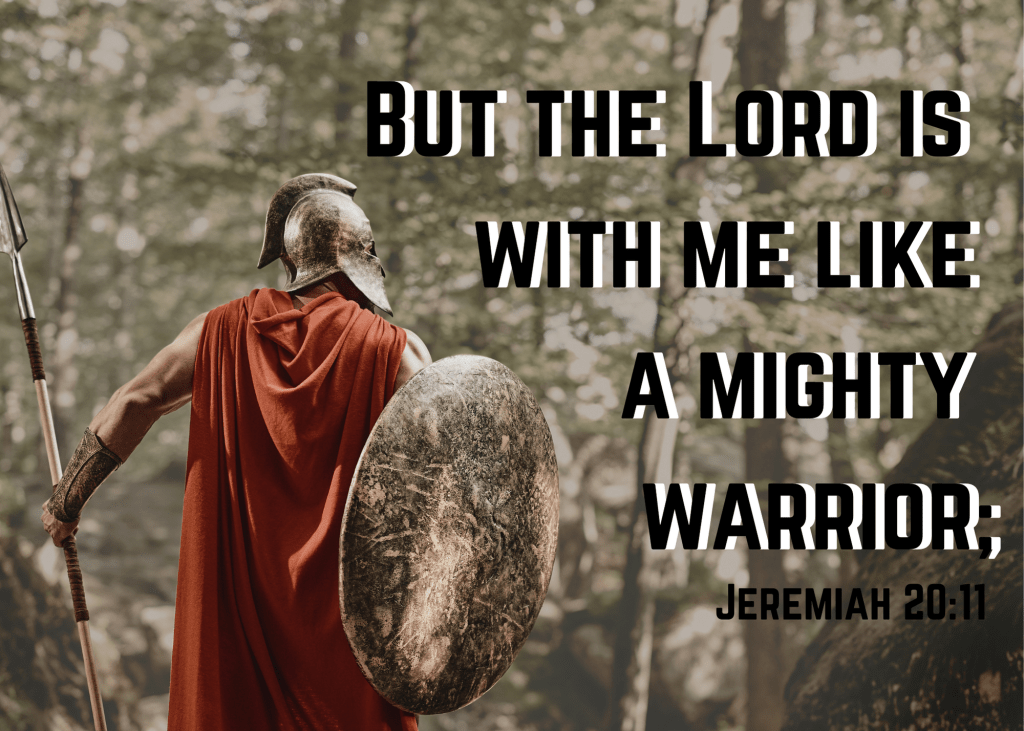
11 But the Lord is with me like a mighty warrior…”

Jeremiah 20:7b-11a NIV

But the Lord is with me like a mighty warrior! He was tired of the ridicule and insults (and physical pain) he received from speaking for God. It seemed so easy and tempting to walk away from it all or just start saying nice things the people wanted to hear. But, he couldn’t. God’s truth was bubbling up inside him and he couldn’t and wouldn’t hold it in. So, regardless of what people would think of him or do to him, he would speak for God, even when it wasn’t nice things to say. And he would have the confidence that God was with him like a mighty warrior!

I pray we may have that same courage, that same convicting knowledge of the sin in and around us that can’t be ignored, that clear vision of God’s mercy and judgment, that same willingness and unstoppable desire to speak God’s words that can’t be held back, and that same confidence that we have a mighty warrior God standing by our side.

Speak His Words,

Marcia Railton

Today’s Bible reading passages can be read or listened to at BibleGateway.com here – Jeremiah 19-20 and Hebrews 1

Good Grief before God

Lamentations 1:1 – 3:36

Lamentations 3 32 NIV sgl

The word lamentation is defined as “the passionate expression of grief or sorrow; weeping.”  The book of Lamentations is appropriately named.  Jeremiah has witnessed profound calamity, and is overwhelmed with grief, which he is pouring out to God in the book of Lamentations.


Jeremiah is called “the weeping prophet” for good reason. Here are a few examples of verses that portray his grief…

1:16, “This is why I weep and my eyes overflow with tears.  No one is near to comfort me, no one to restore my spirit.”

2:11, “My eyes fail from weeping, I am in torment within, my heart is poured out on the ground because my people are destroyed.

3:19-20, “I remember my affliction and my wandering, the bitterness and the gall.  I well remember them, and my soul is downcast within me.


Jeremiah is honest with his feelings, telling God how he feels – and he doesn’t mince words.

(I might mention here that I think this is an important part of the grieving process, not just for Jeremiah, but for us too.)


But even in the middle of his grieving, Jeremiah looked to God for comfort, too.  We see this in Lamentations 3:22-32…

22 Because of the Lord’s great love we are not consumed, for his compassions never fail.

23 They are new every morning; great is your faithfulness.

24 I say to myself, “The Lord is my portion; therefore I will wait for him.”

25 The Lord is good to those whose hope is in him, to the one who seeks him;

26 it is good to wait quietly for the salvation of the Lord.

31 For no one is cast off by the Lord forever.

32 Though he brings grief, he will show compassion, so great is his unfailing love.


I think Jeremiah gives us a good example to use when working through mourning and grief.  Honestly tell God how you’re feeling.  He already knows, so it’s not for His benefit.  Verbalizing our grief,  as well as literally crying out to God, actually helps us process our grief, and can help us work through it.


But even when overwhelmed with grief, it is also important to remember that God is compassionate and loving.  He will see us through.  Sometimes, it may feel like it’s hard to get through each new day, but the truth remains…


“Though He brings grief, He will show compassion, so great is His unfailing love.”


Despite this truth, we need to remember that the ultimate comfort will be in God’s kingdom, as we’re told in Revelation 21:3-4, “And I heard a loud voice from the throne saying, ‘Look! God’s dwelling place is now among the people, and he will dwell with them. They will be his people, and God himself will be with them and be their God.’  He will wipe every tear from their eyes. There will be no more death or mourning or crying or pain, for the old order of things has passed away.”


–Steve Mattison
Today’s Bible passage can be read or listened to here – Lamentations 1:1-3:36
Tomorrow we will read the rest of Lamentations – 3:37-5:22 – as we continue on our 2020 Chronological Bible Reading Plan


Deceived by Pride

Jeremiah 49-50

Jeremiah 49 16 NIV sgl

More sin, more judgment, more destruction, and a little more restoration – just like yesterday – only the names have been changed.  Yesterday we read about the judgment God was planning against Egypt, the Philistines, and Moab.  Today, we read what was in store for Ammon, Edom, Damascus, Kedar and Hazor, Elam and the big one – Babylon.  God saw their sins and would be bringing judgment and destruction to their lands.

There is one sin that is mentioned again and again.

“Why do you boast of your valleys, boast of your valleys so fruitful? O unfaithful daughter, you trust in your riches and say, ‘Who will attack me?'” (Jeremiah 49:4  NIV).

“The terror you inspire and the pride of your heart have deceived you” (Jeremiah 49:16 NIV).

“See, I am against you, O arrogant one” (Jeremiah 50:31 NIV).

It may come by many names – boasting, pride, arrogance – but every time it is a sin worthy of judgment.

How could the pride of your heart be deceiving you?

A few weeks ago I was preparing a devotion for posting and I was looking for a background photograph for a verse referring to Hezekiah’s pride (2 Chronicles 32:25).  I didn’t know exactly what I was looking for – but figured I would know it when I saw it.  So I typed in that I wanted to see photos of pride and I started scrolling.  and scrolling.  and scrolling.  You of course are smarter than I and know what I ran across – over and over again.  I am pretty sure there were thousands upon thousands of options for gay pride – rainbows, couples, signs, and more rainbows, a lot of rainbows (when did they get to hijack the symbol of God’s promises?).  There was also the occasional national flag or beaming, proud parent pictured with her perfect child.  But, there was NOTHING there to indicate that pride is a sin, a deadly sin worthy of judgment.  Finally, I opted for the proud peacock as my photo background and shook my head at dismay over what we have become – a culture that celebrates and basks in pride.  Are we any different from the countries of Jeremiah’s day?  Arrogant, boastful, flaunting sin and deceived by pride.  Can we expect anything less than what Jeremiah foretold for these sinful nations?

What about on a personal level?  It can be overwhelmingly depressing to think about trying to fix all the evils of a nation – but what can I work at fixing about myself?  Where do I let pride puff me up so I no longer care for others or about what God says?  How is my use of social media contributing to the spiraling problem of pride?  How is pride connected to so many other sins?

It is time to see our pride and sin for what it is – and treat it as the deadly gangrene it is.  Don’t be led astray and deceived by pride.  Jump down from your high horse and humble yourself.  You aren’t as much as you think you are.  For God has promised judgment for the proud and arrogant.  He has also promised restoration and forgiveness for those who humble themselves  – “If  my people, who are called by my name, will humble themselves and pray and seek my face and turn from their wicked ways, then I will hear from heaven, and I will forgive their sin and will heal their land.” (2 Chronicles 7:14 NIV)

Marcia Railton


Today’s Bible reading can be read or listened to here – Jeremiah 49-50

Tomorrow we will finish the book of Jeremiah with chapters 51-52 as we continue searching God’s Word in our 2020 Chronological Bible Reading Plan

Discipline with Justice – then Restoration

Jeremiah 46-48

Jeremiah 46 28c NLT sgl

Today we remember that God is not just the God of the Jews – but the God of the world – all the nations.  And as God has watched the sins of these nations – so will He exact discipline on these nations.  Jeremiah writes what God tells him to write regarding the coming destruction that God will oversee and orchestrate against Israel’s neighbors.

Jeremiah uses vivid imagery to describe these events:

“The sword will devour till it is satisfied, till it has quenched its thirst with blood.”  (Jeremiah 46:10 NIV)

“Moab is disgraced for she is shattered.” (Jeremiah 48:20 NIV)

His descriptions show not only how scary and total the destruction will be – but also what a sad state of affairs these societies had become.  The most powerful passage that got my attention was in the message against the Philistines, “Terrified fathers run madly, without a backward glance at their helpless children.” (Jeremiah 47:3b NLT).  Where have the strong, brave protectors and defenders of their families gone?

We would do well to pay special attention to the passages that point to the reasons for this judgment.  All of these neighbors are being punished for their mistreatment of God’s chosen people, as well as for their own sins. “Since you trust in your deeds and riches, you too will be taken captive…We have heard of Moab’s pride – her overweening pride and conceit, her pride and arrogance and the haughtiness of her heart…In Moab I will put an end to those who make offerings on the high places and burn incense to their gods…Moab will be destroyed as a nation because she defied the LORD” (Jeremiah 48:7, 29, 35, 42 NIV).   How many similarities do you have to Moab – just one of the countries that would feel the burn of God’s discipline?  How do you treat God and His people?  Is your pride in check?  Where do you put your trust – in your job, your finances, your teachers, your doctors, yourself – or in God?  Do you offer your best and first time, talents and resources to God or to selfish pursuits and false gods?

After 46 verses of judgment against Moab, the final verse of chapter 48 says, “Yet, I will restore the fortunes of Moab in days to come.”   Hope and restoration is coming – at least for those judged worthy.  Amongst the condemnation of these chapters, Jeremiah includes a beautiful word from God for Israel as well,

But do not be afraid, Jacob, my servant;
    do not be dismayed, Israel.
For I will bring you home again from distant lands,
    and your children will return from their exile.
Israel[f] will return to a life of peace and quiet,
    and no one will terrorize them.
28 Do not be afraid, Jacob, my servant,
    for I am with you,” says the Lord.
“I will completely destroy the nations to which I have exiled you,
    but I will not completely destroy you.
I will discipline you, but with justice;
    I cannot let you go unpunished.” (Jeremiah 46: 27-28 NLT)

God sees and will not let the guilty go unpunished.  But His deepest desire is to find and reward faithfulness in His children so He can live with them in peace.  God still judges in His love today – as a wise and caring parent.  There will yet be a time of unequaled punishment for those who appeared to get away with evil with a proud heart, relying on themselves and turning their backs on God.  This is discipline with justice.  And, then, there will be restoration and peace.  Come Lord Jesus Come – may He find us faithful.

Marcia Railton


Today’s Bible reading can be read or listened to at Jeremiah 46-48.

Tomorrow’s reading will be Jeremiah 49-50 as we continue on our 2020 Chronological Bible Reading Plan

Why are You Destroying Yourself?

Jeremiah 41-45

Jeremiah 44_71 NLT sgl

Life is often not what we expect.  The last few days we have read about the Jews who went into exile to Babylon under King Nebuchadnezzar.  This was punishment from God for turning their backs on Him and following after their own selfish interests – false gods.  No doubt it would be very difficult to be uprooted from your homeland and all you have ever known to be taken to a foreign land – with a strange new language, foods, neighbors, rulers, homes and customs.  It would be easy to think that the ones left behind to stay in Judah were the lucky ones.  But, that would depend on how they acted.  After having just witnessed their brothers’ and sisters’ tragic deportation, you would have thought they may have learned their lesson and stuck a bit closer to God’s guidelines.  But….then you would read today’s Bible reading (Jeremiah 41-45) and find out mankind doesn’t always do the wise thing.

When Babylon invaded Jerusalem the foreign commanding officer released Jeremiah from prison and gave him the option of going to Babylon and being well cared for in a foreign land, or staying with those left behind.  He (or God) chose for him to stay behind – perhaps knowing how much the people still needed a word from the Lord – if they would listen.  Before the Babylonians left town with their captives they set up Gedaliah as governor of the land.  But just 3 months later he is assassinated by Ishmael who also kills several Babylonian soldiers, some Judeans who were loyal to Gedaliah, as well as 70 travelers who had come to worship at the burned down temple.  Next, Ishmael kidnaps the king’s daughters and others that had been under Gedaliah’s care.  Violence, treachery and strife are still rampant in the land.

It seems like a bright new start when Johanan saves the day and Ishmael runs away and the people ask Jeremiah to ask God what they should do.  The people want to head to Egypt as they are scared Babylon will hear that the governor they left was killed and come to punish the whole tribe.  But they sound so brave and upright when they say, “May the Lord be a true and faithful witness against us if we do not act in accordance with everything the Lord your God sends you to tell us.  Whether it is favorable or unfavorable, we will obey the Lord our God, to whom we are sending you, so that it will go well with us, for we will obey the Lord our God.” (Jeremiah 42:5,6).   

Ten days later, Jeremiah tells them God says stay and He will protect you.  It should have been good news, and not too hard to follow.  But, suddenly their eloquent words mean nothing.  Because they were really hoping and thinking God would say to go.  That’s what they wanted to do – so that’s what they would do – regardless of a good speech about following God.  Suddenly, it was more convenient to call Jeremiah the liar and continue packing their bags in defiance of all God said, thus shattering the promise they had just made.

Jeremiah tells them that war, strife, famine, persecution and death will follow them to Egypt.  There is not a safe place to go to disobey God.  But off they go.  Totally disregarding God, they turned again to their false gods that would give them the answers they wanted to hear and let them go where they wanted to go and let them do what they wanted to do.

They thought they had won.  But they were actually destroying themselves (Jeremiah 44:7a NLT).  Just as Jeremiah foretold, Egypt was not a safe place.

It still happens today.  People who commit to follow God anywhere – until they decide they would rather make the rules and the map.  And, if you listen carefully to God and His Word, you can still hear Him say, “Why are you destroying yourselves?”.    Examine yourself and see if there are any ways you are breaking your commitment to God, and thus destroying yourself.  He has offered protection and hope for those who rely on Him and follow Him with their whole life.


Marcia Railton


Today’s Bible reading passage can be read or listened to at Jeremiah 41-45.

Tomorrow’s reading will be Jeremiah 46-48 as we continue on our 2020 Chronological Bible Reading Plan

Not Enough

Jeremiah 38-40 and Psalm 74 & 79

Jeremiah 38 18 NIV sgl

I believe today’s Bible reading ranks high among the most depressing passages of Scripture.   From the burning of Jeremiah’s scroll by King Jehoiakim which we read about yesterday to the major blows against Judah we read about today another 17 years has passed.  Jeremiah is still preaching, warning, and speaking truth for God, but very few seem to be interested.  In all, Jeremiah will have preached 39 years, his ministry reaching across the reigns of 5 kings of Judah, only one of whom truly listened to Jeremiah and had a heart for God.  If more had responded the way Josiah had, the disastrous events of today’s reading would have been avoided.  But instead, Judah’s final king, Zedekiah (chosen by Nebuchadnezzar), is a weak king who lacks the courage to do things God’s way.

Unlike Jehoiakim who scorned God’s word and His prophet, Zedekiah seems to know about God and His power.  He asks Jeremiah to pray for them and he secretly asks Jeremiah what he should do.  BUT – he doesn’t do it.  And, when feeling pressure from Jeremiah’s enemies, he even gives his permission for them to mistreat him and abandon him to die in a deep, muddy pit.  Thankfully, Ebed-Melek was there to petition the king to allow them to rescue Jeremiah.  Even at Judah’s final hour, with Babylon at the city walls, God, through Jeremiah, gave Zedekiah an opportunity to save his life and his city.  He could surrender to Babylon and peacefully accept the “time-out” Judah deserved for her waywardness.  But, instead he runs from God’s plan into a tragic, tragic end for himself, his family, his advisors, his city and his country.  Do you think he regretted his decision as he was watching his sons be put to death, or as his eyes were gouged out?

Suddenly, surrendering to God’s plan doesn’t seem so hard, difficult or painful after all -considering the consequences of the alternatives.  Is there an area where you are feeling too weak, too prideful, too insignificant, too scared to follow God’s plan?  Remember, there are often painful consequences of running from God’s plan.  It’s not enough to know of God and his power and truth.  It’s not enough to ask for prayer and guidance.  You must step up and do what God wants you to do.

Marcia Railton


Today’s Bible reading can be read or listened to at Jeremiah 38-40 and 

Psalm 74 & 79

Tomorrow’s reading will be 2 Kings 24 & 25 and 2 Chronicles 36 as we continue on our 2020 Chronological Bible Reading Plan

Our Hope in the Wilderness

choose joy

This week, we’ve been taking some time to rest and reflect on what it means to wander through the wilderness. Through the complex stories of the Israelites, Elijah, David, and Jesus, we see both the types of wildernesses that we may face in this life as well as the ways that we can ultimately overcome the wilderness and make it out of those difficult seasons.

As we’ve discussed this past week, these are the four Wilderness Wandering Lessons that we learned from these stories:

  1. The faithful love of God is infinitely more secure than our fractured circumstances.
  2. Remembering past victories can help to steady our heart in the midst of our current despair.
  3. When the desires of our heart lead us away from God, true repentance leads us back.
  4. God’s word sustains us when we are depleted by the trials of the wilderness.

If you find yourself in a time of wilderness wandering, don’t despair. Many have been there before you and have made it out and used that time as a witness for God’s deliverance. Remember, one of Satan’s ultimate goals, as I mentioned earlier this week, is to steal your joy. One of the primary fruits of the Spirit is joy, and that joy should be evident in your life. The Israelites and Judeans knew what it was like to lose their joy when they were exiled from Israel at the end of 2 Kings. But, as we read in Jeremiah 31:2-3, 11-13, God promised that Joy to the Israelites and Judeans and he promises that Joy to you too.

“This is what the Lord says: They found favor in the wilderness – the people who survived the sword. When Israel went to find rest, the Lord appeared to him from far away. I have loved you with an everlasting love; therefore, I have continued to extend faithful love to you… For the Lord has ransomed Jacob and redeemed him from the power of one stronger than he. They will come and shout for joy on the heights of Zion; they will be radiant with joy because of the Lord’s goodness. I will turn their mourning into joy, give them consolation, and bring happiness out of grief.”

By living our life in Christ, our joy is made complete (John 15:11). When you find the hurt, isolation, or pain of life weighing down on you, pause and remember that we can overcome through Christ. Trade your grief for happiness, your mourning for joy. We can celebrate. We can overcome. Because the joy of our Lord is our strength.

~ Cayce Fletcher

***Click on the following link to listen to one of my favorite songs by Rend Collective called the “Joy of the Lord is my strength.” Learning this song can be a reminder to you to choose joy. https://www.youtube.com/watch?v=c2B6Yw0zy70

Even in the Midst of the Heartbreak

Lamentations 4-5

lamentations5_21

Saturday, March 18

Jeremiah is recounting a lot of the rough times that Judah had faced. At the end of this desperate passage (in chapter 5), Jeremiah asks God to restore the people of Judah. I love, though, that even in the midst of the heartbreak, he doesn’t forget to praise and adore God:
 
19 But Lord, you remain the same forever!
    Your throne continues from generation to generation.

Then Jeremiah is raw and honest with God again about his frustration:
20 Why do you continue to forget us?

    Why have you abandoned us for so long?
But he is still hopeful and believing in God and his promises:

21 Restore us, O Lord, and bring us back to you again!    Give us back the joys we once had!
Jeremiah included praise and petition in an honest prayer to God. I know that sometimes I feel silly being “honest” with God, letting Him know what I am really thinking… but he is GOD, and He already knows all my thoughts and feelings! We can with confidence humbly pray to our Lord and offer our requests and concerns, making sure to give thanks and praise to Him. There are a lot of good books to read on prayer. (My most recent favorite is “Fervent” by Priscilla Shirer.) I encourage you to read up… and of course, pray up! That is my personal challenge for myself and for you! Will you join me?! Here are a few verses on which to meditate as you focus on seeking God today:
Hebrews 4:16 Let us then approach God’s throne of grace with confidence, so that we may receive mercy and find grace to help us in our time of need.
Philippians 4:6-7 Don’t worry about anything; instead, pray about everything. Tell God what you need, and thank him for all he has done. Then you will experience God’s peace, which exceeds anything we can understand. His peace will guard your hearts and minds as you live in Christ Jesus.
-Rachel Cain
(Photo Credit: http://www.verseoftheday.com/en/09212015/)