
Mark 11 & John 12
Perhaps the saddest words in English literature are found in the poem, “Maud Muller,” by John Greenlear Whittier. The poem recounts the story of a farm maid, Maud Muller, who is raking hay in a meadow. A town judge on horseback passes by, and they exchange pleasant greetings. He asks for a drink of water from the bubbling spring, and she fills her cup and offers it to him.
After the encounter, as the years go by, she considers what life might have been like as the wife of a judge, possessing wealth and servants. He, in turn, considers what life might have been like without the stress of his position, but instead married to the maiden, enjoying a simple rural life.
Near the poem’s end, Whittier penned these lines.
“For all sad words of tongues and pen, the saddest are these: ‘It might have been.’”
All of us, whether young or old, can look back at our lives and have regrets. Words we might have said, places we might have gone, decisions we might have made.
In our Bible reading today, we find a deeply sad and somber passage contained in one short phrase.
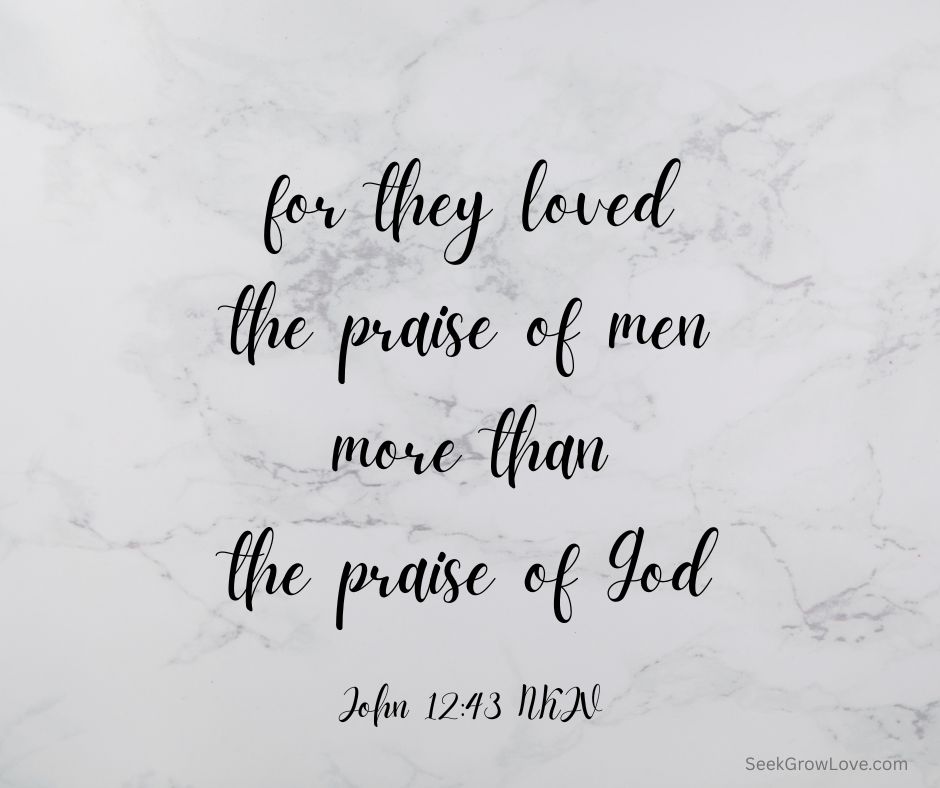
“For they loved the approval of men rather than the approval of God.” John 12:43
It was the week of the Feast of the Passover, and Jesus’ ultimate betrayal and crucifixion. A great multitude had greeted Jesus with “Hosanna” and palm branches when he entered Jerusalem. After the joyous welcome, Jesus had once again explained the coming events of his life to the large crowd gathered around him.
“And Jesus answered them, saying, ‘The hour has come for the Son of Man to be glorified. Truly, truly, I say to you, unless a grain of wheat falls into the earth and dies, it remains alone; but if it dies, it bears much fruit. He who loves his life loses it, and he who hates his life in this world will keep it to life eternal. If anyone serves Me, he must follow Me; and where I am, there My servant will be also; if anyone serves Me, the Father will honor him.Now my soul has become troubled; and what shall I say, ‘Father, save Me from this hour’? But for this purpose I came to this hour.’” (John 12:23-27)
Then Jesus continues in verses 32-33, “‘And I, if I am lifted up from the earth, will draw all men to Myself.’ But He was saying this to indicate the kind of death by which He was to die.”
The crowd questions Jesus in verse 34. “We have heard out of the Law that the Christ is to remain forever; and how can You say, ‘The Son of Man must be lifted up’? Who is this Son of Man?” Amazingly, they ask ‘Who is the Son of Man’ as Jesus stands before them!
Jesus responds by saying that he—the light—will only be with them a short while longer. The people need to believe in the light—believe in him—while he is still with them. (vs. 35-36) What more can he say?
Jesus performed signs and miracles before the multitude. He taught them, cared for them, and was compassionate towards them. But they did not believe, fully believe.
Isaiah’s prophecy was fulfilled. (Isaiah 6:9,10) Blinded eyes and hardened hearts don’t lead to conversion. (John 12:39, 40)
And then we come to verses 42-43, an explanation for their hardened hearts.
“Nevertheless many even of the rulers believed in Him, but because of the Pharisees they were not confessing Him, for fear that they would be put out of the synagogue.”
Remarkably, there WERE many who believed in him, even rulers. They understood Jesus’ words, his plea: “While you have the light, believe in the light.” But they would not acknowledge him. Their positions in the synagogues were at risk. Their status was threatened. They could not take a chance, could not jeopardize their standing. It was not to be.
“For they loved the approval of men rather than the approval of God.”
Each morning when you wake up, whose approval are you seeking? As you go throughout your day, making small and big decisions, whose blessing do you pursue? At the end of your day, what or who carried you through?
Let us resolve together that each of our waking hours, each of our thoughts or actions, be grounded in the approval of God.
“Let us hold unswervingly to the hope we profess, for he who promised is faithful.” (Hebrews 10:23)
Reflection Questions
- What does it mean to you to seek the approval of God?
- How do you seek the approval of God in your life?

 Seek Grow Love