David’s Costly Mistake

2 Sam 24, 1 Chr 21

When David sinned with Bathsheba, we see him at his lowest point. He is made to confront his sin as Nathan the profit reminds him how God brought him up from being a shepherd boy to king over all of Israel. God humbled him and cut through his swollen pride to remind him of his true heart. 

We would think after such a time as that David would be ‘home free.’ The story was played out, exposition, conflict, resolution, and all. David would be able to live righteously the rest of his life, ‘happily ever after.’ 

But we know that life isn’t like a fairy tale. As we talked about earlier this week, we all experience highs and lows. We have many story arcs throughout the years. And, David did too. 

We don’t know how many years have passed since David and Bathesheba’s sin and the events we read about today. But, today we read about another step off the good and righteous path that David took. This blunder resulted in more than the death of one man and one child. It resulted in the death of 70,000 people. 

In 1 Chr. 21, it says, “Then Satan stood against Israel and incited David to number Israel. So David said to Joab and the commanders of the army, “Go, number Israel, from Beersheba to Dan, and bring me a report, that I may know their number.” 

David’s request seems pretty innocuous. Censuses happened throughout scripture, but generally, they occurred when God commanded them. (The first part of that passage is a whole different theological question… that we are not going to talk about today.) In this case, the people weren’t being numbered because it pleased God. They were being numbered so that David could be puffed up in pride over the strength of the army he had gathered. Even Joab, not a very righteous man, told David he was crazy for wanting to do this. 

David’s guilt left him with a choice: How was he going to atone for his sins? The price of his sin turned out to be a disease against Israel, because of which 70,000 people died. 

Finally, David fell to the ground and pleaded for God to stop for the sake of his ‘sheep’, the people of Israel. David bought an altar that would become the future site of the temple of God. 

From today’s reading, we see: 

  • We should never think that we are ‘too righteous’ to never sin. No matter how long you walk with God, you have the potential to be tempted away from the right path. This does not mean that we live in fear. It means that we need to recognize the importance of relying on God. 
  • Our sins affect our community. When David did this thing, he chose to sin himself. But, his sins affected an entire nation. 70,000 people is more people than the US casualties in the Vietnam war… and every major US conflict since. We think we are doing things in isolation but they have far-reaching consequences for the people around us. 
  • God can use painful things for good. The altar that David sacrificed to end the plague ended up being the future site of the temple. Even evil situations can be redeemed by God and used for good – if we humble ourselves, repent, and ask God to enter into the situation. 

How are you living today?

-Cayce Fletcher

Cayce blogs at https://amorebeautifullifecollective.com about faith, family, and life. You’ll find encouragement for how to build intentional lives rooted in faith and beauty. Check out the latest post on the human nature of Jesus here. 

Reflection Questions

  1. Have you ever felt ‘too big to fail?’ What are some ways that we can cultivate humility in our lives? 
  2. How does sin have far-reaching consequences? How have you seen others affected by sin that seemed like something done in secret and isolation? 
  3. How can God use broken situations for good? Is there a broken situation in your life that you need to invite God into today?
SGL.2025.MayFullPageDownload

Worthy of Worship

Ps 95, 97-99

Music has always been a huge part of my life. From singing along to Veggie Tales songs in the car to being dressed up in my Sunday Best doing a ‘special’ on Sunday Mornings, from an early age I was taught the importance and beauty of song sung in worship. 

I still like to sing and dance to ‘I Like Bananas’ around a campfire, but my understanding of worship has expanded and grown. Just singing doesn’t mean that we are worshipping God, and sometimes the most worshipful moments are done in silence. We all know the days where we are going through the motions in a Church service, singing familiar words without it ever truly reaching our hearts. 

What should a heart of worship look like?

In today’s reading, we see Psalm after Psalm of praise and worship. Importantly, the Psalms show the heart behind worshipping God. 

A heart of worship is: 

  • Based on the character of God, not the quality of our voices. We don’t sing praises because we ‘sound good.’ We sing praises because God is the ultimate thing that is worthy of praise. We sing because he has truly done ‘marvelous things.’
  • Grounded in the truth of scripture, not the beat of the song. The Psalms repeat the truth again and again: “The Lord reigns.” Why? Because the transformative power of worship is focused on repeating the truths of scripture to ourselves. We can praise God and weather difficult circumstances because God reigns. 
  • Focused on remembrance, not emotions. Our summer camps were always a highlight of the year because we loved the worship. But the truly quality of worship isn’t based on the quality of the band. It’s based on the way we remind ourselves of the goodness and faithfulness of God and praise him for it. 

Today, let’s cultivate a heart of worship.

-Cayce Fletcher

Cayce blogs at https://amorebeautifullifecollective.com about faith, family, and life. You’ll find encouragement for how to build intentional lives rooted in faith and beauty. Check out the latest post on the human nature of Jesus here. 

Reflection Questions

  1. How do you cultivate worship in your life? 
  2. What should characterize a ‘heart of worship’?
  3. Create a list of attributes about God that you can use while you worship. 

SGL.2025.MayFullPageDownload

The Rollercoaster Ride of Life

2 Sam 22-23, Ps 57

One of my son’s favorite places to go is Dollywood Theme Park in Tennessee. He loves the decorations, the shows, and the food, but his favorite thing to do is ride the rollercoasters. I’ve never been a huge fan – I’m deathly afraid of heights and don’t like the feeling of being slung around. But, you can tell the joy (and a little fear) on his face as he clicks up to the first big drop and then races down through the twists and turns. Of course, at the very end, he always turns to me and says, “Can we ride it again?” 

David’s life was definitely a roller coaster ride. He was sent to watch sheep by his father while Samuel came to pick the king, only to be called from the fields and anointed. He was elevated to be a part of King Saul’s court, only to be forced to flee for his life at night. He spent 15 years running from Saul, only to finally be crowned king. And this isn’t to mention Bathsheba, Abasolom, and the census. 

So many highs and so many lows. 

But, through it all David remained faithful. 

We can see the contrast between the highs and lows as we read Psalm 57 and David’s song in 2 Samuel 22.

In Psalm 57:4, David cries out, “My soul is in the midst of lions; I lie down amid fiery beasts— the children of man, whose teeth are spears and arrows, whose tongues are sharp swords.” But still, he praises God. 

In 2 Samuel 22:17-20, he exclaims, “[God] sent from on high, he took me; he drew me out of many waters. He rescued me from my strong enemy, from those who hated me, for they were too mighty for me. They confronted me in the day of my calamity, but the Lord was my support. He brought me out into a broad place; he rescued me, because he delighted in me.”

In both the highs and lows, David cried out to God. He praises God. He finds refuge in God. 

You may be stuck on the roller coaster now. You may be in the lowest of lows, or you may be high on that mountaintop. But, wherever you are, remember God is there with you. 

Wait on the Lord. Put your trust in God. He is faithful. He will walk you through it. 

-Cayce Fletcher

Cayce blogs at https://amorebeautifullifecollective.com about faith, family, and life. You’ll find encouragement for how to build intentional lives rooted in faith and beauty. Check out the latest post on the human nature of Jesus here. 

Reflection Questions

  1. Have you experienced a low time in your life? Where did you turn for comfort and support at this time? How did you see God’s faithfulness in this time? 
  2. How does remembering God’s past faithfulness help you to navigate your present circumstances? 
  3. What are some ways that you can incorporate more worship into your life? 

SGL.2025.MayFullPageDownload

A Man After God’s Own Heart

Ps 5, 38, 41-42

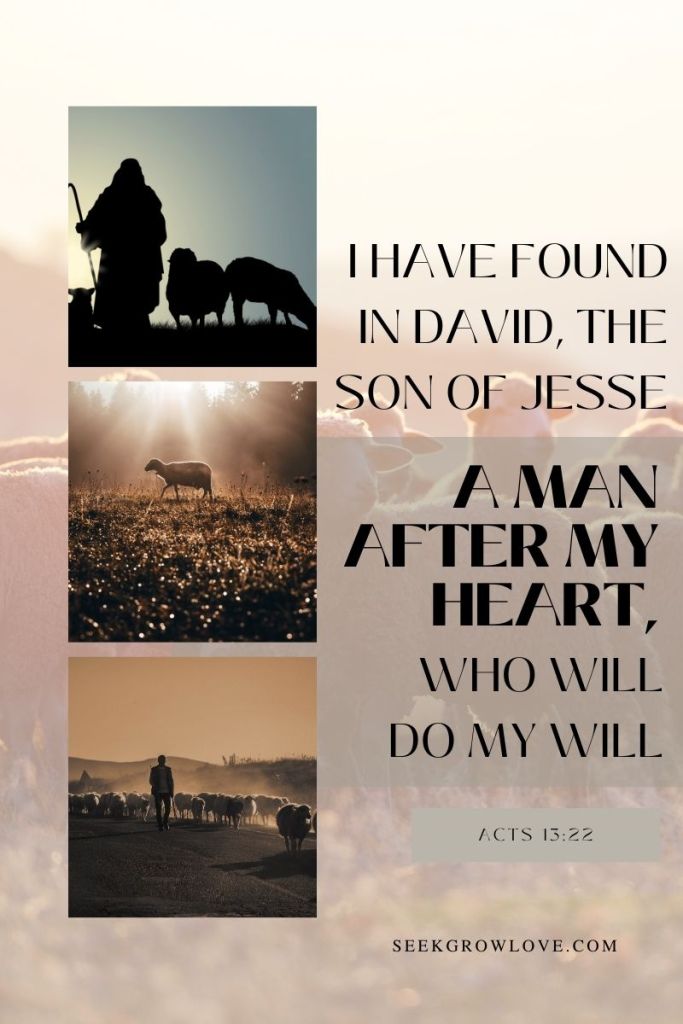
One Sabbath day, Paul came to a synagogue in Antioch (a city in modern-day Turkey) and sat down to listen to the law and scriptures. After the reading was down, Paul got up and gave a sermon. Nestled in the middle of his speech is this interesting passage, “After [God] had removed [Saul], [God] raised up David to be their king, of whom he testified and said, ‘I have found in David the son of Jesse a man after my heart, who will do all my will.” (Acts 13:22)

How amazing it would be to be known as a man (or woman) after God’s own heart! Of all the epitaphs that we could put on our tombstones, this would be the highest praise. 

But, we know that there is more to David’s life than just this statement. In fact, it seems a little incongruous to describe the man who sent Uriah to die because of his sin and who sent an Angel of the Lord on his people because of his decision to do a census as a man after God’s own heart. 

I think the Psalms we read today – the cries written from David’s own heart – show how he reflected the heart of God. 

In the Psalms, we see that: 

  • David understood that God loves righteousness and hates evil. David repeats the truth to himself that God does not delight in wickedness. When he comes to God in prayer, he describes his wickedness as wounds that stink and fester. This bleak picture demonstrates his view of sin: it is evil and something from which you should flee.
  • David understood the importance of confession. David’s harsh view of sin did not mean that he was blameless. We know that he slipped and fell multiple times and had to deal with the consequences of his actions. Still, when David veered from the good and right path, he recognized it and he turned back toward God. He didn’t minimize sin, and once he humbled himself, he didn’t stay in his sin. Instead, he confessed and repented. 
  • David longed for God. He longed for God’s temple, God’s favor, and God’s very presence. He longed for it as deer pants for streams of water. He describes his soul as thirsting for God. And we know that God is the author and sustainer of life. As the very best thing, he is the ultimate thing we should long for. 

To be a man after God’s own heart didn’t mean that David had to be perfectly sinless. No human is able to do that in this lifetime. Instead, being a man after God’s heart means that we are trying to make our heart – our priorities, desires, and understandings – match the heart of God. 

If we want to be people after God’s own heart, we should: 

  • Love righteousness, and hate evil 
  • Repent from our sins in humility
  • Place God as our utmost desire

How would you describe your heart today? 

-Cayce Fletcher

Cayce blogs at https://amorebeautifullifecollective.com about faith, family, and life. You’ll find encouragement for how to build intentional lives rooted in faith and beauty. Check out the latest post on the human nature of Jesus here

Reflection Questions

  1. David was anointed king after the downfall of Saul. How would you describe the difference between the heart of Saul and the heart of David? 
  2. What is your view of sin? How do you show your view of sin in your actions or your willingness to confess and seek repentance? 
  3. What does it mean to long for God ‘as a deer pants for streams of water’? Do you long for God in this way? How could you deepen your desire for God? 

SGL.2025.MayFullPageDownload

Living Wisely in a Wounded World

2 Sam 19-21

The Kingdom of Israel is in the midst of a terrible civil war. Brother had turned against brother and sons against their fathers. The battle was over. Absalom, the rebellious son, had been killed. 

At first glance, it seems like David should be rejoicing. He was king again over Israel. Instead, he was caught up in his grief.

 Joab told him in 2 Samuel 19:5-7, “You have today covered with shame the faces of all your servants, who have this day saved your life and the lives of your sons and your daughters and the lives of your wives and your concubines, because you love those who hate you and hate those who love you. For you have made it clear today that commanders and servants are nothing to you, for today I know that if Absalom were alive and all of us were dead today, then you would be pleased. Now therefore arise, go out and speak kindly to your servants, for I swear by the Lord, if you do not go, not a man will stay with you this night, and this will be worse for you than all the evil that has come upon you from your youth until now.”

Then, David picked himself up out of the sackcloth and ashes and made his way back to Jerusalem to take back the throne. 

This passage strikes me in the way that David has to navigate the circumstances that appear. People grovel at his feet while double-crossing their masters. Political turmoil and intrigue roil underneath the surface as another revolt occurs. A famine stretches the land to its breaking point, and difficult decisions have to be made. 

David has to live wisely to save not only himself but also the entire nation from more war, brokenness, and suffering. 

And through it all, we see this: our choices carry weight.

What does wise living look like? 

  1. Wise Living means stepping out of our circumstances to fulfill our God-given role. Grieving is a necessary part of life. It has its place as we mourn those we love. But, we cannot stay in a place of grief forever. We have to move on and step into our calling. 
  2. Wise Living means pursuing reconciliation without compromising truth. As David worked to restore peace in Jerusalem, he had to act as judge over the people who supported him and revolted under him. Through it all, David was not led by vengeance. 
  3. Wise Living means recognizing the long-term consequences of sin. In a heartbreaking scene, we see how to pay the blood guilt of Saul a mother who had to lose her sons. Our sin can cause brokenness in our lives, our families’ lives, and the lives of future generations. 

Wise Living is a radical decision in this world, but ultimately, it leads to righteousness. How are you pursuing wisdom in this broken world today? 

-Cayce Fletcher

Cayce blogs at https://amorebeautifullifecollective.com about faith, family, and life. You’ll find encouragement for how to build intentional lives rooted in faith and beauty. Check out the latest post on the human nature of Jesus here. 

Reflection Questions

  1. What decisions am I making today that will shape the next season of my life or family?
  2. Where is God calling me to seek reconciliation, even when it’s complicated
  3. How might I carry my grief with both honesty and courage?

SGL.2025.MayFullPageDownload

Our Hope in Every Season

Blessed is the man who makes the Lord his trust

Ps 26, 40, 58, 61-62, 64

Mother Teresa spoke of ‘the dark night of the soul.’ You would think that someone who served in such a ministry would be a titan of faith, impervious to doubt. But still, she wrestled with God. 

And, who could blame her? I’m sure that the stresses of her ministry continually bashed against the rock of her faith. 

All of our circumstances have a way of doing that. They are the waves of doubt, of shame, of sin, and of fear. They hit us throughout life in the jeers of our friends in middle school to the first heartbreak that comes with young love to the frustration of parenthood to the inevitable pain that comes with the final breaths our loved ones take.

James says that someone who doubts is like a wave blown and tossed by the wind. The antidote to that doubt is faith. But, what can be said of us then? For who can say that they haven’t wrestled with God? 

As we turn through the pages of scripture, we find that we are in good company. Abraham, Moses, and of course, Jacob wrestled with God in their own way. And, we see David struggling through the pain of his circumstances in the Psalms we read today. 

David cries out to God. He begs him to turn and listen. For someone who had slept on the floors of caves and pretended to be a madman in an enemy’s court, these words are more than just cliché. 

David always goes back to the same statement, ‘In God alone I trust. I will wait patiently for the Lord.’ 

How powerful that statement is. And, oh how hard it is. 

In the seasons of my life, I have prayed. When I woke up, when I lay my head down, and all the footsteps in between were filled with the same cry. And yet, my prayers were unanswered. What could I do? 

In those times – even now – I could make a choice to turn my face from God. But, the question “Oh Lord, who could I turn to? Where could I go from your presence? Who have I but you?” rings out. 

David understood this truth. God is our strong refuge in both the good times and bad. In health and sickness. Riches and poverty. Joy and sorrow. We turn to him in every season, and we wait patiently for him to act. 

And when we do, we understand the truth of Psalm 40:4-8: 

“4 Blessed is the man who makes

    the Lord his trust,

who does not turn to the proud,

    to those who go astray after a lie!

5 You have multiplied, O Lord my God,

    your wondrous deeds and your thoughts toward us;

    none can compare with you!

I will proclaim and tell of them,

    yet they are more than can be told.

6 In sacrifice and offering you have not delighted,

    but you have given me an open ear.

Burnt offering and sin offering

    you have not required.

7 Then I said, “Behold, I have come;

    in the scroll of the book it is written of me:

8 I delight to do your will, O my God;

    your law is within my heart.”

-Cayce Fletcher

Cayce blogs at https://amorebeautifullifecollective.com about faith, family, and life. You’ll find encouragement for how to build intentional lives rooted in faith and beauty. Check out the latest post on the human nature of Jesus here. 

Reflection Questions

  1. Have you ever experienced a season of sorrow or silence? What was the outcome?
  2. What does it mean to wait on the Lord? Try to create a sentence-long definition of what that looks like.
  3. How is the perseverance of the saints related to waiting on God? Why is perseverance an important virtue in the Christian life?

SGL.2025.MayFullPageDownload

Help!

Psalm 3-4, 12-13, 28, 55

In today’s reading, I couldn’t help but see some parallels between David and Jesus. In both of these passages, we see a crying out to God in a time of true despair or suffering.  

In Psalm 28, we read David’s heartfelt words:

1 ​​To you, Lord, I call;

    you are my Rock,

    do not turn a deaf ear to me.

For if you remain silent,

    I will be like those who go down to the pit.

Hear my cry for mercy

    as I call to you for help,

as I lift up my hands

    toward your Most Holy Place.
(NIV)

The words, “For if you remain silent” stood out to me. Up until that point, David clearly felt that God had been silent. He wanted to be reminded that God was on his side and actively fighting for him. 

In Matthew 27:46, Jesus also cried out to God in distress:

46 About three in the afternoon Jesus cried out in a loud voice, “Eli, Eli, lema sabachthani?” (which means “My God, my God, why have you forsaken me?”). NIV

To me, that sentence contains some of the most poignant words in scripture. Jesus is truly taking on the weight of the world at this moment by bearing all of humanity’s sins. The weight of it must have been crushing. It must have felt so terribly dark and cold. In this case, he alone had to pay the price and it was not the plan for God to rescue him from death; however, we know how the story ends. We know God did not forsake him in the grave. We read in Acts 2:31: 

31 Seeing what was to come, he spoke of the resurrection of the Messiah, that he was not abandoned to the realm of the dead, nor did his body see decay. (NIV)

When we are in the depths of despair or metaphorically running from danger, it can seem like God is silent and turning a deaf ear to us. However, His word assures us in Romans 8:28 that He is not turning His back to us. 

28 And we know that in all things God works for the good of those who love him, who have been called according to his purpose. (NIV)

In the latter portion of Psalm 28, we read David’s recognition that God came through for him.  

Praise be to the Lord,

    for he has heard my cry for mercy.

The Lord is my strength and my shield;

    my heart trusts in him, and he helps me.

My heart leaps for joy,

    and with my song I praise him. (NIV)

Notice the words from verse 7: “my heart trusts in him.” How do we cultivate trust in God? One of the best ways is to learn about Him through His word. His character radiates beautifully all throughout scripture. One aspect of God’s character that really spoke to me in today’s reading is His tenderness. In Psalm 28:9 we read: “Save your people! Bless Israel, your special possession. Lead them like a shepherd, and carry them in your arms forever.” (NLT)

Isaiah 40:11 gives us more insight into how He shepherds His flock: 

He tends his flock like a shepherd:

    He gathers the lambs in his arms

and carries them close to his heart;

    he gently leads those that have young. (NIV)

God carries us close to His heart. Now that’s an amazing image! Where we are might feel very cold and alone in the moment, but God is there holding us close to His heart. Unlike Jesus on the cross, we never have to bear the weight of our burdens alone. He is working things out for the good for those who love Him. It might not look like how we imagined, but it will be beautiful in the long run. Trust His timing. Trust His goodness. 

-Kristy Cisneros

Kristy is married to Pastor Andy Cisneros who pastors Guthrie Grove Church in Pelzer, SC. This May they will celebrate their 27th wedding anniversary! They are the proud parents of two awesome children: Brooke and Logan. 

(originally posted January 29, 2023 when our Bible reading plan for the year included a New Testament reading from Matthew 27 and a Psalm, 28)

Reflection Questions:

  1. Do you feel that you trust in God’s timing and goodness? If not or maybe not as much as you should, make it an intentional prayer that God will help you grow in these areas.
  2. How can you use this year’s Bible reading plan to grow further in your appreciation of God’s timing and goodness?

Enduring Faithfulness

2 Samuel 7

1 Chronicles 17

When was the last time you made a truly eternal promise? If you’re married, hopefully, you’ve made an eternal promise of love and commitment. I’m sure if you have children, you’ve vowed to love and cherish them always. Even something as seemingly simple as getting a tattoo is a promise to yourself that you’ll carry that image on your body for the rest of your life.

Today’s scripture, 2 Samuel 7, reveals the profound truth of God’s eternal promises. This passage contains the Davidic Covenant, where God promises that David’s house will rule forever. We know this promise will be fully realized when Jesus returns to establish God’s Kingdom on earth. Think about it: God has been keeping this promise for over 3,000 years! Despite Israel’s occasional disappointments and frustrations, God remains steadfast.

While our most sincere promises can falter due to betrayal, anger, misunderstanding, or irreconcilable differences, a promise from God is unwavering. That’s a reason for a true celebration! 

David’s response to this incredible promise is one of humility and awe: “How great you are, Sovereign Lord! There is no one like you, and there is no God but you, as we have heard with our own ears.” Today, may we find ways to celebrate God’s faithfulness that has endured all this time and will continue long past us.

-Hope Fletcher

Reflection Questions

  1. When have you witnessed or experienced God’s enduring faithfulness?
  2. When have you responded to God with humility and awe saying (similar): ““How great you are, Sovereign Lord! There is no one like you…”?
  3. How are you at keeping your promises? Can your word be trusted?

Lists

These are the sons of Israel: Reuben, Simeon, Levi, Judah, Issachar, Zebulun, Dan, Joseph, Benjamin, Naphtali, Gad, and Asher.         -1 Chronicles 2:1-2 (ESV)

1 Chronicles 2

Psalm 16, 19, 21

If you’ve been reading along with me this week, you may have noticed I like lists.  In fact, it’s kind of an obsession of mine.  I have lists for pretty much everything – grocery lists, daily to-do lists, lists for upcoming birthdays and anniversaries, to-do lists of projects (for me and for my husband), packing lists for trips, lists of nursery helpers and teachers at church, so many lists. 

Lists can be great as reminders.  Yesterday and today we have read through the first two chapters in 1 Chronicles.  I know the headings aren’t actually “Biblical”, but they are helpful.  1 Chronicles 1:1-24 is the genealogy from Adam to Abraham.  Verses 28 – 34 is the genealogy from Abraham to Jacob (Israel).  1 Chronicles 2:1-15 is the genealogy of David.  Now, I don’t particularly like to read the genealogies in the Bible, or anywhere, really.  I usually skim through them and pause at the names of characters in the Bible I recognize. 

But God wanted them in the Bible, in His Word, so they must have a purpose.  I know God had special tasks for different tribes.  I know that prophecies that tell of Jesus’ lineage rely on genealogies to prove he was the Messiah.  So, don’t write them off too quickly, even if you don’t read every name. 

A short devotion to make up for the long list of names you just waded through!

Amy Blanchard

Reflection Questions

  1. Consider your own genealogy.  There are people in your lineage who have shaped your life and your faith.  Is there anyone you want to thank?  Or thank God for?
  2. I encourage you to read the Psalms for today as well.  A great prayer for every moment of every day is Psalm 19:14, “May these words of my mouth and this meditation of my heart be pleasing in your sight, Lord, my Rock and my Redeemer.”   In looking back over your day, at what time would you have been happy to say this prayer?  When would you have wanted to hide your words and thoughts (meditation) from God?  Praise God for His forgiveness! 

Safe Cities

Joshua 19-21

After studying the Underground Railroad, my family and I toured a local church that played a major role in helping escaped slaves reach freedom. Though the dismal, subterranean tunnel boasted no modern amenities, its hidden passage beneath the church’s sanctuary had served as a refuge for countless escapees on their way to freedom. How I wished the walls could talk! There are no written records of the tunnel’s guests from that time period, probably to protect the identities of the escaped slaves (and besides, most local records were destroyed in the 1913 flood that ravaged this region), but shards of pottery and discarded animal bones from choice cuts of meat provide evidence of the meals that were smuggled in to nourish the “fugitives.” I was speechless while envisioning the grueling journey a desperate, sweet soul must have endured to arrive this far north – more than 60 miles beyond the Ohio River – weighed down by the well-preserved foot chains that had been found in that very tunnel. 

The escaped slaves were hungry for safety. “Safety” is a concept that we often take for granted in this twenty-first century, first-world country; in many countries, simply proclaiming Christianity could cost one’s life. I find it interesting that God designated several cities of safety for his people in the Promised Land. These were cities to which anyone could escape who had accidentally killed someone, in which they would safely await trial without threat of the victim’s family avenging the (potentially innocent) murderer. 

Though we no longer have similar cities of refuge, this concept is a foreshadowing of sorts to Jesus: in him, we sinners find refuge from our enemy. “We run to Christ to escape the danger we are in from the curse and condemnation of the law, from the wrath of God, and from an eternity in hell. Only Christ provides refuge from these things, and it is to Him alone that we must run. Just as the cities were open to all who fled to them for safety, it is Christ who provides safety to all who come to Him for refuge from sin and its punishment.” (quote source). 

“He is our refuge and strength, an ever-present help in trouble.” Psalm 46:1

“Therefore, we who have fled to him for refuge can have great confidence as we hold to the hope that lies before us. This hope is a strong and trustworthy anchor for our souls.” (Hebrews 6:18, NLT)

I am so grateful for the hope that lies before us! Aren’t you?!

-Rachel Cain

Reflection: 

Look up synonyms for the word “refuge.” Which one stands out most to you in your journey of faith? 

“He kept every promise he had made to the Israelites; each one came true.” (Joshua 21:45) What a powerful verse! God is always faithful. Reflect on his faithfulness in your life by writing a memoir or journal about how he has moved in your life, and share it with those close to you.