Carrot and Stick

Deuteronomy 28-29

“And if you faithfully obey the voice of the LORD your God, being careful to do all his commandments that I command you today, the LORD your God will set you high above all the nations of the earth… But if you will not obey the voice of the LORD your God or be careful to do all his commandments and his statutes that I command you today, then all these curses shall come upon you and overtake you. Deuteronomy 28:1;15 (ESV)

Motivating my four children, ages 4 to 12, requires different strategies. My 12-year-old is motivated by rewards, i.e., if you do all your chores and then some extra work, you can have an extra 30 minutes playing the Switch. Consequences, however, don’t seem to faze her quite as much. The other 3 children are less cut and dry and require a more measured approach with rewards and consequences; however, one great challenge is follow-through. As busy parents with hundreds of things to do each day and limited energy reserves, it can be difficult to be consistent and follow through on our threats and promises.

God is not inconsistent. God is merciful, but he follows through on his promises. In Deuteronomy 28:1, he promises a blessing in return for obedience, but in Deuteronomy 28:15, he promises punishment for disobedience. It’s the same as a carrot and stick. Something tasty to motivate or something that brings pain to correct course. We see through Israel’s history that even though God followed through on his promises of blessing, he still had to break out the stick to use on a hard-headed people.

Over the past couple of weeks, I have been preaching from Romans 7-8. In Romans 7, Paul writes about not understanding his actions. Paul knows what is right, he knows what God desires of him, and he wants to be obedient, but there’s a problem. Despite the faith in and knowledge of God’s ways, Paul succumbs to human desire and does the things he does not want to do, i.e., the things of the flesh. Can you believe it? Paul, the apostle, was a “slave” to sin in the flesh! Is that hard to believe? Paul is human like us, and despite what we know is right, we often don’t do the right thing. Why, why, why? Because sin is ingrained in the flesh.

There are debates on something called original sin, which is not something we’ll get into here, but it is clear we learn how to sin from an early age. We are naturally selfish as children; we need to be self-focused to survive, but as we mature, we should become less self-focused and more focused on the big picture. In the Christian view, we should be imitating Jesus, who humbled himself (Philippians 2). Jesus was a model of selflessness and submission to God’s will. Jesus did not want to die, yet he was obedient to the point of death so that many could be ransomed from the death that comes from sin; he saw the big picture. Though we can see the big picture, we often fall short of the kind of selflessness that Jesus modeled.

Unlike the Israelites under the old covenant, we have Jesus in clear view. We are not holding out hope for a future savior but rather holding onto the promise that the blood of Jesus has covered our sins past, present, and future. While we are called to obedience, God does not hold our salvation in limbo every time we mess up. We are faced with the present consequences of our mishaps with sin, but we have constant forgiveness through the blood of Christ Jesus. If we confess our sins, he is faithful and just and will forgive us our sins and purify us from all unrighteousness” 1 John 1:9 (NIV). We don’t have to go through the carrot and stick metaphor as partakers of the New Covenant in Christ’s blood. We must strive to be obedient, but fess up when we miss the mark, and move forward in each new day as we are redeemed by the blood of the lamb.

-J.J. Fletcher

Reflection Questions:

  1. Why do you think it is so hard to balance the desires of the flesh with the knowledge of the living God and some pretty clear instructions on his will for us?
  2. Is it easy to become discouraged when we fall short? What are some obstacles to confidence in our faith walk?
  3. Does a tendency toward legalism sometimes impede our ability to deal with flaws in ourselves and others?
  4. Is there a place for carrot-and-stick dynamics in church life and discipline?
  5. What would Paul think about the way that some modern churches deal with reconciling the desires of the flesh with faithfulness to the gospel?
A First Fruit Sacrifice

Deuteronomy 24-27

And behold, now I bring the first of the fruit of the ground, which you, O LORD, have given me.’ And you shall set it down before the LORD your God and worship before the LORD your God. Deuteronomy 26:10 (ESV)

It is Sunday morning. What are you going to do this morning (or, depending on when you read this, what did you do this morning)? It is the first day of the week; did you spend it on yourself, or did you give some of your time in worship of Yahweh our God and in remembrance of his son, Jesus, our savior? Most of those reading this likely attended a local church this morning, but some of you may have needed to work, or perhaps there was another reason for not being in church today.

Why am I asking these questions? Deuteronomy 26 speaks of the act of giving the first fruits of the harvest as an offering to God. Looking forward to the entrance into the land of milk and honey, the promised land, the Israelites are instructed to take a portion of their first fruits and bring it to the priest to set before the altar. Taking a portion of what God has blessed them with and giving it back as a sacrifice or offering. Things are different now. We are not under the ceremonial law, but are we exempt from sacrifices?

Through him then, let us offer up a sacrifice of praise to God continually, that is, the fruit of lips that make confession to his name. Do not neglect to do good and to share what you have, for such sacrifices are pleasing to God. Hebrews 13:15-16 (REV)

Worship is something God desires of us, and while it is not for us, it does us good, for it puts God into our focus and puts him in his exalted place. Jesus told his disciples to break bread and partake of the cup whenever they got together “in remembrance of me”. We need to remember Jesus’ sacrifice as we try to live sacrificial lives.

Gathering for worship and fellowship is important, but it is a sacrifice. Many people don’t work on Sunday, a day to sleep in and relax! We may see the value of setting this time aside for worship, but sometimes we may struggle with it. Churches are filled with imperfect people (sorry if this comes as a surprise to you), and sometimes those people are a source of pain in our lives. We hurt one another and sometimes struggle to confess our sins against one another, and sometimes we fail to forgive those who sin against us (that seems backwards from how Jesus instructed us to pray). Maybe we see this sacrifice of our time as a duty, and we lose some of the wonder that we experienced toward Christ’s church.

There can be reconciliation through our sacrifices of praise and obedience, just as Christ’s sacrifice reconciles us to God, as we spend time in community and in fellowship through the spirit of God, we should be transformed to be like Jesus, who was able to forgive the betrayal and brutality that was directed to him. Jesus had to slog through difficulties and disappointments like we do; he had his times of questioning, and maybe he even struggled at seeing the wonder of it all at times. Through obedience, sacrifice, and confession, we can be conformed to his image of Jesus and also glorify God as we recognize him as our provider and source of our hope.

-J.J. Fletcher

Reflection Questions:

  1. What do we have for first fruits that can be brought before God?
  2. I see time as being our most valuable resource. When we give time to God, what does this do to and for us?
  3. Do you give money to your church or other ministries? How does financial offering correlate to first fruits?
  4. When you give the first fruits of your day or week to God in devotion or worship, does it differ from giving him whatever you have left at the end of a long day or week?

True Holiness

Deuteronomy 21-23

When reading chapters such as the ones we read today, I find it’s sometimes easy to just glide through these laws that initially seem irrelevant to us today. Within these ancient statutes, however, two timeless themes particularly stood out to me: God’s call for His people to be set apart in holiness, and His heart for the most vulnerable in society.

1. A Call to Holiness

As we’ve read previously, God set Israel apart from the surrounding nations to be a people that reflected His righteousness. These laws we observed today emphasize moral purity, integrity, and responsibility within the community. For example, laws regarding sexual immorality (Deut. 22:13-30) were meant to protect family structures and promote faithfulness. 

While we no longer live under these specific laws, the principle of holiness remains. Something beautiful happens in the New Testament—though it caused an outrage at the time. Jesus shifted the focus from outward regulations to inward transformation. 

Blessed are the pure in heart, for they will see God. – Matthew 5:8

Holiness today, while still requiring abiding by a list of rules (the handy little updated one provided by Jesus), is ultimately about living in a way that honors God, demonstrating His love and goodness in our daily actions. Even though we don’t face the consequence of being stoned to death if we fall into temptation, these passages point out just how important it is in the eyes of God that we choose to walk in His light. 

2. Justice and Care for the Vulnerable

These chapters also reveal our Father’s deep concern for justice and protection of the weak; many of the laws were designed to guard against exploitation:

  • Captive women were given dignity and rights, rather than being killed or treated as property, as they would if their home had been conquered by other nations at the time (Deut. 21:10-14).
  • Neighbors were expected to care for one another—returning lost property and offering help when needed (Deut. 22:1-4).
  • Fair treatment of runaway slaves—they were not to return an escaped slave to their master but to let them settle freely in their land. (Deuteronomy 23:15-16)

We see Jesus continue this mission throughout his ministry on earth, declaring, “The Spirit of the Lord is on me, because he has anointed me to proclaim good news to the poor… to set the oppressed free” (Luke 4:18-19). He demonstrated through both his life and death that true holiness heeds more than personal purity, but also constantly considers how best we can treat those around us, especially those in need.  

-Isabella Osborn

Reflection Questions:

  • How do we maintain spiritual purity in a world full of distractions? What are some ways you can guard your heart, mind, and actions?
  • Even though we are no longer called to live according to the Old Law, we still are called to holiness in the New Testament. What are some of Jesus’ commandments that you find it difficult to abide by?
  • What are some practical ways we can reflect God’s heart for the weak and vulnerable in our modern world?

A Just God. A Merciful God.

Deuteronomy 17-20

Your eye shall not pity. It shall be life for life, eye for eye, tooth for tooth, hand for hand, foot for foot. – Deut 19:21

We serve a just God. Since the very beginning, He has worked to keep His justice system in place, while still pouring out His love and upholding His commitment to bring humanity back to Him. In Genesis, it was impossible for Adam and Eve to remain in the good and perfect world that God created for them, for they were no longer good and perfect. They were tainted with sin and death. But it broke His heart to lose His children, so He made a way for them to live out full and meaningful lives, and to someday be eternally reunited with Him in a renewed good and perfect world. 

When Abraham’s descendants were established into the nation of Israel, they found themselves tugged toward sin and disorder, godlessness and false-god worship. And so God gave them a nice set of very thorough, very just laws, such as the ones we read about today. Israel served a God of order and righteousness, and was to be a nation of order and righteousness—a beacon among the lawlessness that surrounded them. Some of the laws found within these chapters seem harsh to us today, but this was before Jesus was sent to justify us freely. There had to be a system in place to bring God’s people back to Him when chaos ensued, and to discourage such chaos from coming about in the first place.

The Rock, His work is perfect, for all His ways are justice. A God of faithfulness and without iniquity, just and upright is He. – Deut 32:4

Fortunately, our God of justice and order is also a God of love and mercy. By making His Son Jesus our sacrificial lamb, we are saved. We need not impose justice upon our neighbor by repaying an eye for an eye, a tooth for a tooth, a hand for a hand, or a foot for a foot. We, the guilty, have been justified—our debt paid. Jesus, the innocent, took our full punishment. He is our city of refuge, where even the most stained by sin can find rest and grace. 

In Jesus, justice and mercy collide. The weight of the law, which once demanded life for life, was satisfied on the cross. Because of his sacrifice, we no longer stand condemned, but redeemed. Let us walk in the freedom he purchased for us, extending to others the same mercy we have received, and living as a reflection of God’s righteousness in a chaotic world.

-Isabella Osborn

Reflection Questions:

  1. God’s justice required that sin be dealt with, yet His love moved Him to make a way for redemption. How does understanding both His justice and mercy deepen your relationship with Him?
  2. In what ways can you extend the same grace and forgiveness to others that God has given to you?
  3. Israel was called to be a nation of righteousness and order, standing apart from the lawlessness around them. How can you live as a reflection of God’s righteousness in a world that often rejects His order and truth?

Remember His Faithfulness

Deuteronomy 14-16

Celebrate the Festival of Tabernacles for seven days after you have gathered the produce of your threshing floor and your winepress. Be joyful at your festival—you, your sons and daughters, your male and female servants, and the Levites, the foreigners, the fatherless and the widows who live in your towns.” – Deuteronomy 16:13-14

Today we read God’s commands to begin observing three major feasts: Passover, the Feast of Weeks, and the Feast of Tabernacles. Each of these festivals was meant to be an intentional time set aside for remembrance (a recurring theme in Deuteronomy). The Israelites had witnessed God’s power and provision in so many ways… like so many. They were delivered from Egypt, provided for in the wilderness, and were finally being brought into the Promised Land—all of which included various miracles and supernatural occurrences. These celebrations were more than legalistic rituals—they were acts of worship and gratitude intended to continually remind God’s children of His unending goodness.

While most Christians today don’t keep these feasts in their traditional form, their purpose no doubt remains deeply relevant. We are still called to remember God’s goodness, rejoice in His provision, and keep His Kingdom promise forefront in our minds. Jesus, our Passover Lamb, has secured our ultimate deliverance, and we live in the hope of the final harvest when God will gather His people into His eternal presence. Not only must we live in hope, but in daily remembrance. Our hope is not a baseless one. We have a book full of stories and people and places that display our Father’s faithfulness. We live in a world uniquely and precisely designed for human life in ways that defy mere chance. We see glimpses of the Kingdom in small moments every day. These are the things that we must recognize and reflect upon on a daily basis. 

Whether through communion, worship, prayer, or perhaps even partaking in some feasts or holidays, we are called to consistantly honor the God who has redeemed us, sustains us, and promises us a future. I pray today that we cultivate hearts of gratitude and remembrance, celebrating our Father’s steadfast love and infinite goodness in every season of our lives. 

-Isabella Osborn

Reflection Questions:

  1. God established specific times for Israel to remember His faithfulness. How can setting aside time for remembrance strengthen our faith? How might neglecting remembrance weaken faith?
  2. How can you intentionally set aside time to remember and celebrate God’s goodness?
  3. What are some specific ways God has delivered you in your life? Have you taken time to truly reflect on and thank Him for those moments?

The Cure for Complaining?

Numbers 21-22 

Shalom from Tennessee! This is Stephanie Schlegel writing this week as we continue through the Bible. We lived in Israel for 25+ years where our five children were born and raised. So I’ll be adding in some extra thoughts and pictures from and about Israel. 🙂   

The first verse of Numbers 21 caught my attention as it still relates to today! The king of Arad fought against Israel and took some captives! :0 I’ve been reading the news of the current captives slowly being released and talk of what to do with Gaza. Surprisingly, three times in chapter 21 Israel fought against their enemies and destroyed their cities and took possession of them. For a LONG time Israel has had to contend with those against them, including up to today!

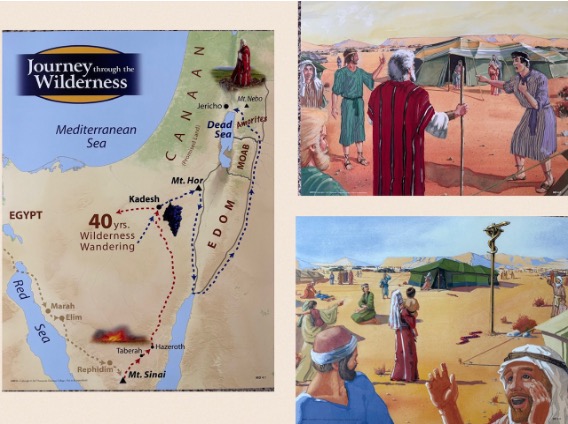
In their travels they got thirsty, hungry, and cursed the manna God provided for them! It also says they spoke against God and Moses, their leaders. Thus, God sent fiery serpents among them, in which many were bitten and killed. So they asked forgiveness, and that Moses would pray to God to remove them. 

Included is a picture from the ABEKA Bible Flash-a-Card Series 3 of the life of Moses. These sets have many great pictures of Bible stories not normally seen in children’s books. We used them in our congregation’s children classes in Israel as they were taught in Hebrew. They’re great for home use as well for children and grandchildren. 

Complaining about what one eats is a good lesson for all ages! Bites from deadly snakes is a rough punishment in the desert. There was a period of time while raising our children that if they complained about the food I made for dinner then they’d be doing the dishes afterwards! The complaining stopped quickly! Actually, I wasn’t even sure if they liked what I made or not as they ate it with no comments. Haha! Occasionally, after a new recipe I’d let them vote after dinner on the count of three with a thumbs up or down (or sometimes in the middle), so I could get some feedback. 🙂

One of the teachers/moms in our children’s class in Israel made a “bronze serpent” on an upside down mop with paper twisted around the top of it and then covered with duct tape and spray painted it bronze.  It was a good visual aid for the kids! (I couldn’t find a picture of it since it was before the days of cell phones).

Jesus recalled this incident in John 3:14,15, “And as Moses lifted up the serpent in the wilderness, so must the Son of Man be lifted up,that whoever believes in him may have eternal life.” Thankfully, we can look to Jesus during troubled times and after we’ve failed and need forgiveness. May God help us not to complain but to repent and give thanks.

“So, whether you eat or drink, or whatever you do, do all to the glory of God.” 1 Cor. 10:31

-Stephanie Schlegel

REFLECTION QUESTIONS

1. What was the Israelites punishment for complaining? Did the punishment seem just or too harsh? What are some things that you’re complaining about that perhaps need to be addressed?

2. How does complaining against God, leaders, and food hurt us? What’s something we can do to change that?

3. The bronze serpent that they looked at to be saved eventually became an idol! Is there something in your life that has helped you that now has turned into a negative effect that maybe you should break away from? We can pray and ask God to show us and help us to turn from it.

Clean, Holy, Set Apart

Numbers 18-20


Back in 1847 a doctor named Ignaz Semmelweis noticed that, through several events, women who had died of postnatal fever had been attended during the birth by doctors who had just done autopsies. Semmelweis came up with the idea that doctors should wash their hands between autopsies and births. And all of us collectively think… well yeah! Of course! But this was not part of the course of a doctor’s day at the time. In fact, many doctors were offended at the suggestion they weren’t clean. Semmelweis was absolutely ridiculed and eventually driven mad. He was placed in an asylum where he died within two weeks, ironically from an infection, after being beaten by prison guards.
Perhaps these doctors should have referred to today’s reading. After discussing the duties of the Levites in Numbers 18, Numbers 19 discusses being “unclean” for 7 days after touching a corpse for any reason. Definitely something these doctors should have taken note of.


Much is said about what is clean and unclean in the Pentateuch. The Israelites certainly benefited physically from not touching dead bodies or eating pork. Some issues of cleanliness could not be helped, such as touching the dead or having a monthly period. In these cases, people were unclean for a time and then had to wash themselves in special ceremonies and offer sacrifices.
But God did not delineate what was clean and unclean just for hygiene’s sake. God also wanted the Israelites to be set apart, different than the rest of the world, holy.


We are to come before Him with clean hands and pure hearts (Psalm 24: 4). But there are times when we become unclean and need someone who can wash us white as snow. Praise God for providing the sacrifice that completely cleans us, His Son, Jesus Christ.


We’ve come a long way since 1847. Hand washing is the first skill nurses have to demonstrate before moving on to other skills. As you wash your hands today, keep in mind the One who cleans you completely!

-Maria Knowlton

Reflection Questions

  1. What can we learn from Ignaz? What can we learn from the doctors who ridiculed Ignaz, believing that they themselves were clean?
  2. Does God still want His people today, the church, to be clean, holy and set apart? What does that look like? What does it look like to have a church that is dirty/stained, unholy and blending in with the world?
  3. Are there any common practices today that you think might be making many Christians unclean before the Lord?
  4. What is the only way you can come before God clean? If you accept Jesus as Lord of your life, are there still things you do that make you clean and unclean? How might Numbers have been preparing God’s people for Jesus?

On the Move

Numbers 7-9

Ok quizzers and especially National Quizzing Director, Jacob Ballard, hear me out! Numbers 7 should be part of the quizzing materials next year! I mean, while it is the longest chapter in Numbers, you really would only need to memorize 5 verses! 

Numbers 7 is very repetitive because all 12 tribes of Israel come to present their gifts to the Tabernacle, and they all give almost exactly the same thing (apparently there was no Tabernacle gift registry 😉). But that was actually on purpose as God wanted all of the people to praise and participate in the rights and responsibilities equally. He wanted every tribe to be fully devoted to Him no matter the size of the tribe. That is a reminder to us that even if we are all of different socio-economic statuses, we all bring the same thing to God, our hearts and our devotion. 

Numbers 8 describes how God set the descendants of Levi apart as royal priests. Whenever I have read about the jobs of the Levites, I’ve been glad that was not my calling. These guys were not standing around praying all day. They were working hard as they had to do a LOT of butchering. Like. All. Day. Long! My husband used to work in the meat department at our local grocery store. It is a lot of bloody, messy work. Ugh… and don’t get me started on cleaning all the tools! But these priests understood the importance of their jobs, helping God’s people atone for their sins through the sacrifice of the animals they raised. And it wasn’t a one-time thing for each person; it was continual for all of each person’s life.  This reminds me of how thankful I am that we don’t have to do that anymore because of what Christ did for us (Hebrews 10). Besides eternal salvation, we also don’t have to spend a great deal of our time butchering animals and barbequing them! 

Numbers 9 discusses God’s decrees on celebrating the Passover and then their “moving” protocol. Growing up in the Air Force, I think I can understand never knowing how long you would be in any given spot.  Sometimes God would have the Israelites stay for a few days, sometimes for a few years. I don’t know if this is the reason, but I suspect God did not want them to become too comfortable where they were and wanted them to remember their current position was not their home.  We too would be wise to remember that where we are now is not our permanent home and we should not become too comfortable within the world. 

-Maria Knowlton

Reflection Questions

  1. Have you ever moved at God’s command – or stayed put at His command?
  2. How do we tell today when and where He wants us to go – or stay?
  3. What are you learning about God in Numbers so far?

Tabernacle Parking

Numbers 1-3

Once upon a time, I had to take a statistics class.  It was awful! I am not a numbers person at all and the professor was dry and would trail off while he was talking. Every class was an exercise in trying to stay awake for an hour and 15 minutes! But I do think he could have spiced things up a bit if he had thrown in some fun or shocking stories in between the equations.  For example: “So in this case p is equal to the sum of the number of participants in the study, which was looking at the correlation between owning a machete and a ninja outfit and ending up in the emergency room.” 

So when I was reading the first two chapters, I was getting flashbacks of that statistics class. They are purely numbers and logistics. The 12 tribes of Israel had left Egypt about a year before and God was now “parking” the tabernacle in the desert, with the 12 tribes in specific stations around the tabernacle.

God had Moses and Aaron count all the men in the tribe. Boring! I like how Chuck Swindoll put it in his commentary, “Numbers takes the reader on a long and winding path through a desert of excruciating detail.”  But then I hit chapter 3 and Aaron’s two eldest sons, Nadab and Abihu fall dead because they offer God an “unauthorized fire” and they had no children, WHAT??? That got my attention! Why was the fire “unauthorized”? Why did God strike them dead? So many questions??? But the biggest question the story starts to answer is WHY Numbers is included in our Bible. 

Besides its historical significance, Numbers speaks of the importance of obedience to God and God’s intolerance of sin. Leviticus 10:1-2 gives a little more detail on what happened to Nadab and Abihu, but it was basically just straight up disobedience to God. We may think this was a pretty minor issue, but it points to the fact that God does not tolerate sin of any kind. No matter how “good” you are, you will not live a life of perfection and will at some point deserve the punishment Nadab and Abihu received. Goodness, do we need a savior! THANK GOD for JESUS! 

So, yes, much of this book is boring, especially today’s reading, but unlike that statistics class, you will find application for your own life in this book.

-Maria Knowlton

Reflection Questions

  1. God has a plan for His people, even for where each tribe was to park around the tabernacle. How might He share His plans today?
  2. Why is God looking for, and expecting, obedience from His people during the time of Numbers? What does God’s desire and expectations look like today? Does the sacrifice of Jesus mean obedience isn’t required any more?
  3. What application can you find for your life from Numbers 1-3?

Still Relevant Today

Leviticus 17-19

If you ask anyone about what Jesus taught his followers to do, there is usually a wide variety of responses: however, most of the answers you will receive will focus on his command to “love your neighbor”. Indeed, this was considered the second greatest commandment by Jesus:

The greatest commandment is, ‘Hear, O Israel! The Lord our God is one Lord; and you shall love the Lord your God with all your heart, and with all your soul, and with all your mind, and with all your strength.’ The second is this, ‘You shall love your neighbor as yourself.’ There is no other commandment greater than these.” – Mark 12:29-31 NASB1995

However, most people today would be shocked to learn where Jesus got this second greatest commandment from: the book of Leviticus!! In Leviticus 19:18, we find out that God has always desired His people to love their neighbor as themselves, even in a book that most modern readers want to throw away because it doesn’t seem “relevant” anymore. While we don’t have animal sacrifices and aren’t bound to certain ritualistic laws found in this book any longer, it is still a relevant book for Christian living: in the book of Leviticus, we not only find the second greatest commandment (according to Jesus), but also what loving our neighbor as ourselves looks like. How are we supposed to “love our neighbor as ourselves”?

Beginning in chapter 17, we begin a new section within Leviticus, oftentimes called the Holiness Code: in this new section, God stops directing instructions to the priests and begins addressing the people of Israel directly. In this Holiness Code are very relevant and practical ways that we can “love our neighbor as ourselves”. Among the descriptions in chapters 18 and 19 are:

  • Not pursuing improper sexual unions (still relevant today)
  • Not sacrificing your children to other false gods (still relevant today)
  • Showing reverence for your parents (still relevant today)
  • Leaving some of your wealth for the poor and needy (still relevant today)
  • Not stealing or lying (still relevant today)
  • Not withholding pay from someone you hired (still relevant today)
  • Having fair judgment in court (still relevant today)
  • Not hating or bearing a grudge against your neighbor (still relevant today)

As we can see, most of the Holiness Code is still proper for us to practice under the New Covenant (if not all of it), as we seek to love our neighbors as ourselves. There is one more part to loving our neighbor that we need to focus on and re-learn in our society today, but may be difficult to hear.

… you may surely correct your neighbor, but shall not incur sin because of him.” – Leviticus 19:17b NASB1995

When I’ve made some bad decisions in my life, there have been people who have called me out on it and tried to correct my actions: in the moment, I didn’t enjoy it at all and felt “attacked”, but I learned quickly that they were only concerned, loved me deeply, and wanted me to do better. True love for our neighbor doesn’t turn a blind eye to their sins or allow them to continue down a dangerous road because we don’t want to “hurt their feelings”: true love is difficult, because it is hard to warn someone when they are doing the wrong things that could hurt them or others. Jesus knew this and commanded us to do the same thing.

If your brother sins, rebuke him; and if he repents, forgive him.” – Luke 17:3

In our current world where we are very sensitive towards the emotional needs of our friends and family (which is good), we cannot ignore the clear commands from Scripture to step into their lives and help them see their need for change. If you want to truly love your neighbor as yourself and fulfill the second greatest command in Scripture, you MUST call your loved ones out when the moment calls for it: it is super uncomfortable and can feel damaging at first when they inevitably get upset, but could be the most life-changing and loving thing you ever did for them. Nobody has everything figured out perfectly until Jesus comes back, and if we are Christians, we will want to live the best we can until that Day comes: however, sometimes that comes with the pain of admitting we were wrong.

If someone you love is making choices that are damaging to their life (and spiritual life), don’t be afraid to say something: it is the most loving and difficult thing you can do for them.

-Talon Paul

Reflection Questions

  1. Suppose we do a really good job of loving God – why would He care if we also love others or not? Have you ever met anyone who did a really good job of loving God but wasn’t very loving toward others?
  2. Who has been there to love you by correcting you? Looking back, is there any time in your life when you wish someone would’ve shown love to you by correcting you – even if you might not have appreciated it at the time?
  3. Are you aware of any current situations where God might want you to love your neighbor by lovingly correcting – speaking the truth in love? What might that look like? Is it a job you have been trying to avoid? What happens if we don’t do it? There is a lot of sin in the world. Does God want us to spend all of our time correcting? How do I decide when it is the loving thing to correct?