A Chosen Instrument

Acts 9-12

acts 9

Thursday, June 8

Saul fought Christ in every way possible throughout his life up until this point.  He was the most unlikely Jesus follower.  He loved God and served God and thought he was doing His will.  But he thought that Jesus had been a false teacher and liar and that everyone who followed and spread Jesus’ teachings needed to be stopped.  There are people today who think they are doing God’s will but instead are ignorant of the truth, possibly because, like Saul, they don’t understand who Jesus is.


And then came the light!  Following the spectacular flash of light and the great voice of Jesus, Saul was led to Damascus where he was blind and did not eat or drink for three days.   I imagine this was a time of tremendous wrestling and questioning and perhaps doubting everything that he thought he had known about his whole life’s work and about Jesus.


Enter Ananias.  In a vision, Ananias, a follower of Jesus, is given specific directions to find Saul and place his hands on him to heal him.  Ananias answers, telling the Lord what a bad guy Saul is and how dangerous this could be.  Has the Lord ever tried to send you in one direction and instead you had your list of reasons why it didn’t make sense?  God’s work and His will doesn’t always make sense to us, and it doesn’t ‘have’ to make sense.  Our list of excuses and reasoning is worth nothing in comparison to God’s plan and desire for us.  So the patient Lord once again told Ananias, “This man (Saul) is my chosen instrument to carry my name before the Gentiles and their kings and before the people of Israel.”  (Acts 9:15).  How might you also be the Lord’s chosen instrument?  To whom has he prepared and designed you to carry His name?  Perhaps not to kings, but maybe to your neighbor and facebook friends and co-workers?


So, with no more excuses left, Ananias went to Saul and placed his hands on him to give him sight.  Ananias told Saul he would be filled with the Holy Spirit.  With the Lord’s powerful light, three days spent questioning what he had thought he had known, and Ananias’ faithful intervention, Saul realized the mistake he had made in his life and he was healed and baptized.  Just like Saul, anyone can change their life and follow Jesus.  God can set anyone straight.  Keep praying for those fighting against Christ and consider how He wants you to carry His name to others?

-Jason Railton

Living Words

Acts 7-8

acts_waterdrop

Wednesday, June 7

Stephen had an interesting life that was cut way too short.  I wonder what would have happened had he lived longer?  How many more people could he have reached?  I admire the way he knew his Old Testament history.  Beginning with Abraham leaving his country, Stephen then recounts stories of Isaac and Joseph and Moses.


In verse 38 of Chapter 7, it tells us of the living words Moses received to pass on to us.  These words are still being passed on to this day.  Even when people hear the living words, they have a choice of what to do.  Back in Moses’ day, these living words were rejected.  The people refused to obey and in their hearts turned back to Egypt (7:39).  How have you heard the living words and what has your response been?  Are you listening to these words or rejecting them?


I respect the courage Stephen had in saying what needed to be said even if it meant angering those who could kill him.  Even as he was being stoned, he was full of the Holy Spirit and saw the glory of God, and Jesus standing at the right hand of God.  Stephan prayed that the Lord Jesus would receive his spirit and he asked him to not hold this sin against them.  This is an example of an extremely dedicated and devoted man of God.  How many of us can praise God as Stephan did while being persecuted?


While Godly men buried Stephen, Saul began to destroy and persecute the church.  Tomorrow we will hear more about Saul and his stories.


-Jason Railton


Spreading the Word

Acts 5-6

acts5_29

Tuesday, June 6

As we continue into chapters 5 and 6 , Peter and the apostles could have stopped spreading the Word of God because of fear of discipline from the Sanhedrin.  Instead, they continued to teach and preach and perform miracles, always pointing others to Christ.  Once again they were arrested and put into jail.  In the night, an angel of the Lord appeared to them and instructed them to go back out into the temple courts in the morning to tell the people the full message.

Verse 42 of chapter 5 says, “Day after day in the temple courts and from house to house, they never stopped teaching and proclaiming the good news that Jesus is the Christ.”  This verse explains pretty well that they persevered and just kept going and going and going.  Ask yourself this, “Who have I talked to today?”  Or this week?  Are we as dedicated to spreading the Word as Peter?  What can we do to become better at spreading the good news?  How can we all become more like Peter?

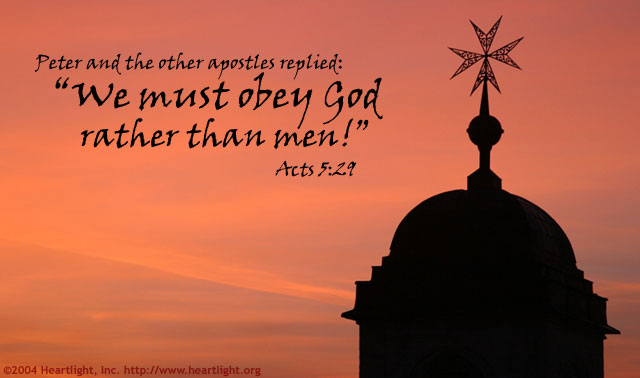
So my question to you today is, “Are you obeying God rather than men?”

-Jason Railton


Be Bold!

Acts 3-4

Be Bold Image

Monday, June 5

Peter and John were arrested for teaching about Jesus.  In 4:18, it says the Sanhedrin (the rulers, elders and teachers of the law,  making up Israel’s supreme court)  called them in again and commanded them to not speak or teach at all in the name of Jesus.  Peter and John replied, and in verses 19-20, they said:  “Judge for yourselves whether it is right in God’s sight to obey you rather than God.  For we cannot help speaking about what we have seen and heard”  What do we do today?  Do we listen to authorities rather than what God tells us to do?  Are we too tied up in being politically correct to say this or that or just plain don’t say anything at all just to be ‘safe.’  I think many people today don’t want to ruffle any feathers so they just sit quiet.  Do you stand up for what God says, or keep your mouth shut?


This just makes me think about being bold and not being afraid to speak the truth.  You should pay more attention to what God would desire, rather than being afraid you might offend someone.


In 4:23 it says: “On their release, Peter and John went back to their own people and reported all that the chief priests and elders had said to them.  When they heard this, they raised their voices together in prayer to God.”  So when we see something that doesn’t agree with a teaching from God, are we silent, or do we speak up and explain what is right in God’s eyes.


In verse 29 it says:  “Now Lord, consider their threats and enable your servants to speak your word with great boldness.”  Peter and John asked the Lord for extra boldness to speak His word.  Perhaps we should request the gift of boldness when it pertains to speaking up for what God instructs is correct.  This week let’s look for more opportunities to be bold.

-Jason Railton


Why Am I Reading This?

John 20-21

Jn20

Saturday, June 3

If you are in high school, you have asked this question sometime this year. If you are in college, the question probably gives you flashbacks of finals. If you are like me, you are 300 pages deep in a 400 page textbook by the time the question comes up. By that point, you are too doggedly determined to put the book down. “By gum, I’m gonna finish it!” the stubborn, stalwart voice in my head says.
Truthfully, it is a great question. When we ask, “Why am I reading/watching/listening/responding to this?” we ask a bunch of questions at once. What do I hope to gain from this? How will this knowledge inform my future actions? In what way does this information or content contribute to my mental, emotional, physical, spiritual, or financial success and well-being? And the answers to “why am I reading this?” may be diverse. Maybe, like us college & graduate school students, you read something simply to gain the information from it for a test or project. Maybe you are reading to make wiser decisions in the future. But beyond these questions, which we ask of ourselves, this is also a question we ask of the author. We are also asking, “Why did you write this?” Why did J.R.R. Tolkien put pen to paper and craft some of the most iconic stories ever? (Lord of the Rings) Why did C.S. Lewis tell of magic (The Chronicles of Narnia), of angels and demons (The Screwtape Letters and The Space Trilogy), and teach through his lovable, accessible, British way (Mere Christianity)?
In the Bible, this question doesn’t get answered too often. The Book of Job doesn’t tell us why the author wrote it. Sure we have very informed guesses, like, “The good and righteous will suffer. That is the way of this world.” But never once does the author tell us WHY he (or she) wrote the text. The authors of Matthew, 1 Kings, and 1 Chronicles, similarly did not take the time to tell you why they wrote. Again, there is a case to be made that the purpose can be found, like “to record history.” But then, why is Matthew’s account of Jesus’ life so different than John’s, and why do 1 Kings and 1 Chronicles differ so greatly in their retelling of the same events? (There are answers to these questions. They are not easy answers, but they help us in understanding the text, if we are willing to do the work.)
All this is to point to two of my favorite verses in the entire Bible, John 20:30-31. If you have never memorized a verse in your life (John 3:16?), seriously, start with these two in John, because they could basically sum up the ENTIRE NEW TESTAMENT. Actually, there is a case to be made that the ENTIRE BIBLE could be summed up in these beautiful words.
John 20:30-31 –  Jesus performed many other signs in the presence of His disciples that are not written in this book.  But these are written so that you may believe Jesus is the Messiah, the Son of God, and by believing you may have life in His name.
The author of John completely acknowledges he left things out. It doesn’t matter to him that every single detail down the line be absolutely perfect. He does not even begin to suggest that he told the story in chronological order. There is no way to make the Synoptics (Matthew, Mark, Luke) and John compatible, with one single “correct order of the life of Jesus.” That isn’t the author’s point. The author didn’t write this Gospel to give us another “play-by-play” of Jesus’ life.
What the author does say, the reason why he put his pen to paper, what the Spirit was doing in him when it moved in and used him to write down words through the authors hand and brain, is so that YOU may believe. You reader. Not another “you”. I’m talking to you. These signs, these teachings, this crucifixion and death are written so that you may believe that Jesus is the Messiah, the Son of God. The author cares about how you deal with this. See, if at the end of the day you are done reading John and you say “Jesus was a really good man” or “Jesus was a wise teacher” then YOU’VE MISSED THE POINT. The point is not that Jesus was a pretty cool dude, or that he was a man who died for what he believed in. He was inaugurating the Kingdom of God by coming, and that we can choose to be a part of God’s Kingdom now; in other words, he is the Messiah. He came to live a perfect life, overcome the world, and be the lamb of God who takes away the sin of the world; in other words, he is the Son of God. Any other reading of John is a mistake. It is wrong. Jesus is not just another good leader, good religious teacher, good dude. He is the Messiah, the Son of God, the Only Begotten Son.
If you end up believing in WHO Jesus is, in WHO he pointed us toward, in WHAT he was doing by ushering in a new way of being, then you have hit the point of the message of Jesus. You understand what the author of John was doing in all these many chapters, in signs, teachings, moments with the Savior. Moreover, by believing in Jesus, you will have life in his name, eternal life, abundant life now that can’t help but last forever! I hope that is where you find yourself today. The reason why I write so much about John is because I love it. I am a mess. I am a broken and sinful mess. But there are a couple things I know. I see these signs, these miracles and this death and resurrection and I have to believe that Jesus is the Messiah, the Son of God. And because I believe, I know that I have life because of him. I didn’t earn it. I don’t deserve. But I’ve got it. Come, you who are also undeserving, just like me. You sinners like me. You broken messes like me. Jake, like John, calls out “Believe that Jesus is the Messiah, the Son of God, and by believing, you too can have life in his name!”
In Christ,
Jake Ballard
(Photo Credit: https://biblia.com/bible/esv/John.20.29)

How Do You Crown Your King?

John 18-19

PastedGraphic-1

Friday, June 2

(This is a longer post. Please give yourself ample time to read it and pray over the questions at the end.)
Interesting trivia: the Greek Orthodox Church fasts every Wednesday and Friday. Every single one. Why? There are reasons to believe the Jews began this practice of fasting and that they carried it on. Beyond that, they also add a religious and theological reason: on Wednesday Christ was betrayed and on Friday Christ was killed. Every single week they remind themselves that they are in some way responsible for the Son of God hanging on the Cross.
These are the chapters we read this week in John 18-19. They tell the story of Jesus’ betrayal, torture, crucifixion and death through the eyes of John. What can we learn from this?
First, Jesus said, “Am I not to drink the cup the Father has given Me?” (John 18:11) Jesus accepted that this was the way that God had given him, and did not want to resist this way with violence. We can be so much like Peter, who cut off the ear of Malchus. We can be so  quick to violence. But Jesus, even with these men sent to kill him, his worst enemies on earth, was about peace, love and healing. Luke 22:51 expounds the story by finishing up the scene. “But Jesus responded, “No more of this!” And touching his ear, He healed him.”
That’s because Jesus is not focused on the injustice of what is being done to him. He is not looking for his personal justice. Jesus is, instead, focusing on his God-given destiny and duty. When being questioned by Pilate, he says “You say that I’m a king.” Jesus goes on to say,  “I was born for this, and I have come into the world for this: to testify to the truth. Everyone who is of the truth listens to My voice.”(John 18:37) Jesus is focused, in the middle of supreme injustice and false imprisonment, on why he was born, the reason for his existing. And what is that purpose? Not to disparage any evangelical preacher, but Jesus did not merely come to do three days’ work. Instead, he came to “testify to the truth.” The truth is humans need to be saved from their sins, he is that salvation, he is the only way to salvation, eternal life and the spirit will be given to those who seek this truth.
In the midst of this, we also see a picture of the world. Now, I’m of a specific bent that says God does not control every facet of the universe. God does not predetermine or force my hand and only make me act as he wants me or wills me to act. However, this does not mean that the world is completely and utterly out of control. In a way that is completely unknown to me, a way that I daresay we should call a mystery, God controls certain events, outcomes, or situations. Here, Jesus seems to take comfort in the fact that his own torture and death is not outside of the plan of God. God knew, “If my Son goes among the Jews and tells them the truth, they will crucify him. I will give humanity the authority to do so.” God isn’t wringing his hands in heaven saying, “I wish I could do something, but I’m not strong enough!” Nor is God a puppet master with all the strings making his marionettes dance. He is working out his will inside the real, free, true choices of humanity.
Interestingly, Pilate may have gotten it. Pilate, according to all the history books was a brutal and bloodthirsty man ready to squash any rebellion with the slightest whiff. But I think he understood who he was talking to in Jesus and what the Jews were asking of him. He seems to have answered his own question “What is truth?” And he answers it with the inscription above Jesus’ head “Jesus the Nazarene, the King of the Jews” written in every common language. The truth is that in this suffering, we see the ultimate juxtaposition. A savior killed like a slave, a righteous man made wretched, a King on a cross. THAT’S the symbol we gravitate toward. That’s the symbol that defines Christianity. It is a cross that shows the greatest moment of humanity, depravity and sin, and the greatest moment of the God-granted mercy, compassion and love.
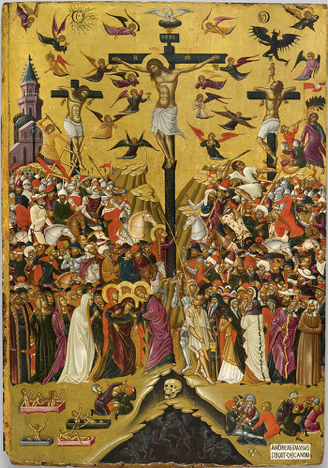
Then, Jesus dies. There’s no fanfare in the book of John. It is interesting that what happens in the other gospels, the earthquake and the darkness and the resurrection of righteous ones, are summarily overlooked or forgotten. They pale in comparison to the fact that the King of the Jews, the bread of life, the water of life, the SON OF GOD is hanging dead on a cross. This man, who only loved, who only wanted the best. Who demanded that the pharisees live the same life they demanded of everyone else. Who said “turn the other cheek” and “do not judge unless you are ready to be judged”. Who said “blessed are the meek, blessed are the poor, blessed are the persecuted.” This man who lived a life of perfect relationship and obedience to God, is hanging limp on a cross, covered in blood and bodily fluids. His arms and legs are no longer straining against the nails because he feels the pain no longer. His body bears the marks of scourging. His face is beaten beyond recognition, and above the bruises and laceration that disfigure the face of the Messiah, sits a crown of thorns, a gift from humanity to inaugurate our King.
There are many questions to ask of ourselves after this.
Do you treat your enemies with love and respect?
In times of trouble do you rest secure in the knowledge that you have a larger purpose than simply existing for today?
Do you even know what the larger purpose of your life is? Do you know specifically what the goal of your life is?
Do you rest secure in the knowledge that God is ultimately in control, whatever that might mean?
But above all of this is: what does it mean, FOR YOU, that the Son of God died on a cross? What does it mean for you that Jesus was tortured unjustly by a religious institution that couldn’t handle the fact that they were, in fact, broken and messed up and needed some saving? What does it mean for you that you were just as much responsible for the death of Jesus as Pilate and Caiaphas?
What will you do? We’ve place the crown of thorns of his head.
Will we cast our crown before him and acknowledge that Jesus is not only the King of the Jews, but the King of Kings and the Lord of Lords?
Will you commit to making him YOUR Lord, the Lord of every part of your life?

In Christ,
Jake Ballard

The Importance of “the”

John 14-15

the

Wednesday, May 31

We live in a world where diversity, multiculturalism and relativism rule the day. In some respects this is not bad. Having a variety of opinions in the “market place of ideas” means that the best are used, recycled, reused, adapted, interpreted, and used again. In short, the best ideas, the best inventions, the best of the best succeed. Diversity should be a part of our society we embrace; indeed the Kingdom is made up of people “from every tribe and language and people and nation.” (Rev. 5:9) God delights in the diversity of tribes, where people look and think and act differently from one another. He glories in the diverse languages we use to bless Him and our fellow humans. He loves all peoples, all nations. We praise God for the diversity of humanity we see in creation. But is this true in every situation? Is diversity always acceptable? Because of some of the claims of Jesus, I am inclined to say that no, not all types of diversity are acceptable. What could I possibly be talking about? If you haven’t read John 14:1-6 yet, please do. As you read it, what strikes you about this teaching of Jesus?
Notice that there are a few words Jesus repeats a couple times. Jesus has said a few times that he is going away and his disciples know the way he is going. But Thomas, the doubter a few chapters later, asks a REALLY good question “How can we know the way if you’ve been speaking in riddles?!”(14:5) Jesus up until this point, it seems has been withholding what would happen to him other than expressing it as being “glorified” or literally, “lifted up” (John 3:14, 7:39, 11:4, 12:23-34, and on). But Jesus is talking about his death. He is going away to the Father, to glory, by way of death. Jesus is say “You know the way to the Father, to eternal life.” Thomas, expressing his wonder, exclaims how can we get to the Father, how can we have eternal life?
And then Jesus says that “Well, all paths lead to life. As long as you sincerely believe whatever you believe and you don’t harm or judge anyone else, you’ll get eternal life.” Right?! That’s what we would expect if all the diversity and relativism in our society was correct. But Jesus says some stuff that really ruffles some feathers if we understand it. If you actually read the verses, or if you have memorized this verse (good on you if you have!) John 14:6 reads “I am the way, and the truth, and the life. No one comes to the Father except through me.”
Jesus used something grammarians (people who study grammar and language, like dorks like me) like to call “the definite article.” Normal people call it the word “the”. Each word in this list of three gets a definite article: the way, the truth, the life. I want you to get the importance of what this means. Jesus is not saying that his life is just “a life.” The life he has been promising, this eternal life, is the only life. There is only one life, and he is THE life. No others, no others compare. Jesus and his teachings are not “a truth” in a market place of truths, where you can pick which ones work for you and which ones don’t. Jesus claims he is THE truth. Buddha, the Gurus, Muhammad and other religious leaders or movements are not competing with Jesus in the matters of truth. Jesus is TRUTH, and the source of all truth. As far as they align with Jesus they are correct and when they differ with Jesus, they are in error. Jesus is the standard for truth, no one and nothing else. Jesus is not claiming to be “a way” to God. The analogy that Jesus is “one path up the mountain to God” could not be farther from the words of Jesus himself. Jesus said that he is the ONLY way to his Father, who is the only true God. (John 17:3) When you walk on the path of Islam, the path of secular humanism, the path of Buddhism, your path does not lead to the Father, according to Jesus.
And that is the shocking thing about this. I am not making these claims on behalf of Jesus. I don’t have to try and defend these claims on my own authority or reason or anything. Jesus himself made these claims, and the most shocking claim that anyone who comes to the Father comes only through him. Anyone who will be saved in the final days do not do it because they are really great Muslims, devoted Buddhists or EVEN great Christians. The only reason anyone will ever be given eternal life, the only reason anyone will live in the Kingdom, the only reason is Jesus Christ himself. He is the way, the truth, and the life. Belief in Christ, trust in him, love in him is the only way to life.
If this offends your modern sensibilities, trust me, it offended me, too! Jesus is claiming that he is better than all other religions and leaders and rulers and law-givers! How? But remember, we are not talking about one more leader or ruler or religious man or law giver. John testifies that Jesus is the Word, the Logos of God, made flesh among us. All the wisdom, power, planning, and thoughts of God take on flesh in Jesus Christ. Jesus is the perfect representation of the very nature of God, he is the image of God in skin and bones walking around. Instead of taking offense at Jesus and his hard teachings, as so many do, this teaching should cause us to fall down and worship and be grateful that God showed us any way to eternal life, and that Jesus is not restrictive in who can come to him. All who are weary and heavy laden, he will give rest. He will give life to as many as call on him, as many as trust that he is exactly who he claimed to be. Let us praise God that he has revealed to us Jesus as a gracious and merciful Lord, the one who is “the way and the truth and the life.” Let each and every one of us come to God through the name of Jesus Christ!
-Jake Ballard

Defined by Love

John 12-13

john13_34-votdTuesday, May 30

How do you know who somebody is? Not just what his or her name is but who they are, on the inside? Well, they may tell you. When introducing myself at Pine Grove to visitors or guests, I always say “I’m Jake, I’m one of the pastors here.” That way people know a little something about me; namely, they know I am employed as a clergyman (whatever they may think I do.) If we talk about my hobbies, quickly board games, Harry Potter, Star Wars, Star Trek and video games come up. Each one of these shape a person’s perspective of who I am. BUT, if someone could watch over my shoulder for a day, imagine what they would know about me? They would see how I treat my family in our home, they would know what I read and what I write, they would know all sorts of things. And in the end, if they were to make a decision on who is Jake, really, it would be wise of them to define me NOT by my words but by my actions. If I describe myself as a quiet-spoken, shy introvert, my actions would CRUSH that description.
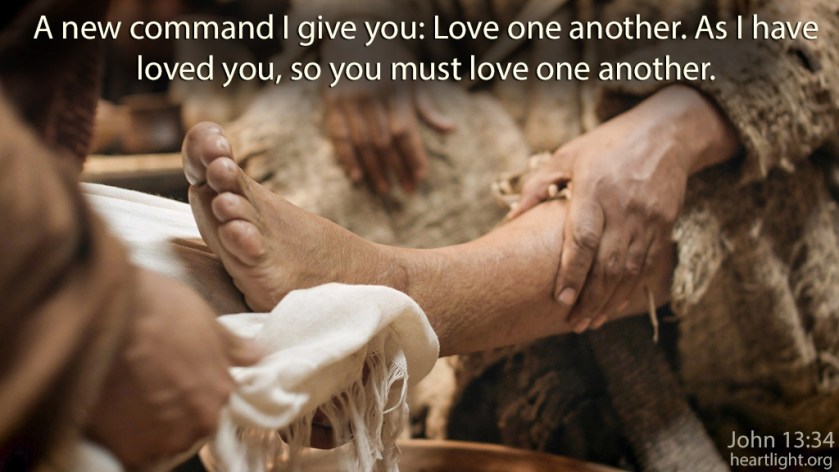
Jesus also knows that we show who we are by our actions. That is why he leaves us with a powerful and difficult commandment in John 13:34-35. A new commandment I give to you: love one another. Is there really anything new about this commandment? Yes and no. Is it new that we are supposed to love others and care for them? No, because that is what the Old Testament Law (remember that?) is all about. Jesus’ command to “Love your neighbor as yourself” is not a new thing that he made up, it comes out of the second half of Leviticus 19:18. But then how is this command new? It is new because Jesus points to a new example of this kind of love. We have to love each other as Christ loved us.
Why does he make us do this? Because it answers the question of who we are. When we tell someone who we are, that we are a follower of Christ, what do those outside the church normally think? Do they think close-minded, dogmatic “truth”-deniers? Do they think racist, sexist, homophobic bigots? Do they think arrogant, hypocritical jerks? There are some who may! There are many who would say something similar to Gandhi: “I like your Christ, I do not like your Christians. Your Christians are so unlike your Christ.” This does not mean that Gandhi had the true picture of Christ, nor does it mean that everyone who critiques Christianity is right! There are many who would make the claims that “Christians are X” who don’t know why Christians believe what the believe. However, there is something wrong if many people know us for something more akin to hate, than to love? After all, Jesus tells us “By this ALL PEOPLE  will know that you are my disciples, if you have love for one another.” Christianity is a way of life that should be drenched, dripping, overflowing with love.
But what does this mean for us?
First, love the Christians you are around. If you are not part of a church, you should be. There are many who critique Christianity from INSIDE as well as out. But the fact of the matter is that we were never made to live this faith alone. We were always to have a community of committed disciples around us. Also, this may be very difficult. The church is a place where broken people gather. Of course we are hypocritical and faithless and falling apart. We are just like every other humans. The fact of the matter is that Christians admit to it, which makes us the only ones who aren’t hypocritical and faithless and falling apart. We are blind and because we know we are, we can see. (See Sunday’s devotion.)
Secondly, love the world. While the starting point for our love is of course the “one another” of other disciples, if we want to be like God and Christ (and we do want that) it means that our love has to be for “the world”. Just quote John 3:16. God loved the world, not just his Church, not just his sons and daughters, but the whole big messy of humanity. Love for this world is the defining characteristic of God, because “God is love.” (1 John 4, you’ll get there!) However, love can be tough to pin down. Surely love doesn’t mean accepting someone’s sin, because God doesn’t do that, but it does love the person. Love doesn’t mean allowing someone to remain in sin and call themselves a believer, but that we help them come to a better understanding of the harms of sin. It also means that we allow ourselves to be connected to and friends with those outside the church who need to hear the gospel message of Christ. (1 Corinthians 5:9-13 for an interesting comment by Paul.)
This isn’t easy, but you can love others. However, it will only happen if you have experienced the love God has for you. God loves ugly, horrid, wretched sinners and CONGRATULATIONS! YOU QUALIFY! But seriously, it means that he does love you. The love of God, if you have truly experienced it, can’t help but flow out of you and into the people and the world around you. May people know the God you serve and the Messiah you follow by the love that you show. May those who don’t know Christ give praise and glory to God through your loving deeds. (1 Peter 2:12)
In Christ,
Jake Ballard

Life Everlasting

John 10-11

john 11

Monday, May 29

Yesterday we saw Jesus give a man sight; if you thought that was cool, get ready to have your mind blown!
Jesus had some good friends. We know about Peter, James and John, who were his closest disciples. They went with him when he was “transfigured.” (Remember this story from Matthew 17, Mark 9, and Luke 9.) These guys saw Jesus do things that no one else saw, which is pretty amazing. But Jesus’ friendships didn’t only include his disciples. In the city of Bethany, south-east of Jerusalem lived two sisters, Mary and Martha, and their brother Lazarus. These three people seem to be good friends of Jesus. These people trust in Jesus (11:21-22) and know that God will raise the dead (11:24). But when Lazarus gets sick, Jesus doesn’t go to visit him and Lazarus dies.
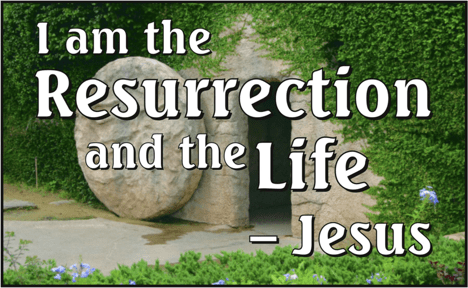
Now, Jesus is the man who has saved people from the brink of death. This is the man who walked on water. This is the man who has constant communion with the God of the universe. This is the man who is the Resurrection and the life. But what does this man do? He weeps. Jesus does not bottle his emotions, he does not try to put on a happy face and “celebrate the life” of Lazarus. He weeps. Jesus knows the sting of death.
But then Jesus changes everything. There are miracles of children being raised to life from death in scripture. But, the Jewish belief at the time of Jesus was that after three days they were gone. There was “no hope” after three days, and even these trusters-in-Jesus seem to think so. Martha says, literally “Lord, he stinks. It’s been four days.” This is the man beyond all hope, but Jesus is bigger than even our hope. He simply speaks the words, “Lazarus come out” and out he comes, alive and struggling out of his grave cloths. Jesus proves who he is, Jesus is not simply a good man, but he is the RESURRECTION AND THE LIFE!
Again there are some take away thoughts that I’d like to have rattle around in your brain:
First, death is awful. Seriously, it sucks. Don’t let anyone tell you differently. Whether it is your pet cat, your grandmother, your mom and dad, or your child, death is terrible, horrific, evil. Death is an enemy. If you have lost someone, allow yourself to feel the loss. Jesus, the Resurrection and the Life Himself did not try and cheer everyone up. When you have lost someone, you need to grieve as God has made you to grieve. Do you weep in a corner? Do you play sports until you can’t stand? Do you write music on a guitar and play until you fingers bleed? This grief is acceptable. Allow God to speak into your grief, but don’t feel ashamed.
But, secondly, that’s not the last story. There is life again. Death doesn’t win! Spoilers, God kills death. What a beautiful irony! God takes the thing that destroys the people he loves and destroys it. “Death” is not the final word; the final word is “Life” with God in Christ!
You can experience this. It is not hidden and unaccessible to you. This life is available for anyone and everyone. Do you want to have Resurrection and Life? Can you say what Martha said?  “Yes, Lord. I believe You are the Messiah, the Son of God, who comes into the world.” (John 11:27) Does this sound familiar? John 20:30-31 reads, “Jesus performed many other signs in the presence of His disciples that are not written in this book.  But these are written so that you may believe Jesus is the Messiah, the Son of God, and by believing you may have life in His name.” Do you believe?
Do you want this life? It’s not JUST for the future. This week we also read “10:10 A thief comes only to steal and to kill and to destroy. I have come so that they may have life and have it in abundance.” Do you want life? Do you want an abundant life? Christianity is not just good life for later, but abundant, God-bathed life now and eternal, blissful life later. That is not just good news. That is GREAT NEWS. May you believe in Christ and begin to experience the abundant life that overflows into eternal life by believing in his name!
In Christ,
Jake Ballard
(Photo Credit: http://presenttruth.info/the-resurrection-and-the-life-january-2016/)

I Once Was Blind, But Now I See

John 8-9

Sunday, May 28

Jesus is an awesome teacher. I have read Dallas Willard’s amazing work, The Divine Conspiracy, where he discusses the Sermon on the Mount. One of the points that Willard makes is that Jesus is not just a smart guy, but the smartest guy. He is not just a wise person, but the wisest person. Jesus confirms this when he says that one “greater than Solomon is here”. (Matt. 12:42, Luke 11:31) So if anyone asks you who the wisest person in the Bible was the answer isn’t Solomon; it’s JESUS!
Jesus shows his masterful hand at teaching here in John. In these first 12 chapters of the Gospel, Jesus is performing miracles, which the author calls signs. We have already read about the sign where Jesus changed water into wine (2:1-12). There have been a couple healings, one of the royal official’s son (4:46-54) and one of a paralytic on the Sabbath (5:1-15). Then he did two where he overcame the normal laws of nature by feeding the five thousand with only a little food (6:1-15) and by walking on water (6:16-21). All these signs are connected in John, because all these signs point to an important truth: Jesus is the Messiah, the Son of God, and by believing in him, we can have life in his name. (John 20:30-31)
In John 8 and 9, Jesus connects both his teaching and a sign to point to his Messiahship. In chapter 9, Jesus and his disciples see a blind man. Instead of tying the blindness to anyone’s sin, Jesus says that God’s glory, and the glory of the One and Only Son, would be displayed in the man’s life. Jesus taught previously, in chapter 8, that he is the light of the world. He declared that if we follow him we will not live in darkness but walk in the bright light of life. He then makes his point vivid by giving this blind man sight!
The once-blind man is taken in, questioned, harassed and abused by the religious leaders of his community. Instead of listening to this man tell his testimony about the truth of Jesus, they were intent on shutting down Jesus and claiming that he was a fraud. The man’s testimony is only the truth: “I was blind, but now I see.” Jesus comes to the once-blind man and basically tells him, “You can see that I am the Messiah.” Even Jesus loves puns! Jesus teaches that the blind will see and those who think that they can see are truly blind.
This story is a wonderful picture and full of rich imagery on its own. But I also come away with three thoughts for how we live today.
First, the once-blind man was “giving a testimony” about Jesus. He wasn’t even close to a “believer” as we might define it. He trusted enough to go and wash and he came back with sight; nothing more than trust that the washing would work was asked of him. That is pretty amazing. He says nothing of faith before the miracle takes place. And when people ask him about his life, all he does is tell his story. That’s all God and Christ call you to do when they say to share the good news of the gospel. It does not mean you have to have a suave and sophisticated philosophical demonstration of the proofs of God. You simply tell people how Jesus found you, and why you are better now. Were you blind and now you see? Were you addicted to something and no longer? Are you more loving to your family and friends? THAT is your evangelism, that is the good news God calls you to share.
Second, do you feel like the once-blind man? There are times when we experience God doing something in our lives that doesn’t make sense. We CAN’T explain why something is happening. This guy just says “All I know is that I was blind, and now I see!” Sometimes, we feel God moving in ways that may make our families, our churches or ourselves uncomfortable. The people who should have celebrated this man’s miracle the most, his family and his religious leaders, turned their backs on him and cast him out. When God is moving, trust in what He is doing, keep looking for Him, and no matter who let’s go of you, God will find you. 
Third, take care that you are walking in the light of Christ so that you can see and live. Just like the people of Jesus’ day, this sign is pointing us to Jesus so that we can believe and have life in his name. Take care that you don’t lose sight of that purpose. The purpose is not for us to say “I wish I could see a miracle.” The miracle has been done. Will you believe because of it? Will you trust that Jesus is who he claimed to be? Remember, if you don’t want to believe, that is still an option. But there is a cost: rejection leads to a life of darkness, and the ultimate darkness of death. Christ offers us so much more with life in this life that leads to eternal life. He is the light of the world and he offers us himself. Praise be to God through Jesus Christ, the Light of the World!
-Jake Ballard
Jake Ballard is Pastor at Pine Grove Bible Church in Brooklyn Park, MN. He is a husband to Amber, father to Melody Grace, and proud “daddy” to a black kitty named River (for my Dr. Who and Firefly fans). Jake is a graduate student at Bethel Seminary, where he is kept busy. When he does have free time, he likes to read (Tolkien and Riordan at the moment), watch Netflix (Star Wars: Deep Space Nine), and play video and board games. (Always open for suggestions, as I am less busy in the summer). He hopes that his devotions will help you, dear reader, fall in love with the Gospel of John, because if he had to pick a favorite book, it would be this one! God bless! 
(Photo Credit: http://www.boldcupofcoffee.com/blog/i-am-the-light-of-the-world)