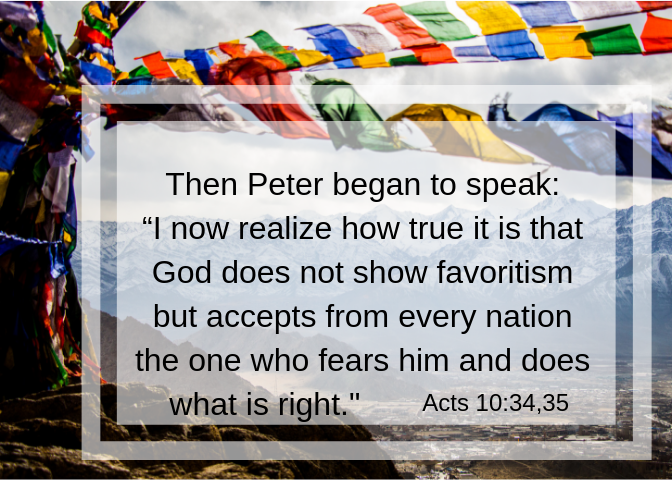
Peter and Cornelius

THEME WEEK- Peter: Acts 10

Old Testament: Nehemiah Intro – found below

Poetry: Psalm 18

This devotion comes from Acts chapter ten. The Centurion of what was known as the Italian Cohort was a devout Christian man named Cornelius. Being known for the faith of all his house and his charitable actions toward the Jews, Cornelius is definitely the kind of guy you want around when change needs to be made. Now Cornelius has a vision, and in this vision he is instructed to seek out Simon Peter, afterwards he listens whole heartedly and dispatches a group to go find Peter and bring him to meet Cornelius. While the group is going to find Peter, Peter goes to a housetop to pray. On the housetop he becomes hungry and he is shown a vision. In this vision, a large sheet descends from the sky and in it are a multitude of unclean animals; birds, reptiles and all kinds of four footed animals. A voice instructs Peter to get up, kill and eat. But Peter is hesitant. He doesn’t want to, for he follows the tradition of the time and won’t eat anything considered unclean by tradition. The voice tells Peter “What GOD cleansed, no longer consider unholy” three times and the sheet is taken back up into the sky.

 At this time, while Peter is thinking over what he witnessed, the men sent by Cornelius arrive at the house of Peter. The Spirit tells Peter to receive the men without misgivings and after they greet one another Peter invites them in to stay.

So finally the stage is set. These men have come to take Peter to meet a Gentile, as Peter is starting to rethink what GOD considers holy and unholy. Breaking down traditions.

The group takes Peter and some others from Joppa to Caesarea to meet Cornelius and as he enters the house Cornelius bows to worship Peter. “Stand up” Peter says “for I too am just a man.” There with Cornelius were multiple other gentiles. Peter says “You yourselves know how unlawful it is for a man who is a Jew to associate with a foreigner or to visit him; and yet God has shown me that I should not call any man unholy or unclean. That is why I came without even raising any objection when I was sent for. So I ask for what reason you have sent for me.”

Cornelius gives the account of the vision he received and how he was instructed to reach out to Peter, and to hear the preaching of Peter. 

So Peter begins to preach. Starting with the beginning of Jesus’ ministry and his anointing. Then to the death and resurrection of Jesus, ending with the fact that Jesus appeared to those who ate and drank with him before his crucifixion. And while Peter was still preaching to those gathered the Holy Spirit descended upon all those that were in the room, Jew and Gentile alike. 

The believers that came with Peter were amazed that the gentiles also could understand the speaking of tongues. 

Acts 10:47-48 reads “Surely no one can refuse the water for these to be baptized who have received the Holy Spirit just as we did, can he?” And he ordered them to be baptized in the name of Jesus Christ. Then they asked him to stay on for a few days.”

So that’s the story of Acts chapter ten, but what do we learn? Our preconceived notions of what “GOD wants” may not always be true, just because our traditions teach us something doesn’t mean it’s right. Even though everyone is doing something doesn’t make it right.

But this passage is beautiful in its own way. Just because we may not belong to the house of Israel, doesn’t mean GOD’s love isn’t for us. While it seems like a surface level idea, this passage plainly shows our adoption into the family of GOD.

-John Evans

Reflection Questions

  1. Peter described to Cornelius who Jesus was. How would you describe Jesus?
  2. Are there any areas in which perhaps your ideas of what “God wants” is actually different than what God truly wants? Explain.
  3. What does it mean to you to be a part of the family of God?

Nehemiah Introduction

The book of Nehemiah was written by Nehemiah, the cupbearer to King Artaxerxes.  This is the exciting sequel to the book of Ezra.  Ezra oversaw the rebuilding of the temple.  Nehemiah oversaw the rebuilding of the wall of Jerusalem in an amazing 52 days.

The two important themes of the book are:
1. The amazing way God protected and provided as the returned exiles rebuild the wall around Jerusalem with amazing speed
2. The importance of being loyal to God.

I particularly appreciate chapters 8 and 9 where Ezra read the law of Moses to all the people; the people listened attentively and worshiped God.

May we be able to say, like Nehemiah in 13:31, “… Remember me with favor, O my God.”

-Steve Mattison

“The Lord Will Not…?”

Zephaniah 1

Saturday, November 12, 2022

Without repeating themes from the previous days this week, like the punishment of Israel or the reconstruction of the remnants of Jacob, we’re going to focus on one verse in particular. 

“It will come about at that time That I will search Jerusalem with lamps, And I will punish the men Who are stagnant in spirit, Who say in their hearts, ‘The Lord will not do good or evil!’ ” (Zephaniah 1:12)

These words of God issue a strong warning to a multitude of people, many of whom are within our churches. Similar to the warning issued by Jesus about not having a lukewarm faith, here God is warning us to increase our own. The follow up to that is when those who are stagnant in spirit then say “The Lord will not do good or evil”, It is stated that God will indeed punish them. This draws me to think of Romans eight, when Paul writes about either being in the flesh or the spirit.

It is my understanding that you are either living in the flesh or in the spirit. There isn’t really a way to balance it. The people saying that “The Lord will not do good or evil” are trying to balance and will receive punishment.

I am reminded of a saying I have heard from an elder in my church that goes like “Being a Christian requires more than being a ‘good ole boy.’ ” The older I get, the more I realize that is much too prevalent in our world. Too many think that just being a good person is all there is to living for God.

It is my encouragement to all readers today to structure a prayer along with the wishes of the apostles in Luke 17:5. “Increase our faith!” When we become on fire for God and don’t remain lukewarm we can truly experience what God has required of us. To fully dedicate our lives, as a living sacrifice.

-John Evans

Reflection Questions

  1. How would you describe the stagnant in spirit or those with a lukewarm faith? What are their attitudes toward God? Where do you see this today?
  2. Do you want your faith to grow? If so, definitely pray for it! Then what? How badly do you want your faith to grow? What are you willing to change in your life, your schedule, your speech, your heart, your priorities in order to see your faith grow?

Even If

Habakkuk 3

Friday, November 11, 2022

I want to use this devotion today as a part confession, part devotion to share. At multiple times in my faith I have doubted God. The most common question I ask is “Why does so much bad happen in the world if we have a powerful God?”

And that’s the question Habakkuk asks when communicating with God. The minor prophets before him continuously condemned the corrupted Israelites, but all Habakkuk does is ask God that same question.

The main reason I share that about my life is so that even if one reader out there has asked that question, they know they’re not alone. The cool thing about it? It’s not a new or unusual question! Luckily the answer to the question, that eventually brought me peace, lies within this book.

To really focus on what Habakkuk three is all about we have to look at the set up of the previous two chapters. In the first chapter, he’s complaining to God about the corrupt Israelites. God then responds by saying that’s why he is raising Babylon. Habakkuk then flips to backtracking and telling God to slow down, Babylon is WAY worse than Israel. God teaches Habakkuk that all of the nations will have to answer eventually and that he’s not with Babylon, simply God’s not bringing them down just yet. These sins of Babylon aren’t exclusive to Babylon, there will always be a Babylon. Will God let this cycle continue?

So this back and forth is developed through the first two chapters to lead us to the third and final chapter. Habakkuk implores God to renew them in their days, not wanting to wait any longer. In verses three through fifteen Habakkuk then goes on in prayer, starting with God’s mighty appearance to the world, “radiance Like the sunlight”, a lot like the appearance of God to the Israelites way back in Exodus. He then produces in this prayer/poem that God will indeed crush evil.

“In indignation You marched through the earth; In anger You trampled the nations. You went forth for the salvation of Your people, For the salvation of Your anointed.

You struck the head of the house of the evil To lay him open from thigh to neck.” (Habakkuk 3:12-13)

This is Habakkuk eventually coming to realize the truth. God will come around to having evil vanquished from our world and our lives, and he will do it by our side.

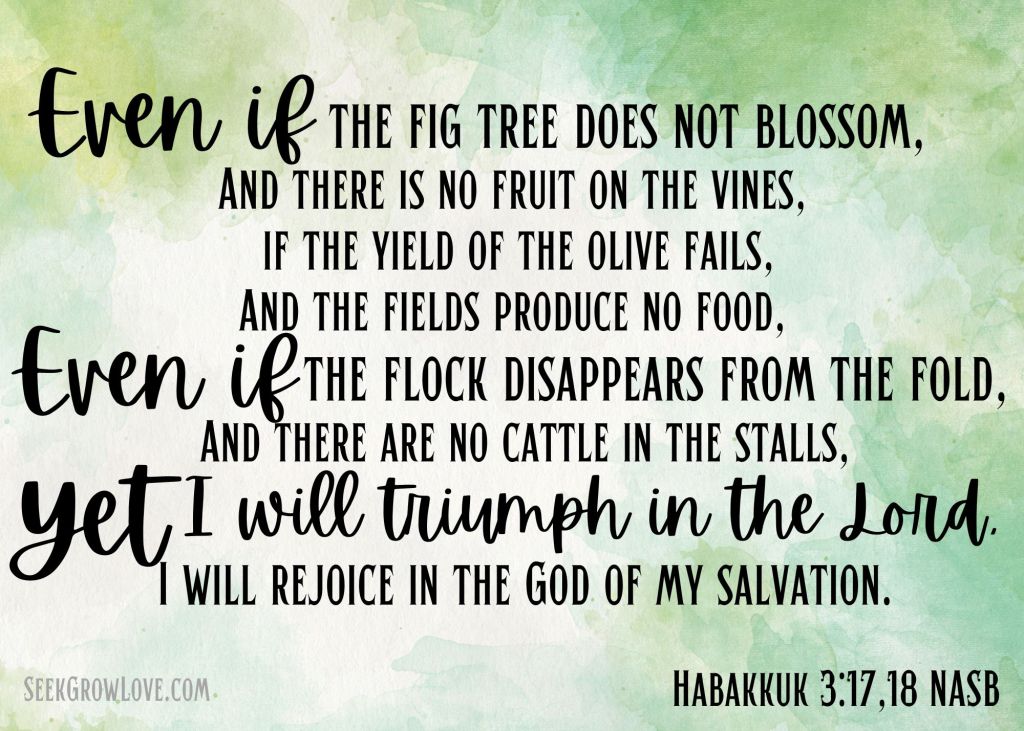
In the last three verses of the chapter, Habakkuk choses faith. He chooses that whether in war or peace, or famine or harvest, he will choose triumph in the Lord. To rejoice in the God of his salvation.

Understanding what went on in the whole book of Habakkuk draws very clear parallels to the lives of any and all who, at one time or currently, have doubted God. Take extra time to pray today but structure it differently. Pray to have your faith increased, and to be strengthened in submitting yourself to the timing of our God.

-John Evans

As a new writer for SeekGrowLove, I was asked to include a short bio about myself, so here goes...Currently attending McGintytown Church of God of Abrahamic faith, and serving as a youth leader, deacon, and assisting with worship. At Twenty-One years of age I have a lot to learn, but was once told I don’t have to know everything to be a great teacher, I just have to know something you don’t. Thanks for reading, have a blessed day.

Application

  1. Have you ever doubted God? What can you learn from Habakkuk?
  2. If you were to write a personal version of Habakkuk 3:17-19 what are some “Even if..” statements you would include? Consider hardships God has already seen you through, hardships you are currently in, as well as what the future may hold. How would you describe God’s strength and benefits for you (verses 18 & 19). Share your new poem with God as you pray for your faith to be increased.

Against You

Nahum 2

Thursday, November 10, 2022

While deciding what to write for each day this week I was quite confused about the second chapter of the prophet Nahum. The book at face value is a prophecy of a military assault on Nineveh. Verses one and two call the people of Nineveh to battle. Verses three through seven go through the visions of the battle. Using phrases like “Chariots rage in the streets” and “The palace is dissolved” or my personal favorite, “They run like lightning.” Close to the end of this section is the phrase “She shall be led away captive.” Nahum saw the outcome of the battle and knew that Nineveh would eventually fall to the hands of this mighty army. In verses eight through twelve, is the prophecy of Nineveh crumbling and being looted after the war. “Take spoil of silver! Take spoil of gold! There is no end of treasure, or wealth of every desirable prize.” Nineveh was seriously gone.

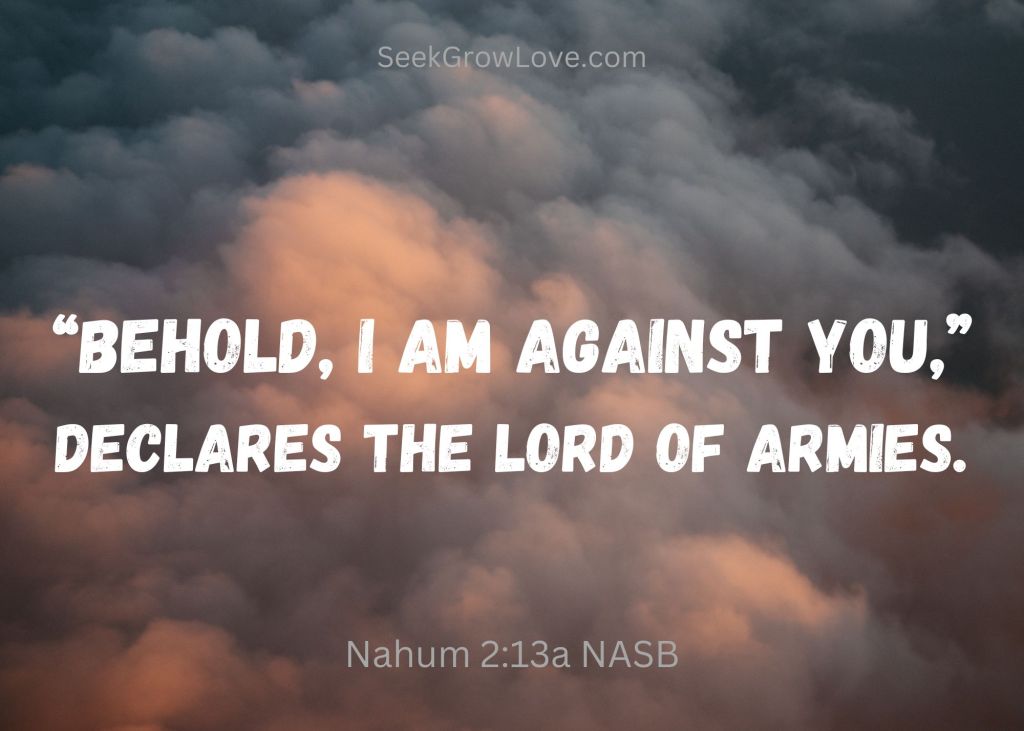
“I am against you,” declares the LORD Almighty. “I will burn up your chariots in smoke, and the sword will devour your young lions. I will leave you no prey on the earth. The voices of your messengers will no longer be heard.”

That was Nahum 2:13. The direct quote from God, the LORD Almighty, was that he was against Nineveh. While reading a commentary about this, the author quoted Romans 8:31 “…If God is for us then who can stop us.” The author followed it up with the question “If God is against you, who can be for you?”

This small chapter of the Bible is one that may not be entertaining at first glance but there at the end, ask yourself the question; “Would God have a reason to be against me?” 

Pray for discernment of all things in your life, and repent. Get right with what rules God has laid out for us to follow, so that God will be for us.

-John Evans

APPLIcation

  1. Really, ask yourself the question, “Would God have a reason to be against me?” Pray for discernment, examine yourself and repent.
  2. Are there any of God’s rules that you need to work a bit harder at following? Which ones
  3. How would you answer question 1 in light of Romans 3:23? What does Jesus’ sacrifice for your forgiveness mean to you? Does this mean you can sin now?

But as for You…

Micah 5

Wednesday, November 9, 2022

One of the major downfalls of us as humans is that we love evidence. We hear a cool fact, and want to know where it is cited. We learn something in school, and we need a peer reviewed article. When a statistic is cited we like to know how the study was conducted. The cool thing about God is that he knows this about us. In Micah 5 we receive prophecy about Jesus which reads; “Now muster yourselves in troops, daughter of troops; They have laid siege against us; With a rod they will smite the judge of Israel on the cheek. But as for you, Bethlehem Ephrathah, Too little to be among the clans of Judah, From you One will go forth for Me to be ruler in Israel. His goings forth are from long ago, From the days of eternity.” (Micah 5:1-2)

This direct prophecy from God through Micah foretells of the only king the Israelites will ever need, Jesus Christ the Messiah. The remainder of Micah 5 relays the message that the land of the Israelites will be laid waste for their sins and for their breaking of the covenant God set forth to protect them.

There’s a message that parallels something rather unfortunate that goes on in our modern churches today. I have been quite blessed in my experience in church growing up. The people surrounding me who I have known as God’s people have acted accordingly. However, as I meet others my age, I learn that is not always the case. This experience, I have come to learn, is called church hurt. It seems to be when people experience behavior that doesn’t quite align with the ways a Christian should conduct themselves, causing a disruption between what is expected from God’s people and the reality of their actions. But like all sin it’s hardly anything new. Micah was attempting to call out the corrupt leaders of his day, comparing them to Ahab stealing the family vineyard from Naboth, (see 1 Kings 21) and to call out the Prophets who are offering “God’s protection” to those who are willing to pay.

Throughout the book, Micah continues to warn that God has withdrawn his protection and is going to allow the Babylonians to take over and use them to remove the corruption of the Israelites.

“Then the remnant of Jacob Will be among many peoples Like dew from the Lord, Like showers on vegetation Which do not wait for man or delay for the sons of men. The remnant of Jacob Will be among the nations, Among many peoples Like a lion among the beasts of the forest, Like a young lion among flocks of sheep, Which, if he passes through, Tramples down and tears, And there is none to rescue. Your hand will be lifted up against your adversaries, And all your enemies will be cut off.” (Micah 5:7-9)

This is where we are today. Remnants of Jacob. We wait for the day of our prophesied King to return to rule correctly. So what do we do in the meantime? Despite having a bad experience, continue meeting with your fellow Christians, but be on guard for the “Wolf in sheep’s clothing” (Matthew 7:15). There will be a day when we are gathered together as one nation truly under God, and we’ll be awarded according to our faith in the King born in Bethlehem which prompts us to obey and work for him.

-John Evans

Reflection Questions

  1. What is the good news of Micah 5? And for whom is it good news?
  2. What is the bad news of Micah 5? And for whom is it bad news?
  3. Do they both still apply today? Which do we hear more of today?

Your Enemies

Jonah 4

Tuesday, November 8, 2022

A couple years ago in a class at our youth event FUEL, I was in a class that focused on the idea of forgiveness. In the class we were watching a video by Bob Goff, a Christian author and lawyer, recounting his case against a witch doctor preying on the children of a few tribes in Africa. To make a long story short, Bob was able to assist in getting a witch doctor named Kabi jailed for the mutilation of a child. Unfortunately this crime was nothing new, but this time the child lived! This is definitely a story that is worth looking into after this, but let’s pick it back up in a little bit.

I want to turn to the life of Jonah the prophet. Despite the fun story many of us heard as kids I don’t think Jonah was a good prophet! He disobeyed directly what God had told him to do and expected God to simply vanquish his enemies. When he arrived at Nineveh, Jonah gave a half hearted message “Forty more days and Nineveh will be overthrown.” And that’s all he said yet, it worked. When the people of Nineveh heard this they repented and mourned and decided to serve God, including their king.

When Kabi was jailed it seemed like a win, but an interesting thing happened. The enemy of this story, Kabi, acted in the same way Nineveh did. Kabi wanted to repent and turn to God!

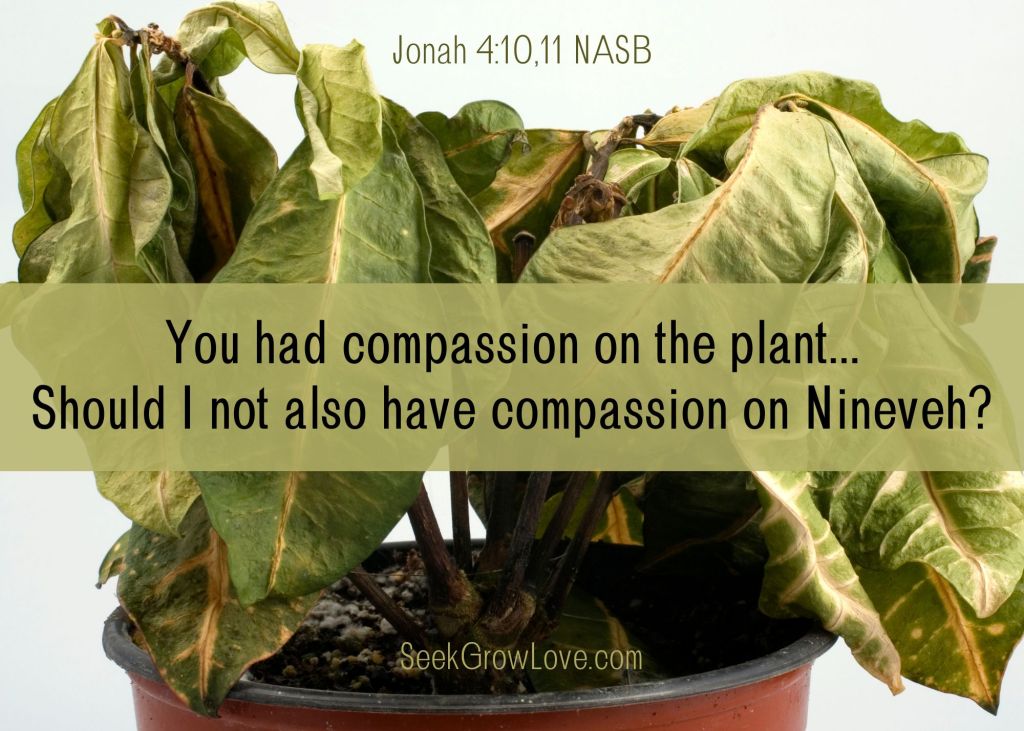
When God decided not to punish Nineveh, Jonah was angry. He went on a hill and built a lean-to shelter and God grew a plant to shade Jonah. God then sent a worm to  kill that plant so that the hot sun and scorching winds would wear Jonah down. Jonah 4:9-11 reads “ ‘Is it right for you to be angry about the plant?’ ‘It is,’ he said. ‘And I’m so angry I wish I were dead.’ But the LORD said, ‘You have been concerned about this plant, though you did not tend it or make it grow. It sprang up overnight and died overnight. And should I not have concern for the great city of Nineveh, in which there are more than a hundred and twenty thousand people who cannot tell their right hand from their left—and also many animals?’”

When I was told Kabi was allowed to repent of his sins I was actually furious. I thought the most evil thing imaginable had been done and now this man gets to repent! But let’s look at the parallels. That plant was God’s to give and God’s to take away, just like our own grace given to us by God. The message of Jonah four is to be a reflection on our own lives and ask, “Are you okay with serving a God that loves your enemies?” And if not? He loves them anyway. Considering we’re not always on God’s side doing what he asks of us, it might just be a good thing.

-John Evans

Reflection Questions

  1. Are you okay with serving a God that loves your enemies?
  2. What was God’s desire for Jonah? For Ninevah? What is God’s desire for you? For your enemies?
  3. How can you grow closer to God’s desire for you?
  4. How will you show compassion to your enemies?

It is Coming

Obadiah

Monday, November 7, 2022

Sometimes it can be hard to see what God has planned in our lives. When we choose to live a God-honoring lifestyle, it is easy to see all of the pain and suffering in the world and sit back and ask, “Why?” Why are some extremely wealthy and prosperous, yet, evil people allowed to do what they do untouched? The first thing we say is that it just isn’t fair. But really, to the people of God, good is coming and all we need to do is trust in God’s timing.

To be the smallest book in the Old Testament, the book of the prophet Obadiah is probably one of my favorites. Its message, once determined, is quite comforting and tells a message that is familiar to those of the Christian faith, albeit, from a different angle.

The whole book is composed of a powerful twenty-one verses that is to reveal the outcome of Edom, descendants of the family of Esau and long term enemy of the Israelites. And it doesn’t hold back. Condemning them for their pride, and for Esau’s violence against his brother Jacob, God says that though they build themselves up high like eagles, from that place He will bring them down.

“Then the house of Jacob will be a fire And the house of Joseph a flame; But the house of Esau will be as stubble.” (Obadiah 1:18)

The main lesson to be taken from this book is that God is a God that will vanquish our enemies. Yahweh is a living God that if we can trust, does hold the ultimate reward and in verse 21 “The deliverers will ascend Mount Zion To judge the mountain of Esau, And the kingdom will be the Lord’s.” The kingdom of those who can put their peace in the future day of the LORD.

-John Evans

Reflection Questions

  1. What are your feelings when you hear the Day of the Lord is coming?
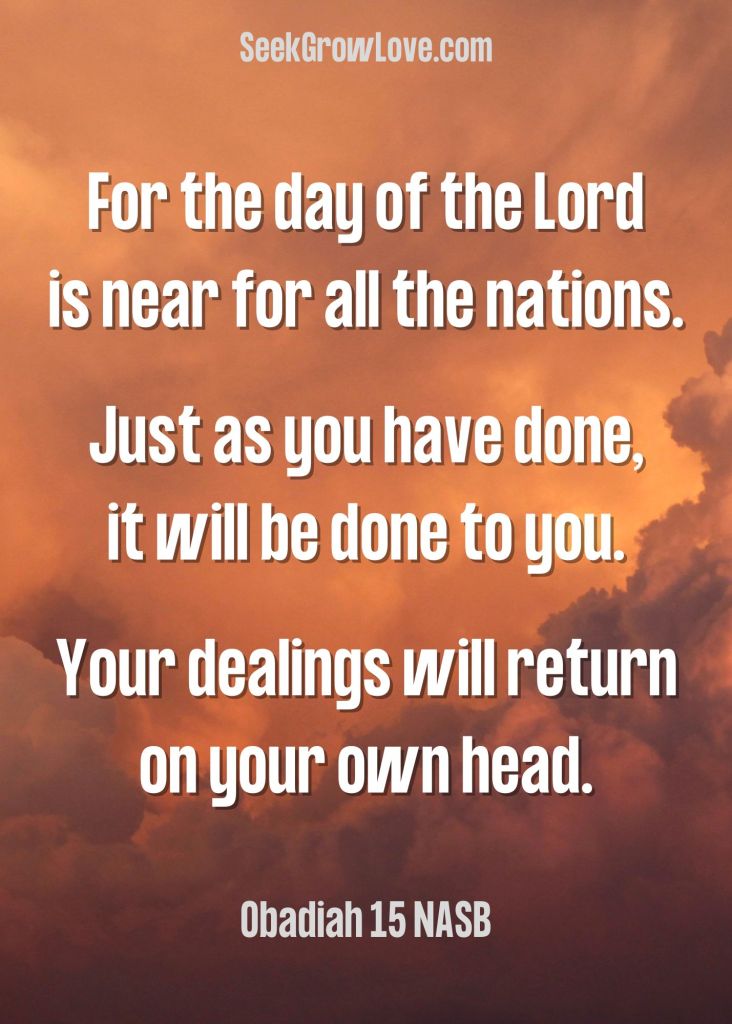
  2. What does it mean to you that, “Your dealings will return on your own head”? Are there any exceptions?
  3. Do you feel prepared for the Day of the Lord? Is there anything you need to take care of in your relationship to God and to others before that day comes?

Come Back

Amos 5

Sunday, November 6, 2022

For the last three years I have been in the retail industry. Working with the public, you are exposed to a wide variety of people. Ever heard of people watching? That’s when you literally just observe people for fun, whether at a shop or restaurant, because the state of our society can be so entertaining. However, it can be disheartening to a Christian. The way people talk and conduct themselves, and especially the way people treat each other, is really hard to watch. Let’s look at today’s scripture.

In Amos 5 we are greeted by a funeral song. Now, music has always been a huge part of my life. From Frank Sinatra to Dr. Dre, my appreciation of music is quite eclectic. Imagine my joy when I hear the chapter I get to write about is Amos 5! It reads, “ ‘The virgin Israel has fallen, never to rise again! She lies abandoned on the ground, with no one to help her up.’ The Sovereign Lord says: ‘When a city sends a thousand men to battle, only a hundred will return. When a town sends a hundred, only ten will come back alive.’ ” This is a warning from the prophet Amos to the people of Israel to provide another chance before facing the judgment of God. The sin they needed to repent from in this case was idolatry, and the imagery of the men dying in battle was to foreshadow the eventual tool God had planned to use to remove this sin, an invasion at the hands of the Babylonian empire. 

In verse 4 it reads, “Now this is what the Lord says to the family of Israel: ‘Come back to me and live!’ ” And that’s the amazing thing about the grace of God, is that’s all it takes. If the Israelites had simply put their false gods aside, they would have not (eventually) been punished.

Let’s pull it all together. You hear all the time from people that modern times are “so awful” and “that nothing like this has ever happened”. But that is plainly false! The sins of man have always been abhorrent, but “God is not a man, that He should lie, Nor a son of man, that He should repent…” (Numbers 23:19, NASB 1995), that means that when God said “Come to me and live” he MEANT that and will ALWAYS mean that.

-John Evans

Reflection Questions

  1. Read Amos 5 and list all the things God saw the Israelites doing that He was warning them against continuing. Also list what God wanted them to do instead. Which of these actions and attitudes do you see today in society? In God’s church? In yourself?
  2. What warning do we need today?
  3. What does it look like to Come Back to God? How will you Come Back to Him? How will you help another to Come Back to Him?