John Introduces Jesus

OLD TESTAMENT: Ezekiel 21 & 22

POETRY: Psalm 123

NEW TESTAMENT: John 1:19-34

Last week in the United States we had our election for President.   For months people campaigned on behalf of the candidates.  There were debates, speeches, and interviews.

2000 years ago in Israel, there were questions surrounding potential leaders.  One man who had developed a large following drew interest in from the leaders who sent religious leaders to question who he was.  He made it clear who he was not.

John 1:19-34

19 Now this was John’s testimony when the Jewish leaders in Jerusalem sent priests and Levites to ask him who he was. 20 He did not fail to confess, but confessed freely, “I am not the Messiah.”

21 They asked him, “Then who are you? Are you Elijah?”

He said, “I am not.”

“Are you the Prophet?”

He answered, “No.”

22 Finally they said, “Who are you? Give us an answer to take back to those who sent us. What do you say about yourself?”

23 John replied in the words of Isaiah the prophet, “I am the voice of one calling in the wilderness, ‘Make straight the way for the Lord.’”

24 Now the Pharisees who had been sent 25 questioned him, “Why then do you baptize if you are not the Messiah, nor Elijah, nor the Prophet?”

26 “I baptize with water,” John replied, “but among you stands one you do not know. 27 He is the one who comes after me, the straps of whose sandals I am not worthy to untie.”

28 This all happened at Bethany on the other side of the Jordan, where John was baptizing.

John Testifies About Jesus

29 The next day John saw Jesus coming toward him and said, “Look, the Lamb of God, who takes away the sin of the world! 30 This is the one I meant when I said, ‘A man who comes after me has surpassed me because he was before me.’ 31 I myself did not know him, but the reason I came baptizing with water was that he might be revealed to Israel.”

32 Then John gave this testimony: “I saw the Spirit come down from heaven as a dove and remain on him. 33 And I myself did not know him, but the one who sent me to baptize with water told me, ‘The man on whom you see the Spirit come down and remain is the one who will baptize with the Holy Spirit.’ 34 I have seen and I testify that this is God’s Chosen One.”

John made clear that he was not the one, he was not the Messiah, the King.  John made it clear that Jesus was the true King.  God himself declared that Jesus was revealed to be the savior of the world.  Jesus was God’s chosen.  He was God’s sacrificial lamb who would take away the sins of the world.

John was a man of great humility.  He did not pursue power and glory.  His call was to witness the truth about God’s true savior.

Presidents come and go, but Jesus is the true Messiah and Savior.  Just as John in all humility pointed people to Jesus, let us all point to Jesus as our savior and king.

Pastor Jeff Fletcher 

Reflection Questions

  1. What characteristics of John do you admire? What makes a good Christian leader?
  2. What evidence did John have that Jesus was God’s Chosen One – God’s Messiah?
  3. Like John, how can you prepare people to meet Jesus? How can you introduce Jesus to your friends/co-workers/neighbors?

John the Baptizer, a baptism for the repentance of sin

Matthew 3, Mark 1, Luke 3

We mentioned on Wednesday (John 1 and Luke 1) why and how John the Baptizer played such a key role in announcing the coming of Jesus the Messiah. John the Baptizer was such an influential figure in 1st century Israel that many people thought he may be the Messiah. But the Baptizer and the authors of the New Testament made it clear: this prophet of God was not the Messiah, but came to bear witness that Jesus of Nazareth was the Messiah and the Lamb and Son of God.

Mark 1:2 and Luke 1:17 tie the coming of John the Baptizer to a declaration of the last prophet of the Old Testament, Malachi (Mal. 4:46; cf. Matt.17:12, Mark 9:12). But all four of the Gospels quote a passage from Isaiah 40 in connection to the ministry of John the Baptizer (John 1:23 is the Baptizer’s own testimony).

“The voice of one crying in the wilderness;

Prepare the way of the Lord, make his paths straight”

Did the Prophets Isaiah or John the Baptizer think and proclaim that the LORD, Yahweh was literally to come to earth as a human being? This is the way much of traditional Christianity interprets this verse. However, it is clear that both prophets understood that the LORD Yahweh would come, and His glory be revealed, through the circumstances of events that were about to unfold. In Isaiah’s case the restoration of Israel from Babylon would be a second Exodus in which Yahweh the LORD is understood to come and lead Israel, displaying His glory.

For the prophet John the Baptizer, Yahweh, the LORD, would break into human history and reveal his glory by sending the Messiah, the one who “comes in the name of the LORD Yahweh” (Psa. 118:26, John 12:13). The Messiah is Yahweh the LORD’s messenger, Yahweh’s agent. To receive Yahweh’s messenger was to receive Yahweh.

And how were the people to prepare for the one who was to come after John the Baptizer, to whom John testified “I’m not worthy to carry his sandal”?

Repentance. Both John the Baptizer and Jesus preached a baptism of repentance for the forgiveness of sin. “The time is fulfilled, and the king of God is at hand; repent, and believe the good news of the kingdom” (Mark 1:4, 14-15, Matt. 4:17, 23).

-Bill Schlegel

Bill Schlegel is the author of the Satellite Bible Atlas and general editor of the One God Report podcast.

Today’s Bible passage can be read or listened to at BibleGateway here – Matthew 3, Mark 1, Luke 3

Tomorrow we will read John 2-4 on our way through our Bible reading plan.

Jesus and John the Baptist, a New Beginning

John 1 and Luke 1

The first chapters in the Gospels all describe a new beginning. There had been some 400 years of silence, prophetically speaking, since the days of Malachi the last prophet of the Old Testament. The beginning of the Gospel of Jesus Christ has continuity with Old Testament sacred history (compare for instance Malachi 4:5-6 with Luke 1:17). Indeed, the Gospels claim that this new beginning is a fulfillment of Old Testament hopes (Matt. 5:17). All the Gospels culminate with the resurrection of Jesus the Messiah from the dead, who is the ultimate new beginning, the first born of God’s new creation (cf. Col. 1:15, 18; Rev. 1:5).

A main emphasis in the early chapters of all of the Gospels is the relationship between Jesus and John the Baptizer.

Luke described the amazing births of both John the Baptizer and Jesus.

Matthew described the birth of Jesus, and then skipped to the adult ministry of John the Baptizer.

Mark and John do not describe either birth, but start their Gospels with the adult ministries of John the Baptizer and Jesus.

Why would the relationship between the two men, John the Baptizer and Jesus, be such an important issue? Because John the Baptizer was a very significant individual at the time. Many Jews in 1st century Israel believed John to be a prophet sent by God (John 1:6, Matt. 21:6 “all held John to be a prophet”).  We know from the Gospels and also from the 1st century Jewish historian Josephus Flavius that John the Baptizer had thousands, probably tens of thousands of followers (see here for Josephus’ description of John). Some people thought John the Baptizer might even be the Messiah (John 1:20). The Gospels clarify John the Baptizer’s role and make it clear that Jesus is the Messiah, of higher rank than John the Baptist.

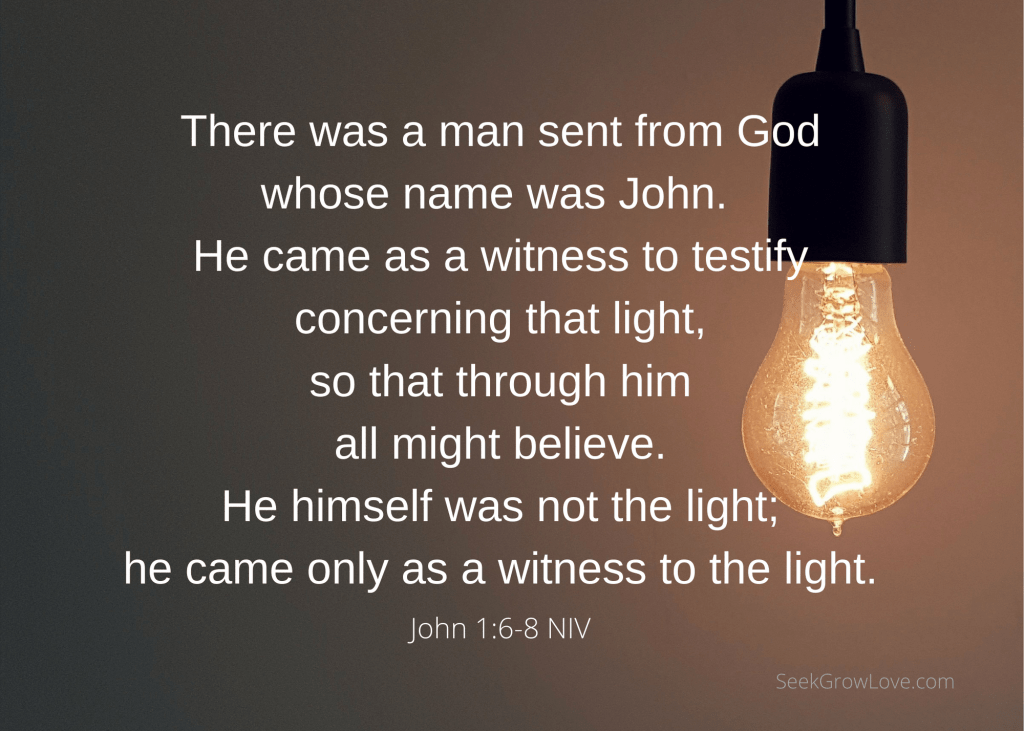
John’s Gospel’s specifically introduces the ministry of John the Baptizer already with three verses in 1:6-8, and then again in 1:15 and 1:19-35 (cf. 3:25-30). The appearance of John the Baptizer so early in John’s Gospel, the sixth verse of the Gospel, is evidence that “the beginning” of John 1:1, and all of these verses at the beginning of John’s Gospel refer not to the Genesis creation but to the same beginning that the Gospels of Matthew, Mark and Luke describe, “the beginning of the Gospel of Jesus Christ” (Mark 1:1, cf. Luke 1:1-2, Matt. 1:1, John 8:25, 16:4).

In other words, John the Baptizer is so quickly and prominently introduced at the beginning of all the Gospels, including John’s Gospel because the Baptizer has a key role in this new beginning. The Baptizer’s key role was to bear witness to the coming of the Messiah: “After me comes a man who ranks above me…behold the lamb of God…this one is the Son of God” (John 1:15, 29, 34).

One other aspect of the new beginning that the Gospel of Jesus Christ inaugurates was declared by Mary the mother of Jesus when she visited Elizabeth the mother of John. The coming of the Christ was to initiate a “reversal of fortune”. In language that echoes the prayer of Hannah (the first person in the Bible to mention the coming of God’s king messiah, 1 Sam. 2:10), Mary knew that the new beginning would turn the world upside down (Luke 1:47-56). Those of low estate would be exalted, the proud would be scattered, and the mighty brought down from their thrones. As Jesus promised, “the meek will inherit the earth”.

-Bill Schlegel

Bill Schlegel is the author of the Satellite Bible Atlas and general editor of the One God Report podcast.

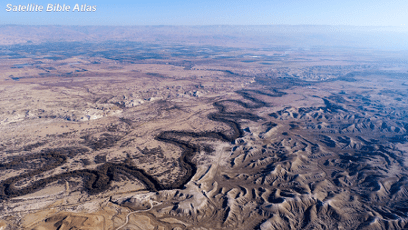
Jordan River near Jericho

Today’s Bible passage can be read or listened to at BibleGateway here – Luke 1 and John 1:1-14

Tomorrow we will read Matthew 1 and Luke 2:1-38 as we continue seeking God, growing our faith and increasing our love. Come follow along and see what God as in store for you!