Unworthy of His Greatness

2 Samuel 7 & 1 Chronicles 17

2 Samuel 7 21 NASB

Sometimes I feel like I keep beating the same drum but when we talk about David and the Psalms I have such a difficult time getting away from his heart. The heart of this man is extraordinary and I think because of this God made him into someone extraordinary. God molded him into someone that we are still talking about to this day. At the risk of sounding like a broken record, here we go.

When we talked about David’s ability on Sunday, we talked about how he looked after God’s people and put their desires above his own. Today we will look at how David continued to be an impressive man after God’s own heart.

I want to look at the entire incident in 2 Samuel 7. In the opening paragraph David recognizes what he sees as injustice. The injustice being that though he lives in a house made of cedar, the ark of God dwells in a tent. David’s heart here is pure. He sees that what represents the presence of God for the nation of Israel is dwelling in a measly little tent while he is living in a full-blown swanky house made of cedar. He recognizes that this just doesn’t seem right. It seems very wrong that the maker of heaven and earth, the God of this nation, the reason for this nation’s success, the reason they even existed, the God who had blessed them and literally done everything for them didn’t have a proper dwelling place. He did everything from singling out Abraham and blessing him and all his descendants after him, saved them from oppression in Egypt by sending the plagues, delivered them out with Egypt’s spoils, parted the Red Sea as they walked between walls of water on either side, saved them from their enemies by collapsing that sea on the army seeking to kill them or enslave them. I could go on and on and on about all that God did for the nation of Israel. David didn’t forget any of this. He looked back in gratitude and decided that his God should at least dwell in a place as nice as the one he had. That gratitude sparked a desire in David to take the action of wanting to build a house for the ark.

God’s reaction to David wanting to build a house for him is quite interesting. He says, “Did I speak a word with any of the judges of Israel, whom I commanded to shepherd my people Israel, saying, “Why have you not built me a house of cedar?” God had never before asked someone to build him a house. Have you ever wondered why God never asked anyone to build him a house? Maybe he didn’t want one. Gods of other nations had physical temples. So why wouldn’t the one true God? When you look back in the history recorded in scripture it seems like God was hesitant to have a physical representation on earth that could be misconstrued. This was not without cause since in the time of the temple when God’s people had drifted away from him, they claimed that they couldn’t be taken over because of the temple. It seems like God’s focus is on his people believing in him and not becoming preoccupied with something that simply represents him. This is continued in the New Testament with what is defined as the church. God defines the church as his people and tells us that we are all the building blocks of his temple as the body of Christ. That is so awesome and mind blowing to me! The thought that I would be a building block of his temple is an overwhelmingly beautiful thought.

Let’s keep going with this passage, though. God continues to speak to David and tells him He would make a great name for him, plant his people and help to leave them undisturbed, give him rest from his enemies, make him a house, allow his children to build him a house, establish his child on the throne, love that child and discipline him as a father, establish his throne, house and kingdom forever. Dang, that is a list, right? Those are some amazing promises! For you girls, if a guy promises you the world – don’t believe him. But if God promises you all that, I would believe him. Utterly blown away is how I think I would feel if I were David.

David responds in the best way ever. He responds in the only way someone who was qualified to receive these promises should. Who am I and what is my house that you have brought me thus far? David didn’t let being king get to his head rather David knew that he was nothing without God. David knew without God he would still be that shepherd in that field. He felt unworthy of all that God had already done for him. Here is the thing, he totally was unworthy. David recognized he deserved none of these things. He recognized that there were better and smarter. David recognized how undeserving he was of the grace and love that God extended to him.

David’s response continues as I think he is lacking the words to even handle this and he says as much in verse 20. He continues to acknowledge and praise God throughout this response where he speaks about God’s knowledge of his heart, his greatness, how none is like him, praising him for raising up the nation of Israel, and stating that because God spoke those promises they would surely come true.

I think it would be too easy to disassociate from this passage and say “God never promised me any of those things” and in doing so we would miss the very heart that David had.

God sent his son to bear your sins. God has made the whole earth and it is all his. I didn’t make anything and yet I still have everything I need. My actions and my sin without the cross mean I don’t deserve a relationship with God, life or breath. My first sin should have been the end of my life and yet the Lord still gives me life and breath. He still wants me and a relationship with me. He is continually extending his grace to us EVERY SINGLE DAY. I don’t even want to think about what my life would look like without God’s grace.

In this way all of us should be responding every single day “Who am I, O Lord God, and what is my house that you have brought me thus far?” (2 Samuel 7:18)


Daniel Wall


Today’s Bible reading can be read or listened to at https://www.biblegateway.com/passage/?search=2+Samuel+7%2C+1+Chronicles+17&version=NASB

Tomorrow’s reading will be Psalm 25, 29, 33, 36 & 39 as we continue the 2020 Chronological Bible Reading Plan

For Others not For Yourself

2 Samuel 5:11-6:23; 2 Chronicles 13-16

2 Samuel 5 12a NIV


Have you ever been in class, at home or with your friends and you start to get the impression that the people around you don’t necessarily have your best interests in mind? In fact, I think one of the most heartbreaking things in life is that moment that you start to realize that you have to look out for your interests. You start to realize that people will talk behind your back, they will say nasty things about you, they may try to take advantage of you. It’s truly heartbreaking for me to see someone have their trust betrayed.

The reason why this is heartbreaking for me is it leads people to have a cynical view of the world. This view can be seen all over the world. People looking out for themselves instead of caring for those around them. In some ways, this is a natural behavior for humans. Inside all of us there is this innate desire toward self-preservation. This isn’t entirely a learned behavior. I can see this in my 2 and half year-old nephew as he interacts with his 10-month-old sister. He doesn’t want to share his toys with her. When she is holding one of his toys his desire is to take the toy away from her. Even if he isn’t playing with that toy or even wanted it before she started to play with it. As a parent or adult, one of the things you are supposed to teach your child is how to share or how to look out for the interests of others. Putting others wants and needs above your own is unnatural but that is the way that love works.

One of our passages for the day is 2 Samuel 5.11-6.23 but as I began to read this passage it was the second verse that struck a chord with me. I encourage you to read the whole passage; it really is a great passage. That being said I really want to just hone in on this verse today and get all we can from it.

5:12 “And David knew that the LORD had established him king over Israel, and that he had exalted his kingdom for the sake of his people Israel.”

To give you a little backstory David at this point had overcome Saul and was no longer a “criminal” on the run. God had established him as king of Israel through all the trials that he had to overcome and endure through. This was a long time coming for David but God finally gave him the victory.

The first statement gives us an indication of David’s heart when becoming king. David knew and gave the credit to God for when he assumed the throne. He didn’t try to say it was because of all he endured that he was now the king of Israel. He gave the credit back to the one who actually put him there. Even then as the king of Israel David was humble before God.

The next line though is really what I want to hone in on. David knew that God had exalted his kingdom for the sake of the people of Israel. God put David on the throne because God and David loved God’s chosen people, Israel. David was given the responsibility of the kingdom, not for his sake, or for his own self-interest, David was climbing the ladder from shepherd to harpist to giant slayer to mighty warrior to king but for God’s and his people. He was seeking the people’s best interest and this is where God put him. God put him there because he knew he cared for his people and that he would seek God and seek the people’s interest above his own.

David had unlearned that natural tendency towards self-interest and preservation and learned to put other’s interest, safety and good above his own. He put on the heart of a servant. The world and our own minds have taught something that may be the way that this world works but it isn’t the way that God works. He works through people who have laid themselves aside and serve and put others ahead of themselves.

The fascinating thing about David in this is he didn’t have Jesus telling him to love others as he had loved them. David just had a heart for people and I don’t think this was something special because of who David was. I think David had this because of his relationship with his heavenly father.

Here is my exhortation for us today—go serve people. Go out there and lay aside your own self-interest and seek someone else’s good. Seek the good of those around you. In the same way that David wasn’t given the kingdom for his own good, the things that we are given whether it’s our money, time, attention, or work—what has been given to us is meant to serve those around us. Whether we acknowledge it all the time, or not, ALL that we have, including this very day, has been given to us by God. So, let’s lay ourselves down to serve those around us.

Daniel Wall


Today’s Bible reading can be read or listened to at https://www.biblegateway.com/passage/?search=2+Samuel+5%3A11-6%3A23%3B+1+Chronicles+13-16&version=NIV

Tomorrow’s reading will be Psalm 1-2,15, 22-24, 47,68 as we continue the 2020 Chronological Bible Reading Plan
Patience while Preparing

2nd Samuel 5:1-10 & 1st Chronicles 11-12

2 Samuel 5 2b NIV

We return to the people, places and events of King David’s life in our reading today.  The last we read of David, he had been named king of his tribe of Judah following the death of King Saul and he was ruling in Hebron.  It is now 7 years and 6 months later, David is 30 years old and he will finally be anointed king of all 12 tribes of Israel. And he will conquer the town of Jerusalem to convert into his capital city: The City of David.

He has waited a long time for this moment.  Remember the day long ago when the prophet Samuel was sent by God to the town of Bethlehem to visit the family of Jesse.   God had revealed to Samuel that one of Jesse’s sons would be chosen to rule over Israel.  And how surprised everyone was when it was the youngest son, David, a little shepherd-boy, whom God led Samuel to anoint.

Much has happened to David since then.  His life has been full of many twists and turns.  It was not an easy or clearly illuminated path to the throne.  There had been days with great news where it seemed the kingship might not be too far off: invited into the king’s court as a musician, killed the giant, the king offers his daughter to David in marriage, and the king’s son says he wants to see David become king. But, it wasn’t to be – yet.  There would be many difficult years of hiding in exile from jealous King Saul who wanted nothing more than to see David dead.  But, Saul’s plans were nothing compared to God’s.  God would protect David, and use this time to refine David and prepare him to be king of His people.

You may be questioning God’s plans for your life.  Remember David.  You may be wondering how long you will need to be patient.  Remember David.  Even when you aren’t sure what the next step will be – rest in knowing God’s plans and design is greater than man’s.  His promises come true.  Use this time to work on refining yourself  in preparation for whatever God is preparing for you.

Don’t miss the many striking similarities between David and Jesus.  From the town of Bethlehem.  To Jerusalem.  30 years old.  King of the Jews.

Never doubt that God’s plan continues through the ages – including David, and Jesus, and YOU!  And God has so much more planned – including the return of Jesus as King and a New Jerusalem and reigning with Christ!   How are you preparing for what comes next?

Marcia Railton


Today’s Bible reading can be read or listened to at https://www.biblegateway.com/passage/?search=2+Samuel+5%3A1-10%2C+1Chronicles+11-12&version=NIV

Tomorrow’s Bible reading will be Psalm 133 as we continue on the 2020 Chronological Bible Reading Plan

Not the Human Nature Way

2nd Samuel 1-4

2 Samuel 2 1 NIV

Today our Bible reading begins the book of 2nd Samuel.  It is somewhat an odd name for the book, since Samuel died in 1st Samuel 25 and he will not appear as a character at all in this second book named after him.  Rather, this book is all about David, as king: his rise to power, the growth of his kingdom, his personal weaknesses and sins, as well as the sins and trials of his sons.  But we can remember David’s beginnings – the young shepherd boy God chose to be the one anointed by Samuel to one day replace Saul as king and rule over Israel.  So, while Samuel will not play a part in this book personally, he was the one who acted on God’s behalf to set the stage for David’s performance.

In the same way, your story today was shaped by many who went before you.  Perhaps they spoke God’s words over you, as Samuel did over David, to shape you into who you are and what you do today.  Their names are written all over your book, even if they aren’t with you today.

Don’t miss the opportunity you have to be a Samuel for a young David.  Pour God’s spirit on the young minds and hearts of those who will be the Christian fathers and mothers and pastors and Sunday School teachers and youth leaders of the next generation.  Encourage them.  Mentor them.  Let them know that even when they feel they will always be the least in their family and community that God can raise them up for works for Him.  And in this way your story will last into the future.

Your sphere of influence is much wider – and longer – than you realize.

As David was poised here on the edge of a new chapter in his life, I am certain he remembered where it all started.  He remembered Samuel and the day that changed the trajectory of his life.  He remembered playing his harp for King Saul.  He remembered the day he slew the giant with a stone.  He remembered how his popularity grew as God gave great success in his exploits against the enemy Philistines.  He remembered Saul’s jealousy and rage.  He remembered the ten long years of fleeing from the king who wanted to kill him, even though David remained loyal to him.

And, now King Saul is dead.  What will David do?  He has a golden opportunity to seize the day and the power and make himself king by force.  No longer needing to fear Saul he can safely trash talk the dead king and let bitterness over ten lost years control his emotions and decisions.  He could.  But he doesn’t.

Instead, he truly mourns the loss of the king and his 3 sons.  He writes a beautiful song of lament, speaking of Saul and Jonathan’s might and splendor and the great loss faced now with their death.  Others expect him to celebrate Saul’s death (and reward the messenger who claimed to have a part in it).  It would be natural to, since Saul had treated David so poorly time and time again.  It would be normal to, since Saul’s death now paved the way for him to set up his own rule as king.  But, David rose above what was natural and normal.  Rather than letting human nature rule, he acted in a way deserving of the title “Man after God’s Own Heart”.  He rose above revenge, and in so doing became a man that others wanted to follow.

Rather than making rash, though natural and normal, human decisions, “David inquired of the Lord.” (2 Samuel 2:1).  Should he return to his homeland, Judah?  If so, where?  God answered, “Yes, Hebron.”  So, David went.  In his last ten years he seems to have learned a thing or two about relying on God’s timing and answers rather than striking out on his own human reasoning and inclinations.

How are you doing at inquiring of the Lord?  Not reverting to natural, normal human behavior and bitterness? Rising above revenge?  Honoring those God put in authority, even when we don’t agree with them?  Having a heart of mourning for what God mourns?  Being a person of God that others want to follow?  Being a Samuel for a young generation of Davids?   Today is a great day to strive to be a man or woman after God’s Own Heart?


Marcia Railton


Today’s reading can be read or listened to at https://www.biblegateway.com/passage/?search=2+Samuel+1-4&version=NIV

Tomorrow we will be reading more of the Psalms – 6, 8-10,14, 16,19 & 21 as we continue the 2020 Chronological Bible Reading Plan

Will You See God’s Face?

Psalm 17, 35, 54 & 63

Psalm 17 15 NLT

In Psalm 17:3, we see that David wholeheartedly sought God – “Though you probe my heart and examine me at night, though you test me, you will find nothing; I have resolved that my mouth will not sin.”  He goes on to say, in verse 5, “My steps have held to your paths; my feet have not slipped.”


Because David wholeheartedly followed God, he could then say with confidence in verse 6, “I call on you, O God, for you will answer me; give ear to me and hear my prayer.”  Unlike Saul, David’s predecessor, who rejected God (and God rejected Saul), David longed to please God, and knew that God heard and answered him.


With this assurance, David then prayed in verses 8 and 9, “Keep me as the apple of your eye; hide me in the shadow of your wings from the wicked who assail me, from my mortal enemies who surround me.”  David was literally running for his life, but was able to have an assurance that God was with him and would help him.


Finally, in verse 15, David acknowledged his ultimate rescue, “And I – in righteousness I will see your face; when I awake, I will be satisfied with seeing your likeness.”  David is looking forward to the resurrection, recognizing that at the resurrection of the righteous, all sin will be removed, and David will awake, and see God’s face – and will be satisfied.”


Ultimately, this is our longing too.  We must live a righteous life today, not only so God will answer our prayers now, but ultimately because only by living for God today, will we be resurrected to eternal life, and see God’s face – and be satisfied.  And this all starts with drawing close to God today.


I’ll close with Psalm 63:1-4, also from today’s reading, “O God, you are my God, earnestly I seek you; my soul thirsts for you, my body longs for you in a dry and weary land where there is no water.  I have seen you in the sanctuary and beheld your power and your glory. Because your love is better than life, my lips will glorify you. I will praise you as long as I live, and in your name, I will lift up my hands.”


–Steve Mattison
Today’s Bible reading can be read or listened to at https://www.biblegateway.com/passage/?search=Psalm+17%2C35%2C54%2C63&version=NIV
Tomorrow’s reading will be 1Samuel 28-31 and Psalm 18 as we continue on the 2020 Chronological Bible Reading Plan


Cleansing Your Heart

Matthew 15


matthew 15_18


In Matthew 15, Jesus is very critical of the religious leaders during his time, which were among the group called the Pharisees. In verses 1-14, the Pharisees had criticized Jesus and his disciples for not following their traditions about “washing their hands” before they ate, as if it was a salvation issue for them. Now, it is definitely a good idea to wash your hands before you eat; in fact, I definitely recommend doing so. However, when we make such small matters an issue for the salvation of others, it becomes a problem.


Jesus goes on to tell them that it is the things that come out of our hearts that affect our salvation, not merely the things that we put into our bodies in verse 15-20. You see, God is more concerned about our hearts than he is with our religious duties. Praying and worshiping before God is good, but if it isn’t done with the right motives, it does not profit you at all. We need to develop a heart within ourselves that is truly committed to our God. 1 Samuel 16:7 says that “man looks at the outward appearance, but YHWH (God) looks at the heart.”


Jesus tells us that we can know whether our hearts are good or corrupt by what they are producing in our life. If you are producing evil thoughts, hatred, sexual immoralities, lies, and more, then you need to have a change of heart. However, if you have a good heart that is led by the Holy Spirit, you will produce these things: “love, joy, peace, patience, kindness, goodness, faithfulness, gentleness and self-control” (Galatians 5:22-23).


A good biblical example for us to follow would be that of King David. If you know the story of King David from 1 and 2 Samuel, God calls him a “man after His own heart” (1 Samuel 13:14). What a compliment from the Creator of the universe! Wouldn’t you like to be described by God in this way? You see, David was concerned with the things of God and longed to worship Him. His whole heart was devoted to making his God pleased.


I encourage you today to look at your life and ask yourself, “What am I producing?” If you are lacking in some area in your life, repent and start making a change. Although King David was a highly spiritual man, he also fell deep into sin, just like we all do. If that is your situation today, I encourage you to pray to God the same words that David prayed in Psalm 51:

Create in me a clean heart, O God, and renew a steadfast spirit within me. Do not cast me away from Your presence, and do not take Your Holy Spirit from me. Restore to me the joy of Your salvation and sustain me with a willing spirit.”


-Talon Paul

What Do the Stars Tell You?

Psalm 19


I have always been amazed at God’s creation here on earth.  The beauty.  The creativity.  The grandeur. In fact, I have always wondered a little bit about the the new heaven and new earth that Revelation 21 records will herald the new Kingdom of God.  Could God really create something more majestic than what we have already seen?  Is there a chance that the new heaven and earth will be a little bit of a let-down?  I am after all a tad attached to what we have here and now.

And then, I saw pictures of Jupiter!  They are breathtaking!  NASA’s space probe Juno has been on a carefully routed 5 year trip to reach Jupiter – and in August 2017 Juno sent back to Earth stunning pictures of the planet it is now orbiting.  Here are just two pictures … many more can be found at https://www.nasa.gov/mission_pages/juno/images/index.html

jupiter swirling south pole            jupiter south pole from Juno


And all of a sudden, I am again in awe of Him and His creations.  And I know I can trust Him.  I can trust Him to create a spectacular new heaven and earth and I can trust Him today with my life.   There is so much He knows that I do not.  There is so much power that He has that I do not.  He is a great Big God and sometimes I forget how much I need Him because I think for just a few minutes that I have this world figured out.  And then my mind is once again blown away by how many stars there are and the new-found beauty of a planet we are just beginning to really discover.

David says it well in Psalm 19.  “The heavens declare the glory of God; the skies proclaim the work of his hands.  Day after day they pour forth speech; night after night they display knowledge.  There is no speech or language where their voice is not heard.  Their voice goes out into all the earth, their words to the ends of the world.” (Psalm 19:1-4).  God’s masterpiece speaks for Him.  His works of art tell us about the artist.

In the New Testament Paul writes similar words to the believers in Rome.  This city was proud of what they considered their superior culture, amazing architecture and roadways (some of which can still be seen today), and numerous temples to foreign gods (amongst them, Jupiter and Juno).   In many ways it was not too unlike our society today.  Paul writes to the church in Rome: “For since the creation of the world God’s invisible qualities—his eternal power and divine nature—have been clearly seen, being understood from what has been made, so that people are without excuse.” (Romans 1:20).  His artwork proves the power and majesty of the artist.

And yet, as we well know there are those who prefer to be blind and create their own explanations for the intricate and beautiful creation.  Interestingly, not one but two psalms begin with these words: “The fool says in his heart, ‘There is no God.'” (Psalm 14:1 and 53:1).   You get to decide which camp you will set your tent in, but there will be a day when everyone will acknowledge God (Romans 14:10-12).

This brings us back to the rest of Psalm 19 which you can read or listen to here –  (https://www.biblegateway.com/passage/?search=Psalm+19&version=NIV).

The first six verses of Psalm 19 speaks of God’s magnificent creation and how it points to God.  The next 5 verses give us a little foretaste of Psalm 119 which we talked about yesterday: the superiority and importance of God’s Word and commands.  “By them is your servant warned; in keeping them there is great reward.” (Psalm 19:11).  And the final three verses emphasize watching my own actions, attitudes, words, and thoughts to see that they are in line with God’s laws and desires for his children – and seeking forgiveness and change when they are not.  I love the final verse of the Psalm as much as the opening verse: “May the words of my mouth and the meditation of my heart be pleasing in your sight, O Lord, my Rock and my Redeemer.” (Psalm 19:14).

We serve an awesome Creator God who has provided a detailed guidebook for our lives and a brilliant plan for the future  – which will include everyone acknowledging him.  May we always strive to be pleasing in his sight.

Marcia Railton

(Stars photographed by Chris Mattison – thanks for sharing!)


Warning: Lethal Wound

Psalm 38

Untitled design (1)

I am afraid we have an ugly topic to talk about today.  It’s no fun, but it has to be done.  It is more fun to talk about sunshine, knitting and fruit salad (see the last two days’ posts).  But when we don’t talk about this topic and acknowledge it and be on the defensive against it, it has a way of festering, oozing out of control and taking over by force – consuming ourself and others in its path of destruction.

I am talking about sin.  One verse toward the end of yesterday’s psalm about trials points to the seriousness of sin: “If I had cherished sin in my heart, the Lord would not have listened.” (Psalm 66:18) .  Ouch.  The All-Powerful God who loves and cares for me will not hear my prayers, my petitions, or even my praise if my sin is creating a sound-proof barrier between me and Him.  His holiness will not allow it.  Sin is serious and must be dealt with in order for me to be heard by God.

King David was a man who knew a thing or two about the devastating effects of sin.  In Psalm 38 he describes many consequences of sin: God’s anger and discipline, ill health, overwhelming guilt, searing pain, severe depression, social isolation, increased enemies, and confusion.  What other consequences can you find in this psalm?  He states, “My wounds fester and are loathsome because of my sinful folly.” (Psalm 38:5).

The thing is…”sinful folly” sounds just a wee bit fun, doesn’t it??  Maybe it’s a glance at pornography, experimenting with friends doing drugs or alcohol, speeding recklessly down the interstate with some great tunes cranking out, making out with your significant other, or getting a good laugh out of the lunch crew when you share a great put-down.  It’s a little exhilarating – for a time.  And that’s the trouble with sin.  It can start by seeming like no big deal.  I highly doubt that King David woke up one morning and said, “This is the day.  I am going to go watch a woman bathe, and then commit adultery and that will lead to deception, murder, the death of my child, a plaque of violence on my family, and ….   No one plans to be sucked into a downward spiral of sin, deceit and pain.  Rather, it begins with small acts of selfishness – thinking of my own pleasure over and above what is right, pleasing to God and helpful to others.  And then the demon of pride enters and says we can handle this burning coal and we won’t get burned.  So, we say yes to that little urge of ‘sinful folly’.

Before we know it, we are facing festering wounds and a forest fire.  And the good-feeling exhilaration is long gone.  In it’s place is only pain, isolation, depression, guilt and confusion.

Sadly, this is not true for only adulterous murderers.  It is the same for me.  It is the same for you.  It is the same for the most saintly person you know.  In the New Testament James gives the same warning David does: “But each person is tempted when they are dragged away by their own evil desire and enticed.  Then, after desire has conceived, it gives birth to sin; and sin, when it is full-grown, gives birth to death.” (James 1:14-15).  Sin is a big deal, and not just for the sinner, but for so many others who will be affected.

I was looking for a great picture of gangrene to open this devotion.  They were much worse than I had anticipated (as is the case with sin) so I will not include an actual visual.  But, imagine, blackened decaying flesh surrounded by raw, oozing, pain.  Death has set in – even while the rest of the body lives.  Sin, left unchecked and allowed to grow, is like this extreme infection.  It leads to death most certainly – if not treated.  Sin, too, must be treated, and the earlier the better.  Psalm 38:18 shares the first important step to restoration: “I confess my iniquity; I am troubled by my sin.”  Tear down the sound-proof barrier your sins have built up between you and God.  Cry out to him in confession.  Thank God for the gift of His Son Jesus Christ who died so we might be forgiven when we come to the Father with a repentant heart, ready to be obedient in turning from our sins and seeking to live a holy life.

Even gangrene can be healed.  It requires hard dirty work (sometimes even using amputation or maggots) – a process of cutting out and destroying the old which causes death.  Maybe a friend who is a bad influence needs to be cut out, or maybe it’s a TV channel or social media.  And, then a lot of antibiotics and sometimes lifestyle changes are needed to return to health. God’s Word, prayer, a church body and healthy habits are great antibiotics for a repentant sinner.

Remember our memory verse for this week from Psalm 139:24 – “See if there is any offensive way in me, and lead me in the way everlasting.”  Sin is serious – even when it starts small.  Don’t let sins fester.  Pray for conviction where conviction is due, and healing and restoration where that is needed.  And seek out the everlasting way.

-Marcia Railton


Resolutions

Psalms 76-78

psalm-77

January 7, 2017

This week we celebrated the New Year and often people make a New Year’s resolution. Some common resolutions are to lose weight, go to the gym or exercise more, and to eat better. People focus on things that will make them feel better or improve themselves. And some people resolve to read their Bible more and improve their relationship with God. These are all good; however, most people give up within a month and go back to their old ways.

Ps 76:11 “Make vows to the Lord your God and fulfill them; let all the neighboring lands bring gifts to the One to be feared.”

                  In Psalm 78, David retells the story of the Israelites. He recounts the many times they called to God to help them and He answered. David also tells of all the times they turned their back on God. They chose to turn away to the easy path, the gods of the foreign lands. Is this how you will approach a vow with God? Stay close when the need is great and depend less when all is good? Just like with resolutions, having setbacks aren’t permanent. The only failure that is permanent is the failure to start again!

-Susan Johnson


(Photo credit: http://alifequest.net/AW82.htm)

What Does This History Have to do with ME? (2 Samuel 21-22)

Tuesday, October 24

By Sherry Alcumbrack

As we are reading through the Old Testament, we are seeing wonderful stories of the patriarchs of our faith and the history of the Israelites. I love history, so to me it’s fascinating, but it’s not just history. We need to read it with an eye toward, thinking about how this affects us in our lives today. In every chapter it speaks to characters that will help us develop into godly people that will impact the world around us.

In Chapter 21, life for the Jewish people follows a similar pattern. While King David is leading them, God continues to be them. But not all is hunky dory. The Philistines still really hate them and would like nothing better than to annihilate them. They have to go up to battle them 3 times. They even kill Goliath’s brother and other members of the family, one was a giant with 6 fingers on each hand and 6 toes on each foot (24 in all)…ewww!!! But they defeated them in every battle. When we pray for a miracle and God answers our prayers, how do we act? King David knows how to be thankful. Chapter 22 is a beautiful song of praise for God.

2-sam-22-2-pic

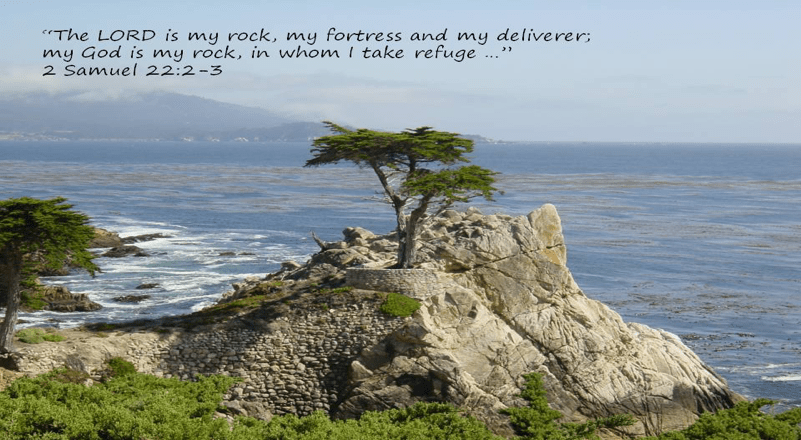
What are some characteristics of a rock or fortress? They are solid, unmovable, and unshakeable. These are some of the characteristics of God and we can confidently place our trust in him.

King David went through a lot of things in his life with King Saul trying to kill him, many battles with the enemies of Israel, and even his son trying to kill him. He looked to God to be his protector, his hiding place. Verse 7 says, “In my distress I called upon the Lord and cried out to my God.” We need to realize that God is our only hope as we go through the different struggles in our lives.

The creator of the universe, the one who created thunder, lightning, the sea, and the foundations of the world is our defender. King David tells us who his deliverer was in verses 17-20, he did not try to take any of the glory. He said, “He is my support and He delivered me because He delighted in me.” We need to realize that God delights in giving us his help and shelter during our storms. He is there for us just as he was there to help King David. He tells why God delights in him; because he kept the ways of the Lord, he did not depart from God, he kept His judgements before him, and did not depart from His statutes. But verse 23 is key. “Therefore the Lord has recompensed me according to my righteousness, According to my cleanness in His eyes.” Like I said yesterday, once God forgives you, you are forgiven. We can be thankful that when he looks at us he doesn’t see the sins we have committed in our lives, he sees his son Jesus who was sinless.

God’s way is perfect, the word of the Lord is proven. He is a shield to those who trust in Him.

psalm-121-1-2-pic