Ecclesiastes 1:1-5(NKJV) The words of the Preacher, the son of David, king in Jerusalem. 2 “Vanity of vanities,” says the Preacher; “Vanity of vanities, all is vanity.” 3 What profit has a man from all his labor In which he toils under the sun? 4 One generation passes away, and another generation comes; But the earth abides forever. 5 The sun also rises, and the sun goes down, And hastens to the place where it arose.
“Ecclesiastes” comes from the Greek “Ekklesiastes” which is from the word “ekklesia” which in the NT is translated into “assembly” or “church”. Solomon is the writer, and the book is the “Speaker to the Assembly”. Or we could say “Preacher”. These are words that the church needs to hear.
Ecclesiastes 1:14-17(NKJV) I have seen all the works that are done under the sun; and indeed, all is vanity and grasping for the wind. 15 What is crooked cannot be made straight, And what is lacking cannot be numbered. 16 I communed with my heart, saying, “Look, I have attained greatness, and have gained more wisdom than all who were before me in Jerusalem. My heart has understood great wisdom and knowledge.” 17 And I set my heart to know wisdom and to know madness and folly. I perceived that this also is grasping for the wind.
Our readings for today and tomorrow are wisdom from Solomon about the meaning of life. He explores wisdom, wealth, work, art, and faith throughout the book. The word “vanity” used in many versions of the Bible is the Hebrew word “hebel”. It is translated in different versions as vanity, meaningless, or futility. It is a word which is not easily translated directly to English. The meaning comes from the idea of “breath” or “vapor” like the breath of steam from your mouth on a cold day. It cannot be grasped with your hands or put into a bottle or jar. Meaning in our lives without God being involved is like trying to grab ahold of that breath or vapor. People desire for their lives to have meaning and purpose. We also want to be remembered as doing things that are useful and lasting. Solomon certainly did all that a man could do in his life and had God given wisdom to work from. Yet he says that all is meaningless without the purpose of serving God. Even our Christian religious activity doesn’t have meaning without true godliness at its base. This fallen world needs to find Christ in order to find meaning. Only God in His wisdom knows what we need and has provided it for us.
Reflection Questions
Do you feel like you are grasping the wind or vapor when trying to understand life?
How does the Word of God change that?
Are you sometimes frustrated by your study of the Bible?
How does the perspective of Ecclesiastes change your thinking?
Enjoy reading Ecclesiastes today and tomorrow and try to look for the purpose of your life in the reading.
In the final portion of the book, Solomon turns to remind his readers to think often of their Creator early in life before all the “evil days” come. His point is not to just think of God when you are young, but the need to establish the foundation of one’s life in their youth. The phrase “evil days” probably refers to old age (and eventually death). As life goes on, there is more opportunity for trouble and adversity. Old age has its host of difficulties and struggles. One’s youth is often thought of as the best of times, and during that period of life it is good to develop the habit of remembering the Creator before the days of “evil” come. That doesn’t mean that older individuals cannot “remember” the Creator. Solomon is simply asserting that this practice is best formulated and built into the foundation of life at an early age before life’s complications arise and produce much turmoil and frustration.
Verses 1-7 is a whole poem that focuses on the remembrance of one’s youth and the pleasures of life that a young person is able to enjoy in contrast to the gradual decline of physical abilities and the dulling of the senses with age, a relentless progression ultimately toward death. To be “afraid of heights” and the “terrors…in the road” refer to the weakening of the body and the feebleness that accompanies aging to where a person cannot defend themselves. The “almond tree will blossom” is likely a figurative reference to the graying of one’s hair with age, like the white blossoms of the almond tree when it is in season.
The complicated saying that the “grasshopper will be a burden” likely represents small activities and simple tasks; when you are old even the smallest endeavors can seem difficult. Furthermore, when one’s “desire will fail” perhaps refers to sexual desire, but if that is true, by metonymy it refers to the failing of the physical body in general. And the “age-long home” is the place, after the failing of the body, when a person goes to the grave.
Verse 8 is a large inclusion (i.e., bookends) restating the thesis that Solomon presented at the outset of the book in 1:2, ““Utterly pointless,” says the Sage. “Everything is pointless!”
The change in voice to the 3rd person (i.e., “the Sage”) perhaps indicates that a narrator is giving an epilogue to the foregoing discourse (chs. 1:1-12:7). This epilogue functions to frame the previous discourse and Solomon’s investigation.
The summary of what Solomon discovered is that to submit to and obey God is what it means to truly live as a human being. It might be difficult to understand why Solomon asserts the “pointlessness” of life so heavily and exposes it in so many facets of life under the sun. His approach can appear to lean toward doubting everything or concluding that nothing ultimately matters (i.e., nihilism). But the pointlessness of everything he saw has driven him in the end to a deep piety and dependence on God. To understand that everything that happens under the sun has no ultimate significance or meaning only draws out the fact that meaning must reside outside of life under the sun and the work that humans do. In the face of all the oppression, injustice, uncertainty, and death in life, the Sage finds the only true meaning in life is humbling oneself before the Almighty Creator and remembering that he is God, and we are not. Our role as creatures is to worship and obey the one who makes everything and to not try and control or manipulate life, because everything we can try and do on our own is ultimately pointless. The only ultimate meaning is found in relation to the Ultimate Being whose breath fills the world and whose hand spans the universe. It is to him that we are accountable and will be judged for everything we do, whether good or evil.
So, let’s live for Yahweh and trust in him and not in our own understanding. We are weak and finite creatures, and our meaning and purpose in life can only be discovered through an obedient and faithful relationship with our God and Creator. This is the wisdom of the book of Ecclesiastes.
-Jerry Wierwille
Reflection Questions
If you were to write a book of wisdom – what would your conclusion be? Where did you learn this “wisdom” from? Do you think God would agree with your conclusion?
Regardless of your age, what changes have you seen in yourself as you have grown older? How does growing older affect your wisdom? What changes in your relationship with God would you like to see as you keep growing older? What can you do to bring this about?
What challenges do you find in Ecclesiastes 12? Will you rise to these challenges?
Solomon begins by asking “Who is like the wise man?” in a rhetorical fashion to get the reader to consider if they are like the wise man in the verses that follow where Solomon will set forth several scenarios involving a king (who represents any authority figure) and how certain responses are appropriate or not. The phrase “makes his face shine…hardness of his face is changed” refers to how using wisdom can change the way someone is presenting themselves to their superiors. One’s demeanor and conduct, if done with wisdom, can sway the other person’s opinion of them and earn them their favor.
Verse 3 is probably better as expressing the wisdom in leaving the king’s presence and carrying out his command rather than the instruction to remain since the following phrase instructs the reader to not “persist in an evil thing” by objecting to the king’s command and remaining in his presence to argue and oppose him.
An “evil thing” is likely a reference to a “bad idea” or a proposal that is not favorably received by the king. On the basis of the king’s authority as absolute, anything that interferes with or opposes his will automatically becomes “evil.” However, this is not moral evil, it is just Solomon’s way of describing something that causes trouble (the Hebrew word for “evil” also can mean “trouble”).
Wisdom would say for a person to respect those in authority and not push their agenda or object rudely to their directions. Why is that? Well, Solomon says that “the king’s word is authoritative.” Now, Solomon has in mind a monarchical government where the ruler (i.e., the king) is a totalitarian. This was the common form of government in the ancient world. But in our world, we could think of someone who has a superior rank (e.g., our teachers, boss, or civil leader).
“Whoever keeps the commandment” refers to the person who listens and obeys the king. This person will be safe, and no harm will come to them. Punishment does not fall on the one who does what they are told. Rather, the consequences are reserved for the one who rebels and disobeys.
But if there is a disagreement with the king, Solomon notes that there is “a proper time and procedure,” meaning that there is an appropriate way to provide feedback and one’s opinion for the king’s consideration. The wording here is extremely close to the wording we saw in 3:1—“For everything there is a season, and a time for every matter under heaven.”
Verse 10 begins a new section in Solomon’s discourse in the chapter. The issue that Solomon raises is about justice and retribution. He sets forth a scenario where he sees wicked people live and then die, and he watches them get buried. He even describes them as previously participating in the temple worship of Yahweh, and they received the praise of people in the city where they carried out their wicked schemes.
Here in this section, the pointlessness that Solomon is interested in expressing is about the delay judgment of these wicked people. He asserts that they were never judged while they were alive, and so it seems as though they never were punished, and the victims never received justice for their crimes.
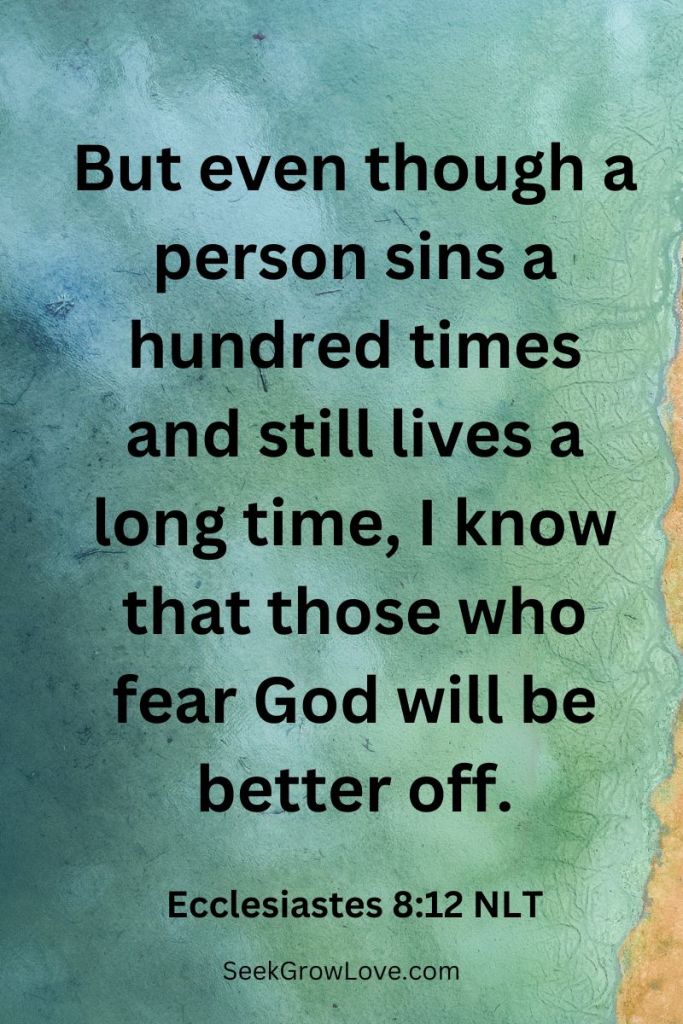
vv. 12-13—this is the first assertion that Solomon makes that departs from his methodology of observation. It is outside the scope of inquiry to know that it will be “better” for the person who fears Yahweh and is reverent before him, since all of his observations point toward an experiential indifference between the righteous and the wicked. In fact, he even notes an inversion that he sees in the world where the wicked live long and the righteous die young.
Solomon is expressing a distinction between what he “knows” and what he “observes.” What he “sees” happening is vastly different from what he internally “knows.” And so, we begin to see the dilemma that Solomon is facing in his quest. But he doesn’t resolve the tension here. He merely presents it.
Solomon expressed a similar idea in 3:16-17, where he said, “16And moreover I saw this under the sun: in the place of justice, that wickedness was there, and in the place of righteousness, that wickedness was there. 17I said in my heart, “God will judge the righteous person and the wicked person, for there is a time of judgment for every purpose and for every deed.”
The judgment of God was not something that Solomon observed. In fact, what he saw was a complete absence of justice “under the sun.” And thus, the issue of delayed justice is brought back up again in verse 14: the righteous are punished and the wicked go free.
Since the judgment of the wicked is not happening in the present world, but Solomon “knows” that it will occur, his advice is to not focus on it, but to enjoy life despite the brokenness and the injustice happening all around. The “joy” that Solomon says is to accompany one’s work and the eating and drinking the fruit of that work has been a theme already mentioned twice before in 2:24 and 5:18.
In certain circumstances in life, we often make a deductive choice on what would be at least a good way to respond. For Solomon, his deduction is at least, “enjoy life,” by eating, drinking, and being merry. This is at least a good response for humankind with the work that God has given them to do.
The exhaustive effort that Solomon has applied to his search has caused him to lose sleep. The lack of any satisfying answer has left him disturbed and unable to find rest. All day and all night, his mind is busy, preoccupied with the question that he feels he must answer. But because he cannot solve it and discover the ultimate meaning of life, he resorted to a simplified suggestion as a baseline of what he knows—it is good to enjoy life as one labors all the days that God has given to them.
Solomon offers verse 17 as a summary of his effort and makes a grand claim that he has observed it all—all the work of God—and his conclusion is that no one can find it out. No matter how thorough Solomon has been or could be in his investigation, his methods fail; he cannot discover the answer to the ultimate meaning of life. And if a wise person thinks that he can figure it out, he’s wrong, Solomon says—He can’t, because no one can.
-Jerry Wierwille
Reflection Questions
Can you give some examples of when what you “see” is different than what you “know”?
What is your approach to people in authority? Is there anything you can learn from Solomon in this chapter regarding your interactions with people in authority?
What are the benefits to being a wise person? What are the limitations to human wisdom?
In chapter six, Solomon reiterates some of his former sentiments but in a reverse fashion. In 5:18-19, Solomon said, “18Here is what I have seen to be good: it is appropriate for one to eat and to drink and to see good in all his labor in which he labors under the sun, all the days of his life that God has given him for this is his portion. 19Every man also to whom God has given wealth and riches, and has given him power to enjoy them and to accept his portion and to take pleasure in his labor—this is the gift of God.”
Solomon’s frustration has reached nearly a fever pitch by what he sees happening around him with people not being able to enjoy the wealth and honor that God has given them. He offers an anecdote to explain the “evil” that he sees happening “under the sun” and the heavy weight that is upon all humankind: God gives to a person “wealth, riches, and honor” to the degree that they have no lack of anything, and they have all that ever desired. But that is all that they get! God does not give them the accompanying ability to enjoy the bounty and pleasant life that having everything you want is supposed to offer.
Solomon cannot understand why this is the case for some people. His logic is that if someone works hard and God gives them “wealth, riches, and honor,” but then they don’t get to enjoy those things, but rather someone else does, this is wrong and unexplainable in his eyes. To “eat” something was often a metaphor for fully experiencing and enjoying it. It is as if Solomon is thinking, “Why shouldn’t someone get to enjoy the fruit of another person’s labor?” And so, he is repulsed by this observation and finds it entirely enigmatic and confusing.
We are not told why God would withhold giving a person the ability to enjoy the benefits of their hard work and the revenue and recognition that it has produced. But the answer to “why’ really isn’t the focus of his story. Instead, Solomon is bewildered that it even happens at all, and that in his view, such a reality is mysterious and frustrating. He even goes so far as to say that this is an “evil” and a “severe affliction.”
In vv. 3-6, Solomon considers that as enjoyable as having a large family with many children would be, it can’t be the answer to his question about the meaning of life because Solomon says that even if a person had a hundred children, if their “soul is not satisfied with good things,” then it is all pointless. So apparently, children are not the answer for true satisfaction in life.
It is the absence of enjoying the “good things” that brings discontentment. But what are those “good things” if not one’s family? The “good” that Solomon has mentioned already in the book of Ecclesiastes is eating, drinking, and rejoicing in one’s work (5:18). Essentially, Solomon is saying that no matter how good the circumstances are or what you possess or what you can do, if you don’t simply enjoy life, then everything else is pointless.
Furthermore, in his vexation over this issue, Solomon turns to offer a dark comparison by suggesting that a stillborn child is better off than a person who remains unsatisfied in life. This is a grisly move that is emotionally charged, for Solomon thinks that the baby who never had the chance to draw breath is better off than a person who lives an unsatisfied life. Now, Solomon is not defying the Creator and saying that life is worthless and not even worth living. Remember, what Solomon says he says with a certain perspective in mind. Here, he sees the stillborn baby as not having to suffer and endure the frustration and pointlessness of all that goes on under the sun. They don’t have to be subject to a life deprived of enjoyment and filled with futile desires that can never be met.
Solomon appears to move on from this thought (vv. 1-6) to address yet another issue: wisdom and foolishness.
In broad terms in verse 7, Solomon attributes the reason for all human work as being aimed at satisfying his sensual desires, but those desires are never fulfilled. A person is never completely content and satiated—the desires just keep returning. And so, the search for satisfaction is never ending; it is a vicious cycle that keeps spinning. Thus, the inability to find satisfaction is a deep frustration to Solomon.
Solomon perceives that perhaps there is an answer in the teaching of wisdom as wisdom was viewed in the biblical culture as the normative way to acquire material wealth. If a person was wise, then they would be blessed and would prosper and accrue riches. But the wise are not immune to the desire for wealth and material goods which ultimately does not lead to satisfaction.
Furthermore, Solomon does not find wisdom to provide an advantage for the poor person. His point is not that wisdom is unable to help the poor person in their material needs, but that wisdom doesn’t give the poor person an advantage in finding satisfaction in life. Even if the poor person were to gain wealth through employing wisdom in their dealings, they are no closer to satisfying their true desires than the person who was wise to begin with. Wisdom can help a person obtain money, but not meaning in life.
Verse 9 provides the proverbial statement, “Better is the sight of the eyes than the wandering of the desire.” The general idea of the proverb is that what is present in one’s hand that they can use and enjoy is much better than what one desires but does not yet have (and may never have).
Beyond these issues, many questions can plague a person about their life, but which of them can provide the answer to the meaning of life. Solomon exasperates himself to no end trying to understand this answer. Ultimately, he seems to think that no one can know what is “good” for a person in life since life is so brief, and no one can know what will happen in the future after they are gone. Endless questions about if what we do now will have any lasting effect for those who come after us. But we are all left not knowing if there is a “profit” in what we do because we are limited to only knowing the here and now. “For who can tell a person what will be after him under the sun?” (v. 12b).
-Jerry Wierwille
Reflection Questions
Where do you agree with Solomon? Anything you disagree with in Ecclesiastes 6? (Remember, he has not yet come to his final conclusions.)
Can you give some examples of where you have found truth from the proverb in Ecclesiastes 6:9?
How content are you right now with your life? Why or why not? What might Solomon say to you? What might God say to you?
After plodding through Ecclesiastes 1 and 3 over the last two day’s devotions, we are finally at Ecclesiastes 12, where Solomon has his reveal about the meaning of life. Verse 1 starts out the chapter with, “Remember your Creator in the days of your youth, before the days of trouble come and the years approach when you will say, I find no pleasure in them.”
The next 7 verses highlight why the elderly may not find pleasure in their old age – because they experience things like fading eyesight, losing hearing, developing tremors, stooping because of osteoporosis, losing teeth, unable to sleep – and then die.
So what does it mean to “remember your Creator?” Is this like “remember to take out the trash?” No. And it entails a lot more than just thinking about Him once in a while. When you’re tempted to enjoy the pleasures of sin, remember your Creator. When you’re tempted to live your life in rebellion against God, remember your Creator. When your peers are doing something you know is wrong and you’re tempted to join in, remember your Creator. It means putting God at the forefront of your thoughts, dedicating your life to Him, and living for Him.
I think there are several practical reasons to start serving the Lord while you are young. Here is a partial list:
Life in a close relationship with God is satisfying and fulfilling, so the earlier you start that relationship with Him, the longer you’ll experience meaning in your life.
By accepting God while you are young, you will spare yourself a lot of pain and problems that you would experience in a life of rebellion against God.
You may want to live it up while you are young and plan on a “death bed confession” (giving your life to the Lord just before you die). But we never know when we may die. Accidents happen. And you don’t want to suffer the eternal consequences of not devoting your life to the Lord.
You may get dementia as you age, and won’t be able to make a decision for the Lord late in life.
As people age, they get more set in their ways and find it more difficult to change.
I think Solomon is giving good advice, “remember your Creator in the days of your youth.”
At the end of Ecclesiastes 12, we finally come to Solomon’s conclusion when seeking the meaning of life. Ecclesiastes 12: 13-14 read, “Now all has been heard; here is the conclusion of the matter: Fear God and keep his commandments, for this is the whole duty of man. For God will bring every deed into judgment, including every hidden thing, whether it is good or evil.”
Fear includes a lot more than being scared of God. It includes being in awe of Him. Giving Him reverence. Giving him glory. Giving Him your life (living for Him).
To paraphrase Solomon, the bottom line is this:
You can live your life your own way, and experience a life that is meaningless and unfulfilling, then die. Or you can live your life God’s way, and experience a life that is meaningful and fulfilling, and then die.
Either way, you will die. And when Jesus returns, you will face judgment. If you have lived your life your own way, you will face condemnation and the second death. If you have lived your life for God, you will receive commendation and will enjoy eternal life.
The only rational choice is to “fear God and keep his commandments.”
You don’t have to be rational. But you do have to choose. Choose wisely.
–Steve Mattison
Application Questions
Look again at the list of reasons to start serving the Lord while you are young. Is there anything else you would add to it?
If you have started serving the Lord, when did you start? Why was that a great time to do it? If you haven’t yet, what are you waiting for?
Solomon was the wisest person who ever lived (see 1 Kings 3:10-12). He wrote the book of Ecclesiastes to probe the meaning of life. It’s widely believed that he wrote this toward the end of his life, after he had experienced much of what life had to offer.
Let’s look at some of the treasures of wisdom Solomon wrote down:
Ecc 1:2, “Meaningless! Meaningless! says the teacher. Utterly meaningless! Everything is meaningless.”
Ecc 1:11, “There is no remembrance of men of old, and even those who are yet to come will not be remembered by those who follow.”
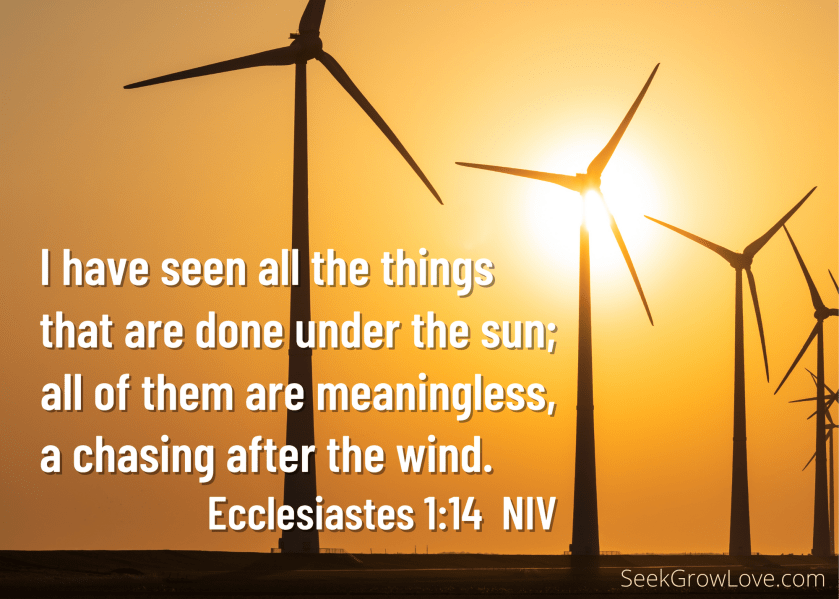
Ecc 1:14, “I have seen all the things that are done under the sun; all of them are meaningless, a chasing after the wind.”
Ecc 1:17, “Then I applied myself to the understanding of wisdom, and also of madness and folly, but I learned that this too is a chasing after the wind.”
Ecc 1:18, “For with much wisdom comes much sorrow; the more knowledge, the more grief.”
We’re only covering chapter 1 here, but chapter 2 goes on to point out the uselessness of pursuing wealth or pleasure or accomplishing great things.
What’s going on here? Does life just stink?
Solomon is pointing out the futility of living this mortal life to the fullest – apart from God. If all we have to look forward to is death, life is indeed meaningless. It doesn’t matter how much we pursue pleasure, wealth, or anything else that our hearts desire – our life will be unfulfilled, without satisfaction, without joy, without purpose, and without hope.
When my wife was dying after a four-year battle with cancer, we could both take comfort in the fact that we have the hope of the resurrection, and eternal life to look forward to. Even in death, we have hope of future joy. Living a life for God gives us hope. Our life can be fulfilling, with satisfaction, purpose, and joy.
It takes a lot of people a very long time to figure this out. My challenge to you is to carefully consider the meaning of your life today. Choose a life of submission and service to God, and your life won’t be meaningless. Or go your own way, and identify with Solomon’s Ecclesiastes.
–Steve Mattison
Question Application
What do you spend a lot of time (effort, or money) on that Solomon, or God, might consider “Meaningless”?
Have you found anything that gives life satisfaction, purpose and joy? Where would you look?
Throughout chapter 20, the Pharisees attempt to undermine Jesus with trick questions, and starting at verse 20, they decide that they’re going to try to pose him another unanswerable question. They comment on his lack of favoritism in his teaching, although it seems to imply that they are cynically calling him out on a lack of respect for authority. Following up on this, they ask him another question meant to undermine his teachings.
They ask Jesus whether or not they have an obligation to pay taxes to Caesar. This has an important historical context behind it, because there had been several Jewish revolutions against Roman occupation that had turned out terribly for the Jews. The Pharisees, who were cooperating with the Roman governors much to the expense of their own people, were essentially asking Jesus an impossible question.
Consider this, if Jesus had answered that they were obligated to pay taxes, then he would be implying the relevancy of both Roman authority and the authority of Pharisees and would be undermining the tenacity of his own teachings. However, if he had spoken against the need to pay taxes to Caesar, he would be openly defying Roman authority and so would be putting himself on grounds of treason, and would have been executed as quickly as it could be reported to the Romans. As it was, Jesus’ answer was simple and avoidant, while also proving a much larger point to them. His response is to take a look at whose face is on the coin, which was Caesar’s face. He then tells the Pharisees to give to Cesar what is “his” and give to God what is “God’s”.
Not only did Jesus successfully navigate around their impossible question, but he also gives a stronger context for understanding his teachings as well. This seems to tie into what Jesus meant when he said that his purpose was not to destroy the law, but to fulfill it. According to Jesus, the call that we have is a moral one beyond the law or social convention. Neither is he advocating that law is unnecessary. Rather, he invites us to be pragmatic about the circumstances, but understand that the truth he teaches is a way of finding meaning in our lives, rather than how to simply conduct it.




 Seek Grow Love