Surviving a Deadly Plague of Snakes

Numbers 21:9 NIV for SGL

Old Testament: Numbers 21 & 22

Poetry: Job 17

New Testament: Mark 3

In today’s reading, the Israelites needed a spiritual “blood transfusion.” Their sinful and rebellious attitude had shown itself in impatience, complaints about hardships, ingratitude for manna, and a lack of faith in God’s leader, Moses. This faithlessness resulted in a deadly plague of snakes that were killing the people.

The Israelites repented and asked Moses to intercede for them. God’s response required them to show their repentance by a simple act of faith. Moses made a bronze serpent and lifted it up on a pole. To be healed, people had to look at the serpent. If they didn’t believe God’s words, they wouldn’t look up and would therefore die. Only through faith could they be saved.

Homeopathic medicine is the practice of curing likes with likes. The patient receives diluted doses of substances that, at full strength, cause the same symptoms the patient already has. This type of medicine is used in many parts of the world, though it remains controversial among medical experts. In this instance, God prescribed a similar remedy for Israel, treating snake bites with a replica of a snake. Going a step further, God undid the effects of the plague through an image of the curse itself.

Today’s story begins with the people grumbling … again. It was the same old story: we’re dying, we’re starving, we don’t like the miraculous food, and we’re sorry we ever left Egypt. But this incident is unique; this time, the people repented.

In past events, Moses had asked God for mercy on behalf of the Israelites, but on this occasion, his prayers were prompted by a recognition of their sin that Israel hadn’t shown before. They realized on their own why the snakes were sent, and they confessed their sin. In that way, this was a spiritual breakthrough for Israel!

If God had followed the formula we’ve seen so far, we might expect Him to demand a sacrifice of some kind, like a lamb without defect. But the Lord told Moses to put a bronze snake, a picture of judgment, on a pole for all to see. He directed the people’s eyes, not to an image of purity, but to a symbol of wrath.

For healing to take place, the people had to close the loop of repentance. They sinned, confessed, and asked for mercy. The last step was to accept God’s remedy by faith and follow His instructions.

We often picture Christ as the perfect sacrifice, and that he is. But He also took upon Himself the shame of sin and the full penalty of wrath. In His conversation with Nicodemus, Jesus compared His upcoming crucifixion to the lifting up of the serpent in the desert. Let’s confess our sins, seek His mercy and turn our eyes to him, who not only gave his life but also received our punishment. Thank Him in word and in deed today.

Andy Cisneros

(Originally posted on March 3, 2020 for SeekGrowLove)

Reflection Questions

  1. What have you most recently complained about? Do you often complain? Is there a problem with complaining and grumbling? How do you think others view your complaining? How do you think God views it?
  2. What role does confession and repentance play in your relationship with God and others? How has God shown His mercy to you when you have repented? Is there anything you need to confess and repent of?
  3. After the Israelites confessed and repented what did they have to do next? What does God expect from us after confession and repentance?

Handling Hardship

Numbers 11:23 NIV for SGL

Old Testament: Numbers 11

Poetry: Job 10

New Testament: Acts 24

Ok, we know that things are not going to go well when we read, Now the people complained about their hardships in the hearing of the Lord, … (Numbers 11:1)

Why would they do that? The Israelites grumbled, argued and complained, but this never works out for them. Honestly, if we look at our own lives, are we guilty of this too?  Do we show God that we are thankful for our life and the provisions that He gives us?  If I may quote Madame Blueberry: “A thankful heart is a happy heart.”  But, the Israelites are not thankful, and they are not happy.  In Numbers 11, they complained about their hardships in the hearing of the Lord, and when he heard them his anger was aroused. Then fire from the Lord burned among them and consumed some of the outskirts of the camp.

So, surely they adopted a new way of doing things, a new way to react to the situations that arose. Nope.

“The rabble with them began to crave other food, and again the Israelites started wailing and said, “If only we had meat to eat!  We remember the fish we ate in Egypt at no cost—also the cucumbers, melons, leeks, onions and garlic. But now we have lost our appetite; we never see anything but this manna!” (verses 4-6)

Wow. Yep that slavery, that was the good life. Sure, they lived lives of servitude, but they had cucumbers.

Unfortunately, this complaining spread until Moses heard the people of every family wailing at the entrance to their tents. The LORD became angry and Moses was troubled. This is where I think we can learn from the way Moses responds.  He asked the LORD.  He is troubled because he is in a situation that is impossible for him to handle alone.  He just has an honest conversation with the LORD. We see him react in the same way that he did in chapter 9 when he is asked a question about the Passover feast.  He told the people to wait until he found out what the LORD commanded concerning them. I think that is how all of us should handle hardships.  We should talk with God about what ever is troubling us. If we are in a continual conversation with the LORD, we bring him our praises and requests continually too.

Moses told Him that he could not carry all those people by himself; the burden was too heavy. The LORD had a solution for him. The LORD would take some of the power of the Spirit that was on Moses and put it on seventy of Israel’s elders.  They shared the burden of the people so Moses did not have to carry it alone. As far as the request for meat, the quail arrived when the LORD said it would.  Even Moses did not know how God could do it, but again he talks with God about it. I wonder how things would have gone for the Israelites if they had humbly thanked God for their manna and asked for meat.  The LORD could even have thrown in cucumbers if He wanted to.  From today’s reading lets be encouraged to pray continually sharing our hardships and praises with God.

-Rebecca Dauksas

(first posted for SeekGrowLove on September 3, 2016)

Reflection Questions

  1. When hardships hit do you spend more time complaining or praying?
  2. If you were a pastor/youth leader or spiritual counselor for the Israelites what issues or problems would you address with them? Which of these problems do you have as well? What could they – and what can you – do to work towards fixing these problems?
  3. What do you learn about the Lord God in Numbers 11?

God’s Guidance System

Old Testament: Numbers 9

Poetry: Job 8

New Testament: Acts 22

My college kids and I just completed a 2100 mile spring break trip with Apple Maps guiding the way – telling us when to turn, when to go straight and when to reroute. The Israelites preparing to set out into the wilderness missed out on this modern technology, but they had something so much better.

They had been camped out in the region of Sinai and it had now been two years since they had left Egypt. During this time they were learning God’s commands and learning what happens when you break them. Also, the tabernacle was being built and furnished and set up so God would have a dwelling amongst them, even during their coming travels to the Promised Land.

But, without maps (print or digital) how would they know where to go? I enjoyed what Kyle McClain had to say about their direction system in his March 4, 2021 devotion for SeekGrowLove, so I will share that here:

“Truth be told, there are a ton of events recorded in the Bible that would be flat out awesome to see firsthand!  Of all the awesome things to see, Numbers chapter 9 records one of the top 10 things that I would have liked to have witnessed firsthand – maybe top 5.  That awesome thing recorded is the pillar of fire that guided the Israelites where to go at night.  During the day, a pillar of cloud guided them, but at night it had the appearance of fire.  How cool would it be to see the pillar of fire in the sky at night?!  I would say top 10 throughout the whole Bible!  Our God is incredible, and he is capable of some awesome feats.

I don’t think many of us are going to be led by a pillar of cloud or fire.  However, similar to the Israelites, we can and should still be guided by God.  There’s a very good chance that the guidance that God provides you will not be as obvious as the pillar of cloud or fire.  Therefore, we really need to be in tune with God and keep our eyes, ears, heart, and mind open to His guidance.  There are a number of ways in which God can lead us, so we should be ready at all times.  If we are actively seeking God’s guidance, then we are much more likely to see it.  That has to do with our Reticular Activating System in our brains.  If you don’t know what that is, then look it up on Google or YouTube.  You’ll be amazed.

 I would encourage you all to pray to God to help you become susceptible to God’s guidance.  You may be surprised with all the ways that God attempts to guide you.”

Also in Numbers 9 we see Moses setting a great example of what to do when we are unsure of how to proceed and don’t know what God wants us to say or do. Some Israelites asked Moses if they were able to celebrate the Passover because they were unclean at the time (had recent contact with a dead body). Moses wasn’t sure. God hadn’t told him, yet. Instead of making up something on the spot that sounded smart at the time, Moses said, “Wait until I find out what the LORD commands concerning you” (Numbers 9:8). And God rewarded Moses’ wisdom by giving His answer.

What do you do when you don’t know where to go or when to go and when to stay? Seek direction from the Lord! When you don’t know the answer, like Moses, wait until you find out from the Lord. And what do you do as you wait? I do not recall any time I have received direction from God while I am watching the latest tv show or scrolling on my phone. However, I have lost count of the number of times I have received God’s direction while reading from His Word. His answers are there for your life, too. Faithfully stay in His Word, following His guidance system.

-Marcia Railton and Kyle McClain

Reflection Questions

  1. What do you do when you don’t know where or when God wants you to go or stay or say or do?
  2. When have you received God’s direction in your life? Did you follow it?
  3. What do we also learn from Paul in our Acts reading today about following God’s direction?

Homemade Idols

*Old Testament: Exodus 31 & 32

Poetry: Psalm 32

New Testament: Matthew 27

I grew up on a farm and was around cows a lot. Never once did I find qualities to be worshipped in our cows. Sure, sometimes they did something cute or funny, but to lift a calf into idol worship seems ridiculous to me. Yet many ancient cultures worshipped the bull. Apparently, the Hebrew people were aware of this practice, too. So while Moses is receiving the Law of the Lord on the mountain, Aaron is left in charge. The people told him to make them gods who would go before them. And amazingly he does it. He creates the idol from their jewelry. Aaron goes on to build an altar in front of it. He announces that they will have a festival to the Lord with burnt offerings and fellowship offerings. The LORD is writing instructions for Moses of who He is and how they can worship Him, but they decide to create their own idol and practice their own form of worship. Along with these bad decisions, they eat, drink and indulge in revelry.

The golden calf should illustrate the ridiculousness of placing anything or anyone in a position of worship. The LORD is the only One who should be there.

I wonder if we had our modern-day idols put out on public display with altars in front of them, what would we find? Things that represent power, relationships, careers, educational degrees, wealth, fame…What offerings are being given for these idols? Are we offering most of our energy, time, focus or money?

Even good things can become idols when we make someone or something else the highest priority in our lives. Material possessions can be viewed as blessings from the LORD. We can thank Him for them and use them to help others. When we do this, we are using God’s blessings for good, but if we become consumed in our material possessions, they become an obstacle to fully loving and serving the LORD.

We should ask ourselves, “Does anything or anyone hold a higher priority in my life than the LORD?”  In Colossians 3:5 we are told to “Put to death, therefore, whatever belongs to your earthly nature: sexual immorality, impurity, lust, evil desires and greed, which is idolatry”.
So we see here that evil things need to be eliminated from our life before we find that they have become idols.

The Hebrews show us the seriousness of putting idols in the place of the LORD. They made themselves a laughingstock to the other nations and they broke a blood covenant with the LORD. (Ex. 24:7-8) How much better it would have been if Aaron had refused? Even when leadership falters, we should stand for the LORD. Let’s move out any idols and make the LORD the center of our world by loving Him with all our heart, soul, mind and strength.

-Rebecca Dauksas

Reflection Questions

  1. Does anything or anyone hold a higher priority in your life than the LORD? What or who? 
  2. What offerings are being given for these idols? Are you offering most of your energy, time, focus or money to anything or anyone who is not the LORD God?
  3. What will you do to put God first (either again, or for the first time in your life)? What changes need to be made? What habits need to be broken? What habits need to be started? What will you do today to make it so? 

The Big Ten

Old Testament: Exodus 19 & 20

Poetry: Psalm 27

New Testament: Matthew 23

Today’s reading of Exodus 19 & 20 is probably one of the most familiar passages in the whole Bible for it includes the Ten Commandments.  It is important to understand the context of these commandments.  God entered into a covenantal relationship with Abraham and Abraham’s descendants through Isaac and Jacob and Jacob’s sons who became the twelve tribes of Israel.  God promised to bless and provide for his people and in exchange His people promised to be faithful and obedient to God and worship God alone.

After 400 years of slavery, Israel has grown from 12 sons and their immediate family to millions of people.  These people, God’s covenant people, will be settling in a land where they will need to live in community.  They are no longer slaves.  They are now responsible to live in that community in peace and productivity.   They need help to know how to live together.  God provides His people with the structure of how to live together as God’s people.  The Ten Commandments and subsequently nearly 600 additional laws were all designed to help them be healthy and blessed representatives of God to the rest of the world.

God loves all people.  We must never falsely believe that God only loves certain people.  God considers all human beings His children and loves them all.  God wants to be in a right relationship with all of his children; however, many are disobedient and have no willingness to be in a relationship with God and many deny that God even exists.

So God needed to start with one group of people and prepare them to be a special, chosen people who would bring the knowledge of God to others.  Exodus 19:5-6 says, “Now if you obey me fully and keep my covenant, then out of all nations you will be my treasured possession. Although the whole earth is mine, you will be for me a kingdom of priests and a holy nation.’

Israel was to be a kingdom of priests and a holy nation.  A priest is one who helps connect people and God.  God would go on to designate priests in Israel to help the people connect with God, but His expectation for Israel was that the whole nation serve as priests to help other nations connect with God.  Because the whole nation was being set apart by God to be priests for the world, they needed to live holy or set apart lives.  There were behavioral expectations that they were to follow.  They had to be exclusively loyal to God, they could not murder, steal, lie, cheat, they were to be respectful and honoring of parents and not misuse God’s name.

Now we are completing what God began in Israel.  Through Christ we have entered into a covenant with God.  We are now the covenant people, we are called to be a kingdom of priests and a holy nation.  That is the Church’s role.  And God expects us to live lives of holiness as we are set apart to serve God.  As you read through the many laws in the Old Testament, recognize that some applied very narrowly to the Nation of Israel and do not necessarily apply to us.  Dietary laws and sanitary laws were important in Israel at the time they were given but are no longer applicable.  However, some of the laws which pertain to morality have been reaffirmed by Jesus Christ for the Church.  In other words, as Christians we are free to eat pork and worship on Sundays, but we are not free to practice polygamy or murder.

God is truly a God of grace and mercy, but God is also a God who hates sin and punishes sin.  In this way we are still to live in fear of the Lord: Exodus 20:20 “the fear of God will be with you to keep you from sinning.”

Jeff Fletcher

(originally posted Feb 5, 2020 for SeekGrowLove)

Reflection Questions

  1. Looking at each one of the Ten Commandments, what can you learn about God? Why do you think He included each one in this list?
  2. Which of these commandments do you need to look at more closely in your own life? What will help you abide by them better?
  3. Looking at Matthew 23, the scribes and Pharisees Jesus was speaking about had worked hard at following the Ten (and additional commandments). But Jesus was not pleased. What were their problems? How can you avoid these problems?

The Long Way Around

Old Testament: Exodus 13 & 14

Poetry: Psalm 24

New Testament: Matthew 21:33-46

I love a good underdog story. And there aren’t many better than the slaves overcoming Pharaoh. 

There are SO MANY phrases that stick out to me as I am reading Exodus 13 & 14 that make this story stand out as a grand and glorious experience of what God can do and why it is worthy of being remembered. 

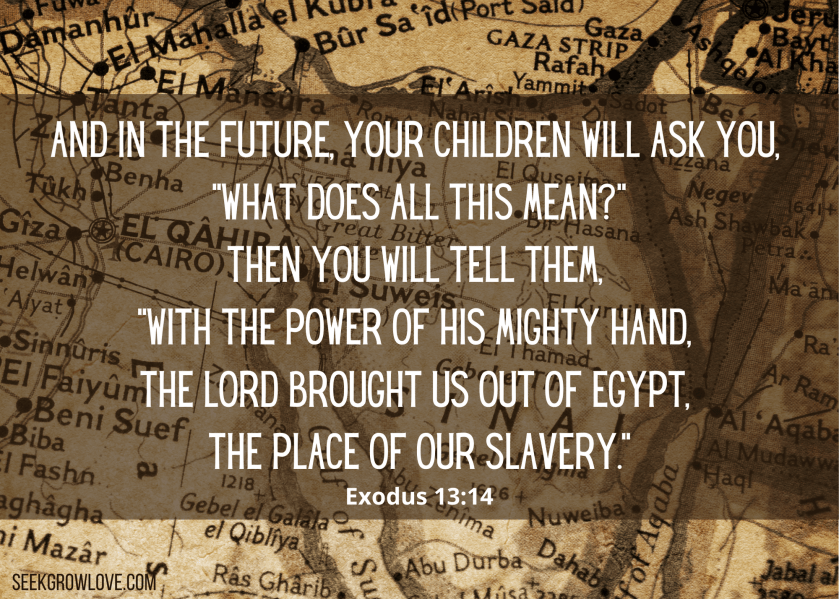
The Israelites have JUST left behind their lives as slaves. And God says – let’s remember this event, every year, in fact, for 7 days every year let’s celebrate my power and goodness and these events unfolding now. And why? So you and your future generations can be reminded “that the law of the Lord is to be on your lips; for with a powerful hand the Lord brought you out of…” (Exodus 13:9)?  What reminders and signs and symbols do you have on your calendar and in your home and in your life that remind you and the future generations to speak of God’s power and rescue and goodness? 

Do you ever get frustrated when the GPS sends you the long way around when you know the area just well enough to know there is a shorter way which is generally quicker? Or, maybe you can relate to when God doesn’t send the quick and easy answer you had in mind, but sends you on a completely different path in life, perhaps even through the desert. God did the same for the Israelites – for a very good reason. We don’t always get to see, hear or understand WHY the GPS sent us this way instead of that. Perhaps there was an accident ahead or a bridge out and so a better route was selected. Similarly, we don’t always get to see, hear and understand God’s reasoning on why He chooses which path to send us on. But in this particular case Moses writes that God knew the quickest route to the promised land would be through the Philistine country. But, he also knew they weren’t ready for war and if they faced war now they might get scared and return to Egypt. ”So God led the people around by the desert road toward the Red Sea.” (Exodus 13:18). Can we trust that God knows best, even better than our GPS? He knows which road is best for you, too.

Even when it seems to end at the Sea.

Because, at the edge of the water God does some pretty amazing things! Well, actually, He doesn’t wait til we get to the edge. He was sending a pillar of cloud to guide them during the day and a pillar of fire to guide by night – that sounds like a pretty cool night light to follow. God was showing His protection and guidance, but can you imagine the fear they must have felt when they looked up and saw the Egyptians coming after them, as they were at the edge of the Sea. Terrifying fear that leads to anger and outrage directed toward Moses and the Lord. But Moses says, “Do not fear! Stand firm and see the salvation of the Lord that he will provide for you today; for the Egyptians that you see today you will never, ever see again. The Lord will fight for you, and you can be still.” (Exodus 14:13,14 NET). What fearful situations have we found ourselves in where our fear turns to anger toward God and men? Could it be God is telling us to stand firm to see how He will deliver us, save us, and fight for us? 

I love how it says the angel of God and the pillar of cloud which had been leading the way now moved to the rear, positioning themselves between the scared Israelites and the powerful Egyptians and all night the cloud brought darkness to the Egyptians and light to the Israelites. 

Now the stage is set and God acts – again – in a mighty way! He sends a strong east wind all night long. We’ve all seen some amazing and terrifying things wind has done. But this beats them all. A wind strong and long enough to drive the sea back and turn it into dry land, with a wall of water on the right and a wall of water on the left. Typically people don’t survive well in hurricane force winds that create walls of water. But on this miraculous night, the people, young and old as well as all their flocks and herds all walk across the sea on that dry land! Can you imagine the amazement and awe and dream-like experience that must have been! I wonder if it was difficult to walk upright? I wonder how wide the dry path was for the 600,000 men (and women and children)? I wonder if there were children on the edge of the dry path trying to run their fingers through the wall of water while their mothers were urging them ahead. I wonder what the Egyptians thought as they followed in their chariots, still in the dark. 

Exodus 14:24 says, “During the last watch of the night the Lord looked down from the pillar of fire and cloud at the Egyptian army and threw it into confusion.” Some versions say He made the wheels come off the chariots, others translate it that He jammed their wheels so driving the chariots was difficult. Either way, it seems to me a bit humorous – as long as I am not an Egyptian. We love to remember the God who saves His people – as long as we are one of His people. It would be wise for us to also remember He can and has and will frustrate and confuse the way of His enemies, and make sure we are not in that category. 

Don’t find yourself still in the dark – walking on the wrong side of His cloud of protection and guidance. God is providing light on the other side. Seek Him and what pleases Him. And Stand Firm and watch His salvation. 

-Marcia Railton

Reflection Questions

  1. In what ways have you seen God provide favor, protection, guidance and sometimes even miraculous intervention to save His people? 
  2. Is there a time God may have led you on the longer, indirect route to save you from an unknown pain on a shorter more direct route? 
  3. How will you seek to remember and share with future generations what God has done – both during the time of the Israelites and in your life as well? 

The Hope of the Passover Fulfilled

OLD TESTAMENT: EXODUS 11-12

POETRY: PSALM 23

NEW TESTAMENT: MATTHEW 21:28-32

One of my favorite movies growing up was Dreamwork’s The Prince of Egypt. I loved the music and the story, though it was slightly embellished for dramatic effect. In the movie, Moses and Rameses are the best of friends in addition to being brothers. As plagues ravage Egypt, Moses and Rameses face off against each other, asking each other “Is this what you wanted?” The Bible never talks about Moses and Rameses being close or caring for one another. But, I do think the movie captures what happened to Egypt. 

Egypt destroyed by the plagues in Dreamwork’s Prince of Egypt

As the Israelites gathered up their belongings after the Passover, they walked through a city in complete ruins, statues falling over and temples broken. God had triumphed over Pharoah and the Egyptian gods, and now the Israelites were on their way to freedom. 

The Passover lamb (another sheep reference) is a preview of both the law and the sacrifices that would be required for our sins and the ultimate fulfillment of the law in the sacrifice of Jesus on the cross. Our Matthew readings for the week show Jesus as he grows nearer to the time of the cross. In fact, Jesus enters Jerusalem in Matthew 20 to celebrate the Passover. 

In Matthew 26:17-30, Jesus celebrates the Passover with his celebrates. He breaks bread with them and then tells them that he will not have the Passover banquet again until the kingdom of heaven (Luke 22:14-18). The wedding banquet of the lamb is the hope that we have in the Kingdom (Revelation 19, Matthew 22) – that are sins are passed over forever, as we are raised up incorruptible in a new heavens and a new earth (1 Cor. 15:52). The Passover was a sign of salvation to the Israelites, a testament that they were to observe for generations to come. We can read about the Passover today and be reminded of what is to come in the kingdom. 

We should want to shout in jubilee, believing in the miracle of God rescuing us from the bondage of sin and shame. 

Matthew 21:28-32 leaves us with a caution. As we look forward to this coming kingdom, we want to be the ones who are faithful to the end. The parable draws a distinction between the brother who said he was going to work and the brother who actually worked. In the grand scheme of things, it doesn’t matter how much you talk about Jesus if you don’t actually follow him. You have to leave your life in bondage to sin and go forward to your new life in Freedom. Your life must change. The new focus of your life should be to work for the good of the kingdom of God. 

Psalm 23 ends in this way, 

“You prepare a table before me

    in the presence of my enemies.

You anoint my head with oil;

    my cup overflows.

Surely your goodness and love will follow me

    all the days of my life,

and I will dwell in the house of the Lord

    Forever.”

We see another table set, another banquet, a foreshadowing of the Passover fulfilled, the marriage feast. David trusts completely in God, even in the midst of his enemies. The final words – the sweet hope of David – is to dwell in the house of the Lord forever. The desire of David’s heart is not those green pastures, those quiet waters. The true desire is to be in the presence of God, and the beautiful thing is that being in the presence of God leads to places of beauty and comfort – maybe in this life but definitely in the kingdom. 

May that be the desire of our hearts: To long for the marriage supper of the Lamb. 

~ Cayce Fletcher

Cayce writes about discipleship, productivity, and homemaking at her blog https://amorebeautifullifecollective. You can find her latest post on creating a theme of the year here. You can also listen to A More Beautiful Life Collective Podcast on Apple Podcasts, Spotify, YouTube, or wherever you listen to podcasts. 

REFLECTION QUESTIONS

  1. How do you think the Israelites felt as they left Egypt? How do you think the Egyptians felt? 
  2. Which brother are you in the parable of the two sons? The worker or the talker? 
  3. What do you hope for most in the coming kingdom? What are you most excited about? 

SGLCalendar2024DOWNLOAD

Who are you following? 

OLD TESTAMENT: EXODUS 9-10

POETRY: PSALM 23

NEW TESTAMENT: MATTHEW 21:1-27

The showdown between Moses, God, and Pharaoh’s hard heart escalated in our reading today. What God said would come to pass did: Pharaoh continued to harden his heart again and again despite the plagues that came upon Egypt. At one point, the officials said, “How long will this man be a snare to us? Let the people go, so that they may worship the Lord their God. Do you not yet realize that Egypt is ruined?” (Exodus 10:7). We see the same cycle repeated. At first, Pharaoh was completely unyielding. But, as harsher and harsher plagues were brought upon the people, Pharaoh began to consider letting the Israelites go. 

Exodus 9:15-17 says, “For by now I could have stretched out my hand and struck you and your people with a plague that would have wiped you off the earth. But I have raised you up for this very purpose, that I might show you my power and that my name might be proclaimed in all the earth. You still set yourself against my people and will not let them go.”

Hail rained down and wiped out everything in the fields. Pharaoh finally said, “This time I have sinned. The Lord is right and my people are wrong” (v. 27). It would seem like the plagues could finally stop right? Pharaoh finally humbled himself and was willing to let the people go. After the plague stopped, Pharaoh changed his tune. His heart was hardened, and he refused to let the people go. 

He followed this same cycle of refusing, repenting, hardening his heart, and refusing again with the plague of locusts and darkness. Reading through this story, you might wonder why Pharaoh didn’t see that by hardening his heart, he didn’t gain anything. In fact, he led his nation into ruin with his pride. If he had just let the people go, he would have saved everyone from a lot of pain and suffering. 

It’s interesting to consider that the pharaoh was considered a god by the Egyptian people. Pharaoh is so rash, foolish, and fickle, compared to the God of the Israelites. Pharaoh kept deciding to do something and changed his mind once his feelings changed. Would that be a god you want to follow? 

In Psalm 23, we read about how God, as our shepherd, leads us on right paths. Lysa TerKeurst describes this scene: 

“We might imagine lush green hills like you’d find in Ireland, but David’s reality was the steep, rocky, dry Judean hills. Hills that had to be carefully traveled in order to get to the water and vegetation waiting in the valleys below.

Shepherds leading their flocks also had to be cautious about the timing of their trips. Hard rains could quickly lead to flash floods in a gorge. When a shepherd knew a storm was coming, he wouldn’t allow the sheep to be down in the gorge because they’d drown; instead, he’d wait patiently until the storm passed to lead his flock down to drink. So not only did sheep have to trust where the shepherd was leading them; they had to trust the when of his leading.

The Hebrew word for “paths” in Psalm 23:3 referred to well-worn or deep ruts that were actually good ruts, important because they marked the safest paths. While these paths could be formed by one shepherd over time, it’s more likely they were formed by other shepherds who’d gone before — generations of shepherds wisely walking the same paths. Even today, you can literally look at the hills in Israel and see paths the shepherds have been walking for generations.”

Valley of the Shadow of Death

The showdown in Exodus draws a distinction in leadership, sovereignty, and control between God and the Egyptian gods. The God who proved to be the true God – the one who was the most powerful and in control – was the Israelites’ God. 

The world’s leadership mimics that of Pharaoh’s. Culture is fickle and promotes rash, foolish behavior. If you follow the world’s leading, you will end up being led to destruction. When we follow God, we are walking in the sure and right paths. The paths that don’t lead to danger, but instead lead to life.

Who are you following today? 

~ Cayce Fletcher

Cayce writes about discipleship, productivity, and homemaking at her blog https://amorebeautifullifecollective. You can find her latest post on how to seek the kingdom of God everyday here. You can also listen to A More Beautiful Life Collective Podcast on Apple Podcasts, Spotify, YouTube, or wherever you listen to podcasts. 

REFLECTION QUESTIONS

  1. Describe the differences between Pharaoh and Moses. And, between the Egyptian gods and Yahweh.  
  2. How does it change your understanding of Psalm 23 when you consider the actual terrain of Judah? How does picturing the rocky, steep hillside help you to recognize your need for a shepherd? 
  3. What is the difference between the leadership of God and the leadership of the world? Where does following the leadership of God end? Where does following the leadership of the world end? 

SGLCalendar2024DOWNLOAD

For His Name’s Sake

OLD TESTAMENT: EXODUS 7-8

POETRY: PSALM 23

NEW TESTAMENT: MATTHEW 20:17-34

Yesterday, we focused on trusting in the faithfulness of God despite the challenges, troubles, and obstacles we face. Moses struggled with that trust and confidence that God would be faithful as he saw the increased oppression of the Israelite people. He asked the question, “Why?” Underlying this why was the sentiment: ‘Why – if you could free your people from this oppression – why wouldn’t you, God?’ 

We often ask God the same question. ‘Why – if you could intervene and alleviate the suffering of the world – why wouldn’t you, God?’ The answer to this question that we read in Exodus may ruffle the feathers of our modern sensibilities, but it does not make it any less true. 

We see a pattern through the story of the Israelites that God foretold what the story of the Israelites would be, including even the suffering they would face. Abraham was told about the 400 years the Israelites would spend in Egypt. The suffering of the people as slaves was foretold. And, Moses was told about the hardening of Pharaoh’s heart which would ultimately lead to the Israelites plundering the Egyptians on their way to freedom and the Promised Land. 

This makes us bristle because, in the modern world, our comfort, safety, and happiness are the greatest good. Nothing else is as important as those things. Honor, virtue, courage, and grace are deemed unworthy if they get in the way of our pursuit of these modern ideals. So, when we read that the Israelites would be forced to endure hardship, slavery, death, and injustice, we just can’t believe it. Why would a good God do this? 

God actually tells us why this happened. In Exodus 7:5, God says, “The Egyptians will know that I am the Lord when I stretch out my hand against Egypt and bring the Israelites out of it. The Egyptians will know that I am the Lord when I stretch out my hand against Egypt and bring the Israelites out of it.” God did these things for his name’s sake. The plagues spoke to the glory of God. They demonstrated that ‘God was god, and there is no other’ (Isaiah 45:5). 

The values of comfort, safety, and happiness are not esteemed in the Bible. In fact, the greatest good turns out to be the glory of God, which is exactly what God has brought about with the plagues. His name was made great. 

When we read this emphasis on making God’s name great, we may have some concerns. Some may even say that God is egotistical because he desires for us to glorify him, for us to worship him, and desires to make his name great. 

The basis for greatness and glory can only be found in God. 

When God commands us to worship him foremost in our lives, he is actually establishing boundaries for our worship that will keep us from sin and heartache. When we step outside God’s created order, we fall prey to greed, selfishness, and an endless pursuit of desires and addictions that do not lead to fulfillment or joy. We have a belief in faux modesty in our culture. Though in practice we exalt ourselves daily, we say that don’t. We place that same value of faux modesty on God, and so, we question when God seems to buck against that value. 

John Piper said, “Does my opposition to God’s God-centeredness reveal that my supposed God-centeredness is just a cover for wanting myself at the center, and the use of God to endorse that because he is so centered on me?” 

Who is at the center of your world? Is it God or is it yourself? Is your life’s work to make great the name of God or your own? 

For a more in-depth look at how the plagues depict Yahweh vs. Egyptian gods, read this previous SeekGrowLove post by Sean Finnegan

~ Cayce Fletcher

Cayce writes about discipleship, productivity, and homemaking at her blog https://amorebeautifullifecollective. You can find her latest post on prayer here. You can also listen to A More Beautiful Life Collective Podcast on Apple Podcasts, Spotify, YouTube, or wherever you listen to podcasts. 

REFLECTION QUESTIONS

  1. How did the plagues make God’s name great? 
  2. In Psalm 23, God “guides me along the right paths for his name’s sake” (v. 3). How does guiding us along right paths give glory to God? 
  3. Matthew 20:20-28 tells the story of the mother of Zebedee’s sons coming and asking for Jesus to exalt James and John in the coming kingdom. Jesus responds by stating, “You know that the rulers of the Gentiles lord it over them, and their high officials exercise authority over them. Not so with you. Instead, whoever wants to become great among you must be your servant, and whoever wants to be first must be your slave— just as the Son of Man did not come to be served, but to serve, and to give his life as a ransom for many.” How does becoming a servant bring glory to God and make his name known? 

SGLCalendar2024DOWNLOAD

Choosing to Believe in God’s Faithfulness

OLD TESTAMENT: EXODUS 5-6

POETRY: PSALM 23

NEW TESTAMENT: MATTHEW 20:1-16

Moses overcame the excuses we read about in Exodus 3-4. He traveled to Egypt and met Aaron in the wilderness at the mountain of God. Together, they went and told the people. “The people believed, and when they heard that the LORD had paid attention to them and that he had seen their misery, they knelt low and worshipped” (Exodus 4:31). 

I wonder what Moses thought would happen next. He had spoken to the people, and due to the signs Moses had shown them, they believed that God would deliver his people. Did they think it would happen right away? Did they think that Pharoah would just let them go? What did Moses think? Was he prepared for a resounding no? 

Moses went and told Pharaoh to let God’s people go, but Pharaoh responded, “Who is this God that I should listen to him?” Pharaoh’s response was to make the Israelites labor harder. God had told Moses at the burning bush that “the king of Egypt will not allow to go, even under force from a strong hand” (Exodus 3:19). Even so, it seems like Moses begins to doubt that God will do what he said he will do as he sees Pharaoh make the Israelites’ lives even harder. 

The Israelites begin to complain, saying that it would be better if Moses had never come (Exodus 5:19-21). Moses cries out to God, “Why, Lord, why have you brought trouble on this people? Is this why you sent me? Ever since I went to Pharaoh to speak in your name, he has brought trouble on this people, and you have not rescued your people at all.” (Exodus 5:22-23). Those old insecurities pop up again as Moses repeatedly tells God, “If the Israelites will not listen to me, why would Pharaoh listen to me since I speak with faltering lips?” (Exodus 6:12, 30) 

Moses had the promise of God to fulfill his covenant with Abraham. God said he would deliver the people. But, Moses began to doubt as he looked around at his current circumstances. He tells God, ‘You haven’t even rescued your people at all. You’ve made things worse.” 

We often fall prey to a certain kind of prosperity gospel preaching. We believe that if we work for God and do what he asks, we will see big returns right away. No waiting. No fussing. No pain. No problems. 

This is simply not the way God works. When we act in faith, we know that eventually, we will see a return for what we are working towards. However, that return is not promised to be quick or readily apparent. We work for a lifetime, and with the benefit of time and wisdom, we can look back and see the faithfulness of God. It is a fruit that takes decades not days. A fruit that may not be seen until the Kingdom. 

When Moses didn’t see immediate results, he began to doubt God’s intentions, his power, and his goodness. (Even though he was told that Pharaoh would have a hardened heart!) We have also been told that “in this world, we will have trouble” (John 16:33). How often do we doubt God’s intentions, his power, and his goodness in the face of the trouble of the world? 

We can “take heart” because Jesus has overcome the world!

~ Cayce Fletcher

Cayce writes about discipleship, productivity, and homemaking at her blog https://amorebeautifullifecollective. You can find her latest post on remembering God’s story in our lives here. You can also listen to A More Beautiful Life Collective Podcast on Apple Podcasts, Spotify, YouTube, or wherever you listen to podcasts. 

REFLECTION QUESTIONS

  1. Do you think Moses expected Pharaoh to let the Israelites go right away? Why or why not? 
  2. How do you persevere in your calling in the midst of setbacks and ‘troubles’? What are some practical ways you can stay encouraged to “keep fighting the good fight?”
  3. What is a past example of God’s faithfulness that you can remember when you face troubles in the future? 

SGLCalendar2024DOWNLOAD