
With Humility, Carry Your Cross & Find the Lost

Luke 14-15

Devotion by Jerry Wierwille (New York)

Luke 14-15 presents some of Jesus’ most challenging teachings, calling us to embrace humility, count the true cost of discipleship, and rejoice in God’s relentless pursuit of the lost. Also, we find some of Jesus’ most memorable parables and statements that help us to understand what it means to be a servant and call him “Lord,” and the depth of God’s grace for all who turn to Him.

Humility and Hospitality in God’s Kingdom

Luke 14 opens with Jesus at a Sabbath meal in the house of a Pharisee, where he observes how the guests desired to sit in places of honor. Jesus uses this moment to teach about humility, saying, “Everyone who exalts himself will be humbled, and whoever humbles himself will be exalted” (Luke 14:11). In God’s kingdom, Jesus is declaring that status is not measured by one’s social standing, but by a heart that is willing to serve and take the lowest place. Jesus goes further, urging his listeners to invite not just friends and wealthy neighbors to their feasts, but “the poor, the maimed, the lame, the blind” (Luke 14:13). True hospitality, he teaches, is generous and selfless, reflecting God’s own gracious invitation to everyone.

Reflect: In what ways can you practice humility in your daily interactions with others? Who in your life might need an invitation to experience God’s love through your hospitality or kindness?

Counting the Cost

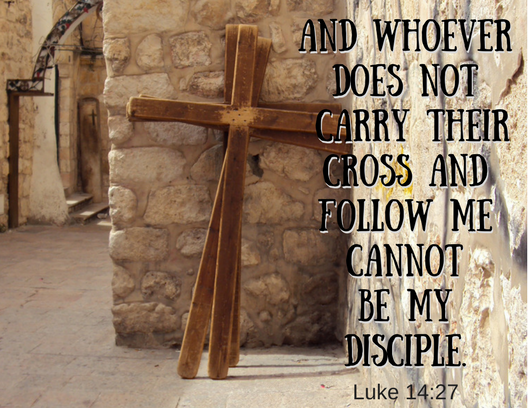
As crowds follow Jesus, he turns to them with sobering words and says, “If anyone comes to me, and does not hate his own father, and mother, and wife, and children, and brothers, and sisters, yes, and his own life also, he is not able to be my disciple. Whoever does not carry his cross and come follow after me is not able to be my disciple” (Luke 14:26-27). This statement would have certainly caused his audience to be taken back, wondering what this stipulation could mean. But Jesus is not commanding hatred or any ill-will toward others. Rather, he is using intentionally strong language to emphasize the supreme loyalty required to follow him. Discipleship means putting Jesus above all other relationships and comforts, and being willing to endure hardship and sacrifice for his sake. He illustrates this with parables about building a tower and a king preparing for war—both which require careful consideration of the cost (Luke 14:28-33). Jesus’ main point is that following him must be a wholehearted commitment and not a partial or casual decision.

Reflect: What does it mean for you to “carry your cross” in your current season? Are there certain comforts or relationships that are impeding your commitment to Christ that you do not want to let go of?

The Joy of God’s Restoration

Luke 15 is a chapter overflowing with God’s heart for the lost. The religious leaders grumble at Jesus because he welcomes and eats with sinners; something which they find repulsive and utterly alarming. In response to their judgmentalism and resistance to seek those who need help, Jesus tells three parables—the lost sheep, the lost coin, and the lost son. Each story highlights God’s relentless pursuit of the lost and the extravagant joy that accompanies when even one sinner repents and is saved (i.e., “found”).

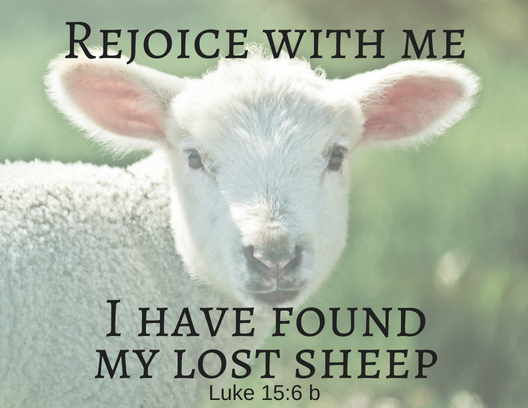
The Parable of the Lost Sheep (Luke 15:4-7) shows a shepherd leaving ninety-nine sheep to find the one that is lost, rejoicing when it is found. “I tell you that in the same way there will be more joy in heaven over one sinner who repents than over ninety-nine righteous people who have no need of repentance.” In like manner, the Parable of the Lost Coin (Luke 15:8-10) and the Parable of the Lost Son (Luke 15:11-32) echo this theme about how God’s love actively seeks, restores, and celebrates the return of those who were lost.

These parables reveal the depth of God’s grace and mercy and the value he places on every individual, no matter how small they might seem. In the parable of the Lost Son, in particular, the father’s embrace of his long-lost son illustrates God’s loving heart and readiness to forgive and restore, no matter how far we have wandered, if we will just turn back to Him in repentance.

Reflect: Where have you experienced God’s restoring grace in your life? Who in your life might need to hear about God’s joy in welcoming the lost home?

Encouragement

This section of Scripture invites us to embrace humility, count the cost of following Jesus, and rejoice in God’s heart for the lost. As you reflect on these teachings of Jesus, consider how you can embody Christ’s humility, make courageous choices to follow him, and join in God’s joy by welcoming others into His grace and forgiveness. May you find encouragement in knowing that every step toward Jesus is met with God’s open arms and heaven’s jubilant celebration, for this is the will of God.

Lost and Found

Matthew 18

Devotion by J.J. Fletcher (Minnesota)

Yesterday, we read Mark 9, and today we see some of its parallels in Matthew 18. The idea of causing “a little one” to sin is here, as well as dealing with one who sins against you, and addressing our own sinful actions. Sandwiched in between these teachings, we read the parable of the lost sheep.

The image of Israel as a flock of sheep is prevalent in the Old Testament. Leaders are viewed like shepherds, but God is the ultimate shepherd. When Israel loses its way, God sends a messenger or “shepherd” to seek out the lost and bring them back to the fold, to the path that they should be walking on.

Sheep get a bad rap. They are often characterized as dumb, but they are far from it. Sheep can remember human faces and differentiate between them. Sheep are herd animals, and the fact that they rely on following the herd, or the sheep in front of them, contributes to the mischaracterization of their lack of intelligence.

You have probably followed someone whom you had a level of trust in, but at some point, you realized that you had followed them the wrong way. Was it easy to course correct, or did you wander for a while? Did someone have to come and find you to bring you back to where you were supposed to be?

There’s a saying that not all who wander are lost, but many who wander are in fact lost. We follow the wrong crowd or come under the teaching of someone who is guiding us in the wrong direction. Those of us who are parents are acutely aware of how challenging it is to raise our “flock” in a culture that embraces self-gratification and relative truth (my truth as opposed to objective truth). Maybe we have become devotees to tradition rather than God’s commands (see the Unwritten Rules devotion from Tuesday). 

We probably all have friends or family members who have gone astray, and we desperately hope to get them back to the flock. We see that God has that same desire, for the lost to be found, to be reunited with his flock. There is much joy when someone returns. The rejoicing over the one who returns over those who remained is not a statement of value; all the sheep are valuable. The celebration is that the one who has been saved from death is now safe, like the 99. 

There are powerful testimonies from people who have lived problematic lifestyles, who walked in a way that was destructive or even dangerous. Many of us have boring testimonies. What a joy to have not had to be saved from a life of trauma, addiction, or danger! We celebrate those powerful testimonies not because those who have struggled are better, but because we can see in their stories the power of the one who went out and found them.

Reflection Questions:

1.        Think about ways that you were lost and how God brought you back. What methods did he use? How can you see His handiwork in your faith story?

2.        How has God used you to seek out his lost sheep? When you feel God’s prompting, do you embrace it, or have you struggled and responded in some other way (Jonah, anyone?)? 

3.        What ways can we work to keep the flock together and avoid having that one sheep split off that we may need to go searching for?

Seeking Shepherd

Old Testament: Hosea 3-5

Poetry: Psalm 77

New Testament: Luke 15:1-7

I have a free pizza awaiting me today. I couldn’t be more excited. Every year around my birthday, as a reward for not dying, I redeem a voucher for an entire pie of my choosing at my favorite pizzeria. There is something more satisfying about good food when you haven’t paid for it, although I’m not advocating for dining and dashing, simply making friends with chefs, restaurant owners, or in this case, signing up for an email newsletter.  As I read for today, and I think about greasy-cupped pepperonis, I can’t help but think deeper about redemption. 

Befriend a realist, and it won’t be long before you hear the wisdom, “nothing is free.” Redemption rings true to this adage because by definition it means that the price or obligation has already been fulfilled. Therefore, you receive the reward without the typical settling of debt.  The dough, the cheese, the sauce, and the toppings have already been purchased, but I wasn’t the buyer. In a more significant example, enslaved men and women could be released of bondage, receive paperwork, and be transported to the North due to the fundraising efforts of American abolitionists.  In the Old Testament, God’s laws command redemption of property, or giving back land, houses, animals, and freedom, to the impoverished when they sell as a last resort to make ends meet, with the buyer gaining nothing in their return (Lev. 25:25-55). But in a much greater way than any of these examples, we have redemption through Christ.

There is absolutely nothing we can do to deserve the Love of God, yet it is poured out upon us as an abundant gift. God demonstrates His love and redemption in Hosea’s actions in redeeming Gomer in the midst of adultery, “The LORD said to me, ‘Go, show your love to your wife again, though she is loved by another man and is an adulteress. Love her as the LORD loves the Israelites, though they turn to other gods’” These words tell us that God does not simply pine for relationship with us while we are in sin, but that He actively pursues in the midst of our fall. God hates sin, but He is unrelenting.  His grace goes farther than the guilt, and hopefully, guides us back to Him.


In the same manner, Jesus demonstrates this as the Good Shepherd watching over His flock. “Suppose one of you has a hundred sheep and loses one of them. Doesn’t he leave the ninety-nine in the open country and go after the lost sheep until he finds it? And when he finds it, he joyfully puts it on his shoulders and goes home.” Again, Jesus illustrates the commitment of the Father and His love for all within the body. It says heaven rejoices, but aren’t we too supposed to rejoice in the redemption?  As those who already know Christ, we should not be lining up for apologies, but instead extending the hands of grace.  If we were robbed by the redeemed of our possessions, our time, or our emotions, they have all become forfeit for the sake of redemption.

Despite our own unfaithfulness and wandering, God’s love has found us and refuses to let go.  He has already executed the campaign to offer you an eternal reward far greater than we could ever imagine (and I can imagine quite a bit of pizza).  Therefore it is our job to continue the work of Jesus, tending to His sheep.  We search the fields for the lost one, giving constant and enduring love to those failing to be victorious over temptation. It is simply put, but the practice is daunting. It is having an awkward conversation at the gas station with someone who hasn’t been to church in a few years.  It is  offering a listening ear to someone in distress, possibly never knowing if you have heard the truth.  It is showing kindness and compassion at business close when all you wanted was to get home to relax. Every act of love is a step toward spiritual restoration, not only for others, but ourselves, because we too have hope in life eternal at the expense of the Creator through His Seeking Shepherd.

-Aaron Winner

Reflection Questions

  1. What similarities do you find between the lives of Hosea and Gomer and the parable of the lost sheep?
  2. What lost sheep have you seen restored?
  3. What sheep do you know who are still lost? What acts of love can you be a part of to demonstrate the Father’s love to them?

Can You Relate?

THREE PARABLES—Luke 15

Thursday, December 22, 2022

There are so many layers to these three parables of Jesus, but today I want us to think about whom we most relate to in these short stories. Probably we all want to cross off the Pharisees.  You know, those guys who stand on the sidelines, quick to distant themselves from the sinful people in the world. “And the Pharisees and scribes grumbled, saying ’This man receives sinners and eats with them’.”( v.2)   None of us is like them, right?  We are anxious to see all the sinners repent and enter the kingdom when Jesus returns.  Most importantly, we are not quick to criticize people who reach out to sinners, as they did.  They even thought it was their righteous duty to criticize Jesus because He ate with sinners.  Surely, we cannot relate to them.   

Parable One—The Lost Sheep

Jesus narrows in on the Pharisees’ pride in these three short stories.  It seems as though he specifically chose the first two parables to increase the ire of the Pharisees. Jesus’ first words,  “What man of YOU, having a hundred sheep…”(v3) stung.  How dare He compare THEM to a shepherd?  They were, after all, much above a lowly disgusting shepherd.  Their beautiful robes and position in religious society proclaimed their superiority.  Yes, really, the Pharisees thought they were much better than a shepherd was, and undoubtedly disliked Jesus’ comparison of them to a poor sheepherder.

Maybe, however, you relate most to the shepherd.  Of course, you would rush out to find that one lost sheep, even though you have more than enough other sheep (who by the way, are safely gathered together).  Think of a father, who rushes back into his burning home to save his one child who is still inside, even though his other children are safely outside.  Just like Jesus, you would pick up that child and carry him with great joy to safety.

Parable Two–The Lost Coin

The second parable serves to further increase the ire and grumbling of the Pharisees. Once again, their beautiful flowing robes and position got in the way of doing God’s work.  How dare He compare them to a woman, and, an obviously poor, careless woman at that!  But this woman, like the shepherd, has lost something extremely important to her. Perhaps you relate most to this woman who would not stop or sleep until her valuable lost coin was found. 

When Jesus uses this poor woman and shepherd as examples of God’s forgiveness, He is telling these Pharisees (and US), that this woman and shepherd represent God’s desire to seek lost sinners.  To end these two parables, Jesus shares a wonderful scene of great rejoicing in heaven among the angels when the lost sinners are found.  However, the Pharisees probably found it offensive to envision such rejoicing in heaven with sinners. Heaven forbid.

Parable Three—The Lost Sons

Traditionally, we think of this final parable as the Parable of the Prodigal Son.  You know, the son who considered his father “as dead” and asked for his inheritance from him before the father had even died.  He wanted to go out and live the good life, away from his father.  Things did not turn out so well for him, and the prodigal son soon realizes that he made a huge mistake and decided to return home and beg for forgiveness.

“But the father said to his servant, ‘Bring quickly the best robe, and put it on him and put a ring on his hand, and shoes on his feet.  And bring the fatted calf and kill it, and let us eat and celebrate.  For this my son was dead, and is alive again; he was lost, and is found.”  vs. 22-24

 This is a wonderful story of forgiveness, and probably the Pharisees think this story is tolerable because, after all, it is about a rich family, a beautiful robe, and a big party with music and dancing.   But hold on, the rest of the story was about to be told.

The other brother, the good other brother, was in the field working for his father when he approaches and hears the dancing and music.  He inquires and finds out the ugly truth.  His brother has returned to his father, and the party is for him.  Instead of going in and being happy that his brother was back home, the pity party began.  He reminded his father how good he had been; always served the father, never disobeyed, and certainly was not a son who wasted his father’s wealth on prostitutes. He made it clear that in his mind his brother is a sinner.  Once a sinner, always a sinner.  How could his father receive his brother back and eat with him? He could not let it go.

“He was angry and refused to go in.”(v.28)   Can you relate?

-Kayla Elwell

Questions for reflection:

  •  Whom did the other good son represent in this last story? 
  •  Can you relate to the resentment and anger the good son felt? Why or why not.
  •  Have you ever felt cheated, angry, upset, jealous, revengeful, or disappointed that you were not properly rewarded when others got recognition for lesser good works, or when others got forgiveness for messing up royally? Where do you believe that those feeling come from? A false sense of pride? A desire to get what is rightfully yours? Wanting to be better than others? Perhaps someone has hurt you deeply.  How do those feelings apply in this last parable?