It’s All Good Now

Old Testament: Deuteronomy 25 & 26

Poetry: Job 40

*New Testament: Romans 8

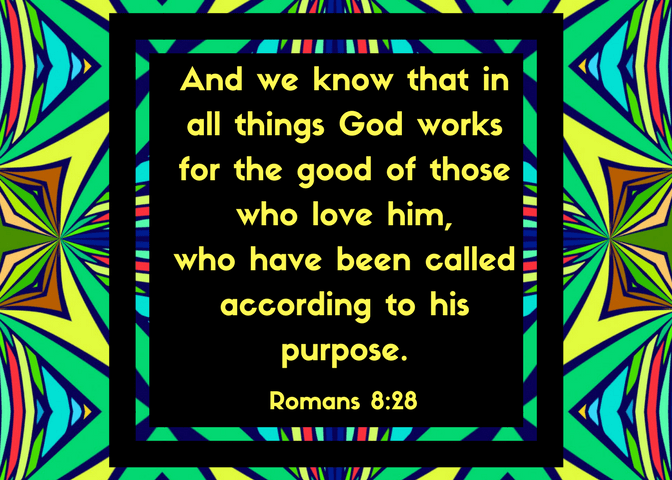
 “And we know that for those who love God all things work together for good, for those who are called according to his purpose.”  – Romans 8:28 (ESV)

Of all the books of the Bible, Romans is my favorite. Chapter 8 may very well be my favorite chapter in the book for many reasons. It starts with the declaration that there is no condemnation for those who are in Christ Jesus, and it ends with the encouraging reassurance that there is nothing in all of creation that can separate us from the love of God. In between, however, is a great life verse that provides comfort and hope regardless of your situation or circumstance.

Romans 8:28 says, “And we know that for those who love God all things work together for good, for those who are called according to his purpose.”

It is just as important to understand what is not said as it is to understand what is said. Paul does not say that all things are good but rather all things work together for good. It is often a matter of time and/or a change of perspective to see that the bad things that happen end up working for your good. I can speak specifically to that being the case. My salvation story depends on it.

On Easter Sunday in 1995 I was invited to come to church and help the men cook breakfast for the congregation. It was a tradition that had been going for a while and continues to this day at Pine Grove Bible Church. I was not a member or even a Christian at that time but as a former short order cook and someone who enjoys hanging around with other guys I agreed to come and help.

As a result of me driving in early to help cook, we had two vehicles at church and then two vehicles at my in-laws as we celebrated Easter dinner. When it was time to leave, my wife Amy and our two children were going to get in the car she was driving and I would get in mine to head home. I asked my almost 7-year-old son David if he wanted to ride with me and he said no. I told him we could beat mom home and he could ride in the front seat (this was pre-airbag times) and so he agreed to hop in with me. This was not a common occurrence as he often would sit in the middle of the back seat loosely buckled and leaning forward between the front bucket seats to entertain his incredibly crabby sister. As fate would have it, we made a stoplight that Amy and Stephanie did not, so we did indeed arrive home first.

I was busy unpacking the leftovers and Easter baskets (at that point we had the only two grandchildren, so it was always a bonanza for them) when I noticed a message blinking on the answering machine. It was Amy, calling from someone’s cell phone (very few people had them back then) letting me know that she had been in an accident and the car had flipped and she was very shaken up. I couldn’t hear Stephanie crying in the background (if any of you reading this were around at that time you know that she was always crying in the background) so I grabbed David and raced back to the accident site.

When I got there, I saw her mangled car in the ditch on its side facing the wrong way. I recall heading to the squad car and then desperately clinging to my 18-month-old daughter as tears ran down my face. I came to find out that a car traveling in the opposite direction had a blowout, lost control, and ended up hitting them almost head on. Thankfully, Amy was able to turn quickly enough to have the car hit her by the driver door, slide down the side to the rear wheel well where it caused the car to flip 180 degrees over and backwards. It was an Easter miracle that neither Amy nor Stephanie was seriously injured.

The accident was not good, in fact it was bad, very bad, as Amy still suffers neck pain as a result. But, given the ability to look back, I can honestly say that it worked for the good. I was working in a sales job where I was gone most nights and the realization that what mattered most to me could have been lost in the blink of an eye caused me to quit that job that next week. Wanting to spend more time with my family caused me to start attending church and Wednesday night Bible study and eventually I gave my life to Christ.

Now, nearly 29 years removed from that horrible accident I can see God’s hand working through all things, even accidents, for the good of those He has called according to his purposes. Trust in His timing, God is good!

Todd Blanchard

Reflection Questions

1. Can you identify a specific time in your life that seemed devastating at the time (i.e. job loss, death, relationship ending) but now you can see how it shaped you into who you are today?

2. Who do you know that is going through a tough time that you can share your story with?

3. How can you remind yourself to trust in God’s timing for your life?

Why NOT Me?

Old Testament Reading: Deuteronomy 23 & 24

*Poetry Reading:  Job 39

New Testament Reading:  Romans 7

­­­­­­­­­­­­­­­­­­­

If you’ve been reading along in Job you have watched terrible tragedy come upon Job time after time.  You have seen his friends come to be with him.   You have heard those same friends accuse Job of sinning; all of their advice coming from the perspective that he needs to repent in order for God to end his punishment.  You have also heard Job defend himself, holding fast to his innocence.  He boldly tells his friends what he would do if God would answer him. 

  • 23:4-7:  I would lay my case before him and fill my mouth with arguments. I would know what he would answer me and understand what he would say to me.  Would he contend with me in the greatness of his power?   No; he would pay attention to me. There an upright man could argue with him, and I would be acquitted forever by my judge.
  • 31:35-37:  Oh, that I had one to hear me!  (Here is my signature! Let the Almighty answer me!)
        Oh, that I had the indictment written by my adversary!   Surely I would carry it on my shoulder;
        I would bind it on me as a crown; I would give him an account of all my steps; like a prince I would approach him.

Job 39 is part of a “rant” by God that puts Job in his place.  God first joins in the conversation between Job and his friends in Job 38:3, “Dress for action like a man; I will question you, and you make it known to me.”  God repeats this in Job 40:7, “Dress for action like a man; I will question you, and you make it known to me.” 

We will look at God’s reply and Job’s response in a couple of days.  Today, I want to focus on a few other thoughts. 

First, God is BIG and we are small. 

  • Omniscient – God is all-knowing – we are ignorant
  • Omnipotent – God is all-powerful – we are weak
  • Omnipresent – God is everywhere, all the time – we are limited

We need to keep these differences in mind at all times.  This is what allows us to fully trust in God and His plan for our lives. 

Second, we need to have a proper perspective of our lives on this earth. 

  •  2 Timothy 3:12a:  “Indeed, all who desire to live a godly life in Christ Jesus will be persecuted
  • John 16:33:  “I have said these things to you, that in me you may have peace. In the world you will have tribulation. But take heart; I have overcome the world.”

Both of these verses are directed to those who are in Christ.  The Bible’s perspective is that we will face trials and persecution.  It is much more difficult to face those trials when we have the perspective that it shouldn’t happen to us.  Sin, evil, suffering – these are normal for this life.  They should be expected.  If we are in Christ, our perspective and expectations should be that these things should happen to us.

Having the right perspective of who we are compared to God and what expectations we should have regarding life in this age will help us trust God as we face whatever circumstances come our way. 

Amy Blanchard

Reflection Questions

  1. Do you accept that you are ignorant, weak, and limited….at least in comparison with God?  He wants us to depend on Him, to trust in Him, and to let His power be seen in us (2 Corinthians 12:7-10).  To do this, we need to begin to see how great God is.
  2. I desire to live a godly life.  I am in Christ.  I still don’t want to be persecuted.  However, I am trying to accept that if I am living a godly life, I will face persecution.  Are you trusting God to bring you peace in your troubles? 

Complaining

Numbers 11-12 and Psalm 42-43

A couple of years prior to Numbers chapter 11, the Israelites were enslaved in Egypt.  They were being mistreated by the Egyptians, and they wanted out!  God answered their plea, and he delivered the Israelites from the Egyptians.  It wasn’t an easy process though, as man could not have done it alone.  God had to perform a number of miracles along the way to free the Israelites. 

If we fast forward back to Numbers 11, the Israelites begin to complain because they are hungry.  They complain to Moses who then complains to God.  It’s as if the Israelites completely forgot all of the miracles that God performed in the first place to get them out of Egypt.  When I read about how the Israelites complain time and time again about being hungry, thirsty, or whatever, I get irritated with them.  I ask how in the world could they complain after all that God has done for them?!

Unfortunately, the more I think about the Israelites complaining, the more I realize similarities between them and many of us today, myself included.  God may not have rescued us from the hands of the Egyptians, but He has done so much more than we could ever begin to ask.  God laid down his own Son for us, so that we could have everlasting life in His coming Kingdom.  That’s powerful!  After all that God has done for us, we still have our bad days.  We still have our days in which we complain to God about the current issues we are experiencing in life.

From the outside looking in, the problems that the Israelites faced seemed like such small issues in the big picture, and the truth of the matter is that they were.  The same could be said about many of the small issues that we face on a daily basis and have the audacity to complain to God about after all He has done for us.  I’m all for being honest with God and expressing our real, raw feelings to God, so I don’t think that’s the issue.  Rather, maybe we shouldn’t let the small issues that we may experience affect us so much.  We need to put all the temporary issues that we experience into perspective.  Most of the issues that a lot of us, myself included, may complain about aren’t even worth complaining about in the first place! 

A small bump in the road may seem like a giant mountain when we are going through it, but hindsight is often able to put those issues into perspective.  Let’s work on putting those small issues into perspective in the moment, which is a lot easier said than done.  If we do this, then our positive attitudes will uplift us and those around us.

A note from Psalms:

“Send out your light and your truth; let them lead me; let them bring me to your holy hill and to your dwelling!” Psalm 43:3

This ties directly in to our conversation yesterday about being led by God.  Pray for God to send out his light and truth to us to lead us where He sees fit.

-Kyle McClain

Links to today’s Bible reading – Numbers 11-12 and Psalm 42-43

“That’ll do, Pig.”

Daily reading: 1 Peter 1-5

When Jesus told Peter to ‘Feed my sheep,’ he was commissioning him as a shepherd. And in the book of First Peter, we see a part of the fulfillment of that commission.

There are believers (the Lord’s sheep) scattered throughout Roman provinces in Asia Minor, and Peter is writing a letter to be routed amongst them.

There was a movie out in the 90’s about a pig that herded sheep. When the sheep dogs on the farm did their job, they demeaned and scared the sheep into submission. But sweet little Babe the piglet just asked them nicely and off they marched in lines for him.

Sheep of a different flock, however, didn’t know this sweet pig, and saw no reason to listen to him. That is, until, Babe received word from his pasture back home of the secret words to tell these new sheep that he was on their side. ‘Baa, Ram, Ewe’

We are an individualistic bunch of sheep, I think. 

Maybe it’s just me. Reading the book of First Peter with the eyes of a flock, a group, instead of reading it just for me, I see it somewhat differently.  There’s a definite theme coming through it all that it seems Peter wanted these sheep in his scattered pasture to remember:

There’s more than this.

  • Seek the holiness of sincere love for each other, because you’re like perishing blades of grass and God’s ways endure. There’s more than this way of loving.
  • You might feel rejected, but you are chosen. There’s more than this world’s acceptance.
  • Live to please God not the society you live in. There’s more than this wisdom.
  • God cares about how you treat your family. There’s more than your own perspective.
  • Compassion and humility never go out of style. There’s more to be gained through suffering than we can often see.
  • Wake up, pay attention, Jesus is coming back and you need to be ready. There’s literally more than this world coming one day.

Peter may not have needed to say ‘Baa, Ram, Ewe’ to unite the scattered sheep of his day, but perhaps we need a reminder that we, too, are a scattered flock.

Friends, there’s more than this.

Do you feel the sincere love of the body of Christ? No? Don’t wait for someone else to ‘do something’ about it. Everyone else is a perishing blade of grass just like you. Authentic love doesn’t start with a social media campaign; and it doesn’t start with the whole church, it starts with a few individuals. Be those few.

There’s more than this way of loving.

Have you felt rejected? Alone? Broken? Empty? Peter’s response to the scattered flock on this issue was to remind them about Jesus, and of this: “Once you were not a people, but now you are the people of God; once you had not received mercy, but now you have received mercy.”

It seems that acceptance begins with mercy. Mercy comes after repentance. Repentance comes after we own up to our sin. This world tells us to own our sin. Big difference.

There’s more than this world’s acceptance.

Along those lines, if the wisdom of this world affirms all of your choices, you might want to question if God would. Living to please God rarely aligns with the wisdom of this world.

There’s more than this wisdom.

Perspective is a powerful influencer, and seeing our family solely from the lens of our own perspective is not only selfish, but dangerous. We can fall into the trap of living for ourselves even while fooling ourself into thinking we are part of a team. How lonely. How unfulfilling. And definitely not God’s best for us.

There’s more than your own perspective.

Suffering is difficult and hard and it stinks. Anyone who says to say ‘Praise God!’ for suffering is a liar or a robot (or a lying robot, perhaps?). Jesus didn’t even want to suffer, he asked his Father if he could avoid it if possible.

Finding peace in the midst of suffering, finding joy in God’s provision during times of suffering, and praising God during suffering are all very different than praising him FOR the suffering.

There’s more to be gained through suffering than we can often see.

Peter quotes a Psalm and tells these scattered sheep that they must seek peace and pursue it.”  Compassion, humility, gentleness, sympathy, blessing… these are all active. A person who is actively pursuing peace, especially when suffering abounds, will stand out. Maybe that’s why Peter suggests it?

People loving differently, repenting of sin, showing mercy, treating their families differently, being the most kind, compassionate, gentle, humble, easy to get along with group of people anyone ever met…yet not compromising God’s standards, not backing down, standing strong against the roar of evil around them, refusing to be devoured — Those people would garner attention.

There’s literally more than this world coming one day.

Wake up, pay attention, Jesus is coming back and we need to be ready.

-Susan Landry

Today’s Bible passage can be read or listened to at BibleGateway here – 1 Peter

Tomorrow we begin the book of Hebrews (chapters 1-6)

4 Benefits for Christians in This Age


Out in the world today, we see a lot of bold claims made by companies. They promise you weight loss, happiness, wealth, status, and anything else that you can think up. What is their purpose in making these bold claims? They want your money. Many of the times the claims are flat out lies and at best they deliver only a fraction of what was promised. What about Christianity? Does the Bible make big claims like companies do?

Personally, I think the Bible makes a lot of claims about those who put their faith in God. But the logical follow up question to that statement is  – are they true? So in this blog post I want to set out to show you four claims the Bible makes about the benefits a Christian receives in this age. The fact that we are talking about this age is important. Obviously a Christian has a major benefit in the age to come with eternal life and the kingdom. However, I want to focus on this life and how being a Christian makes our lives better, now. The four benefits to being a Christian are peace, purpose, perspective, and people.

Peace is a commodity of which the world is in short order. It seems that mental illness is all over the news with illnesses like depression and anxiety sweeping over our nation. Christianity promises to those who put their faith in God that they can find peace. Look at Philippians 4:6-7, “6 Be anxious for nothing, but in everything by prayer and supplication with thanksgiving let your requests be made known to God. 7 And the peace of God, which surpasses all comprehension, will guard your hearts and your minds in Christ Jesus.” Paul, talking to the people of Philippi, is saying that if we hand over our anxiety to God through prayer and thanksgiving in return we will receive peace that surpasses all comprehension. I love how Paul makes the point to say that this peace will guard our hearts and our minds in Christ Jesus. I think Christianity has the best solution for finding peace in this life.

1 Peter 2 9

Purpose is an elusive things that some people spend their whole lives searching out. I truly think that people thrive the most when they are living a life after the purpose for which God created them. If you are looking for purpose look at 1 Peter 2:9-10 which says, “9 But you are a chosen race, a royal priesthood, a holy nation, a people for God’s own possession, so that you may proclaim the excellencies of Him who has called you out of darkness into His marvelous light; 10 for you once were not a people, but now you are the people of God; you had not received mercy, but now you have received mercy.” First look at verse 10 where it says, “you once were not a people, but now you are the people of God”. In other words, once you had no identity and no purpose but now you are the people of God and you have a purpose. The purpose statement is at the end of verse 9, “so that you may proclaim the excellencies of Him who called you out of darkness into His marvelous light”. I think when we are giving the good news to people, and that is our driving purpose, we find fulfillment with our lives. What could be better than helping someone change their life forever?

Perspective can be a tricky thing to find, especially perspective that is trustworthy and true. Let’s talk about the world’s perspective on one of the most difficult things we deal with in life, death. To the world, death is crushing, scary, oppressive, breaking, and most of all final. The world has no hope when it comes to death but the Bible offers a better perspective on death. 1 Thessalonians 4:13-18 says, “13 But we do not want you to be uninformed, brethren, about those who are asleep, so that you will not grieve as do the rest who have no hope. 14 For if we believe that Jesus died and rose again, even so God will bring with Him those who have fallen asleep in Jesus. 15 For this we say to you by the word of the Lord, that we who are alive and remain until the coming of the Lord, will not precede those who have fallen asleep. 16 For the Lord Himself will descend from heaven with a shout, with the voice of the archangel and with the trumpet of God, and the dead in Christ will rise first. 17 Then we who are alive and remain will be caught up together with them in the clouds to meet the Lord in the air, and so we shall always be with the Lord. 18 Therefore comfort one another with these words.” If you are a Christian, you are offered a perspective on death that doesn’t include fear but instead centers on hope. Don’t get me wrong, death is still a painful and difficult event but it isn’t crushing for Christians. To me, 1 Thessalonians 4 is a clarifying and liberating passage. Because of the Bible I am freed from the fear of death. Christianity offers us a better perspective on death and a whole multitude of other things.

People, who doesn’t want a people to call their own? Community is an essential part of human flourishing and Christians absolutely crush the competition when it comes to community. Look at what Jesus says in Mark 10:29-30, “29 Jesus said, ‘Truly I say to you, there is no one who has left house or brothers or sisters or mother or father or children or farms, for My sake and for the gospel’s sake, 30 but that he will receive a hundred times as much now in the present age, houses and brothers and sisters and mothers and children and farms, along with persecutions; and in the age to come, eternal life.’” In this present age we will receive 100 times the family that we currently have. This doesn’t mean that all of a sudden our family multiples by 100. What it means is that those who are Christians become our family. You are probably familiar with the term family of God. It is short hand for the community of believers that form one large family all around the world. When I walk into church I know that those people have my back, they love me, they support me, and they are my family.

Maybe now you are asking how can I be sure that these claims actually hold up under pressure? Are these claims made by the Bible like the false claims made by big companies? If you are curious about the validity of the Bible, just ask a long time Christian that you know. They will tell you about the peace they have felt in their lives when there should not have been peace. They will tell you about the purpose they have found. They will tell you about how the Bible has shifted their perspectives for the better. They will tell you about the community that they have in the family of God.

If you are looking for peace, purpose, perspective, or a people I think you should give Christianity a serious look. Maybe you have been on the fence about dedicating your life to Christ or maybe you have fallen away and aren’t where you want to be with God. Either way there is a better life out there, it just takes commitment. You need to commit to following God wherever He leads and you need to put your trust in Jesus. If you are thinking about dedicating or rededicating your life to Christ find a pastor or Christian you trust and talk to them about how following God can change your life for the better.

-Josiah Cain

A Change of Perspective

Thursday –

Romans 8-28


His divine power has given us everything we need for a godly life through our knowledge of him who called us by his own glory and goodness.  2 Peter 1:3

Repeat after me:

“I am the masterpiece of God.  I’m a new creation in Christ.  I already have everything I need to do everything God wants me to do.  (And God DOES have something for me to do).”

If you didn’t actually repeat after me, we’ll wait.  (No, I’m not kidding).  Say it.  Out loud.  If you really want to believe something, it can help to speak it out loud.  So let’s try it again:

“I am the masterpiece of God.  I’m a new creation in Christ.  I already have everything I need to do everything God wants me to do.  (And God DOES have something for me to do).”

I’ve never made a tapestry, or any major work of art, but I can understand that those who do need to repeatedly take a step back to look at the big picture.  Just looking at the little area where the artist is currently working doesn’t allow for seeing how that bit fits with the rest of the piece.

A change of perspective can make all the difference.

When Joseph was being sold into slavery, being accused of committing a crime he didn’t commit or serving time in prison (Genesis 37, 39-41) I’ll bet he wasn’t thinking, “Hey perfect!  Slavery!  This is the next logical step in accomplishing my leadership vision!”

Of course not.  But what Joseph did do was use the gifts God had given him even in his distress.

Joseph had taken hold of God’s purpose for his life.  He believed that God had a plan for him.  But he still had to walk through very difficult experiences (for years) to see those plans fulfilled.

And we know that in all things God works for the good of those who love him, who have been called according to his purpose. (Romans 8:28)

How many things?

How many?

And who are you?

“I am the masterpiece of God.  I’m a new creation in Christ.  I already have everything I need to do everything God wants me to do.  (And God DOES have something for me to do).”

Sneak Peek at tomorrow’s devotion:  God made us to be overcomers, even when we don’t feel like it.

-Susan Landry

I’ve Been Robbed of My Peace and Happiness

Philippians

verse-of-the-day (3)

Friday, June 30

There are three different types of problems, which sometimes can also be referred to as opportunities.  First, there are problems that are only problems because our perception of the situation is not what it should be.  Second, there are problems that are in our control and could be solved if we put our mind to it.  Lastly, there are troubling situations in our lives that we have little or no control over.  They all can rob our peace and happiness, but fortunately the first two types of problems can be eliminated.  But how can we find peace and happiness if there is a problem that won’t go away and we can’t do anything about?

Some examples of the type of problem where our perception needs to be altered are when they forget to put the French fries in the bag at the drive thru, when you can’t watch your television show because someone else had the television first, or when the strap on your purse breaks.  If these types of things make you upset or unhappy, you need to work on your perspective in life.  Stuff happens; we need to learn how to deal with it without getting so upset.  These are not the types of “problems” that I want to talk about today.

The types of problems in our control are that I cough too much because I smoke, I am getting poor grades in school because I waste too much time, or I don’t have enough energy because I am overweight.  We can solve these problems with a good dose of self-discipline.  Stop smoking, do your homework, exercise, and eat less.  You’ll be amazed at how your problems will disappear.  I’m not saying it will necessarily be easy, but it can be done.  I am also not going to talk anymore about these types of problems today.

I’ll be honest; I don’t have a lot of sympathy for people that get upset about the small stuff that aren’t really problems (sometimes referred to as first-world problems) or for people that have self-inflicted problems that they could fix if they wanted to.  However, there are problems that are quite real and there is little or nothing they can do to fix them.  They can be quite serious in nature and can very easily rob you of your peace and happiness.  I am talking about someone with an alcoholic spouse that refuses to get help, yourself or a loved one that has been diagnosed with an incurable disease, someone who has been paralyzed due to an injury, a parent who has a child who refuses to be a Christian, someone who made a big mistake and will be spending the rest of their life in prison, or someone who just had a parent die.  These problems are real and they suck.  These problems might not go away.  They can really weigh on your heart and mind and they can make you extremely sad or very stressed out.  How can you still have peace and happiness if your problem doesn’t go away?

The answer lies in Philippians 4:6-9.  In verse 6 we are told to never be anxious and to let our requests be known to God through earnest prayer and thanksgiving.  Verse 7 does not say that your problem will go away; instead, it says you will receive the peace of God that surpasses all comprehension.  God is saying that He will give you peace in your heart and mind in situations that peace doesn’t even seem possible.  How can you feel true peace when you know someone you dearly love is going to die soon?  That doesn’t begin to make sense, but that is exactly what God said, it surpasses comprehension.  It makes no sense that you could have peace, but God can give you an amazing gift of peace that we can’t understand because He is God.

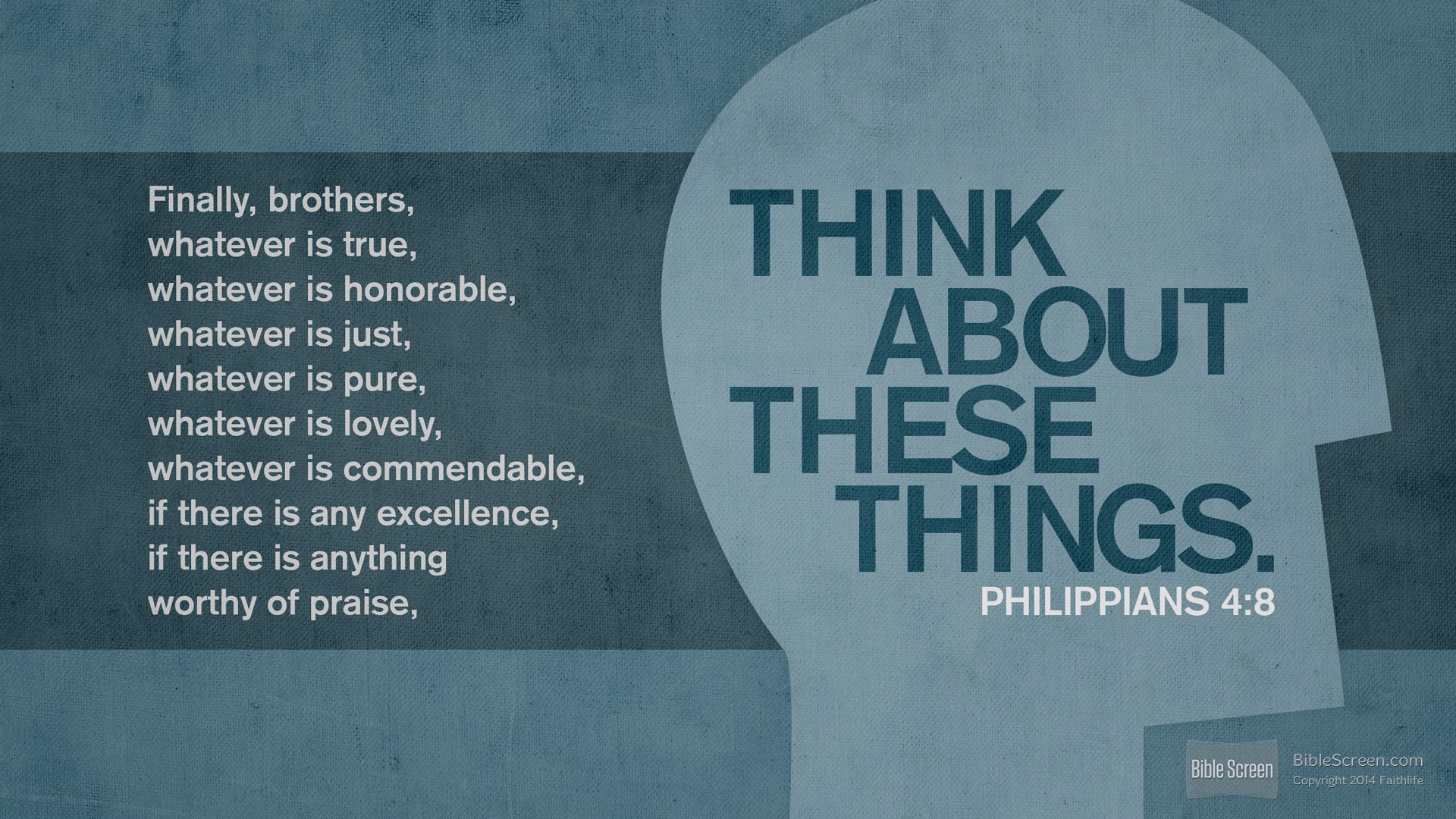
I had a problem that pretty much sucked the joy out of my life for a long time.  I tried hard to make the problem go away, but to no avail.  I really struggled with this because I had always had a pretty easy life with few problems, and I couldn’t change this situation no matter how hard I tried.  I didn’t know what to do.  Then I stumbled across Philippians 4:8, which is now one of my favorite verses in the Bible because of the peace and happiness that it gave back to me.  “Finally brethren, whatever is true, whatever is honorable, whatever is right, whatever is pure, whatever is lovely, whatever is of good repute, if there is any excellence and if anything worthy of praise, let your mind dwell on these things.”  It all makes perfect sense.  If we dwell on the stuff that makes us sad or stressed out, we are going to be sad or stressed out.  Duh.  If we dwell on the excellent things in life that make us happy, we are going to be happy.  It was too simple, but I couldn’t figure that out until I read that verse.  It was life-changing.  Do I still think of my problem from time to time?  Sure, but I don’t dwell on it.  I will no longer let it rob my joy.

If you have a problem that you can’t fix, pray for some peace that surpasses comprehension and start dwelling on the good things in life.  It works.

-Rick McClain

(Photo Credit: https://biblia.com/bible/esv/Phil%204.8)

Nothing New Under the Sun

Chapters 1-4 of Ecclesiastes (eh/kle/see/as/tees; which might rhyme with “meh – see the nasties”)

ecclesiastes31

Tuesday, January 31

Many Bible books were named from a key word near the start of the book, which often means they are named after the author. That is sort-of the case with Ecclesiastes, but the author’s name isn’t used in the book so it picks up a title the author took. In Hebrew that title could mean “lecturer”: it comes from the word for “gatherer” and the idea is that he gathered information and then passed it along. When the book got translated into Greek this lecture-teaching was described as preaching, so its title now is a word for “preacher.” You might wish that the name of the book was translated to English when the book was. (By the way, “ecclesia” is the Greek word that normally is translated as “church” in the New Testament). We read the book of Proverbs, a collection of wise statements that often gives advice. We read the book of Psalms, a collection of poems which often call on God. You could get the impression that our current book is a collection of downer thoughts about life. That is how a lot of people have read this book, and it is understandable if some of what we read in Ecclesiastes seems sad to us, but there is more going on here than that.

In over 20 places the book says a thing is “meaningless”, but that doesn’t mean “don’t do it”, it is more about looking at things from a long perspective and saying that the “meaningless” event or action doesn’t really change things. Certainly that is true if we look at things from the perspective of generations (1:3). The verses keep returning to the idea of our work, our labors. In the short term they can bring us satisfaction, and we are meant to accept that, it is a gift from God (3:13). But we also should be careful how we view things, never totally forgetting the big picture.

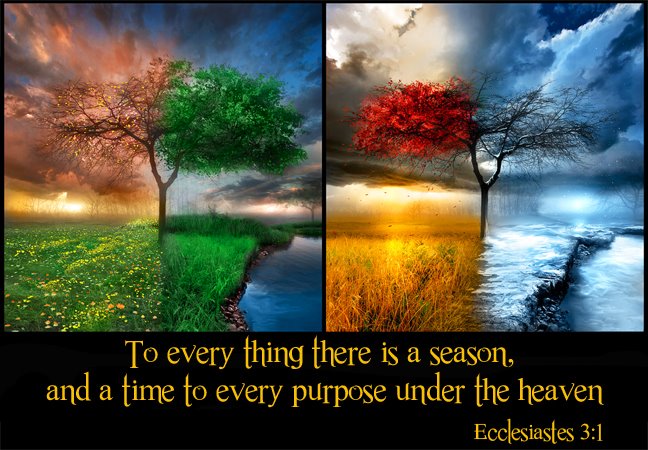
If you haven’t heard the song that Pete Seeger made out of the lines in 3:1-8, check it out (“To Everything There is a Season”). Part of the point of the verses is that we can never emphasize one thing as “the point” for our actions, what is pushed in one direction will also be pushed in another. Nothing we change stays that way forever.

An obvious example for this is eating. You can feel really hungry, say right before a church potluck that has been delayed, and then a few minutes after you eat you have no interest in food at all. But a few hours later you will be hungry again. You can’t eat enough to end the cycle, and we can ask how much importance there is in any one meal we ever eat – but we certainly cannot skip all of them.

So, that cupcake you ate the other week may have tasted good, but does it still please you? That binge-session on Netflix of sit-com episodes? Almost certainly meaningless. The test you are studying for may make a big difference to your grades – but for how many years will it matter what grades you received? It is possible to poke holes in every form of human labor and success, but “wisdom is better than folly, just as light is better than darkness” (2:13). The wise person may recognize, like the Preacher, that success is temporary in this world, but it is still better to be wise.

The Preacher / Teacher is described as a king of Jerusalem, and many people tag him as Solomon late in life. It may require being a powerful king to test all the things the Preacher tested, to see what would make him happy. He could do what he wanted, and none of it was enough. But some of the simplest things, the inexpensive things, can bring happiness to us – we just know that none of it lasts. “Happily ever after” doesn’t have much sense behind it, because people are not immortal, and the struggles of this world don’t just get skipped over for the people who want to serve God.

In a way this book is an extended piece of wise-talk, like Proverbs has, but directed to just one issue – what the point of this life is. If this world were the one God was aiming for in the first place we could expect the Preacher to give us a more positive answer, but this world is what resulted from sin. God is in the process of fixing things.

This is the book about “meaningless” (temporary) things where there is “nothing new under the sun” (in this world) and both wise and foolish people “chase after the wind” but can’t catch it, and get nothing from the chase. But along with all the comments about our work not changing things, or being undone or forgotten, we get comments about the endless importance of what God does (3:14). Maybe that is a hint at the future. What God does lasts forever, and God sent Jesus to die for us and God raised Jesus from death as the first-fruits of many who will come to immortality and live with him forever.

If you find yourself getting dragged down by anything this book says, you could question if that is because it is telling you truth you didn’t want to know about something that you have considered to be more important than it should be. But don’t ever let yourself get brought to despair by this scripture or by anything at all – always remember that the story is not over

-Daniel Smead

Daniel grew up in Missouri, then attended Oregon Bible College, Atlanta Bible College, and Columbia Theological Seminary. He has pastored in Eden Valley, Minnesota, and now attends the Pine Grove Bible Church in Brooklyn Park, Minnesota. He has worked for many years editing adult Sunday School lessons, and also writes some (slowly). He is trying to create a card game about the first few centuries of Church history (very slowly). He also recognizes in himself a tendency to focus on a thing(s) more than he should, and the need to put things in God’s hands and leave them there – so if that describes you, you are not alone. God bless you.  : )

(photo credit: http://keywordsuggest.org/gallery/386871.html)