After the heavy words of judgment in chapters 1–3, Micah shifts his tone in chapter 4. We are given a beautiful glimpse into a future when there is a godly rule from Zion, and nations will come to learn His ways (Micah 4:1–4). Peace replaces war. Oppression is overturned. God gathers the lame and makes them into a strong nation (4:6–7).
Micah chapter 5 reveals God’s answer to a broken world: a king born in Bethlehem (Micah 5:2). This prophecy clearly points to Jesus, the ruler who will bring security and peace to all of the Earth. Though God is serious about his judgement, He is also a gracious and merciful God who has offered redemption for us.
Micah chapter 6 is home to my personal favorite verse. For some reason, Micah 6:8 constantly comes up in any messages I do. I believe it’s because it so broadly applies to many message themes and is an answer to the idea of sacrifice. First, Micah exaggerates the idea of a sacrifice that would be worthy to be in the presence before God in Micah 6:7:
“Will the Lord be pleased with thousands of rams, with ten thousand rivers of olive oil? Shall I offer my firstborn for my transgression, the fruit of my body for the sin of my soul?” (Micah 6:7)
Afterwards, he amends by stating my favorite verse:
“He has shown you, O mortal, what is good. And what does the Lord require of you? To act justly and to love mercy and to walk humbly with your God.” (Micah 6:8)
Sometimes, it may feel like a lot to read through the Bible, meditate on His words, and realize that there is a lot that we are called to do. However, we come almost full circle here with this idea of walking humbly with God. If we do this, and we put our faith in him and act justly, we are more worthy of our calling in his presence than any sacrifice ever could make us.
Then, at the finale of this book, Micah laments. He laments the corruption and distrust in Israel, and he laments the misery in the nation. However, he does not end the book on a sour note. Instead, Micah presents words that should echo for us in times of darkness.
“But as for me, I watch in hope for the Lord, I wait for God my Savior; my God will hear me.” (Micah 7:7)
Micah ends on a message of clear hope. Hope in God being with him. Hope in God redeeming the nation of Israel with the remnant of Jacob. Hope in God delivering on his promises.
-Colby Leggitt
Discussion Questions:
Why do you think the people offered sacrifices instead of obedience?
What does it practically look like to “act justly, love mercy, and walk humbly with God” in your life or community?
Micah 7:7 says, “My God will hear me.” Do you live with that same confidence? Why or why not?
As Marcia mentioned in yesterday’s devotion, many of us were at Midwest Family Camp last week, where the theme was “Stand Firm”. In a nutshell, if we don’t have a relationship with the Lord, it is critical that we repent and come into a relationship with Him. If we already have a relationship with the Lord, we need to strengthen that relationship, and stand firm in the faith – no matter what.
In today’s reading in Proverbs 28, there are a few verses that jumped out at me which reinforced that message. The first is found in Proverbs 28: 9, “If anyone turns a deaf ear to the law, even his prayers are detestable.” This proverb tells us that if we’re not doing everything to live the life God called us to live, if we’re not following His rules, then He won’t listen to our prayers. Since many of our prayers are about asking for God’s help with various things, if we selfishly want Him to answer our prayers, then we need to obey His rules, and live for Him. As we grow in relationship with Him, we come to long for an even deeper relationship with the Lord. Then we learn that prayer is powerful, and we don’t waste it just asking for superfluous things.
Proverbs 28:13 goes on to say, “He who conceals his sins does not prosper, but whoever confesses and renounces them finds mercy.” This is saying if we pretend to be Christians, we won’t prosper (you can’t fool God). But if we confess and renounce our sins, and turn completely to God, we will receive God’s mercy. I don’t know about you, but I would much rather have His mercy than to have Him holding me back from prospering.
As we continue to read through this chapter, we get to verse 20, which says, “A faithful man will be richly blessed, but one eager to get rich will not go unpunished.” I’ll take a detour here and comment on the health and wealth teachings we often hear from people who don’t know better. The theory goes sort of like this… “if someone follows God, God will bless every aspect of their life. They will be rich, healthy, and blessed.” Many people who call themselves Christians subscribe to this false belief. Jesus told us in John 16:33, “…In this world, you will have trouble. But take heart, I have overcome the world.” We have to remember this life isn’t our reward. This life is the test to see what reward we will receive when Jesus returns. If we are faithful to the Lord now, we will enjoy peace with God now, and eternal life when Jesus returns. If we are just trying to get rich, we are actually worshiping money, not God — our reward is in this life, and we will forfeit eternal life.
1 Tim 6:9-11 says, “People who want to get rich fall into temptation and a trap and many foolish and harmful desires that plunge men into ruin and destruction. For the love of money is a root of all kinds of evil. Some people eager for money have wandered from the faith and have pierced themselves with many griefs. But you, man of God, flee from all this, and pursue righteousness, godliness, faith, love, endurance, and gentleness.”
Instead of trying to get rich, we need to follow the advice given in Proverbs 28:27, “He who gives to the poor will lack nothing, but he who closes his eyes to them receives many curses.” Again, I think the idea is that if I’m greedy, wanting to keep all my money for myself, I’m not trying to please God, I’m just greedy for money, and God will curse me for not following Him. But if I’m generous with the things God has given me by giving them to the poor — this mimics God’s generosity to me. When I am imitating God, God loves that. In fact we’re commanded in Ephesians 5:1, “Be imitators of God, therefore, as dearly loved children.”
So the bottom line is this. We need to do everything we can to reconcile ourselves to God. We need to confess and renounce our sins, obey His laws, be faithful, and be generous. All these things are required to live in close relationship with God. And if we live in a close relationship with God, we will have peace with God in this life, and an amazing reward in the life to come. In Rev 21:4, we’re told, “He [God] will wipe every tear from their eyes. There will be no more death or mourning or crying or pain…” Rev 21:7 goes on to say, “He who overcomes will inherit all this, and I will be his God and he will be my son.”
How well are you imitating Dad?
Stand Firm.
–Steve Mattison
(Originally posted June 28, 2021 – but we did just return from another week of Family Camp, where the theme was “Pray Continually”. You can watch Steve’s Thursday Night sermon and story on Yield to God’s Will here.)
Reflection Questions
What are the prayer lessons to be remembered from Proverbs 28?
How well are you following God’s instruction?
When was the last time you confessed your sins to Him?
What relationship do you have with money? Is it stronger than it ought to be? How would you rate your generosity? Why do you think God values our generosity?
After receiving instructions from Moses in Leviticus 18 and 19, instructions about how to live a holy life continue in Leviticus 20 and 21. Not only are the children of Israel warned and instructed about sexual sins and moral conduct, then a law of consequence is set forth to them. The penalty for killing babies, consulting familiar spirits (devil spirits, mediums, wizards and such like) and sexual sins is death! The death penalty was necessary because the blood offerings of animals can not cover for these sins. God has been very generous with his chosen people in communicating these consequences. Wanting to please Almighty God and live a holy life requires submission to his ways and his justice. So what does one do when the laws of land permit such abominations and atrocities?
In Leviticus 20:4-5: “And if the people of the land do any ways hide their eyes from the man, when he gives of his seed (offspring) unto Molech, and kill him not; then I will set my face against that man, and against his family, and will cut him off, and all that go a whoring after him, to commit whoredom after him, to commit whoredom with Molech, from among the people.” It is not good to be cut off from God and his precious covenants. It is not good to have God’s face set against you. We are not to just shut our eyes to these kinds of sins. The people of Ammon had a god named Molech whom they worshipped by sacrificing their children. Apparently, this way of sacrificing children, killing your own offspring was after the doings of the land. The penalty for this kind of sin and also the ignoring of the sin by the people has serious consequences. Eternal life for some is on the line.
Only because of Jesus Christ and his holy sacrifice could these sexual sins and moral sins be forgiven. Acts 13:38-39: “Be it known unto you therefore, men and brethren, that through this man is preached unto you the forgiveness of sins: and by him all that believe are justified from all things, from which you could not be justified by the law of Moses.” Now’s the time to preach forgiveness of these sins and to draw men to Christ. If they do not submit to God’s way of redemption, they most surely will die from these sins and perish forever. For it is written in Revelations 21:8: “But the fearful, and unbelieving, and the abominable, and murderers, and whoremongers, and sorcerers, and idolaters, and all liars, shall have their part in the lake which burns with fire and brimstone: which is the second death.”
It is important that we take a stand and teach people how to draw to a Holy God. It’s also important for us to instruct those who oppose themselves. “God would have all men saved and come unto a (full) knowledge of the truth.”(1 Timothy 2:4).Now is the time to plead with people and invite them to know the only true God so they can see his love and why he knows what is best for mankind. If we can show people that God loves them and sent his son so they could be forgiven of these types of sins because of Jesus Christ, then at least they will have a choice. That is the real pro-choice issue. Many do not understand, because they have not been shown God’s love. We are here to be that love and to give them the real choice.
-Cindy Abbott
Reflection Questions
Is there someone you could help to see the error of their way by loving them enough to show them the truth?
Have you ever hidden your eyes from someone committing these sins, instead of lovingly imploring them with true knowledge of life and death decisions?
In what ways do you pray and ask for strength to “withstand in the evil day, and having done all, to stand.” (Eph 6:13)?
“For it would have been better for them never to have known the way of righteousness than after knowing it to turn back from the holy commandment delivered to them.”
2 Peter 2:21 (ESV)
An idea stitched through today’s readings is that the God of Heaven prefers human behavior that is good and has an aversion to human behavior that is bad (to put it mildly). The Maker of mankind pays attention to both the wicked and the righteous (Proverbs 15:3). God sees all that happens on earth and, although all bad is wrong from His perspective, there seems to be a certain kind of action that uniquely draws His ire: people, who “speak on behalf of God”, using their influence to persuade others to evil–such people are called false prophets and false teachers (Jeremiah 23:16-17, 2 Peter 2:1). How do we avoid becoming like these people and live in a way that pleases our Maker?
Looking through the whole of scripture, one will discover that nearly all the people God employed for His purposes displayed humility (or were first humbled), while those whom God rejected or stopped using were dragged down by pride. When Jesus ministered in Judea and the surrounding regions, he embraced people who were stereotypically seen as bad (or, unrighteous) and opposed those who were known (and self-described) as good (or, righteous). While it is true that those whom Jesus befriended did bad things and those whom Jesus antagonized did good things, the defining distinction between the two was humility (in the former) and pride (in the latter).
The religious leaders of first-century Jerusalem saw themselves as righteous men who had things figured out–they needed no one to save them. The outcasts, meanwhile, longed for salvation–both from the Roman overlords and their own sinfulness. In other words, the people who embraced Jesus saw him as a doctor and themselves as the sick, while those who rejected him, saw Jesus as an instigator and themselves as the people preserving the peace. If one denies they have a problem, one cannot get the help needed.
There is a conundrum for the Christian: we are called to do good works (Ephesians 2:10) and to represent Christ on God’s behalf (2 Corinthians 5:10), but we are also warned that one who has claimed to be a Christian (maybe even one who has been an effective evangelist) can come to a place where, because of their pride, it would have been better if they had “never known the way of righteousness” (2 Peter 2:21). How do we avoid this state, while being faithful to our calling?
From what I see from scripture, the best antidote to getting on God’s bad side is to live in, with, and by humility. First, by fearing, above all (with reverence, awe, and worship) Yahweh. Second, by recognizing Jesus as the only way to the Father, to life eternal, and to the good life. Third, by recognizing that, while this knowledge radically changes lives, it doesn’t make one superior to anyone else.
You can, with great fervor, study your Bible for countless hours every day, and do all the spiritual practices prescribed or implied by the text, but it won’t make you any better off…unless you are aware and live as though you need a doctor and view Jesus as that doctor. The religious leaders of Jesus’ day didn’t recognize the great physician because they didn’t acknowledge their sickness. If we want to make sure we don’t go down that same dead-end road, if we don’t want to get scolded or labeled as a false teacher, we must take our humble medicine every day.
-Joel Fletcher
Joel Fletcher lives in Minnesota with his wife and two small children. He is involved with youth group and worship music at Pine Grove Bible Church.
Reflection Questions
Do you realize your need for a doctor and Savior? How does Jesus provide what you need?
What happens to those who once knew they needed Jesus, but then are puffed up with pride and go their own way?
What steps can you take to stay humble (or first become humble)? In what areas of your life do you most frequently run into the problem of pride? How can knowing this help you in the future?
The most humbling truth of the Bible is described in Psalm 14: every single person has turned aside from God and falls short of doing good (verse 1-3). God is looking down from His heavenly throne, desperately seeking for one person that will listen to Him perfectly, and yet, we have all failed. Even though we have tried, there is something about humanity ever since the Fall in the Garden of Eden that is inclined to pursue the opposite of what God wants. Even though He has clearly told us what we are supposed to do, we are unable to do it. So how can we have any shot at being in God’s Kingdom?
The gospel is everything: the good news tells us that Jesus is the person God has been looking for all along. He obeyed his Father perfectly, all the way to the cross. Now, he is raised to immortal life and seated at God’s right hand. He now pours out God’s Spirit on his followers, granting them the ability to live like he did, in complete obedience to his God. The gospel teaches us that it is only through Jesus that we can be redeemed, since there is no one else who does good (see also Acts 4:12).
The fool of this age not only rejects the existence of God, but also the grace of this God found in Jesus Christ. It is just as foolish to think that we can be pleasing to God apart from Jesus, as it is foolish to think that God doesn’t exist at all. The gospel tells us that we are completely incapable as people to do the will of God: we absolutely need Jesus in every single way. Without him, we remain to be enemies of our God, acting against His will (Romans 5:10).
Brothers and sisters, humble yourselves today, accepting the reality that we are broken, sinful, and unable to do anything pleasing to our Father. But now rejoice, because that same Father we have let down over and over again allowed Jesus to die in our place, taking the penalty we deserve. By the power of God’s Spirit, we can now do what God wants, since we are new creatures (2 Corinthians 5:17). Despite our sinfulness, our God loved us enough to give us another chance through Jesus. Don’t be foolish like the world: take that chance today.
“Make every effort to enter through the narrow door, because many, I tell you, will try to enter and will not be able to.”
In thinking about one’s faith, how easy is it to get caught up in the motions of religion. “I go to church every week, I attend Sunday school, I make food for the potlucks, I give an occasional offering, I went to church camp as a child, etc…when the kingdom comes, surely I will be known and in relationship with the Lord.”
Luke 13:25-27
“Once the owner of the house gets up and closes the door, you will stand outside knocking and pleading, ‘Sir, open the door for us.’ But he will answer, ‘I don’t know you or where you come from.’ Then you will say, ‘We ate and drank with you, and you taught in our streets.’ But he will reply, ‘I don’t know you or where you come from. Away from me, all you evildoers!’”
Thinking about where your heart is and what kind of faith you have takes courage, honesty, and oftentimes real change within our daily habits.
Today is a perfect day to renew or strengthen your relationship with God and his son Jesus Christ. This looks different for all in many ways. When I picture a narrow door, I think of a door that not many choose to enter through. This “door” may not be the popular choice, the easy choice, or the fun choice. However, choosing to live a life that is pleasing to God is more rewarding than any earthly desire or temporary pleasure. I encourage you to take a moment today and consider one tangible way that you could get to know God on a deeper level this week. This may be through prayer, worship through song, spending time in nature, reading your Bible, serving others, etc.
May we be a people who stand outside the door and are fully known as our hearts align to God through his son Jesus Christ.
-Kayla Elwell
Reflection Questions
Choose at least one way you could get to know God on a deeper level this week? When will you do it? Where? How? Why?
How does “Make every effort to enter through the narrow door” work with Ephesians 2:8&9. Do you think Jesus would say that there are some people who rely too much on their works? Do you think Jesus would say there are some people who rely too much on God’s grace? How do you keep from being in either camp?
Yesterday, we read about how the Thessalonians turned from their idols to serve the one true God. However, this caused some problems to arise for them. Those around them still worshiped the idols and chose to persecute them. But Paul has advice for them on how to continue to stand firm in their faith in the midst of all this opposition.
At the very beginning of the chapter, in the first two verses, Paul explains that they came to witness to the Thessalonians right after they had faced persecution in Philippi. Paul says that in Philippi they faced much suffering and mistreatment. He continues to say that in Thessaloniki they continued to face lots of opposition when they worked to spread the gospel.
Many people would have stopped after facing serious persecution in one city. Many more would have stopped when they saw the opposition against them in the next city. But Paul and his companions continued to spread the gospel throughout all these hardships. By telling the Thessalonians about his problems, Paul encourages them by showing that it is possible, when you have God, to stand firm in the faith and to continue doing God’s will. We should let this also encourage us because we know that Paul, in the midst of all the troubles of this world, continued to be one of the greatest witnesses to the whole world.
Paul continues by describing their attitudes in sharing the gospel, even while they were faced with persecution. In verse 7, he describes themselves as “gentle among [them], as a nursing mother tenderly cares for her own children.” Paul, later in verse 12, explains why they acted in that manner. He says that it was “so that [the Thessalonians] would walk in a manner worthy of the God who calls [them] into His own kingdom and glory.”
In the midst of suffering and persecution, many people would have acted in anger against those who were causing this. However, by doing this you are more likely to drive people away from God than you would be to bring them to Him. But, when you act as Paul and his companions did, being gentle in the midst of persecution, you become an imitator of God, showing love to those who are your enemies. Through this love, people will come to know God and walk in the way that God has called them to walk.
While this letter may have been written to the Thessalonians, it doesn’t apply only to them. We also need to make sure that we are not letting persecution stop us from doing God’s will. When we continue to do the work that God has called us to do in the midst of opposition, we need to make sure that we do it in the attitude of love and gentleness.
-Kaitlyn Hamilton
Questions for Reflection and Discussion
What encouragement do you gain from hearing Paul’s testimony?
Can you think of a time you faced opposition while spreading the gospel? Did it stop you – or did you continue, with God’s help? If you can’t think of a time you were spreading the gospel – how can you start now?
Paul says, “We are not trying to please people but God, who tests our hearts” (1 Thessalonians 2:4 NIV). Can you say the same? Are there any areas where you slip into people pleasing mode rather than concentrating on what God wants to see from you? How does this relate to spreading the gospel?
Back when I was a child, at Church camp when you stood in line for a meal they made you say a Bible verse. Us young boys learned that John 11:35 was the “go to verse” for quick memorization: “Jesus wept.” A two word verse, easy to memorize- boom “Jesus wept!” the legal requirements are met, now can I eat?
Bonus round—what is the shortest book in the Bible? 2 John or 3 John depending on how you measure it. 2 John has the fewest verses, 3 John has the fewest words. For fun sake, Obadiah is the shortest book in the Hebrew Bible (The Old Testament). We can argue about anything, can’t we?
But there is no argument about the longest chapter in the Bible- Psalms 119 is the big winner. Psalm 119 has 176 verses. Compare that to the shortest chapter in the Bible – Psalm 117 which has only 2 verses. Not only is Psalm 119 unique because of its length, but its structure is quite unique as well. Psalm 119 is written as an acrostic poem. It is made up of 22 sections which are 8 verses each and each section begins with a different letter of the Hebrew alphabet, beginning with the first Hebrew letter “aleph” and ending with the final Hebrew letter, “taw”. This was likely a device that helped the student to memorize the Psalm, which good little Jewish boys and girls did.
Obviously with 176 verses we can’t look at the whole Psalm in one brief devotion and we won’t even try. I’ll just point out something basic for you to consider and then focus on one section in some detail.
Something basic for us to consider is that this Psalm is devoted to an appreciation of God’s Word. Different Hebrew words are used in the Psalm including “Torah”, which can mean: “teaching, direction, guidance and law”; “Debar” which means “word” and “Misva” which means commandment or ordinance. The entire Psalm is devoted to having a love for God’s word or commands or teaching. This clear expression of love for God’s word is important. In many places in the Bible, beginning in the Old Testament in places like Deuteronomy 6:5 , we are told to love the LORD/YHWH/God with all of our hearts. Here in Psalm 119 we are told to also love God’s Word or teaching. Vs. 97 says “O how I love your ‘Torah’ (law/teaching) I meditate (think about/ponder deeply) on it all day long.”
I don’t know about you but there are only a few things that I’ve ever thought about literally “all day long”. (One of them was my wife back when we first began dating, and another may or may not be Krispy Kreme hot donuts-they are beautiful and delicious and hot). You usually only think about something constantly if it’s someone/thing that you really, really love a lot, or something that you are really, really worried about. In the case of Psalm 119 it’s clear that the writer is thinking about God’s Word all day long because he/she loves that Word.
Is there a difference between loving God and loving God’s Word? In one way, yes. There are people who diligently study the Bible simply as literature or history. They tear it apart and analyze it like someone might dissect an animal or human cadaver or look at tiny things in a microscope. But in this case, the person writing the Psalm loves God’s Word and thinks constantly about God’s Word because it’s God’s Word and this person loves God wholeheartedly so he also loves God’s teaching, instructions, commandments. Jesus would later tell his disciples “If you love me you will keep my commandments.” (John 14:15).
Let’s go back to that thing that I said I have literally thought about all day long (not the Krispy Kreme donut, but my wife, Karen, who is also beautiful, delicious, hot and begins with a K- sorry, but I needed to include that in order to embarrass any of my adult children who might be reading this devotion today, you’re welcome). Because I love my wife I usually try to pay attention to the words she speaks to me. (I’ll admit, I’m not always perfect on this, but in my defense, sometimes she’s just talking to herself and I have to clarify who the intended listener is, me or herself, sometimes I miss the things that I’m supposed to hear). Part of love is paying attention to the words spoken by the one we love. So, for the Psalmist, he loved God so he also loved God’s word. So for Jesus, if we love him we also need to keep his commandments/teaching/words. So the overall theme of Psalm 119 is “I love God and so I also love God’s word.”
The section of Psalm 119 I want you to think about is the second section- verses 9-16 which begins with the Hebrew letter “Beth” ב. It begins with a question and answer: “How can a young person stay on the path of purity?” That’s a great question and reveals the important desire that forms the content of this person’s heart. They love God so much that they want to know how to keep on the right path, the path of purity. They want to know how to live a life that is pleasing in the sight of God. The answer is by living according to God’s word. If a person wants to walk a path that is pleasing to God then he or she needs to follow the word of God. God has revealed to us, by His word, how to live a life that is pleasing to him. We need to follow that path.
In order to stay on that path of purity we must be intentional. We need to seek God with all of our heart. Why do I want to pay attention to and follow God’s word? Because I’m seeking God with my whole heart. How do we avoid falling into sin? By putting God’s word deep into our hearts. He speaks about the Law with strong emotional words: joy (rejoice), meditate and delight. For him staying on a path that is pleasing to God brings him such joy that he is thinking deeply about God’s word all of the time and finds his delight in doing what God’s word says.
You can love someone’s words without loving the person, but you really can not love a person if you don’t also care deeply about the words they use to convey what is important and meaningful to them. The next time you look at your Bible, consider this: out of all the trillions of words that have ever been spoken or written in the history of the world, these words contained in this Bible are the words that were spoken by God to human beings in order that we might know, love and serve God. So why would we not love the words that come from the God that we love, and why would we not obey the words that come from the God that we love?
Do you want to keep your way each day pure (pleasing in God’s sight). Then pay attention to those words each day, think deeply about them, immerse yourself in them, delight in them, find joy in reading and obeying them because you love those words because they are the words of the God you love.
-Jeff Fletcher
Reflection Questions:
Which words from today’s reading (Psalm 119) will you choose to think deeply about?
Which words from today’s reading will you take special delight in thinking about?
Which words from today’s reading will bring you the most joy?
How will these words from God help you when you find yourself tempted to go in a direction that is not in keeping with loving God?
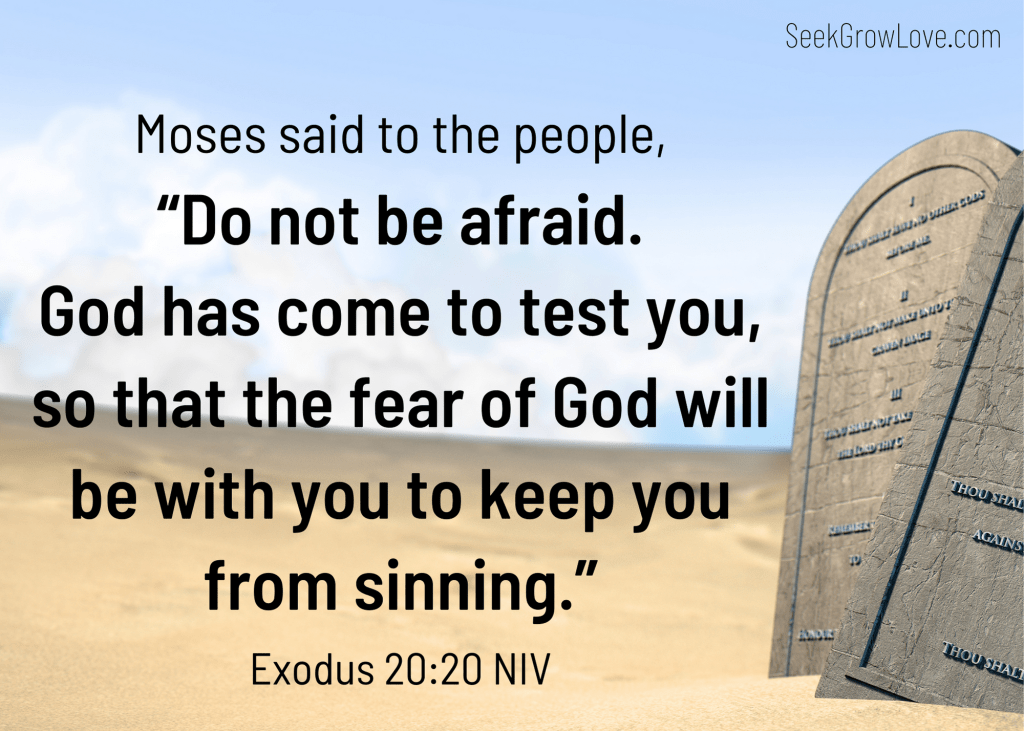
God, as we know, is all powerful. He freed the people from a land of slavery. (Exodus 20:2) God is a loving God, but he can be a jealous god. (Exodus 20:5). He can show us just how powerful he is. (Exodus 20:5-7,25-26) When I was younger, I was always confused by the saying “Fear God”. As I got older I have come to better understand this. We aren’t to fear God like we are the devil, but we are to fear him because we know His strength and power. We are supposed to fear Him so that it keeps us from sinning.
He has shown us and told us what we are to do and not to do. We are to honor our mother and father. We are not to commit murder. We are not to commit adultery. We are not to steal or give false testimony against our neighbor. These are just a few of the commandments. In order to follow these God wants us to fear His power and in a way fear disappointing him. He is our Father in heaven. It’s the same fear we should have for our earthly parents. Exodus 20 is a great chapter because it shows us all the things we should do to please God.
-Genesis Dylewski
Questions for Reflection and Discussion
Look closely at the Ten Commandments (Exodus 20:1-17). How would you describe each commandment in your own words? Now consider, why do you think God included each of these commandments?
What is the overall subject of the first 4 commandments? And of the last 6? Which do you generally find more challenging – having a good relationship with God or having good relationships with people? While recognizing the importance of all 10, choose one commandment from the first 4 and one commandment from the last 6 to focus on this week. How will you better align your thoughts, attitudes, words, and actions with these commandments?
Can you think of a time the fear of God kept you from sinning? Explain. Can you think of a time you should have feared God more? Explain. How can you work on developing a healthy fear of the LORD?
In this first chapter of Exodus, we see that the Israelites are viewed as a formidable threat due to their increasing numbers. There was a great fear that the Israelites would continue to multiply and if war were to break out, they would choose to join with Egypt’s enemies and eventually leave the country. In verse 16, we read of the horrific remedy that the king of Egypt concocted and delivered to the midwives: “When you are helping the Hebrew women during childbirth on the delivery stool, if you see that the baby is a boy, kill him; but if it is a girl, let her live.”
We then read with great relief in verse 17 that the midwives “feared God and did not do what the king of Egypt had told them to do; they let the boys live.”
Do we always have the courage to do what is right in the eyes of God—even at great risk and cost to ourselves? We might think that we would never be put in such a dire predicament, but I believe our faith is tested in both big and small ways. Our faithfulness in the “small things” can actually speak to the overall health of our faith. As stated in Luke 16:10, “The one who is faithful in a very little thing is also faithful in much; and the one who is unrighteous in a very little thing is also unrighteous in much.” Imagine you are eating dinner at a restaurant and you notice the server forgot to charge you for that delicious artichoke and spinach appetizer. Do you think, “Ha! It’s my lucky day!” or do you remember that the right thing to do in the eyes of our Heavenly Father is to pay for everything that you ordered?
I have a theory. I think that it might actually be easier to make the right choice in dire circumstances as opposed to authentically living out our faith on a daily basis amidst the small trials and challenges of life that constantly wash up against us. Have you ever been in the ocean or even in a tidal pool at a water park and found it hard to regain your footing after getting knocked down by a wave? Even the smallest of waves can wipe us out and deplete us of strength if we don’t feel like we can catch our breath between the waves. Psalm 42 gives us some comfort for these times:
6 “My soul is downcast within me; therefore I will remember you in the land of the Jordan, the heights of Hermon—from Mount Mizar. 7 Deep calls to deep in the roar of your waterfalls; all your waves and breakers have swept over me. 8 By day the Lord directs his love, at night his song is with me—a prayer to the God of my life.”
May we be encouraged by this reminder that God’s song is with us and that He rewards our faithfulness. Verses 20-21 of Exodus 1 demonstrates how God rewarded the faithfulness of the Hebrew midwives: “So God was kind to the midwives and the people increased and became even more numerous. And because the midwives feared God, he gave them families of their own.”
May our goal always be to please our Heavenly Father in the big and “small” things and to lean into Him when the waves of challenge sweep over us.
-Kristy Cisneros
Questions for Reflection and Discussion
Do you find it difficult to live out your faith authentically when faced with the big and small challenges of life?
How can we better lean into God during times of challenge?
Which heroes of the faith inspire you with how they leaned into God during times of trouble?





 Seek Grow Love