Because He Accepted Me

Romans 15

Romans 15 7

Hello friends!

I do not necessarily have a set style of writing when it comes to devotionals… so (un)lucky for you, you get to listen to my general thoughts on the chapters this week!  I will list a few of my thoughts that are a little less common or obvious on each chapter and pose some reflection questions that will hopefully get you thinking deeper about what we’ve read this week.  My goal is that something I think of, you hadn’t thought about and you’re willing to dig deeper into the idea.  So, let’s look at Romans 15 according to Sarah’s brain, shall we??

Thought #1 – Vs. 1 – 12: There are some great verses in that small chunk that carry big meanings and can be so relevant to our lives!  Focusing on verse 7 specifically, I think it can be very easily manipulated to satisfy an individual’s personal agenda.  “Accept each other… ” that means you can’t tell me what I’m doing is wrong.  Because maybe it’s wrong for you, but it’s right for me.  How many times have you heard that or said that yourself?  I’ve definitely used that excuse!  And while that statement may not always be abused, or even inaccurate, we need to use discernment when bringing that idea up.  When we finish out that sentence, “Accept each other just as Christ has accepted you, SO THAT God will be given glory”  we see more clearly into the message Paul was trying to get across.  If we are accepting others as Christ accepts them, we are not letting them do whatever they want.  We are loving them enough to correct them when necessary, pick them up when they need, and not leaving them even when they mess up.  Let’s be honest, interacting with people can be difficult.  Accepting people who are difficult, is difficult!  But yet we are called to do so.  And why are we doing this?  SO THAT God will be given glory.  We don’t have to try to accept people when it’s hard for any other reason other than to bring God glory.  When you interact with difficult people in a positive way, what is your thought process behind it?  Are you doing it with a self-righteous attitude or genuinely trying to bring God glory?

Thought #2 – Obviously we know that prayer is important, but seeing yet another example of how Paul truly and genuinely believes in the power of prayer is very motivating to my own prayer life.  Not only does Paul live out a strong prayer life, he encourages others to join him and asks that they pray for him.  He clearly truly believes and trusts in the power of prayer.  Are you fully utilizing the power of a praying body of Christ?

Thought 3# – Vs. 30: Final thought for today… Sometimes you need to be refreshed by the presence of like-minded believers!  FUEL, Family Camp, ReFUEL, Refuge, Christian Worker’s Seminar…. These are all great places to be uplifted, encouraged, and refreshed.  But, just as Paul writes, I think it makes a difference in the attitude you come with.  If you are not looking forward to meeting with like-minded believers with joy and anticipation, are you being held back from refreshing company?

I hope some of these ideas were able to make you think a little deeper about our text today!

“May the God of peace be with you all.” Romans 15:33

~Sarah Blanchard

Worship God with your Mind

Philippians 4 6

Free theme week: Worship

Chapter reading for the day: Philippians 4


The mind is incredibly powerful. Because the mind is powerful and directly affects how we live our life and how we think about ourself, setting our mind on God is of paramount importance. If Satan and dark spiritual forces can win over your mind and have you believe their “truth” then they control you. We see this when Jesus was led into the wilderness and then was tempted by Satan. Satan questioned Jesus’ identity twice trying to get Jesus to believe that he was not who God said he was. Satan was attacking the mind of Jesus. But Jesus had a strong mind that was set upon God and his promises and did not fall for Satan attacks. Worshipping God with our mind is essential if we want to stand firm against the schemes of the enemy. Today we’ll look at one way that we can love and worship God with our mind.

The definition of anxiety is a being in a state of apprehension, uneasiness, or nervousness. Anxiety wrecks the mind and bombards it with endless “what if’s”. All of us have experienced anxiety at one time or another. There are many situations that we can become anxious about including our relationship with God. If left unchecked anxiety can consume a person and drastically affect their relationship with God and Jesus. When this happens the person and their mind is living in a state of “non-worship”. In Philippians 4.6-8 God reveals to us the remedy of anxiousness:

“6 Be anxious for nothing, but in everything by prayer and supplication make your requests made known to God. 7 And the peace of God which surpasses all comprehension, will guard your hearts and your mind in Christ Jesus. 8 Finally brethren, whatever is true, whatever is honorable, whatever is right, whatever is pure, whatever is lovely, whatever is of good repute, if there is any excellence and if anything worthy of praise, dwell on these things.”

Philippians 4.6-8 is a call to worship God with our mind. To set our mind on God and Jesus and not dwell or focus on anxiety. Here are some things we learn from this passage:

  1. Let nothing in life give you anxiety
  2. Because we are called to give everything to God in prayer (including anxiety)
  3. The supernatural peace made available to us because of Jesus will guard our heart and mind
  4. We are to set our mind on things that are good, godly, and wholesome.

Notice that Philippians 4 does not say that life will not have anxiety. But when you do have episodes or seasons of anxiety do not let it consume you. Surrender it to God in prayer. When we allow ourselves to be consumed with anxiety and fear we live in a state of non-worship of the mind. But when we obey what God has said we worship God with our mind, it says I will not let [fill in the blank] define me or consume me, I will bring it to God. That is worshipping God with our mind. This is worship that God desires from his people.

-Jacob Rohrer

Paul Faces Felix

image (1)
Acts 24
When the Roman Empire conquered the Holy Land in the middle of the first century BC, it established its own rulers to ensure peace and cooperation throughout the region. The Jews have had a long history of revolting against their rulers (especially when they weren’t monotheists), so it makes sense that one of the main jobs of the regional Roman rulers was to keep Zealots (Jews who vocally, and sometimes violently, opposed Roman rule in their homeland) from causing too much trouble. Whenever any of these Zealots caused an uprising in a Jewish city, there were major consequences–sometimes death.
 So when in chapter 24, the attorney for the Jewish elders accused Paul of being a trouble maker who stirred up riots among the Jews, he was saying that Paul was not such a great guy and should perhaps be killed. He also claimed that Paul desecrated the temple–a capital offense. These religious leaders wanted Paul taken out.
As Paul stood to defend himself before Felix, the first of several Roman rulers who would hear his case, he was up against some serious allegations. But Paul was unfazed. He had just been assured by his Master that his journey would not end here. Paul spoke boldly in both the defense of his character and his faith. I think Paul would have done this even without that assurance because of where he had his focus. Paul’s eyes were fixed firmly on his savior and the future hope of the resurrection. This allowed Paul to operate without fear of death or retribution–to be at peace.
You may not live in a society where you must defend yourself or your faith in front of corrupt rulers. But perhaps someday you will face charges because of your beliefs. If that time ever comes, you, like Paul, can have a peace that passes understanding. Trust in God, rely on His promises, focus on His Son and the hope of the resurrection, and pray.
-Joel Fletcher

Dreams and Determination

Acts 11

Acts 11 5a

“I was in the town of Joppa and was praying when I fell sound asleep and had a vision.” Acts 11:5
Peter experienced dreams.  What about us?  How do we hear from God?  When God gives us the urge to follow, we cannot rest until we complete the task that has been assigned.  When it’s right, you will be moved to do it.
He rewards our faithfulness. I pray often for my spirit to be stirred. To move me towards God and lead me to the adventure He has planned for me.  I pray for the wisdom to know when He is speaking to me.  I ask Him to help me be fearless in His name.  Are you willing to be obedient, to have a life of changing moments?  It’s not a burden to follow the Lord, it’s a true privilege.
Acts 11:19-30
News of this reached the ears of the church at Jerusalem, and they sent Barnabas to Antioch.  When he arrived and saw the evidence of the grace of God, he was glad and encouraged them all to remain true to the Lord with all their hearts.  He was a good man, full of the Holy Spirit and faith, and a great number of people were brought to the Lord.                            Acts 11:22-24
Defining moments for any of us can be loss or can be about God’s great grace that can transform us in the midst of sorrow.  Through times of suffering we can see that through God’s grace we can achieve greater depth, compassion, joy, and appreciation of simple blessings.  This story in Acts reminds us of the great persecution and suffering that was going on at the time.  Yet Barnabas (the great encourager) arrived and saw the evidence of the grace of God and he was glad.  What a gift to live outside the box—to trust in God’s great grace.   There is such depth in the faithfulness of God in our lives.  If you are going through a difficult circumstance, a tough choice, a rough path in your life, try recalling God’s love, faithfulness and His great grace.
God, thank you for the gift of your great grace.  May we trust that your grace is sufficient for us.
-Andy Cisneros

Delayed Gratification

matthew 7 7

MATTHEW 7

One of the most famous experiments ever done to understand the human psyche is the Stanford Marshmallow Experiment.  In this study, a marshmallow and a bell were placed in front of a preschool child. The instructions were as follows: if the child wanted to eat the marshmallow in front of them after the adult left the room, they only need to ring the bell to gain permission; however, if they waited for the adult to return to the room on his/her own, about fifteen minutes later, then they would receive an additional marshmallow for their wait, essentially doubling their pleasure.  A seemingly simple experiment became a tortuous endeavor for these children. Initially, almost all the children tried to wait, but the longer they watched the door and thought about the marshmallow, disbelief and displeasure began to fill their minds. The ones who were ultimately successful looked in a different direction, sang a song, or reframed their desires, all of which helped to ultimately endure to receive their reward in full. Conversely, some were overcome with their desire or doubt; they rang the bell and received a lesser reward.


Matthew Chapter 7, our reading for today, contains a handful of verses we will most likely wrestle with at some point in our lives when our metaphorical marshmallow is placed in front of us.  Yesterday’s devotion showed us God’s provision, but there is a distinction here that appears in times where we appeal to God for greater things, beyond bread or fish (Matt 7:9): the search for a spouse, selection of a college or career, the growth of a church or ministry, the health of a loved one, the birth of a child or wisdom in a difficult situation.  All of these have a biblical basis as blessings from God, the giver of “good gifts to those who ask” (Matt 7:11), so we might suspect for these to move up God’s priority list. The only requirements are we ask, seek, and knock (Matt 7:7). Initially, these three actions seems the same, but through my own appeals, I have come to realize these in fact may be steps of a larger process.

ASK

First, you must ask.   While our action and efforts show our faith, if we bring God in, we are no longer in control (or under the illusion that we are in control).  By making our request known to our Heavenly Father, we begin to have peace with the “marshmallow” that passes our comprehension of the situation (Phil 4:6-7).  We are settled knowing that if we ask in the name of Jesus Christ, our Heavenly Father will not only hear our request, but has already placed our desire within the scope of his will and eternal plan (John 14:12-14). You will receive it.

SEEK

Next, you must seek. We are to search for God’s will in our lives which is much larger than a single request.  It is so easy to be consumed with a single desire and measure your faith and relationship with God by it. He rewards those who earnestly seek Him (Hebrews 11:6), so we must look away from the “marshmallow”, and look towards God’s kingdom as the first priority for our lives.  By daily searching for God and His perfect and pleasing will, we will ultimately collide with the desire of our heart at the single most opportune moment which is mutually benefiting God’s kingdom and us. You will find it.

KNOCK

Finally, knock, which is by far the most difficult of the three.  You must patiently wait and trust God. As we wait, the rain will come down, maybe harder than ever, the floods will come up, maybe higher than ever, and the wind beat against the house, maybe stronger than ever, and the foundation of our lives will be exposed (Matt 7:24-29).  These are the moments that make or break a faith. To endure the storm, we must be persistent in our prayer lives, even when we are frustrated. We are to be fervent in our discipleship, even when our will is depleted. We must share our faith, even if we have moments of doubt.  We will not “earn” our reward, but they give us the strength to continue to stand at the door knocking, waiting for God’s perfect timing, the delayed gratification, the moment when faith becomes sight. And soon enough, He will open the door.


The children who participated in the Stanford Marshmallow Experiment were later studied as teens and adults.  There were some startling correlations with the group that found their way to endure to the end, delaying their reward until a more pleasing moment.  They were better able to cope with stress, more likely to be fulfilled in the work, less likely to be impulsive or aggressive, and less likely to be addicted or become divorced.  As we wait for our good and perfect gift from above, God may be moving heaven and earth to bless us (2 Kings 20:1-11). The problem is He is on the other side of the door, and all we can see is the marshmallow.  It is so easy to become focused on this one thing and forget about the promise. There is so much blessing waiting in the waiting. Our focus changes, we become disciplined, we find ways to sing while stressed, we become fulfilled in God – blessing or not.  We are focused by and consumed with God, not the marshmallow. Then the door opens and we remember the promise, and we see our reward and how His plan was so good.  God delays our gratification, not to experiment or simply because He can but to show us He truly is the giver of the greatest gifts to those who ask, and he will double or exponentially multiply the reward.  Don’t give in and ring the bell – Ask, and it will be given to you. Seek, and you will find it. Knock, and the door will be opened.

-Aaron Winner

Begging for Help

Acts 3 1,2

Happy late Thanksgiving everyone! #thankgivingisthebestholiday Although the day of turkey has passed I hope we can all be thankful for what we have considering many do not have anything at all. Recently in Saint Louis, I encountered a man named Ron who was homeless and had nothing to his name except his torn up bag and the clothes on his back. Ron, like many you may encounter in your lives, asked me for money. There are at least two easy ways to handle this situation. First, we could give them the money they were asking us about. Or second, we lie and walk away feeling like we did that person well by not giving them money that could possibly enable their bad habits.

I would say Peter and John have a more effective way of serving these people. In Acts 3:1-10 Peter and John encounter a man who can’t walk and is begging for money in front of the temple gates (a common practice in that day, which could be compared to those at the stoplights we see). Instead of giving him money, they give him prayer and healing. Something we all can afford and is always at the ready. Next time you encounter someone like this it might be appropriate to pray with them about their situation and see if something big happens.

-Jesse Allen

Waiting – Patiently

psalm 37 7a

Psalm 37:7 “Be still before the LORD and wait patiently for him; do not fret when people succeed in their ways, when they carry out their wicked schemes.”

Waiting, especially for a response to prayer, is always hard. How often have you asked God for guidance, only to be met with silence?  It is hard to be patient when others around you are succeeding. How do you respond to the times the answer to prayer is “Wait”? God will always help those who call on Him, sometimes He is waiting for us to be obedient.

Often when we are unsure of the direction God has for us, we seek help from other Christian friends.

Reflect on a time an answer to prayer was “Wait.” How did you respond? Do you have a trusted friend or mentor to help you be patient as you wait for God’s direction? Take some time to pray for them. Work on being patient as you wait on the Lord.

-Susan Johnson


How to Have Peace Instead of Anxiety

phil 4 6 (1)

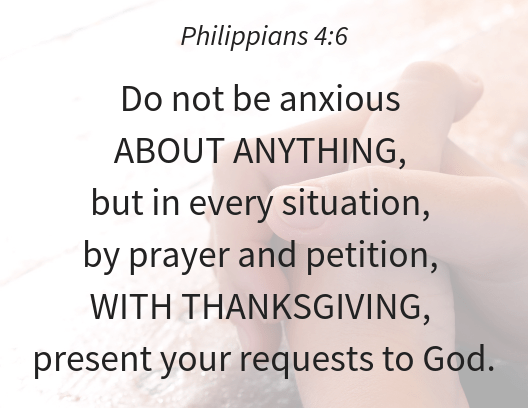
Philippians 4:6-7 “Do not be anxious about anything, but in every situation, by prayer and petition, with thanksgiving, present your requests to God. And the peace of God, which transcends, will guard your hearts and your minds in Christ Jesus.”

My grandma Kenney was widowed in 1946, with 11 children. This was before welfare or food stamps. She had to find a way to support herself and the children. Being a devout Catholic, Theresa found work at the church across the street. Her job was to do the laundry: the church housed 8-10 priests and had daily mass, she was responsible for their laundry and the alter linens. While to some this wasn’t important work she took it very seriously. The same pride she took in starching the alter linens, went into the priest’s boxer shorts!

I knew my grandmother when she was retired, yet she still attended mass as often as she could. Life had been hard, yet she trusted God and his word. She kept her iron and ironing board next to her chair. And on the ironing board was her Bible, and as she talked with visitors, her hand was always on the Bible. To the very end, she brought her needs to God and trusted He would always be there for her.

Take some time to reflect on a person of faith who you admire. Thank God for the example they have provided for you.

-Susan Johnson

Regeneration and Renewal

titus 3 5

Titus 3    &    James 5

Two chapters?! They’re both short so I’m sure you’ll have no problem reading both.  I just couldn’t decide which of these chapters I wanted to use to discuss healing of the spirit, so I am going to use them both.

In Titus 3:3, Paul graciously gives us a list of things that we do wrong. There’s no doubt that every one of us can find a few of these words to associate with. These things are why I believe that we all need spiritual healing. You may have heard that term used before by non-Christians, but what I mean by spiritual healing is a little different. I mean the renewing of our minds through forgiveness. I mean the ability to turn away from our sins and start walking in the other direction.

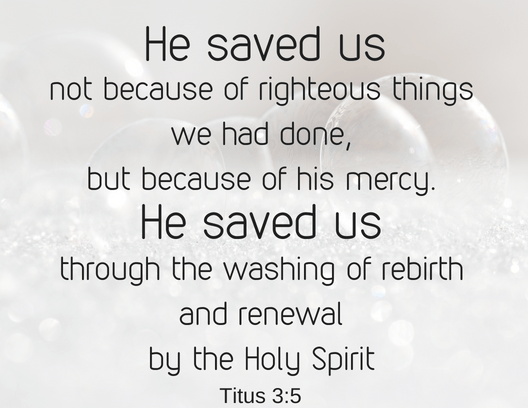
Spiritual healing is easy in concept. We all know that Jesus died for our sins. There is grace overflowing for us. Titus 3:5 says “He saved us – not by works of righteousness that we had done, but according to His mercy, through the washing of regeneration and renewal by the Holy Spirit.” All we have to do is ask for forgiveness and it will be ours.

But spiritual healing is so hard in practice. So many times, we let our past selves become the master of our present selves. Two things can happen that get in the way of our healing.

First, the sins of our past enslave us and we can’t forgive ourselves. We beat ourselves up for things that we should be able to leave behind. John 8:32 says that the Truth will set you free. If that is true, then why is it so easy to feel tied down? Jesus gives a conditional before saying that you can be free. He says, “know the truth.” The truth can’t set you free if you don’t know the truth. You need to know who Jesus (the Truth) is and you need to know the truth of forgiveness. The truth is asking for forgiveness is easier than feeling forgiveness.

Second, we continue to live in our sin. Remember how Jesus said, “The truth will set you free”? He also said, “Continue in my word.”  If you haven’t truly turned away from your past sins, then of course they are going to continue to rule your life. Once again, this is easy to understand and hard to practice.

In my experience, there is a crucial step that is always overlooked when it comes to spiritual healing. Let’s look to James now, in 5:16. We need to confess our sins, not only to God, but also to each other. We need to hold each other accountable, and you can only do that if you know what your friend is struggling with. James also repeats something that I’ve been saying all week: pray. Pray together for healing because “The urgent request of a righteous person is very powerful in its effect.” James give us an example of an effective prayer. Elijah prayed that God withhold the rain and God did so. The key point of the example can be easy to miss though. Elijah was a man with a nature just like ours; he faced temptation and sinned just like us. He prayed earnestly, and through his prayer, he was able to do great deeds for God.

Don’t let your past enslave you. Turn from your sin. Confess your sin to your brothers and sisters in Christ. Let the Truth set you free.

-Nathaniel Johnson


Another Kind of Healing – When Pigs Fly

Mark 5:1-19

(But no one is stopping you from reading the whole chapter)

How many of you have ever seen a scary movie? I don’t recommend them. Being scared is not fun, but sometimes we can’t help being scared. Today we’re going to talk about something scary, but fear not! This devotion has a happy ending.

In this segment of Mark, we see Jesus healing another man, but this time, he is casting out demons. This wasn’t an ordinary casting out of demons either. This man that Jesus encountered had an unclean spirit that consisted of thousands of demons (5:9).  The man had been so out of his right mind that he was cast out of normal society and forced to live in a cave where people had tried to chain him up, but not even chains could hold this man down. He would scream and cut himself day and night (5:5). This man is clearly not okay. Yet Jesus still let the man seek him out.

Notice how Jesus is being approached by a man that can literally break chains, but he doesn’t seem to be worried. That is exactly how we should feel knowing that we have the God of Jesus on our side, too. The demons in this man fear Jesus and respect his authority. It says in verse 13 that Jesus “gave them permission.” They obey Jesus! Now the next part of the story is a little weird, but it is very important. The demons went into a herd of pigs and subsequently flew off a cliff. Okay, maybe they didn’t fly, but it’s still an odd thing for pigs to do.

This story is a little different from the story of the blind man that we looked at yesterday. The man who was healed in this story didn’t have a physical impairment; he was healed of a sickness of the mind. These kinds of sicknesses can be even scarier than the kind that affect us physically. One such mental sickness that has become very prominent lately is depression. I know firsthand just how many people suffer from depression these days, especially teenagers, so I want to share with you the story of when I saw pigs fly.

When I was younger, I had a close friend who suffered from severe depression and harmed herself in ways like the man that Jesus healed. Many times we think that self-harm is unique to our generation but this story really says otherwise. This was a really painful experience for me just by knowing that my friend was going through this. I urged my friend to talk to a trusted adult and to see a doctor because I knew that I was not qualified to counsel on this subject. However, there was one way that I was able to help. I offered my prayers. Prayer became a constant for me in this period of my life. I wanted nothing more than to see my friend freed of this demon, her depression. One day, I wanted to pray with my friend, so we went out to a park and sat together praying for hours. I remember my prayer: “God, I know that you have the power to cast out demons. Cast out this demon.” After repeating this many times, my friend looked up and I could see a difference in her eyes. Pigs flew, and her depression has never bothered her since then.

I don’t know whether an actual demon was involved in this story, but depression certainly acts like a demon, taking over your thoughts and actions. Whatever the cause of depression may be, our God is bigger and more powerful and there isn’t anything in this world that disobeys His command.

Don’t forget the ending of the story in Mark. After the man was healed, he wanted to follow Jesus, but he was turned down. Jesus told the man to go back to his family and testify to them. This is just like what we saw in John yesterday. After you are healed, Jesus wants you to make sure that the people you know can see that you really were healed.

Tomorrow I am going to go into the role that modern medicine plays into the healing that we can receive from God.
-Nathaniel Johnson