Priestly Portion

Joshua 12-15

I’ve heard sad stories of siblings living hostilely toward one another for decades because of arguments regarding the inheritance from a late parent. I wonder if the Israelites assumed God picked favorites as he doled out their assigned territories in the Promised Land. 

Remember Caleb? At eighty-five years old, Caleb finally realized his dream of inheriting Hebron four decades after he had first explored it. He and Joshua were the only two of the dozen spies who had encouraged the nation to take their Promised Land; the ten other agents involved in the espionage had invoked great fear in their people. As a result of their collective lack of faith, the Israelite nation would wander for 40 more years in the wilderness while most of that unfaithful generation died off. Caleb, now an octogenarian, was very eager to finally claim the territory that had been promised to him two scores ago. He and Joshua had kept the faith, remained true to God, and waited patiently to receive their inheritance, just like we must wait patiently for our Promised Land, the Kingdom (Romans 8:25). 

Perhaps the Levites, the tribe designated to serve as priests, initially felt slighted when they learned that they would inherit no land at all; rather, God promised to be their portion and take care of their needs as they served as religious leaders for His people. Though it might seem like they had received nothing tangible, they actually received the best gift: a closeness with and dependence on God that most would never experience. 

We, too, are beneficiaries of a similar priestly portion:  “But you are a chosen people, a royal priesthood, a holy nation, God’s special possession, that you may declare the praises of him who called you out of darkness into his wonderful light.” 1 Peter 2:9 

Unfortunately, we tend to chase temporary things in this life, like fortune and fame, rather than keeping our eyes on the eternal prize. None of this truly satisfies, and we can’t take it with us when we die – you’ll never see a hearse pulling a U-Haul, after all! Jesus reminds us to “store up treasures in heaven… for where your treasure is, there your heart will be also” (Matthew 6:20-21). As followers of Jesus, we have a much greater inheritance promised to us, far better than all the riches of this world. 

I leave you with the priestly blessing from Numbers 6:24-26: 

The Lord bless you and keep you;

the Lord make his face shine on you and be gracious to you;

the Lord turn his face toward you and give you peace.

-Rachel Cain

Reflection: 


What does it mean personally to you that God is your portion? How does that impact your soul?

Meditate on these scriptures as you thank God for being your portion! 

  • My flesh and my heart may fail,but God is the strength of my heart and my portion forever. Psalm 73:26
  • Because of the Lord’s great love we are not consumed, for his compassions never fail. They are new every morning; great is your faithfulness. I say to myself, “The Lord is my portion; therefore I will wait for him.” Lamentations 3:22-24
  • And this is God’s plan: Both Gentiles and Jews who believe the Good News share equally in the riches inherited by God’s children. Both are part of the same body, and both enjoy the promise of blessings because they belong to Christ Jesus. Ephesians 3:6

Succession Plans

Deuteronomy 30-31

Then Moses called Joshua, and said to him in the sight of all Israel, “Be strong and courageous; for you will go with this people into the land that Yahweh has sworn to their fathers to give to them, and you will cause them to inherit it. Yahweh, it is he who goes before you; he will be with you, he will not leave you or forsake you. Do not be afraid, and do not be dismayed.” Deuteronomy 31:7-8 (REV)

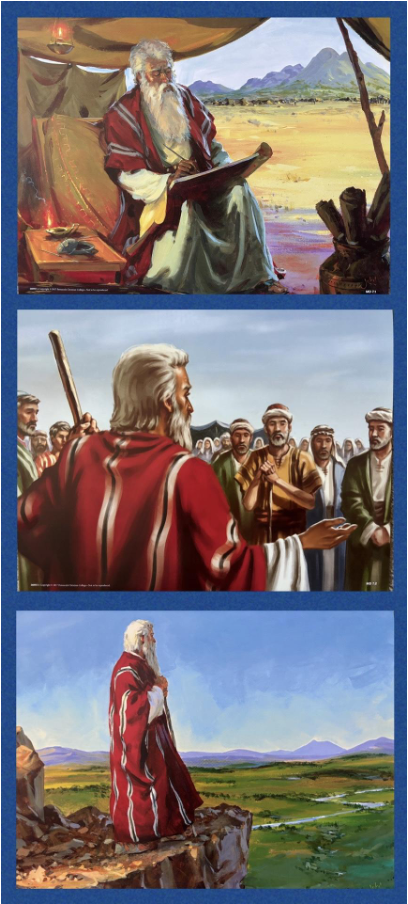
In Deuteronomy 31, Moses begins to reflect on the fact that his life is about to come to an end and he will not be leading the Israelites into the promised land. We see Joshua enshrined as Moses’s successor, as God directed Moses (Numbers 27).

Succession plans are important as leadership changes are critical junctures for organizations. When a known change is coming, it is easier to start laying the groundwork for succession, but that can be short-sighted. There is wisdom in succession plans that consider the unknown. No one knows how many days they have left to live in this age. Illness can come on suddenly, and tragic accidents happen frequently. By the grace of God, you reader, will live many more years to serve God faithfully, but what if the unthinkable happens? Have you ordered your house? Have you, in your role as pastor, leader, director, or church volunteer, poured into those around you and prepared individuals to do the necessary ministry of the church if, for some reason, you must vacate your position, voluntary or otherwise?

In my first year at Atlanta Bible College, I took the course Principles of Ministry and Leadership (I think that was the correct class name) with Professor Jon Cheatwood. One of the books that we used was the 21 Irrefutable Laws of Leadership by John Maxwell. While I have not touched that book in nearly twenty years, I remember clearly one of the concepts in the book: Leaders should be training their replacements, figuratively working themselves out of the job. You should ensure that those under you or around you can take over the tasks and responsibilities you are responsible for. This is not to create job insecurity but to ensure stability for an organization or ministry if unexpected departures happen.

Just as Moses was chosen by God to lead his people out of Egypt, Joshua was chosen to lead them into the promised land. Moses publicly enshrines Joshua as leader, making clear the succession plan and avoiding a power vacuum with multiple individuals striving for the top spot or fearful individuals that pick up camp and head back to Egypt.

Several years ago, there was a TV show called Succession that was loosely based on real events from a power struggle within a powerful business. I am not recommending the show, but it showcases the chaos that surrounds an organization that does not have clear protocols and succession plans in place.

About 10 years ago, my church was thrust into unexpected changes in pastoral leadership. While not without bumps in the road, the leadership of the church was equipped enough to manage a very difficult period. Clearer succession plans certainly could have made some things easier and maybe would have created some different dynamics in leadership structures than what was implemented during the transition. While you may not be able to perfectly clone yourself as a leader (and you probably shouldn’t), you can pour into the next wave or generation of leaders and begin preparing them for the joys and difficulties of ministry and leadership. Whether you are a senior pastor, a volunteer coordinator, or somewhere else on the spectrum of ministry roles, we should always be working to ensure that the ministry of the Gospel is primed to continue in our organizations, with or without us.

-JJ Fletcher

Reflection Questions

  1. Have you ever experienced a sudden change in leadership? Either as a member of leadership or someone that looked to leadership, what were some of the takeaways that you had from that experience? What could have been better in that situation?
  2. How important do you think it was that Moses made a public showing of the transition of leadership from himself to Joshua?
  3. What are some of the pitfalls of tight-fisted leadership that does not allow for the incremental growth and training of future leaders?
  4. Does God choose leaders now like he did in the times of Moses and Joshua? What does leadership selection look like now?

Looking Back and Looking Ahead

Deuteronomy 1-2

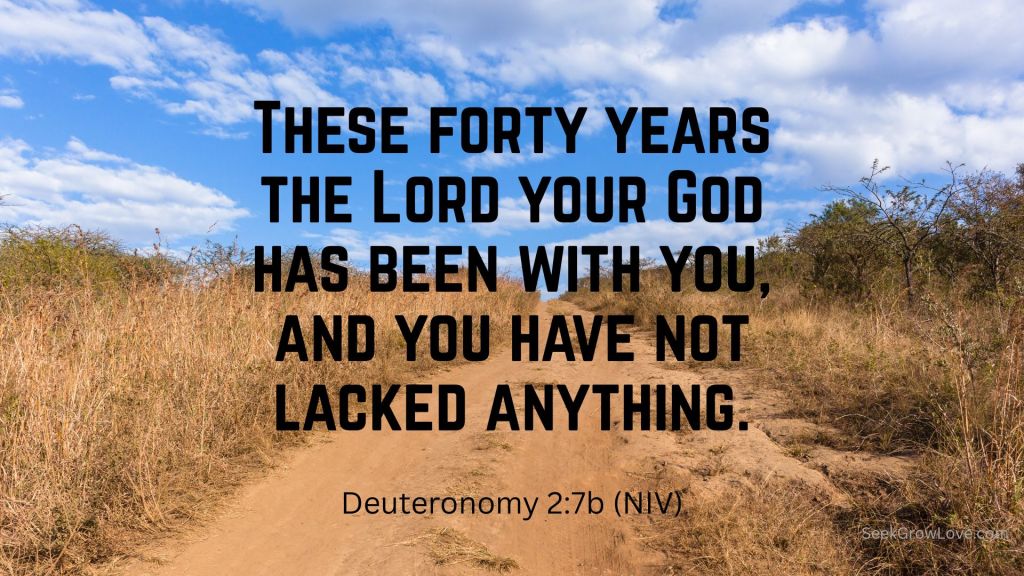
A time of reflection and recap of events as the Israelites prepare to enter the Promised Land. “For the LORD your God has blessed you in all the work of your hands. He knows your going through this great wilderness. These forty years the LORD your God has been with you. You have lacked nothing. (2:7) They’ve LACKED NOTHING?! They probably didn’t agree with that, but it shows how God provided for them the basics, which is ample for a person. He literally gave them their daily bread.

Moses reminded them, “The LORD your God who goes before you will Himself fight for you, just as He did for you in Egypt before your eyes,and in the wilderness, where you have seen how the LORD your God carried you, as a man carries his son, all the way that you went until you came to this place. Yet in spite of this word you did not believe the LORD your God.” (1:30-32)

It’s amazing that we can do the same thing like the Israelites at times, cry out to get out of a difficult situation (Egypt), then afterwards when we’re out we complain again. But if they would’ve trusted that God would fight for them they could’ve been spared the long difficult 40 years. The wilderness was the ONLY way to get to the Promised Land, and their lack of trust made it even harder (and longer).

Not one of these men of this evil generation shall see the good land that I swore to give to your fathers, except Caleband Joshua who wholly followed the LORD.” (1:35) Even Moses wasn’t allowed to enter as the LORD was angry with him too (or, had been angry and was following through with consequences).

Despite failures and difficulties Moses pressed on with the people until his departure. This reminds me of parenting! It’s difficult and rewarding! One of my main parenting verses that encouraged me over the years, besides Deut. 6:4-7, is 1 Peter 4:12,

Above all, keep loving one another earnestly, since love covers a multitude of sins.

– Shalom y’all, Stephanie Schlegel 🙂

            (From Israel and Tennessee:)

REFLECTION QUESTIONS

1. Have you had to endure a difficult situation for years? How did God sustain you through it?

2. Is there an issue you’re dealing with that if you’d wholly trust God, the situation would be better? Are you taking matters into your own hands or trusting God with it?

3. Reflect over this last month how God’s provided for you and thank Him for it!

4. How does looking back better prepare the Israelites for looking ahead? How can it benefit you?

A New Shepherd

Old Testament: Numbers 27 & 28

Poetry: Job 20

New Testament: Mark 5

Once again, we have come across another section of Numbers with a number of sacrifices, laws, and other things that the ancient Israelites were expected to fulfill.  Unfortunately for us, those laws are not as relevant to us today and can seem boring. To them though, these were essentially important to living in communion with their God. But what lesson can we Christians who are no longer bound by the Old Covenant take from this section?

I believe that 27:15-23 has very great insight for all people of all ages. This passage explains that Moses will not be leading the people into the Promised Land because of his disobedience back in 20:8-12. However, Moses is commanded to install Joshua as his successor as leader of the Israelites. Up to this point, Joshua was likely studying underneath Moses and worked with him.

The point of this lesson is two-fold: Those that are older need to prepare someone younger to take their place eventually, and those that are younger need to learn from those that are older. Unfortunately today, people have a mindset that their generation is the only one that is correct, while the truth is that there is much that can be learned from all generations, both older and younger.

To those that are older: Look for the potential in those that are younger in your church and start training them up to eventually enter ministries that you will be leaving eventually

To those that are younger: Learn from those older than you, be willing to do ministry work in your church, and develop a passion for the Lord.

-Talon Paul

(originally posted September 8, 2016)

Reflection Questions

  1. What was Moses’ concern when the Lord told him he would not be entering the Promised Land?
  2. If you are on the older end of ministry – who are you mentoring and teaching to do the ministry you are doing? Who else can you get involved?
  3. If you are on the younger end of ministry – who will you ask to teach you how to serve and minister?

Generations

* Old Testament Reading: Numbers 20 & 21

Psalms Reading: Psalm 69

New Testament Reading: 2 Corinthians 6

In Numbers 20-21 we encounter the Israelites at the end of their journey as they wrap up their years in the wilderness and prepare to enter the promised land of Canaan. Unfortunately, before they do that, we see a purging of a generation of people who had rebelled, distrusted, and quarreled with themselves and with the LORD. In Chapter 14 God had instructed them that only Joshua and Caleb would enter the promised land, and now we see God was serious. In Numbers 20:1 Miriam dies, in verse 12 Moses is told he will not be entering the promised land, and by the end of the chapter Aaron is dead. No special privileges here for being a priest, a leader, or related to a special someone who “was a really good person most of the time”.

In recent years I’ve heard more and more talk about generations.  Terms like X, Y, Z’s, Millennials, Zillennials, Baby Boomers. All have their strengths and weaknesses, and since I fall right in-between two, depending where I am or what is being said, I might want to associate with one more than another. That is because there are stereotypes of generations, but none are always accurate nor are they particularly important or beneficial. No matter what, as a body of Christ, we are an intergenerational people, and research continues to show the benefits of multigenerational worship and education. The year of your birth simply does not have anything to do with who we are in Christ. What does matter is our faith in Jesus and being a follower of him. In today’s reading, we see a generation dying out who knew God, yet had managed to waste the better part of 40 years not doing much to please Him, but doing a great job finding things to fight and complain about. We are currently living in a world where fights and complaints are the norm, and also one where our life expectancy is dropping. Many people born in recent generations have a lower life expectancy than their parents did. We are on this earth for a finite time, and unless we live until Jesus returns, we will “rest with our fathers” the same way people have been doing since the days of Numbers.

But, the story of Numbers doesn’t just end with death and burials, and ours doesn’t have to either. Joshua and Caleb (and crew) did get to the Promised Land. And we see more symbolism again in this idea since Yeshua can be translated as Joshua in Hebrew (our OT character leading them to the promised land) and when translated into Greek/from Greek can be translated as Jesus (our NT character through whom we have hope of our promised land in the kingdom). There is lots more out there to learn about as far as name studies if that interests you which I’ve learned a bit more about through a friend who has “Yeshua is my king” stickered across his back window. I couldn’t help ask about that one the first time I met him!

Another thing I found interesting as I read Numbers 20-21 is that a lot of the pagan enemies they are fighting on their way to the promised land are their “relatives”. The Edomites come from Esau (who was later named Edom), the Moabites and Ammonites come through incestuous relationships through Lot, and for that matter, all of them go back to Noah’s three sons! But, it didn’t matter if you were a descendant of Abraham or a relative of someone who once believed in the one true God. The people who entered the promised land were those who trusted and relied on Him, humbling themselves to allow Him to lead. Everyone else who didn’t worship the one true God as he instructed them to, set apart and holy according to his expectations. . . they were enemies. It didn’t matter if they had heard YHWH, the God of Israel, was powerful and real and they were a little scared of him. It mattered if they honored and obeyed him, and they certainly did not. While family trees can be interesting, that is about all they are good for when it comes to things of eternal perspective. The fact that your great grandpa was an elder who walked 10 miles uphill to go to church every Sunday doesn’t matter, and whether or not your relatives called themselves Christians or you attended church as a kid does not matter for your future. What matters is that in your present, regardless of which generation you are from or how much longer you may have left on this earth, you humble yourself before God and let Him lead.  The wilderness surrounds us, but the promised land to come is real.

Yesterday I ended with a verse I really liked about Jesus being the sacrifice for sins for all of us, for the whole world for all time. No more sacrifices required, and we are cleansed and forgiven. That is beautiful and true. But, the verse immediately following is too. It tells us how God expects us to respond to that gift and is a good way to wrap up our studies in Numbers this week I think.

“And by this we know that we have come to know him, if we keep his commandments.” (I John 2:3, ESV)

-Jennifer Hall

Reflection Questions

  1. What did this Israelite generation have going for them? What were strikes against them? What most important thing did they keep forgetting?
  2. Right now, this week, have you been more like Joshua and Caleb – intent on trusting a great big God who saves and will lead you into the Promised Land – or the generation that will not survive the wilderness – losing sight of God’s greatness as you focus instead on complaining, arguing, living in fear and negativity and quarreling with the Lord? Are there any changes that need to be made starting today?
  3. What does God reveal about Himself in the passages we have read from His Holy Word today?

Creating a Nation

Psalm 65-66 and Joshua 11-12

Joshua and the Israelites are getting things done and cleaning up Canaan land. Piece by piece, city by city, town by town, they are accepting their inheritance – the Promised Land that God has been preparing for them the past 430 years.

Beginning with the promise made to Abraham, the old man with no offspring, that if he followed God he would be made into the father of a great nation that would occupy the land. The promise was passed down to Isaac his miracle child, and given again to Isaac’s son Jacob, the father of 12 sons/tribes. It was these brothers that were saved by Joseph when he brought his family to Egypt to survive the famine in their land. A new pharaoh brought the Israelites into slavery and for the next few generations their numbers continued to grow in Egypt. Then Moses entered the scene with the 10 Plagues and “Let My People Go”.

This hasn’t been the easy way to grow a nation. But, God doesn’t have to go the easy route. He was not just creating any nation, but creating a holy nation that called on Him and relied on Him and followed Him.

In Joshua 11:15-16a it is recorded, “As the LORD commanded his servant Moses, so Moses commanded Joshua, and Joshua did it; he left nothing undone of all that the LORD commanded Moses. So Joshua took this entire land…”

The work passed on to the next generation and the promise passed on to the next generation. And here they were, back in the land where Abraham had pitched his tent. They were seeing the fulfillment of so many years of waiting and watching to see how God would make His promises come true. They had seen the waters of the Jordan stop flowing at flood stage so they could cross into this land. They had felt the ground shake when the walls of Jericho came down. They had witnessed the sun standing still! This was not a usual way to create a nation, because they did not have a usual God!

I love that this same awe of God is found about 200 years later in the writings of David. David is still writing about when God “turned the sea into dry land” (Psalm 66:6), as well as His majestic creation, His forgiveness, His care through rain and crops, and His “awesome deeds of righteousness” (Psalm 65:5).

I especially love a passage from yesterday’s Psalm reading – Psalm 62:11-12

“One thing God has spoken, two things I have heard;

that you, O God, are strong,

and that you, O Lord, are loving.

Surely you will reward each person according to what he has done.”

We serve a strong and loving God who rewards his faithful children. It is not enough for God to just be powerful (that could be scary). It is not enough for God to just be loving (that is also scary if you consider a loving but powerless God). But a loving and powerful God is the one I want to follow. He will have good things for His children and the strength to deliver them. Just as He delivered in mighty ways for the children of Israel as they entered the Promised Land under the outstretched arm of Joshua, God is now preparing the fulfillment of all His promises in the Coming Kingdom of God which will be ushered in at the return of His Son Jesus. And that is an event you don’t want to miss.

-Marcia Railton

Today’s Bible reading passages can be read or listened to at BibleGateway here – Joshua 11-12 and Psalm 65-66

Numbers 25-26, Luke 3

Almost 40 years had passed, and the Israelites were nearing the time when they would enter into the Promised Land. A generation had died in the wilderness because they failed to trust that God would guide them, protect them, and give them the good things he had promised. God had used the Israelites’ wilderness wanderings to teach them about his holiness and to teach them to trust in him more. However, not all of the Israelites were sanctified through this time. 

In Numbers 25, the Israelites are staying in the country of Moab. Because of intermarriage and lack of loyalty, they turn away from God and begin to worship Baal, a pagan god. Leading the way in this idolatry are several leaders of the people. God sends a terrible plague among the people that eventually killed 24,000 people and orders Moses to strike the idolatrous leaders down. So, Moses and Aaron’s great-grandson, Phinehas, gather the people together. The people are in mourning for the loved ones they lost in the plague, and all gathered together at the tabernacle, they are mourning in supposed repentance. However, Phinehas sees one of the Israelites blatantly bring a Moab woman into the tent of meeting! While the people are weeping in repentance, this person acts in a way that would indicate that he was not repentant at all. He was going to continue in his sin. The repentance was only caused by the negative experiences the Israelites faced, but it wasn’t true, heart-changing repentance that would cause them to change their actions. 

Phinehas, in a zealous passion, takes a spear and kills both the man and the woman who are doing this. Because of that harsh measure, the plague stops and God promises the priesthood would continue with Phinehas for generations. This seems like a brutal action. But, the reason why God praised Phinehas for doing it was because this action shows (1) Phinehas understood the concept of the holiness of God and his tabernacle and (2) Phinehas recognized how sin has to be stopped so it won’t continue to do its damage. Sin spreads like a plague, which, once it gets started, is very difficult to eradicate. If we recognize the importance of holiness and trying ourselves to live a lifestyle of holiness, we cannot continue to allow sin to spread in our lives. We have to be willing to act zealously to snuff it out. 

In Luke 3, we read about the ministry of John the Baptist in his own wilderness. He cries out to the people to ‘Repent, for the Kingdom of Heaven is near!’ He urges those who come out to see him to “produce fruits consistent with repentance” because “every tree that doesn’t produce good fruit will be cut down and thrown into the fire” (Luke 3:8-9). Recognition of the severity of sin and true repentance from that sin are crucial to producing good fruit. If we do not recognize and repent from sin, we will not produce good fruit. We will not live lives that glorify God. 

Evaluate your life. Is it characterized by a right understanding of sin? Of an understanding of the importance of holiness? What about true repentance and good fruit? As John and Jesus said, “Repent! The Kingdom of Heaven is near!”

~ Cayce Fletcher

Read or listen to today’s Bible reading at Biblegateway.com: Job 1-2 and 2 Corinthians 2 .

Renewal

 Joshua 22-24

Joshua 24 15 b NASB

Chapter 22 sees the return of the Eastern tribes to their allotted land across the Jordan river, after helping the rest of the tribes of Israel conquer the remainder of the Promised Land.  Verses 1-4 says, “Then Joshua summoned the Reubenites, the Gadites and the half-tribe of Manasseh and said to them, ‘You have done all that Moses the servant of the Lord commanded, and you have obeyed me in everything I commanded. For a long time now -to this very day – you have not deserted your fellow Israelites but have carried out the mission the Lord your God gave you. Now that the Lord your God has given them rest as he promised, return to your homes in the land that Moses the servant of the Lord gave you on the other side of the Jordan.'”


I see a  parallel here between the Israelites serving God faithfully and being rewarded with their home in the Promised Land, and our own lives being measured, with the reward being a place in the Kingdom.


Verse 5 then says, “But be very careful to keep the commandment and the law that Moses the servant of the Lord gave you: to love the Lord your God, to walk in obedience to him, to keep his commands, to hold fast to him and to serve him with all your heart and with all your soul.” Soon after, the Eastern tribes set up an altar to God along the Jordan River as a reminder to the Western tribes that they worship the same God.  But the Western tribes were alarmed that they may have actually set up an altar to other false Gods.


Thankfully, at this time, they had not set up altars to other gods.  But maybe we have.  We are going through tough times in our world right now.  For most of us, this is the first time we have gone through really tough times.  Even though our country is and has been at war many times in our lifetimes, and even though the United States has endured terror attacks and financial low points, for the most part, we have had it easy.  Probably no one reading this lived through the Great Depression.  This isn’t to say that we have not endured tough times individually for any number of reasons, but for the most part, we have all lived charmed lives.  And that my friends, is poisonous.  When times are good, we don’t feel the need to turn to God.  When we hear about the Kingdom of God in church, and how we should be looking forward to it, we think, “I’ve got it pretty good right now, why would I want that to change to something else?” And yes, we allow things like careers, hobbies, future vacation plans, possessions, even our spouses and children, to become idols in our lives, taking our focus and gratitude away from our Heavenly Father.


We often look at all of those wonderful things as blessings from God, and certainly they may be!  But He doesn’t bless us in order for us to turn our backs on Him and others.  Instead, He blesses us and then expects us to be grateful every minute of the day for those great blessings, and in turn take the opportunity to bless someone else, as He has blessed us.  Our blessings should make us outward focused, but instead it is far too easy to allow them to keep us inward focused, and then allow those blessings to distance us from God.  We think that we did something ourselves to earn the blessings, or convince ourselves that we deserve this or that.  Wrong attitude.  Any blessing, including each breath you are taking as you read this, is solely a result of the grace of God.  We deserve nothing, due to our sin nature.


As we endure this Pandemic crisis, which means different negative effects for so many people, some of which are terrible to think about, I hope that if you have not yearned for the Kingdom of God before now, that you are finally doing so now.  In the Kingdom, there will be no pandemics, no viruses.  There will be no fear and no anxiety.  There will be no sickness and no death!  Praise God.   That is something to be yearned for.  That is something to be excited for.


With so much extra free time right now for so many of us, this is a perfect opportunity to rededicate our lives to Christ and to reconnect to God.  Will you do that?  Are you trusting Him right now?  You should be.  He keeps His promises.  As Joshua is about to die, in chapter 23, verse 14 he says, “Now I am about to go the way of all the earth. You know with all your heart and soul that not one of all the good promises the Lord your God gave you has failed. Every promise has been fulfilled; not one has failed.” That holds true today folks.  But read the next two verses as well.  Those also hold true today.


So what will you do?  Here is what Joshua decided he would do:  24: 14-15  “Now fear the Lord and serve him with all faithfulness. Throw away the gods your ancestors worshiped beyond the Euphrates River and in Egypt, and serve the Lord. But if serving the Lord seems undesirable to you, then choose for yourselves this day whom you will serve, whether the gods your ancestors served beyond the Euphrates, or the gods of the Amorites, in whose land you are living. But as for me and my household, we will serve the Lord.”


If you are choosing to make a renewal or re-dedication of your life today, I celebrate with you, but I also encourage you to mark the occasion in some way.  This period of difficulty and uncertainty will pass.  (And yes, that is a very good thing, but only as long as we are changed.)  So we need a reminder of the commitment we are making, and a reminder that God was with us through this, because as things get easier, we tend to return to our old ways.  So, make a note to yourself on your mirror, or change your smart phone wallpaper, or even stack some rocks up in your front yard, just like the Israelites did to remember things.  Just do something so that the renewal isn’t short lived.


Encouraging verse of the day:

Psalm 118:14

The Lord is my strength and my song; he has become my salvation.


Greg Landry


You can read or listen to today’s Bible passage at https://www.biblegateway.com/passage/?search=Joshua+22-24&version=NIV

Tomorrow we begin a new week and a new book of the Bible as we jump into Judges 1-2 on our 2020 Chronological Bible Reading Plan

Refuge

Joshua 19-21

Joshua 21 45 NIV

Chapter 20 instructed the Israelites to set aside six cities as Cities of Refuge that were to be used to protect an individual from retribution if they had accidentally killed someone.  The High Priest would hear their case, and allow them to be protected within one of the cities if it was clear that they fit the criteria.  This system will be reflected later when Jesus, our own High Priest, stands up to defend us and protect us from a punishment that we are due.  God is so good to have provided refuge for His people so long ago, and for all of us today.


Chapter 21 ends with, “So the Lord gave Israel all the land he had sworn to give their ancestors, and they took possession of it and settled there. The Lord gave them rest on every side, just as he had sworn to their ancestors. Not one of their enemies withstood them; the Lord gave all their enemies into their hands.  Not one of all the Lord’s good promises to Israel failed; every one was fulfilled.”


In addition to the refuge that God has provided, we see here that He is a promise-keeper as well.  So much of Joshua contains the details of the land areas that were given to each tribe, which seems kind of boring.  But this meant everything to the people of that time, and to modern Israelites today.  This not only shows that God keeps His promises, but also shows that this particular area is INDEED set aside for the nation of Israel forever.  The Promised Land doesn’t have an expiration date.  And neither does God’s love and care for all of His people, including you.


I hope you can take comfort in knowing that God keeps his promises, He cares for His people, and that includes you.  He provides a place of refuge for us today, in His arms, and has set aside a Promised Land of refuge for us in the future, the Kingdom.


Encouraging verse of the day:


1 John 4:16

So we have come to know and to believe the love that God has for us. God is love, and whoever abides in love abides in God, and God abides in him.


Greg Landry


You can read or listen to today’s Bible passage at https://www.biblegateway.com/passage/?search=Joshua+19-21&version=NIV

Tomorrow we will finish the book of Joshua with chapters 22-24 on our journey through the 2020 Chronological Bible Reading Plan


Follow God Fully

numb 14 24

In Numbers 13 is a well-known Bible story, The Israelites were at their promised land and God told them to send in spies to spy out the land “that he was going to give to the sons of Israel.” They had just witnessed the deliverance from the army of Pharaoh and then God had provided them with manna, water, and quail as they traveled.

As we learned in a song years ago “12 men went to Canaan land, 10 were bad and 2 were good.” The spies came back and reported that the land was good but the people were strong and the cities are fortified, they are descendants of the giants. In verses 30-31 Caleb said “We should by all means go up and take possession of it, for we shall surely overcome it.”  But the men said “We are not able to go up against the people, for they are too strong for us.” In Chapter 14:7-10 Joshua says “The land, which we passed through to spy it out, is an exceedingly good land. If the Lord delights in us, he will bring us into this land and give it to us, a land that flows with milk and honey. Only do not rebel against the Lord. And do not fear the people of the land, for they are bread for us. Their protection is removed from them, and the Lord is with us; do not fear them.” After he tells them this, the congregation wanted to stone Caleb and Joshua. The two that knew God would take care of them, and give them the land that he promised them, are threatened by the rest of the congregation.

After this God decides that the people of Israel will wander in the desert until that generation dies, Joshua and Caleb are the only ones that will go into the promised land of that generation. Ch. 14 v. 24 says “But my servant Caleb, because he has had a different spirit and has followed Me fully, I will bring into the land which he entered, and his descendants shall take possession of it.”  The difference between Joshua and Caleb, and the other 10, was not that they were smarter, or stronger than them but that they put their trust in God. They wandered in the desert for 40 years because they did not trust that God was in control and that He would never leave them or forsake them. Deuteronomy 6:5 “You shall love the LORD your God with all your heart and with all your soul and with all your might.”

We only have to wander in the desert for 40 years when we don’t follow God wholly. As we live our lives, I pray that we will all have the spirit of Caleb and follow God fully. Let’s go into the Promised Land that God has prepared for us even when things look too difficult for us, because we know that God will take care of the obstacles in our way. When we have trust in God, we know that things that are too difficult for us alone can be accomplished because God is with us.

Sherry Alcumbrack