Jesus’ Target Audience

Luke Chapter Five – Jesus’ First Disciples
Luke 5 10 11

Soon after Jesus began his earthly ministry, Jesus went out to find some people who would follow him.  One would think that Jesus would choose his followers from among the elite scholars.  After all, shouldn’t the king of kings have an elite group of close followers?  However, Jesus did not go that route.  Instead, we see in Luke chapter five, that Jesus chose the likes of fishermen and tax collectors to be his select, close followers.  Fishermen had very little to no education, and they would have been close to no one’s first choice when starting a revolution.  Tax collectors, on the other hand, had a poor reputation, as they often tried to cheat people out of their money.  Therefore, tax collectors would have been close to no one’s first choice either.  For whatever reason, Jesus chose this group to be his followers and to take over when he was to ascend to heaven.


A big part of Jesus’ ministry revolved around healing people of their ailments.  In chapter five, Jesus heals both a leper and a paralytic.  One would think that after Jesus got done healing people, he would want them to go tell everybody of the great miracle.  However, the opposite is true.  Often after Jesus would heal somebody, he would tell them to tell no one!  We see this in verse 14, as Jesus told the leper to tell no one.  Now, why would Jesus not want others to share of the great wonders Jesus had done?  The answer is because Jesus’ time to die had not yet come.  Jesus still had much to accomplish before his death.  If word had spread too much, they would have had him killed sooner.


After Jesus had called Levi, a tax collector, to be one of his disciples, Jesus went to eat with the tax collectors.  This caused the Pharisees to grumble and ask Jesus why in the world he would eat with the sinful tax collectors. Jesus replies, “Those who are well have no need of a physician, but those who are sick.  I have not come to call the righteous but sinners to repentance,” (Luke 5:31).  Here Jesus says that his target audience are the sinners rather than the righteous.


Too often in church, our focus is on the righteous rather than the sinners.  We design our services, classes, and events for those that are churched and not unchurched.  Perhaps we should consider the words of Jesus in Luke 5:31. Perhaps we should put our focus on the sinners, rather than the righteous.  It is those who are lost and sinners that really need the church!  Our churches should contain people who are not currently saved but are on the road to salvation.  Jesus says it is these kinds of people that he came to call to repentance.  Our target audience should reflect that of Jesus’ target audience.  At the same time, we do need strong Christians within the church to bring up the unchurched.  There is a healthy balance somewhere that we all must find.


Kyle McClain
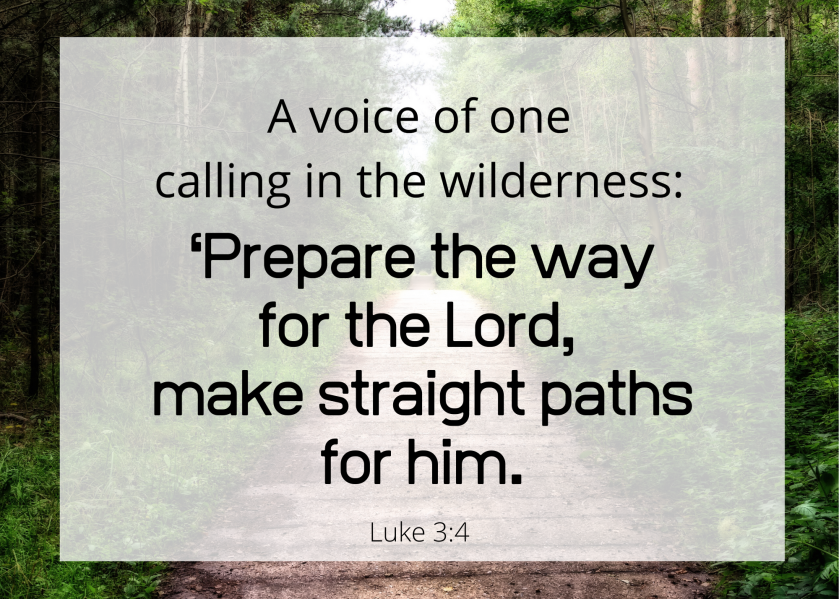
Prepare the Way

Luke Chapter 3

Luke 3 4

Luke chapter three talks about a very important and specific job that John the Baptist had.  This job that John had was documented all the way back in the book of Isaiah and quoted in Luke 3:4: “The voice of one crying in the wilderness: Prepare the way of the Lord, make his paths straight.” John needed to prepare the way of the Lord and make his paths straight.


Jesus’ public ministry only lasted about three years.  It was important that people were ready for his ministry, as he had a lot to accomplish in little time.  Therefore, John prepared the way, so Jesus could make the most out of his little time here on earth.  John did a number of things to help prepare the way for the Lord.


One way that John prepared the way for Jesus was to baptize people with water.  This baptism was “a baptism of repentance for the forgiveness of sins,” (Luke 3:3).  I’m sure that we all understand the importance of repentance and the forgiveness of our sins.  Therefore, we can see the importance of this baptism by water, as it was for repentance and the forgiveness of sins.


John also spent time teaching and preaching to help prepare the way for Jesus.  The crowds asked John, “what then shall we do?”  John went on to describe the importance of being generous with our possessions and money (verses 10-14).  John also focused on preaching “good news” (verse 18) to the people.  That good news that John preached about focused on the message of the kingdom, as evidenced by Matthew 3:2.


Preparing the way for Jesus was the main responsibility that John had.  We also have that same responsibility that John had.  Right now, Jesus is sitting at the right hand of God, but one day Jesus is going to descend from heaven and return to earth.  He is going to establish his Father’s Kingdom.  We have to prepare the way for Jesus to come back to earth.


We have to prepare ourselves and others for Jesus to establish his Father’s Kingdom on earth.  You can’t prepare others if you yourself are not prepared for God’s coming Kingdom.  Therefore, if you aren’t ready yourself, then get ready!  If you find yourself ready, then it is paramount that you focus on getting those around you ready for Jesus’ return.  In essence, we have the same responsibility that John the Baptist had.


Kyle McClain


The Witnesses

Revelation 11

Revelation 11 3 NIV

Following our strange detail about John eating the Scroll that God gave to him, we are finally going to learn about what the Scroll says through what John tells us! Unfortunately, it is very detailed, also strange in some ways, and has been the cause of many interpretations over the past 2,000 years. However, we are going to do our best to humbly try and understand what John says in this passage, while focusing on his main point. I don’t assume that my interpretation is 100% correct, so I invite all of you to critique it by looking at the text itself and speaking with other Christian teachers that you trust.


We are introduced to two Witnesses, or two Martyrs, who are proclaiming to people “their testimony”. Now, throughout Revelation, we see that John testified to “the testimony of Jesus Christ” (1:2, 9) and that the Christian martyrs from chapter six also had a “testimony” that they proclaimed (6:9). We will learn later that Christians are able to overcome Satan using “their testimony” as well (12:11). Narratively speaking, it is likely that these two Witnesses have the same testimony as John and the Christians. That testimony is the gospel message about Jesus’ death, resurrection and eventual return to establish God’s kingdom, as can be seen throughout the whole letter. In other words, the two Witnesses are two individuals that are faithfully preaching the gospel to those around them.


There has been speculation as to whether these are literally two individual people that are to come in the future, or whether they represent what the churches are supposed to be doing, since they are described as lampstands like the churches (compare 1:20 and 11:4). I assume that these are representatives for what the churches, and us, are supposed to be doing, but also don’t believe that John’s main point is in their identity; John’s main point to this vision is what is produced by their faithful preaching of the gospel.


After the two Witnesses are killed, resurrected, and exalted to God’s space, the people actually repent of their evils! In 11:13, it states that people “gave glory to the God of heaven”, which is repentance language. As we saw in the previous seven seals and seven trumpets, and will see in the later seven bowls, God’s judgment actions are not enough to bring about repentance; but the faithful preaching of the gospel message is enough, even if Christians die for it!


My encouragement to you today is to behave like these two Witnesses; faithfully preach the gospel, even at the expense of your own life. Whatever the cost may be for you, the reward is going to be more than you ever imagined! And just like the story of Revelation states, that reward is coming soon, after the Church does her job of faithfully preaching to the nations. Are you ready for that day to come?


Talon Paul

Baptism – What is the Big Deal?

Matthew 3:13-17

Matt 3 17 (1)

Conversations abound over the importance of water baptism. Is it the baptism or simply a confession of faith? If baptism, then is it pouring, sprinkling or immersion? There is a semi-famous song about this. What about infant versus conscious baptism? What about those who do not have access to water? So many questions surround this topic. And these are just focusing on the methods and timing. What about what happens when we are baptized? What is the point or reason for being baptized? Why is it a public thing? It can be exhausting and at times confusing.

So let us look at the example set by Jesus. He travels from Nazareth in Galilee to the Jordan River where his cousin John is baptizing people in droves. Baptism itself was commonplace but it was a simple cleansing ritual. It was not too deep or meaningful and was certainly not a public spectacle. The people had never seen anything like what John was doing. In addition to the large masses of people coming to him he was telling them that this baptism was for the repentance of their sins. John was the precursor to Jesus, the keynote speaker if you will. He was highlighting the points that would be vital to Jesus’ ministry – repentance and the coming kingdom.

Jesus came to John to be baptized. John however recognized Jesus as the Messiah and understood that it was Jesus who should be baptizing John. He tried to argue with Jesus because he understood that among them only Jesus was righteous and sinless. Jesus was the only one who did not need this baptism.

Jesus’ response was that he must be baptized to fulfill all righteousness. In doing so he was consecrated by God and officially approved by Him. His baptism had nothing to do with Levitical Law though. John’s message of repentance and the coming kingdom pointed to a Messiah who would be righteous and bring righteousness to the sinner. Jesus was identifying with the sinful world even though he himself was without sin. His baptism also marked the arrival of the long expected Messiah and the beginning of Jesus’ ministry. And finally his baptism was symbolic of his death, burial, and resurrection and was an example for his followers to come.

Upon being baptized the spirit of God rested upon him. This is the moment when God gave Jesus all authority and power to carry out his Father’s perfect will here on earth. Jesus later told his disciples that this same spirit, a portion only however, would come upon them. It is the same spirit received by all who come to God through Jesus and the waters of baptism. This spirit strengthened and encouraged Jesus when he needed it most, as it does for each of those who faithfully follow his example.

So he comes up out of the water and the Spirit of God comes upon him and then it happens! Something incredible! Something amazing! Something that has not happened for four hundred years. Man hears the first words from God since the close of the Old Testament. His silence is broken so that He can confirm Jesus is His son, “Whom I love, with him I am well pleased.” This statement in itself is timeless. God was not simply pleased that Jesus was beginning his ministry. It is the culmination of a millennia old plan to bring all people back to Him. The fulfillment of His covenant with Abram is realized in this moment. All people will be blessed through Jesus if they choose Yahweh as their God and Jesus as the way to Him. Past, present and future balanced on this man’s obedience to God.

John was baptizing in a river and most examples of baptism in the New Testament appear to be in or around large bodies of water so immersion in water makes the most sense for how we ought to be baptized. There are biblical examples of baptism of the spirit alone, a confession of faith without involvement of water. These examples however appear to be the exception and not the rule. People without access to water or without time to get to water are exceptions.

If someone has the means and opportunity to go through the waters of baptism and does not are they saved by confession of sin and repentance alone? I do not know just as I do not know if someone who confesses, repents, and is baptized is saved. We have biblical and personal examples of people being baptized and living in a way that is completely opposed to God’s will. God alone knows our hearts. He knows where we stand.

One of the radical things about what John was doing is that those who came to him to be baptized were obeying God from their heart. It is a conscious decision to be baptized. I was “baptized” as an infant but it meant nothing to me. I had not made the choice to change my life. I had not chosen God or His son until I was a grown man. That has been the point from the beginning, back when Adam and Eve were in the Garden. They had a choice to choose God or not, trust Him or not. They chose not. Jesus presents to the whole world that very same choice.

In this moment when Jesus was baptized God’s confirmation of Jesus was both for his assurance and for a witness to others. This is the same reason for us to publicly surrender and commit to God through Jesus. We need the inner confirmation of His great blessing upon us, and the world needs the testimony of a life committed to His will through Jesus.


To be continued…

Jeff Ransom

How to Gain a Beloved Brother – Forgive

Philemon

Philemon 16 a

This a personal letter from Paul to Philemon. Philemon was a slave owner that came to know Christ. In the past he had a slave named Onesimus. When given the opportunity, Onesimus found a way to escape.

Onesimus, in his freedom, ran into Paul. After hearing Paul, he also gave his life to Christ and wanted to make right his wrong doings of the past. He told Paul about being a run away slave and it just worked out that Paul knew his master. He convinces Onesimus to go back to Philemon.

This letter is preparing Philemon for Onesimus’ arrival.

In verse 17-19 is one of the finest illustrations of substitution.

“So if you consider me your partner, welcome him as you would welcome me. If he has wronged you in any way or owes you anything, charge it to me. I, PAUL, WRITE THIS WITH MY OWN HAND: I WILL REPAY IT. AND I WON’T MENTION THAT YOU OWE ME YOUR VERY SOUL!”

Onesimus, the unprofitable runaway slave, was to be received as Paul, the great apostle, in the home of Philemon.

Sounds a lot like Christ agreeing to take our place and having all our sins put on him. He took our place in death but he offers us the life only he deserves. Because of this, we have the standing of Christ before God.

The letter also shares how we are to love other people. (Friends and enemies, masters and servants alike)

Paul spoke of the new relationship between master and servant in his other letters. Here he demonstrates how it should work. These men belong to two different classes in the Roman empire hating each other and hurting each other but are now brothers in Christ and they are to act like it.

We see the desire for repentance and urging for forgiveness.

Wouldn’t our world be a better place if people owned their mistakes, sought forgiveness — and then the offended actually forgave!

You have been forgiven and you need to forgive others.

-John Wincapaw

Repentance that Leads to Salvation

2 Corinthians 7

2 Corinthians 7_10

While I was at church last week, one of the younger girls that I have watched grow up  since she was a baby came up to me and was so very excited to whisper some big news into my ear. Her smile grew larger and larger as she leaned in close to reveal that she and her older sister are planning to be baptized in just a few weeks! I looked at her with excitement! I was overjoyed! What wonderful news for anyone to tell me, let alone this sweet girl who I adore. Of course as an education major, I am drawn towards investing in youth. I am passionate about teaching children in my daily life but more than that, I am passionate about guiding youth to become individuals who strive to honor God daily. In the same sense, Paul was passionate about building and growing the church. He was passionate about investing in others also as we see here in 2 Corinthians. I imagine the excitement that I had when I received the news of the baptisms in my church was similar to the excitement that Paul had when the people of Corinth were repenting.


While reading this chapter today, I was especially drawn to verses ten and eleven as they state,

10 For godly grief produces a repentance that leads to salvation without regret,

whereas worldly grief produces death. 11 For see what earnestness this godly grief

has produced in you, but also what eagerness to clear yourselves, what indignation,

what fear, what longing, what zeal, what punishment! At every point you have proved

yourselves innocent in the matter.


Question:

Is there anything in your life that is holding you back from pursuing a healthy relationship with our Heavenly Father? Moreover, is there anything in your life that is stopping you from accepting the sacrifice that His son made on our behalf?


  • No matter where you are at in your life right now, no matter what struggles you may be facing, I encourage you to give it all to God. Lay down all of your burdens and troubles and He will meet you wherever you are. It’s not too late to say yes to His free and perfect gift. It’s one that you don’t want to miss out on!


And Peter said to them, “Repent and be baptized every one of you in the name of Jesus Christ for the forgiveness of your sins, and you will receive the gift of the Holy Spirit.

Acts 2:38


-Kayla Tullis

Don’t Give Up on Them

Matthew 20

for the kingdom of heaven is like a landowner who went out early in the morning to hire workers for his vineyard.

In Matthew 20:1-16, Jesus gives a very interesting parable about a landowner who hired some people to work on his land. He hired one man early in the morning, one at 9:00 am, one at 12:00 pm, one at 3:00 pm, and another at 5:00 pm. At the end of the day, all of them received a day’s wage, which they had all agreed to. Understandably, the one who was hired first was upset that he received the same pay as the person who started at 5:00 pm. The landowner simply told him that he agreed to work for that day’s wage and wasn’t being unfair.


This parable is talking about people’s salvation. There are some people who have been saved for many, many years; they have dedicated their life to Jesus, served in the Church for years, and made many disciples through their lifetime. Then there are people who come to faith at the very end of their lives, sometimes repenting on their deathbeds. However, in the eyes of God, both those people have the same reward waiting for them: life in the Kingdom of God.


There are at least two things we should learn from this parable. The first is that it does not matter when someone comes to salvation; we should rejoice that they came to faith at all! We shouldn’t view them differently than we view someone who has served for years in the church. Everyone who accepts Jesus has received the same salvation, according to Romans 10:9-10. We need to be happy for that individual, not jealous or bitter towards them.


The second lesson we learn here is that we should never give up on people. As long as there is still breath in their lungs, we have a shot at blessing them with the gospel. Just because a friend or family member that you know has rejected the gospel right now, doesn’t mean that they will never accept it. There is always an opportunity for their salvation in God’s eyes. Our job is simply to try and plant a seed in their life, and allow God to cause the growth (1 Corinthians 3:5-6). So do not give up on that person you have been working with, no matter how hopeless the situation may seem; you do not know what God could be doing in their hearts.


-Talon Paul

A Prideful Warning

matthew 3 1

Pride goes before the fall.  It is warning given to us by our elders, many times in our youth when we think we have it all figured out, and is based in one of Solomon’s proverbs (Proverbs 16:18-19).  Just when we think we are on top of the world with our wealth, education, social status, or even our religion, we are undoubtedly a gut-wrenching moment away from being put back in our place.  And unfortunately for us, the bigger the man, the harder the fall.

In Matthew Chapter 3, John the Baptist is sent out to prepare the way for Jesus.  He is the “voice of the one crying in the wilderness”, and man dressed in camel hair (although I don’t think it was cashmere turtlenecks), and a diet based on what he could find around him in nature.  No doubt, this man sent to prepare the way was a bit of a spectacle, but not deliberately. John gathered many followers, baptizing them for the forgiveness of their sins. John was taken aback when he saw who was in the line – Pharisees and Sadducees.   Both the Pharisees and Sadducees were caught up in outward observance of religious law. They might pray in the streets (Matt 6:5), openly announce their giving (Matt 23), ask many religious, pious questions (Act 23), becoming spectacles themselves, yet still they only abided by the laws that conveniently roll off the tongue and fit their interest.  These men were highly regarded for their piety. They were key members of the religious community. Their roots were in the church. Yet, time and time again, John, then, Jesus see these men for who they are: prideful hypocrites.

It is no wonder they come to John to be baptized for the forgiveness of their sins, something common with Jewish culture even before Christ, because this was an outward observance of faith, and really the one enduring public expression that remains today.  For them, it was another way to add another tassel, place another feather, earn another merit badge to showcase their devotion (to their pride) on their whitewashed tomb (Matt 23:27-28). John calls out this action for what it is and begins to cut these men down to size, pleading with them to work on the inside: true repentance and bearing fruit (Matt 3:8).  Then he warns them that God himself will cut these men down to size if he must, not simply pruning (John 15), but cut at the very root, and throwing their fruitless mess into the fire once and for all (Matt 3:10).

As we are reading today, let this be a warning to us, especially those of us who are “church folk”. We may study the Bible, hold a position of leadership, or make eloquent confessions of faith, but to whose purpose do we do these things?  Are we lining up so we can receive our reward in full today (Matt 6:4)? Earn our badge, sticker, or tassel? I know I constantly battle my pride as I check more boxes of serving God.  As I articulate and expound on deep theological questions, cast judgement in situations of others, or feel like I have shared a great message, I can’t help but think, “Wow. Good thing God has me on His side.” How arrogant. How prideful.  How ashamed am I. The things I share, that I might selfishly revel in, that are so wonderful, so grand, are not my own, but God’s! Doing things “for Him”, like we ever could, does not assure our place in His kingdom (Matt 7:22; Eph 2:9-10). Only repentance and bearing fruit. Everyday we must fight for altruism in our lives, to die daily, to fall a little, and be consumed by God’s kingdom message.  I’d rather be eating locust and wearing camel skin, than have God bring justice to me later – but today, it is a warning – Church, check your pride.

-Aaron Winner

Lessons from the Wilderness: David

Wilderness Wandering Lesson #3: When the desires of our heart lead us away from God, true repentance leads us back.

Psalm-51-Prayer.jpg

At the heart of our lessons from the Israelites and Elijah is a focus on trust. We need to trust that God knows best for us and will lead us in the right direction as the Israelites learned. And, we need to trust that God will provide and protect us according to his will like Elijah learned. Elijah, in our previous lesson, was not lead into a wilderness season by any failing on his part. Instead, the wilderness for him was because of circumstances outside of his control. By looking to God and remembering those past successes with God, he was able to overcome trying circumstances.

The wilderness story that we will look at today also concerns a man that could remember past successes with God. In his story, he had stood against giants, mad kings, had been through the wilderness once and overcame it. David was a “man after God’s own heart” (1 Sam. 13:14). We see in the book of 1 Samuel David’s victories. He was blessed by God, and because of this blessing, he was able to overcome his enemies. The book of 2 Samuel then describes what happened to David after he overcame these things and became King of Israel. During the first 10 chapters, David is set on the throne and receives the Davidic covenant, where he is told that Jesus will come from his lineage. If David could have just stayed in these moments where his focus was on God, he would have dwelt securely in the land and set up his children to do the same.

Instead, we see David drifting down a path that led him to devastation in 2 Sam. 11. In this chapter, we see the story where David, without questioning his actions for how they would reflect God, sleeps with Bathsheba and sends her husband to her death. After this, David is told that he would lose the baby Bathsheba just bore and that his house would be destroyed. David’s actions here lead toward the hurt that he faced with his son Absalom in 2 Sam. 14-15. The first sin that we see in these chapter 11, lusting after Bathsheba, began the sin cycle that led David into a wilderness period that was a time of intense pain that David never really got over.

So how did David get to this point? During this time, he had stayed back at his palace idle instead of going with his armies to fight in the wars he wanted them to engage in. At this moment, his desires began to be misaligned from the desires of God. And from here, his actions lead him away from God.

We see some of David’s reactions in 2 Samuel as he mourns his son and repents of his sin. But, at this time, we don’t see his feelings about this time in the wilderness. In Psalm 38, a psalm written by David, we see the danger that comes from drifting too far from God. We see the desperation in David’s voice as he says, “There is no health in my body because of Your indignation; there is no strength in my bones because of my sin. For my sins have flooded over my head; they are a burden too heavy for me to bear. My wounds are foul and festering because of my foolishness” (Ps. 38:3-5). Because of David’s sin, he had to experience terrible pain, a trying wilderness experience. We can look back at the lessons of the Israelites to realize this time in the wilderness was for purification, but still, if David had aligned the desires of his heart with the desires and character of God, he could have saved himself from this pain.

ps. 51

The wilderness is not always caused by our sin, as we’ve seen. But, at times, it is. And during these times, we can look to David’s example to see how to overcome those moments in the wilderness that were caused by our sin. Psalm 38 is an example of a penitential psalm, that shows both David’s true repentance and his desire for God in his life. Psalm 51 is another example of David writing in repentance. He says, “Be gracious to me God, according to your faithful love; according to Your abundant compassion, blot away my rebellion. Wash away my guilt and cleanse me from my sin. For I am conscious of my rebellion, and my sin is always before me. Against You – You alone – I have sinned and done this evil in Your sight. So you are right when you pass sentence. You are blameless when You judge” (Ps. 51:1-4). In this psalm and the other psalms, we see how David takes responsibility for his sin and also recognized what is required from him if he sins. He needs to be purified with a new heart that reflects the desires of God to be placed within him. This is key to accomplishing what David asks God in v. 12: “Restore the Joy of Your salvation to me and give me a willing spirit.” When we are in a wilderness of cause by our sin, we may be tempted to harden our hearts in anger against God. But, that is the path that leads us away from God and further into the wilderness. When we truly repent, we can receive back the true joy that comes from the salvation of God. After we have made it through the wilderness, we can use this time to bring others back to God (v. 13). If you are in this time today, choose the right path and come back to God. It may be painful to soften your heart and feel the weight of your sin, but that will lead you towards the true joy that comes from God.

~ Cayce Fletcher

Lukewarm Caterpillars

2 Corinthians 5_17

A few weeks ago, we got to experience an up-close view of a bit of a twist on the classic caterpillar to butterfly spiritual analogy. Maybe you’ve heard the classic version in youth group, Bible School, or a devotion book….the idea that we are all new creations if we are Christians. That we start as these creepy, crawly, fuzzy little beings and then as a gift of God, through faith in Christ….voila….we are made completely new into creations of beauty and wonder like a butterfly.

Thanks to our friend, Terri Tschaenn, and her milkweed stash….we have gotten to watch this truly amazing experience of God’s creation several times, and it hasn’t gotten old yet. We’ve gotten to feed those adorably cute little caterpillars as they grow at amazing rates each day. We’ve watched the miraculous chrysalis formation, and we’ve gotten to hold brand new monarch butterflies on our pinky fingers before they fly off. It is amazing. It is beautiful. And, it certainly is representative of the hope of new life and transformation God tells us about in 2 Corinthians 5:17.

But. . .does every caterpillar turn into a butterfly? Hmmm.

Terri told us the unfortunate story of one of her baby caterpillars that accidentally met a predator while she was trying to keep it safe in her school classroom….and….chomp. All gone. No butterfly.  And, recently, we watched our caterpillar which we had been watching grow for several weeks, for some unknown reason, never develop his chrysalis at all. Instead, he slowly wasted away and died. It was rather depressing to watch. He had eaten milkweed like all the rest, had gotten to full size, and had looked “just right” to us from the surface. But, inside….something was wrong. He never experienced the stage of transformation. And, instead of achieving beauty and new life, he died a caterpillar. It is common. It is sad. And, it is also certainly representative of what God tells us about in scripture whether or not it makes for as many Sunday School craft ideas on Pinterest.

The Bible warns us about the Christians who look like Christians, but who haven’t experienced a transformation through repentance and faith in the Messiah, Jesus Christ. These Christians are lukewarm. Just like the caterpillars who die, they lack something inside. But mind you, these aren’t atheist caterpillars or caterpillars who don’t go to church. These are Christian caterpillars. Ones who look just like us. Ones who go to church with us. Maybe us. They haven’t achieved the transformation of repentance and faith in Christ which leads to obedience. And their demise if they don’t repent? “I will spit you out of my mouth” (Revelation 3:16, NASV).

Truth can hurt, but it matters. It matters because God and Jesus love us. And true love includes speaking honestly and intentionally. It also matters because unless we repent, at the judgment day, we do not become “butterflies” to live eternally with God and his son Jesus in the kingdom of God. The alternative to that option is death. Today, we live in a world telling us that almost any belief imaginable is “Christian”, and it can get quite confusing as we seek to be on the narrow road and not in the lukewarm masses. It requires diligent searching of scripture and faithful prayer on our parts. We cannot rely alone on our teachers, our families, our churches, and traditions of men. We must not just believe “in” God and Jesus, but know what they say and apply those words to our lives. So, if we find ourselves lukewarm and amongst lukewarm believers. . .what does Jesus say to us?

Those whom I love I rebuke and discipline. So be earnest and repent. 20 Here I am! I stand at the door and knock. If anyone hears my voice and opens the door, I will come in and eat with that person, and they with me. To the one who is victorious, I will give the right to sit with me on my throne, just as I was victorious and sat down with my Father on his throne. (Revelation 3:19-21, NASV).

Let’s seek and pray to be more than lukewarm this week and to be victorious in Christ.

-Jennifer Koryta Hall