Bearer of Bad News

Ezekiel 24-26

ezekiel 24-26 amber

Sunday, March 26

When I think of Ezekiel, the phrase “bearer of bad news” comes to mind.  After completing numerous acts of valor such as eating a scroll, becoming mute, laying on his side for over a year, shaving his head, and scattering his hair among the Earth, Ezekiel continues to be one of the few servants of God in his time.  As a major prophet, he does not have news of prosperity and victory to recount to the people.  Instead, he continues to call the rebellious people in exile (and in the surrounding nations) to repentance, ultimately forewarning of their destruction and the destruction of Jerusalem.


To me, Ezekiel is no “easy read”.  At times, these scriptures seem abstract and I have a hard time finding application to my daily life. Therefore, I have created a visual to help me, and hopefully some of you understand some of the main concepts in these passages.  I hope these illustrations help some of the content “stick” and become real for you.  If my amateur doodles aren’t your thing, I completely understand that too J


Here are a few of the main points/interpretations and moments of personal application that I picked out in our passages today as noted by the visual above:

  • Parable: Jerusalem as a Cooking pot
    • Pot = Jerusalem
    • Scum = corruption of the people *notice this corruption is visible; it cannot be hidden from God.
    • Choice meat = God’s chosen people
    • The meat (God’s people) is thrown out because it is ruined from the scum (corruption/sin)
    • The pot must be set on coals until it’s impurities are burned away (Jerusalem must be destroyed).
    • Application to our lives: Don’t let the scum of your life keep you from bearing good fruits. Find your peace and fulfilment in God, not in the approval of others, your work, sin, the media, and other worldly influences. These things will fail you, God will never fail you.


  • Death of Ezekiel’s Wife
    • Ezekiel is told not to mourn, but “groan quietly” (24:17)
    • Interpretation: God instructs Ezekiel and the community not to mourn as he tries to give them perspective into their behaviors. The rebellious people do not mourn when the temple, which should be “the object of their affection” (25:21), is destroyed.  Therefore, they ought not mourn when something of lesser tragedy takes place.  God should be the top priority of all men.
    • Application to our lives: Where are your priorities? Do you value the gifts of this earth more than you value the glory of God? Do you worship the approval of others, celebrities, idols, your children or spouse on accident?


  • Prophesies against nations near Judah
    • Because the nations of Ammon, Moab, Tyre, Philistia, and Edom did not care when the temple was destroyed or when the people of Judah went into exile, they will also be punished. The entire nation will know that HE IS GOD.
    • Application to our lives: Earlier in Ezekiel we read that Ezekiel will be held accountable for the sins of others if he fails to spread God’s word. Here we see that other nations are held accountable to a similar degree. We too must spread the good news to ALL nations! What a blessing and a privilege!


Do you allow yourself to accept the peace that only God brings?

-Amber McClain


Amber McClain cannot wait for the Kingdom.  If she won the lottery she would 1.) Buy a helicopter so that she could spend weekdays learning and teaching in the USA and weekends with our brothers and sisters abroad.  2.) Pay for her fiancé, Josiah to get his helicopter-flying license, and 3.) Throw a world-wide pizza & prayer party; everyone in the world is invited!

Graphic Material

Ezekiel 5-9

ezekiel 5 14

Monday, March 20

This portion of Ezekiel is, admittedly, difficult to read.  It’s a pretty graphic account of God impending judgment against the city of Jerusalem and his people, Israel.  God tells Ezekiel to shave his head and beard.  This would have been an act of mourning for most people, but it was double disturbing for Ezekiel, since he was a priest and normally forbidden from shaving his head or beard.  Ezekiel was told to burn, take a sword to, and scatter his cut hair.  This was to symbolize what was to happen to Israel.  A few hairs were kept back, symbolic of the remnant who would not be destroyed.

God accuses his people, Israel, the chosen nation, of being worse than the other nations.  They broke the law more than the nations that did not have the law.  God was bringing his judgment against His own people.  The description of the siege almost defies comprehension, including cannibalism of both parents and children.  This was to serve as a warning to the other nations: if this is how God treats his own people for their idolatry, beware of what he will do to you.

In Ezekiel six God makes it clear that their judgement is upon them because of their idolatry. However, there is a remnant that will be spared and live in captivity and will come to repentance.

In Ezekiel seven, a special emphasis is made regarding their idolatrous attachment to gold and silver.  This wealth that they turned to and fashioned into idols will be unable to save them from the coming judgment.  All the money in the world can’t save you from judgment.

In Chapter eight Ezekiel has a vision of the temple in Jerusalem.  This includes the “Idol of jealousy” which we discover is the pagan god Tammuz.  Tammuz was the Sumerian god of food and vegetation.  At the summer solstice there was a period of mourning as the people saw the shortening of days and the approaching drought.  Sacrifices were made to Tammuz at the door of the Jerusalem Temple.  This was an absolute abomination to Israel’s God, YHWH as He made it clear that He alone was to be worshipped as God (see Deuteronomy 6:4-5).

In Chapter Nine an angel is sent out to put a mark on all of the people of the city who did not commit idolatry and worship Tammuz.  They would be spared.  But then all those who did not receive a mark would be destroyed.  This is reminiscent of the story of Exodus, when the doorposts of the Israelites were to be marked with the blood of the sacrificial lamb, and those with the mark were spared their firstborn sons dying when the Angel of Death passed over their houses.  It also points to the future (See Revelation 13) when the beast will cause people to have a mark on their forehead or they would not be able to buy or sell.  This is contrasted with those in Revelation 14 who have the name of God and of the lamb on their foreheads.

God is a God of love and mercy.  God has provided a means for us to be rescued from the consequences of sin.  There is a way for each of us to be spared the final judgment of God that is coming.  Jesus Christ, the lamb of God is the only means by which we can escape judgment.  Along with God’s mercy is His holiness.  God will not allow sin and rebellion to continue on earth forever.  A day of judgment is coming for all the earth just as it did for the nation of Israel.  God tolerated their sin for only so long, and then came the time for judgment.  Mercifully, God spared those who repented by placing His mark upon them.  God has been tolerating sinful rebellion on earth, but a day is coming when He will destroy sin and sinners who have not repented and turned away from their sins and turned to him through Jesus Christ.  Ezekiel’s harsh imagery should remind us that we must not forget that God’s wrath is coming from which we all need to escape, and we need to warn others.  This won’t make us popular, but doing God’s will is seldom popular among the rebellious.

-Pastor Jeff Fletcher


(Photo Credit: http://w3ace.com/stardust/)

God’s Watchman to A Generation

Ezekiel 1-4

ezekiel 1

Sunday, March 19

Ezekiel was a priest in Israel during a tumultuous time in their history.  The Northern kingdom had been decimated by the Assyrian empire and its people scattered and assimilated resulting in a complete loss in their identity as a distinctive people of God.  The Southern Kingdom of Judah was now being systematically taken apart by the Babylonians.  Ezekiel was among the early members of Judah’s elite leaders who were taken captive to Babylon.  Ezekiel was now a priest living in a foreign land where he had no access to the temple of Jerusalem and the religious symbols that helped shape his life and give him meaning and purpose.

In today’s readings God comes to Ezekiel in a series of visions.  These visions  are recorded as a type of scripture known as apocalyptic- where something is revealed or unveiled.  In addition to portions of  Ezekiel there are apocalyptic passages in the books of Daniel, Isaiah and Joel.  God reveals what is going to happen as He brings an end to the present age preparing the way for the age to come or coming Kingdom of God.  You will notice some similarities between Ezekiel 1 and Revelation 1 and 4.

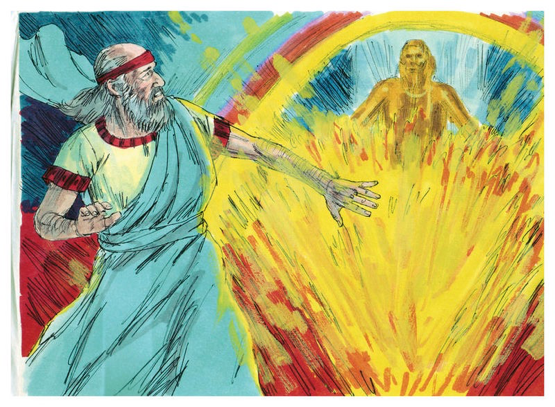
Ezekiel’s description sounds like something in a science fiction movie- 1:27-28 says: “ I saw that from what appeared to be his waist up he looked like glowing metal, as if full of fire, and that from there down he looked like fire; and brilliant light surrounded him.  Like the appearance of a rainbow in the clouds on a rainy day, so was the radiance around him.  This was the appearance of the likeness of the glory of the Lord. When I saw it, I fell facedown, and I heard the voice of one speaking.”

Imagine if, for a brief instant, God permitted you to have a vision of himself in all of His glory.  You would probably struggle to find the right words to communicate what you saw.  So it is with Ezekiel.  He is overcome by the glory of God and he falls on his face.

The whole of Ezekiel is surrounded by the image of a holy God.  But God’s people, Israel, have been disobedient to God.  Ezekiel is appointed by God to serve as his “watchman” (3:17) for the people Israel in captivity.  His mission is to warn God’s people of their sins and to call them to repentance.  Ezekiel 2:7-8: “You must speak my words to them, whether they listen or fail to listen, for they are rebellious.   But you, son of man, listen to what I say to you.”

The job of a watchman is to stay awake, keep one’s eyes open, and warn if anything dangerous or illegal is taking place.  It might also include a warning to those who are tempted to trespass.  Ezekiel’s job was to warn God’s people about the consequences of their sins and the coming judgment of God.  God tells Ezekiel essentially: “you need to warn the people about my coming judgment.  If they don’t listen to your warning, then they will suffer the consequences, but if you fail to warn them, then I’ll hold you responsible for their sins.”  God was letting Ezekiel know that he had a mission, to share God’s word with people.  If the people didn’t listen or heed the warning, it was on them, but if he refused to give the warning it was on him.

As followers of Jesus Christ today, we are called to be priests in this world.  Like Ezekiel,  we are living in an age where much of Christianity has been decimated by a massive turning away from God and people are scattered and assimilated into the world resulting in a complete loss in their identity as a distinctive people of God.  And like Ezekiel, we are to keep watch and issue warnings to the people of the world.  As with Ezekiel, sometimes we will warn people and they won’t listen.  If that’s the case, it’s on them.  But if we fail to do our job and give the warning, then it’s on us.  People won’t always like what we have to say- prophets and priests are sometimes labelled as intolerant and not very popular, but that should not prevent us from doing the work God has given us to be His watchmen to our generation.  (Note: our job is not to be the judge, it’s not our place to condemn the world, but to tell them what God tells us to tell them, which is the Gospel.)

-Pastor Jeff Fletcher

My name is Pastor Jeff Fletcher.  I’m one of the old guys.  I first attended what is now FUEL (then it was called National Camp) back in 1977 and I’ve been a camper or on the staff for most of the past 40 years.  I’m a graduate of Oregon Bible College, (Now ABC) and I’m completing a Master’s Degree from Eastern Mennonite Seminary.  I’ve pastored Churches in Illinois, England, Louisiana, South Carolina and now Virginia.  My wife Karen and I have eleven children and 4 grandchildren and my daughter, Karee Anne is getting married this Saturday, March 25.  In addition to pastoring a Church I also work as a hospital chaplain.  I am passionate about bringing the message of God’s loving presence to people who are hurting and in need of hope and purpose in life.

Time for Some Reshaping?

Jeremiah 18-21

jeremiah-18v6b

Saturday, March 4

A very close tie in exists between chapter 17 and chapters 18-20.  Destruction is in sight (chapter 17) but repentance can still prevent that (18:7,8).  However, repentance was not really coming (18:12), so Jeremiah’s shattered flask illustrated God’s judgement on Israel (chapter 19).  Then their rejection of God’s word (19:15) led to persecution against God’s mouthpiece Jeremiah (chapter 20).
18-20 is God’s 7th message chapter 21 is God’s 8th message.  The invasion has began.  Now they not only have the Babylonians as their enemy, but God.  Jeremiah tells them to submit and surrender to the invaders so they would be captured and not killed.
Has your sin brought you pain?
Their is still time to repent.  Sometimes we feel like its too late but God can still save you and reshape your life to hold all that God has intended for you.  What will you do? (18:2-10).
-Andy Cisneros
(Photo credit: http://hiswordinpictures.blogspot.com/2016/08/jeremiah-186b.html)

Your Sins Hurt Others

Jeremiah 15 – 17

jeremiah-17_7

Friday, March 3

Chapters 15-17 deal with the pain others feel for Judah’s continuous betrayal.  God feels sadness when we sin.  Jeremiah is frustrated and hurt (physically and emotionally) by this sin.  Our sins trap us (just like the enemies of Judah) and change us (16:10-13)
Sin has a deep hold on us.  But in chapter 17 Jeremiah reminds us that we can repent.
Repentance is explained in Jeremiah 17:5-8.  The difference in being blessed or being left with nothing is determined by our trust.
Do you trust God?
Do you believe that He will take care of you and that His way is better than your way?
Sometimes we feel like we can’t come back from our sin but God knows you can if you trust in Him.
Do you want barrenness (vs. 5,6) or blessing (vs.7,8)?
-Andy Cisneros
(Photo Credit: http://www.godswordimages.com/wallpaper/hope/jeremiah-17-7/)

Cease to do Evil – Learn to do Good

Isaiah 1-3

isaiah-1-18

Sunday, February 5

The Old Testament is split up into five major categories: (5) Law, (12) History, (5) Poetry, (5) Major Prophets, and (12) Minor Prophets. Isaiah is the first book of the Major Prophets.  The word “prophet” occurs 324 times in the Old Testament alone.  Therefore, it is no doubt that whatever a prophet is, it is important.  A prophet is simply someone who speaks on behalf of God.  Isaiah then is someone who spoke for God, so the word Isaiah spoke had authority.

Isaiah begins his writing by stating all the wickedness that is being done by the people of Israel, God’s chosen nation.  Verses 2-15 go into detail as to what they were doing.  However, I want to take note at verses 16 and 17 of the first chapter.  Verses 16 and 17 are Isaiah’s (really God’s) call to repentance.  There are two main steps to this call for repentance.  Step one found in verse 16: “cease to do evil.”  Step two found in verse 17: “learn to do good.”  These are the two fundamental steps to repentance that Isaiah pleads the Israelites pursue.  The Israelites need to rid themselves of all the wickedness they are doing as was stated in the first 15 verses.  However, this is just the first step to repentance.  After they rid themselves of evil, they must then learn to do good.  Once the evil is removed from one’s life, they must then fill it with something good.  If not, then they will fall into the same pattern of sin.  This is an oft neglected part of repentance.  This completely applies to us over 2,000 years later.  To repent, we must cease to do evil and learn to do good.  If we do this, then our sins, “shall be as white as snow,” (Isaiah 1:18).  What a beautiful reward.

Something that caught my eye in chapter two was the end of verse 9.  It clearly stated, “do not forgive them!”  What a bold statement that is from Isaiah (and again, really God), and a rather controversial one in modern Christianity.  Once again, Isaiah goes on about how the Israelites are sinning.  It appears as if they have not repented and continue in their wicked ways.  Isaiah then declares not to forgive them!  This is contrary to what many modern Christians think.  There is a nasty word floating around that is being connected to Christians nowadays with movements such as the LGBT.  That nasty word that people are throwing at Christians is “tolerate”.  Many believe that the duty of a Christian is to tolerate and “love”.  Nowhere in the Bible is this message of “toleration” found.  Rather, there are passages such as Isaiah 2:9 which state, “do not forgive them!”  These Israelites that Isaiah is describing are sinning without any signs of repentance.  Isaiah doesn’t go on to tell others to accept and tolerate them for who they are as idol worshippers.  Instead, he blatantly states to not forgive them.  It appears from this verse alone that we should not be tolerating other people who live a life of sin.  However, this is just one verse, and you should rely on the Bible as a whole to make decisions such as this.  Therefore, I encourage you to look more into this, and I just think you might be convinced that the message of “tolerate” is ridiculous.

I hope you all have a splendid week and I look forward to starting off the Major Prophets with you all!

-Kyle McClain

Maybe I Should Apologize

Nehemiah 8-10

nehemiah-8-10

Saturday, December 10

After the wall was completed the people gathered at the square which was in front of the Water Gate and they had Ezra read the books of the law to them and had them explained to them.  The people were so moved that they bowed down low and worshipped the LORD with their faces to the ground.  Nehemiah and Ezra told the people not to mourn but to keep the day as holy to the LORD, to go and feast and be filled with joy because the LORD is their strength.  They were encouraged to make shelters of branches to help celebrate.  This was the custom that was known as the feast of booths or tabernacles that is celebrated to this day by the Jews.  Ezra read the law daily for the entire celebration lasting 7 days, and then there was a solemn service held on the eighth day.

After the reading of the scriptures something very interesting and dramatic happens.  The Jews separate themselves from any foreign people in their city and they fasted and smeared ashes and dirt upon themselves, wore itchy sackcloth, and confessed their sins and the iniquities of their fathers.  Then in the hearing of the people the leaders told of the goodness of the LORD to the people throughout generations past.   Telling of all His mighty deeds.  Then the people all sign an agreement to follow the commands as God laid them out in His law, and to live holy and pleasing lives to the LORD from that time onward.  This national repentance and reconciliation was done in order to please the LORD.  Whenever God’s people do what pleases Him, His blessings are soon to follow.

What catches my eye about this is that the people hold a national time of repentance.  Could you imagine what would happen if we tried to do this today?  I’m sure the news stations would be all over it in an instant.  Watch out CNN!  The interviews could be quite interesting , and could lead to some very juicy gossip to be sure.    The point is that people today rarely apologize for anything.  They  find it even more hard to change their ways .  You may have some examples of  people you know who don’t apologize when it would be appropriate to do so.  You might also know people who say they are going to change their ways but find it difficult to set any new pattern in their behavior.  Personally, if I had a dime for every time I’ve heard a person struggling with addiction say they are going to quit – I would be very rich indeed!  I’m not saying that it is impossible for a person to change but it is in reality quite difficult for people to change their attitudes which are then reflected in their actions.

The Jews had this same difficulty.  They had a national time of repentance and even signed the document but as history unfolds we can see that they were not very good at keeping their promise to God.  It’s important to keep your promises to God.  Repentance is all about changing your ways.  It’s good to apologize to God when appropriate but even better is to change your behavior so that you don’t have to be in the situation where you need to apologize!  God wants us to be sincere in our words and our deeds.  Are there any of your actions that you need to apologize to God for, and change?  What do you think is the first step you can take to help change your ways so that they are pleasing to God?  God’s blessing follows true repentance.  What blessings do you think God might have in store for you when you are in right standing with Him?

-Merry Peterson

Camping in Enemy Territory

Ezra 8-10

ezra822

Wednesday, December 7

Who would have thought that there would be a story about camping in the Bible.  The book of Ezra goes on to tell about how Ezra went with a company of people and those of Levitical heritage on a journey to the city of Jerusalem and the surrounding area.  They had a long, dangerous trek ahead of them sometimes even camping  in enemy territory.  They did not ask for soldiers or guards to protect them for their journey because they had said to the king that their God would protect them.  They were placing their trust in God to see them through the rough territory and prayed specifically for Him to protect them, their  children, and their possessions.  God honored their trust in Him and protected them.  When they arrived at Jerusalem they were able to give the gifts that King Artexerxes had sent, and able to offer the appropriate sacrifices.  They were also able to deliver the king’s edicts to the governors in the provinces beyond the river, and so Jerusalem’s neighbors began to show support for Jerusalem and the people who inhabited it, and the temple of God.

Then it is brought to Ezra’s attention that God’s people have been intermarrying with the idol worshipping people of the area around Jerusalem.  God had specified that the people should not intermarry as not to become entangled in the worship of other false gods within their homes, and the pagan influence that would be brought upon their children.  God wanted to keep his people from being drawn into pagan idol worship as they were so prone to being drawn into.  Ezra went into a time of mourning for the situation of God’s people.   He pleads with God for forgiveness for the people’s sins of disobedience.   A time of group repentance was held and sacrifices made to pay for the sins of disobedience to God in marrying foreign women who did not worship God thus concluding the book of Ezra.

What caught my eye was that Ezra and his company of people camping along the way decided to ask God for His protection instead of asking the King for a human army of protection.  They could have been attacked at any time by enemy forces, but because they chose to ask God for protection and trust Him – God protected them.  Have you ever asked God for his protection?  Are there times that you have felt God protecting you?  God is faithful to his promise that when we place our trust in Him, He will bring us through whatever situation we find ourselves in.    Key thought:  Place your trust in God because he is faithful to his promises.

-Merry Peterson


UNfailing Love from the Promise Keeper (1 Kings 8-9)

Sunday, October 30 – start of week 15

img_0007

Melissa New

I love to picture in my mind the great King Solomon, in his prime, standing humbly before the newly finished temple. With his hands raised to Yahweh, he is the epitome of a great spiritual leader in that moment. And what a prayer! First, he recognizes that there is no God like our God. Then, he is grateful to Him for keeping his covenant. Solomon knows that it’s a precious privilege for him and the Israelites to have a permanent place to go to worship God and offer sacrifices. Next, he petitions for Yahweh to always hear and forgive when His people confess and repent. And Solomon wants this not only for the Israelites, but for any foreigners who would come to the Temple because they have heard of “your great name.” Finally, at the end of his remarkable dedication, he reminds the “O Sovereign LORD” that He had set Israel apart to be His “own special possession.” How cleverly and beautifully worded! It’s a reminder to all of the Israelites listening that they need to confess and repent when they do wrong for “who has never sinned?” he asks. It is vital, too, that we ask for forgiveness when we do wrong. We need to acknowledge our sin as the wickedness that it is, turn away from it, and instead turn with our whole hearts to God. There is comfort in knowing that we are His special possession too; and He will hear our heartfelt prayers and forgive.
Melissa New attends the McGintytown Church of God of Abrahamic Faith in Arkansas. She is pleased to be a part of this community of COG bloggers and is already feeling much blessed by it! Her favorite verse is Jeremiah 29:13 “You will seek me and find me when you seek me with all your heart.”

Faithfulness in Spite of the Faithless (Judges 9-11)

Monday, October 3

cycle-of-sin

Shelby Upton

In Judges there is a reoccurring theme of Israel being faithless, turning to false gods, running into hardships and crying out to God.  Then the judge intercedes for them, they turn back to God and he takes them back once more.
We  see this scenario happening once again in Judges 10. Things are quiet and faithful with two judges for about 40 years until Israel turns away from God, again. God then gives them over to the Philistines and Ammonites. Then they cry out to God once again, recognizing their sin and begging God to deliver them.
I see this situation in my own life. When things are going really well and I forget to keep God as my focus and I let things like relationships, entertainment, my career, my possessions become idols in my life.  Inevitably something happens and I need God to deliver me.
The Israelites then turn from their idolatry and worship God. Even though God is angry with the Israelites He is burdened by their suffering and then does deliver them from their misery.
Repentance is key in this scenario.  We all struggle with sin and losing God as our focus.  We need to learn from Israel’s mistake of turning from our faith at all but when sin does creep in we know that God is a loving God and he will forgive us when we repent because even when we are faithless he remains faithful.
2 Chronicles 7:14
“Then if my people who are called by my name will humble themselves and pray and seek my face and turn from their wicked ways, I will hear from heaven and will forgive their sins and restore their land.”
you-may-choose-your-sin                 sin-always-takes-you