Tough Times Ahead

Luke 21

Wednesday, December 28, 2022

            Most people are a bit apprehensive about living in the end times.  In Luke 21, Jesus described many things that are going to happen, and quite frankly, most of them don’t give us the warm fuzzies.  There will be a lot of death and suffering, but Jesus gives us some good advice on how to approach those days.

            I don’t want to freak you out but there will be wars, disturbances, earthquakes, plagues, famines, terrors, great signs from heaven, persecution of Christians, family and friend betrayals, some will be put to death, you will be hated by all, roaring of the sea, men fainting from fear, and the powers of heaven will be shaken.  It is safe to say that these will be scary times for Christians, and for non-Christians as well.  Therefore, you might think the word to describe the end times is “hopeless”, but quite the opposite is true according to Jesus.

            In verse 9, he tells us not to be terrified.  He tells us in verse 28 to straighten up and lift up our heads when these things begin to take place because our redemption is drawing near.  He continues in verse 31 saying that when we see these things happening, we will know the kingdom of God is near.  These are actually going to be pretty exciting times for Christians because we know the start of the kingdom is right around the corner.

            Jesus also gives us some advice on how to handle the end times.  In verse 34, he tells us to be on guard so our hearts will not be weighted down with the worries of life, and to be on guard so it does not surprise us like a trap.  He instructs us to stay alert in verse 36, and to keep praying that you will have the strength to escape all these things.

            However, the most surprising and interesting part of this chapter to me was verses 13 to 15.  “It will lead to an opportunity for your testimony.  So make up your minds not to prepare beforehand to defend yourselves; for I will give you utterance and wisdom which none of your opponents will be able to resist or refute.”  I surely wasn’t expecting that guidance.  We’re not supposed to be preparing beforehand to defend ourselves because we could potentially have a chance to give our testimony to those who we would be defending ourselves from.  We could help someone be saved at this last hour by talking to them, with the words and wisdom given to us by Jesus, rather than fighting against them.

            If you are alive during the end times, it will be difficult to watch what will be happening all around you.  Nevertheless, you need to remember that we already know who wins in the end, and it is not the bad guys.  Some that are weak will lose faith, but those who understand what is happening will be glad that the kingdom is near.

-Rick McClain

Time to ponder:

Do you worry about what is going on in the world today?  If so, do you not believe that God is in control and those who put their trust in Him will live happily ever after?  Ask God for a big dose of peace that only comes from Him during these difficult times.

How can you prepare today for the end times?  How should we not prepare (verse 13)?

Why is it important to study what is going to happen in the future?  What could happen to you during the end times if you are not aware of what is happening?

And in This Corner…

Luke 20

Tuesday, December 27, 2022

            Yesterday we mentioned that there were people that flustered Jesus.  In Luke chapter 20, we get a big dose of people hating on Jesus.  How bad was it?  How did he handle it?

            Don’t you find it strange that a man who never sinned against anyone ticked so many people off?  He never did anything wrong to anybody, but so many people disliked him, especially religious people who believed in the same God we worship today.  Moreover, they didn’t just ignore him; rather, they spent a lot of energy trying to take him down.  In Luke 20 alone, the religious folks confronted Jesus about his authority, tried to lay hands on him (and that wasn’t to pray over him), and sent spies who pretended to be righteous in order to catch him in a statement so they could hand him over to the authority of the governor.  They really didn’t like Jesus at all and wanted him silenced.

            Put yourself in Jesus’ sandals for a moment.  How would you feel if people were constantly attacking you even though you had never done anything bad to them?  I’m a fairly patient person, but I think at some point if someone continually attacked me when I had done them no wrong, I would lose my cool and flip out at them.  If someone continually tried to turn others against me, tried to physically harm me, and tried to get me arrested, my anger would most likely boil over eventually.

            How did Jesus react?  He used the “3 C” approach – Calm, Cool, and Collected.  He didn’t raise his voice.  He didn’t call them names (like the Pharifesces).  He didn’t ignore them or run the other direction.  He didn’t get physical with them.  On the other hand, he did treat them with respect.  He did take the time to speak with them.  He was completely civil with them, but he also didn’t hold back the truth.  He explained to them that what they were doing was wrong and that they would pay for it.

            I must admit that it is entertaining to me to see how Jesus masterfully with his words put them in their place time and time again.  They knew he had gotten the best of them, and they backed off so they could regroup and try again.  I’m sure many of the scribes and priests became even angrier in defeat, but we do get a small glimpse of Jesus’ approach changing some minds about him.  Luke 20:39-40 says, “Some of the scribes answered and said, ‘Teacher, you have spoken well.’  For they did not have courage to question him any longer about anything.”

            Today, anger rules the day.  When people don’t agree, they tend to blow up at each other, call each other names, ignore each other, and just really dislike each other.  They want so bad to change the minds of the people on the other side of the issue, but their strong words and actions actually entrench the other side further into their beliefs.  If you want to have any chance at persuading someone, don’t attack them; try to stay calm, cool, and collected the same way Jesus dealt with his adversaries.  You don’t need to like the things they say and do, but you do need to love them as your neighbor.

-Rick McClain

Time to ponder:

Is there a person or group of people that you don’t like because of the viewpoints they hold?  If so, their viewpoints may be completely wrong or even evil, but it is time to forgive them and not hold those wrong beliefs against them personally.  You may also need to apologize to them for your words or actions.

There is a time to be angry at people.  The Bible even records Jesus getting very angry and acting out…once.  He took a whip into the temple and flipped over tables…once.  People constantly persecuted him, and he got angry…once.  Anger is not the best way to act…except maybe once.  How quickly do you get angry with others?  Try to separate the issue from the person.  You don’t have to agree with them, but you do need to control your temper and love them.  Is there anyone you need to apologize to that has been on the wrong side of your wrath?

Don’t Be a Hater

Luke 19

Monday, December 26, 2022

            You may have noticed there is a huge culture war going on within our country.  There is no shortage of issues that are dividing people such as politics, abortion, LGBTQ issues, gun control, removing names from buildings, taking down statues, and climate change to name a few.  It is very easy to demonize the “other side”, and both sides do it to each other every day.  However, as Christians, we shouldn’t be demonizing anyone.  God created all the people on both sides of the issues, and we are told to love everyone.

            I have some pretty strong opinions about many issues.  I strongly believe that your mother should not have had the right to end your life, and I believe you became you at conception.  I will go to my grave standing up for unborn babies that deserve a chance to live because they are alive.  However, I will still love those that disagree with me.  I will actually like them, want to hang out with them, and would even call them a friend as well.

            Some of you may think I shouldn’t be chummy with the other side, especially if it is an issue of Christians versus non-Christians.  I can understand why you would feel that way, but it wouldn’t stop me.  It also didn’t stop Jesus from going to Zacchaeus’ house.  The people grumbled that Jesus had gone to be the guest of a sinner.  How dare he get chummy with the other side.  Was he not concerned about his reputation?  Did he not understand how bad a person Zacchaeus was?  He knew exactly what he was doing and stated it in Luke 19:10: “For the Son of Man came to seek and to save the lost.”  And it worked; Zacchaeus was saved during that visit.

            Jesus knew there were people that lived immoral lives and didn’t agree with him about much of anything.  They were lost.  He didn’t ignore them or dislike them because of their disagreements; he made a point of getting to know them, showed sincere concern for them, and eventually died for them if they would accept him.  He wanted to make a difference in their lives, and it is nearly impossible to do that if you take a side against them and demonize them.  He took sides against issues, but he did not take sides against the individuals on the other side of those issues.  He wanted everyone to be saved.  Did some people fluster him at times?  For sure, but he never stopped loving them.

-Rick McClain

Time to ponder:

Are there any individuals or groups of people on “the other side of an issue” that you look down on because of their beliefs or actions?  If so, you should forgive them for whatever wrong they have done.

Is it possible to strongly disagree with someone’s beliefs, but still love them as your neighbor?

Is it ok to still support a business that has publicly fought for an issue that you vehemently oppose?

Pushy, Pushy

Luke 18

Sunday, December 25, 2022

            Pushy people can be annoying.  They’re relentless until they get what they want.  But you must admit, they usually get what they want.  Luke 18 is loaded with chunks of wisdom, but one of the teachings throughout the chapter is that pushy people get what they desire, and Jesus says we should be just like them.

            Jesus started with a parable about prayer.  He talked about a widow that kept coming to a judge asking for legal protection.  For a while the judge was unwilling to give her what she wanted, but the woman kept pushing and he finally gave in.  He said that the reason he gave her what she wanted was because the widow kept bothering him and he was concerned if he didn’t help her, she would continually come to him and wear him out.  It may be surprising to you that we are told to be like the pushy widow when it comes to prayer.  Don’t just pray for something one time and forget about it.  God wants to see how bad you really want it.  It’s Christmas today and I am reminded of when my kids were young and would ask for a particular gift for Christmas.  If they were relentless and asked for it over and over, there was a pretty good chance they were going to get it.  Furthermore, it was more exciting as a parent to watch their reaction when they opened that gift that they really really wanted because they were extra appreciative when they saw what it was.  God is the same way.  He likes to give us what we want and need, and I am sure he enjoys our reaction when we show Him how appreciative we are.

            A little later in the chapter, parents were bringing their babies to Jesus so that he would touch them.  Apparently, they were being a bit pushy, so the disciples started to rebuke them.  Jesus saw what was happening and told the disciples to back down and let the children come to him because “the kingdom of God belongs to such as these”.  The aggressive parents got what they wanted, and Jesus was happy to give it to them.

            Lastly, Bartimaeus was a blind man who was sitting by the road begging.  He heard a crowd go by and asked what was going on.  They told him that Jesus was passing by, so he called out to Jesus asking for Jesus to have mercy on him.  Those who led the way sternly told him to be quiet…so he gave up and sat quietly as to not bother anyone.  Not!  He kept crying out even more!  Jesus heard him and asked that he be brought to him.  Jesus asked Bartimaeus what he wanted Jesus to do for him.  He said he wanted to regain his sight.  Jesus said, “Receive your sight; your faith has made you well.”  Immediately, he regained his sight and began following him and praising God.  What do you suppose would have happened if he kept his mouth shut after he was told to be quiet?  I think we know the answer to that, and it doesn’t have anything to do with regaining sight.  It was because he was pushy, and dare we say a bit obnoxious, that he received his sight.

            I don’t think the lesson here is that it is a good idea to be rude and bad-mannered to others; rather, when you really want something from God, be persistent in your prayers and tell God how badly you really want it.  And then ask Him again and again.  It pleases Him to see that we are reaching out to Him and depending on Him instead of relying on ourselves.

-Rick McClain

Time to ponder:

What messages are we giving to God when we continually ask Him for something?  Conversely, what messages are we giving to God when we don’t continually ask Him for something?

Is there something you really want from God, but you haven’t spent much time letting Him know that?  What are you waiting for?

How can you bring children to Jesus, rather than being like the disciples who tried to keep them from Jesus?

How are you doing at showing appreciation for God’s greatest gifts? Specifically this holiday season, how will you show thanks for the gift God gave – his Son born to die (and welcome children, and show the Pharisees a better way, and heal the blind, and open the way to eternal life …) – and rise again (Luke 18:31-34) – and come again!

Financial Peace

When you hear the term financial peace, you may think of Dave Ramsey and his teachings about finances.  He has a lot of good advice and I recommend you read his books to discover great ways to be good stewards of your money.  He will show you how to overcome your financial difficulties and will help you put your mind at ease.  However, true financial peace isn’t about having enough money; it is the realization that money is not very important and God will take care of your needs.  Of course, this guarantee only applies to those who trust in God and seek His kingdom first.

This is the last devotion of the week and I would like to list the reasons why people experience financial trouble and solutions to those issues.  Much of this is just common sense, but I think it is important for people to realize that there may be consequences for our actions, but there is a way out of the struggle.

I believe the number one reason people stress over their finances is because they have purchased things that they could not pay for by using credit cards and taking out loans.  I can relate to this one.  Obviously, the first step to a solution or a way to avoid this altogether is to not use credit cards or take out loans.  If you don’t have the cash to buy something, don’t buy it.  This might be very difficult to do, but Hebrews 13:5 is a good verse to remember.  “Keep your lives free from the love of money and be content with what you have…”  If you are content with what you have, you will not be so anxious to buy something you can’t afford.

An obvious reason you may be experiencing trouble with finances is that you don’t work.  We talked about the need to work earlier this week.  Proverbs 10:4 says, “Lazy hands make for poverty, but diligent hands bring wealth.”  Enough said.

Another reason you “think” you are having financial difficulty is that you “think” you don’t have enough money.  Recall that we learned that more than a third of the world’s population lives on less than $2 per day.  If you live in the United States, you are probably better off than you think, even if you are not keeping up with those around you.  If you don’t worry about where your next meal is coming from and you have a place to sleep, you may just need a different perspective about your situation.

Proverbs 21:17 warns us that whoever loves pleasure will become poor.  The simple solution to that is to not love pleasure, but let’s dig a little deeper.  Why would someone love pleasure?  People who love pleasure are living for themselves.  If you live for God and not for yourself, you will not have trouble with this one.

I think the most difficult situation to deal with is a tragedy.  There are many different tragedies that can wreak havoc on a person’s life.  Accidents, illnesses, fires, hurricanes, crime, etc. are many times out of our control and cannot be avoided.  We can take steps to avoid some tragedies or at least lessen their chances, but being a Christian does not mean you won’t experience a tragedy.  There may be consequences to a tragedy that you did not deserve, but I can tell you that if you put your trust in God, He will make sure your needs are met.  One way He helps people get through these tough times is to engage others to help you.  I would encourage you to keep your eyes open for people that need help and to be that help that they need.

Lastly, Luke 12:29-31 says, “And do not set your heart on what you will eat or drink; do not worry about it.  For the pagan world runs after all such things, and your Father know that you need them.  But seek His kingdom, and these things will be given to you as well.”  This is actually a pretty key concept about financial peace.  If you seek His kingdom, God will take care of your needs.  However, if you are not seeking His kingdom, I can understand why you are worrying about your finances.  You should be worried.

I hope these devotions this week have given you some clarity about money.  I was confused about money before I searched the scriptures for some answers.  I now have a much better understanding of the role money should or should not play in my life.  The Bible is pretty big, but I love that there is so much to learn if you take the time to search it out.  Thank you, God, for sending us your words of wisdom.

-Rick McClain

Today’s Bible reading plan passages can be read or listened to at Biblegateway.com here. Isaiah 59-60 and Titus 1

Got Money?

We’ve talked about giving money to the church, but is there anything else we should be doing with our money?  I found several ways in the Bible that we should be using our money.

The first way is not necessarily the most important thing I learned during my study of money in the Bible, but it is the most surprising thing I found.  Jesus told us to use worldly wealth to gain friends for yourselves.  Yup, we are encouraged to buy our friends.  People have a hard time believing Jesus said that, but look at it for yourself in Luke 16:9.  I think he is trying to tell us that relationships are important, and buying someone a lunch may be the start of a friendship that could have eternal consequences in a good way.

It is not surprising to hear that we should provide for our relatives, especially our own household in 1 Timothy 5:8.  However, it is bit shocking that the verse tells us that we have denied the faith and are worse than a non-believer if we don’t.  Worse than a non-believer!  Don’t ignore the financial needs of your relatives.

1 John 3:16-18 questions if the love of God can be in someone who has material possessions and sees a brother or sister in need but has no pity on them.  The verse in Timothy was talking about our relatives, but notice that these verses are referring to our brothers and sisters in Christ, our church family.

Deuteronomy 15:7-11 goes a step further by telling the Israelites that they should give generously to fellow Israelites who are poor.  This opened the giving beyond the church family to any poor people in their community.  In verse 9 it warns them that if they show ill will toward the needy and give them nothing, they will be found guilty of sin.  It’s not just a good thing to give to the poor, it is a sin if you don’t.

Along those same lines, Proverbs 21:13 states that whoever shuts their ears to the cry of the poor will also cry out and not be answered.  Ouch.

Acts 4:32-35 is not a commandment for us to follow, but it is an interesting way that believers took care of each other.  No one claimed that any of their possessions were their own and they shared everything they had so there were no needy people among them.  They went so far as to sell their land or houses and give the money from the sales to the apostles so they could distribute it to anyone in need.  It mentioned that God’s grace was powerfully at work in them all.  Would you be willing to sell your house for a brother or sister in need?

I hope the verses we covered today were enlightening or a good reminder if you had heard them before.  I think Proverbs 3:9-10 sums up pretty well what we should be doing with our money.  It says to honor the Lord with your wealth.  I would feel pretty good about honoring the Lord, but wait, there’s more.  It says your barns will be filled to overflowing and your vats will brim over with new wine if you honor God with your wealth.  And I think it is safe to say that some really nice blessings would be headed your way even if you don’t have a barn or a vat.

Got money?  Honor the Lord with it.

-Rick McClain

Today’s Bible reading plan passages can be read or listened to at BibleGateway.com here – Isaiah 57-58 and 2 Timothy 4

Is it OK to be Rich?

More than a third of the world’s population lives on less than two dollars a day according to research done by the United Nations.  You might not consider yourself rich if you compare yourself to others in the United States (and many other countries), but most or all of you are probably quite rich when looking at the whole world.  Is it ok to be rich?

Let’s first consider Solomon, the richest king that ever was.  God gave him wealth, possessions, and honor such as no king before or after him (2 Chronicles 1:12).  God made Solomon rich, so the good news is that we have an example of someone who was very rich and it was ok in God’s eyes.

Being rich may be ok, but the rich young man in Matthew 19:16-24 received advice from Jesus that made him sad.  Jesus told him if he wanted to be perfect, he should sell his possessions and give to the poor.  He then told his disciples that it is hard for someone who is rich to enter the kingdom.  Jesus had more to say about the matter in Luke 6:20-26.  He said, “Blessed are you who are poor, for yours is the kingdom of God.”  He went on to say, “But woe to you who are rich, for you have already received your comfort.”  Jesus was warning us that being rich could interfere with your salvation.

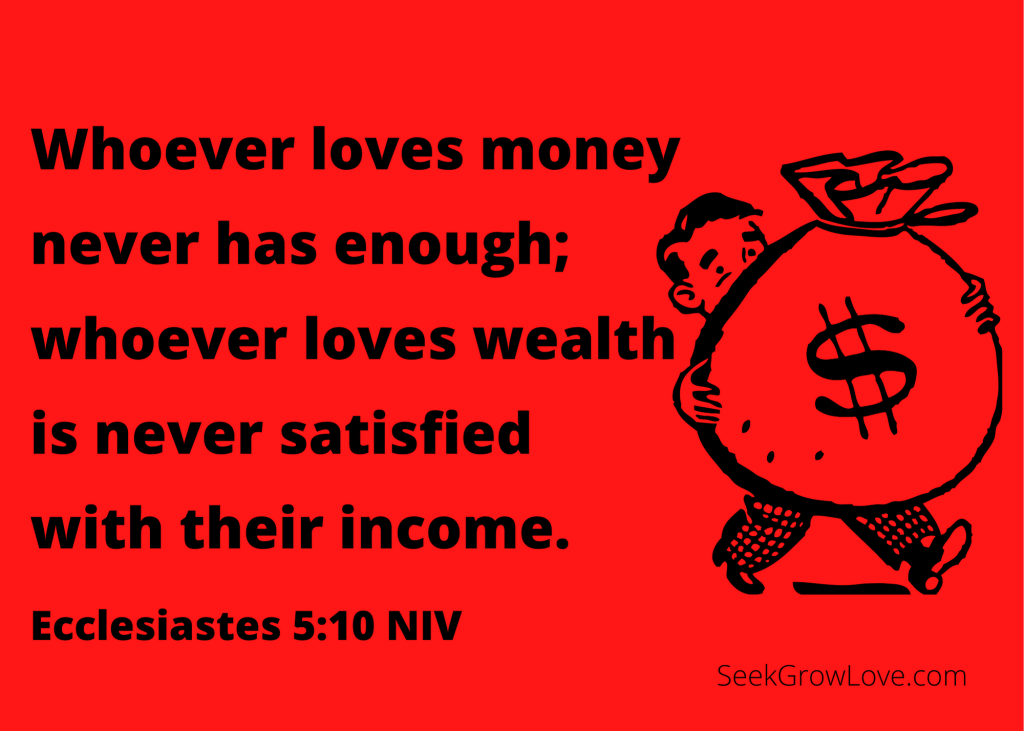
Ecclesiastes 5:8-20 says that whoever loves money never has enough, and whoever loves wealth is never satisfied with their income, and this is meaningless.  It also says that the abundance of the rich permits them no sleep.  However, it also says that it is appropriate for a person to eat, drink, and find satisfaction in their labor during the few days God has given them.  It explains that it is a gift from God when He gives someone wealth, possessions, and the ability to enjoy them.

This may be a bit confusing to hear that wealth can be good or bad.  I think it all boils down to your attitude and how you spend your money.  If money is your master, you are always wanting and trying to get more, and you spend it all on yourself; that is bad.  If you realize that your money comes from God, is actually owned by God, and is not the focus of your life, it is fine to enjoy that gift from God from time to time.

I now want to change gears a bit here and talk about yesterday’s devotion on tithing a bit more.  I said it was not mentioned in the New Testament that we should tithe.  However, there are two verses in the New Testament (Matthew 23:23 and Luke 11:42) that talk about the Pharisees giving a tenth of their spices and Jesus scolding them for neglecting justice, mercy, faithfulness, and the love of God, and saying they should have practiced the latter without neglecting the former.  I do not consider these two verses a mandate for us today to tithe ten percent of our earnings, although I can see how it can be interpreted that way.  These individuals were giving a tenth of their spices and Jesus said they should continue to do that.  If they had said they were fasting, I think Jesus might have told them to continue to do that, but I don’t think that necessarily means we all must fast today.

I could be wrong about this, but I don’t think the ten percent tithe is a specific rule we must follow today like the many rules they were required to follow in the Old Testament.  However, I definitely believe we should be giving money to the church, and I think it would be fine to look at what they were instructed to do and model that by giving ten percent of your earnings to the church.  I also believe it is possible that God wants some people to give more than ten percent.

Paul never discussed tithing ten percent, but he did talk about giving.  In 2 Corinthians 8:3, he said the Macedonians gave as much as they were able, and even beyond their ability.  In 2 Corinthians 9:6-7 he says, “Remember this:  Whoever sows sparingly will also reap sparingly, and whoever sows generously will also reap generously.  Each of you should give what you have decided in your heart to give, not reluctantly or under compulsion, for God loves a cheerful giver.”  In Paul’s first letter to the church in Corinth, he told them that they should set aside a sum of money in keeping with their income on the first day of every week (1 Corinthians 16:2).  I think if it was still a rule to tithe ten percent, Paul would have mentioned it, but instead he talked about giving with the proper attitude and according to your income.

-Rick McClain

Today’s 2021 Bible reading plan passages can be read or listened to at BibleGateway.com here – Isaiah 55-56 and 2 Timothy 3

To Tithe or Not to Tithe

Our discussion this week about money would not be complete without talking about tithing.  Many believe that we should be giving ten percent of our earnings to the church, which is called tithing.  I must admit that I was very surprised when I researched the topic of money to find that it was not mentioned in the New Testament that we should tithe.  Does that mean we are not required to tithe anymore?

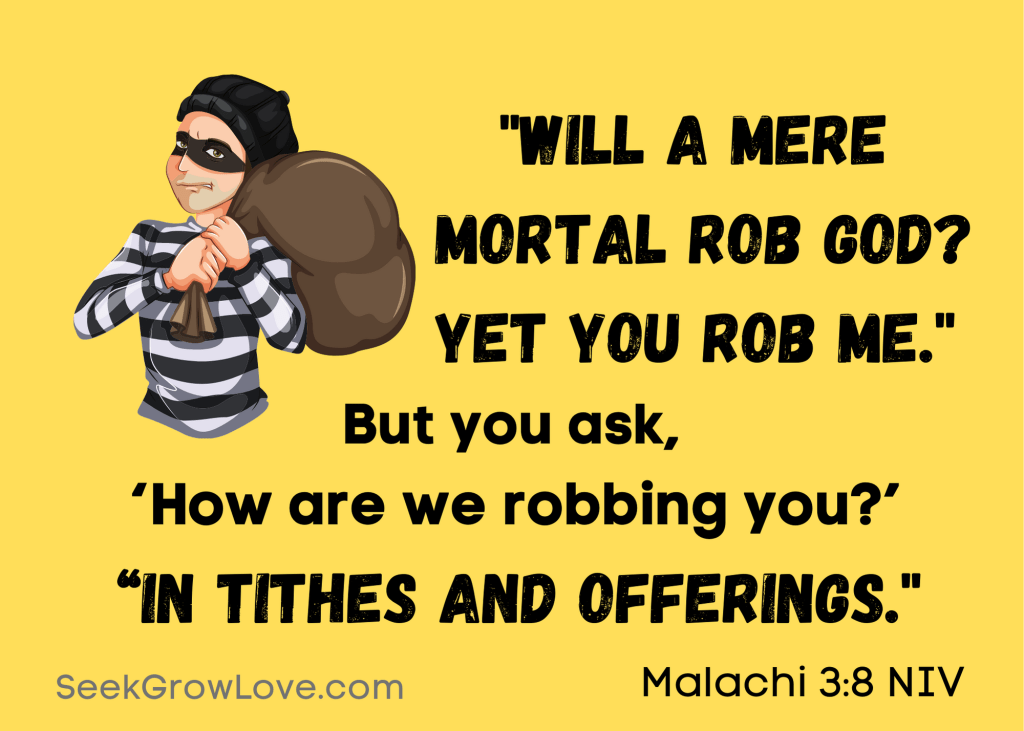
Let’s start with some Old Testament history.  Tithing was a practice back then (Malachi 3:8-12), but if you think you should be following the guidance from the Old Testament, you need to read about all the ways to give money to the church.  I won’t go into great detail, but there were some pretty elaborate rules about giving.  Check out Deuteronomy 14:22-29, Numbers 18:21-32, Numbers 18:8-11, and especially Leviticus 27:1-21.  For example, in Leviticus, if anyone dedicates their house to the Lord, a priest will judge its quality and set a value on it.  If the homeowner wants the house back, they can redeem it by adding a fifth to its value.  You could also dedicate people to the Lord by giving an equivalent value.  A male between the ages of twenty and sixty was valued at fifty shekels of silver, while a female between one month and five years was valued at three shekels of silver.  Of course, we are not under the Old Testament law anymore, so these rules are not in place anymore, including tithing.

Again, the talk of tithing is absent in the New Testament so what should we do about giving money to the church?  I don’t believe there is an exact calculation to follow so I am going to give you my opinion about what should happen.  First, we do not need to follow Old Testament rules anymore, but I think we can learn about God and how he operates by looking at the rules in the Old Testament.  Giving ten percent was a popular theme in the Old Testament.  I think that is probably a good starting point for our giving today.  If God liked using that percentage back then, I think it is likely He still thinks that is a good percentage today.  However, don’t forget that there were other rules for giving that didn’t simply follow the ten percent rule, so it is probably a bit naïve to think that is exactly what we need to do today.

Yesterday we learned that all our money is God’s money, not our own.  I think we need to consider that when deciding on how much to give to the church.  Furthermore, some of God’s money should probably be given to areas outside of the church.  For instance, your neighbor’s house burns down.  God may let you know that it is a great idea to send some money their way to help them get back on their feet.  Should that come out of the ten percent?  That is a trick question.  We should not be concerned about a particular percentage when 100% of the money we have is God’s.  We need to figure out the best way to use that money by listening to God and trying to understand His desires for that money.  I think He may want some to give twenty percent, fifty percent, or maybe even more to the church.  Perhaps, someone is in a tough situation right now and five percent is the right amount.

I do think church is important, and I do think it is important to give money to the church to further God’s work.  I would not want to be selfish in that regard and spend too much on myself and neglect the church.  If you want to know what is important to yourself in life, just look at what you spend your money on and what you do with your time.  If you don’t spend very much money and time on church, then church is not important to you.  If church is important to you, you do not have to tithe to it, but I encourage you to make God’s day by giving an appropriate amount to His work.

-Rick McClain

While this week we are discussing a Christian perspective on money…you can still keep up with your Bible reading plan. Today’s Bible reading passages can be read or listened to at BibleGateway.com here – Isaiah 53-54 and 2 Timothy 2

My Money

Many people work hard for their money, some have inherited their money, and others make money in many ways.  Most of us feel good about the money we have, even if it isn’t that much, but is the money really ours?  Today we are going to talk about the heart of the matter when it comes to a Christian perspective about money.  The most important thing you need to understand about your money is that it is NOT your money.

Psalms 24:1 states that the earth and everything in it is the Lord’s.  God says that the silver and gold are His in Haggai 2:8.  1 Corinthians 6:19-20 tells us that we don’t even own our own bodies; they were bought at a price.  God owns everything, including your money.  That makes you the manager.  He is the owner, and you are the manager that works for Him.

If this is a new idea to you, it can be a game-changer.  Have you ever been upset when your car broke down and you wondered how you were going to pay for the repairs?  Let me explain this situation with our new lens.  Let’s pretend you work for UPS (unless you actually do work for UPS; then you don’t need to pretend).  Let’s pretend that the UPS truck you drive breaks down and needs major repairs that will cost a lot of money.  Are you going to be upset about that, or are you just going to let someone know that your truck broke down and ask for a different one to drive?  You aren’t going to be too upset because you don’t own the truck, UPS does.  You know they have plenty of money to fix it and you won’t lose any sleep worrying about the cost of the repair.  When your car, I mean God’s car, breaks down, you shouldn’t be worried about the cost of the repair.  I’d be quite sure God is not up in heaven wondering how He is going to get through this problem.

Let’s try another one.  Someone steals $100 out of your wallet.  That tends to make us upset.  Let’s pretend this time that we work for Wal Mart as a cashier and someone steals $100 out of your cash register at gunpoint.  Granted, being held up at gunpoint would be very stressful, but how concerned would you be that Wal Mart just lost $100?  You wouldn’t be concerned at all.  And God is not concerned about how He is going to help you get by with $100 less in your wallet.  He is pretty capable of finding solutions to help you get by so you should not be concerned when someone steals money from your wallet.

Having said that, it does not give us a license to be reckless with our money.  We are the manager of the money and we still need to act responsibly.  We shouldn’t be driving crazy and we shouldn’t leave our wallets sitting on our front porch.  But if bad things happen when you are acting responsibly, don’t sweat it; God is going to take care of you.

We have one last myth to bust with this new mindset.  Some Christians believe that if they give 10% of their money to God, the rest is theirs to do with it whatever they want.  Again, we don’t own 90% because God owns 100% of our money.  That doesn’t mean you can’t spend any money on yourself.  You are the manager, and you need to decide what an appropriate amount of spending on food, housing, clothes, vacations, etc. would be.

If you are a good manager, Luke 16:10-12 explains that someone who can be trusted with little can also be trusted with much.  It is likely that if you make good decisions with the money you are managing, God will trust you with more.

If you find yourself stressing out about finances, think about who really owns the money.  That should put your mind at ease because we both know that God is not stressing about your finances.

-Rick McClain


Today’s Bible reading plan passages can be read or listened to at BibleGateway.com here – Isaiah 51-52 and 2 Timothy 1

Work

Yesterday I tried to convince you that money is not that important.  So…you may be thinking, great, I don’t need to work that much.  Not so fast.  The Bible is pretty clear about the need to work.

Proverbs 10:4 says that laziness makes you poor and Proverbs 6:9-11 states that sleep brings on poverty.  Moreover, 1 Thessalonians 4:11-12 says that we should work and not depend on anybody.  Paul even gave the Thessalonians a rule concerning work.  He said, “The one who is unwilling to work shall not eat.”  He then told them that if someone refuses to work, they should not associate with that person in order that they may feel ashamed.  He said they should not regard them as an enemy, but they should warn them as a fellow believer.  Clearly, we need to work.

Work can bring us down sometimes.  If you are working in a job that you love, you are fortunate; good for you.  However, I think there are many who don’t love their job and are just doing it to get by.  I don’t think you have to love your job, but Colossians 3:22-24 tells us that whatever we do, we need to work at it with all our heart, as if we are working for the Lord, not for human masters.  We need to put forth our best effort at our jobs every day.  If something is worth doing, it should be done well.

Okay, we need to work, but how much should we work?  First, Proverbs 23:4-5 warns us not to wear ourselves out to get rich.  Again, don’t let money be your master.  Second, if you have made a decision to live your life for God, all of your time is God’s time, and He also has some work for you to do.  Ephesians 2:10 says that we are created to do good works, which God has prepared in advance for us to do.  If you are a Christian, you have some “God work” to get done.  Although, you shouldn’t try to think of ways that you can do work for God.  It said that God has already planned out your work for you in advance.  You just need to figure out what that work is.  If you are having trouble knowing what you should do for God, pray, listen to others, and be aware of what needs are around you.  God has given you a purpose in life and it is your job to fulfill that purpose.

We have a lot of work to do, but there is also good news for those that work.  Ecclesiastes 5:18-20 lets us know that it is appropriate for a person to eat, drink, and find satisfaction in their toilsome labor during the few days God has given them.  It goes on to say that when God gives someone wealth and possessions, and the ability to enjoy them, they should accept their lot and be happy in their toil because this is a gift from God.

Think about your own situation.  First, are you working or are you depending on others to meet your daily needs?  Second, are you working with all your heart or do you put forth less effort when nobody is looking?  Third, are you doing the work that God has prepared for you to do or do you use most of your time on yourself?  Fourth, do you work too much due to your drive to make more money?  Last, do you ever slow down enough to enjoy some of the gifts in this world that God has given you to enjoy?  If you struggle with any of these areas, work at it.  😊

-Rick McClain

Today’s 2021 Bible reading plan passages can be read or listened to at BibleGateway.com here – Isaiah 49-50 and 1 Timothy 6