Kingdom Ticket – Paid

Will You Accept the Gift?

Hebrews 5_8,9

Hebrews Chapter Five

Hebrews chapter seven is known for being the chapter about Jesus being our high priest.  However, that theme is found in previous chapters, including chapter five.  Jesus being our high priest is one of the main themes of Hebrews.  God appointed Jesus to be our high priest.  Verse one shows us that the purpose of a high priest is “to act on behalf of men in relation to God, to offer gifts and sacrifices for sin.”  Jesus being our high priest acts on our behalf in relation to God.  He is our mediator between us and God.  Jesus being our high priest also offers a sacrifice for our sins.  A normal high priest like Aaron needs to offer sacrifices for his own sins and the sins of others.  However, Jesus had no need to offer a sacrifice for himself because he was sinless.  Rather, he offered himself up to be our permanent sacrifice for sins.  That is a sign of a high priest who loves us dearly.

One would think that since Jesus was perfect that he would not suffer.  However, Jesus “learned obedience through what he suffered,” (Heb 5:8).  Jesus truly did suffer when he was here on this earth.  Two examples that come to my mind are when Jesus wept when his friend Lazarus died and when Jesus sweat tears of blood in the Garden of Gethsemane before he was crucified.  It’s through experiences like this that Jesus learned obedience.  It’s through experiences like this that we too can learn obedience.  It’s often through the most difficult times in life that people draw closer to God.  Job is a great example of this, as he lost nearly everything he had in one day.  However, he responded by worshipping and praising God.  He was brought closer to God and learned obedience through his suffering.

In verse nine, we see that “being made perfect, he became the source of eternal salvation to all who obey him.”  Jesus truly was made perfect, and he was sinless.  He was the last person in the world who should have had to suffer on the cross.  However, because of his and our Heavenly Father’s great love, he did die and suffer on the cross.  Through his suffering on the cross, he became the source of eternal salvation!  Jesus paid our way to go to the Kingdom!  All we have to do is accept the free gift of God of eternal life through Christ Jesus our Lord.  Unfortunately, not everyone is going to accept that free gift.  Verse nine states that Jesus is “the source of eternal salvation to all WHO OBEY HIM.”  To accept the free gift of eternal life, we must obey Jesus.  We accept the gift through obedience and faith.  Similar to what we talked about yesterday, don’t belittle the consequences and meaning of sin because eternal salvation is granted to those who obey Jesus, not those who disobey.

Similar to the chapter break between chapters three and four, the chapter break between chapters five and six is an awkward break.  At the conclusion of chapter five, the author of Hebrews is talking about the difference between elementary and mature doctrines, and he continues the talk in chapter six.  The author compares the elementary and mature doctrines to milk and solid food.  A baby needs milk, and adults eat meat.  New Christians focus on the elementary doctrines, whereas the mature Christians should focus on the more mature doctrines.  Since it’s a weird chapter break, I also want to sneak peek to verse one as well.  Hebrews 6:1 states, “Therefore let us leave the elementary doctrine of Christ and go on to maturity.”  Throughout the first six chapters of Hebrews we have seen some good proof to suggest that the Trinity may be false.  This is good proof as well.  Many people who claim they believe in the Trinity cannot even explain the Trinity themselves because it is so confusing and complex.  They have to use extra biblical illustrations to describe the Trinity.  The Trinity is anything but an elementary doctrine.  It is one of, if not the most, complicated doctrines out there.  However, the author of Hebrews states that the doctrine of Christ is supposed to be elementary.  Jesus being the Son of God does sound like an elementary doctrine to me, not the Trinity.  This is just some food for thought (pun intended).

I hope you have a great day!

In Christian love,

Kyle McClain

Hold Firmly

Hebrews Chapter Four

Hebrews 4_14

There is a belief in the Christian world that some hold to called “once saved, always saved.”  Basically this means that if you come to a saving relationship with God and Christ, then you can never lose your ticket to eternal salvation.  This can be a dangerous perspective because it enables Christians to become complacent with where they are at if they believe they can never lose their salvation.  Worse yet, it can lead people to a life of sin and destruction if they do not take seriously the consequences of sin.  Verse six of Hebrews chapter four discusses this doctrine of once saved, always saved a bit by stating, “Since therefore it remains for some to enter it, and those who formerly received the good news failed to enter because of disobedience.”  The author is stating that some who receive the good news/gospel fail to enter rest because of their disobedience.  They initially accepted the promises of the gospel, but they failed to enter because of their disobedience.  In other words, they were once considered saved when they accepted and received the gospel, but they lost it when they disobeyed.  This verse suggests that maybe the doctrine of once saved, always saved is not founded in the Bible.

This should provide a wakeup call for us!  We need to take the sin in our lives very seriously.  We are to be sanctified and set apart from this world, so let’s act like it!  Let’s not become complacent and degrade the consequences of sin.  God hates sin.  The hardening of our hearts can lead us to sin, and again the author warns us of hardening our hearts in verse seven.  We should take this warning seriously since the author has repeated it three times in chapters three and four.

The concept of rest is repeated a lot in this chapter.  What exactly is the author referring to when he is talking about rest?  Let’s take a look at what this rest is described as in chapters three and four:

  1. Israelites unable to enter God’s rest because of their disobedience and unbelief (3:18-19)
  2. The promises of entering God’s rest still stand (4:1)
  3. We who believe enter the rest (4:3)
  4. God swore that some will not enter his rest (4:3,5)
  5. God rested on the seventh day (4:4)
  6. Remains a Sabbath rest for the people of God (4:9)
  7. Whoever enters God’s rest also rests from his works (4:10)
  8. Strive to enter the rest (4:11)

Here’s what I get from all of this.  God offered the Israelites during the exodus a chance to rest, but they were not able to enter God’s rest because they were disobedient.  The author then compares the rest that was offered to the Israelites to the coming Kingdom.  I come to this conclusion because the promises of entering God’s rest still stand.  There is still a chance to enter God’s rest.  However, not everyone will attain that rest, only the people of God.  In fact God swore that not everyone will enter his rest.  If we are disobedient and unbelieving, then we will not enter God’s rest.  However, if we are a people after God’s own heart, then we surely will enter God’s beloved rest in the coming Kingdom.  Hallelujah! Praise God! Amen!  Therefore, continue to strive toward the Kingdom and bring as many people with you as possible because one day you will enter God’s rest in the Kingdom.

Chapter four ends with talk of Jesus being the great high priest.  We truly do have a great high priest in Jesus.  One of the awesome things about Jesus being our high priest is that he is able to sympathize with us.  Jesus was tempted just like we are, but fortunately he did not sin.  He knows what we go through when we are faced with trials and temptations.  He is no stranger to struggle and suffering.  We can seek refuge in our high priest when we face these temptations because he is able to sympathize with us and plead our case to our Heavenly Father, YHWH.  Jesus being tempted is also more great proof against the trinity.  James 1:13 states, “God cannot be tempted with evil.”  If Jesus were God as well, then James and the author of Hebrews would be contradicting one another.  It cannot be possible for the word of God to contradict itself.  Jesus can’t be tempted, and never have been tempted at the same time.  It doesn’t work that way.  It logically does not make sense.  Jesus was indeed tempted like us, and being our high priest, he is able to sympathize and help us.

To close out today’s devotion, I want to point out Hebrews 4:12, “For the word of God is living and active, sharper than any two-edged sword, piercing to the division of soul and of spirit of joints and of marrow, and discerning the thoughts and intentions of the heart.”  I hope you have gotten benefit from reading these posts.  However, if you don’t get anything else, I want you to know and fully understand that the word of God is living and active.  We are beyond blessed to have the Bible today.  If it weren’t for God’s supervision, there would be no stinking way that we should have it because of the numerous attempts to rid the world of the Bible.  The Bible has only flourished though.  It is truly a divine miracle that we all have access to a Bible, God’s word.  I want to encourage you to keep up the awesome work in delving into God’s word through these devotions.  You are truly doing a great deed.  Keep up the awesome work, and truly believe in your heart that these words are living and active.

-Kyle McClain

New Year’s Resolutions

Luke 19_3a

Luke 19:1-10

As we are entering into the third full week of January I want to think about how you have begun your new year. Did you make any resolutions? Why or why not? Have you already broken your resolutions? If so, what made you let them go so soon? If not how are you staying true to your goal?

This week I am going to talk about some common New Year’s resolutions amongst Christians, their biblical founding and some strategies to help us keep these resolutions. My hope for you this week is that you take a moment to evaluate where your relationship with God is, where you would like it to go and how you are going to get there. If you did not make any resolutions or goals for 2018, that is okay, but maybe after reading this you will consider refocusing certain things in your life.

Some of the most common New Year’s resolutions in general are people wanting to be healthier, people wanting to save more of their money, getting better grades, maybe even trying to get a new and better job. These are all good, but so many people lose sight of their goals within the first 3 months of the new year, for a multitude of reasons. They made their “rules” too drastic, or they did not make their goal focused enough, or they did not have any accountability. These are all reasons people ditch their resolutions. Some common resolutions amongst Christians, in regards to their faith are to read their Bible more, go to church more often, pray more, etc. Again, even people of faith abandon these goals more often than not, because they want to do everything on their own, or they want to be absolutely perfect and when they are not they feel like they failed. All of these feelings are valid, but do not let them hold you back.

My first challenge to you if you are wanting to deepen your faith and your relationship with God, is to seek him and his son. Seek Jesus. This is the first topic of the week. Seeking Jesus. I want you to go ahead and read Luke 19:1-10.

Luke 19:1-10 is all about Zacchaeus. “Zacchaeus was a wee little man, who climbed up in a sycamore tree to see what he could see”- Right? That is not the only thing we can take away from this passage. Zacchaeus was too short to see Jesus over the crowd, but why did that matter to him? He most likely had heard the stories of Jesus and the people he had helped and the lives he had changed. Zacchaeus probably wanted to know what all this “salvation” was about, and how he could live eternal life. His entire knowledge and experience of Jesus prior to this day depicted in Luke was through the accounts of other people. If your faith is struggling or you feel lost, ask for other people’s stories. Ask people to share how they grew to know God, ask other people how they rely on him, and you may receive the help you need and some amazing relationships along the way.

Another thing to take away from this account is this; are you afraid to look silly for Jesus? We are called to not be of this earth, we are called to be different and not follow the ways of the world. Zacchaeus was the chief tax collector, everyone knew who he was and the power that he had. Not only was he powerful, but he was extremely wealthy. Here was this man of high power and esteem, and in order to see Jesus he climbed a tree. That would look a little silly. How silly are you willing to look in order to see Jesus? I hope the answer means that you would fall on your knees before him, or praise God whenever you are compelled to do so. The opinions of others do not matter, your relationship with God is far more important.

To have a relationship with God, and to truly seek him and his son out is much more simple than we make it. Many times we feel like we need to be perfect in order to come to God and ask him for help, or to come to him and thank him, but that is not the case. He sent his one and only son to the world to die for us while we were still sinners. He put that salvation plan in motion so long ago, because he wants us to come to him in every time in our lives, good or bad. God wants us to come to him in our darkest hours, but also in the best times.

-Jana Swanson

One Thank You

Luke 17

Luke 17 17 edit

A simple, but important rule in my sixth-grade classroom is students must say “thank you” anytime they receive something from me.  It doesn’t matter if that something is homework, a reward, a present, or even a consequence, the expectation is always that I am thanked.  Why?  There are a few reasons.  First, when you thank someone you acknowledge you are receiving something.  Second, when you thank someone you acknowledge they are the giver of that something.  Finally, when you thank someone you are showing that you have considered and accepted that something.  Conversely, if I am not thanked, I must assume my students do not value the item, the giver, or its intention.  Now, I am not naive enough to believe every eleven-year-old that says “thank you” has gone through this thought process.  They may simply be well-mannered (or well-rehearsed).  Maybe they know it is a rule and do it to avoid a negative consequence (which they would have to say “thank you” for anyways).  They simply may do it because everyone else is doing it.

It can be hard to tell the authenticity of a thank you, but one pattern I have noticed is when someone is truly thankful, they will seek you out to tell you.  Such was the case of a student of mine who delivered a letter to me on Teacher Appreciation Week last year.  While the standard fare is a box of chocolates, a coffee mug, or a cleverly-punned present, she crafted an honest-to-goodness thank you card.  There were no generic references to how awesome I was, how my class was the best, or how funny I am (which all are true), but she acknowledged specific words I had written in her yearbook at the close of the prior school year. She stated those simple words had changed her attitude, and she wanted to let me know that she greatly appreciated the time I took to consider them, write them, and live them.  Favorite “appreciation” received to date.

In today’s reading, Luke 17, Jesus amid traveling from Galilee to Samaria is met by a lot of lepers.  They each want the same thing: to be healed.  Jesus obliges, and without much reference to how he did it, he simply states in verse 14, “Go and show yourself to the priest,” meaning they would now be known as the men who formerly had leprosy.  They were cleansed, restored, no more peril or pain. They could now enter the city gate, walk the street, and be with all those they had left behind.  In their excitement, nine men rush to show everyone how they had been healed.  A single soul stops; he turns to praise God and give thanks to Jesus for this wonderful blessing beyond measure.  Jesus is curious about the other nine, but tells the lone returner he was “healed because of his faith.”

So many times I have read this story and am left wondering, “Why did Jesus say this man was healed ‘because of his faith’? Were they not all healed?” The more I read over this passage, place it preceding Jesus’ next topic, the Kingdom of God, it begins to resonate what Jesus may be alluding to.  While this thankful leper was cured in the very same way as the other nine, he alone received the lasting healing and life that comes through the acknowledgement of Jesus Christ.  This thankful man’s healing was not physical transformation but an allegoric alignment of his spiritual salvation.

So where does this leave us?  Often, we are the nine.  We joyously jog back to the place we came – complacency or repetitive sin — because we know we are restored, we can enter the city gate, we can walk the streets, and we can be with those we have loved because Jesus has already paid the price for us to do so.  We may thank him because we are well-rehearsed to do so in prayer.  We may thank him because we fear what might happen if we don’t.  We may thank him because that is what everyone else is doing; however, the minute everyone else turns and runs, we are there following them instead of running to our Lord and Savior.  Take a moment to stop. STOP!  Turn around.  Run to Jesus (repent).  Praise God (for your blessing)!  Tell him what he has given to you, what He means to you, and how that is changing your life, not because that is something you do, but because that is something YOU do!  When we offer thanks to him in this way, we will know the eternal healing that comes through a thankful faith.

-Aaron Winner

Forget Not All His Benefits

Psalm 103

psalm 103 2 b

Yesterday we practiced seeing God revealed in Psalm 100.  Today you can try it again with another great Psalm – 103.  Read through the Psalm and search for what you can learn (or be reminded) about God.

What characteristics of God are you especially thankful for?  His omniscience (all-knowing)?  His omnipotence (all-powerful)?  His faithfulness?  His forgiveness?  His compassion?

Verse 12 gives a little teaser of what was yet to come in God’s perfect plan of salvation. “As far as the east is from the west, so far has he removed our transgressions from us.”  At the time this was written God’s people were still living under the Old Testament law with it’s system of sacrifices and priests.  There was a plan in place for forgiveness but it required strict adherence to a detailed list of sacrifices and who could perform them for what sins.

Sin was – and still is – a big deal because it causes separation from God who can not be in the presence of sin.

And so, in the New Testament a new gift from God was given!  A new path to forgiveness – one not just for the Jews, but for all who would believe on the name of the Lord Jesus Christ – the Son of God!  The giver of all good gifts gave us His one and only Son – first to teach us how to live and to point us to his Father – and then to die so that we can be saved from our sins.  But God still wasn’t done gifting.  He raised Jesus from the dead.  And today he is in heaven at God’s right hand, interceding on our behalf and serving as the mediator between God and man.

Let us forget not all his benefits…and thank Him for His Son.

-Marcia Railton

Hearts of Flesh

Empathy

This week, we have explored the ways in which empathy informs and shapes our call as Christians to love one another.  We’ve learned how empathy is sitting with and understanding another’s perspective.  We’ve looked at how empathy allows us to love others in ways that uniquely speak to their circumstances.  We’ve even seen how we have a high priest in Christ who’s empathy has brought us salvation.


Today, I would like to end our time together by encouraging each one of us to live our lives more empathetically in light of our readings.  In a society that often seems more and more connected, we can increasingly find ourselves alone.  At its very root, empathy stands against such isolation by opening our own hearts to those around us.


This is hard.  This is dangerous.  It’s a path that has even led to the cross.  But when we refuse or close our eyes to the full humanity of those around us, we begin to break the very ties that make us human.  Because out of everything that God has made, only loneliness was not good.


To be human – the way that humanity is meant to be – is to be in community, relationship, and connection with all those around us.  Who is our neighbor? Everyone.  Am I my brother’s keeper? Yes.  Who should I love? Even my enemies.


The work of God, from the emancipation of the Israelites to the salvation of the resurrection, is a story of an ever widening circle of people that are called to love and care for one another in the glory of God.  That cause has not changed even today.


We are called to love and care and expand the boundaries of our own comfort so that the unlovable will be cared for and the lonely will no longer be alone.


Empathy is the tool that protects our hearts from becoming stone.


As we part ways today, my prayer for each of us is that we are transformed and empowered to carry hearts of flesh that can love beyond human comprehension.

-Graysen Pack

Union with Christ

Philippians 3

IMG-0279

The last few days we’ve been talking about unity in the body. Today I want to spend some time discussing unity (or union) with the head of the body. Our connection with Jesus affects every relationship in our lives. If we are to achieve unity in our local church, we must maintain union with our Lord.


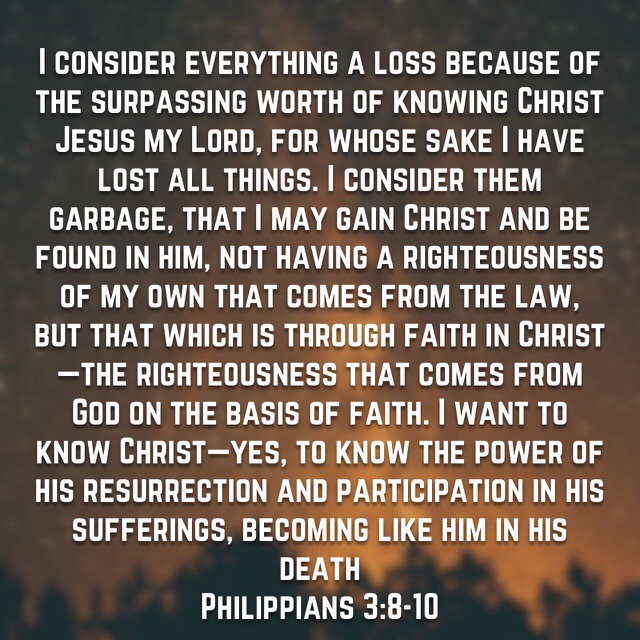
Union with Christ has two important aspects. The first is knowing him. This does not mean to know who he is or to know some things about him. It is to understand what he went through and why he endured it. It is to realize that without him we are hopeless. It means communicating with him. It means recognizing that our own efforts count as nothing towards our salvation and that only through him can we be saved and that this is a good thing. Paul says that everything he could boast about in himself is garbage compared to the worth of knowing Christ (Phil. 3:8), and in John 17:3 Jesus says that eternal life is to know the only true God and His son. Knowing Christ is essential for salvation and for being united with him.


The second aspect of our union with Christ is being like him. Earlier in Philippians, Paul tells readers to have the same mind as Christ (2:5).  Just as Jesus lived to serve the will of God, we should. Just as he was willing to give up his life for others, we should. He lived perfectly and we should strive to do the same. In Galatians 2:20 (ESV) Paul says, “I have been crucified with Christ. It is no longer I who live, but Christ who lives in me. And the life I now live in the flesh I live by faith in the Son of God, who loved me and gave himself for me.” Union with Christ is about emptying ourselves of the muck that comes from our sinful nature and replacing it with the holiness that comes from Christ—out with the old, in with the new.


“Therefore, if anyone is in [union] Christ, the new creation has come: The old has gone, the new is here!” (1 Corinthians 5:17, NIV)


In this life, we will never achieve perfect union with Jesus. We will not fully know him or be totally like him until we can be with him—without the presence of sin. Paul recognized this and writes that despite his shortcoming he would “press on toward the goal for the prize of the heavenly call of God in Christ Jesus” (Phil. 3:14, NRSV). We, too, should press on towards the goal to have union with Jesus. It won’t be perfect, but it will go a long way in furthering our own spiritual development and the unity of the Church.

– Joel Fletcher

Separation

What can separate us


Romans 8:35-39         Who can separate us from the love of Christ? Can affliction or distress or persecution or famine or nakedness or danger or sword? As it is written: Because of you we are being put to death all day long; we are counted as sheep to be slaughtered. No, in all these things we are more than conquerors through him who loved us. For I am persuaded that neither death nor life, nor angels nor rulers, nor things present nor things to come, nor powers, nor height nor depth, nor any other created thing will be able to separate us from the love of God that is in Christ Jesus our Lord.

What can separate me from the love of God in Christ? Romans 8 says, “nothing,” but I have my doubts.

I bet I prayed “The Sinner’s Prayer” twenty times growing up. I was always so afraid I’d missed something, or paranoid I’d somehow nullified my salvation since the last time I said the magic words. After walking with Jesus, I now know: there is nothing magical about it.

My words don’t save me. Jesus saves me. My response is to repent of my sins and believe He saves me.

We focus on the exact words we said, the exact time and place we knelt. We make our coming to Christ about our circumstances rather than our Savior. It was never about what I was doing. It was always about what He did for me.

The depth of our need for Jesus is so vast that even our act of coming to Him is flawed, but He is never surprised by this. He knows us fully and loves us still. He came to make everything right, including our half-heartedness and our ill intentions.

Come as you are and bare your soul. Cry out like David cried out in Psalm 51, confessing honestly and openly before the God who made you and promises to make you new, who loves you and stands ready to save. Then come back day after day. Walk daily in the grace you first received, knowing there is nothing you can do or not do to reverse the rescue the cross secured.

-Jennie Montgomery

Freedom IN CHRIST

Monday, September 25, 2017

Romans 8-1-2

Romans has always been one of my favorite books of the Bible. God speaks through Paul so powerfully and his words paint such a beautiful portrait of the Gospel. Romans 1-7 seems to just lay it all out and to sum it up, he shares the Gospel story like this: holy God, sinful man, coming wrath, perfect Savior, Jesus Christ crucified and risen, justification by faith, sanctification by faith.

Paul drives home his message in Romans 8:1-2.

“Therefore there is now no condemnation for those in Christ Jesus, because the law of the Spirit of life in Christ Jesus has set you free from the law of sin in death.”

That’s it. That’s the central, foundational message of God to the world. The message that we preach. The message that we take to the nations and to our neighbors. The message that we lay down our lives for: there is no condemnation for those who are in Christ Jesus because Christ has set us free.

If you have grown up in church like me, we can sometimes get used to this message. We hear over and over again the message of “freedom in Christ” and too often discount the weight of that phrase. Freedom in Christ– this message should never grow stale! Every day that we walk this Earth, we should be reminded of our freedom found only in Christ. We are free. We are free from death. We are free from finding our satisfaction in this world. We are free from the weight of sin, just as we are free from the eternal consequences of sin. And it’s only because of Jesus Christ that we are we are free.

And although we strive to obey God and walk in the Spirit, we will constantly find ourselves falling short. It is at these times that we must remember the beginning of Romans 8:1 that “there is no condemnation for those who are in Christ Jesus.” But because of Jesus’s great victory, there is now no condemnation for believers. Our sins and failures do not cause the Lord to give up on us or to love us any less, because we are secure in Christ.  In this security found in Christ, we live a life of faith and repentance, continually serving the Lord and putting sin to death.

Tomorrow, we will continue to dive into Romans 8, talking about what it means to put sin to death. It is my prayer that today we will rejoice in our freedom that is found only in Christ.

-Jennie Montgomery


And, in case you missed Jennie’s Sunday intro video (sorry for that techie glitch) …

Here it is – enjoy!

Say Yes

Revelation 20-22Revelation_22-12

Saturday, July 22

The Bible begins in the book of Genesis with God and his children named Adam and Eve living in a perfect garden where his children have immediate access to the presence of God and can interact with God face to face.  The act of rebellion against God caused them to be separated from God.  They initiated this process by hiding from God and by their failed attempts to cover over their guilt and shame.  The consequence of their rebellion against God was that they were cut off from immediate fellowship with God, they were cut off from the garden which, along with all of the earth and the inhabitants of the earth including animals and humans fell under the curse of death.

Within God’s ruling of the consequences of sin and the resulting curse came a kernel of good news in Genesis 3:15.  One would come who was a “seed of the woman” meaning a child, a human child, who would ultimately defeat the serpent, which represents evil.  In the process of destroying the evil serpent, that human would also suffer a wound (a bruised heel).

The rest of the Bible is the story of how God’s plan to rescue the earth from the curse and restore  and redeem humanity that was cut off from God is fulfilled ultimately by Jesus Christ, the human being, he was a seed of the woman, who was also the perfect and sinless son of God.  In going to the cross and dying for the sins of all humanity, and being raised up by God to everlasting life, Jesus defeated the serpent.

Revelation 20-22 provides a vision of the ultimate victory of how this is ultimately realized.  The serpent/dragon/devil/satan(adversary) is permitted to influence the world only so long, and then it will finally meet it’s end.   Evil will be defeated by Jesus Christ.  Christ will return, the dead will be raised, there will be a final judgment based upon what we have done.  Some will be resurrected to everlasting life with God on a renewed earth in the city of New Jerusalem.  Some will be judged and condemned by God and cast into the lake of fire, which the Bible calls the second death.  (Note that it does not teach that they will be tortured for eternity, but that they will die a second and final time in a type of mass cremation).  Death has to be destroyed.  Those who reject God’s love and gracious gift of salvation will not have it forced upon.  God allows us the freedom to accept his love and the offer of salvation, but he also gives us the freedom to reject it.  Just as a bride must consent to marrying the groom in order for a marriage to be valid, we, God’s people must consent to God’s love before our covenant relationship will be valid.

For those who reject God’s love, they will finally and mercifully be brought to everlasting destruction.  Those who accept God’s love through Christ, will be granted everlasting life.  The Bible ends with the reversals of Genesis 2-3.  God will again make his presence here upon the earth.  The image John gives in Revelation is of a New Jerusalem coming down from God to take up occupancy on the earth.  This new Jerusalem, interesting, is built on the same scale as the Temple in Jerusalem was… only so much larger.  The new temple occupies a territory that rivals the ancient Roman empire.

For Christians living in the first century suffering under Roman oppression, this must have given them hope.  Rome/ or Babylon or whatever earthly power that was anti-God would be brought to an end, and God’s Kingdom, God’s government would cover all the earth, with Jerusalem acting as a giant temple where God and his people would dwell for all eternity.  Within the temple, emanating from the throne of God is a river of life surrounded by the tree of life.  The tree of life was the very reason why Adam and Eve were banished from Eden, so that they would not partake of the tree of life/immortality in their sinful and broken condition.  Sin had to be defeated once and for all before immortality could be enjoyed.  But now, in Revelation, we are free to partake of the tree of life, we are free to embrace immortality, and we will live forever with God in His Kingdom on this renewed earth.  We have, in a sense, come full circle, we are back home with God’s presence in the new Eden, and we are forever blessed.  Even those who have suffered martyrdom for their faith, will enjoy the benefits and blessings of the New Jerusalem the New Eden and the New Earth.

If you’ve never said yes to God’s love, I don’t want you to miss out on this greatest of all blessings.  Say yes to God, you can do it right now.  And then solidify that “Yes” by entering into a covenant relationship with God through Baptism.  And then live as a child of God and share this good news with as many as you can, until the day all is fulfilled and Christ returns, or the day that you draw your last breath.

-Jeff Fletcher

(https://www.kingjamesbibleonline.org/Revelation-22-12_Inspirational_Image/)