2 Samuel begins with Saul’s death. Chapter one tells of his death and David’s reaction. Chapter two shows David seeking God’s advice and being anointed king over Judah, the northern kingdom. Also, we see Abner anointing Ish-bosheth, Saul’s remaining son, king over Israel, the southern kingdom.
Both armies met at the pool of Gibeon. 2 Samuel 2:14 says, “And Abner said to Joab, ‘Let the young men arise and compete before us.’ And Joab said, ‘Let them arise.’” They arose, each sending 12 men to fight. They each caught their opponent by the head and thrust their sword in their opponent’s side. All 24 died. Not the brightest way to fight! A battle broke out after this and one of Joab’s brothers, Asahel, ran after Abner; Abner ends up killing him. That brings Joab and his other brother, Abishai, pursuing Abner. Joab ends up retreating, but David’s men won the battle 20 deaths to 360 deaths. Chapter three tells of Joab and Abishai getting their revenge on Abner and of Ish-bosheth’s death.
There you have the cliff notes version of the first four chapters of 2 Samuel.
There are two stories in these chapters that show David’s moral character. If you remember, there were a couple of times when Saul was chasing David when David could have killed him and did not because Saul had been anointed by God. Even though it would have been viewed as a proper response to the situation, David didn’t do it. In 2 Samuel 1 an Amalekite man comes to David to report Saul’s death. He tells how Saul, near death already, asks to be put out of his misery and how he honors that request. David kills him. In 2 Samuel 4 we read that after Abner was killed Ish-bosheth lost his courage. Two captains of raiding bands for Ish-bosheth realized they were on the losing side and wanted to find a way to show their loyalty to David. They killed Ish-bosheth and brought his head to David. They were proud of their actions, and thought David would be as well. Just like the Amalekite man, David has them killed.
One more side note…In chapter four we are also introduced to a character who doesn’t come into play until chapter 9. Verse 4 says, “Jonathan, the son of Saul, had a son who was crippled in his feet. He was five years old when the news about Saul and Jonathan came from Jezreel, and his nurse took him up and fled, and as she fled in her haste, he fell and became lame. And his name was Mephibosheth.” Just keep that mouthful in mind (muh·fi·buh·sheth).
Amy Blanchard
Reflection Questions
When you think of your own moral character, how would you rate yourself?
When the world says something is right and good do you consider if that is how God views it? Who do you choose to follow?
Keeping in mind 2 Samuel 1:14, what are some things that David – and God – would suggest we should be afraid of?
Sometime in the Advent season, my family gathers round and we read out these words. There is a familiarity to this “scary ghost story”; who hasn’t seen, or watched, or read, or heard some version of *A Christmas Carol*. There are dozens, scores, of different versions: stages plays, to ballets, to movies, to the MUPPETS. Seriously, if you haven’t seen a Muppet’s Christmas Carol, what are you doing in the Holiday season?
As I was saying, my family reads these words every year, and I particularly love Dickens’s dry humor and wit, which is somewhat lessened by the theatrical productions of his creation.
But he also makes very clear why he begins his illustrious novel with a death of a character we know nothing about : “The mention of Marley’s Funeral brings me back to the point I started from. There is no doubt that Marley was dead. This must be distinctly understood, or nothing wonderful can come of the story I am going to relate.”
It is in the exact same vein that the author of 1 Samuel 28 reminds us, “Now Samuel was dead, and all Israel had mourned for him and buried him in his own town of Ramah.” We already knew that from 25:1, but the author wants to be really sure. Absolutely positive that we get it.
Saul is going to attack the Philistines but the Lord doesn’t answer him. And so Saul, in stupidity and desperation, decides to go to Endor, looking for a witch. The witch, in fear and trepidation, speaks as and for Samuel whom she “brought up”. Up from the dead, speaking to Saul. “Samuel was dead to begin with.” This was a big deal. This was massive. We are expecting something wonderful, or maybe in this case, something awful to come of the story which the author is going to relate.
There are some great questions that come to mind when we read this story (see below), but I want us to pick up on what Samuel says to Saul : “Why do you consult me, now that the Lord has departed from you and become your enemy?”
When Saul drags him up, Samuel says “What do you want me to do about it?” Like I said, I expected wonderful or awful; I did not expect grumpy and sassy.
Sometimes, when we find ourselves in sin, and our lives start going poorly, we think, in stupidity and desperation, “more sin will fix this.” Of course, we never say those exact words. Saul didn’t either, but he also didn’t listen to the commands of the Lord. A little compromise here, a little not following the will of God there. “I didn’t kill the sheep so they could be sacrificed!” God stops listening to his prayers, and so he turns his inward sin of rebellion into the outward sin of divination. He does fulfill the prophecy of Samuel in 1 Samuel 15:23.
We tend to do the same. We tell a lie, and to cover up that lie we have to tell more. (Like Junior Asparagus covering up breaking the Art Bigotti Plate.) Instead of dealing with our lust and desires of the flesh head on, we heap false prophecy onto it and say “God told me we should be together.” We lump pride onto sloth: “Sure I was mentally checked out when I was physically clocked in on the job, but I just need some self care. I deserve it! Treat yo self!”
You might think the words used (pride, sloth, lust) in those examples (“stuff that everybody does”) is a bit extreme. Maybe, but sin is usually insidious. Saul didn’t start off thinking he was going to be cavorting with witches in the middle of the night. David didn’t think that avoiding his duty of going to war would end up with him murdering his companion.
Maybe, through you reading the story, you can begin to see that nothing good comes from heaping one sin on top of another. If you find yourself walking down the road of sin, I know how hard it is to change; still, confess your sins, seek the help of pastors and friends who want the best for you, change your ways. Only in turning from sin to the God who wants the best for us will we be able to seek his forgiveness, and not find him as an enemy, but relate to him as a Father who loves his children. Christ will empower us, advocate for us, give us his spirit and put us in a place where God can change us and bless us.
“And so, as Tiny Tim observed, God Bless Us, Every One!”
-Jake Ballard
Reflection Questions
Do you need to confess and stop sinning?: Start off by focusing on the thrust of the devotion; are there any sins in your life that need confession? Where you need help to get out of addictive patterns or habits that are hard to break? Stop the sin as soon as possible so the healing can begin. Only then should we think about the rest of these questions.
Did the magic work?: I have heard some people say the witch was scared *because the magic worked.* As in, she wasn’t expecting a real appearing. But the text indicates that she was scared because she recognized Saul while doing her magic. Saul had killed all the diviners. Why was she scared? The ancient people believed magic worked : The witch in Endor, like the slave girl of Acts 16, make us ask do *we* believe that magic works? Should we be more afraid of participating in the occult and magic than merely saying “that’s make believe”?
Are ghosts real?: Samuel seems to be a ghost. Are ghosts real? What is the Biblical picture of the afterlife? Jesus compared it to sleep, Ecclesiastes talks about the dead knowing nothing and not praising God, but the disciples thought Jesus was a ghost. Does the Bible teach that people can become ghosts? If it doesn’t (and I think it doesn’t), then why did the disciples think people could become ghosts?
Coming *up*?: Where was Samuel coming from? It says Samuel was coming up? If the dead keep on living, we should expect him coming down out of heaven; Samuel seems grumpy, like a man awoken untimely from his sleep. What did the Israelites believe about Sheol?
The Philistines fought against Israel on Mount Gilboa. King Saul and his sons were also fighting against them. They fell slain in battle there. It says that “Saul died for his unfaithfulness which he had committed against the LORD, because he didn’t keep the word of the LORD.” (10:13) He consulted a medium for guidance, “but he did not inquire of the LORD; therefore, He killed him, and turned the kingdom over to David.” (10:14) It is so important to ask God for guidance, first and foremost. We so often ask others or search online for answers, which can be okay, but mainly we need to seek and ask God. It had been almost 9 years since Saul’s disobedience and rejection by God as king, yet he was still ruling for years, until it says that God killed him through the Philistines, and FINALLY the kingdom was turned over to David… as they mourn for King Saul.
Here is a modern aerial (drone) view of Mount Gilboa taken by our homeschooled high school son that was with my husband on a field trip. It is a mountain range, not one individual mountain. And guess what? It still has the same name today! In fact, by it you can see a manmade “snow” slope to go sledding on throughout the year. 😊
Proverbs 21:1 follows the two chapters in Chronicles perfectly! “The king’s heart is in the hand of the LORD, like the rivers of water, He turns it wherever He wishes.” And not just his heart but his whole life, as we just read that He can even kill the king. “To do righteousness and justice is more acceptable to the LORD than sacrifice.” (21:3) “There is no wisdom or understanding or counsel against the LORD.” (21:30)
Another Proverbs I wrote “sp” for speech by it helped me a lot during a rough time in my life. “Whoever guards his mouth and tongue keeps his soul from troubles.” (21:23) There were troubles brewing in my life, but it really helped to GUARD my mouth and tongue like a security guard standing by the opening of my mouth watching what I was going to say. In Israel, there are security guards everywhere. Most malls have a grocery store in them, but before buying milk in the mall’s grocery store, I would need to pass by three security guards! Thus, it is good for our words to be guarded at the exit of our mouth to make sure they are fitting! It is a good exercise today to picture a security guard by our mouths and tongues to make sure what we say is appropriate and pleasing to God.
In today’s Old Testament reading, 2 Samuel 21-22, we see David, a victorious king and man broken by sin, dealing with the legacies of previous leaders of Israel and the political unrest they left behind. In addition to this, we see fall out with the Canaanite peoples, who had remained in the promised land for a thousand years after Joshua and the Israelites were told to conquer it. The last few chapters of 2 Samuel function as an appendix; they list stories that occurred during David’s reign, in non-chronological order.
In 2 Samuel 21, we find a brutal story that involves betrayal, sacrifice, and tragedy. Earlier in David’s reign, there was a famine that lasted 3 years. David responds to this famine, recognizing it as discipline from God, by going to God in prayer. The reason God gave for the famine is because of Saul’s, the previous king, slaying of the Gibeonites – a people the Israelites had made a treaty with (Josh. 9:15-20). David goes to rectify the situation, and so the Gibeonites ask for seven of Saul’s male descendents to punish for Saul’s decisions.
The seven descendents were handed over and killed. Heartbreakingly, Rizpah, the mother of two of the sons, goes to the place where her sons were killed and protected their bodies from the elements and birds from April to October. four months of a day-in-day-out vigil, through heat, cold, rain, and sun. Finally, David heard about what Rizpah had done, her love and dedication to her sons, and because of her actions, he decided to honor the memories of Saul and Jonathan – and Rizpah’s sons – by burying them in their family’s tomb. After all of this, the famine stops in the land.
This story is hard to read, but it shows an important truth: Our legacy is determined by the small, everyday actions of our lives. Those small everyday actions build up into something that can make a profound impact on the lives of those that come after us.
Because of Saul’s actions and his failure to consistently follow the law, he devastated the lives of both the Gibeonites and his own family. His legacy left a ripple effect of destruction that led to a famine in the entire land of Israel. That legacy of destruction was only stopped when another woman consistently showed love instead of violence, for both her sons and for God. Because of her actions, God answered the prayer for the land.
What type of legacy are you building? How are you daily and consistently building up a legacy that honors God and provides hope and help to those around you?
Stephen is a great hero of our faith who does not get a lot of limelight, as he is only covered at the end of chapter six and chapter seven. He is an honorable man we can all learn a lot from, as he was willing to lay it all on the line.
At the end of chapter six, Stephen was seized for preaching about Jesus of Nazareth. Some false witnesses ensured that he would get into trouble with the high priest and other Jewish officials. The high priest had Stephen speak for himself, and that is the majority of the content in chapter seven. In the first 50 verses of Acts chapter seven, Stephen provides a pretty nice summary from Abraham to King David. At the conclusion of this summary, he begins to rip into the Jews for being a “stiff-necked people, uncircumcised in hearts and ears,” (Acts 7:51).
The Jews did not take too kindly to the words of Stephen, so they decided to stone Stephen. I can’t even imagine the level of pain Stephen would have been going through, as he was being stoned to death. If it were me, I would have been so riled up in anger, and I would have wanted to retaliate. However, that is not the course of action that Stephen took. Just moments before Stephen’s death, he fell “to his knees he cried out with a loud voice, ‘Lord, do not hold this sin against them.’ And when he had said this, he fell asleep,’” (Acts 7:60). What a way to go out!
Stephen followed the example set by his Lord and Savior, Jesus of Nazareth, as Jesus prayed for the forgiveness of the people who crucified him. There is so much to be learned in this short recording of the life of Stephen, a lesson of strength and grace.
At the same time that Stephen’s life comes to an end, we are introduced to the man who wrote nearly half of the books of the New Testament. It is an introduction that is only made for the movies (and, well, the Bible). This man proved to be a foundational piece in the spreading of the gospel message. He would go by the name of Saul.
Saul is introduced in the scriptures as approving the execution of Stephen, a hero of our Christian faith. Not only did Saul approve the execution of one man, but he “ravaged” the church. Saul went from house to house finding people who claimed to believe in Jesus. Once he found these people, he would send them to prison. Surely, this led to many of them having to die for their faith.
What an awful start to one’s life! Thank the LORD that Saul did not follow this course of action for much longer, as we will see in the coming chapters. We can learn from Saul that God is willing, able, and wanting to use anybody, no matter what someone has committed in their past.
Let this serve as an encouragement to you, as you may struggle with some choices you have made in your past. Don’t let decisions you made in your past prevent you from being an instrument of God’s work, as God was even willing, wanting, and able to use the likes of Saul, a man who persecuted many Christians. Praise God that we serve a forgiving God.
There’s a lot to learn here, as we take a look at the life of Stephen and the introduction of Saul. It’s my prayer that we all learn to have the strength and grace of Stephen, and we don’t let our past stop us from serving God like Saul.
-Kyle McClain
Today’s Bible passage can be read or listened to at BibleGateway here – Acts 7-8
Tomorrow we continue the story of Saul with chapters 9-10. Don’t miss it!
Saul fought Christ in every way possible throughout his life up until this point. He was the most unlikely Jesus follower. He loved God and served God and thought he was doing His will. But he thought that Jesus had been a false teacher and liar and that everyone who followed and spread Jesus’ teachings needed to be stopped. There are people today who think they are doing God’s will but instead are ignorant of the truth, possibly because, like Saul, they don’t understand who Jesus is.
And then came the light! Following the spectacular flash of light and the great voice of Jesus, Saul was led to Damascus where he was blind and did not eat or drink for three days. I imagine this was a time of tremendous wrestling and questioning and perhaps doubting everything that he thought he had known about his whole life’s work and about Jesus.
Enter Ananias. In a vision, Ananias, a follower of Jesus, is given specific directions to find Saul and place his hands on him to heal him. Ananias answers, telling the Lord what a bad guy Saul is and how dangerous this could be. Has the Lord ever tried to send you in one direction and instead you had your list of reasons why it didn’t make sense? God’s work and His will doesn’t always make sense to us, and it doesn’t ‘have’ to make sense. Our list of excuses and reasoning is worth nothing in comparison to God’s plan and desire for us. So the patient Lord once again told Ananias, “This man (Saul) is my chosen instrument to carry my name before the Gentiles and their kings and before the people of Israel.” (Acts 9:15). How might you also be the Lord’s chosen instrument? To whom has he prepared and designed you to carry His name? Perhaps not to kings, but maybe to your neighbor and facebook friends and co-workers?
So, with no more excuses left, Ananias went to Saul and placed his hands on him to give him sight. Ananias told Saul he would be filled with the Holy Spirit. With the Lord’s powerful light, three days spent questioning what he had thought he had known, and Ananias’ faithful intervention, Saul realized the mistake he had made in his life and he was healed and baptized. Just like Saul, anyone can change their life and follow Jesus. God can set anyone straight. Keep praying for those fighting against Christ and consider how He wants you to carry His name to others?
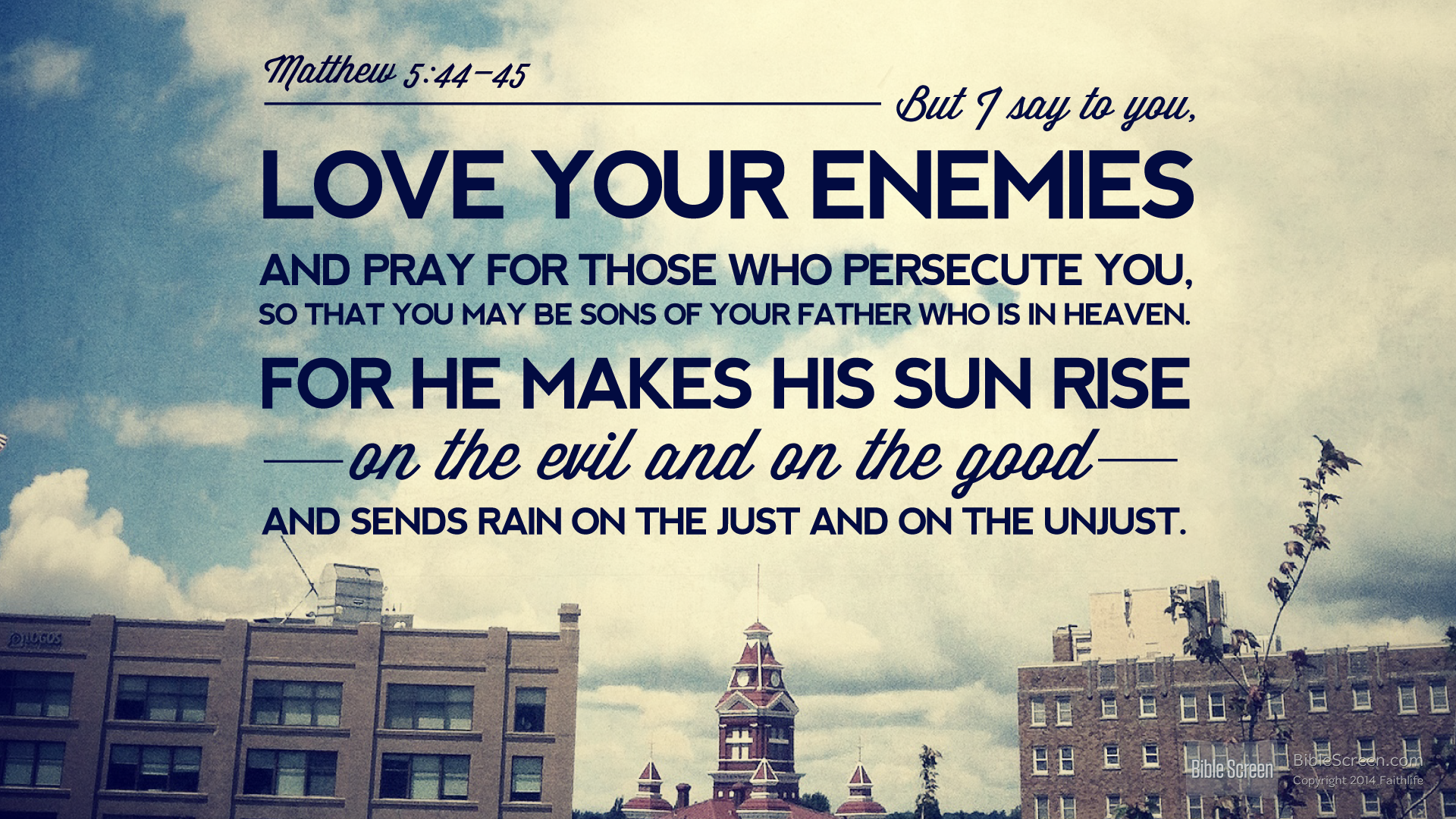
Now that Saul is dead, there’s nothing in the way to stop David from being anointed as the King of Israel. You’d think that this would be a time of celebration for David; he’s finally free from the threat of Saul! But when David hears that Saul fell in battle, we see the opposite of celebration. David and his whole camp fasted and mourned all day. It would be one thing if David was just sad about his friend Jonathan dying, but he also wrote his song about Saul, a man who tried to kill him. How many other people do you know that would praise their enemies? I can think of at least one: Jesus. Jesus said to “love your enemies and pray for those who persecute you” (Matthew 5:44).
David is certainly living out a Christlike virtue here and we should strive to do the same. It can be really easy to be happy when we see our school bully get in trouble with a teacher. But that’s not how David would react and that’s not how Jesus says we should act. We should wish the best on our close friends and our enemies and pray for them daily, because if we do, we will “be sons of [our] Father who is in heaven.” (Matthew 5:44)
For Saul, his main method of communicating with God, was through Samuel, the prophet. Unluckily for Saul, Samuel died and the Lord stopped supporting him. When Saul saw the army that he was supposed to fight, he got scared. He was so afraid of the army that he tried to ask God for help and that’s a great first step! But when Saul didn’t get an answer right away, he went looking for another way to get help. That’s where he went wrong. He went to Endor to ask the Ewoks for help. Just kidding, but he did go to Endor to see a medium. When he finally got the medium to bring Samuel up from the grave, Samuel was not happy. He reprimanded Saul for disturbing him and only brought bad news. Saul and Israel would be handed over to the Philistines. That’s the worst kind of news possible. Saul was going to die.
For David, his way of talking to God was by wearing the Ephod and following the proper ceremonies. When David came back to his city and found his wives and people missing, he was as distraught as any of us would be. He and all his men “wept until they had no strength left to weep.” The men who were with David wanted to stone him but he remained calm and found strength in God. He asked God what he should do and then he listened. He heard God’s answer and then acted upon it.
For us, we have Jesus, which means we can talk to God through prayer (1 Timothy 2:5). If we don’t get an answer from God right away like Saul, we shouldn’t go and seek answers from the wrong sources. All that led Saul to was death. We should be like David. He wept and then he “found strength in the Lord his God.” We should not let our emotions cause us to run off and take matters into our own hands before we consult with God. “Be still and know that I am God” (Psalm 46:10). If we don’t get an answer to our prayer immediately, like Saul, we should be still like David and wait for direction from the Lord.
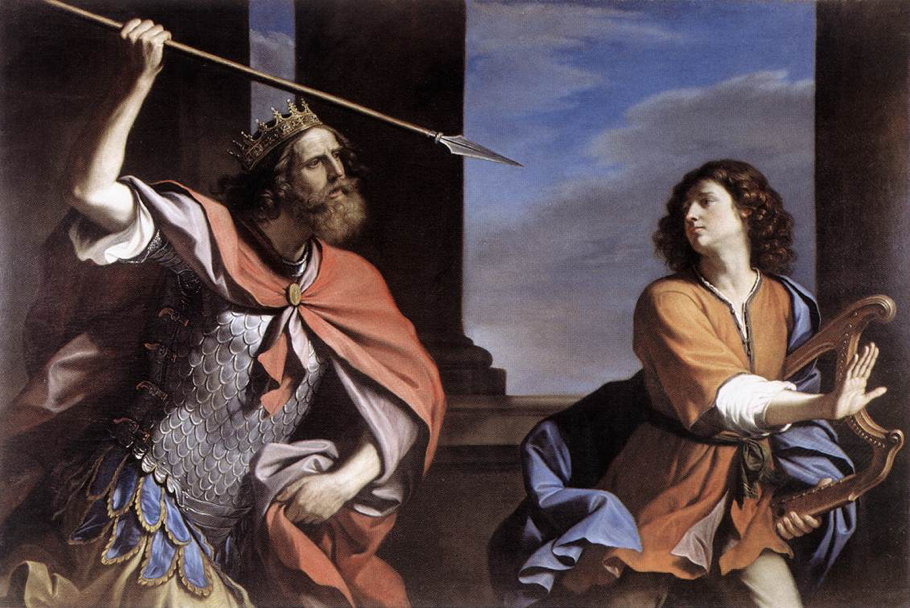
In the chapters we read today, the violence between Saul & David continues to increase. There are a lot of lives taken by both sides out of vengeance and fear. We have a term for all this extra violence “casualties of war”. What a strange way of putting it. As strange as “friendly fire”.
Back to David and Saul. Both of these men were ordained as king at some point. We know that David was ultimately the true king, and a man after God’s own heart. However, there had to be behavior during these chapters that even David was ashamed about. I have really been struggling to add some positive takeaways from these chapters in 1 Samuel. I feel like it is important as a historical account of what happened, but I would really be reaching to make a connection our personal experiences in 2016.
I do think it is important for us to consider the way in which we go about achieving our goals. It is easy to look at Saul, and even David in these chapters, and realize that they made some awful choices out of necessity, or desperation. We have heard the term “the means justify the ends”. I believe this to be helpful for those people who are driven, and don’t want to be bothered with caring for others on the path to conquering their goals. However for Jesus followers, we know how important people are to God. God cares about how we treat others. So as followers of Jesus, and a people obedient to God-we must adopt a more Gandhi-esque approach. Gandhi taughtthe means must express the end that we desire.
(By the way the Gandhi (1982) movie is certified fresh at 88% on rotten tomatoes… I haven’t seen it.)
I guess this should make me feel bad, but in a lot of ways I identify with Saul throughout most of these last chapters of 1 Samuel. We don’t lead very parallel lives. That is to say, there isn’t a whole lot of killing and foreskin collecting in my life(actually none, in case you were worried). However I feel like Saul’s story in these chapters is a desperate one. He is a man who was ordained king, and for a brief time was on top of the world. Saul even had favor with God for a short time. However he disobeyed God, and continued down that path.
In Saul’s disobedience, he kept looking for a quick fix. So as he has lost favor with God, and Samuel has ordained someone else as king, Saul thinks he can fix this, just by killing the future king. He continues to make poor decisions, and soon his family is involved. Saul is making a huge mess of everything. I can relate to this. I have had times in my life when I went against what God wanted for me. Because of my disobedience I began to suffer in some way, and instead of repenting and changing my behavior-I looked for a quick fix. A way out of the discomfort without confession.
We can make a huge mess if we decide to go our own route after we have sinned. God has so much better planned for us in our lives, than running from him, and feeling awful. We may have to go through the pain of confessing, or coming clean with God and others. However the reconciliation will free us from the feelings of desperation. And it will eventually repair our sin and relationships.






 Seek Grow Love