It’s hunting season here in Ohio! All around the countryside, hunters are sneaking though the fields, climbing tree stands, and checking their trail cams. The deer are careful and on alert, listening and sniffing the air for the sign of trouble. Failure to sniff out the enemy can have deadly results for the hunted.
As Christians, we have to be on guard against temptations and situations that can cause us to fall away from the Lord God. 1 Peter 5:8 warns us to “Be alert and of sober mind. Your enemy the devil prowls around like a roaring lion looking for someone to devour”. Peter, in his letter to the Christians across Asia Minor (modern Turkey), has tried to encourage the believers to stand firm in the face of persecution. Instead of getting revenge or lashing out against people who have hurt us, Peter encourages us to rejoice in our sufferings and be thankful for the opportunity to do good to those who hurt us (1 Peter 3:8-12).
It is easy to want to strike back, to say something hurtful, or to defend ourselves. But God has a higher purpose in mind behind our suffering. He wants to shape and mold us into mature Christians. Sometimes, we have to endure hard times to allow that change towards maturity to occur. It is tempting to want to respond in kind to those who hurt us. We have to stand firm and resist the urge to take the bait!
Peter reminds the Christians that this is a sneaky trap, set by our enemy, the devil. We have to be on the alert, and watchful to avoid falling into the traps set by the enemy. Like deer trying to avoid the hunter, we avoid the traps of temptation by seeking to do God’s will. Peter asks us to be alert and sober minded. Resisting the temptation to lash out at our enemies or to hurt other people is not easy. But the more we resist, the easier it is to stand firm against the schemes of the devil. God wants us to trust Him. As we obey Him, He will “restore you and make you strong, firm and steadfast” (1 Peter 5:10).
As David gets ready to die in 1 Kings 2, the beginning verses as he speaks to Solomon stuck out to me.
2 “I am about to go the way of all the earth,” he said. “So be strong, act like a man, 3 and observe what the Lord your God requires: Walk in obedience to him, and keep his decrees and commands, his laws and regulations, as written in the Law of Moses. Do this so that you may prosper in all you do and wherever you go 4 and that the Lord may keep his promise to me: ‘If your descendants watch how they live, and if they walk faithfully before me with all their heart and soul, you will never fail to have a successor on the throne of Israel.’”
“So be strong, act like a man” – what does that look like? I think this statement connects with the next one. To be strong and act like a man is to observe what the Lord your God requires which is to walk in obedience to him and keep his decrees. Doing those things takes strength because it opposes the way of the world.
I am not a man, but I am raising a young one, and this is what I desire for him. I want him to be strong, that is, to stand firm in faith and not give in to pressures from this world, but to instead walk in obedience to God. I want him to be strong as in to stand up for those who can’t, to defend and protect the weak.
Our culture puts definitions on what it wants men to be like, and that changes throughout time (for example, I read recently that pink used to be a very masculine color in the past), but those things don’t really matter. How they follow God matters. How they care for others matters.
As you continue reading in 1 Kings 2, you see poor examples of men in Adonijah, in Abiathar, in Joab, in Shimei as they tried to usurp the leader God put in place or followed the wrong people or refused to listen. These aren’t poor examples of men in a cultural sense, they are poor examples of men in the sense that they were not walking in obedience to God. They were not being strong/faithful to what they were told, but instead were led astray, or were trying to lead others astray. If we can raise up men who follow God and care for others, we raise up men who are like Jesus and that is the strength that I hope to see.
~Stephanie Fletcher
Reflection Questions
How is God’s definition of what it takes to be a man different from what the world currently says men should be?
While it is not discussed in this text specifically, what do you think God would say to women about how they should act?
Man or woman, how have you showed strength in opposing the way of the world? Is there an area where God would like to see more strength in you – more doing what God requires?
What good examples have you had of men or women who were strong in the Lord?
Heads up! This devotion is going to take you in a mini dive into the history of the buckle of all things! But first…
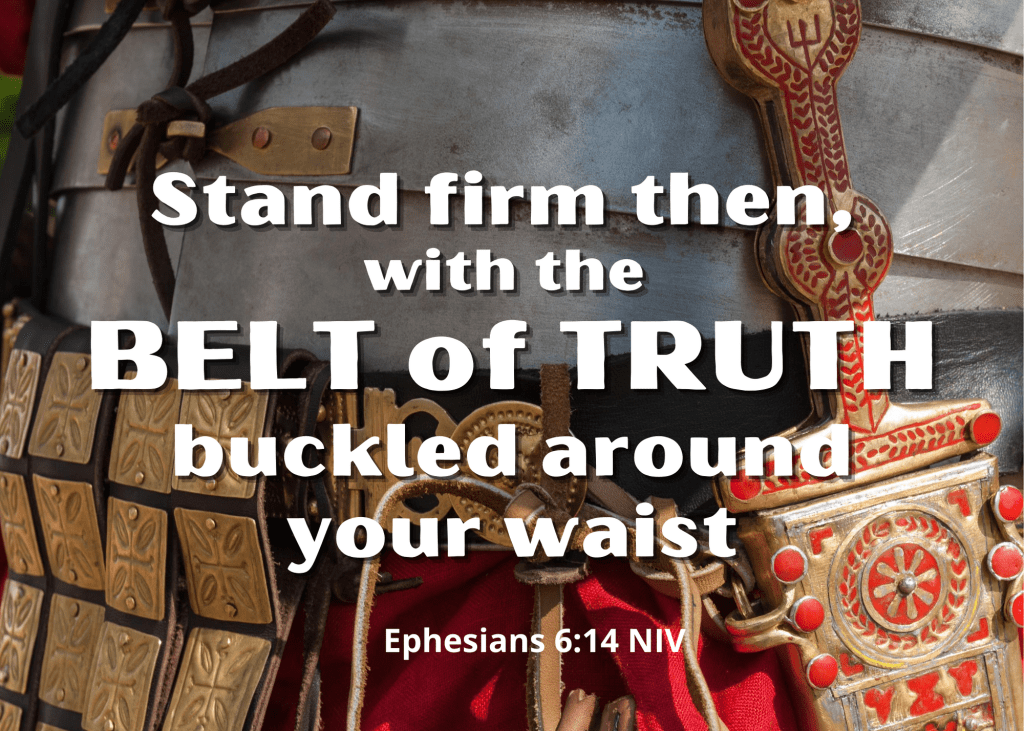
Many of us have read our key verse more than a handful of times in our lives. And we’ve even been taught about the belt of truth in our Sunday School lessons. It’s been explained that in ancient times, before a foot race or prior to battle, runners and warriors would tuck their long garments into their cloth belt, in order to provide free movement for the legs.
As I considered this first half of this verse, the word buckle stuck out to me. My thoughts went a little something like this:
“Wait a minute…a buckle in ancient Roman times? This doesn’t make sense. The earliest I’ve ever seen buckles in history books is on the Pilgrims. Did Roman soldiers wear buckles?”
A few clicks in my web browser confirms that indeed, buckles were part of the Roman body armor. Depending on the type of armor, there could be one main buckle, or in segmented forms of armor, many mini buckles to hold all the pieces together. What’s more, the more elite soldiers had super fancy buckles, whereas those that served in the infantry had simpler and more practical buckles.
Who knew???
With this new knowledge, our key verse today starts to take on an expanded meaning. Without the buckled belt of truth, the breastplate won’t stay in place and the protective plates on the shoulders wouldn’t be able to stay attached. Also, the tunic part of the armor which protected the groin wouldn’t have anything to attach to if it weren’t for the buckle.
It all starts with the buckle on the belt. Just like it all starts with Truth.
John 14:6 – “I am the way, the truth, and the life.”
John 8:32 – “Then you will know the truth, and the truth will set you free.”
2 Timothy – “Do your best to present yourself to God as one approved, a worker who does not need to be ashamed and who correctly handles the word of truth.”
Psalm 25:5 – “Guide me in your truth and teach me, for you are God my Savior, and my hope is in you all day long.”
Ephesians 1:13 – “And you also were included in Christ when you heard the word of truth, the gospel of your salvation…”
The start of our key verse in Ephesians chapter 6 begins with “Stand firm then…”. If we are ignorant of the Truth, there is no way that we can stand firm. We must know the Truth of YAHWEH, and His Son, Jesus. We must know the Truth of salvation and the coming Kingdom. If we fail to know these truths, then our efforts to stand firm against the attacks of our opposition will be for nothing.
So buckle up and stand firm in Truth.
-Bethany Ligon
Reflection Questions
What would happen if you went into battle but couldn’t keep your pants up, or were restricted by your long garments? How important is truth? How do the other components of the armor rely on truth? What happens if we try to stand firm without truth?
What truths do you believe about YAHWEH, His Son, Jesus, salvation and the coming Kingdom? Are there any that you are unsure about and need to study more? How do these specific truths affect other pieces of your armor: salvation, righteousness, faith, and gospel of peace?
What can you do today to be better buckled into the truth?
2 Thessalonians 2 is one of those chapters of scripture that can make us wonder why it was written. Did the people receive a false “spirit or a message or a letter as if from [Paul], to the effect that the day of the Lord” had already come (2)? And if they received such a communication about the day of the Lord, what was its purpose? Was the idea just to plant doubts and create turmoil? Did it achieve anything more than getting the people to check in with Paul?
Maybe someone tailored a piece of misdirection based off Paul’s words in 1 Thessalonians 5:2, that the day of the Lord would come like “a thief in the night,” to suggest that the day was able to arrive and pass without people becoming aware of it. Such an idea would not fit well with the overall uses of the “day of the Lord” in the Bible, as Paul pointed out in 2 Thessalonians 1:10 speaking of “that day”, but we don’t know how the Thessalonians thought of the phrase before Paul wrote this letter. In 2:1 Paul linked “the coming of our Lord Jesus Christ” with “our gathering together to Him” before he addressed the idea of false communication about the day of the Lord. Perhaps the point of whatever deceiving message the people received was an attempt to separate the day of the Lord from one or both of those ideas in their thoughts.
Returning to the “thief” metaphor for a moment, any metaphor or parable generally has only one application to be made from it, and can easily be misunderstood by being overapplied. The “thief” metaphor came from Jesus’ words, and it emphasized diligence (Matthew 24:43, see through chapter 25). Jesus didn’t apply any risks of the metaphor to those who were faithful. We do not know when Jesus is coming, but as believers we will not be left floundering when the world changes because of his return – the believers will join with him in celebration.
Paul has a much plainer case to make than the implications of a metaphor, however, he points out that he already told the church that those who are alive when Jesus is just about to return will have seen signs before his coming. As part of this Paul describes a man engaged in a campaign of evil on behalf of Satan. Paul may seem to write of this remarkably calmly, though admittedly it can be difficult to read tone into written words. And, of course, we don’t know what the Thessalonians had imagined their situation was based on the “spirit” or “message” or “letter” Paul wrote of – he needed to clear things up. We do know that the circumstances Paul is describing will be extreme, and he mentions that he spoke about these things with them in person (v. 5), so he may have previously offered comforting words about the potential of living during this situation. In any case Paul leaves no doubt of who is more powerful, the man of lawlessness, or Jesus. Jesus will slay him by his mere breath (maybe a spoken word?) – it is not a contest. The call to the believers is to stand firm, and having received eternal comfort, and good hope by grace, to desire also to be strengthened in their hearts in every good work and word.
On the other hand, the situation will be extreme for those who have rejected the truth. They will receive a “deluding influence so that they will believe what is false, in order that they all may be judged who did not believe the truth, but took pleasure in wickedness” (11‑12). This is not the situation of those we are trying to reach with an understanding of God’s love, history will have moved beyond that. It will be like what we read about in Exodus, when God hardened Pharaoh’s heart so He could show His signs and wonders in Egypt at the time of the ten plagues (4:21; 7:3). Pharaoh abandoned good behavior well before Moses arrived, but if shown enough miracles he might have been swayed from his course, even if only temporarily. God wanted a clear-cut setting in which to show His power. God intended to punish Egypt. It seems that things will go similarly with the man of lawlessness and his followers at the end of this age. It would be hard for anyone to remain loyal to such an evil leader and not try to weasel their way into compromises, even if just into other forms of evil, after God’s judgment is made clear. But by that point in history God wants a clear-cut setting to show His judgment. (I admit to finding some of this a bit distressing, but Paul had seen more of the evils of the world than I have, so I can understand if he was able to have a more clear-eyed view about it than I as he wrote about it.)
Lord, thank you for your strength, and that I feel able to put my trust in you no matter what situation I arrive in, even if I were to be living during the reign of the man of lawlessness. You are far greater than he. Your son is far greater than he. I trust that your love and your mercy will be comfort to me whatever may come. To whoever of your servants do live in that time, please let them have great outpourings of your grace and confidence from your Spirit. Life is not painless, but life is worthwhile when lived for you. Thank you, Lord. Amen.
-Daniel Smead
Reflection Questions
Do you think the origins of 2 Thessalonians 2 might be from a prank? Or perhaps did it result from a serious attempt to damage a church’s faith where it seemed to be vulnerable? It has been said that it is normally easier to tear down than to build up. What is the best way you have experienced that a church has been built up? How can you visualize being part of building a church up?
How surprising is it to you that Paul needed to write two letters to the church in Thessalonica, perhaps in the same year, based on their confusion about issues of eschatology? What might have happened if these issues went uncorrected? How much have you studied and compared scriptures about the future to develop your grasp on these ideas if you wanted to discuss them? How deeply do you choose to investigate these matters for yourself, compared to where you stop, considering that if you wished to examine the issue further you would take a question to a “Paul”?
Do you find it hard to imagine a time when there will be no room for shifting between those who are fully committed to evil and those who serve God with their whole hearts? If you thought such a time was coming soon, are there things you would be doing today to prepare?
My family, several of my church family, and many friends and family from across the Midwest and beyond just returned home from a week of church camp for the whole family where the theme was Stand Firm. So, I am seeing Stand Firm everywhere. Sometimes good examples, sometimes bad examples, but always examples to learn from.
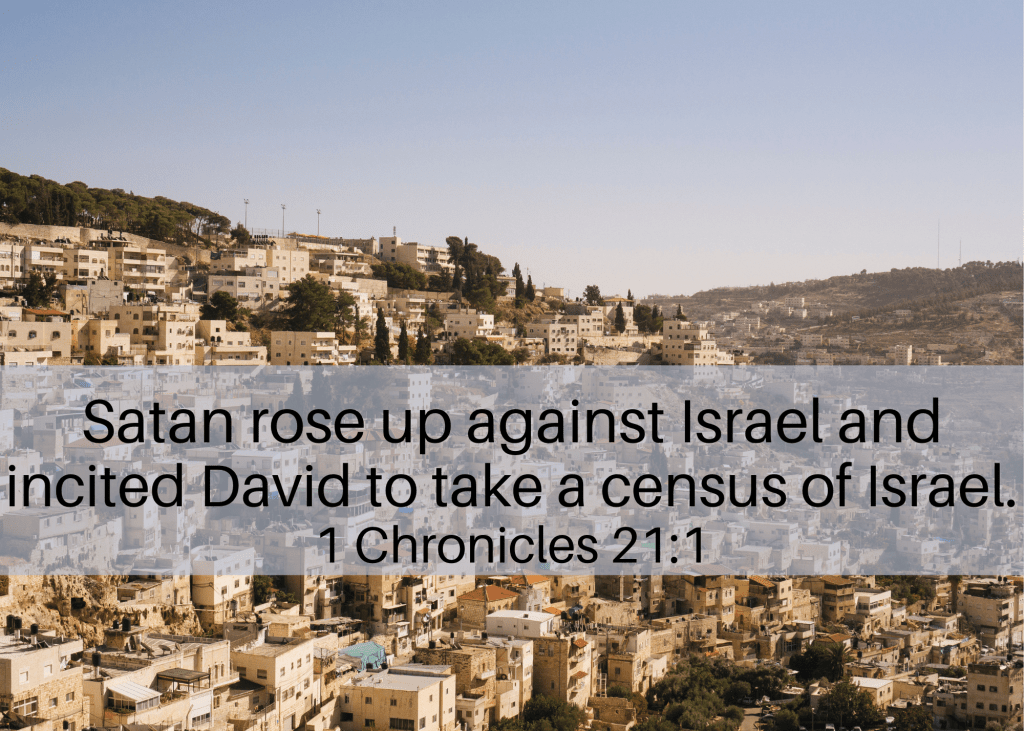
1st Chronicles 21 starts right off with “Satan rose up against Israel and incited David to take a census of Israel.”
One evening at Family Camp our theme was Stand Firm against Evil and many warnings were given of the roaring lion who seeks to devour – not just nibble at your toe. I found it interesting that in this passage (which is one of the few Old Testament passages besides those in Job that uses Satan’s name) Satan’s target is not an individual but a whole country and his means of attack is through their leader. Thanks to Stephanie Schlegel, our writer last week, I know that Israel is about the size of New Jersey and I can much better picture this beautiful land that God chose for His people and that Satan wanted to bring down.
It reminds me of the importance of praying for our leaders who are in vulnerable positions and are themselves perfect targets through which an entire nation or church can be attacked by spiritual evil. And the laws and policies they put in place are sometimes actually brought about by the devil’s deception, as we see in the case of David.
In this case I believe Satan saw David’s ego as a possible chink in his armor through which Satan could attack a whole country. David, unprompted by God but deceived by Satan, decided it would be a good idea to number the fighting men in Israel. His army commander, Joab, tried to talk David out of it. He pleaded with David to be content just knowing that ALL the fighting men were loyal to him and God was watching over them, regardless of how many or few they were. But that wasn’t enough for a man deceived by Satan, he needed to know exactly how large and vast his kingdom had grown. It’s better for bragging rights to be able to say, “The nation I built has one million one hundred thousand fighting men.” But God wanted him to be content saying, “The nation God built is large.” God was disappointed in David and there was a price to pay – by the whole nation. One man’s sins can reap a punishment for a whole nation. And it is a sin to let your pride grow, especially when it grows greater than your trust in God.
The Proverbs have much to say about pride and humility, including Proverbs 27:1-2
“Do not boast about tomorrow, for you do not know what a day may bring forth. Let another praise you, and not your own mouth; someone else, and not your own lips.”
How can you Stand Firm this week – in humility. Never get puffed up about how well you are standing firm, or how large your army or influence is. Resist the devil and his attacks. Don’t be deceived. Stand firm – trusting in God alone.
I have had several opportunities to visit Arlington National Cemetery to witness the changing of the guard at The Tomb of the Unknown Soldier. What never ceases to amaze me is the precision of their movements. Every step, every turn is synchronized to the second. Crowds gather well in advance in order to get a view. But once the ceremony concludes and the crowds disperse, the soldier is there to stand guard in silence and no interaction with another person for 30 minutes, which is when another guard comes to relieve him or her.
What is even more impressive than the precision of their movements is their dedication to the post. The Tomb has not been left unguarded since 1937. Through scorching heat and oppressive humidity, blizzards and hurricanes, these guards stand firm in their watch – 24/7/365. There isn’t anything that will take them away from this honor-filled assignment.
As I read through Luke 21, I was struck by the use of the word “stand” in verses 19, 28, and 36. Jesus is explaining to his disciples what to expect as they wait for his triumphant return. Persecution, betrayal, natural disasters, and wars will be the signs that will foretell of Christ’s return. And 3 different times, Jesus instructs his followers to stand firm through it all.
In verse 19, we’re promised that if we stand firm, we will gain life.
In verse 28, we’re promised that by standing up, we will receive redemption.
In verse 36, we’re promised that if we are attentive during the watch, we’ll be able to escape all the turmoil and stand before the Son of Man.
As followers of Jesus, we are not promised an easy life. We will experience figurative (and sometime literal – depending on where you live) heavy storms that wipe away all that you know. The question and challenge is – will you stand firm through it all knowing that the foundation on which you plant your feet is our Rock, Jesus Christ.



 Seek Grow Love