A time of reflection and recap of events as the Israelites prepare to enter the Promised Land. “For the LORD your God has blessed you in all the work of your hands. He knows your going through this great wilderness. These forty years the LORD your God has been with you. You have lacked nothing.” (2:7) They’ve LACKED NOTHING?! They probably didn’t agree with that, but it shows how God provided for them the basics, which is ample for a person. He literally gave them their daily bread.
Moses reminded them, “The LORD your God who goes before you will Himself fight for you, just as He did for you in Egypt before your eyes,and in the wilderness, where you have seen how the LORD your God carried you, as a man carries his son, all the way that you went until you came to this place. Yet in spite of this word you did not believe the LORD your God.” (1:30-32)
It’s amazing that we can do the same thing like the Israelites at times, cry out to get out of a difficult situation (Egypt), then afterwards when we’re out we complain again. But if they would’ve trusted that God would fight for them they could’ve been spared the long difficult 40 years. The wilderness was the ONLY way to get to the Promised Land, and their lack of trust made it even harder (and longer).
“Not one of these men of this evil generation shall see the good land that I swore to give to your fathers, except Caleb… and Joshua who wholly followed the LORD.” (1:35) Even Moses wasn’t allowed to enter as the LORD was angry with him too (or, had been angry and was following through with consequences).
Despite failures and difficulties Moses pressed on with the people until his departure. This reminds me of parenting! It’s difficult and rewarding! One of my main parenting verses that encouraged me over the years, besides Deut. 6:4-7, is 1 Peter 4:12,
“Above all, keep loving one another earnestly, since love covers a multitude of sins.”
– Shalom y’all, Stephanie Schlegel 🙂
(From Israel and Tennessee:)
REFLECTION QUESTIONS
1. Have you had to endure a difficult situation for years? How did God sustain you through it?
2. Is there an issue you’re dealing with that if you’d wholly trust God, the situation would be better? Are you taking matters into your own hands or trusting God with it?
3. Reflect over this last month how God’s provided for you and thank Him for it!
4. How does looking back better prepare the Israelites for looking ahead? How can it benefit you?
Want to see a map of the borders of the Promised Land?! My husband, Bill Schlegel, wrote the Satellite Bible Atlas (available on Amazon). It’s filled with real photographed maps that he’s added the sites and commentary to. (Sounds like the way I’m doing these devotionals, but he’s much more articulate;). You can go further in depth to your Bible readings with this atlas to help, especially in the upcoming books of the judges and kings. 🙂 He wrote it for the students to use on field trips and classes in Israel.
In the midst of defining the border, God appointed cities for refuge for within. “These six cities shall be for refuge for the people of Israel, and for the stranger and for the sojourner among them, that anyone who kills any person without intent may flee there.” (35:15) Those must’ve been interesting cities with innocent and guilty persons awaiting judgment. Some probably took advantage of them and for others they found refuge they needed .
Nowadays our homes can be a place of refuge. As a mother of five I can testify to that, receiving family members after long days of work, sporting events, school, and other hard tasks. It’s comforting to find refuge in one’s home and provide that for others too looking for peace.
A hammer can build things up and it can tear things down. “The wisest of women builds her house, but folly with her own hands tears it down.” Proverbs 14:1 It’s important we use our tools to build and help others rather than tear them down.
Another place we can greatly find refuge is in God. “The name of the LORD is a strong tower; the righteous man runs into it and is safe.” Proverbs 18:10 Especially after coming to the one God faith this verse means so much more to me. His personal name YHVH/LORD is strong and stable, mentioned some 6,828x in the Old Testament. That’s one out of every four verses making it 25% of the time. It’s powerful just seeing it so many times. Reading the Bible on a regular basis helps one to refocus and gain strength and peace. We can take refuge in God and His Word.
-Stephanie Schlegel
REFLECTION QUESTIONS
1. Where do you find refuge on a daily basis? How has it brought you relief?
2. Is your home a place of refuge for others? Maybe there’s a hurting person you can invite over this weekend to share a meal or coffee with?
3. Is the name of the LORD/YHVH a strong tower for you? What’s a way that could improve that even more?
Misunderstandings! Ever been misunderstood and frustrated?! It’s what happened to Moses and the people he led. The LORD told Moses to take vengeance on Midian. Among them Balaam was also killed with the sword, but the women were kept alive. This upset Moses! The women through Balaam’s counsel caused the Israelites to sin in baal worship. … Moses worked out a solution.
Then two of the tribes wanted to settle east of the Jordan River with their abundant livestock. This upset Moses again! How could their brothers go to war while they sat there?! After a lengthy response he heard their intended promise to cross over with them to help them fight and after return to their livestock and cities.
It can be frustrating to be misunderstood. That’s why it’s important to listen and be patient with others. “Know this, my beloved brothers: let every person be quick to hear, slow to speak, slow to anger; for the anger of man does not produce the righteousness of God.” James 1:19
Lastly, let’s not skip over the AMAZING travel journal of chapter 33, and like my Bible geography teacher/husband would say, “It shows these are real places and a real God.” Many of these places are still called that to this day, and it’s from some 3,400 years ago! Pictured above on the left is an aerial view of the Jerusalem/Jericho area looking to the north of Israel with snow capped Mount Hermon on the northern tip. Did you know that there’s a ski resort up there with 14 ski runs and 5 chair lifts?! YES! One winter on the same weekend one of our boys was skiing up there with friends while the other was snorkeling in the Red Sea (on the southern tip)! Don’t misunderstand Israel, it’s a BEAUTIFUL place! 🙂
-Stephanie Schlegel
REFLECTION QUESTIONS:
1. Do you get angry when you’re misunderstood? How can you be quicker to listen to the person before responding in words and anger?
2. How do you clarify yourself? In anger? With patience? Kindly? Today, try to respond better to a misunderstanding, and ask God’s help to do so.
3. Have you ever kept a travel journal of the places you’ve been? What would people think if they found it 3,400 years later?! :0
The biblical holidays are wonderful and believe me, I knew almost nothing about them growing up in Indiana until I lived in Israel. 🙂 I bite my tongue from saying, “Jewish” holidays as they are biblical holidays. So much meaning behind them, more so than most pagan based American holidays. One of the harder parts about leaving Israel was leaving the holidays.
In our passage today many sacrifices are named with the holidays, which no one is doing now. Also, the holidays were days of rest, set apart from other days. These holidays are still celebrated without sacrifices but with rest, stores close down!! I’m going to briefly give you a taste of these biblical holidays and how they’re celebrated today.
Shabbat: Late every Friday afternoon public transportation, sport games, and stores CEASE, yes, the MALL included, to usher in the shabbat a day of REST. Families eat a nice meal together having leftovers for the next day so no one has to cook/work.
Passover: Feast of Unleavened bread is the first month of the biblical year, which makes sense the new year starts in the spring with new growth blooming. It’s the oldest holiday still celebrated in the world, over 3,400 years! And it’s the BIGGEST holiday, (like Christmas is in America).
Feast of Weeks: Seven weeks after Passover the firstfruits are celebrated. Kids wear white and carry a small decorated basket of fruit to share with others.
Day of Blowing: People blow shofars (ram horns) throughout the day. It’s a warning to repent for the next 10 days before the Day of Atonement.
Day of Atonement: A day of repentance with fasting. The whole country SHUTS DOWN, no flights, vehicles on the highway, EVERYTHING is CLOSED… to REPENT. It’s quite amazing to experience such a national “holiday.”
Feast of Booths: A week long holiday of eating and sleeping in a booth outside. Kids often decorate them with paper chains and pictures.
God appointed these holidays for a reason and for our good. Take a moment to reflect on them. It’s hard to implement them in a society that doesn’t acknowledge them, but it’s still good to be aware of these biblical holidays and their meaning. Maybe the modern sacrifice would be to take time out and rest on these holidays and think about and thank God for what He has done. The first three have been fulfilled in the first coming of Jesus, and the last three with his second coming!
“For the Lord himself will descend from heaven with a cry of command, with the voice of an archangel, and with the sound of the trumpet of God.” 1 Thes. 4:16
-Stephanie Schlegel
REFLECTION QUESTIONS:
1. Which holiday do you like the best? Which one would you like to celebrate?
2. What’s one way your Shabbat rest day could be changed/improved to make it more restful?
3. A holiday of repentance and fasting?! Maybe pick a day within the next week that you could fast a meal and pray for forgiveness to God and others possibly offended.
Today’s chapters 23-25 (and 22) are like an action movie with a lot of suspense! Balak, King of Moab, looked out at the numerous Israelites camped nearby and was greatly afraid. He called upon a sorcerer to come and curse them, which God didn’t allow him to curse but blessed them!
Interestingly, Balaam (sorcerer) was confronted three times to go, three times his donkey refused to proceed and was hit, and three times he built seven altars and sacrificed a bull and ram on each (21x). Not sure of the significance of the tresome repeats but does show the intensity of the situation!
The Spirit of God came upon Balaam and he blessed Israel three times. In the three different oracles a meaningful phrase struck me with each one.
“How can I curse whom God has not cursed? How can I denounce whom the LORD has not denounced?” (23:8)
“God is not man, that he should lie, or a son of man, that he should change his mind.” (23:19)
“A star shall come out of Jacob, and a scepter shall rise out of Israel.” (24:17)
These biblical accounts are written in past, present, and future. God has not cursed or denounced the Israalites. God is not a man, nor past nor will be! Lastly, God will have a future dynasty in Israel.
This is not what Balak wanted to hear, but Balaam obeyed God’s command to only say what he was told to say. Unfortunately, he advised Balak further on how he could bring harm to Israel, and his advice unfortunately worked. The Israelite men were seduced by the foreign women to worship their gods, which brought great anger to the God of Israel. Sadly, more than 20,000 were killed in the plague as a result.
Do you have God’s number on speed dial? It’s easy to remember …Jeremiah 33:3
“Call to me and I will answer you, and will tell you great and hidden things that you have not known.For thus says the LORD, the God of Israel.”
He’s ALWAYS available, never sleeping anytime of the day.
-Stephanie Schlegel
REFLECTION QUESTIONS
1. Who do you call upon for help? Depends what kind of help we need, right?
2. What’s God’s “phone number?” Do we go to the throne or phone when we need help?
3. Is there something today that you’re afraid of? What care needs to be cast upon Him today because He cares for you?
Shalom from Tennessee! This is Stephanie Schlegel writing this week as we continue through the Bible. We lived in Israel for 25+ years where our five children were born and raised. So I’ll be adding in some extra thoughts and pictures from and about Israel. 🙂
The first verse of Numbers 21 caught my attention as it still relates to today! The king of Arad fought against Israel and took some captives! :0 I’ve been reading the news of the current captives slowly being released and talk of what to do with Gaza. Surprisingly, three times in chapter 21 Israel fought against their enemies and destroyed their cities and took possession of them. For a LONG time Israel has had to contend with those against them, including up to today!
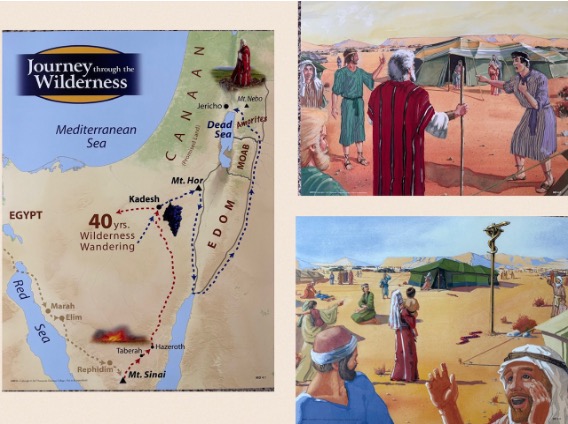
In their travels they got thirsty, hungry, and cursed the manna God provided for them! It also says they spoke against God and Moses, their leaders. Thus, God sent fiery serpents among them, in which many were bitten and killed. So they asked forgiveness, and that Moses would pray to God to remove them.
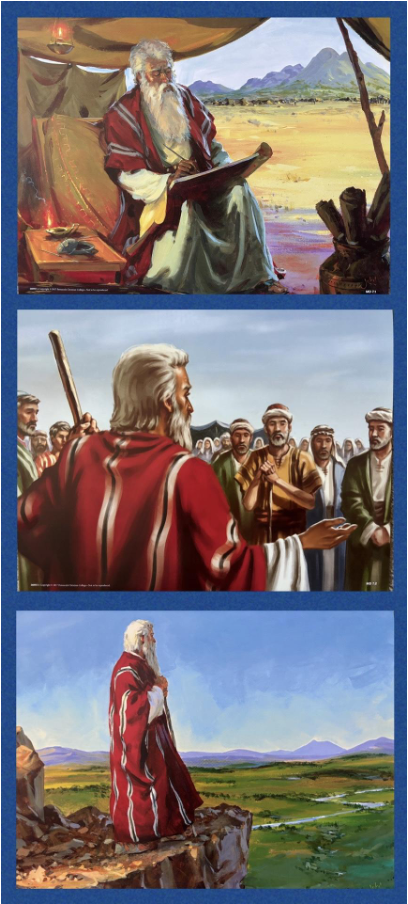
Included is a picture from the ABEKA Bible Flash-a-Card Series 3 of the life of Moses. These sets have many great pictures of Bible stories not normally seen in children’s books. We used them in our congregation’s children classes in Israel as they were taught in Hebrew. They’re great for home use as well for children and grandchildren.
Complaining about what one eats is a good lesson for all ages! Bites from deadly snakes is a rough punishment in the desert. There was a period of time while raising our children that if they complained about the food I made for dinner then they’d be doing the dishes afterwards! The complaining stopped quickly! Actually, I wasn’t even sure if they liked what I made or not as they ate it with no comments. Haha! Occasionally, after a new recipe I’d let them vote after dinner on the count of three with a thumbs up or down (or sometimes in the middle), so I could get some feedback. 🙂
One of the teachers/moms in our children’s class in Israel made a “bronze serpent” on an upside down mop with paper twisted around the top of it and then covered with duct tape and spray painted it bronze. It was a good visual aid for the kids! (I couldn’t find a picture of it since it was before the days of cell phones).
Jesus recalled this incident in John 3:14,15, “And as Moses lifted up the serpent in the wilderness, so must the Son of Man be lifted up,that whoever believes in him may have eternal life.” Thankfully, we can look to Jesus during troubled times and after we’ve failed and need forgiveness. May God help us not to complain but to repent and give thanks.
“So, whether you eat or drink, or whatever you do, do all to the glory of God.” 1 Cor. 10:31
-Stephanie Schlegel
REFLECTION QUESTIONS
1. What was the Israelites punishment for complaining? Did the punishment seem just or too harsh? What are some things that you’re complaining about that perhaps need to be addressed?
2. How does complaining against God, leaders, and food hurt us? What’s something we can do to change that?
3. The bronze serpent that they looked at to be saved eventually became an idol! Is there something in your life that has helped you that now has turned into a negative effect that maybe you should break away from? We can pray and ask God to show us and help us to turn from it.
Saul was looking for Samuel and Samuel was looking for Saul but for different reasons! At first, Saul was looking for his father’s donkeys, and Samuel for the king of Israel – then, all was found. Not only was Saul (tall and handsome) anointed the first king of Israel, but the Spirit of God came upon him. It even says, “He’d be turned into another man (1 Samuel 10:7) … God gave him another heart.” (10:9) Imagine to go looking for donkeys and to be anointed the first king of Israel, what a shocking surprise! Honestly, I’m not too surprised he was hiding amongst the equipment. That’s probably where I would’ve been too. But the LORD knew right where he was and whom He had chosen.
Sometimes things turn out differently than we’d planned, actually a lot of times. My motto around the house is we need to be flexible or we’ll break as our plans are often shifting. 😊 After the time of the judges, authorities will shift to kingship. Yet, ‘Thus says the LORD God of Israel: I brought up Israel out of Egypt, and delivered you from the hand of the Egyptians and from the handof all kingdoms and from those who oppressed you. But you have today rejected your God, who Himself saved you from all your adversities and your tribulations; and you have said to Him, ‘No, set a king over us!’” (10:17-19) It is sad that the people rejected God as their king and yet God was gracious and granted them one anyhow.
“These are six things the LORD hates, yes, seven are an abomination to Him:
A proud look,
A lying tongue,
Hands that shed innocent blood,
A heart that devises wicked plans,
Feet that are swift in running to evil,
A false witness who speaks lies,
And one who sows discord among brothers.” (Proverbs 6:16-19)
“My son, keep your father’s command, and do not forsake the law of your mother.
Bind them continually upon your heart; tie them around your neck,
When you roam, they will lead you; when you sleep, they will keep you;
And when you awake, they will speak with you.
For the commandment is a lamp, and the law a light. Reproofs of instruction are the way of life.” (6:20-23)
Amen!
-Stephanie Schlegel
Reflection Questions:
Is there something in our lives that we’re failing to acknowledge God for doing for us? Let’s keep a thankful heart and thank Him for three things that happened today.
Are we aware of the 7 things God hates and hopefully not doing any of them?
Are we keeping God’s ways close to us throughout the day and letting them guide us even while we lie down to sleep?
Acts Introduction
The Book of Acts, also known as The Acts of the Apostles, is a sequel to the Gospel of Luke. Luke, a physician who traveled with the apostle Paul, wrote both. In fact, Luke wrote more of the New Testament than any other author, including Paul. The book of Acts covers the period of time from just after the resurrection of Jesus until just before the death of Paul, and tells the history of the early Church. Because the story about Paul ends abruptly with his house arrest and awaiting trial before Caesar, it’s likely the Book of Acts was written at that time, likely around 62 or 63 AD.
The first half of the Book of Acts focuses primarily on Peter, who taught mostly Jews, while the last half is about Paul, who taught mostly Gentiles. Luke detailed the expansion of Christianity from being centered in Israel, to reaching worldwide (in the known world of that day). Luke recorded several sermons, from Peter’s on the day of Pentecost, to Stephen’s, and multiple of Paul’s. By using the word “we” in parts of the second half of the book, it is obvious that Luke traveled with Paul.
From Chapter 1, we can see several things the early church believed:
The reality of Jesus’ resurrection (Acts 1:3a)
The promise of the coming kingdom (Acts 1:3b)
The power of the Holy Spirit (Acts 1:8)
Jesus will return the same way he left (Acts 1:11)
Prayer was important, and they spent lots of time in prayer (Acts 1:14)
They believed in God’s leading (Acts 1:24-26)
Some of the more well-known information in Acts includes:
Jesus’ ascension into heaven (Acts 1:7-11)
The Holy Spirit being poured out on the Day of Pentecost (Acts 2)
Peter and John healing a crippled beggar (Acts 3)
Peter and John before the Sanhedrin (Acts 4)
Ananias and Sapphira (Acts 5)
Stephen’s sermon and the stoning of Stephen (Acts 7)
Philip and the Ethiopian (Acts 8)
Saul’s conversion (Acts 9)
Peter and Cornelius (Acts 10)
Peter’s miraculous escape from prison (Acts 12)
Paul’s missionary journeys (starting in Acts 13)
etc.
As you can see, Acts is a very exciting and well-known book.
I love Acts 4:13, which says, “When they saw the courage of Peter and John and realized that they were unschooled, ordinary men, they were astonished and they took note that these men had been with Jesus.” As you study the book of Acts, and ask God to fill you with the Holy Spirit, I pray that people will notice you and be astonished, and will take note that you have been with Jesus.
The men of Kiryat Jearim (City of the Forests) came and took up the ark of the LORD and brought it into the house of Abinadab on the hill where it stayed for 20 years. We could actually look out our window and see this site where the ark had been. Now there is a monastery and church built on top of it, called the Lady of the Ark. Oddly a large statue of Mary standing on the ark is visible from a distance. There is a spring nearby amongst the houses, which would’ve made it a good place to live with a water source. And yes, the hill country of Jerusalem can get snow once or twice a year, and it’s fun! 😊
“Samuel spoke to all the house of Israel, “If you return to the LORD with all your hearts, then put away the foreign gods and the Ashtoreths from among you, and prepare your hearts for the LORD, and serve Him only; and He will deliver you from the hand of the Philistines.” (1 Samuel 7:3) (Applies to modern day relics too!) So, the Philistines were subdued. Samuel judged Israel all the days of his life. (7:15) However, like Eli, Samuel’s sons did not walk in his ways and perverted justice causing the people to ask for a king like the other nations. After warnings the people still insisted on a king to judge them and God allowed them as they’d rejected Him as their king.
Later on, there was a messianic king rejected in Jerusalem. Luke 24 ends with Jesus being raised from the dead. And interestingly, that same day two apostles were traveling to a village called Emmaus, which is 7 miles from Jerusalem. Many believe this to be the site of Kiryat Jearim where the ark resided, as it’s 7 miles from Jerusalem!
As they walked along the way, he said to them, “O foolish ones, and slow of heart to believe in all that the prophets have spoken! Ought not the Christ to have suffered these things and to enter into His glory? And beginning at Moses and all the prophets, he explained to them in all the Scriptures the things concerning himself.” (Luke 24:25-27) Wouldn’t that have been a good listen of what Jesus explained?!
Later on, he was “carried up into heaven. They worshipped him, and returned to Jerusalem with great joy, and were continually in the temple praising and blessing God. Amen.” (24:51,52)
-Stephanie Schlegel
Reflection Questions
Do we recognize and honor God and Jesus as kings in our lives?
Do we accept and turn to them for authority in our lives or reject them and turn to others?
Things don’t always go as planned. The Israelites thought taking the ark of the covenant with them into battle against the Philistines would cause them to win, except the ark was captured and taken by their enemies! For 7 months the ark remained with them. They said, “The ark of the God of Israel must not remain with us, for His hand is harsh toward us and Dagon our god.” (1 Samuel 5:7) God sent deadly destruction in their cities and plagues of tumors. The Philistines sent the ark back on a cart. It was the wheat harvest when the people of Bet-Shemesh rejoiced to see the ark’s return. EXCEPT, the LORD struck many who looked inside to see what was in the ark of the covenant. And the men of Bet-Shemesh said, “Who is able to stand before this holy LORD God? And to whom shall it go up from us?” (6:20) Thus the Israelites in Bet-Shemesh were ready to depart with it also! God is all powerful and holy and should be treated as such.
Here is a picture of Bill teaching students (20+ yrs. ago;) on Bet-Shemesh with the valley in the background where the ark of the covenant would’ve come up from the Philistines. Also, one can see how there would’ve been wheat fields nearby. (The hometown of Samson is on the hill in the distance). It’s so neat how most of the biblical sites still hold their same name today, 1,000s of years later! It’s evidence to show these are real events that occurred.
Some of these rarer Bible stories are found in the Arch Book children’s series, and they’re even written in rhythm. There are 134 different volumes. I don’t have all of them but many over the years. They can make nice gifts to family or friends. 😊
“Take firm hold of instruction, do not let go; keep her, for she is your life.
Do not enter the path of the wicked, and do not walk in the way of evil.”
(Proverbs 4:13,14)
“My son, give attention to my words: incline your ear to my sayings.
Do not let them depart from your eyes; keep them in the midst of your heart.
For they are life to those who find them, and health to all their flesh.
Keep your heart with all diligence, for out of it flows the springs of life.”
(Proverbs 4:20-23)
-Stephanie Schlegel
Reflection Questions:
Are their areas of our lives we need to reexamine that we’ve slacked off on?
Maybe certain instructions we’ve slowly been letting go of that we need to take ahold of again?
Are their others we need to forgive that we haven’t? On the cross Jesus prayed, “Father, forgive them, for they do not know what they do.” (Luke 23:34)
Obedient and disobedient sons! We choose obedient, right?! Eli had some disobedient sons that most seemed to know about, and God told that to Samuel. That they “made themselves vile and hedid not restrain them.” (1 Samuel 3:13) But “Samuel grew, and the LORD was with him.” (3:19) After the Israelites were defeated in battle against the Philistines, they decided to bring the ark of the covenant to battle to save them from their enemies. However, the Israelites were defeated and the ark of the covenant taken away. Eli (98 years old) sat by the gate waiting for news, only to hear the bad report of his two sons dead and the ark captured causing him to fall over backwards breaking his neck and dying. What a tragedy.
It’s still possible to see the ancient site of Shiloh today! They are excavating it. It’s interesting to know that the tabernacle resided here for 369 years (longer than the US has been a country) during the time of the Judges. This is where Hannah would’ve come to pray asking for a child, and where Samuel served, in the hill country of Jerusalem. (The tabernacle was longer in the hill country than in the desert!) In 1978, modern Israelis established a community here of Jews and now has 5,000 residents. They built a synagogue for their place of worship, resembling the tabernacle which was there for so many years.
Also, interesting in the Proverbs of Solomon he exhorts his son, “Do not forget my law, but let your heart keep my commands, for length of days and long life and peace they will add to you. Let not mercy and truth forsake you; bind them around your neck, write them on the tablet of your heart, so find favor and high esteem in the sight of God and man.” (Proverbs 3:1-4) Most people quote the next verses 5 and 6, which are important, but I’ve for so long appreciated the verses prior and following those verses!
“Do not be wise in your own eyes: fear the LORD and depart from evil.It will be health to your flesh, and strength to your bones.” (3:7,8)
“My son, do not despise the discipline of the LORD, nor detest His correction;Just as a father the son in whom he delights. Happy is the man who finds wisdom.” (3:11-13)
In the New Testament we can see the ultimate obedience of the Son of God in his time of difficulty in the face of death. “Father, if it is Your will, take this cup away from me; nevertheless, not my will, but Yours be done.” (Luke 22:42) Jesus was obedient until death.
-Stephanie Schlegel
Reflection Questions
Are we struggling with any kind of disobedience that needs to be corrected today? It’s good to do a search and see if we need to be corrected and be willing to make that change.
How can we teach the wisdom of Proverbs (and the rest of the Bible) to our children, grandchildren, and the children/youth and even adults of our church community? What happens when we don’t?
What do we learn about the Heavenly Father in our Bible reading today? What do we learn about His Son Jesus?










 Seek Grow Love