
The Tragedy of Saul, the first King of Israel

1 Chronicles 10-11 

Psalm 71

Galatians 4

~ Devotion by Cayce Fletcher (SC)

Cayce Fletcher is a wife and homeschool mom of three. She writes and podcasts at amorebeautifullifecollective.com where she helps women grow in grace, build with purpose, and live beautifully. Read the latest post in the Systematic Theology series here

Last week, as I was working on writing our summer camp journals, I turned on David for my kids to watch. It was the first time that I had seen the movie myself, but with The Prince of Egypt being one of my favorite movies as a kid, I had high expectations. 

Of course, there were things that I wish they had done differently, but overall, I was pleasantly surprised. I so appreciated how they didn’t just stop at the Sunday School version of David’s life (just covering the story of David and Goliath), but instead told his story up until he received the kingship after Saul’s death. 

Saul is such a tragic figure. He was so earnest in the beginning. If you remember in 1 Samuel 9, when Saul was first anointed, he responded to the kingship with humility. In verse 21, Saul responds to Samuel, “But am I not a Benjamite, from the smallest tribe of Israel, and is not my clan the least of all the clans of the tribe of Benjamin? Why do you say such a thing to me?” 

As the years went on, this humility began to wane, and it was replaced by pride and self-focus. He is so scared to lose the kingdom, to do something wrong, that he ultimately loses it anyway. In Saul’s story, we see an example of someone who holds the ‘good’ so tightly that it becomes an enemy of the ‘great’ – a deep relationship with and dependence on God.

Over and over, Saul chooses to do ‘little sins’ in order to bring honor and fame to himself. He tries to manipulate the outcomes of battles. He’s willing to kill Jonathan (multiple times). He tries to keep the spoils of war and hides them from Samuel. By the end, he even turns to witchcraft to get answers because he feels like God has left him. 

Like Macbeth and other power-hungry characters, Saul’s downfall was his lack of awareness that God can just as easily take away the responsibilities that he gave if the holder is found lacking. If Saul had depended on God completely, we would have read a different ending to his story than what we read today in 1 Chronicles 10. 

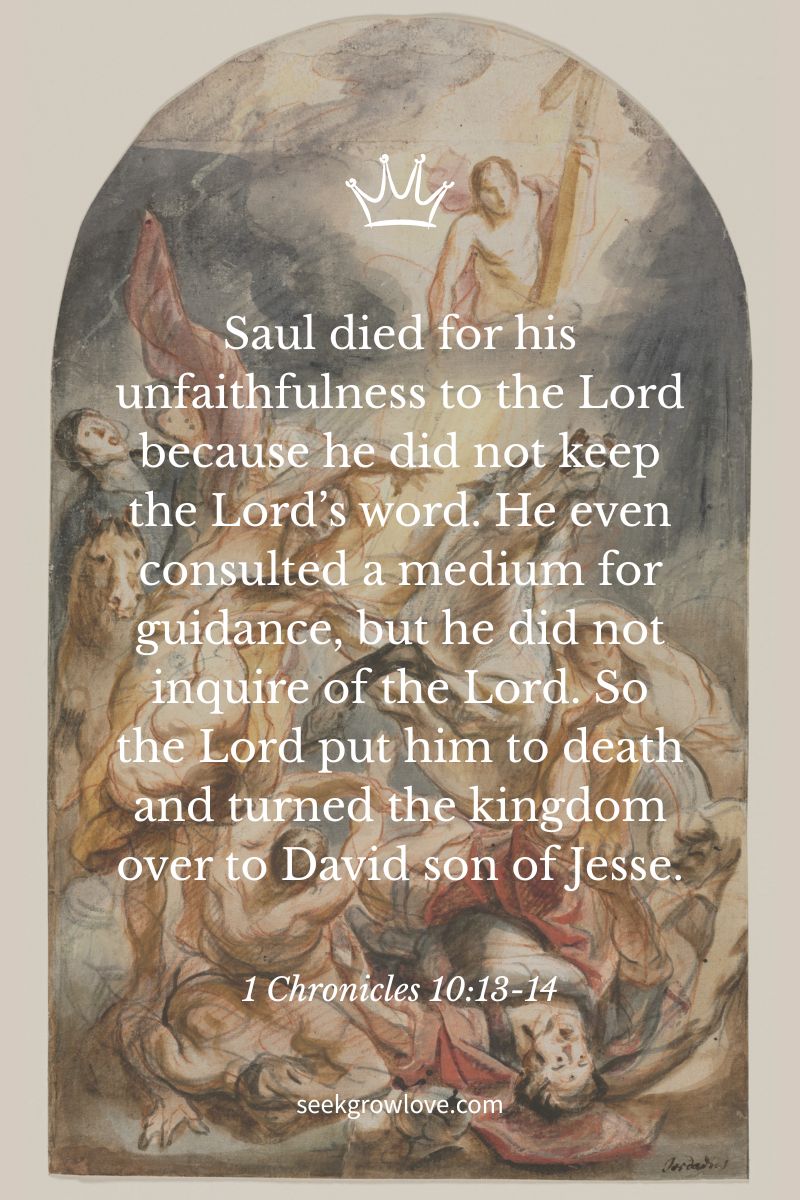
1 Chronicles 10:13-14 sums up Saul’s life: “Saul died for his unfaithfulness to the Lord because he did not keep the Lord’s word. He even consulted a medium for guidance, but he did not inquire of the Lord. So the Lord put him to death and turned the kingdom over to David, son of Jesse.”

The tragedy of Saul affected more than just him. All of his sons fell in the doomed battle against the Philistines – an entire house extinguished. 

Writing this just after Father’s Day, this makes me think about the responsibility we have as leaders. Saul was so concerned with his own pride and recognition that he ultimately sacrificed not only himself but also his family on that altar. As a leader of the people, we were supposed to steadfastly point them to God. Instead, he foolishly acted in ways that ‘seemed right in his own eyes’ but were contrary to God’s law. 

Wherever you are leading – whether in your own homes, your church, or your community – you have a great responsibility to be steadfast. You cannot fall prey to the temptation of allowing the lines between right and wrong to blur in the service of your own desires. You cannot hold the good you feel like you deserve too tightly, ultimately rejecting wholehearted obedience to God. 

Saul’s life is a reminder to look at our own lives and the gravity of our actions. How are they measuring up? May our lives always be characterized by faithfulness, not unfaithfulness like Saul. 

Reflection Questions

  1. Saul’s life is a tragedy, and tragedy is often characterized by a central character flaw that leads to their doom. What do you think is the core sin of Saul’s life? 
  2. As Saul began to grow in influence and power, that tainted his relationship with God. How do you handle influence rightly so that it brings glory to God – not yourself? 
  3. When we think of Saul, we often think of Saul the King, not Saul the Father. How did Saul’s actions affect his family? What lessons can we learn from this about parenting?

Prayer

Lord, 

Help me hold my responsibilities rightly so that they bring glory to you. May I not fall prey to the dangers of pride, but instead lead with humility. Help me to guide those who are following after me to a better relationship with you. 

In Jesus’ name,

Amen.
SGL.2026.CalendarDownload

Changed into a Different Person

Old Testament: 1 Samuel 9 & 10

Poetry: Proverbs 6

New Testament: Acts Introduction below

Saul was looking for Samuel and Samuel was looking for Saul but for different reasons! At first, Saul was looking for his father’s donkeys, and Samuel for the king of Israel – then, all was found. Not only was Saul (tall and handsome) anointed the first king of Israel, but the Spirit of God came upon him. It even says, “He’d be turned into another man (1 Samuel 10:7) … God gave him another heart.” (10:9) Imagine to go looking for donkeys and to be anointed the first king of Israel, what a shocking surprise! Honestly, I’m not too surprised he was hiding amongst the equipment. That’s probably where I would’ve been too. But the LORD knew right where he was and whom He had chosen.

Sometimes things turn out differently than we’d planned, actually a lot of times. My motto around the house is we need to be flexible or we’ll break as our plans are often shifting. 😊 After the time of the judges, authorities will shift to kingship. Yet, ‘Thus says the LORD God of Israel: I brought up Israel out of Egypt, and delivered you from the hand of the Egyptians and from the hand of all kingdoms and from those who oppressed you. But you have today rejected your God, who Himself saved you from all your adversities and your tribulations; and you have said to Him, ‘No, set a king over us!’” (10:17-19) It is sad that the people rejected God as their king and yet God was gracious and granted them one anyhow.

“These are six things the LORD hates, yes, seven are an abomination to Him:

A proud look,

A lying tongue,

Hands that shed innocent blood,

A heart that devises wicked plans,

Feet that are swift in running to evil,

A false witness who speaks lies,

And one who sows discord among brothers.”  (Proverbs 6:16-19)

“My son, keep your father’s command, and do not forsake the law of your mother.

Bind them continually upon your heart; tie them around your neck,

When you roam, they will lead you; when you sleep, they will keep you;

And when you awake, they will speak with you.

For the commandment is a lamp, and the law a light. Reproofs of instruction are the way of life.” (6:20-23)

Amen!

-Stephanie Schlegel

Reflection Questions:

  1.  Is there something in our lives that we’re failing to acknowledge God for doing for us? Let’s keep a thankful heart and thank Him for three things that happened today.
  2. Are we aware of the 7 things God hates and hopefully not doing any of them?
  3. Are we keeping God’s ways close to us throughout the day and letting them guide us even while we lie down to sleep?

Acts Introduction

The Book of Acts, also known as The Acts of the Apostles, is a sequel to the Gospel of Luke.  Luke, a physician who traveled with the apostle Paul, wrote both.  In fact, Luke wrote more of the New Testament than any other author, including Paul.  The book of Acts covers the period of time from just after the resurrection of Jesus until just before the death of Paul, and tells the history of the early Church.  Because the story about Paul ends abruptly with his house arrest and awaiting trial before Caesar, it’s likely the Book of Acts was written at that time, likely around 62 or 63 AD.

The first half of the Book of Acts focuses primarily on Peter, who taught mostly Jews, while the last half is about Paul, who taught mostly Gentiles.  Luke detailed the expansion of Christianity from being centered in Israel, to reaching worldwide (in the known world of that day).  Luke recorded several sermons, from Peter’s on the day of Pentecost, to Stephen’s, and multiple of Paul’s.  By using the word “we” in parts of the second half of the book, it is obvious that Luke traveled with Paul.

From Chapter 1, we can see several things the early church believed:

  • The reality of Jesus’ resurrection (Acts 1:3a)
  • The promise of the coming kingdom (Acts 1:3b)
  • The power of the Holy Spirit (Acts 1:8)
  • Jesus will return the same way he left (Acts 1:11)
  • Prayer was important, and they spent lots of time in prayer (Acts 1:14)
  • They believed in God’s leading (Acts 1:24-26)

Some of the more well-known information in Acts includes:

  • Jesus’ ascension into heaven (Acts 1:7-11)
  • The Holy Spirit being poured out on the Day of Pentecost (Acts 2)
  • Peter and John healing a crippled beggar (Acts 3)
  • Peter and John before the Sanhedrin (Acts 4)
  • Ananias and Sapphira (Acts 5)
  • Stephen’s sermon and the stoning of Stephen (Acts 7)
  • Philip and the Ethiopian (Acts 8)
  • Saul’s conversion (Acts 9)
  • Peter and Cornelius (Acts 10)
  • Peter’s miraculous escape from prison (Acts 12)
  • Paul’s missionary journeys (starting in Acts 13)
  • etc.

As you can see, Acts is a very exciting and well-known book.

I love Acts 4:13, which says, “When they saw the courage of Peter and John and realized that they were unschooled, ordinary men, they were astonished and they took note that these men had been with Jesus.”  As you study the book of Acts, and ask God to fill you with the Holy Spirit, I pray that people will notice you and be astonished, and will take note that you have been with Jesus.

-Steve Mattison