Where is your citizenship?

Old Testament: 2 Kings 23-25

Poetry: Ps. 138

New Testament: Philippians 3

The place where we live is so central to who we are as people. It truly is one of the most important parts of our identity. It changes everything: from the foods we like, the music we listen to, the political parties we vote for, our priorities… basically everything. I’m from the south, and I remember going to our national church camp, FUEL, in the summer and being teased for the way we talk, the types of drinks we like (Who doesn’t like sweet tea? Oh right, all you northerners.), and the music we listen to. Before going to these camps, none of those things even struck me as weird. It was just the way everyone around me lived. Where we live can define us. But, we have a more important citizenship – a more important place of belonging – than just our physical address. 

Today, we read about the final demise of the Israelite nation. From the beginning, when God called Abraham out of the future land of Babylon and into the promised land of Canaan – the future land of Israel, there was a beacon of hope and assurance that God was for the Israelite people and would come to their aid. They were his people. 

Even though Josiah instituted reforms to bring his people back to God, the evil the people of Judah had done was so great that God promised, “I will remove Judah also out of my sight, as I have removed Israel, and I will cast off this city that I have chosen, Jerusalem, and the house of which I said, My name shall be there” (2 Kings 23: 27). The devastating consequence of sin is the removal of belonging with God. This meant that the people of Judah – the last remnant of the Israelites who had settled in Canaan – could no longer find their citizenship in the Promised Land. Instead, they were taken captive by the Babylonians and returned to the land that God had called them out of. This is a harsh statement of rejection of the Israelite people. The one whom God had said, ‘I called you out of Egypt to be my chosen possession’ had been returned to the places of captivity. 

Citizenship, rejection. Freedom, captivity. These opposite poles of human existence that the Israelites could choose based on how obedient they were to God’s commands. Because they rejected God’s commands, he rejected them. The freedom they would have in submitting to God and setting boundaries on their freedom based on his law became captivity under other rulers due to their desire to do whatever they pleased.

We have the same promise and warning today. The same choice is set before us. We can choose for our citizenship – our place of belonging – to be in heaven (Phil. 3:20-21) or to be enemies of Christ (v. 18). Phil. 3:19 describes these enemies in the following way: “Their end is destruction, their god is their belly, and they glory in their shame.” This statement could have been written for the people in Judah and Israel. And it could be written to those today who choose to do whatever is right in their eyes rather than follow God’s word. 

To be citizens of heaven, we must follow Paul’s example. I “press on to make it [the resurrection of the dead, aka the Kingdom Life we are promised] my own, because Christ Jesus has made me his own. Brothers, I do not consider that I have made it my own. But one thing I do: forgetting what lies behind and straining forward to what lies ahead. I press on toward the goal for the prize of the upward call of God in Christ Jesus” (v. 12-14). Hold fast to God, and obey his commands! Choose to be a citizen of God’s Kingdom! 

~ Cayce Fletcher

Reflection Questions: 

  1. How does the place where you live affect who you are as a person?   
  2. How would a citizen of the Kingdom act differently than those of the world? Where do you find your citizenship?   
  3. There’s a glimmer of hope in 2 Kings 25:27-30. Jehoiachin is able to “put off his prison garments. Every day of his life he dined regularly at the king’s table.” How do you put off your prison garments of sin and dine at the table of the King in your everyday life?   

sgl23bibleplanDOWNLOAD

Shine like Stars

Old Testament: 2 Kings 21-22

Poetry: Ps. 137

New Testament: Philippians 2

My son, Jonah, is afraid of the dark. For a while, after we would read him a bedtime story and sing “Silent Night” as a lullaby, we would close the door to a dark, quiet room. And, a few moments later, we would hear the pitter-patter of feet as he would get out of his toddler bed, go over to the lamp in his room, and click it on. One day while he was playing, he told me that he had to turn his light on because he doesn’t like the dark because there are monsters in the dark. 

Even though I am grown, I can empathize with his fears. I remember – and I bet you do too – those moments of fear when the lights go out. I remember begging my parents to leave the closet light on because I was unsure what was lurking out there in the dark past my bed. It seems only natural to be a little afraid of the dark, those places you can’t see. It’s a built-in defense mechanism that humans have to navigate nighttime in our world. 

The Bible is full of themes that occur from beginning to end. You could trace the way water is used as a symbol of chaos and cleansing or the way trees represent a strong, godly life. One theme that occurs from beginning to end is the contrast between dark and light. Darkness is always connected with sin and evil, whereas light is connected with righteousness and God himself. 

This is a quick overview of the way this theme is used in scripture. In the beginning, God created the light and called it good (Gen. 1:4). After the fall, the world is described as being in darkness. God is constantly beckoning his people to be a light to the surrounding nations (Gen. 15:5), but Israel repeatedly chose darkness. Jesus is the true light that shines out into the dark world – and his light “gives light to everyone” (John 1:9). We are now the torchbearers that continue to shine a light in the world. We are called to “shine as lights in the world” (Phil. 2:15). We “cast off our works of darkness and put on the armor of light” (Rom. 13:12, see also Eph. 5:7-14). 

We see an example of being a light to the world in Judah’s king Josiah. After two dark, wicked kings of Judah, Josiah repairs the temple. He becomes a light to the nation calling them back to worship God and obey him after over half a century of disobedience. He repairs the temple and shares the law with Judah. The people were in darkness because of the evil kings, but Josiah was being a light pointing them back toward God. Just like the nation of Judah, we also have a tendency to pull toward darkness. In fact, sometimes we seem to like darkness; we prefer it over having our deeds exposed in the light. However, since we are in Christ, we need to put aside those worldly desires and choose to follow God completely. God is light and there is no darkness in him (1 John 1:5). We cannot do the deeds of darkness and follow God at the same time. Let’s be like King Josiah, and be a leader of light to those around us. 

~ Cayce Fletcher

Reflection Questions: 

  1. Why do you think that the Bible uses the imagery of light and darkness to represent good and evil?   
  2. How was King Josiah a light to his country?   
  3. How can you be a light that represents Jesus to others today? What are some actions you could take?   

sgl23bibleplanDOWNLOAD

When You Don’t Know What Else to Do

Old Testament: 2 Kings 19-20

Poetry: Ps. 136

New Testament: Philippians 1

Yesterday, we learned about the exile of the nation of Israel because of the idolatry that they practiced. 2 Kings 17:34 describes the Israelites who lived in Samaria: “To this day they do according to the former manner [fearing God but also serving the gods of the surrounding nations]. They do not fear the LORD, and they do not follow the statutes or the rules or the law of the commandments the LORD commanded the children of Jacob, whom he named Israel.” The nation of Israel had spiraled down the dark, deep hole of sin that ended in exile. 

There is a glimmer of hope in 2 Kings 18, as we read about Hezekiah the good king of the neighboring nation, Judah. “He trusted in the LORD, the God of Israel, so that there was none like him among all the kings of Judah after him, nor among those who were before him. For he held fast to the LORD. He did not depart from following him but kept the commandments that the LORD commanded Moses” (v.5-6). 

A little over halfway through his reign, Hezekiah is faced with a terrible situation. The king of Assyria attacks Judah and forces Judah to pay him tribute. Things even got so bad that Hezekiah stripped the gold off the temple doors and gives it to the Assyrian king. The Assyrians mock God and swear that God has forsaken Judah. This is where chapter 19 picks up. 

When faced with a terrible situation, what does Hezekiah do? Hezekiah humbles himself, goes to God, and listens. Hezekiah sent people to Isaiah to pray in the nation’s behalf (v. 4). This proves to be exactly the right course of action. 

We can learn so much from the reign of Hezekiah, but I think it’s so important to look at how he handled these difficult situations. You can follow the example of Hezekiah in doing the following: 

  1. Humble yourself. Hezekiah tore his clothes and covered himself with sackcloth. He didn’t try to appear to have his life together. He recognized the severity of the situation and knew he could not save himself without God. 
  2. Go to God. Hezekiah went to the house of the Lord immediately. He knew where to turn with the situation got tough. 
  3. Seek counsel and comfort from godly people. Hezekiah gathered up a few trusted servants and priests to go to Isaiah, the prophet for help. 
  4. Recognize that you have a mediator who knows your needs. Hezekiah turned to Isaiah to be a mediator between God and him. He asks Isaiah to pray for him. We don’t have to turn to men to pray for us. Instead, we can go to God ourselves because we have a mediator in Jesus. 

At the end of this chapter, Isaiah gives some reassuring news. The Assyrian king would not destroy Judah. In fact, he would fall by his own sword. Verse 35-37 goes on to say, “That night the angel of the LORD went out and struck down 185,000 in the camp of the Assyrians. And when the people arose early in the morning, behold these were all dead bodies. Then Sennacherib king of Assyria departed and went home and lived at Nineveh. And as he was worshiping in the house of Nisroch his god Adrammelech and Sharezer, his sons, struck him down with the sword.” God’s promises are true. Praise God that we can go to him in all of our sufferings. 

~ Cayce Fletcher

Reflection Questions: 

  1. What difficult situation are you facing today? What strikes fear in your heart? Makes you despair? Bring this situation to God. 
  2. Who are some people you can turn to in difficult situations that can help to point you to Christ?   
  3. How is prayer different from the Old Testament to the New Testament because of Christ?   

sgl23bibleplanDOWNLOAD

Consequences of Idolatry

Old Testament: 2 Kings 17, 18

Poetry: Ps. 135

New Testament: Philippians Introduction Below

The school year has just ended in SC, and I am thoroughly enjoying summertime. After teaching for 5 years (and being in public school/college all those years before it), summer has become a beautiful time of rest, relaxation, and lots of swimming and sunshine. Summer is one of the perks of being a teacher, but it is definitely a time that feels earned. After a year of pushing students to be better learners and better people, I need a break. 

One of the most challenging things about being a teacher is the constant redirection and discipline that are required to make sure a classroom runs smoothly. If everyone is always doing what they want – whether that’s blurting out, going to the bathroom (as soon as we start taking notes!), or playing on the iPad – not much learning is happening. One of my jobs as a teacher is to set up a structure for my classroom that involves rules so that students know how to overcome doing what they want so that they can do what they need in order to learn. Sometimes students are happy to follow these rules. But, sometimes they are not. When they don’t follow rules, there is a system of warnings and consequences to try to get them back on track. Lunch detention, emails home, you know the drill. Occasionally, a student will not listen, and that is when the big punishment happens: ISS or OSS. Any public school kids know about this place of detention. The purposes of ISS, or in-school suspension, are two-fold: (1) By taking them out of the classroom, they miss out on the fun and good things we do as well. Normally, they don’t want to be away from the class because of this. (2) It also removes the student from the learning environment so they don’t pull everyone else down with them. 

In our reading today, we see the punishment the Israelites received that reminds me quite a bit of ISS, except much more severe and far-reaching. The Israelites were exiled from their land as a consequence of their sin. We read in 2 Kings 17:1-23 about how the Israelite king, Hoshen, continued to follow the pattern of doing evil in God’s sight. This caused the king of Assyria to invade the land and ‘carry the Israelites away to Assyria and place them’ throughout the land of Assyria (v. 6). Verse 7-8 says, “And this occurred because the people of Israel had sinned against the LORD their God, who had brought them up out of the land of Egypt from under the hand of the Pharaoh king of Egypt, and had feared other gods, and walked in the customs of the nations whom the LORD drove out before the people of Israel, and in the customs that the kings of Israel had practiced.” Verses 9-23 go on to describe the Israelites’ descent into sin from the time they entered the promised land with Joshua until the present time. In Deuteronomy 28, we read the promised consequences for the sin of disobedience and see these consequences given after the Israelites choose repeatedly not to listen to what God has told them to do. Despite knowing these consequences, the Israelites still pursued other gods and idols. When God would try to call them out of their sin and draw them back to him, they would not listen. 

Ps. 135 describes the difference between God and idols. Calling back to the deliverance from Egypt, it states the great works of God and praises him because “For the Lord has chosen Jacob for himself, Israel as his own possession” (v. 4). In contrast, the idols are the work of human hands that cannot speak, see, hear, or breathe. “Those who make them become like them, so do all who trust in them” (v. 18). It’s chilling to read this Psalm after seeing the demise of the state of Israel. Because the Israelites trusted in their idols, they either died or were forced to live in captivity where their “life shall hand in doubt before them. Night and day they shall be in dread and have no assurance of their life” (Deut. 28:66). Instead of Israel being God’s chosen possession, God “rejected all the descendants of Israel and afflicted them and gave them into the hand of plunderers, until he had cast them out of his sight” (2 Kings 17:20). 

This is a harsh consequence, but like the punishment of ISS, it is twofold in purpose. The descent into sin needed to be stopped. This was God’s boundary line, stating that if they continued to act like this they would not be allowed to remain with him. It also removed Israel from close proximity to Judah, the nation that still remained in the Promised Land. At this point, Judah was not too far gone, so God didn’t want Judah to be brought down further into sin by Israel. 

God takes idolatry seriously, and there are severe consequences for it. We cannot be God’s chosen people if we choose to pursue idols. Idols look different than in the Israelites’ time, but they are all around us: Beauty, Money, Sex, Work, Family, Political Beliefs, Identity, Alcohol, Drugs, Social Media, Image. These are the intangible idols. We can’t hold them in our hands like idols of the olden days, but we may worship them all the same, giving offerings of our time, money, and relationships – sometimes sacrificing our parents, children, spouses, or friends on the altar of their worship. We will be exiled from his presence if we choose to pursue idolatry if we choose these things over God. It is not too late to turn back to him! Cast down your idols today. 

~ Cayce Fletcher

Reflection Questions: 

  1. What are some of the idols that you see in your life or the life of the people around you?  
  2. Why does God give such harsh consequences for idolatry? What is the danger of idolatry?  
  3. What does exile look like in a modern day context? Do you think God punishes people in the present day, or is it just a future consequence (aka a lake of fire punishment)?

Philippians Introduction

Paul wrote the book of Philippians to the Christians in Philippi, which was the first church Paul established in Europe.  Despite the fact that Paul wrote this letter while he was a prisoner in Rome, Paul repeatedly talked about joy – showing that he could be content in any circumstance (4:11).

Paul reminded the Philippians to conduct themselves in a manner worthy of the gospel of Christ (1:27), despite the persecution they were suffering (1:29-30).  He pointed to Jesus as the ultimate example of humility and submission, and reminded the Philippians that they should have the same attitude as that of Jesus (2:3-11).

In chapter 3, Paul reminded the Philippians that even Paul didn’t earn his righteousness from following the law, even though he was a model Jew.  Instead, all of us receive righteousness that comes from God and is by faith in Christ.

I particularly like Paul’s admonition in 4:6-7, “Do not be anxious about anything, but in everything, by prayer and petition, with thanksgiving, present our requests to God.  And the peace of God, which transcends all understanding, will guard your hearts and your minds in Christ Jesus.”

I also like Paul’s reminder in 4:13, “I can do everything through him who gives me strength.”

May we be able to say like Paul in 4:9, “Whatever you have learned or received or heard from me, or seen in me – put into practice.  And the God of peace will be with you.”

–Steve

sgl23bibleplanDOWNLOAD

Saturday – June 25th, 2022

2 Corinthians 8

Tithes. It’s an uncomfortable topic. People get uncomfortable when you talk about money in general, and when you say they should give away their money, sometimes they can get downright feisty. If you are under 18, the idea of tithing is just that moment in church where they play an instrumental song and some people reach in their purse or wallet to discreetly turn in a folded bill. You may even participate with some money that your parents have given you. After 18 though – when you’re in charge of paying bills and then taking care of other living beings (whether that’s a dog, a child, or a plant), that’s when tithing can get overlooked. I know it does in my case. 

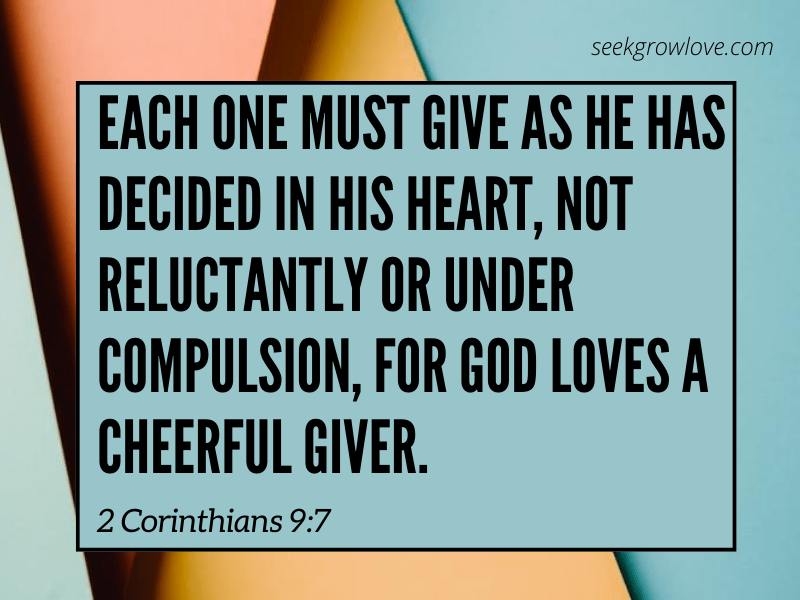
2 Corinthians 8, today’s reading, is all about giving which is just another word for tithing. Tithing was a word that originated in England in the Middle Ages to describe the custom of giving 10% of income to the church to support it during that time. Paul talks about this, but he doesn’t focus on the legalistic requirement of giving 10% to ‘do your duty.’ Instead, Paul frames this giving to support the ministry of the apostles, the ministry of spreading the gospel, as an opportunity, a privilege. He says, “For I testify that they gave as much as they were able, and even beyond their ability. Entirely on their own, they urgently pleaded with us for the privilege of sharing in this service to the Lord’s people” (2 Cor. 8:3-4). To participate in the ministry of the gospel whether through actually traveling from place-to-place or supporting via funds was a good thing. It wasn’t a duty that they should begrudgingly do. Later in the letter to Corinthians, Paul goes on to say,  “Each one must give as he has decided in his heart, not reluctantly or under compulsion, for God loves a cheerful giver” (2 Cor. 9:7). Tithing is very much about our attitude. Are we cheerfully giving this offering to support the ministry of God? Or are we doing it only for the appearance of ‘doing the right Christian things’? 

When you think about giving of your time or money, how much should you give? Paul says this: “And here is my judgment about what is best for you in this matter. Last year you were the first not only to give but also to have the desire to do so. Now finish the work, so that your eager willingness to do it may be matched by your completion of it, according to your means.  For if the willingness is there, the gift is acceptable according to what one has, not according to what one does not have.” In this, Paul again is pointing to the importance of attitude when considering how much time or money to give. He wanted the Corinthians to continue with the same desire, regardless of how much they actually gave. He also pointed out that if the desire to give is there, God doesn’t look at how big the gift is. He looks at how much is given in comparison to how much that person has. You can read more about this in the parable of the widow and the two coins in Mark 12:41-44. 

Ultimately, our tithes and offerings are a display of our trust in God. They harken back to the sabbath rest of the ancient Israelites in the desert. By giving God a portion of our time or our money, we trust that God will do great things with it in the world, and we trust that God will make sure that we are taken care of with what we have left. Now, ‘taken care of’ does not mean that we will get rich off of tithing. (That’s the false prosperity gospel.) Taken care of means that we will have clothes on our backs and food in our bellies (Matt. 6:25-34). Our tithes and offerings can also fix our relationship with money. Instead of holding it tightly and greedily, by giving our money away – we are reinforcing that it is not an idol in our lives. Our attitude towards money changes. 

What can you give back to God today? 

~ Cayce Fletcher

Questions for Application: 

  1. Do you normally tithe? How does giving look for you? 
  2. Can tithing be more than just money? (For example, time serving at a church camp or participating in the worship band.)
  3. What is your relationship with money? How do you think that relationship affects your relationship with God?

Friday – June 24th, 2022

2 Corinthians 7

I recently attended a great Young Adult Getaway hosted by the Church of God General Conference. Around 60 (somewhat) young adults got together and had a great time fellowshipping with one another, learning about God, and worshipping God together. The theme for the weekend was “Find Your People” based on a book by Jennie Allen. Especially after living through the social changes brought about by social media and the pandemic, we probably can all relate to feeling both more socially connected and socially isolated than ever before. I can spend hours scrolling to see the engagement and pregnancy announcements from people I went to high school with (that I haven’t seen or spoken to in years), but I don’t feel like I have time to deeply connect with my present-day family and friends. The getaway focused on how we can connect with people – which is an essential yet often overlooked part of the Christian faith. 

While we were there, I spoke about one uncomfortable aspect of connecting with others in a Christian context: holding others accountable. When we first become a Christian, we may think that our fellowship with others is all based on the love we show each other… which is actually true. But, early on in our walk with Christ, our idea of love is based on what we see in movies and TV shows. Love supports each other no matter what. It speaks encouragement (only) and never criticism. It does not judge. Love never makes the other person feel bad. So, we think, based on this understanding of love, that our Christian relationships should follow the same blueprint, but this is not the case. 

Our understanding of what love is changes when we become a Christian. Jesus did say, “By this all people will know that you are my disciples, if you have love for one another” (John 13:35). But, at the same time our idea of love has changed. John later says in 1 John 4: 10-12, “This is love: not that we loved God, but that he loved us and sent his Son as an atoning sacrifice for our sins. Dear friends, since God so loved us, we also ought to love one another. No one has ever seen God; but if we love one another, God lives in us and his love is made complete in us.” Love becomes much more about self sacrifice than mindless tolerance, much more about spurring each other on than accepting where we are currently at. 

Paul recognizes this. As I’ve read through his letters, a common Pauline trait has stood out to me; he is a master at accountability. In his letters, he is constantly calling his fellow brothers and sisters in Christ to higher standards and encouraging them to hold fast to the standard set before them in Christ. This is especially true in his letters to the Corinthians. In today’s reading,  we see Paul continue to do this. He tells them, “Therefore, since we have these promises, dear friends, let us purify ourselves from everything that contaminates body and spirit, perfecting holiness out of reverence for God” (v. 1). But, he doesn’t say this because he dislikes the Corinthians in any way. Instead he tells them later on, “I do not say this to condemn you; I have said before that you have such a place in our hearts that we would live or die with you. I have spoken to you with great frankness; I take great pride in you.” (v. 3-4a). Paul deeply cares about the Corinthian church, which is why it is so important to him that they live right in the eyes of God. 

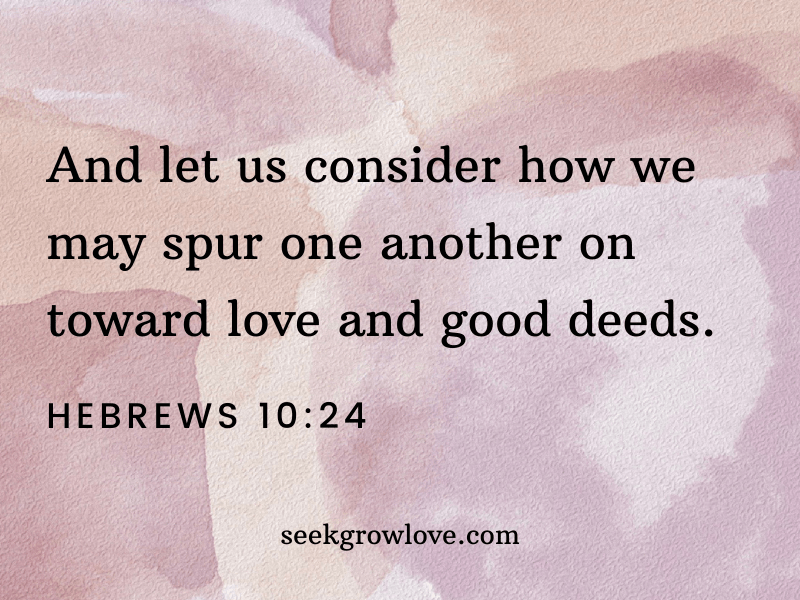
We also are called to live right and hold others accountable. How are you spurring others on to love and good deeds (Heb. 10:24) today? 

~ Cayce Fletcher

Questions for Application: 

  1. Do you feel more connected or more isolated when you think about your everyday life? Who are ‘your people’ that you live close by that can spur you on in the faith? 
  2. Have you ever experienced accountability (whether it was you holding someone accountable or someone else holding you accountable)? What was that experience like? 
  3. How does accountability strengthen our Christian walk? 

Thursday – June 23rd, 2022

2 Corinthians 6

One of the major themes of the Bible is God making a broken people holy. Holiness is a characteristic of God; in fact, God is repeatedly called the “Holy One of Israel” throughout scripture. But, what is holiness? “The Hebrew word for “holiness” is qōdes, a word that highlights the realm of the sacred in contrast to everything common and profane.” (See here for more info.) Holiness describes what is sacred or set apart. God is the ultimate holy one, and he sets the bar for what is holy or sacred. We can determine if something is holy by comparing it to the standard that God has set for us. 

Unfortunately, after the fall, we were not a holy people anymore. We would die if we were in the presence of God because of this fact. God’s ministry of reconciliation which we read about yesterday is all about God bringing us back into relationship with him. God cannot lessen his holiness, but he can redeem us and make us more holy. This is what the whole Bible is about. God making his chosen people holy. In the Old Testament, God made his people holy through sacrifices and the law. The law could not completely redeem us though. So, in the New Testament, the new covenant was establish in which God was making us holy – reconciling us to himself – through Christ. We are saved through this reconciliation (2 Cor. 6:2). 

At the end of the chapter we read today, we see some important warnings that Paul gave to the Corinthians encouraging them to remain holy. In verses 16-18, it says, 

“As God has said:

“I will live with them

    and walk among them,

and I will be their God,

    and they will be my people.”

Therefore,

“Come out from them

    and be separate,

says the Lord.

Touch no unclean thing,

    and I will receive you.”

And,

“I will be a Father to you,

    and you will be my sons and daughters,

says the Lord Almighty.”

We are called to be set apart, called to be holy. Our lifestyles should reflect that. This requires discipline and an awareness of our habits. Are we living in a way that shows we are set apart? Or are we living just like the world? When we live a holy life, we have the promise of a deep and personal relationship with God. He will walk among us. He will be a Father to us. That promise is worth all the sacrifices that we make. 

~ Cayce Fletcher

Questions for Application: 

  1. When you read the word ‘holiness’, what kind of feelings does it stir in you? Do you think that become holy is a worthwhile pursuit?  
  2. What does a holy lifestyle look like? 
  3. One characteristic of being holy described in this chapter is in verse 14: “Do not be yoked together with unbelievers.” What do you think this verse means? Why is this important in our pursuit of holiness? 

Wednesday – June 22nd, 2022

2 Corinthians 5

Most of our lives are spent trying to make sure that we are doing all we can to live bigger and better. We spend years in school so that we can get a good job and make good money. Then, we can buy a nice house/car (which we may sell later on to get a bigger and better house/car). We accumulate lots of stuff that we can eventually pass on to our kids – which may not actually want any of it. It seems kind of pointless when you describe it this way, but this is truly what we talk about when we say we are pursuing the American Dream. It’s a materialistic pursuit of wealth and things… that ultimately prove meaningless when held against the gospel of Christ. 

Though the concerns of the Romans and Jews were different than what we worry about today, we still see the distractions that can come from the pursuit of things other than God. These idols could be wealth (and Rome had its own version of the American Dream), but it could also be power, status, or a legalistic self-righteousness. All of these idols are forms of the old self that should have been put to death with Christ. 

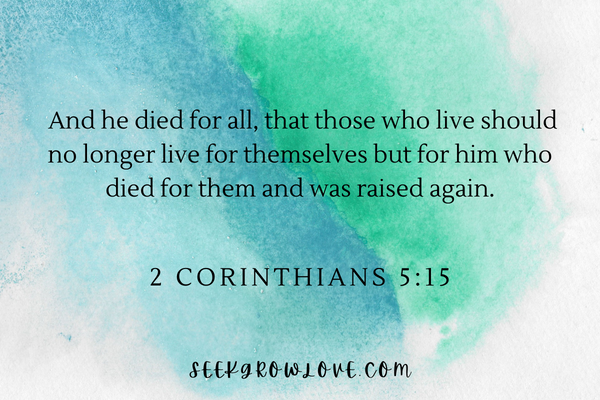
In 2 Cor. 5:14-15, Paul says, “For Christ’s love compels us, because we are convinced that one died for all, and therefore all died. And he died for all, that those who live should no longer live for themselves but for him who died for them and was raised again.” This is such a counter-cultural statement. We are not living for ourselves anymore. We are not trying to pursue lives that are bigger and better according to the world’s standards. We have “died” to that pursuit and are raised again. We no longer live for ourselves but instead we live for Christ. 

This is what it means to be a new creation. In verse 17, it says, “Therefore, if anyone is in Christ, the new creation has come: The old has gone, the new is here!” When we are raised with Christ, our concerns change to the concerns of Christ. What is the concern of Christ? Verses 18-19 say, “All this is from God, who reconciled us to himself through Christ and gave us the ministry of reconciliation: that God was reconciling the world to himself in Christ, not counting people’s sins against them. And he has committed to us the message of reconciliation.” We are being reconciled to God so that we can become the righteousness of God. Praise God! We have been made new! 

~ Cayce Fletcher

Questions for Application: 

  1. What are some of the things that you spend time pursuing? What are things that distract you from God? 
  2. Do you believe that these distractions are idols? 
  3. If you are a believer, you are a new creation in Christ. Do you live in a way that shows that you are a new creation? How? 

Tuesday – June 21st, 2022

2 Corinthians 4

Growing up, I loved to run in races. I never had the fastest time, but I loved the sense of community that came from everyone pursuing the same goal: finish the run. Even though I don’t run as much as I used to, I still see the power of pursuing a unified goal in my family, my job, my church, and my community. We encourage one another to set our eyes on the more important things even when we may not feel like doing so on our own. 

In today’s reading, Paul continues to give a defense of his ministry. He tells the Corinthian church, “Rather, we have renounced secret and shameful ways; we do not use deception, nor do we distort the word of God. On the contrary, by setting forth the truth plainly we commend ourselves to everyone’s conscience in the sight of God” (2 Cor. 4:2). Paul speaks plainly about the gospel and does not try to manipulate or somehow warp the message of the cross to be more pleasing to others. Even so, this message is so winsome that it wins people over anyway. 

This being said, just because the message itself is convincing and life-changing, it doesn’t mean that Paul became rich and famous, living a life of ease. His life was difficult and the only thing that kept him going was the reminder of his purpose and his commitment to reaching his goals. During Paul’s ministry which started with him being blind for three days, he was almost stoned to death, bitten by a snake, shipwrecked, and kept under house arrest. He left for Rome towards the end of his life knowing that he was going to be killed there. A martyr, he was beheaded by the Roman emperor Nero. Despite the difficulties of his life, he recognized that the message that he was speaking was too important to keep hidden. In 2 Corinthians 4:16-17, he says, “Therefore we do not lose heart. Though outwardly we are wasting away, yet inwardly we are being renewed day by day. For our light and momentary troubles are achieving for us an eternal glory that far outweighs them all.” The troubles that he faced did not destroy him. Instead, they renewed him day by day because Paul recognized that through his troubles the gospel was being spread even more effectively! 

So, how can we grow to have the same mentality as Paul? In verse 18, he says, “So we fix our eyes not on what is seen, but on what is unseen, since what is seen is temporary, but what is unseen is eternal.” Just like a runner in the race, we have to keep our eyes set on the finish line. We need to keep our mind set on the eternal. If we do that, the distractions of the present day start to fade away. What are your eyes fixed on? Live life in light of eternity. 

~ Cayce Fletcher

Questions for Application: 

  1. What do you say the goal, mission, or purpose of your life is? 
  2. Are you facing difficulties that keep you from reaching this goal? 
  3. How might these difficulties be renewing you day by day? What could be some of the lessons or benefits from these difficulties?

Monday – June 20th, 2022

2 Corinthians 3

As a middle school teacher, I have an ‘in’ for knowing what’s currently trending whether it’s the Visco girls and HydroFlasks of a few years ago or the devious licks of the past year. Because of TikTok and Instagram, these trends spread like wildfire among my students, and they tend to burn out just as quickly. Quick-moving trends aren’t new either. I remember silly bands and Hollister jackets from my middle school days almost 15 years ago. The common theme with these fads and trends is that they spread like crazy and then are soon forgotten. Facebook was just beginning to grow in popularity when I was younger, so it may seem strange that such fads existed. But, as everyone can tell you, this is just part of humanity and culture. We tend to jump on things that are popular and want to be a part of them. Because of this, we sacrifice time and money accumulating junk and doing some pretty stupid stuff just so that we feel like we are part of the crowd. 

In today’s reading, Paul is addressing the Corinthians and pointing out reasons why the Corinthians should trust his apostleship (or authority about the gospel). He is encouraging the Corinthians to rely on the Spirit to be transformed into the image of Christ. Paul knows the power of this transforming Spirit from his own experience and so speaks with boldness to the Corinthians (v.12). As he describes the difference between the law and the new covenant of Christ, he points to how Moses communicated with God compared to how we are able to through Christ. When Moses talked with God in the wilderness, his face would shine (Ex. 34:35). The Israelites were so terrified of this that they begged Moses to wear a veil when he returned. With the new covenant, the veil was torn (Matt. 27:51), and through Christ, we can see the glory of God. 

In verses 17-18, Paul says, “Now the Lord is the Spirit, and where the Spirit of the Lord is, there is freedom. And we all, who with unveiled faces contemplate the Lord’s glory, are being transformed into his image with ever-increasing glory, which comes from the Lord, who is the Spirit.” A poet, William Blake, said, “We become what we behold.” When I think of the trends and fads I see in culture, I think of people who are beholding (or seeing) so many things around them that they feel like they need to buy or participate in. Watching the culture around them makes them want to become more like the culture around them. Pretty soon, they are stealing bathroom vanities because they saw it on TikTok (a true story that happened at my school). We don’t want to become more like the world, but if all we are beholding comes from the world, what can we expect? We need to spend more time beholding God by spending time in prayer and his word. Only then can we be ‘transformed into the same image from one degree of glory to another.’ 

~ Cayce Fletcher

Questions for Application: 

  1. What is a trend or fad that you see in culture? Is it something you find beneficial to society or detrimental to society? 
  2. What do you behold daily? How is what you are beholding affecting the way that you live? 
  3. What does it mean to be ‘transformed into the same image [of Christ] from one degree of glory to another’? What would a person who was in the image of Christ look like?