The Voice of Wisdom

Proverbs 7-9

Do you ever find yourself looking at someone else’s situation or decisions and think, “I would have done that completely differently”? Of course you have. We all have. The world is full of armchair quarterbacks and side seat drivers. It’s so much easier to look at someone else’s situation and evaluate it as an outsider without the pressures of personal consequence. 

In the heat of the moment, standing at our own crossroads, however, we get wrapped up in the “what ifs” and the worries about whether or not we are making huge mistakes. So how do you know when you’re doing something wise or foolish? 

Chapters 7 and 8 of Proverbs personify danger/foolishness and wisdom as two women. The first woman is the strange or adulterous woman, luring in a simple youth. She uses “smooth talk” and “persuasive words” to seduce him. I feel it’s worthy to note that sexual sin is being used in this personification, probably because it’s the most common and most dangerous. And her opposite is wisdom, who doesn’t use tricks or wordplay, but speaks plainly. She promises no shortcuts, but offers instruction, knowledge, and truth. 

Both women have some similarities though. They are both crying out to those around them, trying to persuade others to follow them. They are both offering up benefits to listening to their words. So how do we know which to listen to? 

It seems obvious when we read the chapters, right? It’s less obvious in our own realities, though. Less obvious, but it’s still possible to make the correct choice. As in all decisions, we should test our options against scripture. If you want to know if your actions are wise or dangerous, test them against God’s word. Discernment, the ability to judge well, is a skill that everyone can, and should, develop through practice. The more we know of God’s word, the better equipped we will be to look at the paths before us and choose the wise one, the one that aligns best with scripture. 

When wisdom calls out to you, don’t you want to be familiar with her voice? 

My prayer for you is that you become so familiar with the voice of wisdom, the words of God, that you are not easily fooled or led astray. I hope you will love instruction so that you will continue to grow in wisdom and righteousness. I pray that you find the benefits of wisdom listed in chapter 9: “For through wisdom your days will be many, and years will be added to your life. If you are wise, your wisdom will reward you.”

-Jenn Haynes

Reflection Questions: 

What decisions do you face right now? Have you placed your options up against scripture? 

How is your scripture study? In what ways can you make yourself more familiar with God’s word, and the voice of wisdom, so that you can easily recognize it?

Are there any voices of temptation in your life right now that are trying to call out to you? Take a moment to honestly analyze and reflect. Often we want to shy away from facing the hard truth that there are likely things in our lives that we enjoy but that we should give up because they are unwise. Does that hold true for you? 

Ready for the Day. And Ready for the Night.

Old Testament: Exodus 23 & 24

Poetry: Psalm 29

New Testament: Matthew 25:1-13

Are you ready for the day? Do you have clean clothes to wear, you have your keys, phone and wallet, your homework is done, you have prepared for the meeting or test, and you remembered to brush your teeth before leaving the house. It’s a good feeling to be ready. 

When was the last time you were caught unprepared? You scrambled to put together a clean (maybe matching) outfit because the dirty hamper was overflowing, the teacher gave a pop quiz, visitors found a messy house, you didn’t have the project complete when the boss wanted it, the bill wasn’t paid by the due date, and in the rush to get out the door you forgot to brush your teeth. It’s no fun not being ready. 

In Matthew 25 today we read of the Parable of the Ten Virgins, or Bridesmaids, depending on which version you read. They are all anxiously waiting for the bridegroom’s arrival and they all have a lamp/torch/light with them as it is day now but they don’t know when he might come, so they (seem) prepared to wait even if it grows dark. And it does. 

Jesus tells us five of the virgins (typically referring to purity) were wise and five (still, pure virgins) were foolish. And since they all had their lamps with them and were anxiously awaiting the bridegroom’s (Jesus’) arrival I feel it is safe to say that all ten would call themselves “Christians” or Jesus followers. The five foolish aren’t chasing after the world and doing immoral, evil things. They have their lights and are waiting, right along with the five wise.  I think they are even sitting in the church pew and doing all the right things right along with the wise, all day long.

And then it grows dark. BOTH the wise and foolish get drowsy and even begin to sleep. BOTH are wakened with the great news, “The Bridegroom is coming!” But now we run into trouble. Well – half of them/us do. 

Five of them didn’t bring oil to keep their lamps burning, their lights are going out, and they haven’t seen the bridegroom yet. They desperately demand to get some oil from the five wise who brought oil with them, but the wise know they don’t have enough oil for both their light and another light. In the final moments the foolish run off scrambling to go buy more oil. And it is in those final moments that the long anticipated arrival of the bridegroom takes place. He finds the five wise waiting with their lights burning bright and he ushers them into the wedding feast. The door is shut and the party begins. 

In the previous chapter Jesus had just warned of the darkness that would proceed his second coming: increased wickedness, love of most growing cold, many deceived by false prophets and false christs, war, famine, earthquakes, and persecution. He warned that during that time of darkness many Jesus followers will fall away. They are the 5 foolish. They are the ones who won’t have enough fuel to keep their light burning through the darkness. They are the ones who will miss the party and be left out in the dark and will hear the Savior say, “I don’t know you.” 

Each person needs to be prepared – and stay prepared – even in the final dark days/moments/hours. Just having a light in the daytime is not enough. Just walking with the wise, right crowd is not enough. It won’t work to get into the Kingdom with a spouse, parent, grandparent, pastor, or friend who is prepared. You need your own light – AND the oil to keep it burning bright all night long if needed. 

Which half will you be a part of? Are you prepared? Are you ready? Do you have your light with you? That’s a good first step! But are you also prepared for the coming darkness that will indeed come before the Savior arrives? Do you have enough fuel to keep your light burning bright until you are ushered into the great wedding feast? Are your ready for the day? Are you ready for the night?

-Marcia Railton

Reflection Questions

  1. First off, are you a Jesus follower, waiting for his return, prepared with a light?
  2. Are you prepared to keep your light burning in the darkness?
  3. What part of the darkness scares you most (wickedness, deception, natural disasters, famine, persecution)? How can you work on strengthening your stand now and preparing for the darkness so you won’t fall away in the darkness? 

Will it Stand or Fall?

Old Testament: GENESIS 19 & 20

Poetry: Psalm 7

New Testament: Matthew 7:24-29

There has been a lot of talk and anticipation over widespread storms this week. Much of the United States has been impacted in one way or another and depending on where you live that could mean changing travel plans or school closings due to snow, ice, wind, limited visibility, heavy rains, and flooding or even tornadoes. And sometimes, like today in parts of lower Michigan, just the threat of poor conditions which could produce dangerous situations is enough to alter course for many. 

Jesus too, warns of storms with such driving rains and rising waters which have the power to totally destroy and wipe out homes if we don’t take the proper actions beforehand. Storms are coming – and in some cases they have already begun. Jesus tells us, some houses will stand, some will not. It depends on their foundation. Is the house built on rock - or on sand – which is determined by how wise – or how foolish – the builder is. Both builders listen to the words of Jesus – good first step. The wise builder proceeds to “put it into practice” – and his house endures the storm. The foolish builder with his house built on sand has heard the words of Jesus but does not put them into practice. And when the storm comes, his house is destroyed.

Hear the words of Jesus. And then, put it into practice. It is not enough to sit at his feet listening every week or even every morning – if you don’t then spend your days DOING what he says. We have just spent the last seven days reading and looking at Jesus’ Sermon on the Mount (Matthew 5-7). Now, what will we do with oit? What will it look like to put it into practice today and tomorrow and every day of 2024 and the rest of our lives – however long or short that may be?Both houses will experience the winds and the rain. Will your house stand?

-Marcia Railton

Reflection Questions

  1. What shape is the foundation of your life/house in right now? Have you built on rock or on sand? Are there some cracks to be filled in before the storms start or worsen or are you in need of a totally new foundation re-do?
  2. What are some reasons people who have heard what Jesus said then don’t put it into practice? Which of these have been the biggest issues in your own life? 
  3. Look back over the Sermon on the Mount (Matthew 5-7). How can you put these words of Jesus into practice? What would he like to see you do today? What steps will you do to put it into action?

Which are You?

Old Testament Reading: Leviticus 3 & 4
Psalms Reading: Psalm 48
New Testament Reading: 1 Corinthians 1

Let’s play a quick game together, shall we? I’m going to give you two separate lists to study, each with a dozen synonymic adjectives, and then ask you questions about them. 

List 1: idiotic, half-witted, brainless, imprudent, ill-advised, senseless, reckless, foolhardy, lunatic, absurd, unwise, nonsensical

List 2: sage, clever, informed, astute, sensible, prudent, judicious, discerning, insightful, perspicacious, sharp-witted, enlightened

Who is the first person to pop into your head when you see each respective list? 


Which list best describes you currently?

Which list would you rather have read about you at your funeral? 

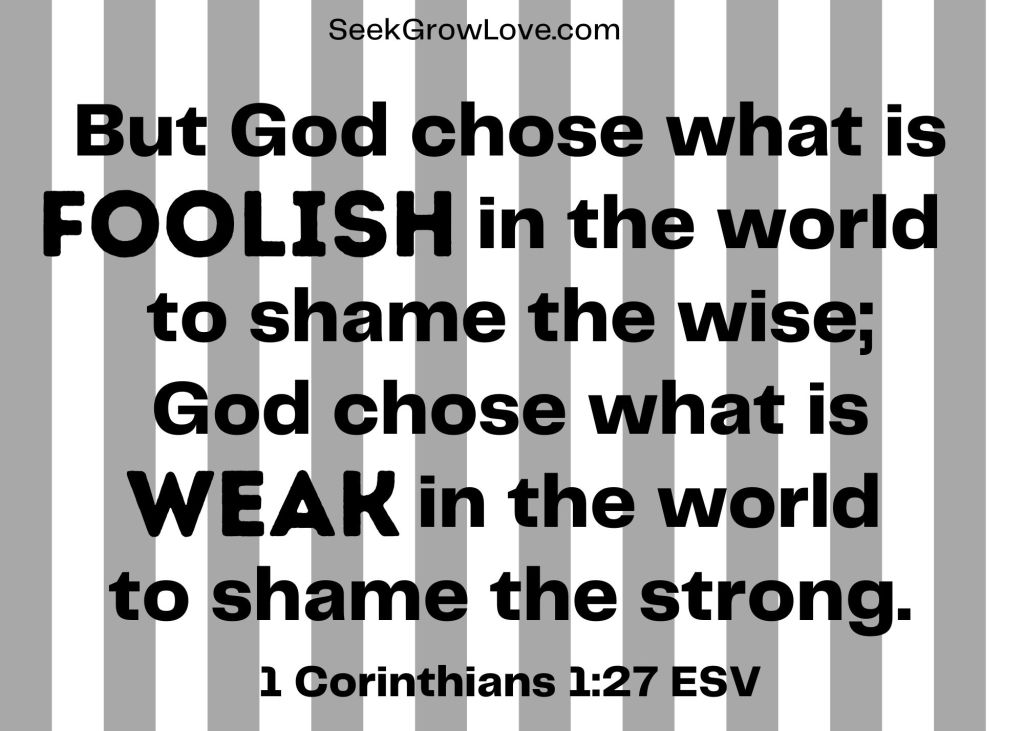
The first set of words contains synonyms for the word “foolish”, and the second one lists synonyms for “wise”. The end of I Corinthians 1 is contrasting foolishness and wisdom as it relates to God vs. man, and how God empowers us to do His work. Paul writes beginning in verse 25 (ESV), “For the foolishness of God is wiser than men, and the weakness of God is stronger than men. For consider your calling, brothers; not many of you were wise according to worldly standards, not many were powerful, not many were of noble birth. But God chose what is foolish in the world to shame the wise; God chose what is weak in the world to shame the strong; God chose what is low and despised in the world, even things that are not, to bring to nothing things that are, so that no human being might boast in the presence of God. And because of him you are in Christ Jesus, who became to us wisdom from God, righteousness and sanctification and redemption, so that, as it is written, ‘Let the one who boasts, boast in the Lord.'”

This verse causes me to bubble over with inspiration and gratitude every time I read it! I take great joy in reading accounts of the underdogs in the Bible whom God used to do great things, and in believing that He can do the same with me. Moses had a speech impediment, but God used him to speak with Pharoah and deliver the Isaelites from slavery. Rahab was a prostitute, but God designated her to save His spies and she was then in the lineage of Jesus. David was only a grungy, petite shepherd, but God used him to defeat Goliath. (David later served God as a great King of Israel, despite being a murderer and adulterer.) Gideon, who was the least important of his family (which was the weakest of his tribe), was hiding when an angel sent from God called him “Mighty Warrior”, but God led him to defeat the Midianite army with nothing but a miniscule army and God’s power. 

BUT GOD. 

BUT GOD. 

BUT GOD throughout history has called people to do great things through his power. Most of them were not already rich or famous or powerful, but when God gave them His power, He did mighty things through them! Even in the New Testament, we read in Acts 4:13 that people were amazed that Peter and John were “unschooled, ordinary men.” 

God is still active and working today. He wants us to strive for wisdom and seek Him. God wants to use you to do great things for Him! God is still using his people in big ways to impact their communities and the world. No matter your history, education level, age, job, or any other excuse you might share for why God can’t use you, remember… He loves to use imperfect people for His glory. 

-Rachel Cain

Reflection:

*What is your excuse for why God shouldn’t use you? Pray for Him to show you the way He sees you and give you His power. 

*What is God calling you to do that might be scary or out of your comfort zone? Pray about that situation and ask Him to fill you with His power! 

*What has God revealed about Himself today?

See Clearly

Matthew 7

January 7

“Do not judge, or you too will be judged.” (Matthew 7:1 – NIV) Its a loaded statement. We don’t like to feel judged and told that we are wrong, so we won’t judge and tell other people they are wrong. And so this single verse is used to justify, and even demand, blind acceptance of others and all their deeds. You are free to be gay – I have no right to judge. You are free to have the right to an abortion – I have no right to judge. You are free to believe you are a woman when God made you a man – I have no right to judge. You are free to hook up with anyone anytime you want – I have no right to judge. And that is what some would have us believe a good Christian should do. Let them be them and accept them for it. Their way is just as good as my way.

Only trouble is – the rest of this passage continues.

“For in the same way you judge others, you will be judged, and with the measure you use, it will be measured to you.” (Matthew 7:2 – NIV) If you use a yard stick to measure yourself but a meter stick to measure others, they will always be coming up short. It is not a fair and right judgment or measure. It is skewed in your favor to make others look less than. They just don’t measure up to your greatness.

Here’s a little true story example – I have been known to be put out and upset when someone I am waiting for is running late. How could they inconvenience me by not operating more according to my clock and my time schedule? Only trouble is, yesterday I was caught by a train (it happens here in northern Indiana – the crossroads of America) and I didn’t show up exactly when someone else was expecting me, but of course my tardiness was excusable, because it wasn’t my fault, I didn’t know a train was going to be coming, etc…. It is not my right to condemn, chastise, be upset with others if I am not willing to be measured in the same way. Late is late. And, in actuality, it’s not my clock or their clock that really matters anyway – but what does God’s clock or measuring stick or word say? That is what matters.

The passage continues, “Why do you look at the speck of sawdust in your brother’s eye and pay no attention to the PLANK in your own eye?…You hypocrite, FIRST take the plank out of your own eye, AND THEN you will see clearly to remove the speck from your brother’s eye.” (Matthew 7:3, 5 – NIV). If a brother has a speck in his eye and there was something loving you could do to help him get that irritating, painful thing out, wouldn’t you want to? Wouldn’t God want you to? But, how much help could I be in this delicate operation if my own eye has a beam sticking out of it? I can’t see clearly to help others out of sin when I am swimming in it myself. That sin in my own life is first priority. I must deal with it. Get rid of it. It may hurt like crazy to pull that beam out – but until I do, my usefulness to help guide and correct others is gone. Pull it out. Heal. See Clearly. Then, I can help others, with the same word of God, same guidelines, same measuring stick and same mercy and compassion that saved me.

It is very true I am not the judge and the jury. God is and He will share that job with His Son. But I DO have a responsibility to watch myself closely, to hold myself accountable to the Word of God, and to be very aware of what is happening around me – including the sin that so easily entangles.

All paths are not created equal. Some – the narrow ones that not many people are willing to stay on – lead to life. Others – the wide, easy, popular ones where the majority are – leads to destruction. It would be foolish of me to not be judging which path I am on at all times. See clearly the two paths.

We are told, “Watch out for false prophets. They come to you in sheep’s clothing, but inwardly they are ferocious wolves” (Matthew 7:15). This will require VERY keen eyesight and insight. We will have to be wise in judging what may at first seem right and true but in fact is cleverly disguised, dangerous, deadly lies which are leading many down the wrong path. Watch out! See clearly those who are deceiving and being deceived. Blind acceptance will take you somewhere you do not want to go.

Make sure you are not sitting in the house of the foolish builder as the wind picks up. Many in that house have heard the word of God. They may profess Christianity and call him Lord and even seek to serve him. But they are not acting any different from the world. They are not doing the will of God. They have grown comfortable with the plank in their eye. They have befriended the wolf in sheep’s clothing. They have failed to put Jesus’ words into practice. They are on the wide path approaching the wide gate that leads to destruction.

Get out and move to the house of the wise builder before the downpour comes! Hear Jesus and listen. Do what he says. Take the plank out of your eye. See clearly. Help your brother take the speck out of his. Don’t make friends with the wolf just because he dressed up like a sheep.

See clearly. All paths are not the same. All houses will not stand. All choices are not okay. All churches will not be saved. Some will lead to life. Some will lead to death. Use the same measuring stick – God’s Word and the teachings of Jesus. And put it into practice! See clearly. Judge roads and gates and houses and wolves wisely. Your life truly depends on this.

-Marcia Railton

Questions for Reflection and Discussion

  1. What was the difference between the wise and foolish builder? What fate awaited each? How can you put into practice the words of Jesus from Matthew 7 today?
  2. When we were introduced to John the Baptist and to Jesus we were told what they were preaching – see Matthew 3:2 and 4:17 to remember. Are any lessons from Matthew 7 connected to this preaching theme? If so, how?
  3. Is it easier for you to see your own sins or the sins of others? What advice does Jesus give? Pray to see clearly your own sins first so you can deal with them.
  4. How do you feel when you read Matthew 7:21-23? How does it relate to the rest of the chapter? How can we live now to avoid hearing these words from Jesus?

The Instruction Booklet

Proverbs 1

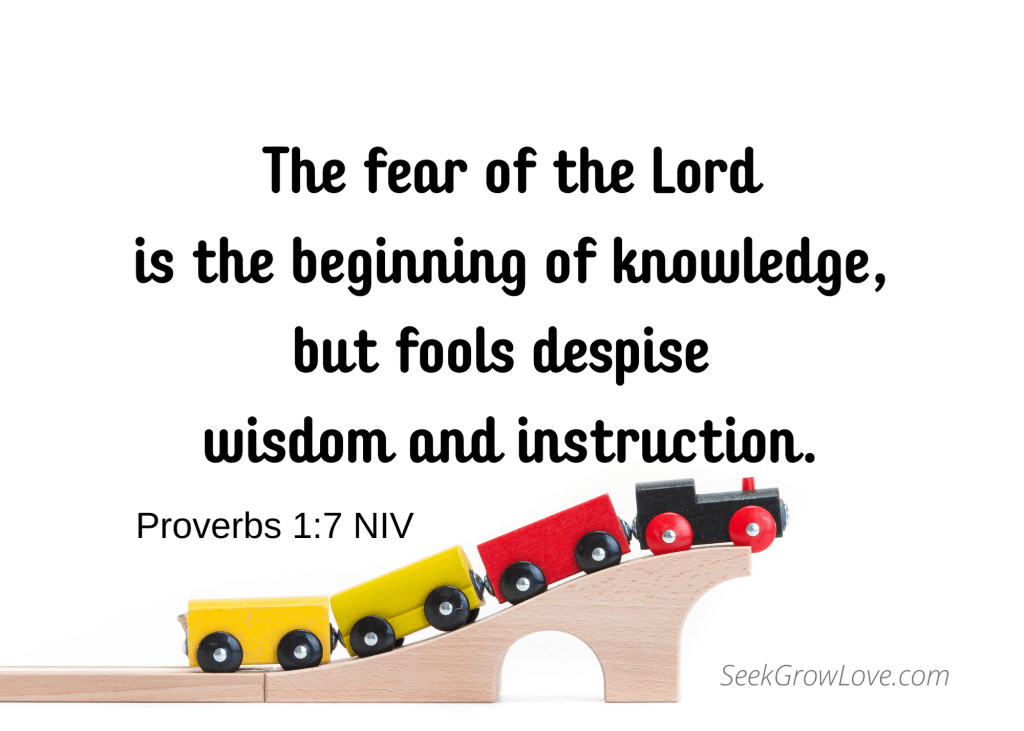
Have you ever tried to help a child put together a toy train track? There are so many pieces and in the end they are supposed to make a complete track. Some of the pieces make sense and, well, others are like that onion ring you find in an order of fries. No instruction booklet is included, so you are on your own. You attempt to put the train track together yourself based off of what you think it looks right. If you are like me, the end result is a train track with very strange turns and a dead end. It is not the complete figure eight as pictured on the box. If only the factory had sent some sort of instructions, then perhaps you wouldn’t be in this fix.

In Proverbs 1, we learn from that, “the beginning of knowledge is the fear of the LORD”. It tells us that only fools despise the wisdom and instruction that they receive. The Bible offers us so much instruction on how to live our lives. Proverbs tells us to walk in the way of wisdom and here we are told that to be knowledgeable we must look to God. He is the foundation of knowledge and only through Him and the heeding of His word can we hope to access true wisdom.

It is encouraging to know that, unlike the factory and the toy train, God gave us an instruction booklet. He didn’t expect us to just figure it out, but God gave us His word so that we may have wisdom and know Him. Sometimes, though, when we are going through hard times, it can be difficult to remember to go to Him and His word for guidance. Like with the train, the instruction booklet may not have been included, but I could have Googled it. Sometimes we get so caught up in the moment that we forget to look for wisdom and instruction.

-Hannah Deane

Today’s Bible reading passages can be read or listened to at BibleGateway here – 1 Kings 15-16 and Proverbs 1

His Story

1 Kings 15:1-24 & 2 Chronicles 13-16

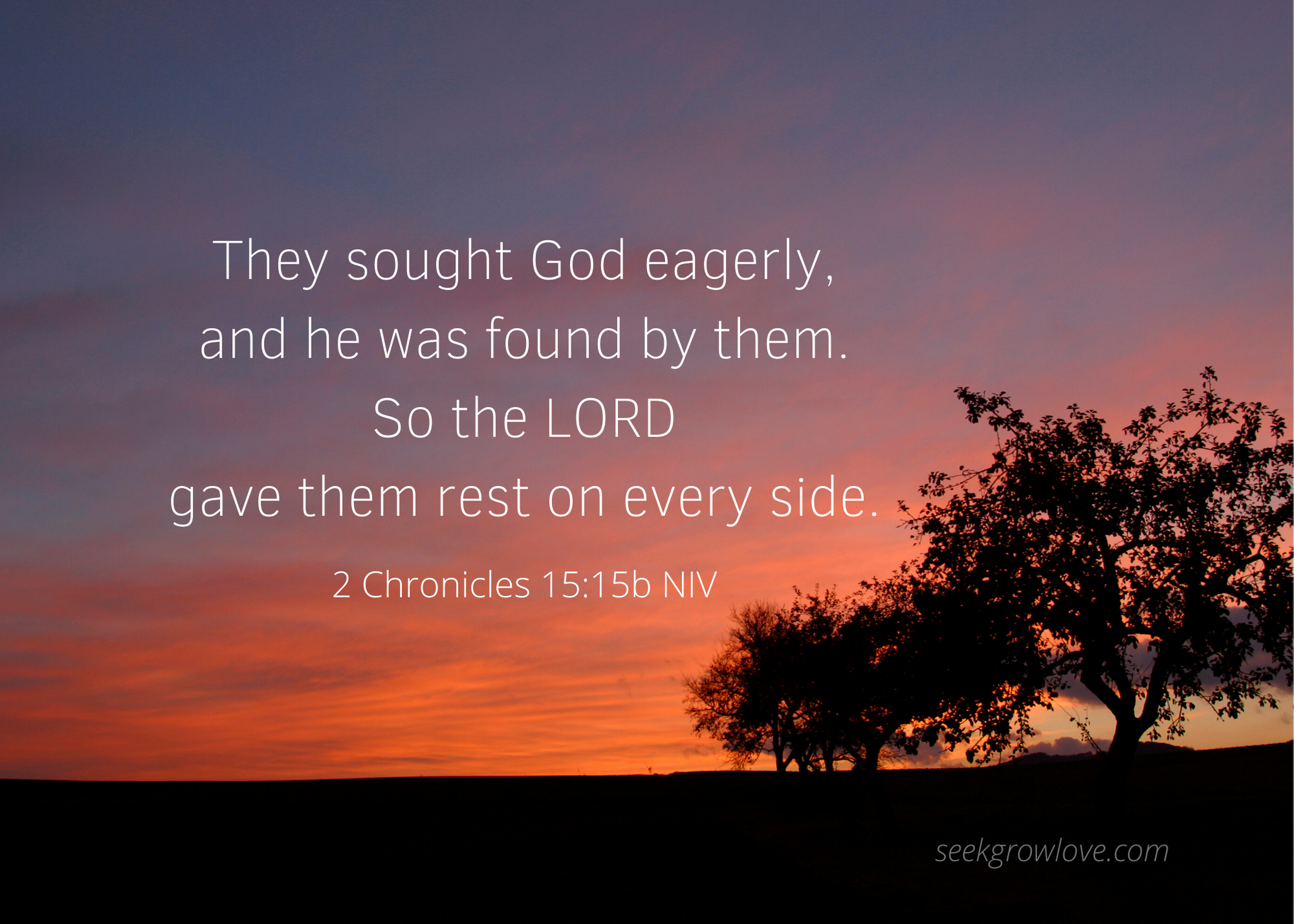
2 Chronicles 15 15b NIV sgl

History is a curious thing.  Today’s reading covers two different kings of Judah, Abijah and Asa, from the perspective of two different writers.  It is quite interesting to see what is remembered and omitted and concluded from the lives of these two kings from the two different authors writing at different time periods for different purposes.

Let’s look at Abijah, King David’s great grandson.  It is easy to love the Abijah recorded in 2 Chronicles 13.  King Jeroboam of Israel is closing in with an army twice the size of King Abijah’s of Judah.  But Abijah responds with courage, faith in God and a rousing speech.  He speaks of Israel’s united history under David and God and then records the sins of Jeroboam (& Israel) in breaking with God, the God-ordained priests, and the house of David.  He concludes that, “As for us (Judah), the LORD is our God, and we have not forsaken him….God is with us, he is our leader.” (2 Chronicles 13:10,12). And then, even though an army twice their size is before and behind them, God gives the victory and Abijah’s army wipes out over half of Jeroboam’s fleeing and destroyed army.  It’s exciting to see how God shows His strength through Abijah.

And then we read the account of King Abijah as recorded in 1 Kings 15.  The details of his life agree completely with what is recorded in 2 Chronicles: reigned 3 years, son of Rehoboam and Maacah, there was war between him and Jeroboam, and his son Asa would rule after his death.  But, absolutely nothing is said of the moving speech or victorious battle or God as his leader.  Instead, the writer of Kings sums up Abijah’s life by saying, “He committed all the sins his father had done before him; his heart was not fully devoted to the LORD his God, as the heart of David his forefather had been.” (1 Kings 15:3).

Oh, Abijah, we had such hope for you from that one outstanding snapshot of your life.  Your sermon that day was so full of convicting truth – that you forgot?  What went wrong?  How was your heart divided that sin won out?  Didn’t you daily recall how God fought for you?  Did you think you did that on your own?  It is discouraging to see what could have been, or once was, a strong testimony for God crumble and cave to sin and a divided heart.

But, it is also encouraging to see what God can do for His purposes – even when He’s working with and through sinful, broken people.  He can use the Joshua’s, the David’s and the Abijah’s and you and me.  He has and can and will have the victory any time He wants – and He can do it using any one He wants.

It is also interesting to see what one chooses to remember when looking back on history.  How do we portray and ultimately judge the heroes and the villains?  Which statues do we decide to pull down, if any, or why not all?  Everyone is certainly a mix of wise and foolish choices.  Some of our forefathers had some really good, faithful days (like Abijah’s) and these can still be celebrated today.  Remember the Chronicles were written long after these events took place and were written to encourage the returning exiles.  They needed to remember the faithful God who worked through the house of David and the priestly line.  They were being prepared for the coming arrival of a Messiah from the house of David who would be a priest like none before.  It would be helpful for them to remember their history as they prepared for their future.  It was time to bolster their courage and faith and remind them that God is their leader.  They needed the story of Abijah’s Really Good Day and the God who supplied it.

And, it is also valuable to consider the bigger picture of someone’s life to see what to avoid in order to get us where we want to go.  Rather than using our own flawed measuring stick to judge (popularity, wealth, good speaker, etc…), whenever possible it is helpful to know what God thought of the man.  That is going to be what really counts, so that is what I want to pay attention to so I am not setting up heroes for my life that God would disapprove of.

All that and we finally get to Asa – one of the few kings recorded as, “good and right in the eyes of the Lord his God” (2 Chronicles 14:2).  And the writer of Kings agrees completely.  There are some beautiful passages you won’t want to miss about God’s provision and Asa’s seeking and working for God wholeheartedly, even when it meant going against some of his family.  Although, for all his wise and courageous decisions, he still had a rough spot towards the end of his reign when he chose to rely on man instead of God – and there was a price to pay for that error.  But it would be a mistake for us to judge and remember Asa only for that sin that sadly would affect him and many others for years to come.

History is interesting, as is our record of it, and our judgement of those who have come before.  But first and foremost lets learn to us it to grow closer and closer to living a life seeking and serving with an undivided heart the God who created all history and present and future.  What would He have you learn from His Story today in order to live better today and prepare yourself for His Future?

Keep Reading His Word and Seeking Him

Marcia Railton


Today’s Bible passage can be read or listened to at https://www.biblegateway.com/passage/?search=1+Kings+15%3A1-24%2C+2+Chronicles+13-16&version=NIV

Tomorrow’s Bible reading will be 1 Kings 15:26-16:34 & 2 Chronicles 17 as we continue on the 2020 Chronological Bible Reading Plan


To Answer a Fool – or Not?

Disagree – Wisely

Proverbs 26 4 5 NIV

Proverbs 25 & 26
Proverbs is hard to write ONE devotion about. From chapter 10 forward, nearly the entire book is a collection of pithy quick sayings that were meant to produce wisdom in those who learned them. (Only chapter 31 is different, but that will be for another author to work through!) Today, for chapters 25 and 26, I want to focus on just one set of verses.
There are two authors to every word of the Bible. The first is the human author, a person who lived in a specific place and time, thought and wrote in a specific language and who was fallible and failing just like the rest of humanity. Also, Christians believe the Bible is inspired by God. This means that God directed the author so that the words, ideas, and stories are those by which God wanted people to live and that everything in the Bible is true. Short and simple, the Bible is not full of lies and misinformation, and it doesn’t contradict itself. (1)
That seems like a hard standard to hold when we read Proverbs 26:4 and 26:5.
26:4 Do not answer a fool according to his folly,
Or you will also be like him.
5 Answer a fool as his folly deserves,
That he not be wise in his own eyes.
DO NOT X & DO X. That is a pretty clear contradiction, right?
Well, yes and no; let me explain. It is clearly contradiction if we believe that all the Proverbs must be followed all the time, like the laws of the Torah. But this is not how the Proverbs were intended to be used.
Proverbs were meant to make people wise, and therefore were to build wisdom AND BE USED WITH WISDOM. Every Proverb doesn’t always give what must be done in every situation always, but instead tells you a general way of living that should guide you in the moment to make a wise decision.
The question we are hard-wired to ask is : Is it right or wrong to answer a fool? But,  THAT’S A BAD QUESTION! Instead we should be asking : Is it wise or foolish to answer this fool right now? Sometimes you debate with a person in private who will never change his or her mind, and you have to throw up your hands and say, “Not worth it” or you could be dragged into the mud and muck of folly and error. Sometimes, you need to correct someone for the foolish thing he or she has said or done, or they go on being foolish forever. Either approach could be wise or foolish; it is the wisdom of God that will sort out which way we should go.
Thus, God’s word is kept from our bad interpretation and we recognize that there is no contradiction!
Jake Ballard
(1) Rarely, if ever, is something truly “short and simple.” There are lots of implications and theological, historical and scientific questions that come up, but sadly, we don’t have time for that at the moment.
Today’s Bible reading can be read or listened to at

Tomorrow’s reading will be Proverbs 27-29 as we continue the 2020 Chronological Bible Reading Plan

A Word for the Fools

Proverbs 8

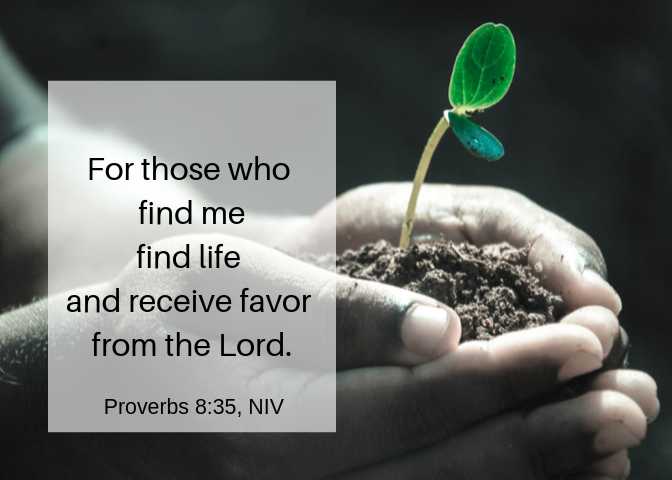
Proverbs 8 35 NIV

This chapter is very poetic and filled with a personification of wisdom.  It is used to draw people in and make the writing more personal, and to have greater impact.  I think this is a way of showing how important Godly wisdom is, and how important it should be to each of us.  The idea that wisdom is calling out at the entrance of the city so that we can each hear “her” is an interesting idea.  Obviously, wisdom is a virtue that we should aspire to, not a being.  However, it is so important, and so beneficial to each of us, something that God desires each of us to have, it is as if wisdom is crying out to us, and we need to listen.

If wisdom is something that we aspire to, why do we need this chapter showing all the strengths of wisdom?  Why do we need to hear wisdom calling out to us?  Why do we need to be told again to heed instruction?  This has already been stated multiple times in the first 7 chapters of proverbs.

Verses 4 and 5 say:

To you, O men, I call,
And my voice is to the sons of men.
“O naive ones, understand prudence;
And, O fools, understand wisdom.

Maybe this isn’t for all of us.  We are all “men” (or people) and sons (or children) of men, but verse 5 specifically talks to naïve ones and fools?  So, maybe this is just for people who aren’t getting it yet.  But, maybe if we are thinking it is just for the naïve or fools, we are being naïve and foolish.

Verses 7 and 8 say:

“For my mouth will utter truth;
And wickedness is an abomination to my lips.
“All the utterances of my mouth are in righteousness;
There is nothing crooked or perverted in them.

When I look at this, I have to admit that not everything I say is done in righteousness.  I say things out of anger at times.  I say things at times when I should jut keep my mouth shut.  So, I still need help with wisdom.

I can read through this chapter and point out things in nearly every verse that shows how important wisdom is.  We obviously need to be reminded of this often, based on how often it is written about.  I encourage you to read through this and pick out each of these items.   The end of the chapter summarizes why we should do this:

“Now therefore, O sons, listen to me,
For blessed are they who keep my ways.
33 “Heed instruction and be wise,
And do not neglect it.
34 “Blessed is the man who listens to me,
Watching daily at my gates,
Waiting at my doorposts.
35 “For he who finds me finds life
And obtains favor from the Lord.
36 “But he who sins against me injures himself;
All those who hate me love death.”

Wisdom comes from God and will only be gained when following God.  This will lead to eternal life.  If we turn away from wisdom, we are turning away from God, and that leads to death.

Andrew Hamilton

Trust Conquers Uncertainty

Eccles 10 2

Ecclesiastes 9:13-11:6

“An example of wisdom that greatly impressed me.” Wisdom that greatly impressed the man that chose wisdom over all of the world’s riches? Okay, you have my attention. It was wisdom that impressed him and saved a city from a superior force. But fools neglect and forget the wise. In times of trouble the wise find themselves surrounded by the lost and afraid, looking for direction. But as soon as they feel safe again they cast off the wise and get back to their hollow lives.

Forget about the wise. Besides it only seems to take a little bit of foolishness to nullify all that the wise do. Whether it is a wise man doing himself harm from his own stupidity or being harmed from someone else, we have seen this and have likely experienced it firsthand. “One sinner destroys much good.” Foolishness is so common. It almost seems incomprehensible that people continue to act the way they do. But I guess that it is easier to believe the unbelievable, to follow the fools way that appears flat and smooth rather than to face the hard truth, to take the difficult path of wisdom and honor. Jesus said it best when he said, “Enter through the narrow gate. For wide is the gate and broad is the road that leads to destruction, and many enter through it. But small is the gate and narrow the road that leads to life, and only a few will find it.” Matthew 7:13-14. The great value of wisdom is lost on the foolish.

Despite what many might think, verse 2 has nothing to do with our modern political party system or whether you are conservative or liberal. The people of Israel understood that the right hand of God is a place of authority and protection. The wise, who we have described as godly, would seem to naturally be inclined toward the right while fools go in the opposite direction. What’s more, the fool flaunts his stupidity. It says he “walks along the road” and “shows everyone how stupid he is.” If you doubt the truth in this I suggest you take an objective look at social media! “Preach it brother!”

Solomon spends a lot of time in these passages reminding us that life is not fair. We may work hard and not get the results that our works merit. Someone else may get all the benefits of what we do while not contributing to it themselves. And of course there are dangers all around us, accidents do happen after all. He urges us to see the dangers, to be aware of them. Preventing us from falling into a pit, literally and metaphorically. The fool though will walk himself right into a pit, into “wicked madness.”

I want to take a moment to address 10:19, specifically “money is the answer for everything.” This is how my NIV puts it and this is a great example of a red flag moment in Bible reading. I personally look at this and I am stunned by most of the commentaries I read concerning this verse. At best they say this is Solomon’s wry humor or his attempt at sarcasm. At worse it is a passage that feeds all the prosperity preachers out there. “You may be struggling to pay your bills right now but God will provide a great bounty, a time of plenty. God knows what you need.” Yes, God does know what you need! We need a relationship with Him, with His son Jesus, and with one another. We need to be like the flowers of the field and be content with what we have. So why does Solomon say this? The original Hebrew reads something more like the NEB version, “money is behind it all” or the NIrV, “people think money can buy everything.” I find it interesting that the young reader version of the NIV is so dramatically different from the standard version on this passage. Apparently kids can handle this truth better than adults can.

Solomon urges us to be diligent and trust in God else we find our heads in the clouds and daydreaming. We cannot get caught up playing with “what ifs” and “what could have been”. We can only affect what we can and trust God to handle the rest.

God has asked His people to trust Him from the very beginning. He has made promises and He has kept those promises. He has worked in and through various people and revealed Himself in many ways. And then the world went dark. For 400 years God was silent, still working but not revealing as He had been. That all changed when an angel of the LORD appeared before Zechariah letting him know that his wife Elizabeth would give birth to a son. That son, known as John the Baptist, would herald in the time of Jesus’ ministry. Jesus, the son of God, knew what he must ultimately do. He could only go to the cross with confidence if he fully trusted in God. After he ascended to the right hand of God the world once again seemingly went dark. …

Indeed it is dark for those who lack trust in God, who do not have a hope through His son Jesus. God calls for trust. Solomon wrote God’s words to teach us how to trust. Jesus’ sacrifice was a display of trust. We remember that sacrifice and know that his was the only death that actually has meaning, for Jesus’ death is the one that gives life.

-Jeff Ransom