
Bless the Lord

OLD TESTAMENT: Ezekiel 43-45

POETRY: Psalm 134

NEW TESTAMENT: John 6:1-24

Our psalm for today, Psalm 134,  is one of the fifteen psalms labeled as “Psalm of Ascents” which in the Hebrew Bible are Psalms 120-134, so today’s reading finishes up this section of psalms.  The author of this one is not known, but it is believed that these psalms were written during the 70 years of Judah being exiled in Babylon (same period from Ezekiel’s prophecies we are also reading right now).

Whether or not this was necessarily the intent of these psalms, they were used later by Jewish people who would sing them as they traveled to Jerusalem for the appointed “Pilgrimage festivals” according to the instructions they had been given in Deuteronomy 16.  Looking back on this group of psalms, I can imagine they would be a wonderful source of encouragement on a long journey (heading uphill to Jerusalem!), and could also facilitate a spirit of giving praise and honor to the LORD.

I read some commentators noting how many phrases from these psalms were used in early/traditional hymns as well as how many continue to surface in contemporary worship songs. In fact, when I read today’s psalm, I had a song pop in my head using these words, and imagine others might have had the same happen but with completely different songs based on the many choices out there.  Personally, I also had a scene surface from the Sound of Music when I read Psalm 121! These psalms are certainly jam-packed with lots of beautiful references, lyrics, and thoughts on which to meditate.

We do not have to make the pilgrimage to Jerusalem anymore, and we do not currently live in Babylonian captivity. But, we live in a world whose messages and words are far different than the ones we read in the Psalms of Ascent. Sometimes the messages are blatant screams, and sometimes they are subtle whispers, but as they bombard us, it is easy to forget who deserves our praise, honor, and obedience. It is also easy to mindlessly sing familiar songs, recite familiar psalms, or get caught up in the razzle dazzle displays of “worship music” sometimes.  But, He deserves better.

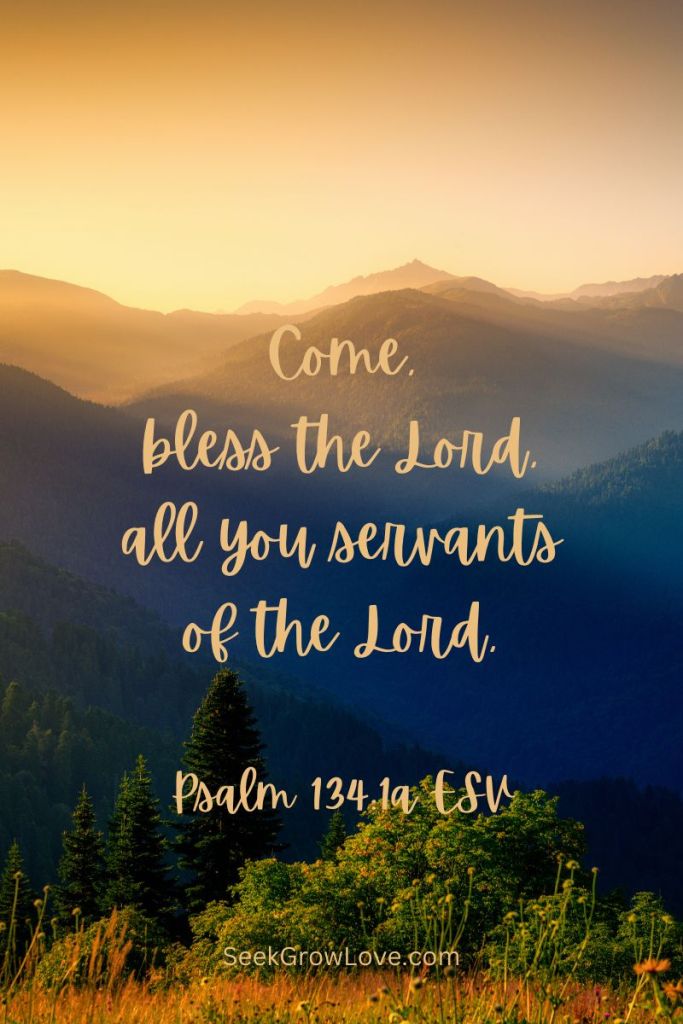
“Come, bless the Lord, all you servants of the Lord. . .” (Psalm 134)

What does blessing the Lord mean though? Doesn’t He bless me?  Ahh….well, to give us a picture of how we are to be blessing Him here…..this Hebrew word in this context means to “praise and adore”.

This week, I’m guessing many of us could likely amp it up in the praise and adoration of God and Jesus.

-Jennifer Hall

Questions:

  1. How can psalms, hymns, verses, or worship songs encourage you on the difficult life journeys you face?
  2. How did the Psalms of Ascents make you feel as you were reading them?
  3. Consider some reasons God and His son Jesus are worthy of praise and adoration!
Strike up the Band!

1 Chronicles 6

1 Chronicles 6 32a NIV

As our Bible reading today we have just one chapter in the book of 1st Chronicles (chapter 6) – still in the genealogies.  This chapter is devoted to the tribe of Levi.  Levi was one of the 12 sons of Jacob and his descendants would be the ones God chose to be the Levites for the nation of Israel.  They were set apart for service to God.  They would be the care takers of the tabernacle (where people sought God), and later the temple.  From their tribe would come the family line that would serve as priests and the most holy role of high priest, which later Jesus himself would take upon his shoulders.

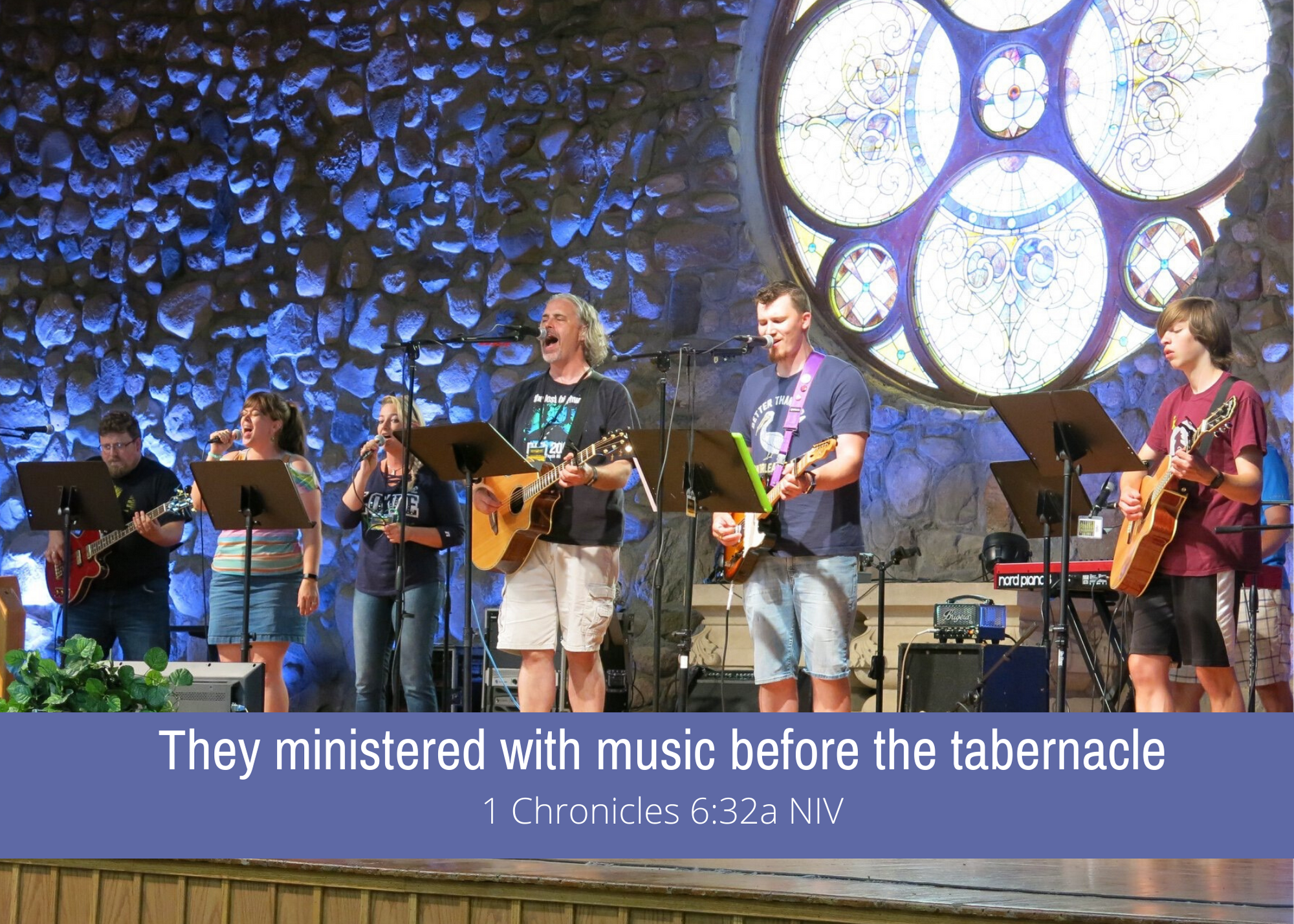
But, that’s not all – some of the Levites (those listed in verses 33-47) – were given the responsibility of temple musicians.  They were to play, sing, and make music to the Lord – to lead the temple-goers in their worship of the Most High.

I love that God created us to enjoy music.  I love the power of music – just read any article on music and the brain or music therapy – or better yet – listen to the nurse as he plays his guitar in the hall of his covid-19 ward.  Or witness the miraculous turn-around of the struggling infant when his big sister sings to him the song that she always sang to the baby in her mommy’s belly.  Or hear the band play as the Titanic sinks.  Music grips us and moves us in many ways.  Let music be a source that moves you toward God as you come to worship.

As our church has gone online during this time of isolation, I miss the community lifting their voices and instruments together in worship.  But even now, music remains as a powerful means to move us closer to God.  Look up the words to an old hymn.  Pick up an instrument you have neglected too long.  Thank those who have used the gift of music to lead you into meaningful worship.  Share with your family a song that reminds you of God’s love, character and promises.  Search for Bible verses about music.  Play worship music as you go about your day.  Research how many instruments are listed in the Bible?  Post a song of Christian joy and hope on social media.  Write your own psalm of praise – maybe you will even set it to a tune.

Music was a powerful part of worship long ago, it is still today, regardless of our situation – and it will be in the future as well.  I love the verses in Revelation where the faithful will sing in worship to God and the Lamb Jesus Christ as the Kingdom of God is preparing to unfold.  Let’s get started practicing today to be a part of that choir!  God and His Son are worthy of our worship!  Sing it out!


Marcia Railton


Today’s reading can be read or listened to at https://www.biblegateway.com/passage/?search=1+Chronicles+6&version=NIV

Tomorrow we go back to the Psalms – 81, 88, & 92-93 as we continue on the 2020 Chronological Bible Reading Plan

How to Pray: Words

Wednesday October 4th, 2017

Lord's Prayer

Unlike when we discussed the posture you should have when you pray, the Bible actually has a lot to say about what words you should use when you pray. Jesus gives a great lesson on prayer in Matthew 6:5-15. I want to start by looking at what the Lord’s Prayer can show us.

We can split the topics of prayer into three categories:

  1. Praises (Matt 6:9)
  2. Petitions (Matt 6:11)
  3. Repentance (Matt 6:12-13)

You might notice that this is one category more than we usually talk about when we pray at church. Jesus himself says that we need to pray for repentance, so make sure you don’t forget to add this to your prayers. Praises and petitions are a lot more familiar to most of us, though. When we praise, we thank God for who he is and what he has done and petitions are when we ask God to provide for us.

Another thing Jesus says is to not babble (Matthew 6:7). Repeating yourself does not make yourself heard. Keep your prayers to the point. Especially when you are praying for a group of people. You don’t need to make your prayer sound special and eloquent. God already knows what needs to be said, so you don’t need to repeat yourself. This is not to say that you shouldn’t continue to pray for something.  If something is on your heart, you should pray for it continuously. In my opinion however, the reason for this is not so that God will be more likely to consider your prayers. More on that tomorrow.

Here a few interesting things to note. Discussion can be a form of prayer. In Luke 9:18, Jesus is praying and talking to his disciples. I believe that when we discuss our prayers with each other, we are participating in a form of prayer. Another form of prayer is music. We can praise God in our songs or we can ask for His help; we can even repent through song.

Jesus gives a few more commands regarding how we should pray in Matthew 6.  For one, he says that we should pray in private. But he also says that God already knows what we need before we ask him (Matthew 6:8), so why do we need to make these prayers in private? You’ll have to come back tomorrow to hear the answer to that one, but I’ll give you a hint now. It has to do with our memory verse: being changed.

-Nathaniel Johnson


The Other Christmas Story

Psalms 1-7

second-coming

Saturday, December 24

In our reading today, we enter into the book of Psalms.  To use an analogy, Psalms is probably like the collection of worship music that your worship team is using at church.  They were written to be set to music, have a variety of authors, covers a wide variety of themes and topics, and even have instructions to the “worship leader” as how (tempo, instruments, mood) many of these psalms should be played.  You will notice as you read throughout the book of Psalms there are lines, stanzas, and chapters that have found their way into the Christian worship (and even some secular music) of today.

One recurring topic, laced throughout the book of Psalms that fits our reading and the season, is the prophetic telling of a promised Messiah: his jubilant arrival, the long awaited Word of God becoming flesh.  The angels, the earth, the heavens, and every man had been created with a longing for this event and had waited its fulfillment (Colossians 1:15-20).  Sadly, much of the focus of this season has turned away from the telling of this story, and turned to other ones.  In many of the Christmas movies I know,  someone asks, “Who wants to hear the story of Christmas?”  The family patriarch takes a seat by the fire.  Children gather around at his feet.  Everyone quietly listens as the story begins.  “Twas the night before Christmas and all through the house…”  I sigh.  This is not the LIFE-ALTERING, SALVATION-BRINGING, PROPHECY-FULFILLING, HISTORY-CHANGING Christmas story I know, BUT there is a rivaling Christmas story that is equal, or even greater than the one we currently know about the humble beginnings of a baby in a manger. This story is made mention of in the Psalm 2:

“I have installed my king on Zion, my holy mountain.  I will proclaim the Lord’s decree:

He said to me, “You are my son; today I have become your father. Ask me, and I will make the nations your inheritance, the ends of the earth your possession. You will break them with a rod of iron; you will dash them to pieces like pottery.” – Psalm 2:6-9

The first advent of Jesus Christ is the fulfilling of prophecy, but it is not complete; there is more to come.  There is a second advent of Christ.  He will come to earth not quietly in a manger, but as the King empowered by God Almighty.  EVERYONE will know of his arrival. To those who know Jesus, it will harken a time of great joy, restoration, and peace; however, the fulfillment is still not complete.

“Therefore, you kings, be wise;be warned, you rulers of the earth. Serve the Lord with fear and celebrate his rule with trembling.  Kiss his son, or he will be angry and your way will lead to your destruction, for his wrath can flare up in a moment.  Blessed are all who take refuge in him.” – Psalm 2:10-12

 There is no justice in telling part of this.  For these wonderful things to occur sin, evil, and death must be destroyed, including those who do not give their lives to the King of Kings.  When all this has happened, the story is complete, and a new age and life begin.  If there is another story we tell at Christmas, let it be this one; the one that has power to bring everlasting joy, peace, salvation to all men.

-Aaron Winner