Can You Be Called a Berean?

Acts 17-19

autumn background

Saturday, June 10

Does your church have a Berean Youth Group?  Way back when, as a child growing up at Garden Park Church of God our youth group was called the Bereans, and I know the name was also used in many other church youth groups.  Hopefully, even if you have never been called a Berean, you really are – or you are working towards that right now.

The name comes from Acts 17.  Paul and Silas had just barely escaped a mob of jealous Jews in the city of Thessalonica.  During the night they fled to the next town and their missionary journey continued – in the town of Berea.  Acts 17:11 says, “Now the Bereans were of more noble character than the Thessalonians, for they received the message with great eagerness and examined the Scriptures every day to see if what Paul said was true.”  Unfortunately for this church group the troublemakers from Thessalonica came to Berea to rile up the masses against the missionaries here, too.  Paul was quickly whisked away to safety in yet another town even further away (Athens) and Silas and Timothy were told to, “join him as soon as possible.” (17:15)  So, this is sadly the only mention in the Bible of the church group at Berea (besides one of its members accompanying Paul in Acts 20:4) .  And yet, what a great thing to be said about this body of believers!  I would imagine that this church did alright – even without the help of months or years of teaching and preaching and encouragement by the famous missionaries (as several other churches would receive).  This church was making sure that they were grounded in God’s Word – daily.  They were diligently using God’s Word (the Old Testament, at that time) to test the “modern” ideas and theories.  Looking to His Word to see – who is this Jesus?  Is Jesus really the promised Messiah?  Is everything that Paul says true?  I have no doubt that God blessed their searching and revealed the answers to them.

In these 3 chapters alone there are multiple other passages reminding us of the importance of Scripture.

Acts 17:2-3 “As his custom was, Paul went into the synagogue, and for three Sabbath days he reasoned with them from the Scriptures, explaining and proving that the Christ had to suffer and rise from the dead. ‘This Jesus I am proclaiming to you is the Christ,’ he said.”

In Acts 18 we meet an interesting man named Apollos, a man with a “thorough knowledge of the Scriptures” (Acts 18:24) – remember that was the Old Testament.  He was on-fire for God, believed in Jesus and was a great speaker and spoke accurately all that he knew – even though he had thus far ONLY been taught about Jesus’ baptism.  Priscilla and Aquila saw his passion and heart and welcomed him into their home so they could teach him much more.  Armed with his new-found knowledge and understanding Apollos “was a great help to those who by grace had believed.  For he vigorously refuted the Jews in public debate, proving from the Scriptures that Jesus was the Christ.” (Acts 18:27,28).

You don’t need to know everything to start standing strong for Jesus.  Start with what you know and keep using all your means and the Word of God given to you to deepen your understanding and your love for your Creator and His Son.  And, just like Priscilla and Aquila, be a Godly mentor and guide to anyone in need of just a bit more understanding.

My prayer for you and me is that we might love His Word more and more and learn what He has prepared for us.   Let’s be Bereans together – examining His Scriptures daily.  His Word is alive and active.  Love it and learn from it!

-Marcia Railton


JOY!

Acts 13-16

acts 16 joy

Friday, June 9

I love listening to missionary stories.  I love hearing how bold men and women have carried the good news of God’s love and plan of salvation to others, sometimes meeting with great success, eager ears, and saved lives, while other times being faced with disappointment, ridicule, shunning or great danger.  The book of Acts delivers all this and more as the great missionary Paul along with Silas, Barnabas, John Mark and others worked tirelessly to teach, preach, baptize and encourage churches and individuals through many towns and countries – growing the Kingdom of God.

One word that caught my attention in these chapters was JOY.  Acts 13:52 records, “And the disciples were filled with joy and with the Holy Spirit.”  Sounds great, doesn’t it!!   Things must have been going very well for our faithful missionaries to be experiencing such JOY.  But, wait, what were the verses just previous . . . “But the Jews incited the God-fearing women of high standing and the leading men of the city.  They stirred up persecution against Paul and Barnabas, and expelled them from their region.  So they shook the dust from their feet in protest against them and went to Iconium.” (13:50-51).  Trials, persecutions, and hardships, being expelled, cast out – these can easily bring up lots of human emotions.  Anger, rage, depression, hopelessness, fatigue, giving up.  But instead it says the disciples were filled with JOY – and with the Holy Spirit.  That is the joy that I want to have.   A deep joy that comes not from everything going as planned, but from knowing you are doing the Father’s Will – even when it is hard, even when it hurts.  A joy that comes hand in hand with His Holy Spirit.


JOY is used again in Acts 16:34 – this time at a truly JOYOUS occasion.  “The jailer…was filled with JOY because he had come to believe in God – he and his whole family.”  Can you imagine the scene – middle of the night, jailer hears singing from the cell as Paul and Silas praise God and pray.  Then – EARTHQUAKE!!!!  Prison doors thrown open and the jailer prepares to kill himself, since he would be executed if any of his prisoners ever escaped, and what prisoners wouldn’t escape if the prison doors were thrown open.  But then a shout is heard, “Don’t harm yourself!  We are all here!”” (16:28).  The astounded jailer needs to know more about these men and the Jesus they profess.  Paul and Silas gladly teach – and baptize – the changed jailer and his family.  The jailer takes them into his home and gives the missionaries a meal.  And there is JOY.  The baptism of a new believer is certainly one of the most joyful events.  But, what events were necessary to proceed this baptism?  In this particular case, the jailer would not have heard the gospel message if it weren’t for several catastrophes and trials: an earthquake, a mob attacking Peter & Silas (because they had healed a slave girl) which led to them being stripped and severely beaten and thrown in jail.  And, even then, if Peter and Silas had reacted differently to these crisis situations (perhaps with anger and selfishness rather than with praise and joy), the jailer would most likely have committed suicide instead of asking how to be saved.

I don’t know what you are going through today.  But, how can you face it with praise and joy and the Holy Spirit?  It just might lead to the saving of a life – maybe your own, and maybe somebody else’s.


-Marcia Railton


A Chosen Instrument

Acts 9-12

acts 9

Thursday, June 8

Saul fought Christ in every way possible throughout his life up until this point.  He was the most unlikely Jesus follower.  He loved God and served God and thought he was doing His will.  But he thought that Jesus had been a false teacher and liar and that everyone who followed and spread Jesus’ teachings needed to be stopped.  There are people today who think they are doing God’s will but instead are ignorant of the truth, possibly because, like Saul, they don’t understand who Jesus is.


And then came the light!  Following the spectacular flash of light and the great voice of Jesus, Saul was led to Damascus where he was blind and did not eat or drink for three days.   I imagine this was a time of tremendous wrestling and questioning and perhaps doubting everything that he thought he had known about his whole life’s work and about Jesus.


Enter Ananias.  In a vision, Ananias, a follower of Jesus, is given specific directions to find Saul and place his hands on him to heal him.  Ananias answers, telling the Lord what a bad guy Saul is and how dangerous this could be.  Has the Lord ever tried to send you in one direction and instead you had your list of reasons why it didn’t make sense?  God’s work and His will doesn’t always make sense to us, and it doesn’t ‘have’ to make sense.  Our list of excuses and reasoning is worth nothing in comparison to God’s plan and desire for us.  So the patient Lord once again told Ananias, “This man (Saul) is my chosen instrument to carry my name before the Gentiles and their kings and before the people of Israel.”  (Acts 9:15).  How might you also be the Lord’s chosen instrument?  To whom has he prepared and designed you to carry His name?  Perhaps not to kings, but maybe to your neighbor and facebook friends and co-workers?


So, with no more excuses left, Ananias went to Saul and placed his hands on him to give him sight.  Ananias told Saul he would be filled with the Holy Spirit.  With the Lord’s powerful light, three days spent questioning what he had thought he had known, and Ananias’ faithful intervention, Saul realized the mistake he had made in his life and he was healed and baptized.  Just like Saul, anyone can change their life and follow Jesus.  God can set anyone straight.  Keep praying for those fighting against Christ and consider how He wants you to carry His name to others?

-Jason Railton

Living Words

Acts 7-8

acts_waterdrop

Wednesday, June 7

Stephen had an interesting life that was cut way too short.  I wonder what would have happened had he lived longer?  How many more people could he have reached?  I admire the way he knew his Old Testament history.  Beginning with Abraham leaving his country, Stephen then recounts stories of Isaac and Joseph and Moses.


In verse 38 of Chapter 7, it tells us of the living words Moses received to pass on to us.  These words are still being passed on to this day.  Even when people hear the living words, they have a choice of what to do.  Back in Moses’ day, these living words were rejected.  The people refused to obey and in their hearts turned back to Egypt (7:39).  How have you heard the living words and what has your response been?  Are you listening to these words or rejecting them?


I respect the courage Stephen had in saying what needed to be said even if it meant angering those who could kill him.  Even as he was being stoned, he was full of the Holy Spirit and saw the glory of God, and Jesus standing at the right hand of God.  Stephan prayed that the Lord Jesus would receive his spirit and he asked him to not hold this sin against them.  This is an example of an extremely dedicated and devoted man of God.  How many of us can praise God as Stephan did while being persecuted?


While Godly men buried Stephen, Saul began to destroy and persecute the church.  Tomorrow we will hear more about Saul and his stories.


-Jason Railton


Spreading the Word

Acts 5-6

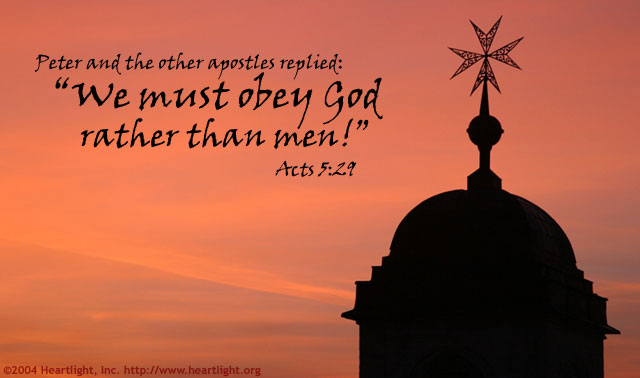
acts5_29

Tuesday, June 6

As we continue into chapters 5 and 6 , Peter and the apostles could have stopped spreading the Word of God because of fear of discipline from the Sanhedrin.  Instead, they continued to teach and preach and perform miracles, always pointing others to Christ.  Once again they were arrested and put into jail.  In the night, an angel of the Lord appeared to them and instructed them to go back out into the temple courts in the morning to tell the people the full message.

Verse 42 of chapter 5 says, “Day after day in the temple courts and from house to house, they never stopped teaching and proclaiming the good news that Jesus is the Christ.”  This verse explains pretty well that they persevered and just kept going and going and going.  Ask yourself this, “Who have I talked to today?”  Or this week?  Are we as dedicated to spreading the Word as Peter?  What can we do to become better at spreading the good news?  How can we all become more like Peter?

So my question to you today is, “Are you obeying God rather than men?”

-Jason Railton


Be Bold!

Acts 3-4

Be Bold Image

Monday, June 5

Peter and John were arrested for teaching about Jesus.  In 4:18, it says the Sanhedrin (the rulers, elders and teachers of the law,  making up Israel’s supreme court)  called them in again and commanded them to not speak or teach at all in the name of Jesus.  Peter and John replied, and in verses 19-20, they said:  “Judge for yourselves whether it is right in God’s sight to obey you rather than God.  For we cannot help speaking about what we have seen and heard”  What do we do today?  Do we listen to authorities rather than what God tells us to do?  Are we too tied up in being politically correct to say this or that or just plain don’t say anything at all just to be ‘safe.’  I think many people today don’t want to ruffle any feathers so they just sit quiet.  Do you stand up for what God says, or keep your mouth shut?


This just makes me think about being bold and not being afraid to speak the truth.  You should pay more attention to what God would desire, rather than being afraid you might offend someone.


In 4:23 it says: “On their release, Peter and John went back to their own people and reported all that the chief priests and elders had said to them.  When they heard this, they raised their voices together in prayer to God.”  So when we see something that doesn’t agree with a teaching from God, are we silent, or do we speak up and explain what is right in God’s eyes.


In verse 29 it says:  “Now Lord, consider their threats and enable your servants to speak your word with great boldness.”  Peter and John asked the Lord for extra boldness to speak His word.  Perhaps we should request the gift of boldness when it pertains to speaking up for what God instructs is correct.  This week let’s look for more opportunities to be bold.

-Jason Railton


Devoted

Acts 1-2

Devoted

Sunday, June 4

What are your three favorite things that your church currently does well?  Looking at the early church, what were their strengths and weaknesses?  We can learn from the early churches in many ways, such as learning from what they did well?

The people’s actions from the early church:

  1. Those who accepted the message were baptized. Does this still apply today?  Well we see many churches and different denominations baptizing their members, but some of them sprinkle, some use full immersion while others have different methods.  The Church of God of course, still practices the original immersion practice of baptism.
  2. The people devoted themselves to the teaching and fellowship of the apostles. Are we as devoted as the people in the early church?  How do you define “devoted?”  Is it 100% of your effort 24/7?
  3. They were consistent in breaking bread and prayer. What are the standards we adhere to in this generation when it comes to prayer?  Do we allocate time each day to prayer or do we get too busy with life to take the time?
  4. The early church sold their possessions and goods and gave them to anyone in need. How eager are the people of this generation to help others?  Do we sell our belongings and use the money to help those less fortunate?  Do we offer our talents that God has gifted us?
  5. They met together every day in the temple courts. Do the people of today’s church meet every day?  Sometimes we have a hard time just getting to church one day a week.
  6. They broke bread in their homes and ate together with glad and sincere hearts. Do we break bread together in our homes anymore?


Peter warned and pleaded with them to save themselves from this corrupt generation.  Does that warning still apply today?  Are we living in a corrupt world?  Do we mimic the early church or do we fall into the antics of this corrupt generation?  How devoted are we to the church? How can we become more devoted?  If we are a righteous church, and a people that follow Him, then God will add to our numbers daily as in the New Testament.

-Jason Railton


Why Am I Reading This?

John 20-21

Jn20

Saturday, June 3

If you are in high school, you have asked this question sometime this year. If you are in college, the question probably gives you flashbacks of finals. If you are like me, you are 300 pages deep in a 400 page textbook by the time the question comes up. By that point, you are too doggedly determined to put the book down. “By gum, I’m gonna finish it!” the stubborn, stalwart voice in my head says.
Truthfully, it is a great question. When we ask, “Why am I reading/watching/listening/responding to this?” we ask a bunch of questions at once. What do I hope to gain from this? How will this knowledge inform my future actions? In what way does this information or content contribute to my mental, emotional, physical, spiritual, or financial success and well-being? And the answers to “why am I reading this?” may be diverse. Maybe, like us college & graduate school students, you read something simply to gain the information from it for a test or project. Maybe you are reading to make wiser decisions in the future. But beyond these questions, which we ask of ourselves, this is also a question we ask of the author. We are also asking, “Why did you write this?” Why did J.R.R. Tolkien put pen to paper and craft some of the most iconic stories ever? (Lord of the Rings) Why did C.S. Lewis tell of magic (The Chronicles of Narnia), of angels and demons (The Screwtape Letters and The Space Trilogy), and teach through his lovable, accessible, British way (Mere Christianity)?
In the Bible, this question doesn’t get answered too often. The Book of Job doesn’t tell us why the author wrote it. Sure we have very informed guesses, like, “The good and righteous will suffer. That is the way of this world.” But never once does the author tell us WHY he (or she) wrote the text. The authors of Matthew, 1 Kings, and 1 Chronicles, similarly did not take the time to tell you why they wrote. Again, there is a case to be made that the purpose can be found, like “to record history.” But then, why is Matthew’s account of Jesus’ life so different than John’s, and why do 1 Kings and 1 Chronicles differ so greatly in their retelling of the same events? (There are answers to these questions. They are not easy answers, but they help us in understanding the text, if we are willing to do the work.)
All this is to point to two of my favorite verses in the entire Bible, John 20:30-31. If you have never memorized a verse in your life (John 3:16?), seriously, start with these two in John, because they could basically sum up the ENTIRE NEW TESTAMENT. Actually, there is a case to be made that the ENTIRE BIBLE could be summed up in these beautiful words.
John 20:30-31 –  Jesus performed many other signs in the presence of His disciples that are not written in this book.  But these are written so that you may believe Jesus is the Messiah, the Son of God, and by believing you may have life in His name.
The author of John completely acknowledges he left things out. It doesn’t matter to him that every single detail down the line be absolutely perfect. He does not even begin to suggest that he told the story in chronological order. There is no way to make the Synoptics (Matthew, Mark, Luke) and John compatible, with one single “correct order of the life of Jesus.” That isn’t the author’s point. The author didn’t write this Gospel to give us another “play-by-play” of Jesus’ life.
What the author does say, the reason why he put his pen to paper, what the Spirit was doing in him when it moved in and used him to write down words through the authors hand and brain, is so that YOU may believe. You reader. Not another “you”. I’m talking to you. These signs, these teachings, this crucifixion and death are written so that you may believe that Jesus is the Messiah, the Son of God. The author cares about how you deal with this. See, if at the end of the day you are done reading John and you say “Jesus was a really good man” or “Jesus was a wise teacher” then YOU’VE MISSED THE POINT. The point is not that Jesus was a pretty cool dude, or that he was a man who died for what he believed in. He was inaugurating the Kingdom of God by coming, and that we can choose to be a part of God’s Kingdom now; in other words, he is the Messiah. He came to live a perfect life, overcome the world, and be the lamb of God who takes away the sin of the world; in other words, he is the Son of God. Any other reading of John is a mistake. It is wrong. Jesus is not just another good leader, good religious teacher, good dude. He is the Messiah, the Son of God, the Only Begotten Son.
If you end up believing in WHO Jesus is, in WHO he pointed us toward, in WHAT he was doing by ushering in a new way of being, then you have hit the point of the message of Jesus. You understand what the author of John was doing in all these many chapters, in signs, teachings, moments with the Savior. Moreover, by believing in Jesus, you will have life in his name, eternal life, abundant life now that can’t help but last forever! I hope that is where you find yourself today. The reason why I write so much about John is because I love it. I am a mess. I am a broken and sinful mess. But there are a couple things I know. I see these signs, these miracles and this death and resurrection and I have to believe that Jesus is the Messiah, the Son of God. And because I believe, I know that I have life because of him. I didn’t earn it. I don’t deserve. But I’ve got it. Come, you who are also undeserving, just like me. You sinners like me. You broken messes like me. Jake, like John, calls out “Believe that Jesus is the Messiah, the Son of God, and by believing, you too can have life in his name!”
In Christ,
Jake Ballard
(Photo Credit: https://biblia.com/bible/esv/John.20.29)

How Do You Crown Your King?

John 18-19

PastedGraphic-1

Friday, June 2

(This is a longer post. Please give yourself ample time to read it and pray over the questions at the end.)
Interesting trivia: the Greek Orthodox Church fasts every Wednesday and Friday. Every single one. Why? There are reasons to believe the Jews began this practice of fasting and that they carried it on. Beyond that, they also add a religious and theological reason: on Wednesday Christ was betrayed and on Friday Christ was killed. Every single week they remind themselves that they are in some way responsible for the Son of God hanging on the Cross.
These are the chapters we read this week in John 18-19. They tell the story of Jesus’ betrayal, torture, crucifixion and death through the eyes of John. What can we learn from this?
First, Jesus said, “Am I not to drink the cup the Father has given Me?” (John 18:11) Jesus accepted that this was the way that God had given him, and did not want to resist this way with violence. We can be so much like Peter, who cut off the ear of Malchus. We can be so  quick to violence. But Jesus, even with these men sent to kill him, his worst enemies on earth, was about peace, love and healing. Luke 22:51 expounds the story by finishing up the scene. “But Jesus responded, “No more of this!” And touching his ear, He healed him.”
That’s because Jesus is not focused on the injustice of what is being done to him. He is not looking for his personal justice. Jesus is, instead, focusing on his God-given destiny and duty. When being questioned by Pilate, he says “You say that I’m a king.” Jesus goes on to say,  “I was born for this, and I have come into the world for this: to testify to the truth. Everyone who is of the truth listens to My voice.”(John 18:37) Jesus is focused, in the middle of supreme injustice and false imprisonment, on why he was born, the reason for his existing. And what is that purpose? Not to disparage any evangelical preacher, but Jesus did not merely come to do three days’ work. Instead, he came to “testify to the truth.” The truth is humans need to be saved from their sins, he is that salvation, he is the only way to salvation, eternal life and the spirit will be given to those who seek this truth.
In the midst of this, we also see a picture of the world. Now, I’m of a specific bent that says God does not control every facet of the universe. God does not predetermine or force my hand and only make me act as he wants me or wills me to act. However, this does not mean that the world is completely and utterly out of control. In a way that is completely unknown to me, a way that I daresay we should call a mystery, God controls certain events, outcomes, or situations. Here, Jesus seems to take comfort in the fact that his own torture and death is not outside of the plan of God. God knew, “If my Son goes among the Jews and tells them the truth, they will crucify him. I will give humanity the authority to do so.” God isn’t wringing his hands in heaven saying, “I wish I could do something, but I’m not strong enough!” Nor is God a puppet master with all the strings making his marionettes dance. He is working out his will inside the real, free, true choices of humanity.
Interestingly, Pilate may have gotten it. Pilate, according to all the history books was a brutal and bloodthirsty man ready to squash any rebellion with the slightest whiff. But I think he understood who he was talking to in Jesus and what the Jews were asking of him. He seems to have answered his own question “What is truth?” And he answers it with the inscription above Jesus’ head “Jesus the Nazarene, the King of the Jews” written in every common language. The truth is that in this suffering, we see the ultimate juxtaposition. A savior killed like a slave, a righteous man made wretched, a King on a cross. THAT’S the symbol we gravitate toward. That’s the symbol that defines Christianity. It is a cross that shows the greatest moment of humanity, depravity and sin, and the greatest moment of the God-granted mercy, compassion and love.
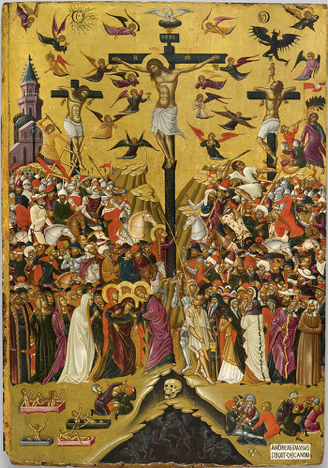
Then, Jesus dies. There’s no fanfare in the book of John. It is interesting that what happens in the other gospels, the earthquake and the darkness and the resurrection of righteous ones, are summarily overlooked or forgotten. They pale in comparison to the fact that the King of the Jews, the bread of life, the water of life, the SON OF GOD is hanging dead on a cross. This man, who only loved, who only wanted the best. Who demanded that the pharisees live the same life they demanded of everyone else. Who said “turn the other cheek” and “do not judge unless you are ready to be judged”. Who said “blessed are the meek, blessed are the poor, blessed are the persecuted.” This man who lived a life of perfect relationship and obedience to God, is hanging limp on a cross, covered in blood and bodily fluids. His arms and legs are no longer straining against the nails because he feels the pain no longer. His body bears the marks of scourging. His face is beaten beyond recognition, and above the bruises and laceration that disfigure the face of the Messiah, sits a crown of thorns, a gift from humanity to inaugurate our King.
There are many questions to ask of ourselves after this.
Do you treat your enemies with love and respect?
In times of trouble do you rest secure in the knowledge that you have a larger purpose than simply existing for today?
Do you even know what the larger purpose of your life is? Do you know specifically what the goal of your life is?
Do you rest secure in the knowledge that God is ultimately in control, whatever that might mean?
But above all of this is: what does it mean, FOR YOU, that the Son of God died on a cross? What does it mean for you that Jesus was tortured unjustly by a religious institution that couldn’t handle the fact that they were, in fact, broken and messed up and needed some saving? What does it mean for you that you were just as much responsible for the death of Jesus as Pilate and Caiaphas?
What will you do? We’ve place the crown of thorns of his head.
Will we cast our crown before him and acknowledge that Jesus is not only the King of the Jews, but the King of Kings and the Lord of Lords?
Will you commit to making him YOUR Lord, the Lord of every part of your life?
In Christ,
Jake Ballard

The “Paraclete”

John 16-17

john 16

Thursday, June 1

Here is a helpful bit of information about the Bible: It was not written in English. (Of course, we all know English is God’s language. (*wink*) No, what we have in the Bible are three different languages used in varying degrees. The Bible is written in Hebrew, Aramaic and Koine Greek. When the Bible speaks about an issue, a person, a place, a time, an event, or anything else, it speaks in a language that is not our own to a culture not our own to a time and place not our own. This is not a reason to be afraid, because men and women for centuries have been working to preserve the meaning of the text and also to interpret it fresh for a new day. It just means when we talk about words in Scripture, it can be very helpful to go back and see what that would mean in its original context. (Just like you need to translate Shakespeare, and he WAS writing in English!)
Therefore, when we read in John 14-16 about a “counselor” we need to see what is being said in the original language to help us flesh out what Jesus is talking about. Who or what is the counselor? The counselor in Greek is “παράκλητος” which is transliterated (four dollar word) as “paracletos” or “paraclete” (think a ”pair-of-cleet”s would be really “helpful”). This word literally means “someone who calls out from beside,” but as it was used as a metaphor, it means someone who advocates, pleads, counsels, or helps. In the world around Scripture, it would be used of someone who pleads another’s case before a judge; more widely, it is someone who acts as an intercessor, a go-between; in the widest sense, it means a helper. It’s a good word, and what is defined as the Paraclete is something that we would want! Who doesn’t need some help?
But then, what is the Paraclete? In John 14:16-17, the Paraclete is the spirit of Truth, and in verse 26, the Paraclete is equated to the Holy Spirit. Jesus says the Paraclete, the Holy Spirit, will teach us all things (14:26) and that the Paraclete will testify about the Son. Here in chapter 16, we learn from Jesus that it is GOOD for us that Jesus left, because we are now given the Paraclete in us and among us, and the Spirit will guide us into all truth.
The Paraclete, the Holy Spirit, the Spirit of all truth. It’s a little hard to get our heads around. But this is the heartbeat of the Christian life. That’s a pretty bold claim, but it is the claim Jesus makes. In these chapters, we are given a picture. Jesus is going away to the Father, and he will send the Spirit of the Father to believers. Then, Jesus and the Father himself will come and dwell with the Christian. The life of the Christian is a Father-, Son-, Spirit-filled life. This is an important part of the Christian life; Acts is full of people who are guided, led, and drenched in the spirit. May the spirit of truth, the helper, the counselor, the Paraclete be with you and lead you into all truth.
In Christ,
Jake Ballard
(Photo Credit: https://nharmony.org/sermons/we-have-a-helper/john-161-15)