I think that Revelation 5 sets up a “hero shot” for us, as a film director might express it. A moment when we really get to be happy with who the main characters of the story are. I don’t expect us so much to explain all the details as to take it in as an image. We are allowed to see Jesus exalted, set apart for how great and powerful and significant he is.
Chapter four has already laid out the main setting, with God in heaven in the midst of thunders and voices, adored and honored by beasts and elders. The start of chapter five focuses in on the hand of the one in the throne (God, of course) – John sees in God’s hand a book covered in writing and sealed with seven seals. Maybe the book was always there and is only just now noticed. Or maybe the book has just emerged, as a gift or challenge or whatever role it takes. And the question is ‘who can open this book,’ and some time must pass because the answer comes back that no one can. No one anywhere is found capable of that act. And in his vision John understands the importance for this book which is being offered by God to be able to be opened, because he weeps.
But John is then told by one of the 24 elders not to weep, because the Lion of the tribe of Judah, the Root of David (two descriptions of Jesus as the Messiah) had prevailed, and would be able to open the book and its seals. (The seven seals themselves are finished being opened by chapter 8, and of course we could view that as setting off the further sequences of the seven trumpets and bowls, but notice that the book itself may be seen as a separate issue which involves a larger scope of God’s intentions.) But John is not shown a lion, but a lamb looking like it had been slain. The one who died for us, alive again and forevermore, victorious, ruling and serving.
He took the book, and the beasts and elders took up a new song proclaiming his worthiness. The lamb redeemed us to God, by his blood, out of every kindred, and tongue, and people, and nation. He is worthy to receive power, and riches, and wisdom, and strength, and honour, and glory, and blessings.
The scene described in this chapter shows us human history in the balance. It shows God providing the right weight to allow things to swing to our redemption. There may be no literal moment in history that this scene matches to, but the scene John describes allows us to see what God has done for us, and to praise Him for it. And it allows us to honour Jesus for what he has done for us. And of course they both continue to work for us. On our own we would never have been able to change the world to what it needs to be. God loved us so much that He gave us what we needed to save our lives, and to reshape our world.
Lord, thank you for your awesomeness. Thank you for allowing us the blessing of seeing some portion of your glory, in your creation, in the scripture, in the blessing of your Spirit in my life, in the work of your Church. Please allow our trust in you to continue to grow. Let us raise our hearts and our words in praise to your name and the name of your Son. Thank you for so carefully preparing and guiding Jesus that he could do what he has done for our lives, and for this world. Amen.
-Daniel Smead
Reflection Questions
What do we learn about God in Revelation 4 & 5? What do we learn about Jesus? What are their similarities and differences?
What is your favorite part of Revelation 5? Why?
What do you praise God for? Tell Him – and others. How will you honor Jesus for what he has done for you and the world?
Revelation 4, although relatively short, is packed with symbological meaning and an introduction to new contexts in the Bible. Furthermore, this passage marks a transition from the opening in the first chapter of Revelation through the third chapter, where John was tasked with writing to the seven churches. Due to the shortness and density of this chapter, I think it is best to discuss on a verse-by-verse basis.
The first verse explains that John is no longer looking at things in an earthly perspective, rather, he is now in the spirit and is envisioning what is in heaven. This happens after a trumpet sounds, and John is told: “Come up here, and I will show you what must take place after these things.” The first thing that John is immediately fixated upon is what we can think of as the centerpiece of the vision: a throne, and what is on it. The throne itself is not described, but what is described is a brief description of the “One” who sits upon it. From this short detailing already, we can see the immense amount of humanism that is emanating from this image already, as there is a throne of supreme importance that is out of the reach of our realm of existence, and only “One” sits upon it. He who was sitting upon the throne was God, and His appearance could only be described with colors by John. His appearance was “like a jasper stone and a sardius in appearance…” Jasper is usually thought of to be an orange or green color, but this passage is usually interpreted with the emphasis on stone, which is more sensible when we know that to be a bright white color. This color signifies the purity that God embodies. Adding on sardius to the appearance also dictates that there is a red aura emanating from His presence, which is a sign of glory, and dominion over all things. The verse goes on to say: “… and there was a rainbow around the throne, like an emerald in appearance.” Before this portion, we have an image that shows that God is a pure and supreme being over all, which is true, but the context is especially enriched with the presence of the rainbow being around the throne. You see, a throne with One ruler may represent dominion, but the rainbow is a sign of covenants, promises, a connection with his creation, and most importantly for the purposes of the image so far: setting his own limitations for our sake. The rainbow being around the throne shows that God is dedicated to his creation, and is a kind and loving God who will make good on the promises that He makes.
After the throne, John’s fixation shifts to what is around the throne: more thrones. Twenty-four of them to be exact. Seated on these twenty-four thrones were “elders” who were clothed in white garments and had gold crowns atop their heads. Now, the Bible does not make clear who these elders actually are, but we can use hints from before and after this chapter in Revelation to have a good guess. These twenty-four elders with white garments and gold crowns are a direct call-back to the two chapters beforehand, where we see that those who overcome and remain faithful will receive a gold crown and will be clothed in white garments. Automatically this makes me lean towards these elders on the thrones being human rather than any other sort of heavenly being. Furthermore, throughout the rest of the book they are seen worshiping and praising God, and even casting their crowns down. The motion of casting crowns signifies that these crowns were not from personal ownership, but rather they were inherited through God. These elders from my best guess then could represent the leaders of the Church. Other theories suggest that these twenty-four elders could represent a bridging between the twelve tribes of Israel and the twelve apostles. However, I believe that from the first verse emphasizing “what must take place after these things” that this is strictly a scene depicting the future, and at this point in history there are still apostles alive, and I also believe John would have in some sense recognized if he saw himself or eleven of his other friends upon the thrones. Furthermore, this theory would imply that Judas made it into the Kingdom, which is open for interpretation whether that could happen or not, and what the implications of that even are. Therefore, I believe a safe interpretation is that the elders represent leaders of the church.
Now, there has been dense symbolization so far, but for what comes next I don’t believe I’m actually studied enough or if anyone in the world is studied enough for that matter to even fully explain this next scene. Out from the throne comes flashes of lightning and sounds of thunder, which is paralleled with the presence that God had on Mount Sinai in Exodus chapters 19-20. Revelation 4:5 continues to read: “And there were seven lamps of fire burning before the throne, which are the seven Spirits of God…” These lamps are not to be confused with the seven lampstands from the previous chapters which represented the churches. The lamps, on the other hand, could be representative of a physical presence of the Holy Spirit. Before then, in Acts we see that the Holy Spirit manifested as burning tongues on the Day of Pentecost.
Below I will write the next few verses and briefly attempt to convey the value of it:
“6 and before the throne there was something like a sea of glass, like crystal; and in the center and around the throne, four living creatures full of eyes in front and behind. 7 The first creature was like a lion, and the second creature like a calf, and the third creature had a face like that of a man, and the fourth creature was like a flying eagle. 8 And the four living creatures, each one of them having six wings, are full of eyes around and within; and day and night they do not cease to say, “Holy, holy, holy is the Lord God, the Almighty, who was and who is and who is to come.”
These four creatures are cherubim, which are angels which are, for our purposes in this short devotion, high on the hierarchy of angels. The eyes that cover them are representative of their deep insight and intelligence, which enforces the holy phrase they repeat over being that of given nature of gratitude rather than that of a mindless nature. The four creatures: the lion, the calf, a man, and the flying eagle can have a multitude of explanations, but for the purpose of this devotion I think it is important to detail what the importance of the characteristics of these creatures actually are. The lion is a creature that exudes might, and is also a wild beast on earth. Furthermore, the Lion is the symbol of Judah, and Jesus in the next chapter (Revelation 5:5) is called the “Lion of Judah.” The calf on the other hand is a strong but domesticated creature, which shows strength and prudence. The eagle is representative of the domains of the birds and the freedom that they have. Furthermore, eagles can be seen as a sort of “otherworldly” creature. No, it’s not because they are literally not from this world, but their domain and experience as a creature is extremely far from that which is human. Furthemore, Isaiah 40:31 relates the elevated heavenly connection that man will have as they will have “wings like eagles.” The last creature, man, represents intelligence and the highest order of creatures on the Earth. If you would like to dwell more on the importance of the appearance of these creatures, I would like to differ the readers to also look back over Genesis 1.
Here below is the last portion of the chapter:
“9 And when the living creatures give glory and honor and thanks to Him who sits on the throne, to Him who lives forever and ever, 10 the twenty-four elders will fall down before Him who sits on the throne, and will worship Him who lives forever and ever, and will cast their crowns before the throne, saying, 11 ‘Worthy are You, our Lord and our God, to receive glory and honor and power; for You created all things, and because of Your will they existed, and were created.’”
No matter the hierarchy or attached symbolism or inherited power, all things owe at least one thing: praise to the loving God who made them. This portion right here should be especially shocking for the time, as there are those in today’s world who will live their lives with knowledge of God, but will believe that their priorities and status in life put themselves above worship. The truth of the matter is that the entire Bible, and the undeniable creationist quality of the universe shows that we must always truly humble ourselves and worship God.
-Colby Leggitt
Reflection Questions:
WOW that was a dense devotion for such a short chapter. What specific part was the most interesting to you?
A lot of this can truly be left to interpretation and further studying. Do you have a different interpretation of the four cherubim or the twenty-four elders? What other parts of the scripture influence you?
The rainbow around God’s throne shows a critical connection to mankind. If there was anything else at all to be had to the scene, what would you imagine would be important symbology?
A few weeks ago, we got to experience an up-close view of a bit of a twist on the classic caterpillar to butterfly spiritual analogy. Maybe you’ve heard the classic version in youth group, Bible School, or a devotion book….the idea that we are all new creations if we are Christians. That we start as these creepy, crawly, fuzzy little beings and then as a gift of God, through faith in Christ….voila….we are made completely new into creations of beauty and wonder like a butterfly.
Thanks to our friend, Terri Tschaenn, and her milkweed stash….we have gotten to watch this truly amazing experience of God’s creation several times, and it hasn’t gotten old yet. We’ve gotten to feed those adorably cute little caterpillars as they grow at amazing rates each day. We’ve watched the miraculous chrysalis formation, and we’ve gotten to hold brand new monarch butterflies on our pinky fingers before they fly off. It is amazing. It is beautiful. And, it certainly is representative of the hope of new life and transformation God tells us about in 2 Corinthians 5:17.
But. . .does every caterpillar turn into a butterfly? Hmmm.
Terri told us the unfortunate story of one of her baby caterpillars that accidentally met a predator while she was trying to keep it safe in her school classroom….and….chomp. All gone. No butterfly. And, recently, we watched our caterpillar which we had been watching grow for several weeks, for some unknown reason, never develop his chrysalis at all. Instead, he slowly wasted away and died. It was rather depressing to watch. He had eaten milkweed like all the rest, had gotten to full size, and had looked “just right” to us from the surface. But, inside….something was wrong. He never experienced the stage of transformation. And, instead of achieving beauty and new life, he died a caterpillar. It is common. It is sad. And, it is also certainly representative of what God tells us about in scripture whether or not it makes for as many Sunday School craft ideas on Pinterest.
The Bible warns us about the Christians who look like Christians, but who haven’t experienced a transformation through repentance and faith in the Messiah, Jesus Christ. These Christians are lukewarm. Just like the caterpillars who die, they lack something inside. But mind you, these aren’t atheist caterpillars or caterpillars who don’t go to church. These are Christian caterpillars. Ones who look just like us. Ones who go to church with us. Maybe us. They haven’t achieved the transformation of repentance and faith in Christ which leads to obedience. And their demise if they don’t repent? “I will spit you out of my mouth” (Revelation 3:16, NASV).
Truth can hurt, but it matters. It matters because God and Jesus love us. And true love includes speaking honestly and intentionally. It also matters because unless we repent, at the judgment day, we do not become “butterflies” to live eternally with God and his son Jesus in the kingdom of God. The alternative to that option is death. Today, we live in a world telling us that almost any belief imaginable is “Christian”, and it can get quite confusing as we seek to be on the narrow road and not in the lukewarm masses. It requires diligent searching of scripture and faithful prayer on our parts. We cannot rely alone on our teachers, our families, our churches, and traditions of men. We must not just believe “in” God and Jesus, but know what they say and apply those words to our lives. So, if we find ourselves lukewarm and amongst lukewarm believers. . .what does Jesus say to us?
“Those whom I love I rebuke and discipline. So be earnest and repent.20 Here I am! I stand at the door and knock. If anyone hears my voice and opens the door, I will come in and eat with that person, and they with me. To the one who is victorious, I will give the right to sit with me on my throne, just as I was victorious and sat down with my Father on his throne.” (Revelation 3:19-21, NASV).
Let’s seek and pray to be more than lukewarm this week and to be victorious in Christ.
-Jennifer Hall
(posted originally for SeekGrowLove – then named Grow16 – on June 24, 2018)
Reflection Questions
What good things were the churches of Revelation 3 doing? What needed to be changed in these churches?
What do you think Jesus would want you – and your church – to repent of?
In Revelation 2, John is tasked by the Son of Man to begin writing to the seven churches. This chapter specifically details what should be written to the churches of Ephesus, Smyrna, Pergamum, and Thyatira. All of these churches share a commonality of starting strong and then waning in righteousness over time. To Ephesus, the Son of Man comments on how they started strong, with perseverance and a low tolerance for evil. However, they have strayed from their faith, and so Jesus warns them to repent, or they will have their lampstand removed. In Revelation 1 it was discussed that the lampstands represented the churches, therefore the church would cease to exist. Furthermore, in repenting they are promised to be able to eat from the tree of life in the Kingdom.
The second church, Smyrna, has a fate that is full of tribulation. They have persevered through poverty and blasphemy against them, and Jesus remarks that the Devil would test them by having them thrown into prison. However, if they remain faithful, then they would receive the “crown of life.” He further remarks that “he who overcomes will not be hurt by the second death.” This situation seems fairly awful, but when you put thought into it, this situation is represented by the world that we currently live in anyways. Sin and suffering are rampant, yet, we are promised the crown of life by persevering and overcoming. This message is purely to enforce steadiness in faith.
The third church, Pergamum, shares commonality with the situation described in the first church. They remained steadfast at first, but now there is heavy straying from their original path. Teachings of false gods, eating idol sacrifices, and general acts of immorality have become practices among some members of the church. Jesus warns that those who walk this path will have “war waged against them” personally. From the being who has a double-edged sword protruding from his mouth, that’s definitely not a message that I would take lightly. However, this can be avoided if they repent, and they in return will receive mana, a white stone, and a new name that only they will know.
The fourth church, Thyatira, has had a congregation that has been led astray by a woman named Jezebel. Now, this woman is not the same Jezebel from the Old Testament, but she is enabling people to practice extremely immoral practices as a false prophetess. The Lord commented that He gave her a chance to repent, but she steadfastly refused to do so. However, those who follow her have been given a chance now to repent, or else they will suffer pestilence alongside the false prophetess. And like the other churches, if they hold fast and overcome, then they will receive the morning star and will be given authority to rule over nations.
All of these messages have two similar messages that can be generalized and applied. The first message is that all of these churches are going through tribulation and external influence, and have been led astray. However, they all have time to repent. This is familiar, though, as every day we will struggle with the external pressures of sin and can very easily be led astray. However, Jesus has made it clear that everyone has a chance at forgiveness upon repentance, even someone as corrupt as the false prophetess influencing the people of the church in Thyatira. The second similar case in these messages is the reward for persevering. This is the same message that Jesus and his apostles have spread since the gospel and throughout the New Testament: the good news for those who hold fast and persevere. Sin is very easy to fall into, but staying on the righteous path is much more favorable considering the reward that awaits.
And so, let us take these messages to the four churches discussed so far and apply them to our lives, let this be like a message to us. Whatever sins we have committed; they are already known as the Lord knows our hearts and minds. This is referenced in Revelation 2:23. Therefore, our time left gives us a window of opportunity to repent of them, and live as righteously as we possibly can. In the end, true victory is on the side of the righteous.
-Colby Leggitt
Reflection Questions:
1. Smyrna specifically is tasked with remaining faithful until death. How can we ensure for ourselves that we are likewise holding steadfast throughout our lives?
2. The Son of Man has offered repentance to everybody mentioned who is living in sin in this chapter. How can we hold these messages in our minds when interacting with those who are deeply entrenched in sin?
3. Does it make sense that these churches have such devastating issues yet Jesus still holds the star of their angel in his right hand? Why?
Today we will be delving into the most unorthodox and arguably most interesting book of the Bible: Revelation. Here, John is on the island called Patmos, and is tasked to write to the seven churches in Asia. What he must write is the prophecy that is about to be unveiled to him over the course of the book by the Son of Man himself.
Here, the Son of Man is described in verses Revelations 1:13-16 in a new form. That which describes his hair being white as snow, his eyes like a “flame of fire,” his feet like burnished bronze, and his face shining like the sun. Furthermore, he has a sharp double-edged sword protruding from his mouth, his voice is like the “sound of many waters,” and seven stars are being held in his right hand. Aside from setting the premise of the book, the key points come from this portion, as well as describing both God and the Son of Man as the “Alpha and Omega.” The point of the devotion today then will be to further understand our Lord as he is described in this chapter.
The hair being described as being white as wool and snow can simply represent the purity that is reserved for the lamb that was and is Jesus Christ. Further reading, we read that “his eyes were like a flame of fire.” In the original Greek text, this phrase reads as: “οἱ ὀφθαλμοὶ αὐτοῦ ὡς φλὸξ πυρός, or “hoi opthalmoi autou hōs phlox pyros” (The eyes of Him [are] like a flame of fire). Breaking this down, the first four words are very common, essentially describing that the subject written about is His eyes. However, the fifth word is a bit interesting, as it is translated as “a flame,” and makes an appearance only twice in the Bible. Those two appearances are this verse (Revelation 1:14) and Revelation 19:12. Both times are used to describe the eyes of the Son of Man. The word is commonly used in Greek to describe swirling, flickering, or a whirling motion; often used when describing fire. However, we don’t necessarily need to have the notion that His eyes are literally ablaze with fire, rather, John may be commenting on the uniqueness of his eyes, as in they have an appearance of intensity and power.
In Revelation 1:15, the Son of Man is described as having feet like burnished bronze, and a voice like the “sound of many waters.” The feet having the appearance of burnished bronze may be an analogy for His glory. And furthermore, the sound of his voice being like the “sound of many waters” gives two traits to his voice. First, the voice is loud and intense, as the word “many” invokes imagery of rushing and sudden waters flooding an area. Second, the voice being described as water also gives a sensation of smoothness that John may feel by hearing the voice. All of these traits match identically with the traits described by Daniel in Daniel 10 when he writes about the revealer. These parallels show that the revealer and the Son of Man are one in the same. This exact appearance being recorded may have been paralleled by Jesus in order to make no mistake as to who he was. If there is one thing we can take away from this appearance, it is that our Lord does not have any intention of being mysterious, and does not shy away from making himself known to us.
The last portion to be analyzed is Revelation 1:16. Out of His mouth protrudes a sharp double-edged sword, his face shone like the sun, and in his right hand seven stars were held. The double edged sword makes another appearance in Revelation later on (Revelation 19:15), and has multiple meanings attached to it. First, it represents the unmatched power that is attributed to God and has been given to the Son to rule. Furthermore, Jesus is representative of his word, and it is fitting that he will conquer by his word. If you’ve ever heard the phrase “the pen is mightier than the sword,” don’t even bother with the ink, as words truly have power, especially those that are uttered from the mouth of our Lord. His face shining like the sun represents the glory that is attributed to him, and parallels with Moses’ face similarly shining after having a personal encounter with God. The seven stars held in his hand are later revealed in this chapter (Revelation 1:20) to represent the seven angels that are associated with the seven churches being written to. “Angels” can be translated too as “messengers,” and essentially shows the connection between Him and the churches. The seven stars being held in his hand also have significant meaning as this essentially makes the point that the churches are upheld by Him and are in His protection. Likewise, we should have the idea that we as a conglomerate group are sanctioned and protected by Him. That is something I hope that all of you can dwell on, as that is an incredible concept.
Relationships are often not one way roads, and understanding must go both ways in order for us to have a significant connection with the Lord. He already understands and empathizes with our hearts, but studying and learning more about Him allows for us to truly understand His objectives and what He stands for. I hope that you have all learned something new, and if not, some interesting points about the Son of Man that you can dwell on.
-Colby Leggitt
Reflection Questions:
Did any of these qualities of Jesus stand out to you? If so, why?
The seven stars were made clear to represent the seven churches that John was writing to. Would that mean that the churches in his name are also held there to this day? What are the implications of that?
What feelings do you have about this representation of Christ versus the representation of Christ in the Gospel?
Have you ever tried reasoning with someone who just doesn’t get it? After reading Malachi that’s exactly how I felt. At this point the temple is built and the Israelites are settled back into their traditions and way of life. They are now waiting for the prophecies of their Messiah to be fulfilled. But with this wait and settling in came the return of sin, doubt and once again a disconnection and separation from God.
The Israelites began to sacrifice improper animals, they were withholding tithes, they were marrying outsiders, they weren’t obeying and honoring the covenant they had with God. With all this corruption going on they refused to see themselves as the problem. Instead they put the blame on God questioning his very love for them (Malachi 1:2) . Almost desperately God points the finger back at them, reminding them of his great love and his promise of a Messiah. He urges them to take responsibility for their actions and remember to obey the covenant they have with Him.
I found it interesting that the last book of the Old Testament left me with a feeling of desperation. You felt the need for the Messiah and I almost couldn’t wait for him to come, then I realized: wait, Jesus did come! Today we have a new covenant with God, one that is fulfilled by grace through Jesus Christ.
I hope you get it.
-Elleigh Dylewski
(originally posted for SeekGrowLove -then named Grow16 – on April 26, 2017)
Reflection Questions
Verse 13 of Malachi 3 says: “’Your words have been arrogant against Me,’ says the Lord. ‘Yet you say, “What have we spoken against You?’” Have you heard others (or yourself) speaking arrogantly against God? Are there still some who don’t recognize this as an offense to God?
What other offenses are being done against God – in Malachi 3 and today?
Think about a time in your life when you felt that you were further from God than you have ever been. Whether you were allowing yourself to be distanced from the Church or you were going about life with God not near as high as he should be on your priorities.
At the time that Zechariah is prophesying to the Jews, the people of Israel were still scattered, the Babylonian conquest had devastated the land, and there seemed to be more and more tribulations building up for them. The Israelites probably felt abandoned and very far from God. Yet, Zechariah was giving a message of hope.
In Zechariah 10:1, he opens up with: “Ask for rain from the Lord at the time of the spring rain – The Lord who makes the storm winds; And He will give them showers of rain, vegetation in the field to each person.” He is reminding the people that God is unimaginably powerful, and can and will provide for them in their needs. The emphasis on the difference between asking for “rain” and receiving “showers of rain” shows the abundance that may be granted to those that follow closely with God, even through these tribulations.
The chapter then goes on to describe the idols and corrupt leaders who will try to stray the Israelites away from the path of righteousness. Again, Zechariah prophesies that God will strengthen the house of Judah, will save the house of Joseph, and will bring them back. As the people are scattered, and go through tribulation before then, in His name they will be strengthened in the Lord.
Although our troubles may not be as great as the Jews were facing back in the times of Zechariah, surely we can identify some idols and false leaders in our lives. Idols were magnified as a topic in FUEL 2022, but one thing that we know is that idols can take many shapes and sizes. Furthermore, false leaders can magnify the effects of idols or faulty ideologies if we allow them to. Doing so can lead us to a path where we can end up very far from God, and such a path leads to devastation. However, no matter how far removed we may feel from God, He will have compassion and will always answer us. That seems to be the most powerful message that is being given in Zechariah 10: the continual usage of the modal verb “will” tells us that God is someone who is always present and will deliver on his promises. So then, we must continually pray and keep God in our hearts so that we may traverse our tribulations with righteous resolve.
-Colby Leggitt
Hello, my name is Colby Leggitt. I am currently a Junior at the University of Arkansas and am currently triple majoring in Physics (Computational), Mathematics, and Political Science with a minor in Education. I attend McGintyTown Church of God, and I adore the COG community!
Reflection Questions
What are some idols in your life if you have any? How can you put God first?
What do you think about the prophecy being fulfilled of Israel coming back together? Is the current state of the world truly a sign of end times?
How have you seen God give showers when He was only asked for rain?
The prophet Haggai is among the first prophets to prophesy after the destruction of Jerusalem and the Temple in 586/587 BCE. The ministry of Haggai can be dated to happening in the year 520 BCE and his words are directed towards two people in particular: Zerubbabel the governor of Judah and Joshua the high priest (Hag.1.1). The message of the prophet is to encourage Zerubbabel and Joshua to rebuild the dilapidated and desecrated temple.
Verse four of chapter one contains what God has against the people and leaders. To paraphrase God says, ‘Why are you living in your nice comfortable homes while my house, the temple, lies still ruined?’. Now this is a different generation than the one that experienced the destruction and exile, but when they returned to the land they carried on about their concerns first before tending to the things of God, namely the temple. Zerubbabel and Joshua hear this charge from God and they take action and focus their attention on the rebuilding of the temple. God blesses their work and encourages them to continue and finish.
Do you put the things of God first or the things of you first? In my experience, when I put myself first ultimately in the end it leaves me unfilled in addition to neglecting God. However, when I put God first not only am I putting things in the right perspective but God also provides for my needs and desires. Putting the things of God first can look like: discipleship, evangelism, Bible study, prayer, pursuing holiness, and so on. When you reflect on your life are you putting yourself first or God first? Is God and the kingdom a priority for you? Be a Matthew 6.33 man or woman.
-Jacob Rohrer
(originally posted for SeekGrowLove on April 22, 2017)
Reflection Questions
When you reflect on your life are you putting yourself first or God first?
Is God and the kingdom a priority for you? How do you show it?
What do you think of verses 5-11 in Haggai 1? Where might God be asking you to “Consider your ways”?
Without repeating themes from the previous days this week, like the punishment of Israel or the reconstruction of the remnants of Jacob, we’re going to focus on one verse in particular.
“It will come about at that time That I will search Jerusalem with lamps, And I will punish the men Who are stagnant in spirit, Who say in their hearts, ‘The Lord will not do good or evil!’ ” (Zephaniah 1:12)
These words of God issue a strong warning to a multitude of people, many of whom are within our churches. Similar to the warning issued by Jesus about not having a lukewarm faith, here God is warning us to increase our own. The follow up to that is when those who are stagnant in spirit then say “The Lord will not do good or evil”, It is stated that God will indeed punish them. This draws me to think of Romans eight, when Paul writes about either being in the flesh or the spirit.
It is my understanding that you are either living in the flesh or in the spirit. There isn’t really a way to balance it. The people saying that “The Lord will not do good or evil” are trying to balance and will receive punishment.
I am reminded of a saying I have heard from an elder in my church that goes like “Being a Christian requires more than being a ‘good ole boy.’ ” The older I get, the more I realize that is much too prevalent in our world. Too many think that just being a good person is all there is to living for God.
It is my encouragement to all readers today to structure a prayer along with the wishes of the apostles in Luke 17:5. “Increase our faith!” When we become on fire for God and don’t remain lukewarm we can truly experience what God has required of us. To fully dedicate our lives, as a living sacrifice.
-John Evans
Reflection Questions
How would you describe the stagnant in spirit or those with a lukewarm faith? What are their attitudes toward God? Where do you see this today?
Do you want your faith to grow? If so, definitely pray for it! Then what? How badly do you want your faith to grow? What are you willing to change in your life, your schedule, your speech, your heart, your priorities in order to see your faith grow?
I want to use this devotion today as a part confession, part devotion to share. At multiple times in my faith I have doubted God. The most common question I ask is “Why does so much bad happen in the world if we have a powerful God?”
And that’s the question Habakkuk asks when communicating with God. The minor prophets before him continuously condemned the corrupted Israelites, but all Habakkuk does is ask God that same question.
The main reason I share that about my life is so that even if one reader out there has asked that question, they know they’re not alone. The cool thing about it? It’s not a new or unusual question! Luckily the answer to the question, that eventually brought me peace, lies within this book.
To really focus on what Habakkuk three is all about we have to look at the set up of the previous two chapters. In the first chapter, he’s complaining to God about the corrupt Israelites. God then responds by saying that’s why he is raising Babylon. Habakkuk then flips to backtracking and telling God to slow down, Babylon is WAY worse than Israel. God teaches Habakkuk that all of the nations will have to answer eventually and that he’s not with Babylon, simply God’s not bringing them down just yet. These sins of Babylon aren’t exclusive to Babylon, there will always be a Babylon. Will God let this cycle continue?
So this back and forth is developed through the first two chapters to lead us to the third and final chapter. Habakkuk implores God to renew them in their days, not wanting to wait any longer. In verses three through fifteen Habakkuk then goes on in prayer, starting with God’s mighty appearance to the world, “radiance Like the sunlight”, a lot like the appearance of God to the Israelites way back in Exodus. He then produces in this prayer/poem that God will indeed crush evil.
“In indignation You marched through the earth; In anger You trampled the nations. You went forth for the salvation of Your people, For the salvation of Your anointed.
You struck the head of the house of the evil To lay him open from thigh to neck.” (Habakkuk 3:12-13)
This is Habakkuk eventually coming to realize the truth. God will come around to having evil vanquished from our world and our lives, and he will do it by our side.
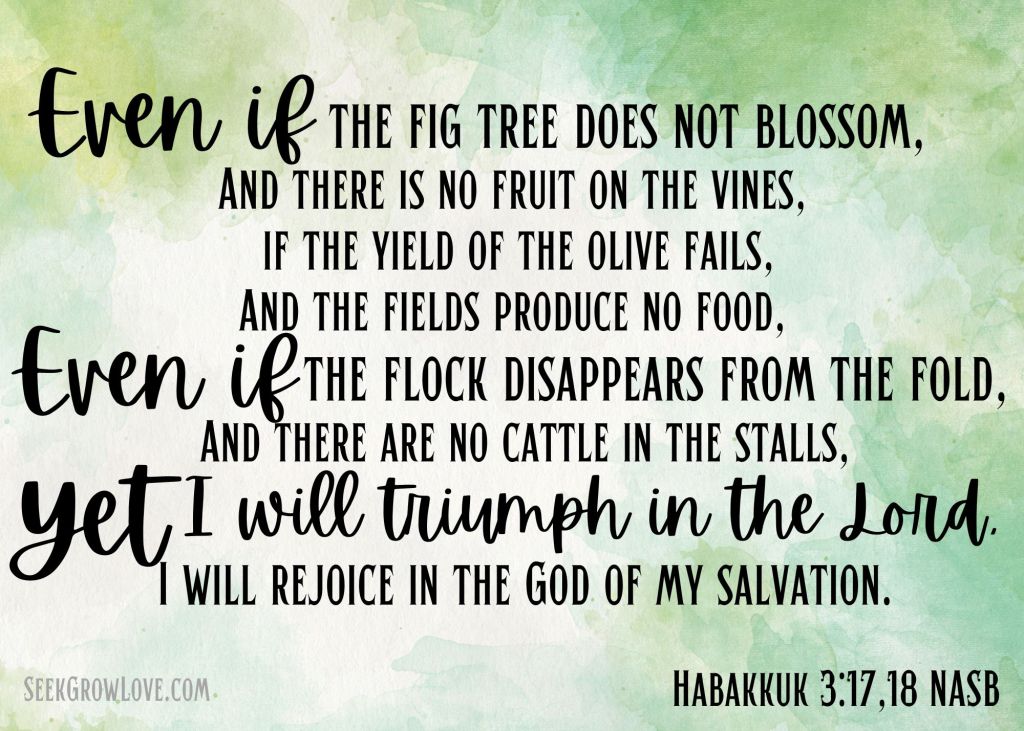
In the last three verses of the chapter, Habakkuk choses faith. He chooses that whether in war or peace, or famine or harvest, he will choose triumph in the Lord. To rejoice in the God of his salvation.
Understanding what went on in the whole book of Habakkuk draws very clear parallels to the lives of any and all who, at one time or currently, have doubted God. Take extra time to pray today but structure it differently. Pray to have your faith increased, and to be strengthened in submitting yourself to the timing of our God.
-John Evans
As a new writer for SeekGrowLove, I was asked to include a short bio about myself, so here goes...Currently attending McGintytown Church of God of Abrahamic faith, and serving as a youth leader, deacon, and assisting with worship. At Twenty-One years of age I have a lot to learn, but was once told I don’t have to know everything to be a great teacher, I just have to know something you don’t. Thanks for reading, have a blessed day.
Application
Have you ever doubted God? What can you learn from Habakkuk?
If you were to write a personal version of Habakkuk 3:17-19 what are some “Even if..” statements you would include? Consider hardships God has already seen you through, hardships you are currently in, as well as what the future may hold. How would you describe God’s strength and benefits for you (verses 18 & 19). Share your new poem with God as you pray for your faith to be increased.





 Seek Grow Love