When we have something important to tell someone and we want to make sure they understand, we will repeat it many times. In the small book of Joel, “the day of the Lord” is mentioned five times, so we know that this is its central theme. That lets us know that what he is telling us is important to understand, he wants to make sure we get it.
There are two “Days of the Lord” mentioned. One is a past event, Israel had been ravaged by locusts: gnawing locusts, swarming locusts, creeping locusts, and stripping locusts. This was a judgement against Israel and the sins against God that they committed. In Chapter 1:14 to gain repentance Joel suggests that they: “consecrate a fast, proclaim a solemn assembly, gather the elders and all inhabitants of Israel to the house of the Lord, and cry out to the Lord.” He understood their need for repentance. Chapter 2: 12-13 says “’Yet even now,’ declares the Lord, ‘Return to Me with all your heart, And with fasting, weeping, and mourning; and tear your heart and not merely your garments.’ Now return to the Lord your God, For He is gracious and compassionate, slow to anger, abounding in mercy and relenting of catastrophe.” He tells us that we have to do more than tearing our clothes (an outward sign), we need to change our hearts, if we do that, God will forgive us.
It even says that he will make up for the years that the locusts have taken and that his spirit will be poured out on all mankind. That verse is very important to all of us. Chapter 2:28 says “It will come about after this that I will pour out My Spirit on all mankind; And your sons and your daughters will prophesy, your old men will have dreams, your young men will see visions.” This is no longer just to the Israelites, he is talking to all of us about a future “day of the Lord.” The people of Israel had to go to the temple to receive forgiveness of their sins with an animal sacrifice. God made a new way when he gave us Jesus as our sacrificial lamb, so now we can repent and be baptized and our sins are forgiven. We look forward to the future “day of the Lord”, when Jesus will return to the earth, and will usher in the Kingdom of God. What a glorious Day that will be!
Reflection Questions
Why is repentance – and how we do it – important to God? What gets in the way of our true repentance?
Contrast the mood in the beginning of Joel to the mood at the end. What makes the difference?
Have you ever read a description of an imagined society, perhaps Plato’s utopia ruled by philosophers, or some other example? Or, going a different route, has a child ever drawn a city and shown it to you, perhaps with a single hospital and a block of farmland off to one side – in fact, often most things set up as blocks right next to each other, rarely with any attention given to parking or railway stations.
Reading the last four chapters of Ezekiel, the third part of his final vision, reminded me of both these things. In today’s text the vision’s focus shifts to zoning: land set aside for the Temple, priestly and Levitical residences, the city of Jerusalem, property for princes, and land for the regular people. And in the last part of the book, land for each tribe. This is laid out down to the cubit, with right angles, like it might be in a child’s drawing. And the social groups are assumed to remain separated and balanced, as in proposals for utopian societies. Perhaps it isn’t meant to be treated as a practical description, but more to say “God has not forgotten anyone, and all will get what they need.”
The description of Israel’s society here emphasizes improvement, with comments like:
“My princes shall no longer oppress My people, but they shall give the rest of the land to the house of Israel according to their tribes” (45:8b). The powerful will not act for their own benefit, and all of the tribes would get what they needed, though in Ezekiel’s time most of the tribes were scattered – so the vision itself is promising the regathering of the tribes.
“You shall have just balances, a just ephah and a just bath. The ephah and the bath shall be the same quantity” (45:10-11a). This comment rebukes theft by cheating in business. Weights on sets of balance scales were used to calculate payments. By using differing sets of weights that looked the same, a merchant could vary which they used when buying or selling to unfairly benefit in every transaction.
Similarly, “ephah” and “bath” were supposed to be the same volume – apparently about 22 liters – just with one measuring dry goods like grain (that might be in sacks or baskets) and the other measuring liquids like oil or alcohol (perhaps kept in stone jars).
The last part of chapter 45, and chapter 46, contains more about God’s expectations for honorable and pure actions by the prince and the priests, which circles back to the Temple’s layout. Washing at the Temple had always required a great deal of water, brought there with difficulty. But here this issue of purifying water is reversed, it is not brought into the Temple but flows from it and will affect the nations.
“By the river on its bank, on one side and on the other, will grow all kinds of trees for food. Their leaves will not wither and their fruit will not fail. They will bear every month because their water flows from the sanctuary, and their fruit will be for food and their leaves for healing.” (47:12)
I have previously cited the estimate that the book of Revelation contains over five hundred references to other biblical texts which are not direct quotations. And, to save you looking it up, here is the similar language to Ezekiel 47:12 in Revelation:
“Then he showed me a river of the water of life, clear as crystal, coming from the throne of God and of the Lamb, in the middle of its street. On either side of the river was the tree of life, bearing twelve kinds of fruit, yielding its fruit every month; and the leaves of the tree were for the healing of the nations.” (22:1-2).
The two quotes share many details, but they also differ. In Ezekiel, for example, the water comes from under the wall of the Temple and then deepens to become a river. The Revelation text involves the huge New Jerusalem, while the “18,000” cubits of the city mentioned in Ezekiel 48:35 is a bit under six miles. Such issues are another reason to question whether the vision is to be taken as about the precise details of future events or themes of purity and redemption.
A message of purity and redemption for the exiles flows through the text. They were torn from their people and their land, forced even to hear about the destruction of their city and its Temple at a distance. They mourned in exile. But God intended to restore what was broken – including the people. God’s people had been broken long before, that is why the exile took place. Exile was part of the penalty God kept putting off generation after generation, though ultimately God’s words had to be fulfilled. But now God was again offering the people an opportunity to live as they should, interacting in purity, they and their princes, priests, and merchants. And no matter how many more times those relationships were damaged, God was committed to them being set right. God’s name was to be exalted, and the people who lived where God’s name dwelled needed to be purified, in keeping with that city being known as “ ‘The Lord is there.’ ” (Ezekiel 48:35b).
Reflection Questions
What application do you see of the principles God applied to the conduct and attitudes of the exiles, in terms of your own life? How demanding do you perceive God as being, compared with how forgiving God is? What impact does the presence of Jesus in the situation have?
Do you think anyone might be looking at you expecting that “the Lord is there”? (Perhaps this would be through an interpretation of Christians being the Temple, having the Holy Spirit in them, etc.) In what senses might that be a reasonable way to understand the text, and in what ways might it be unreasonable?
Ought believers to take more encouragement or discouragement from the thought of the Holy Spirit being in their lives?
Today we continue Ezekiel’s vision, begun in chapter 40. For three chapters suspense built as he observed a shining figure (presumably an angel) give the dimensions of a new Temple, room by room, wall by wall. We might say that measuring the building simulated its construction. Or perhaps these measurements symbolize preparation God’s people needed to accept and undergo so they could properly serve God.
Ezekiel previously relayed to the Babylonian exiles a vision in which God abandoned Solomon’s Temple and Jerusalem. He had seen the glory of God exit the Temple, going East (10:18-19). In today’s text Ezekiel is taken to the eastern gate and sees God’s glory arrive there: “like the vision which I saw when He came to destroy the city,” and falls to his face before it (43:3). Getting this vision confirmed God’s intentions for the covenant, that the people would be restored to the land and again have a Temple.
In that earlier vision we were told that “the temple was filled with the cloud and the [inner] court was filled with the brightness of the glory of the Lord” before it exited (10:4). Similarly at its return “the glory of the Lord filled the house” (43:5). This ‘filling’ of the Temple mirrors events at the dedication of the Tabernacle and Solomon’s Temple, when in each case God’s glory filled the building and prevented people from ministering (Exodus 40:34-35; 1 Kings 8:11). (Though in his visions Ezekiel saw each event from on scene, I would guess that is due to them being visions and not reality.)
I wanted to address a point from verse 7 next which called for background from Tabernacle and Temple history. The next several paragraphs (o.k., 19 paragraphs) give background, after which the devotion proper resumes. (Honestly, I didn’t want to spend the next few hours paring this to a more “normal” length – and then end up saving bits from what I trimmed to maybe use later. I’m sorry about the length, though.)
Background about the Temple and Tabernacle
The basic points involved with the Jerusalem Temple are shown in the Pentateuch. Moses told the people about “the place the Lord your God will choose from among all your tribes to put his Name there for his dwelling” (Deuteronomy 12:5). The “place” is the location of the Temple, as Moses said there, and with similar language several more times (see v. 11, 18; 14:23-25; 15:20; 16:2, 7, 11, 15-16; 17:8; 26:2; 31:11). The Hebrews didn’t set up the Temple very soon, they couldn’t because they weren’t even informed of the location God chose for it until hundreds of years later. Instead at Mount Sinai the people constructed the Tabernacle, a “sanctuary” built for God to “dwell among them” (Exodus 25:8). God gave instructions to Moses regarding that sanctuary, but first he prepared the Ten Commandments, and then the Ark of the Covenant which would hold them. One of the central issues about the Tabernacle, and it would be central for the Temple as well, was that it provided somewhere to place the Ark of the Covenant, along with the other “sacred articles belonging to God” (1 Chronicles 22:19). Those items, created at Mount Sinai, initially went into the Tabernacle’s walls of cloth. Later they went into the Temple’s walls of stone, (walls which were covered by wood, that was covered by gold, decorated with gems and art – it really was quite a fancy place).
The twelve tribes were in the wilderness of Sinai for 40 years, and during that time when they stayed in one spot the Tabernacle was set up in the center of the camp – which is to say the tribes put their tents around the Tabernacle. We are even told the pattern in which they arranged the camp, the tribes that were to the Tabernacle’s north, east, etc. When the tribes moved priests carried the Ark by hand, using poles put through metal rings attached to it. The various parts of the Tabernacle were transported by the Levites. Once the people arrived in the promised land the Tabernacle continued to go with the main camp of the nation while the first few years of fighting took place, and then it was set up in one place or another for long periods (for example at Shiloh, where High Priest Eli raised Samuel). God eventually revealed to King David where the Temple would be (1 Chronicles 22:1), but God did not allow David to build the Temple (v. 8). Solomon, who was not associated with violence, would direct the construction of a place for God’s name (1 Kings 5:5).
Just as I see the Temple as existing to house the Ark of the Covenant, I recognize the central portion of the Temple as the Holy of Holies where the Ark of the Covenant was kept. The other areas of the Temple are defined at least in part by their relationship to the Holy of Holies. Outside the Holy of Holies was the Holy Place, beyond that was the Inner Court, then the Outer Court.
I find it clear that God’s connection with the Tabernacle and the Temple keyed on the Ark of the Covenant more than either building. The Ark which sat in the Holy of Holies is referred to a few times as the “footstool of God” (1 Chronicles 28:2; Psalm 99:5; 132:7). Psalm 99:1 includes the comment that God “is enthroned above the cherubim,” referring to the two statues on the Ark’s lid. That imagery is reflected in the lid’s name, “mercy seat” (Exodus 25:17-22; Leviticus 16:2, 13-15; Numbers 7:89; 1 Chronicles 28:11; Hebrews 9:5). In Exodus 25:22 God promised “I will meet with you; and from above the mercy seat, from between the two cherubim which are upon the ark of the testimony.”
In Exodus 40 Moses learned the final steps for setting up the Tabernacle. After he put everything in place “Then the cloud covered the tent of meeting, and the glory of the Lord filled the tabernacle” (v. 34). It was an impressive moment for the people. Similar events took place when the Temple was ready in Solomon’s time. They brought the Tabernacle to the Temple, and transferred the Ark of the Covenant into the Holy of Holies of the Temple. While people stood outside praising “then the house, the house of the Lord, was filled with a cloud, so that the priests could not stand to minister because of the cloud, for the glory of the Lord filled the house of God.” (2 Chronicles 5:13b-14). (In my mind taking the Ark of the Covenant from the Tabernacle for the last time was rather like removing the power source from the Tabernacle; it couldn’t operate anymore. We aren’t told what happened to the Tabernacle after that, but my guess is that it was dismantled and put in a Temple storage area. Could you imagine it being thrown out, even though it was obsolete?)
In scripture the Ark being the “footstool” of God pairs with “heaven” / “the heavens” containing the “throne” of God. “The Lord is in His holy temple; the Lord’s throne is in heaven” (Psalm 11:4). “The Lord has established His throne in the heavens” (103:19). Isaiah 66:1 is probably the most important Old Testament verse about this subject for us, because of its effect on the New Testament. The Isaiah text has a slight difference of focus from the Psalm texts, saying heaven ‘is’ God’s throne, “Thus says the Lord, ‘Heaven is my throne”. (The three texts do effectively agree about the location of God’s throne.)
The shift in Isaiah 66:1 from a “throne” in “heaven” to heaven itself may serve to set up the text’s similar change with the concept of God’s footstool, which is expanded from the Ark to “the earth.” The impact of that change feels different than with the “heaven” reference, it comes across as representing God as too great, too expansive, to be linked with one spot.
“Heaven is My throne and the earth is My footstool. Where then is a house you could build for Me? And where is a place that I may rest?”
Still, the rest of Isaiah 66 continues to grant significance as physical locations to both Jerusalem and the Temple. Jerusalem is mentioned several times and verse 20 says:
“Then they shall bring all your brethren from all the nations as a grain offering to the Lord, on horses, in chariots, in litters, on mules and on camels, to My holy mountain Jerusalem,” says the Lord, “just as the sons of Israel bring their grain offering in a clean vessel to the house of the Lord.”
I think verse one either tries to daunt human pride, or it warns against humans being complacent. Those issues are related. It seems to suggest two problems that can occur for those who try to build God a Temple: 1) if anyone implies that having a Temple puts limits on God, and 2) forgetting that the materials used for the building project are only ever things God already brought into existence.
The language of Isaiah 66:1 carried into the New Testament, and its use there made that way of speaking about “throne” and “footstool” more familiar to us than the language used by the Psalm texts. But probably far fewer people remember what Isaiah 66:1 says than this line from Jesus: “make no oath at all, either by heaven, for it is the throne of God, or by the earth, for it is the footstool of His feet, or by Jerusalem, for it is the city of the great King.” (Matthew 5:34-35). (If we are considering the impact of Jesus’ words on beliefs about the Temple, another text many people pay attention to is John 4:20-24. Some draw the conclusion from that statement that there is no future for any physical Temple. But I won’t take more space on that sidetrack right now.)
Stephen directly quoted Isaiah 66:1-2, near the end of his speech in Acts 7, after false witnesses claimed that: “This man incessantly speaks against this holy place and the Law; for we have heard him say that this Nazarene, Jesus, will destroy this place and alter the customs which Moses handed down to us.” (Acts 6:13-14; see 7:47-50 for Stephen’s quote). Again, these were false witnesses, and Stephen would not have been disrespectful of the Temple or the Law. It is possible that some of Stephen’s opponents, while being uninterested in learning from him, still heard and skewed things Stephen said.
As a Christian Stephen was no longer called on to follow the Mosaic Law, though that Law still existed. And Stephen seems to have recognized the freedom he had in terms of that Law sooner than most in the Church. As Paul would later point out, the Law continued to apply to those who meant for it to be their way of relating to God; that was why Paul warned the Gentiles in Galatia that a man who chose to be circumcised “is under obligation to keep the whole Law”; Galatians 5:3. (Many people today are circumcised, but what Paul wrote here only applies when that fact is given a religious intent regarding the Mosaic Law.)
And Jesus, about whom Stephen taught, was not going to destroy the Temple, but Jesus did predict its destruction (Matthew 24; Mark 13; Luke 21). Also, at least once Jesus spoke metaphorically of his own death as the destruction of a “temple,” a statement which people had misunderstood even when he made it (John 2:18-22). It is possible that Stephen referred to some of Jesus’ statements about these matters, and that this affected the accusations against him.
As I pointed to above, Isaiah 66 may relate to two issues 1) not being able to put limits on God, and 2) that people could only “create” a Temple in a limited sense because really God made all the materials they used. Herod the Great certainly seems to have been prideful about renovating the Temple. It seems like the ongoing renovations also pleased the priests of Stephen’s time, which may tie to his use of Isaiah 66 (Matthew 23:16). All we humans really do in ‘creating’ objects is rework the shape and function of material provided by God. Jesus said that “not even Solomon in all his glory clothed himself” like a lily of the field (Matthew 6:29). What can be said of Solomon’s wardrobe can probably also be declared of his construction projects. When is a wooden board more impressive than the living tree it came from? Can a wall of stone outclass a mountain (or a canyon)? The book of Hebrews makes explicit the fact that the Tabernacle was intended to reflect heaven’s throne room (Hebrews 8:5 – note that both are “tents”; Isaiah 40:22). By implication the Temple achieved that same purpose. But even when Herod coated the outside of the Temple with gold to make it reflect the sun that didn’t let it outshine the sun. God’s originals are always superior to man’s replicas.
The reference in Isaiah 66:1 to the earth as God’s footstool points to God being much larger than one location can hold. But there is another way that human pride can try to put limits on God with the Temple – a limit on God’s actions. When I read Stephen’s sermon I am reminded of Jeremiah 7:4, when God had him stand in the gates of Solomon’s Temple and warn the people “Do not trust in deceptive words, saying, ‘This is the temple of the Lord, the temple of the Lord, the temple of the Lord.’ ” The point of that statement is that the injustice being practiced in Jerusalem at that time was sufficient for God to choose to let that Temple, though it was God’s Temple, be destroyed. Just because it was offered to God didn’t mean it would be preserved. The fact that it existed in Jerusalem did not mean the people of Jerusalem would be safe from harm. Yet a complacent population could choose not to be revived and reformed, because they had the Temple in their midst.
God did not need a building to dwell in – the Temple existed for humans. God was willing to let the building go if that action helped humans recognize truth (remember, the punishments described in Deuteronomy were ultimately corrective, intended to reform and allow for restoration). The Temple gave a place to worship, with rituals God laid out. It was intended to help people understand and relate with God. It housed the Ark of the Covenant, from which God condescended to communicate. No building can be grand enough to gain significance for God. Yet God can choose to put divine glory into a human offering, granting it significance. God did so with the Temple in Jerusalem. In Isaiah 66:1 God asked about the building someone would offer, and that question comes as a challenge to human pride. As God points out in verse 2 “Has not my hand made all these things?” (NIV). But an assertion of God’s power and authority is not a denial that God in fact called for a building to be constructed in Jerusalem, which God accepted for divine use. Nor was there only one such building. When verse 20 says people will go: “to my holy mountain Jerusalem, . . . to the house of the Lord” the Temple it refers to is still in our future.
Devotion resumes
In Ezekiel 43:7 God says: “Son of man, this is the place of My throne and the place of the soles of My feet, where I will dwell among the sons of Israel forever.” This verse offers a shift from how the Temple is normally discussed in the Old Testament. God is not presented as dwelling in the heavens, feet propped on the Ark of the Covenant. Rather throne and soles are together on earth.
It can be difficult to conceptualize God occupying a single location while having a presence everywhere. Even scripture can seem ambiguous on this topic, for example Psalm 139:7-10, which seems to include both concepts, implying that one or the other is metaphorical. In the past when discussing the “throne” and “footstool” texts I have suggested they involve where God’s focus is. While God is aware of all things, God gives special attention to the promised land.
But if language about the Tabernacle and the Temple normally meant to convey that God’s attention is focused on Jerusalem, while God still dwelt apart in heaven, it seems that in the time of this new Temple the opportunity had come to combine the two settings. God (in whatever sense) dwells “among the sons of Israel forever,” with both God’s throne and the “soles” of God’s feet situated at the new Temple (Ezekiel 43:7). “Behold, the tabernacle of God is among men, and He will dwell among them” (Revelation 21:3). Take joy in this!
The change seems to involve more than the location of God’s throne. We are not told that this new Temple’s Holy of Holies has any furniture, such as an Ark of the Covenant for God’s feet to rest on. We are told: “This is the law of the house: its entire area on the top of the mountain all around shall be most holy.” (v. 12). Does this expanded holiness suggest that in the new Temple there is no need for divided courts, and places of greater and lesser sanctity? It implies that only those who may enter God’s presence are allowed near, for the whole area is where God stands.
(This could be overstated. In 44:13-14 God speaks of priests who had not behaved as they should, but who would be allowed to serve. It says: “they shall not come near to Me to serve as a priest to Me, nor come near to any of My holy things, to the things that are most holy; but they will bear their shame and their abominations which they have committed. Yet I will appoint them to keep charge of the house, of all its service and of all that shall be done in it.” So, we again see ambiguity in the text. What is “most holy,” and what is not?)
Ezekiel was told: “As for you, son of man, describe the temple to the house of Israel, that they may be ashamed of their iniquities; and let them measure the plan.” (v. 10). God expected that contemplating these exalted plans for worship would affect Ezekiel’s hearers. God’s prophet had already received the measurements of the building, and now begins to get those for the altar, followed by expectations for the priests.
Recall that for most of its history the Levitical priesthood did not function as it was meant to. Teaching had not gone out as it should, being a priest had not always seemed honorable, nor possessing God as inheritance been greatly valued. But God is saying this will be fixed, it will work. When God dwells with the people, the priests will do as they were meant to. And the name of the Lord will be glorified.
Reflection Questions
How do you think it felt for Ezekiel, a priest so long separated from his worship roles, to see a vision of this pristine Temple, untouched by false worship, and then filled with God’s glory? What do you think Ezekiel made of God’s plans for the future of the Temple and the priesthood?
What is something that helps you strive for the Lord (perhaps a Bible account, event, image, or the comfort of a friend, which you are able to hold to as an example of what you particularly aspire to or hope for)?
What difficulties do you think Ezekiel may have faced in trying to relay his experience of this vision to his fellow exiles? How does that compare with your experiences of trying to express yourself to others?
The Israelites have been in exile for twenty-five years and it has been about fourteen years since the fall of Jerusalem. The prophet Ezekiel is in Babylon when he experiences visions of God. He is taken to a very high mountain in Israel and from the south side he sees buildings that look like a city. He is visited by a man whose appearance was like bronze, an angel. He is holding a measuring tool. He told Ezekiel to closely pay attention to everything he would show him and he was to tell the people of Israel everything he saw.
He was shown a temple complex. It was given with detailed and specific measurements and dimensions including outside walls, gates, alcoves, thresholds, porches, outer courts, rooms, etc. Some say this vision symbolizes an ideal temple where God’s presence resides and God is glorified. Others believe that it is a literal future temple that will exist in the Millennium. There is much discussion on this vision. For instance, if it is a literal temple in the 1,000 year reign of Christ, why are there offerings there? Are these only memorial offerings remembering the ultimate sacrifice that Jesus provided? Though we may not understand everything about the vision, we know that it showed the people of Israel that there would be restoration and reconciliation with the LORD. This vision gave the people hope. They viewed the temple as a place to worship and praise the LORD. They had the same desire that we do. We want to be in the presence of God. We want to experience Him. After all, He is amazing and we love Him. He desires to be with us as well. How blessed we are to know that the LORD is with us. As the apostle Paul states, “Don’t you know that you yourselves are God’s temple and that God’s Spirit dwells in your midst? And God’s temple is sacred, together you are that temple.” (1 Cor. 3:16&17b) How blessed we are to be so connected to the LORD.
(As editor, I had been concerned that we had a few weeks with no one signed up to write devotions – so I sent out several emails and God answered with not just one writer for today – but two! So, with no apologies, but many thanks to God and to both Rebecca and Daniel, here is your second for the day…)
Devotion by Daniel Smead (Minnesota)
Today’s text is the start of another of Ezekiel’s visions, in which he again visits his homeland of Israel. It takes place on a mountain by a city, which is presumably a way of referring to Jerusalem, and Ezekiel observes a new Temple. His guide in that building is a shining figure, who sounds something like the figures that moved God’s throne-chariot back in chapter one. This figure measures the Temple and declares the dimensions for Ezekiel to record, having calculated them using a stick a bit over ten feet long.
Interestingly, this vision is one of only two places where Ezekiel states the exact date an event took place, the tenth of Nisan, near the start of the Hebrew year that went from 573-572 B.C. The vision is twenty-five years after Ezekiel was taken from Jerusalem and Solomon’s Temple, and about thirteen years after the Temple’s destruction.
In its essence this vision allowed the exiles to look forward to a time when God’s people, again in the promised land, would have a renewed opportunity to worship God at a temple. The passage did not take shortcuts to describe this but went into minute detail. Rather than simply refer to the existence of a temple, we are told about its size and decorations as though the importance of fulfilling every detail is being emphasized. Using some effort, readers could put themselves in the scene alongside Ezekiel.
The building described in this text is quite large, and it is not a prophetic description of the Temple built in the time of Zerubbabel, after the Babylonian exile. Nor, apparently, did the returnees of that generation attempt to follow this design even when doing so would simplify their work. For example, 40:28-37 describes having three gates to the inner courts, and a Jewish Midrash says the second Temple had seven gates. In fact, the small number of gates, and the emphasis on large square rooms, raises the issue of the practicality of the design, and whether this was ever intended as a literal image of a building or just as a symbolic representation – the architectural equivalent of a parable, perhaps.
Ezekiel, as a priest who had ministered at Solomon’s Temple, would have a particular interest in the description this passage provides, whether it was symbolic or a future reality. But Ezekiel was not the High Priest, and even in his vision it seems that he does not enter the Holy of Holies, though he reports its dimensions (41:4). We hear nothing about the contents of that area.
I have written before about John’s measuring of the Temple in the book of Revelation, and how simple it can be for us when reading the figures in that passage to miss the time it would have taken to measure those distances. The same issue applies here. The long period when Ezekiel watched the shining figure go about this task, announcing number after number, can only have felt surreal. Obviously, this scene was leading somewhere, though learning what awaits tomorrow’s text. In the meantime, Ezekiel moved through a nearly empty building, large enough to hold thousands of people, simply recording its dimensions.
How often do you find yourself caught in a moment, feeling incomplete, unsure what comes next? At that time the exiles in Babylon were probably wondering what their next steps would be, and this vision was part of how God laid out expectations for them. Ezekiel, in his vision, must have found it obvious that what he saw was building toward a larger point, although he could have been recording measurements for hours. It may not always seem as obvious to us when God is at work in our lives, or how. But it is to be hoped that we can maintain trust that God is working. I don’t know how often we learn quickly or plainly what our next steps need to be. Sometimes Ezekiel waited years between his visions, visions that we can simply turn pages to link together. And the fulfillment of all that he saw in his visions waited far longer than a few years.
Regardless of all that Ezekiel went through, and how long it took, if the Bible revealed that somewhere along the way he decided not to pay attention to what God was doing with him, that it was not all worth it, we would consider him foolish. From our perspective in history such a choice would appear absurd. But sometimes we, and indeed sometimes I, need to be reminded of this same principle for ourselves. My trust, and my attentiveness for what interests God, need firming up. I can’t expect to maintain the same focus always and in every situation; no one can. Humans don’t have that kind of attention span and focus. I, and maybe you, need to be reoriented when necessary. At times we also need to realize that God still cares about us, continuing to be open and accepting despite our failings. The people God was telling about a new temple had their old one destroyed just 13 years earlier. God is open to offering forgiveness and acceptance, but more than being open to that, God strongly desires to provide it to us, in love.
Reflection Questions
What thoughts and feelings might Ezekiel’s original audience have had before Ezekiel’s temple vision – as they have been stuck in a foreign land far from God with no clear way to worship Him and even no temple to try to return to? Have you ever felt similarly?
What thoughts and feelings might Ezekiel have had as he was getting a tour of this temple? As he was sharing his vision? How might the people have responded?
In what ways might God be asking you to pay attention to what He has done, is doing and will do? Is there anything in your past that you didn’t understand at the time but you can see now how God was using it in preparation for your future?
When do you find yourself needing hope? What gives you hope?
Ezekiel brings a message of future redemption for Israel. How does their redemption happen? By truly connecting with the LORD. “I will give you a new heart and put a new spirit in you; I will remove from you your heart of stone and give you a heart of flesh. And I will put my Spirit in you and move you to follow my decrees and be careful to keep my laws. Then you will live in the land I gave your ancestors; you will be my people, and I will be your God.” (36:26-28) What a beautiful picture of living in a loving relationship with God!
In our passage the LORD is providing everything that is needed to be with Him. Just as we look to our Heavenly Father every day for all that we need to truly be His obedient children. We need the heart that the LORD creates for us and we need the power of His Spirit to transform us. Our circumstances can often weigh us down, so we also need the encouragement that the LORD provides through His message. The people of Israel needed that encouragement from the LORD. They were discouraged – they were disconnected from the LORD and spiritually dry. But God promises restoration and life.
In chapter 37, the valley of dry bones illustrates that God will bring individual and national resurrection. His promise gives hope. The Sovereign Lord says: My people, I am going to open your graves and bring you up from them; I will bring you back to the land of Israel. Then you, my people, will know that I am the Lord, when I open your graves and bring you up from them. I will put my Spirit in you and you will live, and I will settle you in your own land. Then you will know that I the Lord have spoken, and I have done it, declares the Lord. (37:12b-14) God shows compassion on His nation and He will never forget His people. In the same way, He will never forget His children. When He is “proved holy through them in the sight of many nations,” may we also praise our Holy God.
Reflection Questions
In what ways did Ezekiel’s audience have a heart of stone? In what ways do you? What would be different with a heart of flesh given by the LORD?
What else does God say He will do for His people in today’s reading?
When have you felt like you were spiritually dry – in a valley of dry bones? When have you felt spiritually alive? What life has God given you now? What life will God give in the future?
The LORD explains so much of His perfect character in Ezekiel. He is merciful, loving, caring and He is just. We continue to see that each person is judged by their conduct and actions. The LORD declares that He takes no pleasure in the death of the wicked, but wants the wicked to turn from their evil ways and live. He warns to “turn back, turn from your evil ways!” The LORD offers life. The LORD sends the message that true repentance brings forgiveness. Ezekiel gives good news to the one that repents and lives for God. “None of his sins that he has committed will be remembered against him. He has practiced justice and righteousness; he shall surely live” (33:16).
Not only does the LORD offer life, but life with Him. In chapter 34, He gives us this beautiful description of a caring shepherd. The LORD cares for and gathers His sheep. “I will feed them in a good pasture, and their grazing ground will be on the mountain heights of Israel. There they will lie down on good grazing ground and feed in rich pasture on the mountains of Israel. I will feed My flock and I will lead them to rest,” declares the Lord God. “I will seek the lost, bring back the scattered, bind up the broken and strengthen the sick” (verses 14-16a). What a wonderful description of our Good Shepherd.
So why didn’t the people listen to their watchman, Ezekiel? He was giving them the warning against their evil practices and the instructions to turn to the LORD for life. Instead of hearing God’s message, they acted as if Ezekiel were some kind of entertainer. They encouraged each other to come and hear what God’s message was, but just showing up was not enough. The people heard the words, but they did not put them into practice. We are told that they did the lustful desires expressed by their mouth, and their hearts went after their own gain. The LORD told Ezekiel, “Indeed, to them you are nothing more than one who sings love songs with a beautiful voice and plays an instrument well, for they hear your words, but do not put them into practice.” (33:32)
I hope that is never said of us. We want to take in the LORD’s message. We will heed the watchman’s warnings and receive the blessings that God offers. The greatest is to always be in His presence. In the presence of our Good Shepherd there will be showers of blessing. (34:26)
Reflection Questions
How have you responded to the LORD’s offer of life? Are you hearing the words but not putting them into practice?
What warnings do you think Ezekiel (or any modern messenger for the LORD) would have for you today? What role does repentance play?
Is there a time/place God is asking you to be a watchman?
Do you spend time in the presence of the Good Shepherd? How? How could you remain in His presence more? What are some of the blessings found there?
God is once again reaching out to the nations. He is sending messages through the prophet Ezekiel. He wants them to know that “He is the LORD their God.” Yet, they have fallen into the trap of pride. We see this in the way the ruler of Tyre is described in Ezekiel 28:2. In the pride of your heart you say, “I am a god; I sit on the throne of a god in the heart of the seas.” When we are prideful we may elevate ourselves over God. Our self-importance becomes inflated. Self-sufficiency guides our behavior rather than a dependance on God’s grace and strength. Our pride can also blind us to the value of others. We may forget that human beings are created in the image of God and therefore have invaluable worth. God’s children, His image bearers, live lives that show love for God and others. Our worth is found in the LORD. A righteous understanding of the love that God demonstrates to the world (John 3:16) is a source of self-esteem and should produce grateful hearts in us.
Unfortunately, the nations being addressed by Ezekiel have adopted selfish prideful ideas and behaviors. They rely on their natural resources, militaries, trading abilities, treasuries, allies, …but God is sending a message through Ezekiel. Many times God states to these countries, “then they will know that I am the Lord.” These countries needed to acknowledge that God is above all and truly know Him. That should be one of our daily goals, too. We love You Lord! You are the LORD our God!
Reflection Questions
Where else in Scripture do you find God warning about pride? Why does God dislike human pride?
What do you see as the dangers of pride? In what ways have you seen prideful attitudes come between you and God?
The world often tells us to take pride in ourselves, our family, what we have accomplished, etc.. How might you reply?
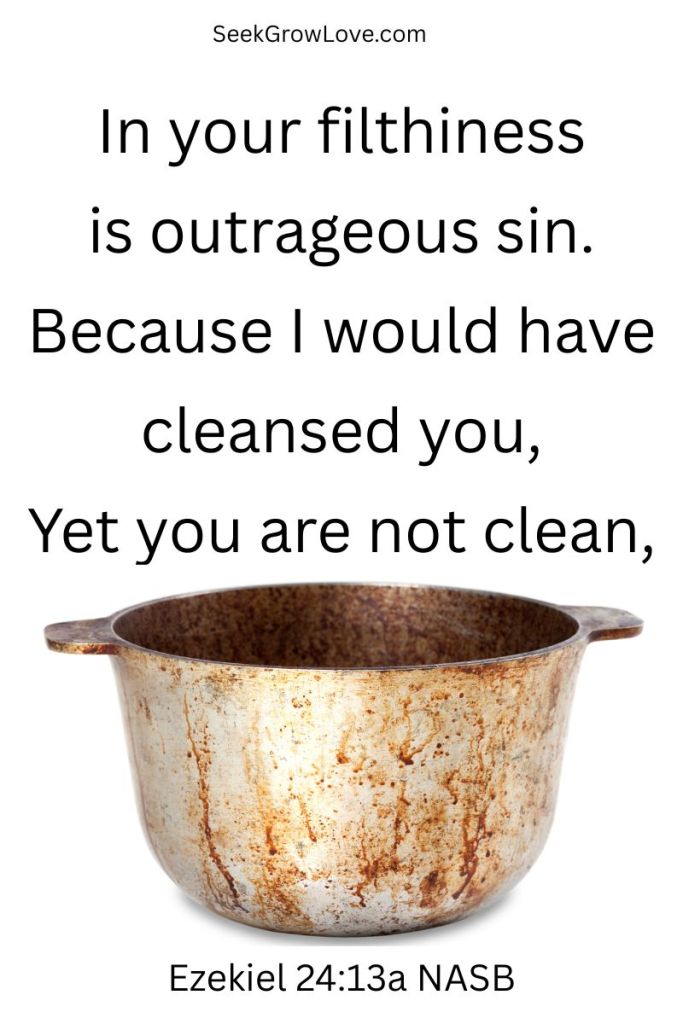
Today I scrubbed out our cast iron skillet. It would have been easier the night before, but I put this task off until today. It reminded me of our reading from Ezekiel 24. The parable for the Israelites contains a dirty, rusted boiling meat pot destined for cleansing by destruction. The pot was symbolic of Jerusalem. Ezekiel once again shares what the Sovereign LORD has said by telling his people this parable. The king of Babylon has laid siege to Jerusalem. The LORD shows the people what will happen if they continue in their evil practices. The LORD refers to Jerusalem as the city of bloodshed. When faced with a warning that severe negative consequences including death for many will follow their actions, we would think that they would stop sinning. We want the people to repent, to turn to God and accept His deliverance and His salvation. Unfortunately, they do not.
That nasty stuff in the pot should have been removed long ago, but the people continued in their sins. We could compare the rust of the pot to the bloodshed that had taken place in Jerusalem. God had seen the killing and wounding of others in this city of blood. All the actions of the people were in full view for God. He also states that their impurity was lewdness. They did detestable acts and committed adultery. They chose indecent, obscene behaviors rather than allowing God to clean out all that crud. They should have been filled with shame and repentance, but they openly committed their sins. The scripture tells us that the LORD tried to cleanse them, but they would not be cleansed. They were told, “You will be judged according to your conduct and your actions,” declares the LORD.
The people of Jerusalem would not turn from their sin, but we can. We can recognize when we fall short and confess our sin. After all, He is faithful and just and will forgive us our sins and purify us from all unrighteousness. So God can make us a “vessel for honor, sanctified, useful to the Master, prepared for every good work.”
Reflection Questions
What sins has Ezekiel mentioned in his book? What does God not like about them?
Why do you think God is giving warnings before the punishment comes?
What sins do you think God sees today – in you – that he would (or is) sending you a warning about? And what sins in the world around you?
What would the cleansing process look like if we turn to God? What would the cleansing process look like if we don’t?
Devotion by Pastor Jeff Fletcher – originally posted for SeekGrowLove on March 25, 2017, for Ezekiel 22-23.
Throughout Ezekiel there are certain themes that keep circling back around: God’s judgment against Jerusalem, Israel’s unfaithfulness to God. In today’s reading we see another very graphic depiction of Israel’s immorality. This time, it’s the northern kingdom of Samaria and the southern kingdom of Judah. They are likened to two sisters who prostitute themselves. They again perform lewd acts shaming themselves before their neighbors. It’s very sad, indeed.
God searches for someone to help: “I looked for someone among them who would build up the wall and stand before me in the gap on behalf of the land so I would not have to destroy it, but I found no one.” God could find no one righteous to fill the gap and act as the mediator between God and His people.
We know the Gospel, the good news of Jesus Christ and God’s Kingdom. One day, Jesus would stand in the gap to keep God from destroying the earth. Jesus on the cross fills the gap between a holy God and a sinful people.
I hope that these devotions from Ezekiel will help you to see some important truths with greater clarity. God loves His people very much. God wants His people to be faithful and obedient. Some are and some aren’t. When His people are unfaithful, God brings calamity and judgment, in order to turn people’s hearts back to Him. It’s not the judgment that ultimately turn hearts, but it’s the fact that despite all of our wicked acts that deserve punishment, God is faithful to His promises and His steadfast love remains. Ultimately, it’s God’s mercy that leads us to repentance. May you know His love and His mercy through Jesus Christ, the man who did stand in the Gap for us.
Reflection Questions
What are the main themes of Ezekiel? How can we learn from them?
How does Jesus, a mediator to fill the gap, change the relationship between God and His people? How has it impacted your relationship with God?
Devotion by Pastor Jeff Fletcher – originally posted for SeekGrowLove on March 24, 2017, for Ezekiel 20-21.
In Ezekiel 20 God reviews Israel’s history. Over and over God provided for His people, over and over He warned them to get rid of their idols, keep His commands and observe His Sabbaths. Over and over Israel failed to obey God and experienced the consequences. Over and over God was compassionate and loving and forgave His people and restored them to blessings.
Israel has repeated this history again. They failed to get rid of idols, they failed to keep his commands and observe his Sabbaths, and now they were about to experience the consequences of their sins. God would once again treat them with mercy, not as their sins deserved and restore them to their land.
Ezekiel juxtaposes God’s promise to be merciful and restore His people with the threat that His judgment is coming and that both the evil and the good will be cut off from the land and the city and the temple. Yes, everyone will suffer the consequences of the evil behavior of some.
There is tension throughout Ezekiel. The wicked will suffer for their sins and the righteous will not suffer, except that at first they will suffer for the sins of others. Sometimes when God brings his judgment designed to bring people to repentance there is collateral damage. Good people suffer when bad people sin. It’s how it was then, it’s still how it is today. God’s salvation is coming, earth will one day be restored and made whole and good, but in the meantime, good people will suffer alongside the wicked. Christians are martyred in places like Pakistan and Syria. Christians sometimes suffer persecution in the United States. Trials may come to God’s people during times of judgment, but those who trust God and repent of their sins will be saved.
Reflection Questions
How often do we fall into the same cycle of disobedience that the Israelites followed for generations? What can be done to help break the cycle for you personally?
How does God’s mercy and justice coexist throughout Ezekiel and today?
What trials are you willing to persevere to avoid disobedience to God?






 Seek Grow Love