An Invitation to be Yoked

Matthew 11

Devotion by Shelly Millard (Nebraska)

Take a look around you.  You might see people who are exhausted and depleted by life and all the challenges it brings.  You may hear phrases like “I never have enough time”, “There is always too much to do”, “I’m always stressed about money”, “I am feeling so isolated and lonely”, “My anxiety is paralyzing me”.  Those common phrases bear witness to people who are struggling to manage life burdens and feeling continually overwhelmed with no relief in sight. All of us feel the weight of life at times whether it be physical exhaustion, emotional depletion, or spiritual unrest.   Jesus had been teaching his disciples and followers that the law only brought burdens, but a relationship with him provides the freedom and lightness that comes with shared burdens.  The passage we will explore out of Matthew 11 offers hope in the midst of life challenges.  

It begins with an invitation from Jesus to “come”.  It’s a simple imperative statement. It’s not a question or a plea—it is a gentle command to connect with him and to create a relationship with him.  It is an invitation to bring whatever is weighing you down and share the burden with him without shame, guilt or fear.  He is inviting us into a safe space where he will share the burden and offer some respite to you from bearing it all yourself. 

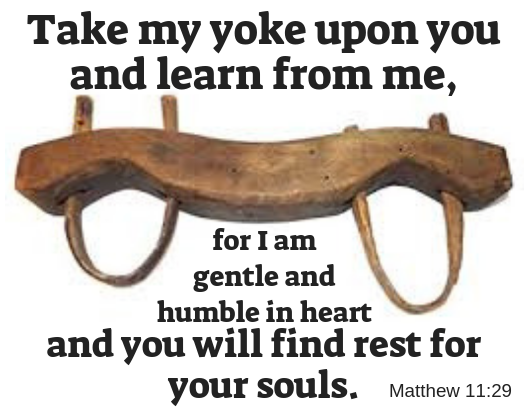
With this invitation comes the metaphor of putting on a yoke with him, which at first glance, may feel like even more of a burden and more constrictive.  He uses a yoke as a metaphor to help us picture the beauty of that “shackling”.  A yoke joins two animals, such as oxen, together so that the animals can share the workload and become more productive. The farmer may choose to shackle an older ox with a younger one or an unruly one with one that is steadier in order to help them both in the work.  The biblical scholar William Barclay describes the creation of a yoke by a carpenter who measures the ox and followed by several fittings, creates a customized yoke that gives the ox comfort while he works.  He also says that there is a legend about Jesus which may or may not be true, that as a carpenter, Jesus had a reputation of making some of the best yokes in the region and had a sign about his door that said, “My yokel fits well”!  Fact or fiction, this is the type of yoke that he is inviting us to take on with him—one that is comfortable, that allows him to lead and gives us relief from bearing burdens by ourselves.   

In the book, The Ragamuffin Gospel, Brennan Manning addressed a specific audience, and as it happens, the same audience Jesus’s invitation is for. He said that the “ragamuffin gospel” is for:

The bedraggled, beat-up, and burnt-out. It is for the sorely burdened who are still shifting the heavy suitcase from one hand to the other. It is for the wobbly and weak-kneed who know they don’t have it altogether. It is for inconsistent, unsteady disciples whose cheese is falling off their cracker. It is for poor, weak, sinful men and women with hereditary faults and limited talents. It is for earthen vessels who shuffle along on feet of clay. It is for the bent and the bruised who feel that their lives are a grave disappointment to God. It is for smart people who know they are stupid and honest disciples who admit they are scalawags.

What would it look like if we actually did this?  We wake up in the morning knowing that we can’t bear the burden of the day and just simply asked him to share the burden?  How would your life be different?

This is an invitation to join with Jesus who describes himself as gentle and humble in heart so that we might find rest for our souls.  In this, he will equip us, teach us, support us, relieve us and guide us as we live our lives. It is a clear path. . . Come to him, Take his yoke, learn from him, and find rest for your weary soul. 

Questions for reflection

What is your initial response to the command to “come”?  What then is your initial response to be “yoked”?

Why do you think we tend to handle our burdens by ourselves?  Why might we hesitate to share the burdens with Jesus?

When you think about being “yoked” together with Jesus, does that feel constrictive or freeing? How do you think you could more intentionally share your burdens as a result of this invitation?

Marvelous Faith

Matthew 8:1-13 and Luke 7

Devotion by Shelly Millard (Nebraska)

It might take a lot to surprise Jesus, but surprised and amazed he was.   We could initially assume that this reaction was directed toward his disciples. Perhaps it was from a crowd’s reaction to one of his teachings.  Maybe, just maybe, it was due to an interaction with a rabbi in a synagogue.  Instead, we are told that he “marveled” at the response of a Roman soldier, an unlikely scenario.  People in the area were abuzz with the news of the teachings and miracles of Jesus.  This talk had reached the ears of a Centurion, a Roman soldier that oversaw 100 soldiers occupying the region.  This centurion, likely well versed in the pantheon of Roman gods, heard news of the one claiming to be the son of the living God. This powerful man, when his servant became ill, decided to seek out this Jesus by asking a group of Jewish elders to intercede on his behalf.  They were willing to do so as this Centurion had helped them build a synagogue.  This intercessory group met Jesus as he entered the town and presented the request, at which time Jesus set off to the Centurion’s house.   He had just been teaching the concept of “loving your enemies” and here he was heading to the home of a Roman.  As they drew close, they were met with another group of emissaries with the message that the Centurion did not feel worthy to have Jesus in his home, but believed that he could just say the word and the servant would be healed.  Jesus was astonished.  Here was a Roman, a man of authority, a pagan, and an enemy of the Jewish people who had enough faith to believe that Jesus could heal with a word.  The Greek word “thaumazo” used to describe the reaction of Jesus to this man’s faith is translated as “amazed” or “marveled”. The only other time that this word is used in the New Testament is when Jesus “marveled” at the lack of faith of those in Nazareth.  This centurion was an unlikely person to “amaze” Jesus, yet Jesus described him as having “great” faith.  In other places, Jesus describes “little” faith in describing his disciple’s response to him.  Little faith from the disciples; great faith from the Centurion.  He demonstrated great faith by believing without seeing, stepping out of his culture and authority to humble himself, and trusting what he had heard about Jesus.  As a man of authority, he understood the power of the authority that Jesus had and had confidence to make the request of him.  Such confidence is the essence of faith. It is that confidence that prompted Jesus to respond with “Truly I tell you, I have not found anyone in Israel with such great faith”. 

Questions for Reflection

In what ways were the actions of the Centurion a surprise in this story?  How did he act differently than what we might expect of a man in his culture and situation?

What prompted the Centurion to make this request?  Why do you think he was reluctant to approach Jesus directly?  What did this tell Jesus about this man?

Why do you think Jesus marveled at this request?  Why did he identify this man as one with great faith?

When looking at your own faith, where would you place it on a scale of “little faith” to “great faith”?

How do you think you could grow your faith into one that was considered “great”?

A Transformed Life

Matthew 5-7

Devotion by Shelly Millard (Nebraska)

It was a warm day by the Sea of Galilee as Jesus and his disciples rested, ate and talked.  They had been on a rigorous schedule following the launch of Jesus’s ministry.  Word about the healings and teachings had spread and people were intrigued by this new itinerant preacher who was sharing a new message about the Kingdom of God.  Folks from all around the region began to seek him out and as Jesus noticed the gathering of the crowds, he moved up the hill to a place where the crowds could see and hear him.  He began to speak, resulting in what we know as the Sermon on the Mount.  He spoke about the Kingdom of God in a way they had never heard before, turning everything they knew about religion, the law and the kingdom upside down. Donald Kraybill in his book, The Upside Down Kingdom, describes how Jesus presented an introduction to the Kingdom of God that was totally opposite of what the world’s definition might be.  In these teachings, Jesus provided a vision of what a life lived with the Kingdom of God in their minds and in their hearts might look like.  Instead of a focus on following the law, he called for the transformation of their hearts and lives.

The upside down kingdom, as described by Jesus, included flipping their perspectives in several ways:

  1.  In a world where power, money, status, aggression, revenge and self-centeredness were valued, he provided a new perspective in the Beatitudes where those who were poor, sad, without status, gentle, forgiving, merciful and looking for peace would be the very ones who were blessed, happy and would receive the ultimate rewards.
  2. The keys to the kingdom were found in sharing your light with the world.  That light was not just keeping the law but letting others see the change in your heart and life.
  3. Keeping the law was not just about following the rules but about creating relationships which reflected the love of Jesus and one another.  You choose not to covet  for example, not because it is a rule, but because it destroys relationships.  Loving God is fleshed out in loving your neighbor by respecting them, sacrificing for them and even loving those you consider your enemies. 
  4. He encouraged them to pray with a focus on building a more personal and intimate relationship with God by providing a template with The Lord’s Prayer.
  5. Instead of focusing on the temporary and insubstantial values of the world, our attention should be on those values of the Kingdom of God which are lasting and substantive.
  6. In a world that is filled with anxiety about the future, Jesus reminds them that this worry is just a waste of time and energy.  Instead, if you focus on seeking the Kingdom, these other things will fall into place. 

We are called to an upside down kingdom where transformed lives allow people to begin to experience the Kingdom of God.  Jesus provided a vision of what a transformed life looks like so that followers can begin the journey toward that destination.  Those steps in that journey come with every intentional decision and choice we, as followers, take.   If I want to reflect God’s kingdom, then I choose to spend time in prayer, focus my time and energy on kingdom values, treat the poor and marginalized with kindness and on and on.  Every choice moves us in the direction of more fully reflecting the Kingdom of God in our lives.  Every thought, belief and action is an opportunity to more fully reflect that transformed life.

Questions for reflection:

How does the term “upside down kingdom” impact how you read the teachings of the Sermon on the Mount?

Which of the teachings contained in this sermon resonate with you?

How do you respond to the idea that each day we are faced with opportunities to intentionally transform into the vision that Jesus has created?

It’s easy to become overwhelmed with the need for transformation and just shut down.  How does it make you feel if you approach it as one decision or choice at a time?

What is one area of your life where you would like to work on transformation? 

The Lord of the Sabbath

Matt 12:1-21

Mark 3

Luke 6

Devotion by Cayce Fletcher (SC)

Every morning, I like to take a little bit of time after my bible study to read a few pages in a book. Currently, I am working my way through Jesus the King by Tim Keller (also called King’s Cross). This book is a compilation of Keller’s sermons on the gospel of Mark, and I’ve enjoyed it so far. Interestingly, my reading today lined up perfectly with today’s passages.

In each of the passages today, we read of Jesus doing the work of God on the Sabbath. The Pharisees were outraged, saying, ‘Who does this guy think he is?’ And, each time, Jesus responded, ‘I am Lord of the Sabbath.’

Before we can dive into what Jesus is teaching here, we have to ask: “What is the Sabbath?”

The Sabbath was instituted in the dawn of time when God rested from his work of the world and then reinforced with the Mosiac law. Why did God need to rest? 

Keller answers this question in his book: “What does that mean? Does God get tired? No, God doesn’t get tired. So how could he rest? A different reason to rest is to be so satisfied with your work, so utterly satisfied, that you can leave it alone. Only when you can say about your work, “I’m so happy with it, so satisfied – it is finished!” can you walk away. When God finished creating the world, he said, “It is good.” He rested.” (Jesus the King, p. 45)

God didn’t need to strive anymore after his creation was made. It was very good, and he could cease from striving. Sabbath in Old Testament times shows a dependence upon the provision of God. The Israelites had to trust that God would provide enough manna so that they could rest on the sabbath. They had to trust that God would provide abundantly with their crops when they let their land rest every 7 years. 

But, by Jesus’ time, the Sabbath had become so distorted that it turned from being a testament to God’s very good creation and provision to being a heavy load carried on the backs of his people. 

As Keller says, Sabbath means ‘deep peace, deep rest.’ When Jesus says he is Lord of the Sabbath, he is saying that “he is the source of the deep rest we need” (p.44). 

Hebrews 4:9-11 says, “There remains, then, a Sabbath-rest for the people of God; for anyone who enters God’s rest also rests from their works, just as God did from his. Let us, therefore, make every effort to enter that rest, so that no one will perish by following their example of disobedience.”

Because of Jesus’ work on the cross, we can experience the same type of Sabbath rest. We can cease the striving, lay down our heavy burdens, and rest in what is already done. 

Cayce Fletcher writes and podcasts at amorebeautifullifecollective.com. Check out the blog and other resources to help you create a life you love and cultivate your heart for God. This free resource here will help you take your Bible study one step further with a Bible reading tracker, Bible study reflection page, and more.  

Reflection Questions

  1. What is the point of the Sabbath? Why did God institute the Sabbath?
  2. Do you think believers are still called to observe the Sabbath? What does that look like under the New Covenant? 
  3. What does it mean that Jesus is Lord of the Sabbath? What does that say about Jesus? What does that say about the Sabbath?

SGL.2025.SeptemberFullPageDownload

“This is Water”

John 5 

Devotion by Cayce Fletcher (SC)

David Foster Wallace, a popular modern literary author, gave a commencement address in 2005 that everyone should read at least once. Wallace wasn’t a religious person, but he was concerned about the search for meaning. His speech highlights a central truth about humanity while recognizing how this truth is realized in an increasingly secular world. 

He begins his speech with the story of a fish who greets two fish by asking, ‘How’s the water?’ After that fish swims away, the other fish turns to his friend and asks, ‘What the heck is water?’

Here is a quote, at length, from his speech: “Because here’s something else that’s weird but true: in the day-to-day trenches of adult life, there is actually no such thing as atheism. There is no such thing as not worshipping. Everybody worships. The only choice we get is what to worship. […]

“The whole trick is keeping the truth up front in daily consciousness.

“Worship power, you will end up feeling weak and afraid, and you will need ever more power over others to numb you to your own fear. Worship your intellect, being seen as smart, you will end up feeling stupid, a fraud, always on the verge of being found out. But the insidious thing about these forms of worship is not that they’re evil or sinful, it’s that they’re unconscious. They are default settings.

They’re the kind of worship you just gradually slip into, day after day, getting more and more selective about what you see and how you measure value without ever being fully aware that that’s what you’re doing. […]

“It is about the real value of a real education, which has almost nothing to do with knowledge, and everything to do with simple awareness; awareness of what is so real and essential, so hidden in plain sight all around us, all the time, that we have to keep reminding ourselves over and over:

“This is water.

This is a truth we all need to remind ourselves of. We are all predisposed towards following idols and worshipping things that ultimately are fruitless. 

In today’s readings, I see the same truth in Jesus’ words. In Jesus’ words to the Jews, he speaks of their reverence – their worship – for the law of Moses. But, he sees – and we see – how this reverence ultimately led them to reject the very thing that Moses was looking forward to: Jesus. 

In John 5:39-40, he says, “You study the Scriptures diligently because you think that in them you have eternal life. These are the very Scriptures that testify about me, yet you refuse to come to me to have life.”

Their worship caused them to become focused on the wrong things, and in so doing, they missed the true life that was in Jesus. 

We have the same option before us. We can choose to follow after all of these idols, thinking we will gain something from them. But, ultimately, that will simply lead to a fruitless life. 

Or, we can choose to come to Jesus and gain true life. 

In Wallace’s speech, his conclusion is that people should just live to be kind, but he rejects the idea that there is a greater religious implication for his worship. And, the tragedy of Wallace’s life is that he never came to Jesus himself. In 2008, he committed suicide.

What are you choosing to worship today? Come to Jesus, and gain true life. 

Cayce Fletcher writes and podcasts at amorebeautifullifecollective.com. Check out the blog and other resources to help you create a life you love and cultivate your heart for God. This free resource here will help you take your Bible study one step further with a Bible reading tracker, Bible study reflection page, and more.  

Reflection Questions

  1. What were the Jews worshipping? Why was this ultimately fruitless without Jesus?
  2. What are you choosing to worship today? Will it result in something lasting? 
  3. Jesus says, “Come to me, and you will have life.” How does Jesus grant life now – in addition to eternal life? 

SGL.2025.SeptemberFullPageDownload

Pursuing Jesus

Mark 2 

Devotion by Cayce Fletcher (SC)

Even so early in his ministry, the crowds had already begun to clamor for Jesus. They wanted to hear his words, to be close to him. In Mark 2, we read that there were so many people at a house where Jesus was teaching that there was simply no room left. 

My church has a fairly large sanctuary. Most weeks, it never gets more than ¾ of the way full. But, there are those special events (and Christmas and Easter) when most pews are full. 

It’s wonderful to go into a full church – not just because of the excitement – but also because we are bigger and grander when we’re together. We sing louder. We have better conversations. We are able to carry each other’s burdens more easily. 

But, even during the biggest service, there has never been a time where there was no room left. 

I wonder what it would have been like to be in this moment at the house with Jesus. What would it have been like to be a part of the growing excitement? To hear Jesus’ name in whispers through the countryside. To see people drop everything just for a chance to hear his teaching. 

What if you could experience this today? 

The truth is we have an even better opportunity to come and hear Jesus’ teachings. To meet with not only him, but also God our Father as well. But, all too often, we reject this opportunity.

How many times have you said the excuse that you were just too busy to pray? How many times have you moved through your days and weeks and just forgot to open your Bible? How many times have you said, ‘I just don’t feel like it,’ when Sunday morning rolls around? You hit snooze and go back to sleep. What about during weekly Bible study? How many times have you just said, ‘I just need some me-time, to relax.’ 

With recent national events, there have been several posts asking about churches to go to. People are searching for answers and trying to find them. 

We have an opportunity for revival in our community and nation if we can point them to the one who gives true life. Not only this, we can experience revival in our own hearts. We just have to commit to show up, be consistent, and be obedient. 

The young men who needed to get to Jesus climbed up on the roof, dug through it, and lowered their paralyzed friend down to Jesus to be healed. How are you pursuing Jesus today? 

Cayce Fletcher writes and podcasts at amorebeautifullifecollective.com. Check out the blog and other resources to help you create a life you love and cultivate your heart for God. This free resource here will help you take your Bible study one step further with a Bible reading tracker, Bible study reflection page, and more.  

Reflection Questions

  1. What are some excuses that you make concerning your quiet time? What about going to church? Do you consistently show up, or do you let things get in the way?
  2. Have you invited someone to church recently? How have you been sparking conversations that may lead to evangelism? 
  3. Several of the events we read about today are about Jesus’ authority. He has the authority to forgive sins, to choose his disciples, when to fast, and even over the Sabbath. Why is the question of Jesus’ authority focused on so much in the gospels?

SGL.2025.SeptemberFullPageDownload

Whoever Believes in Him

John 2-4 

Devotion by Cayce Fletcher (SC)

Our passage of scripture today is action-packed, as Jesus begins his ministry and starts to teach and gain followers as he moves through Judea and Galilee. The reading is bookended by two signs (of which there are 7 in the book of John): Jesus turning water into wine and healing the official’s son. 

It’s interesting to compare the beginning of Jesus’ ministry with the temptations he faced in the wilderness.  Jesus was tempted to exert his authority in a way that disregarded God. His obedience required humility. 

Today, we read about him walking humbly in obedience, doing the will of the Father at a wedding feast, in the temple, and even in a Samaritan village. As he was walking in obedience, he was being elevated. He was shown to have authority over nature, teachers, the temple, and even death. 

Like the actual signs themselves, the whole book of John is a book of witness. John is giving his eyewitness testimony, but he is also documenting how Jesus affected the lives of those around him. Each of these instances ends with “____ believed him.” I’ve heard it said that the book of John can be summed up with the phrase, ‘Come and See.’ 

As we read through the gospels, we are invited to ‘come and see’ the work of Jesus. Like the stories we read today, we can choose to believe in the words and signs of Jesus. 

What is the right response to this belief? 

John 3:21, “But whoever lives by the truth comes into the light, so that it may be seen plainly that what they have done has been done in the sight of God.”

When we believe in Jesus, we are stepping into the light. We are choosing to live righteous lives in obedience to God as we imitate Christ and are made more like him. Belief in Jesus is the first step in a life obedience. 

What is the outcome of this belief? The gospel of John is very clear about that. 

Belief in the Son brings eternal life. John the Baptist sums this up in John 3:35-36, “The Father loves the Son and has placed everything in his hands. Whoever believes in the Son has eternal life, but whoever rejects the Son will not see life, for God’s wrath remains on them.”

We must echo him when we choose to follow Christ: Jesus must increase, and I must increase. That is the true path of life. 

Cayce Fletcher writes and podcasts at amorebeautifullifecollective.com. Check out the blog and other resources to help you create a life you love and cultivate your heart for God. This free resource here will help you take your Bible study one step further with a Bible reading tracker, Bible study reflection page, and more.  

Reflection Questions

  1. How do the miracles and signs we read today show the authority that God has given Jesus? 
  2. What is so important about belief? Why is belief in Jesus the cornerstone of our faith (as opposed to action or other traditions)? 
  3. How are you choosing the path of belief and obedience in your life? Is your life bearing witness to Christ?

SGL.2025.SeptemberFullPageDownload

The Fight Against Temptation

Matthew 4 

Luke 4-5

John 1:15-51

Devotion by Cayce Fletcher (SC)

At the beginning of Jesus’ ministry, we read of his baptism. This is a special moment of God clearly anointing Jesus with his spirit as he says, “This is my son, with whom I am well pleased.” Jesus is anointed and commissioned in that moment to go and preach the gospel of the Kingdom – which is what he does in Matthew 4:17. 

In between the anointing and commencing of his ministry, we read of a curious episode in Jesus’ life. He is led by the Spirit into the wilderness to be tempted by the devil. 

The devil shows Jesus three things to entice him to reject God in disobedience. He tells Jesus to turn the stones to bread, to command the angels to come and rescue him, and to elevate himself physically and figuratively so that the world will bow down to him. 

Interestingly, these things aren’t necessarily the same struggles we may be tempted by. In one Bible Study I was teaching about this passage, one of my friends looked puzzled and mentioned that he would think that Jesus would have been tempted with ‘the lust of the eyes’ because that is such a ubiquitous struggle for our society. But, I think that this instance is more than Jesus staying strong against the seven deadly sins – though he does and remains sinless throughout his temptations. 

In each instance, the devil says, ‘Just show your power to do these things. Show yourself to be like God.’ The devil knows that Jesus has the authority to do the things that he is tempting Jesus with. Jesus also has the power to do those things. But, Jesus knows that he must remain obedient. Jesus is not God, and Jesus knows that the only reason he has the power and authority to do supernatural things is because God has granted him that authority. 

These temptations echo the first temptations in the garden. The ancient serpent also tempted Adam and Eve with the chance to become ‘like God.’ Instead of trusting in God and remaining obedient to his word, Adam and Eve trusted the serpent and grabbed at the chance for the knowledge of Good and Evil. Of course, the serpent’s promises were empty and brought death, not happiness. 

We are also tempted. Yes, temptations mean that we have to be sure to follow the law of God and live righteously. But, more than that, temptations mean that we have to trust that God knows what is best for our lives. Jesus could have looked at his situation in the wilderness (that he was led to by God) and decided that he knew best. In that moment, he could have rejected God, acted disobediently, and sinned. 

But, he didn’t. 

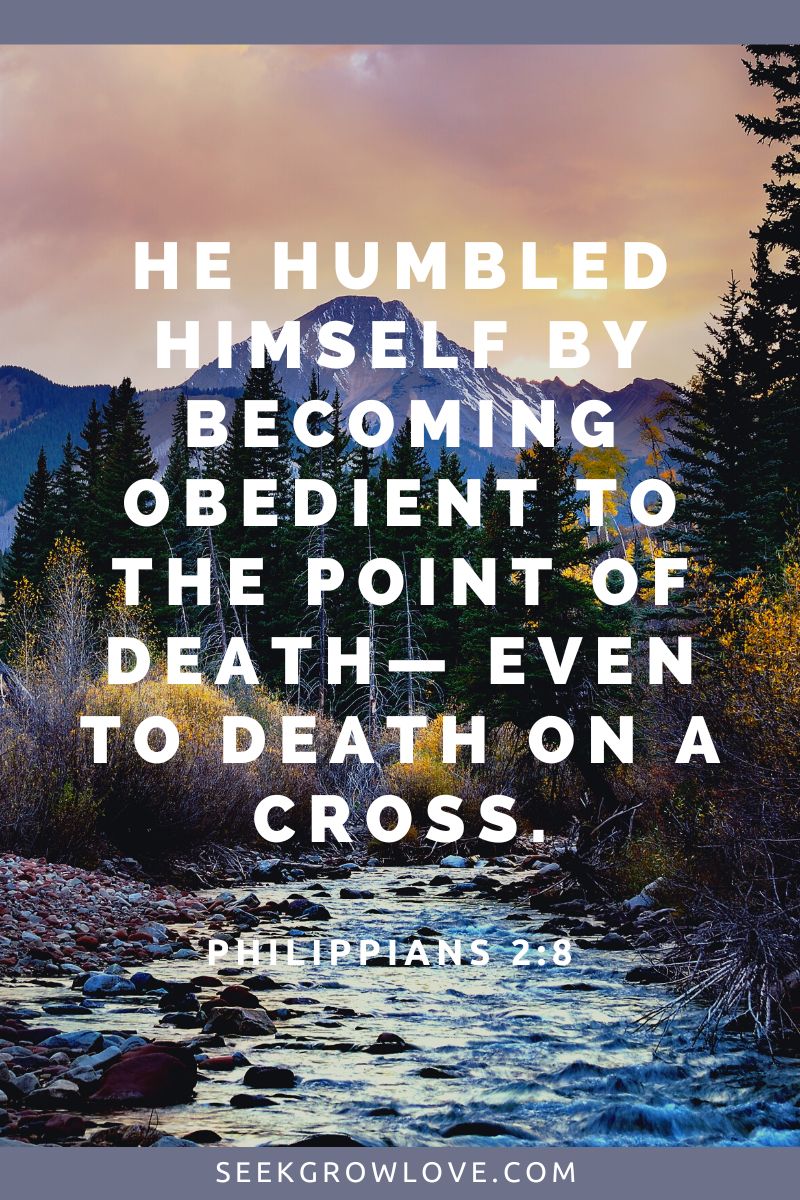
Instead, his obedience required him to humble himself and trust God. Ultimately, this proved to be a training ground for what would be required of him later on. Philippians 2:8 says, “He humbled himself by becoming obedient to the point of death — even to death on a cross.” 

We have to take the same path. We don’t know best. We have to trust God and his word. 

We can take comfort in the end of the story, too. Jesus wasn’t exalted by the devil, but we know that the thing the devil tempted him with will come true because Jesus was obedient. One day, every knee will bow and every tongue confess that Jesus Christ is Lord. 

We wait in hope for that day, and we live in obedience today. 

Cayce Fletcher writes and podcasts at amorebeautifullifecollective.com. Check out the blog and other resources to help you create a life you love and cultivate your heart for God. This free resource here will help you take your Bible study one step further with a Bible reading tracker, Bible study reflection page, and more.  

Reflection Questions

  1. How are the temptations of Jesus in the wilderness similar to and different from the temptations of Adam and Eve in the garden? 
  2. How does Jesus fight against temptation? How can you better equip yourself to fight against temptation? 
  3. Why did God lead Jesus to the wilderness? How was Jesus’ time in the wilderness preparation for the rest of his ministry? 

SGL.2025.SeptemberFullPageDownload

The Beginning of Ministry

Matthew 3

Mark 1

Luke 3

Devotion by Cayce Fletcher (SC)

The past year, I just celebrated the big 3-0. With every new decade, life speeds up, and the long stretch of the future that seems endless at 18 starts to look shorter and shorter. 

I remember when I graduated from high school, I – and all my friends – wrestled endlessly with what to make of our lives. What college? What major? What city? What guy? It seemed like we needed to have it all figured out as soon as we walked across the graduation stage. 

But, as anyone who has a little life experience knows, life rarely goes as planned. What we thought would make up our lives at 18 rarely fits with what our life actually looks like at 30, 40, or 50. 

It always seemed strange to me that Jesus, with such a short life, waited to begin his ministry until 30. Here are some reasons why that could be

Traditionally, 30 was the age in Jewish culture of full maturity. It matches up with the pattern of scripture: David was 30 years old when he became king, Joseph was 30 when he entered the service of Pharaoh, the Levitical priests were 30 when they started their service, and so on (Ezekiel, King Saul, and maybe even Paul the Apostle). 

Jesus needed to wait to gain the experience and wisdom that comes with age. His authority and testimony depended on it. 

When I was younger, it seemed like if I had not decided on a thing by age 22 that opportunity would have passed me by for the rest of my life. Whether that’s a career or a specific ministry, it seems like I’m already too set in my ways to be able to make a change and start doing the thing. 

But, I’ve realized that is not how life works. Our lives are long and full of twists and turns. Joseph probably could not have dreamed of the many changes that would take place between his time among his flocks and entering the service of Pharaoh, but God knew and had a plan. 

Sometimes, I find myself falling into this trap today. If someone has moved on from the church or a friendship is broken, I often give up. I feel as though this will be how this person, this relationship, or this work will be for the rest of my life. 

We need to remember this: As long as we are willing to walk in obedience, it is never too late to start the work. God uses the time waiting and praying as preparation to help to mature our faith and grow our wisdom. 

What can we do in the waiting? 

We can pray, prepare, and trust – as we look to all those who had to wait to begin their ministry. We can trust that God, ‘who started a good work in us, will see it through to completion.’ 

Cayce Fletcher writes and podcasts at amorebeautifullifecollective.com. Check out the blog and other resources to help you create a life you love and cultivate your heart for God. This free resource here will help you take your Bible study one step further with a Bible reading tracker, Bible study reflection page, and more.  

Reflection Questions

  1. Why do you think Age 30 was so significant in God’s plan? What is special about this age? 
  2. What thing do you feel is ‘too late to change’? It could be a job, a personality trait, a failed relationship, or a church ministry. How could you pray for change for this thing? 
  3. How can we ‘wait well’? What are some practical steps we can take to make the most of our time of preparation? 

SGL.2025.SeptemberFullPageDownload

The Gift of the Magi

Matthew 2

Luke 2:39-52

Devotion by Cayce Fletcher (SC)

When I was still teaching seventh-grade English, one of the stories that my students loved (much to my surprise) was “The Gift of the Magi” by O. Henry. In the story, a young couple needed to buy Christmas presents for each other, but like many young couples, they were severely lacking in funds to do so. In order to scrounge together what they needed for the perfect gift, they sold their most valuable possessions (hair in the girl’s case and an inherited pocket watch for the boy). 

At the end, to their dismay, the boy and the girl realized that the gifts they had purchased were useless, though very expensive. The boy had bought a comb for the girl who had shorn her hair. The girl had bought a chain for the boy who had sold his watch. 

As my students reached the end of the story, they would always laugh and shake their heads at the couple. But, the story ends with this famous quote: “Of all who give and receive gifts, such as they are wisest. Everywhere they are wisest. They are the magi.” 

Today’s reading almost feels like Christmas in July (or well… September). In four separate stories of travels, we learn about Jesus’ boyhood. He receives the gifts from the Magi, takes off to Egypt for several years, returns and settles in Nazareth, and finally participates in an annual pilgrimage for the Jewish feast of Passover. 

My students may think that the boy and girl in the story are silly, but when we read the story of the Magi, we should be struck as well. These men left their countries to go on a years long journey. To where? They didn’t know. For what? They also didn’t know. 

All they knew was this: “We saw his star when it rose and have come to worship him.”

O. Henry recognized that this was true devotion and love. To recklessly sacrifice to show devotion for something that we hold as truly valuable. The Magi are famously called ‘The Wise Men.’

But, what is true wisdom? 

It is not always playing it safe. It is not always acting in a way the world deems prudent. 

But, it is always rightly ordering our loves so that we can show devotion to the best thing. 

What does that look like? 

It is choosing to put our faith at the forefront of our lives, prioritizing it. We talk of priorities as a list of 3, 5, or even 10. But, really, the word means the thing we hold first. If our faith is placed first, everything else we do falls behind it. 

And, when we devote our lives to our faith, we may pursue the way of the Magi. We may sacrifice (maybe a little recklessly) in order to obey our God. Because we know that the path of obedience is sweet and good. It is worth giving up everything – even our most valuable possessions – for. 

Cayce Fletcher writes and podcasts at amorebeautifullifecollective.com. Check out the blog and other resources to help you create a life you love and cultivate your heart for God. This free resource here will help you take your Bible study one step further with a Bible reading tracker, Bible study reflection page, and more.  

Reflection Questions

  1. We often think of the Wise Men as being Wise because they were simply ‘learned.’ But, how were their actions also wise? 
  2. What is our first priority in our lives? How do we show this through our actions? 
  3. How can choosing to live wisely and righteously look like foolishness to the world? 

SGL.2025.SeptemberFullPageDownload