You Feed Them

Exodus 11-12

Proverbs 31

Matthew 14

Devotion by Tom Siderius (MI)

Matthew 14:13-16(NLT) As soon as Jesus heard the news, he left in a boat to a remote area to be alone. But the crowds heard where he was headed and followed on foot from many towns. 14 Jesus saw the huge crowd as he stepped from the boat, and he had compassion on them and healed their sick.
15 That evening the disciples came to him and said, “This is a remote place, and it’s already getting late. Send the crowds away so they can go to the villages and buy food for themselves.”
16 But Jesus said, “That isn’t necessary—you feed them.”

As we read in Matthew 14 today, we find the “feeding of the five thousand”, a famous story of Jesus doing a notable miracle.  But what is the real lesson and reason for doing this miracle?  The disciples are very logical and show common sense.  “Send the people away to the local Kroger or Aldi and let them buy their own supper while the shops are still open”.  For most people their bread would be the staple of their diet, and where most of their calories would come from.  As we read the Word, we see the emphasis on bread  as sustenance for us repeatedly. 

Try to be one of the disciples in this situation. Five thousand with nothing to eat and Jesus just says Hey you feed them!!  No prob Jesus we’ll get right on that, lets see.  Hey Matthew what’s in the lunch pail you brought?  Hello John how about those granola bars you have in your pockets?  Hey, Peter and Andrew, how about those sandwiches your Mom made for lunch for us? 

Sorry, Jesus, only 5 loaves and a couple of salt fish, not going to get it done, lets go with our plan.

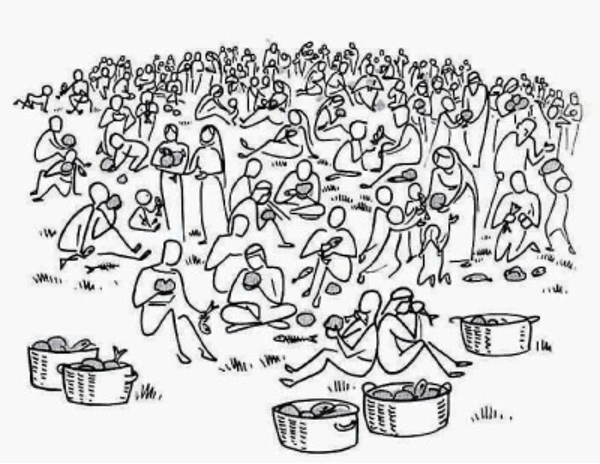
Matthew 14:18-21(NLT) “Bring them here,” he said. 19 Then he told the people to sit down on the grass. Jesus took the five loaves and two fish, looked up toward heaven, and blessed them. Then, breaking the loaves into pieces, he gave the bread to the disciples, who distributed it to the people. 20 They all ate as much as they wanted, and afterward, the disciples picked up twelve baskets of leftovers. 21 About 5,000 men were fed that day, in addition to all the women and children!

Wow what a miracle and how about those leftovers they’ll be eating for days!!  Actually, Jesus is using this as a teachable moment for all his disciples both then and now.  It is not about the miracle but rather that we would trust God for our sufficiency and nourishment, not our own ability to take care of every situation we find ourselves in.  If you examine your life, you will see the hand of God feeding you all through it.  Only by His grace and mercy does the rain fall on the just and also the unjust.  

What did it take to bring the bread to your table today?

Why are we always so hungry?

John 6:29-40(NLT) Jesus told them, “This is the only work God wants from you: Believe in the one he has sent.” 30 They answered, “Show us a miraculous sign if you want us to believe in you. What can you do? 31 After all, our ancestors ate manna while they journeyed through the wilderness! The Scriptures say, ‘Moses gave them bread from heaven to eat.’”
32 Jesus said, “I tell you the truth, Moses didn’t give you bread from heaven. My Father did. And now he offers you the true bread from heaven. 33 The true bread of God is the one who comes down from heaven and gives life to the world.”
34 “Sir,” they said, “give us that bread every day.”
35 Jesus replied, “I am the bread of life. Whoever comes to me will never be hungry again. Whoever believes in me will never be thirsty. 36 But you haven’t believed in me even though you have seen me. 37 However, those the Father has given me will come to me, and I will never reject them. 38 For I have come down from heaven to do the will of God who sent me, not to do my own will. 39 And this is the will of God, that I should not lose even one of all those he has given me, but that I should raise them up at the last day. 40 For it is my Father’s will that all who see his Son and believe in him should have eternal life. I will raise them up at the last day.”

What is the bread of life we all desire to have?

How can we give it to others?

True believing in our Father and God and the Son He has sent is the only good work that we can do.  Nothing else we can do has real value except to believe and act on that belief walking day by day with our Father and our brother Jesus Christ.  Beware of the temptations and the sin of religion in this world and see that our help and sufficiency for our lives can only come from the God that loves us and has called us to Him. 

Mark 8:14-21(NLT) But the disciples had forgotten to bring any food. They had only one loaf of bread with them in the boat. 15 As they were crossing the lake, Jesus warned them, “Watch out! Beware of the yeast of the Pharisees and of Herod.” 16 At this they began to argue with each other because they hadn’t brought any bread. 17 Jesus knew what they were saying, so he said, “Why are you arguing about having no bread? Don’t you know or understand even yet? Are your hearts too hard to take it in? 18 ‘You have eyes—can’t you see? You have ears—can’t you hear?’ Don’t you remember anything at all? 19 When I fed the 5,000 with five loaves of bread, how many baskets of leftovers did you pick up afterward?”
“Twelve,” they said.
20 “And when I fed the 4,000 with seven loaves, how many large baskets of leftovers did you pick up?”
“Seven,” they said.
21 “Don’t you understand yet?” he asked them.

You feed them!!

Reflection Questions:

See questions in bold above

Prayer: 

Father God help us to look to you for our help in time of need, and for our very lives.  Thank you for your sufficiency for every day’s challenges and opportunities as we believe your Word.  Help us to become like our big brother Christ as people we see have needs that we can minister to.  We thank you every day for calling us to this time and place of fellowship and love.  In Jesus’ name we pray.

Who is Agur?

Exodus 9-10 

Proverbs 30     

Matthew 14

Devotion by Tom Siderius (MI)

Agur son of Jakeh is not normally a familiar character in our English Bibles.  Here we are reading right along with the chapters of Proverbs, mining every nugget of gold and truth from these verses and wondering how Solomon is so wise.  And now along comes Agur who writes a whole chapter in the book and is a complete unknown to us. 

His name “Agur” can be translated to mean “gatherer” and his father’s name Jakeh means “pious”.  So from the name we gain some clues about who this man may have been.  He could have been a scholar or writer of their time who wrote down or compiled wise sayings, maybe even from Solomon himself.  It is a mystery for us, but we can see from his writing God’s familiar wisdom pattern.  He compares the physical with the eternal, the earthly with the heavenly, and the corrupt with the pure. 

Agur starts with some statements which are deeply humble in God’s sight and remind me of the later chapters of Job where the majesty of God is compared to our puny, small efforts of this earth.

Proverbs 30:1-4(NLT) The sayings of Agur son of Jakeh contain this message.
I am weary, O God;
I am weary and worn out, O God.
2 I am too stupid to be human,
and I lack common sense.
3 I have not mastered human wisdom,
nor do I know the Holy One.
4 Who but God goes up to heaven and comes back down?
Who holds the wind in his fists?
Who wraps up the oceans in his cloak?
Who has created the whole wide world?
What is his name—and his son’s name?
Tell me if you know!

Right when it seems that I have the wisdom of God for a situation figured out and internalized in my life then failure rears its ugly head.  I am confronted with the reality that there is nothing I can do for God that would indebt Him to me for my goodness.  Nor can I accomplish any great work that God could not do by lifting his little finger.  When we begin to approach God by understanding that with Him we are everything, and without Him we are a complete nothing, then we start to gain wisdom.  The only thing we can do for God is to love Him and believe His Word.  This is Agur’s message in chapter 30 to us.

Proverbs 30:5-9(NLT) Every word of God proves true.
He is a shield to all who come to him for protection.
6 Do not add to his words,
or he may rebuke you and expose you as a liar.
7 O God, I beg two favors from you;
let me have them before I die.
8 First, help me never to tell a lie.
Second, give me neither poverty nor riches!
Give me just enough to satisfy my needs.
9 For if I grow rich, I may deny you and say, “Who is the LORD?”
And if I am too poor, I may steal and thus insult God’s holy name.

Jesus prays in the Lord’s Prayer:  “give us today the bread of our need”.  Our prayers and our desires need to be grounded in what we truly need, and what God is so willing to give us.  Our words and actions need to be true to His Word, and we need to stop telling lies to ourselves or to others to shade statements to give ourselves the credit. 

I was a truck salesman for more than 40 years during my career. Shades of truth in statements about what was good for the customers are sources of scorn and humor about how salesman deal with people.  My products and services weren’t always the best but those were the ones I had to sell to our customers.  I always took the view that I would not lie about anything but also promise that my efforts, and that of our dealership, would support their purchases.  Greed for riches would turn my lips to lies, acknowledging God’s sufficiency for myself and family made telling the truth an easy path.

What are the easy lies that come to your lips?

How do we guard against this?

Look at some more of these pure gold statements that are recorded for us to read by our teacher Agur..

Proverbs 30:18-19(NLT) There are three things that amaze me—
no, four things that I don’t understand:
19 how an eagle glides through the sky,
how a snake slithers on a rock,
how a ship navigates the ocean,
how a man loves a woman.

Just like our explaining to God how He should form, make and create the world and everything in it, we cannot explain from human knowledge exactly how these things work.  We think we know and understand but true to humility towards God will show us the shallow nature of our understanding and knowledge.  Only God’s wisdom is eternal and everlasting.

Reflection Questions

  1. See 2 questions above in bold.
  2. What can bring us to true humility?
  3. How can we turn these lights of understanding towards our hearts and lives?

Prayer

Abba Father, give us today the bread of our need and lead us in paths of righteousness following Your Son and our Savior.  God, we have no words or explanations for Your greatness and Your love for us.  Help us today to turn our hearts to hear, give us ears to hear Your voice.  In the name of our Savior Jesus Christ we pray.

Ears to Hear

Exodus 7-8

Proverbs 29

Matthew 13

Devotion by Tom Siderius (MI)

Matthew 13:9-12(NLT) Anyone with ears to hear should listen and understand.”
10 His disciples came and asked him, “Why do you use parables when you talk to the people?”
11 He replied, “You are permitted to understand the secrets of the Kingdom of Heaven, but others are not. 12 To those who listen to my teaching, more understanding will be given, and they will have an abundance of knowledge. But for those who are not listening, even what little understanding they have will be taken away from them.

The parables of Jesus are beloved by so many of us.  They are stories that illustrate the true purposes of God by comparing them to physical activities that are familiar to the people hearing the story.  The great question that Jesus asks of us is:   “Do you have ears to hear?”.  The question goes to the state of the ears of our heart, not our physical ears.  We will come to an understanding of the secrets of the Kingdom of God when we listen to God’s Word with our hearts and minds.  In the Greek the mind is considered to be the place of our thoughts, where the heart is the place of what we truly believe and treasure. 

What is the “pearl of great price” of your heart?

Then Jesus quotes from the book of Isaiah chapter 6. 

Matthew 13:13-16(NLT) That is why I use these parables,
For they look, but they don’t really see.
They hear, but they don’t really listen or understand.
14 This fulfills the prophecy of Isaiah that says,


‘When you hear what I say,
you will not understand.
When you see what I do,
you will not comprehend.
15 For the hearts of these people are hardened,
and their ears cannot hear,
and they have closed their eyes—
so their eyes cannot see,
and their ears cannot hear,
and their hearts cannot understand,
and they cannot turn to me
and let me heal them.’


16 “But blessed are your eyes, because they see; and your ears, because they hear. 17 I tell you the truth, many prophets and righteous people longed to see what you see, but they didn’t see it. And they longed to hear what you hear, but they didn’t hear it.

In such a few words Jesus cuts right to the important things of life.  We will be blessed when hear God’s Word with our hearts, not just having good thoughts.  He also shows us what the righteous people of Israel have that makes them the people of God.  They desired to understand the wonderful truths that come so easily to us today.  Our access to Biblical understanding and the support and support that we have is amazing.  The history and scholarship that we have to access brings us a great knowledge, but also a great responsibility. 

How precious to you is this truth of God’s Word you have received?

Just in the time of my walk with God we have gone from typing a paper on a manual typewriter to using this wonderful Microsoft Word program I am using.  With my less than perfect typing and grammar being constantly corrected, I can put down decent communication without whiteout or retypes.  We have access to 20 different Bible versions at the ready and the Internet full of research and commentary to help search out this great truth.  I still have research books and materials that are paper bound and treasure them, but to find the passages or section with a search of material online is amazing. 

But still the Word needs to become rooted in our hearts.  Read Psalm 119:11 with me this morning.

Psalms 119:11(NLT) I have hidden your word in my heart,
that I might not sin against you.

Also, Psalm 1 tells us to meditate, which is to consider carefully our thoughts, motives, and actions in the framework of God’s Word.

Psalms 1:1-3(NKJV) Blessed is the man
Who walks not in the counsel of the ungodly,
Nor stands in the path of sinners,
Nor sits in the seat of the scornful;
2 But his delight is in the law of the LORD,
And in His law he meditates day and night.
3 He shall be like a tree
Planted by the rivers of water,
That brings forth its fruit in its season,
Whose leaf also shall not wither;
And whatever he does shall prosper.

Part of the strength of the Word to change us is that God uses so many figures of speech as well as parables to get us to examine our lives.  Knowledge is great, but the understanding of a section comes from the spirit of God within you. 

1 Corinthians 2:9-10(NKJV) But as it is written:
“Eye has not seen, nor ear heard,
Nor have entered into the heart of man
The things which God has prepared for those who love Him.”
10 But God has revealed them to us through His Spirit. For the Spirit searches all things, yes, the deep things of God.

What are the truths that you have learned that have most changed your heart to love God?

Have a wonderful day today with the meditation of your heart focused on God’s truths, and building our love for Him and His Son in all we do. 

Love in Christ Tom S.

Reflection Questions –

See bold questions above

Prayer

Dear God Almighty – I thank you for the wonderful gift of your Words and Wisdom delivered to us, through your dear Son Jesus, the master of parables, through all 66 books of the Bible, and through Your Spirit. I pray for eyes to see and ears to hear Your truths. Help me discern what knowledge, wisdom and direction is from You that I may go in the way You want me to go and say what you want me to say. I want my heart to be focused on You, Your truth, what You have done, are doing today and will do. Thank You for Your Son who is Coming Again! In his name we pray, Amen.

Walk in Wisdom

Exodus 5-6

Proverbs 28

Matthew 13

Devotion by Tom Siderius (MI)

As we read this morning, I am convicted so many times by the pure and simple understanding that the true Word of God brings to the situations of life.  As I read and hear the news of the world around us, the complexity of the situations and actions sometimes is very puzzling.  I cannot immediately discern by my own understanding and knowledge what is the best path or the correct statements.  But when I read verses like these from Proverbs 28 I am convicted so quickly in my heart about what are the right things to think and to do.  These verses cut right to the chase or where our hearts need to be.

Proverbs 28:19-28(ESV) Whoever works his land will have plenty of bread,
but he who follows worthless pursuits will have plenty of poverty.
20 A faithful man will abound with blessings,
but whoever hastens to be rich will not go unpunished.
21 To show partiality is not good,
but for a piece of bread a man will do wrong.
22 A stingy man hastens after wealth
and does not know that poverty will come upon him.
23 Whoever rebukes a man will afterward find more favor
than he who flatters with his tongue.
24 Whoever robs his father or his mother
and says, “That is no transgression,”
is a companion to a man who destroys.
25 A greedy man stirs up strife,
but the one who trusts in the LORD will be enriched.
26 Whoever trusts in his own mind is a fool,
but he who walks in wisdom will be delivered.
27 Whoever gives to the poor will not want,
but he who hides his eyes will get many a curse.
28 When the wicked rise, people hide themselves,
but when they perish, the righteous increase.

We also see in the New Testament in Timothy where God identifies for us where our hearts should be when we walk with Him and His Son Jesus Christ.  God’s wisdom is pure and simple.

1 Timothy 6:9-10(NKJV) But those who desire to be rich fall into temptation and a snare, and into many foolish and harmful lusts which drown men in destruction and perdition. 10 For the love of money is a root of all kinds of evil, for which some have strayed from the faith in their greediness, and pierced themselves through with many sorrows.

God shows us that prosperity is good, but when we desire to be rich, we are sinful and separate ourselves from God’s fellowship.  Money is not the root of ALL EVIL as some teach, but if we read carefully the verse says it is A root of evil.  Only when we desire to have it to enrich and pleasure ourselves does it become an evil purpose for us.  As we read the verses from Proverbs 28 we find so many pure thoughts and clear statements of how we are to handle our work, money, lives and relationships.  When we trust in God we become like that tree planted by the waters which is never without the water, help and love of Our Father. 

Psalms 1(NKJV)  Blessed is the man
Who walks not in the counsel of the ungodly,
Nor stands in the path of sinners,
Nor sits in the seat of the scornful;
2 But his delight is in the law of the LORD,
And in His law he meditates day and night.
3 He shall be like a tree
Planted by the rivers of water,
That brings forth its fruit in its season,
Whose leaf also shall not wither;
And whatever he does shall prosper.
4 The ungodly are not so,
But are like the chaff which the wind drives away.
5 Therefore the ungodly shall not stand in the judgment,
Nor sinners in the congregation of the righteous.
6 For the LORD knows the way of the righteous,
But the way of the ungodly shall perish.

Reflection Questions:

What are the priorities of your financial decisions?

How can we get the God perspective on our finances and relationships?

What can we do today to advance the message of the Gospel to others?

PRAYER:

Father God help us to turn our hearts to You.  Give us the wisdom that You promise here in Your Word to guide us in our lives.  We ask You for the prosperity that is needed to take care of our families and people, and the surplus that we need to support those who are in need.  Truly give us today the bread of our need and then help us to forgive those who trespass against us, keeping our lives pure and unblemished before You.  We pray these things in the name of our Savior Jesus Christ.

Shaliah

*Exodus 3-4

Proverbs 27

Matthew 12

Devotion by Jeremy Martin (TN)

            When we start Exodus 3, the Israelites have been demoted from a position of honor to a position of slavery (Ex 1).  Moses was born into these turbulent times and through a series of miracles survived and was promoted to a position of authority, and then fled when he was near 40 and remained in exile for 40 more years (Exodus 2, Acts 7: 23-30).  This puts Moses at the spry young age of about 80 years old when the story of the burning bush kicks off in Exodus 3.  This is one of the most important stories and chapters in the entirety of scripture for a couple different reasons: firstly,  for the first time the concept of  “shaliah” is indisputably revealed to us in scripture, and secondly God reveals himself to a human (Moses) by name for the first time in recorded history.  There are a few chapters in Genesis where the concept of Shaliah can be strongly inferred, but this is the first time I’m aware of that it’s plainly revealed. 

            If you are not familiar with this concept,  understand it is absolutely critical to understanding scripture.   You are apt to get a number of scriptures wrong if you don’t view them from the perspective of it’s original authors, that is to say, the ancient Jewish people. This is what wikipedia states about the Law of Shaliah (it is a legal term):

( Quoting Wikipedia) “In Jewish law, a shaliaḥ (in Hebrew : שָלִיחַ or pl.שְלִיחִים , sheliḥim (pl) or sheliah, literally “emissary” or “messenger”) is a legal agent. In practice, “the shaliaḥ for a person is as this person himself.” Accordingly, a shaliaḥ performs an act of legal significance for the benefit of the sender, as opposed to him or herself. “

            This concept is shown to us clearly in scripture by comparing and contrasting Ex 3:2 to Ex 3:4.  “And the angel of Yahweh appeared to him in a blazing fire…And Yahweh saw that he turned aside to look, so God called to him from the midst of the bush…” (LSB translation).  In essence, the messenger that God sends (be it angel, donkey, or human) speaks with the full authority of God, as if they are God.  So when “the word of The LORD” comes to the prophets and they speak, they are speaking with the full authority of the Most High God.  When God placed His name in the angel leading the Israelites in Ex 23:20-21, He explained to them that this angel spoke with His authority.  When the donkey spoke to Balaam, through the “angel of Yahweh”, it states clearly that “Yahweh spoke” (Number 22:22-28).  The one speaking was not the donkey, not the angel, but The LORD (YHVH) Himself (through His agent).  This is why it’s so critical to understand Shaliah, because the one who is sent by God speaks with the full authority of God.  This does not make the messenger mysteriously transform into God, but God lets us know that this messenger is speaking with the full authority of God so we’d better listen up. 

            This concept is repeated constantly throughout scripture but a lack of understanding of this concept, along with the introduction of a number of popular Greek philosophies later on, have caused numerous misinterpretations of scripture and much confusion amongst believers.  That concept carries over into the New Testament as well.  Jesus states in the book of John about 42 times that God sent him: he is not only the Messiah prophesied, but the man chosen to be the Shaliah of God.  The title “Christ” in Greek means “The Anointed One”, and we see from the OT that you are anointed by God from among men, so every time you see “Jesus Christ” in scripture, it is an affirmation that Jesus of Nazareth was the prophesied messiah, the anointed one, the man chosen by God to be his Shaliah.  Christ is a title, not a name, and it affirms Jesus’ humanity every time it is spoken while at the same time affirming that he speaks with the authority of God.

            Exodus 3 is one of my favorite chapters in the bible.  In it, God clearly reveals himself through his agent (Shaliah, we just talked about that) by name to a human being, for the first time recorded in history.  This is both awesome and humbling: that the creator of all things would reach back out to we who bear His image in another attempt to draw us closer to Him speaks to the never ending mercy and lovingkindness of our heavenly Father.  While there is some debate as to the proper pronunciation of the most sacred name (YHVH: is it Jehovah, or Yahovah, or Yaweh….?), the fact remains that He chose to reveal his identity to us, and that is wonderfully beautiful.  Some people say that every breath that we breathe, in and then out, whispers the name of God.  Try it, and visualize the name.  That is also wonderfully beautiful, and seems to me like an amazing “made by” stamp like you might see on the bottom of a fine piece of pottery, but in our very breath.      Praise God!

            Personally “The LORD” really bothers me.  Most of your Bibles will say something in the preface notes to the gist of “…and honoring tradition, all references to YHVH (the actual transliterated name of God) have been translated as “The LORD””.  This is a horrible mistranslation, as has led to a whole lot of terrible confusion and mistaken identity later.  Let me be very clear: GOD HAS A NAME.  He reveals it to us, and gives us a command, in Ex 3:15: “And God furthermore said to Moses, Thus shall you say to the sons of Israel, ‘Yahweh, the God of your fathers, the God of Abraham, the God of Isaac, and the God of Jacob, has sent me to you.’  This is my name forever, and this is My memorial-name from generation to generation.”  (LSB translation).  Did you know that in the Old Testament, the actual name of God is used almost 7,000 times?  Why have we stopped using it when we pray or worship?  Think about it. 

Reflection Questions:

  1. If you had seen the burning bush, would you have turned aside to go investigate or would you be too busy with work/school/life?
  2. How many times in a week do you think that God is trying to get your attention to tell you something important?  Of those times, how many times do you stop and listen?
  3. Do you call on God by name when you pray or worship?  Why, or why not?
  4. When you breathe in and out, and listen closely, do you hear the name of God?

Prayer

Blessed be the Lord God Yahovah, creator of the the heavens and the earth, who has made all things and us with them, who causes the sun to go down and the sun to rise, and all things to be made anew every day.  Lord God, renew me today, help me to listen when you are trying to get my attention.  Open my eyes so I can see you, and my ears so I can hear you.  I thank you in your son Jesus’ name, Amen.

Side Note: A brief mention of 1 of the 2 verses in the Old Testament that baffled me a bit: Ex 4:24 has always confused me.   If God had wanted to kill something, it would die, period.  In my Bible currently, I have a handwritten note by Ex 4:24 that says “possible confusion among the host?”.  I think this is one of 2 verses in the Old Testament that tend to point out that in some very rare instances, and in some minor matters, there may be some level of miscommunication amongst the Shelihim (legal agents of God; the story of Balaam is the other).  This is absolutely inconceivable if it were the most high God performing the actions directly, but becomes understandable if beings lower than God are acting on their own perceptions but with God’s authority,  particularly if there are multiple agents in play simultaneously.  Just a theory.

Five Women

*Exodus 1-2

Proverbs 26

Matthew 12

Devotion by Marcia Railton (IN)

In today’s reading of Exodus 1 & 2 we get to meet 5 women (one of them a young lady) who each displayed wisdom, courage and compassion.

First off, we have Shiphrah and Puah, two Hebrew midwives at a time in Egypt when Pharaoh was scared of the growing Hebrew population. Pharaoh had already tried breaking the Hebrew people by enslaving them into forced labor building his cities. But even when he made the work harder and harder, the Hebrews were still multiplying and growing in strength. Fearing an uprising, Pharaoh hatched an evil plan and gave an order to the midwives. They were to kill every Hebrew baby boy that they were called in to help deliver. Imagine for a moment that your job was to help laboring mothers bring new (9 month old) life into this world. What a sacred and holy job of joy, except for the sorrow that came with those rare instances when complications leave grief and loss instead of sweet new breath. But now Pharaoh was commanding them. With their own hands they were to be responsible for the killing of all of the baby boys that emerged – because these babies were Hebrew – and because these babies were males.

I have felt like I have been in some tough situations – but nothing anything like this! What would Shiphrah and Puah do? I am guessing they didn’t send a loud “NO” as soon as they heard the command – or else they likely wouldn’t have lived long themselves. They also didn’t run away or put in for early retirement. The Scriptures tell us they feared God and did not do as the king had commanded them. They went to work, just like before, and helped Hebrew moms deliver their babies, both boys and girls, just like before. Fearing God can take a lot of courage! And they certainly needed that courage when questioned by Pharaoh as to why the baby boys weren’t dying. They said the Hebrew women gave birth before the midwives came. “And God dealt well with the midwives…And so it was, because the midwives feared God, that he provided households for them” (Exodus 1:20-21). Well done, Shiphrah and Puah! You feared God and were rewarded.

Perhaps one or both of these courageous women came to help Jochebed (the “daughter of Levi” in Exodus 2, who is named in Exodus 6) when the time came for her to deliver her baby. Pharaoh had now changed the rules. Since the two midwives had not done his dastardly deed, now it was up to everyone to follow his new order – all Hebrew boys were to be thrown into the river! Can you imagine the scene when a Hebrew boy was born now? The emotions of the room when it was announced that this little bundle of new breath and life was a beautiful boy? The prayers said? The fears? The tears?

I find it interesting we don’t know anything about what the father (also named in Exodus 6:20 – as Amram) did. But we learn Jochebed keeps her boy hidden for 3 months, and then when that becomes impossible – she sets to work preparing a waterproof basket. She will follow the king’s order and put her child in the river – inside of a basket. She has done all she can, she leaves her child in the hands of God. She is our third wise, courageous, and compassionate woman in these passages. She sends her daughter Miriam, our fourth wise, courageous and compassionate woman, to watch over the precious bundle in the basket. I wonder if in all the scenarios (drowning, wild animals, Egyptians) that must have run through their heads if this mother and daughter had envisioned that perhaps it would be Pharaoh’s daughter who would find the basket? And if she were to find the basket – what would her reaction be?

Enter the daughter of Pharaoh. While likely not a believer of the One True God, we can learn a valuable lesson from her as well. Her extremely powerful father had made the decree that ALL HIS PEOPLE (which certainly would include his own flesh and blood offspring) would be responsible to cast Hebrew baby boys into the river. What would she do when she found the crying Hebrew baby boy in the basket in the river? She had compassion on him! She saved him from the river instead of casting him into the river. And thanks to Miriam’s quick-thinking (wisdom from God) and courage she approaches the princess and offers to get a Hebrew nurse to feed the baby. Re-enter Jochebed who not only gets to nurse, cuddle, love on, care for her baby boy (likely for a couple/few years) but is paid to do so by Pharaoh’s own daughter! Wouldn’t you love to have heard the conversations between Pharaoh and his daughter as she explains to him that she has saved a Hebrew baby from the river and she will raise him in the palace! Perhaps this is the first recorded “Daddy’s Girl” in the Bible, able to melt even her dad’s hard heart of stone.

There are so many times in this account when it would have been easy for God’s people (and even the daughter of Pharaoh) to give up. Evil was so real and oppressive. There seemed no safe way out. But, for those courageous people who feared God (rather than fearing men) – who trusted God in all circumstances, and wisely proceeded with a strong and active compassion for life, God had a reward. God saw their needs and provided exactly what they needed when they needed it. And the princess named the boy Moses, and God would use him in mighty ways to free His people.

Reflection Questions

  1. Give some more examples of people who have feared God. What did they do? What did they not do? Do you fear God? If so, how can you show that you fear God? In your case, fearing God well means not being afraid of what?
  2. On whom is God calling you to have compassion?
  3. In what ways was God preparing Moses, and Moses family, for what was coming? Can you think of something in your past that has prepared you for something you have done for God? How might something you are going through now be preparing you for something God wants you to do in your future?

Prayer

Dear God Almighty and Heavenly Father – thank You for both Your power and Your love! Thank you for providing everything we need and so much more. Help us see You at work even when we are in scary situations or evil looms large. Give us the wisdom to fear YOU. Show us what You want us to do and say. I pray for a heart of compassion, even when it requires great courage as well. As these women, and your precious Son demonstrated, help me stand strong with a heart of love and compassion and forever devoted to You. In his name we pray, Amen.

A Constant Dripping?

Genesis 49 & 50

*Proverbs 25

Matthew 11

Proverbs is such a fun book -chock full of wisdom about so many subjects and issues, including laziness, generosity, enemies, friends, instruction/counsel/rebuke, rich and poor, pride and humility, anger, self-control, words (that’s a big one that comes up over and over again), and quarrelsome, contentious women!

Wait, what are you talking about Solomon?

I love the feel of the Proverbs. Solomon could have just written it like an instruction book:

Women – Don’t be quarrelsome, people don’t like that.

Men – Don’t marry a quarrelsome women, it would become annoying.

But instead, he gives us some delightful analogies in these Proverbs to remember and learn from. If you’ve been reading along in Proverbs, you might remember coming across some of these, including one in today’s Proverbs 25:


Proverbs 19:13
…And the contentions of a wife are a continual dripping.

    Proverbs 21:9 Better to dwell in a corner of a housetop, Than in a house shared with a contentious woman.

      Proverbs 21:19 Better to dwell in the wilderness, Than with a contentious and angry woman.

      Proverbs 25:24 It is better to dwell in a corner of a housetop, Than in a house shared with a contentious woman. (Because sometimes saying it once isn’t enough.)

      Proverbs 27:15 A continual dripping on a very rainy day And a contentious woman are alike;

        I know it can be pretty easy to slip into the constant dripping category. We women have opinions and sometimes we are pretty sure our way is the right way. “I wouldn’t have taken this way to the store.” “That kitchen gadget doesn’t go there when you empty the clean dishwasher.” “Eating that isn’t good for you.” Before we know it, our helpful advice is actually not so helpful.

        I want instead to be the excellent, prudent, virtuous, gift from the Lord wife!


        Proverbs 12:4
        An excellent wife is the crown of her husband, But she who causes shame is like rottenness in his bones.

        Proverbs 18:22 He who finds a wife finds a good thing, And obtains favor from the Lord.

        Proverbs 19:14 Houses and riches are an inheritance from fathers, But a prudent wife is from the Lord.

        Proverbs 31:10 Who can find a virtuous wife? For her worth is far above rubies.

        Whether you are married or not, man or woman, it is of great value to pay close attention to the words coming out of your own mouth. Instead of being critical, be supportive. Instead of condemnation, try appreciation. Instead of needing to be right (most often about something that does not matter at all), be kind. Instead of sharing your opinion all the time, be quiet and listen.

        Solomon had some wise advice for us all regarding our words, too. Here’s just two of my favorites.

        Proverbs 16:24 Pleasant words are like a honeycomb, Sweetness to the soul and health to the bones.

        Proverbs 10:19 In the multitude of words sin is not lacking, But he who restrains his lips is wise.

          Reflection Questions

          1. Do a quick look up of the word “word” in Proverbs. What do you find that would be helpful to remember? Where will you put it to remember it? What other word(s) would you like to look up in Proverbs to see Solomon’s advice?
          2. Our other readings today have some more helpful examples, both positive and negative, for the use of our words. What do you see in Genesis 50:19-21 and in Matthew 11:18-19? How can we keep from having a critical spirit (and mouth) that finds fault with others? How can we offer true forgiveness even when we have been wronged?
          3. What have you said recently that would have been best left unsaid, or said a different way? When in that situation again, what do you want to do?

          Prayer

          Dear God, I thank you for the wisdom You gave Solomon that has been saved and preserved and is still so valuable for me today. Help me to seek Your wisdom and apply it daily in my life and in my words and in my attitudes and relationships with others, including those who are closest to me. I confess that some days I might sound like the constant dripping. Help me honestly see and hear myself and make corrections, so my words are pleasant and bring life.

          By Wisdom a House is Built

          Genesis 47-48

          *Proverbs 24

          Matthew 11

          My husband and I both grew up in families that were involved in the building industry. His family had a building/remodeling company in Minnesota and my family provided materials for the industry in Michigan. We were both raised with a knowledge and understanding for the industry so when it came time to build our own home, we were super excited to take on the task.

          We didn’t just wake up one day and say let’s go build a house! It was a process with very specific steps; first, you needed a blueprint to know what you are doing. There are building codes you need to adhere to. You also don’t want to use cheap materials or cut corners. Wisdom is needed in the construction process.

          Today’s proverb uses building as an analogy, in 24:3-4 it says “by wisdom a house is built, and through understanding it is established; through knowledge its rooms are filled with rare and beautiful treasures.” The term house in the Bible also can mean home, family or even legacy. Here Solomon is telling us that we need wisdom (an understanding of knowledge and the fear of God) to establish our home and family. Establishing a family is also a process where you want to make good choices, plan ahead and measure risks. Most importantly is the foundation of your family; you need it to be “established” on a firm basis of Godly wisdom so it will withstand the storms of life. The result will be that your rooms (or life) will be filled with rare and beautiful treasures (children, relationships, community).

          Jesus reinforces this principle in the New Testament with the parable of the Wise and Foolish Builders. In Matthew 7, he illustrates that if you build your life on obedience to God and the teachings of Jesus, then your house will be built on the rock.  When the storms of life come at us, the house will stand firm. Whereas if you build your house like the foolish man on the sand, you will ultimately fall (cue Sunday School song here).

          If we want our families, marriages, parent/children relationships, etc. to succeed in the way in which God would desire our relationships to be , then we MUST operate in the wisdom of God. We cannot depend on our human wisdom. James 1:5 says if any of you lacks wisdom, he should ask God, who gives generously to all without finding fault, and it will be given to him.

          Establish your life and family on the firm foundation of God and his wisdom, and you will have a structure that withstands the storms of this life!

          Erin Bormes

          (Originally posted for SeekGrowLove on October 24, 2019. I loved this devotion years ago, and the writer. But even more so now! A few months ago, her oldest married my youngest which makes me super thankful for the wisdom with which she and her husband built their family.)

          Reflection Questions

          1. Erin described wisdom as “an understanding of knowledge and the fear of God”. How would you define the fear of God? What is an understanding of knowledge without the fear of God? What is the fear of God without an understanding of knowledge? Give some examples of how an understanding of knowledge combines with the fear of God to create wisdom.
          2. Looking back on your own life thus far, can you see some wise house building? What was involved in this process? Can you also see some foolish building without a firm foundation? What did that look like and what was the result?
          3. What plans and action steps would you like to set in place now to be working towards the wise construction of your house/home/life/family/legacy?

          Prayer

          Dear God, I praise You for being The Architect of all wisdom, and for generously sharing Your perfect wisdom with us. Forgive me for the times I have made foolish decisions, sometimes based on fear of others instead of fear of You, and sometimes just plain selfish or lazy. Thank you for the Bible and the community of believers that teach and encourage wise building practices. Help me, and my family, and my church family, listen well and apply them to our lives. I pray specifically for your wisdom as I make plans and proceed with… (choose one or two areas of your life).

          Not Them, But God

          *Genesis 45-46

          Proverbs 23

          Matthew 10

          Devotion by Marcia Railton (IN)

          Two days ago we posted a devotion titled “Not Me, But God” as we were discussing Joseph’s humble and truthful reply to Pharaoh who was seeking someone to interpret his dreams (Genesis 41:16). God did indeed give the answer through Joseph – the dreams meant there would be 7 years of abundant crops followed by 7 years of famine. After giving the interpretation, Joseph – the man who had spent the last 13 years of his life as a servant or a prisoner in a foreign land – stood before Pharaoh suggesting he choose a discerning and wise man to help lead the country through the next 14 years. Pharaoh wisely chose the one man who had been able to interpret his dreams, because in Joseph he saw the Spirit of God, and that is what to look for in a leader. How’s that for being at the right place, at the right time, for the right purpose, with the right spirit. It wasn’t coincidence. It was God. God had sent the dreams, the servant/prisoner from Canaan, the memory of the cupbearer, and the interpretation, at just the right time – and Joseph was saved from prison and also, Egypt would be prepared for the coming famine.

          Today’s reading in Genesis 45 takes place about 9 years later, after 7 years of abundant crops in Egypt during which time Joseph had collected lots and lots of grain, and then, came the famine. It hit hard and not just in Egypt. But Egypt was prepared because of God’s guidance and providence and Joseph’s leadership. Meanwhile, back in Canaan Joseph’s father Jacob (also called Israel) had sent his sons to Egypt to get grain. Remember these are the jealous, hateful, conniving brothers of Joseph who had nearly killed him but instead threw him in the pit and sold him as a slave all those years ago, and had deceived their father into thinking that Joseph had been killed by a wild animal.

          It is in chapter 45 that Joseph reveals his true identity to his brothers after they have come twice to Egypt to get grain. It would be so easy to harbor anger and resentment toward the brothers who did such evil against you. And now Joseph was in a position to really get back at them and make them pay. He had the power and authority to have them killed, imprisoned for life, or whatever he wanted. So what did Joseph want?

           Joseph said to his brothers: “But now, do not therefore be grieved or angry with yourselves because you sold me here; for God sent me before you to preserve life. For these two years the famine has been in the land, and there are still five years in which there will be neither plowing nor harvesting. And God sent me before you to preserve a [a]posterity for you in the earth, and to save your lives by a great deliverance. So now it was not you who sent me here, but God; and He has made me a father to Pharaoh, and lord of all his house, and a ruler throughout all the land of Egypt.” (Genesis 45:5-8 NKJV)

          He wasn’t looking for revenge. He wanted reconciliation.

          He didn’t even want them to feel guilty! He wanted them to see God!

          What an example Joseph sets for us. We all find ourselves in positions we don’t want to be in. It is easy to become bitter and hard hearted. We see injustice and we are wronged, sometimes in petty ways, sometimes in major ways. It is all too easy to blame and to hold grudges. We want to see them pay.

          But Joseph shows us a better way. A way that Jesus will teach us about – loving your enemy, even when they are your brother as well. A way that Paul will write about in 1 Corinthians 13: “Love is patient, love is kind. It does not envy, it does not boast, it is not proud. It does not dishonor others, it is not self-seeking, it is not easily angered, it keeps no record of wrongs. Love does not delight in evil but rejoices with the truth. It always protects, always trusts, always hopes, always perseveres.

          Love never fails.

          But Joseph wasn’t JUST loving – he was also seeing God at work. He saw how God was putting the pieces in place.

          He was giving all glory and honor to God – not taking credit for the good that was done. Not me, but God.

          He didn’t see evil done against him by man. He saw a saving God arranging pieces of deliverance and salvation. Not them, but God.

          He didn’t see wasted years. He saw growth in hard places. He saw God preparing a man with His Spirit. As a brother in a pit he was learning to rely on God not on people. As a servant he was learning how to run a household. As a prisoner he was learning how to run a government entity. He was learning to see God at work. He saw he was never alone. God was with him and God was at work. God was at work saving not only a person who had been mistreated, not just a dysfunctional family, but God was saving nations and creating a people for Himself.

          And when people looked at Joseph – they saw the Spirit of God.

          Reflection Questions:

          1. If Joseph were to write an autobiography what might he title it? What might Joseph want us to learn from his experience?
          2. In what hard places have you found yourself? Have you allowed yourself to become bitter or better through the experiences? How might God have been (or is currently) preparing you for what comes next?
          3. Are you currently holding grudges or wanting revenge for anything man has done against you? What would be a better way? How would you go about this change?
          4. Do you see God at work? How can you be God’s instrument in His business of saving people?

          Prayer

          Dear Heavenly Father, I am in awe of You. You are the Creator of life and of saving plans and of turning what man meant for evil into something good. You do not abandon Your people in hard places, but You work with them, filling them with Your Spirit and preparing them for the saving job You have for them to do. Forgive me of the times I wanted revenge or felt ill will towards those who have hurt me. Help me instead to focus on loving others and seeing You at work. Help me, Lord God, to be faithful and effective to do whatever saving jobs you have prepared me to do today and every day to come. I want to be Yours. I want Your Spirit in me.

          Finding Life

          Genesis 43-44

          Proverbs 22

          *Matthew 10

          Matthew 10:37-39

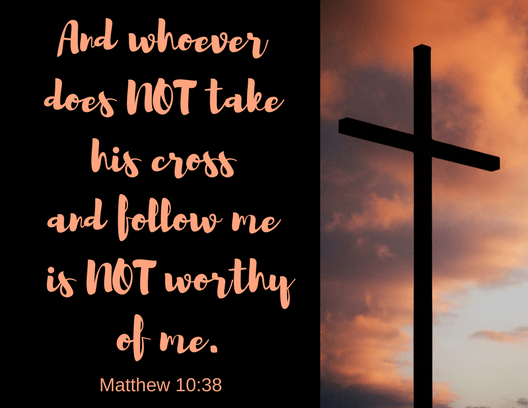
          Whoever loves father or mother more than me is not worthy of me, and whoever loves son or daughter more than me is not worthy of me. 38And whoever does not take his cross and follow me is not worthy of me. 39Whoever finds his life will lose it, and whoever loses his life for my sake will find it.

          After commissioning the twelve apostles, Jesus proceeds to teach them about what this commissioning entails. First, they will be persecuted (vv. 16-25), but they don’t need to be afraid because God will be with them and cares for them (vv. 26-31). Then comes a section that deals with the seriousness of the need to acknowledge Jesus as the Messiah, which can be a controversial subject (vv. 32-39). Jesus says that he did not come to bring peace but a sword (v. 34). This proclamation is not Jesus’ war cry as though his intention is to bring violence, but rather, it reveals that Jesus recognizes and discloses that he will be a point of contention and disagreement for many people. In other words, the truth that Jesus came to bring (and which he represents) will inevitably cause disunity and conflict.

          It is on the heels of this declaration by Jesus that we read of the even more severe nature of this conflict—it may happen even within one’s own family. Jesus assumes the natural love of one’s family as a premise and then moves to identify that as a lesser priority in life than love for him. When he says that a person who loves him less than their family is “not worthy” of me (v. 37), he is making a value claim upon himself as more important than them. To be “worthy of me” means to “be fit to be a disciple.” It is important to clarify that Jesus is not advocating that his disciples not love their families. Instead, he is simply stipulating that the value attachment of a person to their family must not exceed their value attachment to him. To be Jesus’ disciple is to prize him above even one’s own flesh and blood.

          The implications of this statement are far reaching. Who would say that loving a brother, sister, child, or parent should be subservient to the love of another? But this is precisely the demand that Jesus is making of his disciples. It is a declaration of discipleship that calls for absolute devotion. This extreme requirement is extended as Jesus also says that those who would follow him must “take [up] their cross” (v. 38). This is an expression referring to being willing to self-identify and endure the shame and suffering of one who is crucified.

          Jesus elaborates by uttering one of the most interesting paradoxes: Whoever finds his life will lose it, and whoever loses his life for my sake will find it (v. 39). In essence, Jesus is saying that the life that matters is the life that is lived for the sake of Christ. To take the road of self-denial and live for something other than one’s self is to “find life.”

          From these three criteria of discipleship, where do we find ourselves? Are we willing to follow Jesus no matter what? Does our love for him exceed our love for anything else? Are we willing to take up our cross? Are we willing to die to self in order to find that which may truly be called “life”? Such a price is the price of being a disciple. Are we willing to pay that price? What might be stopping us from wholehearted devotion and service to the Master?

          -Jerry Wierwille (originally posted for SeekGrowLove on March 13, 2018)

          Reflection Questions

          1. In what ways have you died to self, taken up your cross, and put Jesus before yourself and others? What was the result (so far)? What do you expect the final result to be?
          2. Slowly read again the last paragraph, replacing the ‘are we’ with ‘am I’ and the ‘us’ and ‘our’ with ‘me’ and ‘mine’. Take time to answer each question for yourself.
          3. Do you want to be a more devoted disciple of Jesus Christ? What specific changes are you willing to make? What will it cost you? Why is following Jesus worth it?

          Prayer

          Dear God Almighty, thank you for your amazing plan of salvation and the gift of your Son. I want to be a wholehearted, devoted disciple of Your Son Jesus Christ who died for me and my sins and is coming again to set up Your perfect Kingdom on earth. May I see clearly what You want me to do to follow better. You know my struggle in sometimes prioritizing other things, such as… (fill in the blank). Help me love Jesus more than these. In his precious name I pray, Amen.