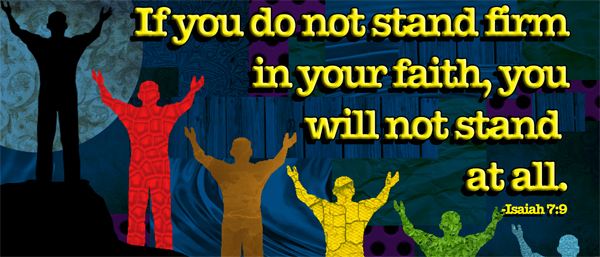
GOOD News!

Isaiah 26-28

is26

Sunday, February 12


Amidst the talk of incense altars and Ashera Poles (what even are those?), there is good advice and great news to be gleaned from today’s reading! I know it can be kind of hard to get through these prophecies that are written in a different time for a different people, but the cool thing about our God is that he can fulfill the same prophecies over and over again, throughout the ages.


The first advice that we see is in 26:13. It would do you well to keep this verse close to your heart. We all have different lords ruling over us in these days: our president, money, school and maybe even friends. This is okay! A problem only rises when you start to honor these other lords in your life. God alone is worthy of your honor.

“O LORD, our God, other lords besides you have ruled over us,

but your name alone do we honor.”

Isaiah 26:13

Second, be careful how you view rules in your life. Do you believe that by following the rules that you’ll be saved? In 28:13, it says “a rule for this, a rule for that… so that as they go they will fall backward.” All rules can do for you is make you fall. You will only ever be able to break rules if that is what you hold as your moral reference point. Jesus is our moral role model and we should be looking to him to see what is right and what is wrong, not the rulebook.


Now let’s finish off with some good news: the dead will live, they will wake up and shout for joy! The Lord’s dead, those we have loved and lost, will rise! (26:19)

“But  your dead will live;

their bodies will rise.

You who dwell in the dust,

wake up and shout for joy.

Your dew is like the dew of the morning;

the earth will give birth to her dead.”

Isaiah 26:19


-Nathaniel Johnson

Death Swallowed Up

Isaiah 22-25

isaiah-25v8-e1480432832403-940x688

Saturday, February 11

I am writing to you guys now, after I took a 6 hour class with Sir Anthony Buzzard on the Kingdom of God as the Gospel.  Therefore, I can’t help but write about the Kingdom today.  One thing that has really shed light for me is that the gospel of the Kingdom is throughout the whole Bible.  It is not just a New Testament idea.  In fact, the gospel was even preached to Abraham from God (Gal 3:8).  It is evident that the gospel of the Kingdom was important to Jesus as he preached about the Kingdom his whole ministry (Matt 4:17).  I knew that Jesus did not come up with the idea of the Kingdom on his own, but I was not aware of how prevalent it was in the Old Testament.  The Kingdom is found all throughout the Old and New Testament.  In our reading today in Isaiah, there indeed is scripture on the coming Kingdom.

Isaiah 24:23 is prophecy about the Kingdom.  The talk about the moon and the sun is similar to the passage in Matthew 24:29 when it talks about signs of the second coming.  Then actually in the Kingdom, the LORD along with Jesus will reign.  There is some dispute as to whether this verse is referring to God reigning on Mount Zion or Jesus.  In my opinion, it does not matter too much.  What matters is that God through Jesus will reign.

Isaiah 25:6-12 is then a beautiful passage on the Kingdom.  One of my favorite verses in the whole Bible is Revelation 21:4.  Isaiah 25:8 is very similar to that verse in Revelation.  In the Kingdom, there will be no more death or tears.  What a comfort that is.  This idea helped comfort me through the loss of my grandpa.  I was devastated to lose him as he was my biggest role model in my life.  I greatly looked up to him.  He inspired (and continues to inspire) me to pursue pastoral ministry like him.  We all experience similar losses to this.  Let Isaiah 25:8 and Revelation 21:4 be a comfort to you.

The Kingdom should be the focus of our lives.  It was surely the focus of our Savior Jesus Christ.  Most people perceive the gospel to be the death and resurrection of Christ.  That is only a part of it.  Christ didn’t even speak of his death and resurrection until Matthew 16:21.  That is about two thirds of his way through his ministry.  What was Jesus preaching before then?  That answer is found in Matthew 4:17, the Kingdom.

-Kyle McClain

(photo credit: http://www.spiritradio.ie/word-for-advent-isaiah-258/)


3 Steps

Isaiah 17-21

isa-19

Friday, February 10

In today’s reading, we have pretty much just oracles against other nations.  An oracle in the Old Testament is simply the Word of God.  Therefore, the different oracles about the separate nations are just the words of God, and the audience of the book of Isaiah is the people of Judah.  That means that these oracles are words from God to Judah concerning other nations.

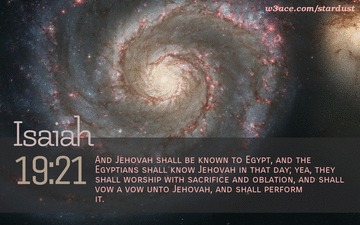
As we have been reading, these oracles concerning other nations are usually more of a judgmental tone.  Often, God states that he will take action against these nations.  This may lead to the people turning to God, and that is present in Isaiah chapter 19.  Chapter 19 contains the oracle concerning Egypt.  In this oracle, God states he will take action for their poor behavior.  As a result of God’s action, “the LORD will make himself known to the Egyptians, and the Egyptians will know the LORD in that day and worship with sacrifice and offering,” (Isaiah 19:21).  Basically there are three steps happening here: The Egyptians sin against God, God punishes the Egyptians, and the Egyptians turn to God because of their fear.

We can learn a lesson from this.  We are inevitably all going to sin in our lives.  We all have sinned, and we all will make more mistakes in the future, similar to what the Egyptians were doing.  The punishment for sin is found in Romans 6:23: “The wages of sin is death.”  Death is what we all deserve.  God is not afraid to punish us if we don’t seek Him.  Similar to the Egyptians, we should then fear God and live a life that is pleasing to Him.  When we do this, we can receive eternal salvation through Jesus Christ, and God will indeed bless us.

-Kyle McClain

(Photo credit: http://w3ace.com/stardust/scripture/book/isaiah/13)

Mercy and Compassion

Isaiah 14-16

isa-14-1-ww-cc-9x

Thursday, February 9

If someone were to look at news regarding the Middle East, there is a good chance it would have something to do with the people of Israel fighting against the surrounding nations.  Israel always seems to have problems with its neighbors.  These problems go all the way back to Abraham!  In today’s section of reading, there were several passages about neighboring nations of Israel.

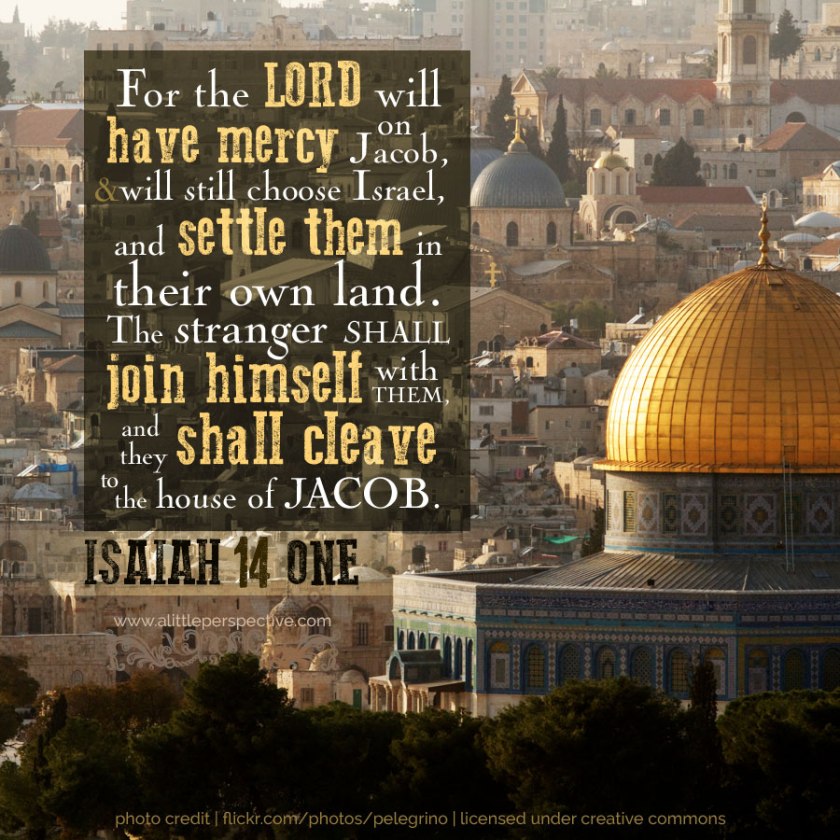
At the beginning of our reading in Isaiah 14:1, it states that “the LORD will have compassion on Jacob and will again choose Israel, and will set them in their own land.”  Even though the people of Israel were a wicked nation at this time, God was still going to have compassion on them.  This is an example of the grace and mercy of God, as He was still going to work with them and give them their own land.  Similar to God having mercy on the people of Israel, God is willing to have mercy on us.  God’s will is that no one should perish; He wants us to seek Him.  If we do, then God will have mercy on us and grant us a spot in the coming Kingdom.

The rest of our reading for the day had to deal with the oracles of the surrounding nations.  Although God was merciful towards his own people, the other nations don’t necessarily receive that same mercy.  These other nations were opposing the people of Israel, and God was not too fond of that.  He was going to redeem His people.  God has the back of the Israelites, even when they were at their worst.

Nowadays, according to Paul, “There is neither Jew nor Greek,” (Galatians 3:28).  Anyone who devotes their life to God, is seen as a chosen people from our Heavenly Father.  The chosen people in the Old Testament were pretty much the Israelites.  The chosen people nowadays are followers of Christ.  Therefore, just as God had the backs of the Israelites, God has our back.

-Kyle McClain

(photo credit: http://www.alittleperspective.com/isaiah-14-through-16/)    

What’s Your Motivator?

Isaiah 10-13

isaiah11_9

Wednesday, February 8

As we continue on with Isaiah, we also continue on with scripture about judgement.  The book of Isaiah as a whole can be split into two sections: judgement (1-39) and restoration (40-66).  Therefore, if you aren’t a fan of this judgement variety, then just stick with it and the restoration will come at the close of Isaiah.  However, even if you aren’t a fan of the judgement material, valuable lessons can still be learned from it.

When reading the judgement material throughout Isaiah, I get a bit tense.  I get tense because the judgement that is coming for so many is severe.  We see the sin of Israel and the surrounding nations causing God to become angry with people, and in reading Isaiah, we are assured that God’s wrath will come out sometime.  The following snip-it’s from this reading give a sense of the kind of judgement coming: “the LORD will utterly destroy,” “shall be cut off,” “destroy both soul and body,” “anger will be directed to their destruction,” “kill the wicked,” “destroy its sinners,” “destruction from the Almighty,” and “fierce anger”.  This is what is coming for those who do not turn their lives over to God.  Furthermore, from Isaiah 13: 6, 9, and 22 we know this day is coming soon.  Although turning our lives over to God to escape this punishment should not be our main focus or motivator, it is still a motivator nonetheless.  I know personally, I do not want this punishment that many will receive.  We know many will receive this destruction as God says, “I will make people more rare than fine gold,” (Isaiah 13:12).  Last time I checked, there wasn’t just a bunch of fine gold laying around.

Yes, escaping a severe punishment that many will receive is motivation to give our lives to God.  However, the greatest motivation of all is found in chapter 11, and that motivation is the Kingdom of God.  One thing the Church of God as a whole is great at is keeping the focus on the Kingdom of God.  One of the great Kingdom prophecies is found in Isaiah 11:6-9.  This passage describes the peace that will take place in the Kingdom.  It describes that a nursing child will play over the hole of the cobra.  Last I checked, no parent in this present age won any parenting awards for leaving their babies next to cobra holes.  However, in this future Kingdom, there will be no death, mourning, crying, nor pain in the coming Kingdom.  The earth will be full of the knowledge of the LORD.  The Kingdom is a never ending celebration.  I know that I want a part in this.  To do this, we must turn our lives over to God.  Let the hope of the coming Kingdom drive you in growing closer to God every day of your life.  The reward for living a life for God is beyond imagination.

-Kyle McClain

(Photo credit: http://www.verseoftheday.com/en/11092012/)

A Call to Be Holy

Isaiah 7-9

man in praise

Tuesday, February 7

I hope you all have enjoyed the first six chapters of Isaiah thus far.  Today, we get to continue with chapters 7 through 9, and we will get right to it.

Chapter 7 has an interesting phenomenon that some scholars within the Church of God call “agency”.  Pay special attention to who is talking when (this may seem complicated).  In 7:3, we see that God is talking to Isaiah, and God instructs Isaiah to relay a message to King Ahaz in 7:4.  7:4-9 is the message that Isaiah was to tell Ahaz.  Then in verse 10, it states, “Again the LORD spoke to Ahaz.”  God was not talking to Ahaz in the first place though; rather, God instructed Isaiah to speak to Ahaz.  Furthermore, in verse 13, the being who was talking to Ahaz says, “my God”.  Therefore, although it says “again the LORD spoke to Ahaz,” in verse 10, I believe that it was actually Isaiah speaking to Ahaz.  In summary, there are two reasons as to why I believe it was Isaiah speaking to Ahaz:

  1. God wasn’t talking to Ahaz in the first place, so the word “again” would not make sense in this context if it were indeed God talking. However, Isaiah was previously talking to Ahaz, so it would make sense to say “again” if it were Isaiah talking to him.
  2. In verse 13, this being talking to Ahaz (either God or Isaiah) says, “my God”. As we all know, the LORD does not have a god, so it wouldn’t make sense for the LORD to say this.  Also, in verse 14, it talks about the LORD in 3rd person.

This idea of “agency” is found in several passages throughout the Bible.  The idea of agency is important when at times Jesus is connected to the term “God”.  It is important to understand to defend the oneness of God.  If this interests you at all or if I made absolutely no sense (which is very well possible) but still want to learn more, then the following article can give some clarification.

http://www.21stcr.org/multimedia-2012/1-articles/re-shaliah-introduction_law_of_agency.html

Isaiah 7:14 is one of the most well-known Immanuel (God with us) prophecies.  The Immanuel, which is Jesus Christ, was prophesied to be born from a virgin.  As far as I know, there aren’t many people born from a virgin mother.  It totally contradicts what we all learned in health class.  However, Jesus himself was born from a virgin.  This alone was a miracle, and it was to be a sign for the people.

In chapter 8, there was one thing that stuck out to me found in verse 11.  It is a call to be holy.  To be holy is to be set apart or different from others, and this is exactly what the LORD told Isaiah to do.  He instructed Isaiah “not to walk in the way of this people,” meaning that he should act differently.  The people in Isaiah’s time were wicked people.  Isaiah 9:17 states, “for everyone is godless and an evildoer.”  We also know this from all the judgement in the previous chapters.  I think most of us would agree that we also live in a society that is very godless and full of evildoers.  We too then should be set apart from society.  We should not walk in the way of the people in our society.  There should be differences between you and the common person.  Are you living differently than others?

Isaiah 9:6 is a controversial verse within the Church of God that probably made many of you uneasy when reading it.  It is a verse that needs to be considered and given thought.  Similar to 7:14 it is prophecy about Jesus Christ.  However, in this prophecy, it states that the son shall be called “Wonderful Counselor, Mighty God, Everlasting Father, Prince of Peace.”  This verse, along with a few others throughout the Bible, has a Trinitarian feel to it.  I do not have all the answers myself, but this verse cannot just be ignored.  I urge you all to look more into this, and make some sense out of it rather than just ignoring it.

I hope you all have a great day!

-Kyle McClain

(Photo credit: https://amokarts.wordpress.com/2012/07/01/scripture-visualized-isaiah-79/)

“Here I Am! Send Me!”

Isaiah 4-6

is6

Monday, February 6

Today, we continue on to Isaiah 4-6.   In this section, there is one of the most well-known passages in the whole Bible, Isaiah’s vision of the LORD in chapter 6.  Before we get there though, we will talk briefly about chapters 4 and 5.

There are essentially two main purposes to the book of Isaiah: “to assure Judah that God would surely judge them for their sins… [And] to assure God’s people of God’s wonderful plan for their future,” (The 5Ws and 1H of Genesis Through Malachi, Robert Jones).  In the first three chapters, we got a sense of the first purpose, to assure Judah/Israel that God does not leave the guilty unpunished.  However, starting in chapter 4, we get a sense of God’s wonderful plan for their future.  After ridding the place of evil, God will establish a place (The Kingdom of God) that shall be “beautiful and glorious.”

Chapter 5 deals with the wicked, once again.  Verse 24 and 25 sums it up fairly well: “for they have rejected the law of the LORD of hosts, and have despised the word of the Holy One of Israel.  Therefore, the anger of the LORD was kindled against his people.”  We have two things happening here.  One, the people are rejecting the LORD and despising Him.  On the other hand, we see that the anger of the LORD is put against his own chosen people.  The people sin, and God responds by getting angry.  However, we know that God is slow to anger as he describes himself in Exodus 34:6, 7.  God’s chosen people kept sinning with no signs of repentance.  What Isaiah is describing is not a sin here or there.  Rather, Isaiah is describing a people, whom God loves very much, living a life of sin.  God’s chosen people of Israel, the same people He has performed many miracles for, were forsaking the LORD.  God does not leave the guilty unpunished, also found in Exodus 34:6, 7.

The beginning of chapter 6 sets the scene of when this was going on.  Isaiah 6:1 states, “In the year that King Uzziah died.”  King Uzziah was one of the Kings of Judah after the split of Israel, and he died in the year 740 BC.  This is not long after the Golden Age of Israel when it was a unified nation under kings Saul, David, and Solomon.  It is also before the Israelites were exiled into the Babylonian land.  Therefore, the ministry and writing of Isaiah took place before books such as Ezra and Nehemiah.  Isaiah’s ministry is taking place at the same time many of the events in 1st and 2nd Kings and Chronicles are taking place.

As mentioned before, Isaiah 6 is one of the most well-known passages in the whole Bible.  It paints a beautiful picture as to what the Throne of God looks like. You can compare this picture to the description of God’s Throne in Revelation 4.  In Isaiah’s vision, as he approaches the throne of God, he humbles himself by basically saying he was not worthy to be seeing what he was seeing.  Then, God asks Isaiah whom He shall send.  Isaiah then wonderfully replied by stating, “Here I am! Send me.”  We can learn a lot from this simple statement.  The attitude that Isaiah displayed here should be the same attitude we express in our lives.  The harvest indeed is plenty and the workers few.  The LORD is seeing who he can send to do His work.  Are you willing to do his work?

-Kyle McClain

My name is Kyle McClain, and I am currently attending the Atlanta Bible College.  It is my second year at the Bible college and I will receive my bachelor’s degree in pastoral ministry next year.  I am excited to be able to go through the first third of the book of Isaiah with you all (or y’all as they say down here in Georgia).


Cease to do Evil – Learn to do Good

Isaiah 1-3

isaiah-1-18

Sunday, February 5

The Old Testament is split up into five major categories: (5) Law, (12) History, (5) Poetry, (5) Major Prophets, and (12) Minor Prophets. Isaiah is the first book of the Major Prophets.  The word “prophet” occurs 324 times in the Old Testament alone.  Therefore, it is no doubt that whatever a prophet is, it is important.  A prophet is simply someone who speaks on behalf of God.  Isaiah then is someone who spoke for God, so the word Isaiah spoke had authority.

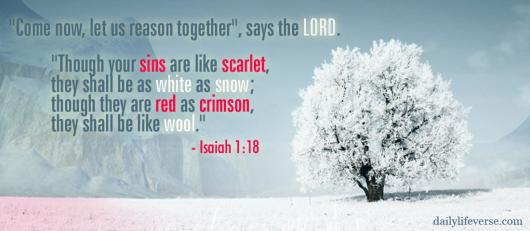
Isaiah begins his writing by stating all the wickedness that is being done by the people of Israel, God’s chosen nation.  Verses 2-15 go into detail as to what they were doing.  However, I want to take note at verses 16 and 17 of the first chapter.  Verses 16 and 17 are Isaiah’s (really God’s) call to repentance.  There are two main steps to this call for repentance.  Step one found in verse 16: “cease to do evil.”  Step two found in verse 17: “learn to do good.”  These are the two fundamental steps to repentance that Isaiah pleads the Israelites pursue.  The Israelites need to rid themselves of all the wickedness they are doing as was stated in the first 15 verses.  However, this is just the first step to repentance.  After they rid themselves of evil, they must then learn to do good.  Once the evil is removed from one’s life, they must then fill it with something good.  If not, then they will fall into the same pattern of sin.  This is an oft neglected part of repentance.  This completely applies to us over 2,000 years later.  To repent, we must cease to do evil and learn to do good.  If we do this, then our sins, “shall be as white as snow,” (Isaiah 1:18).  What a beautiful reward.

Something that caught my eye in chapter two was the end of verse 9.  It clearly stated, “do not forgive them!”  What a bold statement that is from Isaiah (and again, really God), and a rather controversial one in modern Christianity.  Once again, Isaiah goes on about how the Israelites are sinning.  It appears as if they have not repented and continue in their wicked ways.  Isaiah then declares not to forgive them!  This is contrary to what many modern Christians think.  There is a nasty word floating around that is being connected to Christians nowadays with movements such as the LGBT.  That nasty word that people are throwing at Christians is “tolerate”.  Many believe that the duty of a Christian is to tolerate and “love”.  Nowhere in the Bible is this message of “toleration” found.  Rather, there are passages such as Isaiah 2:9 which state, “do not forgive them!”  These Israelites that Isaiah is describing are sinning without any signs of repentance.  Isaiah doesn’t go on to tell others to accept and tolerate them for who they are as idol worshippers.  Instead, he blatantly states to not forgive them.  It appears from this verse alone that we should not be tolerating other people who live a life of sin.  However, this is just one verse, and you should rely on the Bible as a whole to make decisions such as this.  Therefore, I encourage you to look more into this, and I just think you might be convinced that the message of “tolerate” is ridiculous.

I hope you all have a splendid week and I look forward to starting off the Major Prophets with you all!

-Kyle McClain

Smokin’ Hot Mama OR The End Of SOS – Which Title Do You Prefer?

Song of Solomon 5-8

song-of-solomon-8_6

Saturday, February 4

As I mentioned yesterday, there is quite a discrepancy of opinions among Biblical scholars about SOS (Song of Solomon).  Commentators such as Matthew Henry and James Durham believed SOS was solely allegorical.  Whereas, in the “Passion Pursuit” class, the ladies referred to the Shulammite woman as a “Smokin’ Hot Mama”.   In his commentary, Ray Stedman states that the Bible, especially here in SOS, handles physical passion frankly and forthrightly.  In my research, I found an excellent commentary that blends both lines of thought (it was also mentioned several times on the Authentic Intimacy website). How to Love God With All Your Heart by Keith Simons and Mark Kirkpatrick analyzes each verse in both its literal and allegorical interpretations.

I really appreciate being able to pull from both interpretations when it comes to real life applications.  If you are single, the literal application may not apply.  If you only take the allegorical application, you will miss the beauty of physical love and permission from God to be a “smokin’ hot mama” or “dude” in the marital realm.

It makes a lot of sense that SOS follows the other poetic books of the Bible not only because of its poetic nature but also because it offers wisdom for living as do the other books.  Ray Stedman refers to the 5 books of poetry as each containing a “cry.”  Job is the cry of the spirit. Psalms, Proverbs, and Ecclesiastes are the cry of the soul.  SOS is the cry of the body for love.  He goes on to say that because the devil pushed this beautiful gift to extreme evil, Victorianism pushed sex into prudishness, as if it were something to be ashamed of.  SOS represents “sex as God intended it to be, involving not just a physical activity, but the whole nature of man.”

When having “the talk” (one of many) with our son, we described the reproductive purpose of sex and the bonding purpose.  Husbands and wives need to “reenact SOS” to bond.  In fact, I learned in the “Passion Pursuit” class there are many studies that show that the same hormone that bonds a mother to her child, oxytocin, is released during sex and plays a role in bonding a man and woman together.  Of course, discussing the bonding purpose of sex with our son was a little harder than the reproductive purpose.  Both of our children were adopted so he knew that wasn’t an issue… was hoping he wasn’t going to put 2 and 2 together for the other purpose! But alas….

SOS is also a beautiful allegory for God’s love and want for intimacy with his people. The New Testament also compares Christ and the church as a groom and his bride. So clearly, God created marriage as an allegory for this relationship.  I cannot state all of this nearly as well as Simons and Kirkpatrick, so I really encourage you to read How To Love God With All Your Heart ( http://www.easyenglish.info ) or just Google it!

I didn’t recall signing up for writing a devotion on SOS at Family Camp.  I just wanted to do the devotions between school semesters.  But I’m really glad I did.  I got to use some of the stuff I learned in “Passion Pursuit” and I did research I probably wouldn’t have gotten around to doing if I didn’t have to write about it.  We all make jokes about King Solomon’s pick up lines, but in truth, SOS is a beautiful book to be read on several levels.  I think God included SOS in scriptures so that we know that “every good and perfect gift is from above.” (James 1:17)

God bless you and the reading of His Word!

Maria Knowlton

(Maria’s devotion shared this week were originally used as part of a year-long Bible reading plan following 2015 COG Family Camp at Camp Mack.  We thank her for permission to reprint them here).

 (photo credit: http://www.godswordimages.com/wallpaper/love/song-of-solomon-8-6/)

SOS

Song of Solomon 1-4

sos700

Friday, February 3

I hadn’t gotten around to registering for the “mom’s” conference, Hearts at Home, until a few days before and couldn’t find the class descriptions so I had to sign up for classes just based on the names.  I saw one called, “Passion Pursuit,” taught by Dr. Juli Slattery and Linda Dillow.  I’ve heard Dr. Slattery on Focus on the Family and at previous Hearts at Home conferences and really enjoyed learning from her. I also figured I’d like to figure out what I have a passion for, so I signed up for this class.
Pursuing one’s occupational or spiritual passion was NOT what this class was about!  It was about that one book your pastor rarely, if ever, speaks on, the book I personally have never done a jr. church series of lessons on, and as of yet, the one book we’ve never had the kids memorize verses from. That’s right! I’m talking about The Song of Solomon (SOS)!  (Signal collective blush from everyone’s cheeks.)
Over the years, there has been debate about what this book is about and why it is in the Bible.  I did a little bit of research and almost everyone agrees that this book is about God’s great love for His people and the intimacy He wants to have with both the Israelites and those of us who have chosen to become adopted seeds of Abraham.  Where debate and controversy lies is that other meaning.  As Bob Jones stated in his book, “ The 5W’s and 1H of Genesis Through Malachi,”  Song of Songs is to be seen as, “literally describing the sanctity and beauty of human physical love…Maybe God wants us to read this book so that we return marriage and sexuality to the holy place He has always intended them to occupy.” p. 70  The ladies teaching “Passion Pursuit” agree with Bob.  SOS is a book celebrating God’s love for us but it is also celebrating the gift God gives a couple upon their marriage. Those of us who have taken those vows are to embrace this gift to the fullest.( Dr. Slattery and Mrs. Dillow created an online ministry to help people do this called “Authentic Intimacy.”  I highly recommend checking this out. They have scriptural advice and instruction for anyone looking to have greater, true intimacy with God and their spouse or in preparation for marriage.)
Yes, there are a few problems with the actual book.  If Solomon was the author, which most consider as fact, he wasn’t exactly a one woman man.  My study Bible states he probably had 140 wives and concubines at the time and more throughout his life.  Not exactly a fact that would make a woman feel special!
This is also a very hard book to follow. They’re in a garden, she’s having a dream, they’re married….What is going on???? They are also talking in metaphors and similes…they’re in an actual garden, He’s in her “garden.”  And if it weren’t for the headings in my Bible, I would have no idea who is talking.  The Shulammite woman is talking, a whole bunch of women are talking (where did they come from?!) And even God speaks once.  This is a book you’ll benefit from reading along with a commentary.
So how do you use SOS to make a difference in your life?  How do you make this a part of your devotion?  A friend of mine told me that her pastor recently preached a sermon on it and encouraged husbands to tell their wives they are beautiful.  So there you go husbands!  God wants you to complement your wives!  Use lots of flowery words! (Check out youtube for examples on how to use King Solomon’s words to make your woman swoon!)  Ok, that was a little facetious. Seriously, most woman do want to know her man desires her (but maybe not in the words of chapter 4) and God has provided an example of this along with His blessings.
My friend thought of another take on SOS.  She thought that since her husband was being encouraged to tell her she’s beautiful, she should make more of an effort to be beautiful.  She looked at verse 1:6 when the Shulammite woman tries to hide from Solomon.  So my friend decided that in addition to not wearing sweats all day, she would close the door while using the powder room and not burp or otherwise display gross behaviors in front of her husband.  We all laughed when she told us that he didn’t notice but her point was that we shouldn’t take our husbands for granted and we should make an effort to be beautiful for our husbands. We also need to keep in mind verse 2:15, “ Catch for us the foxes, the little foxes that ruin the vineyards, our vineyards that are in bloom.  The chorus talking here, saying not to allow anything to spoil the man and woman’s relationship.  Good advice for all of us in any relationship.
The world may have cheapened the physical relationship between a man and a woman,  likening it to something as casual as a game of ping pong.  SOS reminds us that it is truly a wedding gift from God that is to be treasured, embraced, and protected.
So if you are married, read today’s reading with your spouse and have a great night! ; )
– Maria Knowlton

 (photo credit: cartoon by Andrew Fraser – found at http://www.cartoonsidrew.com/2014_10_01_archive.html)