Hearing What We Don’t Want to Hear

1 Kings 22, 2 Chronicles 18

In First Kings 22 and in Second Chronicles 18 we find the same account of evil King Ahab considering going to war against Ramoth Gilead.  He asked about 400 prophets what he should do and they all said to go victoriously to war.  When encouraged by King Jehoshaphat of Judah to ask a prophet closer to the matter about this, King Ahab’s response is found in First Kings 22:8.  He says, “There is still one man through whom we can inquire of the LORD, but I hate him because he never prophesies anything good about me, but always bad.  He is Micaiah son of Imlah.”  Now remember, it is said of evil King Ahab from First Kings 21:25-26, “There was never a man like Ahab, who sold himself to do evil in the eyes of the LORD, urged on by Jezebel his wife.  He behaved in the vilest manner by going after idols, like the Amorites the LORD drove out before Israel.”  It is no wonder the true prophet of God never had anything good to prophesy, but always bad!

It is noteworthy that King Ahab avoided the truth because he deemed it as bad.  Instead, he listened to the 400 voices that told him what he wanted to hear.  King Rehoboam did the same thing in First Kings chapter 12.  Instead of listening to the advice of the elders, who gave advice he did not want to hear, he followed the advice of his peers.  He followed what he wanted rather than what was best for him.

It would be easy to look at these kings and heap ridicule upon them in judgment.  However, it might be beneficial to consider our own ways.  How often do we gravitate toward people who affirm our immorality, rather than seeking the truth of God?  How often do we lean into confirmation bias, rather than seeking godly ways of thinking about a matter?  The book of Proverbs consistently supports the idea of seeking wise counsel.  Consider Proverbs 1:5, “let the wise listen and add to their learning, and let the discerning get guidance”.  Also, Proverbs 19:20 says, “Listen to advice and accept instruction, and in the end you will be wise.”  Clearly, God desires that we would listen to the voices that speak His wisdom into our lives, even if we don’t want to hear it.

One more thing to consider today.  Sometimes we are the ones who need to hear something from God, even when we don’t want to hear it.  However, sometimes we are the Micaiah’s who have something to say that someone else may not want to hear.  Progress in these situations slowly, discerning God’s wisdom to speak in love.  Ephesians 4:15 says, “Instead, speaking the truth in love, we will in all things grow up into him who is the Head, that is, Christ.”  The words we speak must be spoken in love.  Our goal of speaking should be for us to grow into Christ together.  

Listen to God’s Word, especially if you don’t want to hear it.  Speak to others in love, especially when they might not want to hear God’s Word.

-Michael Cisler

Reflection Questions

How can you actively seek godly voices in your life?

What does it mean to speak the truth in love?  What does each element (truth and love) entail?

When is the right time to speak and when is the right time to be quiet?

Dealing with Disappointment

1 Kings 20-21

In First Kings 21 we find the account of King Ahab in his attempt to gain ownership of a vineyard owned by a man named Naboth.  After the king makes his appeal to Naboth, Naboth declines his offer.  King Ahab’s response is recorded in First Kings 21:4 where it says, “So Ahab went home, sullen and angry because Naboth the Jezreelite had said, ‘I will not give you the inheritance of my fathers.’  He lay on his bed sulking and refused to eat.” 

What a response to the disappointment of not getting what he wanted!  He’s acting like a spoiled toddler.  He doesn’t get his way so he sulks, gets angry, lays on his bed, and refuses to eat.  It’s easy to see why King Ahab is known as one of the evil kings of Israel.  However, might there be something in this account that hits a bit close to home for us as well?

Has there ever been anything in your life that you really wanted and did not get?  How did you respond?  Have you ever played or watched a sport in which you really wanted your team to win but they didn’t?  How did you respond?  Have you ever worked hard and wanted to earn a promotion or a good grade but did not receive what you thought you deserved?  How did you respond?  In any of these situations, or others when you did not get what you wanted, did you sulk or become angry or refuse to eat?

We could certainly look to Jesus and see how he handled disappointments in life.  He weeps over Jerusalem in Matthew 23 but resolutely follows God’s leading to Jerusalem.  He prays God will allow a different path in the Garden of Gethsemane in Matthew 26 but resolutely follows God’s leading to the cross.  These are two of many examples in which Jesus affirms that he will follow God, no matter the disappointments he faces.

Another biblical example of appropriate responses to things not going their way is the account of Shadrach, Meshach, and Abednego in Daniel 3.  When threatened with the punishment of being thrown into a fiery furnace if they do not abandon God, they respond by saying that God would rescue them, “But even if He does not, we want you to know, O king, that we will not serve your gods or worship the image of gold you have set up.”  These three were also resolute that even if they did not get their way, they would follow God’s leading.

As we face times of disappointment in our lives, let’s commit to resolutely following God, no matter what.  The encouragement Paul gave in First Thessalonians 5:16-18 would be good encouragement for us in these times as well.  “Be joyful always; pray continually; give thanks in all circumstances, for this is God’s will for you in Christ Jesus.”  Even when we do not get our way we can choose to be joyful, to pray, and to give thanks.

-Michael Cisler

Reflection Questions

  1. Has there ever been anything in your life that you really wanted and did not get?  How did you respond?  What is your typical response to any sort of disappointment? Why do you think you respond this way?
  2. What could be some underlying thought processes of someone who regularly becomes angry or sullen when faced with disappointment (not getting what they want)?
  3. How can a better response to disappointment be a witness to your faith in God?
  4. What would you like to do next time you meet up with a disappointment?

It’s Personal

1 Kings 17-19

I have appreciated the opportunity to read and share my thoughts with you across these seven days. We’ve traced the unfolding drama of the divided kings and kingdoms of Israel. We’ve watched the culture shift, the crowd move to and fro, and the pressure rise and fall, but through their stories, one truth rings clear: the faithful know that wisdom comes from God alone.

“How long will you waver between two opinions? If the Lord is God, follow him; but if Baal is God, follow him.” (1 Kings 18:21)

Looking momentarily at my own nation, America is a nation with deep Judeo-Christian roots, as many of our founding documents demonstrate a commitment to God as the architect of the law that governs us. Our motto makes mention of our trust in God, we proclaim His work in our patriotic songs, open government functions with prayer, and swear in our presidents with their hand on His Word. I am one of many who believe the blessings we enjoy as a nation—even in today’s troubling times—can be attributed to the enduring declaration that the God of Israel and the Father of Jesus Christ reigns here.  Sadly, more and more are living on borrowed blessings as the altars of moral revision, self-importance, and political convenience are being fashioned and raised.

Today, we look to the prophet Elijah, who lived as a lone voice for the Lord in a nation God had once richly blessed. Elijah wasn’t trendy or tribal. His conversations with God were authentic and intimate, and he took action as one who was swiftly obedient. His faith was so personal that he was often fully dependent on the Lord even for his next meal—fed by ravens and sustained by a jar of oil and flour that never ran dry. How ready would we be to fight off the enemies of God, to recite and rely on His promises, and even to expect miracles in His name, if we lived with this kind of faithfulness?

Each of us is called to that kind of personal, committed, lived-out faith. It may seem like faith is inherited—passed down through our nation’s heritage or through family and friends—but true faith is never proximal. Hanging with a spiritual crowd, attending high-energy worship services, or serving on a ministry team are not guarantors of a relationship with the Lord.  Personal faith is born in the discomfort of repentance, in the surrendering of fear, and in the offering up of our possessions. These are the intimate things God desires from us. In the abandonment of self, we begin to hear God’s call clearly—and are emboldened because we know our Creator personally.

“At the time of sacrifice, the prophet Elijah stepped forward and prayed: ‘Lord, the God of Abraham, Isaac and Israel, let it be known today that you are God in Israel and that I am your servant and have done all these things at your command. Answer me, Lord, answer me, so these people will know that you, Lord, are God, and that you are turning their hearts back again.” – 1 Kings 18:36–37

In this week’s reading, we’ve seen that change in a nation is inevitable. I pray that “In God We Trust” will continue to stand as a reminder of our nation’s steadfastness for the Lord. But however long it endures, let it always point us to something greater—our personal relationship with God, built through surrender, obedience, and faith. If the Lord is God, stand for Him—even if you stand alone. Because at the end of the day, it’s personal.

-Aaron Winner

Reflection Questions

  1. What character traits do you find in Elijah? Is there one you would like to have more of in your life? How would you go about adding more?
  2. What choices are before you today?
  3. Which one will you choose? Why?

The Weight of Waiting

2 Chronicles 17
1 Kings 15:25-16:34

I was rushed out of the room, carrying a kid in each arm, and taken to the recovery room to wait for the return of my wife. The twins were here, and I had no idea what to do. There was a bassinet nearby, but I honestly couldn’t figure out the logistics of laying down one newborn without compromising my grip on the other. “That’s okay,” I thought. “My wife will be here soon, and she’ll help me sort it all out.”  So I waited. I nervously held onto them in a football hold as the minutes crept by. But then the minutes became longer than expected, and my confidence started to fray. I waited with my little ones—without information, without control, and without a clue. In that intermission, I did the only thing I could think to do: I sang. Out of praise, to stave off fear, and to quiet the echoing newborn cries, I sang:

“From my mother’s womb, you have chosen me, love has called my name,”

and “You’re perfect in all of your ways… perfect in all of your ways to us.”

Waiting isn’t for the faint of heart. To be patient is to fight our innate desire for safety and certainty. It reminds us that we are not in control—that our desires are only a small variable in any given situation. If we’re looking for holy ground—a place where our striving ends and God’s sovereignty begins—look no further than the weight of waiting.

As the northern kingdom of Israel spiraled under a succession of corrupt kings, Jehoshaphat began his reign in Judah. He watched the pendulum swing wildly in the wrong direction. But instead of rushing to react, Jehoshaphat paused. He sought the Lord. He devoted his heart to God’s way first, building his faith and fortifying the kingdom—not through conquest or alliances, but by spreading the Word and Law of the Lord and strengthening what already belonged to Judah.

There were no flashy political plays. No dramatic battles or self-promoting power grabs—all of which might have benefited a new king eager for approval. In contrast to war-beaten, idol-chasing, anxious Israel, Judah found peace—politically and spiritually—by halting, reflecting, focusing, and waiting on the Lord to move.

“The fear of the Lord fell on all the kingdoms of the lands surrounding Judah…”

(2 Chronicles 17:10)

Waiting made Israel restless. But it made Judah rooted.  Israel scrambled. Judah stood still.

So how do we wait in a manner that is pleasing to the Lord when life is beyond our control—when answers are delayed or the enemy seems to be advancing?  We fortify what’s already been entrusted to us. We hold our families, will continue using our gifts in ministry, and give consistently with our tithes. We don’t chase what we don’t yet have—we deepen what God has already given.  We also choose worship over worry. Worry imagines every possible outcome.

Worship reminds us who holds them all.  Even if God is silent, He is moving.  Commit to the wait.  Trust in the Lord.  He will act.

– Aaron Winner

Reflection Questions

  1. How well do you wait? How much do you worry? Can you think of a time where your waiting increased your peace?
  2. What is wise to do while waiting? What is foolish to do while waiting?
  3. What do you appreciate from Aaron’s list of waiting activity – halting, reflecting, focusing, and waiting on the Lord to move?

Too Much Experience

1 Kings 15:1-24
2 Chronicles 13-16

I will be celebrating my 40th birthday in just a few short weeks. To be candid, I’m not exactly thrilled about this milestone—but one thing I am looking forward to is being able to say, “That was half a lifetime ago.” There’s something satisfying in acknowledging that with age has come experience.

One of the longest experiences I’ve had is playing guitar. For the last 1,352 weeks, I have averaged a few hours of play and have become masterful at my style. That’s not a gloat or a flex—just an illustration that I’m familiar with my craft. Much of what I do now is second nature, developed through repetition and refined over time. The same could be said of anyone who’s practiced a craft or trade for a significant portion of their life.

But experience is a double-edged sword. It gives us the ability to say things like, “I’ve seen this before,” or “We’ve already tried that,” or “We’ve made it through worse.” That can build confidence as we develop our approach. But when we rely solely on experience or live under the illusion there is nothing to learn, we may fail to consult the Word of the Lord. We make ourselves the master of our own fate, and in time, we are doomed to fail.

King Asa was a dependable leader. After the division of the kingdom, his reign represented a season of peace and prosperity.  These blessings came upon the whole of Judah because he “did what was good and right in the eyes of the Lord.” Asa tore down idols, repaired the temple, and called the people to return to God. He didn’t trust in his half-million soldiers alone.  He petitioned the Lord for help:

“Lord, there is no one like you to help the powerless against the mighty. Help us, Lord our God, for we rely on you, and in your name we have come against this vast army. Lord, you are our God; do not let mere mortals prevail against you.” – 2 Chronicles 14:11

As a result God delivered Asa and the people of Judah.  In gratitude and commitment, Asa responded in worship.  His people offered a tremendous sacrifice as a wholehearted oath to their Deliverer. Again, the Lord gave them a season of rest.

But in Asa’s 36th year—after decades of faithfulness—something changed. Faced with conflict, he no longer sought the Lord. Instead, he relied on his own strategy, forming a treaty with a foreign power. The prophet Hanani rebuked him:

“Were not the Cushites and Libyans a mighty army with great numbers of chariots and horsemen? Yet when you relied on the Lord, he delivered them into your hand. For the eyes of the Lord range throughout the earth to strengthen those whose hearts are fully committed to him. You have done a foolish thing, and from now on you will be at war.” – 2 Chronicles 16:8–9

The temptation to take matters into our own hands often comes not in times of scarcity, but in times of prosperity.  Our experience, knowledge, notoriety, or wealth can make us feel capable, but no matter our breadth or depth, we each have  blind spots and limitations that fall far short of the omniscience of our Heavenly Father.  This is the great irony: the more experienced we become in serving the Lord, the more we should rely on His voice. If anything, maturity should deepen our dependence, not diminish it.

God is ready to win battles for those who are whole-hearted committed to Him. May we be found among them—not only in our youth or our desperation, but even more in our decades of experience. Let us not confuse our  familiarity with faithfulness. And when we hear His voice—whether in instruction, correction, or comfort—may we respond with the same dependence that brought us to Him in the first place.

-Aaron Winner

Reflection Questions

  1. What did Asa do right? What did Asa do wrong? What might his thought process or motives been when he was doing right? And when he did wrong?
  2. Consider your own life – when did you seek the Lord and He blessed you for it? When did you NOT seek the Lord, but relied on your own strength, decision making skills, and human knowledge? What was the outcome?
  3. What does it look like to seek the Lord and rely on Him?
  4. In what areas are you currently relying on the Lord? Where are you in danger of falling into the “too experienced”, can-do-this-on-my-own trap?

The Error of Innovation

1 Kings 12-14

If you’re like me, you’ve purchased an “assembly required” item and unpacked the contents without thumbing through the instructions. “How hard could it be to turn a few screws and boards into a bookshelf?” Halfway through the build, you realize you used the wrong board in one section, another is fitted upside down, and in your haste, you’re now down at least one screw. Necessity may be the mother of invention, but sometimes innovation comes from darker places—with consequences far greater than a shoddy IKEA build. Pride and fear can quickly lead us into folly as we try to adjust and adapt without seeking counsel. Likewise, our spiritual life was never meant to be self-driven, self-led, or self-defined. To build our relationship with God, we are called to be faithful to His instructions and selfless in their pursuit.

In today’s reading, King Jeroboam is appointed as the new leader of Israel. As he takes the reins, he surveys the political pieces of a recently split kingdom. His people had long worshiped in Jerusalem, which remained part of the rival kingdom of Judah. Jeroboam feared that his people’s loyalty would ultimately shift back to Rehoboam, king of Judah, from the anointed house of David. Instead of consulting the God of Abraham, Isaac, and Jacob or one of His prophets, Jeroboam devises his own solution to keep the people close to home.

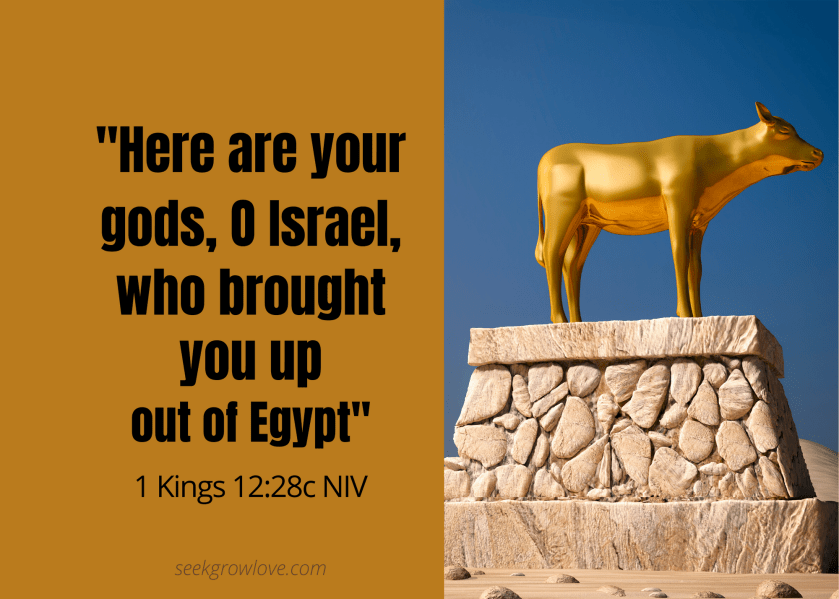
“Jeroboam thought to himself, ‘The kingdom will now likely revert to the house of David…'” So the king made two golden calves. He said to the people, ‘It is too much for you to go up to Jerusalem. Here are your gods, Israel, who brought you up out of Egypt.'” (1 Kings 12:26, 28)

Jeroboam took up his place as both the political and spiritual leader of Israel, but motivated by fear and a desire for control, he led God’s people astray. He created false idols, counterfeit altars, and bogus festivals—all in an attempt to keep his people from returning to the holy city of Jerusalem. Leaving behind the moral clarity of God’s commands, it became easier and more accessible to engage in a made-up religion that appeared similar on the surface to what they knew to be true. They were working with the same pieces, but some were flipped upside down, some placed in the wrong spot, and others lost along the way. As their worship moved farther from Jerusalem, the distance between Israel and God grew greater.

There is a stark warning here for the adjustments and innovations we see in the Church today. We must be careful that our worship, ministry, and evangelism do not favor convenience over obedience or comfort over conviction. If we fail to heed this warning, we may end up with well-developed systems that contain many of the same pieces—but are no longer building the Kingdom of God. Instead, we risk creating idols and events that offer no eternal hope. Granted, we may not be fashioning golden calves, but when we prioritize comfort over truth, we risk building spiritual lives rooted in fear, insecurity, and pride—lives that are void of God’s instruction.

It has never been about innovating what works for us or embracing a “you do you” mentality. God demands surrender and faithfulness in our daily worship, which means we will likely find ourselves worshiping in the city of our enemies from time to time. Resist the urge to craft a god who fits us. Instead, let us be molded to fit His purpose and to build His Kingdom according to His Gospel instructions.

-Aaron Winner

Reflection Questions

  1. What problems do you think God saw in Jeroboam? Do you think God ever sees these same problems in you?
  2. What does God desire from us – in our worship and in the way we live our lives?
  3. What are your thoughts about the following: “If we fail to heed this warning, we may end up with well-developed systems that contain many of the same pieces—but are no longer building the Kingdom of God” ? Have you seen this occur? How can we better heed this warning for our lives and for our church and for the Kingdom of God?

Gifts, God and Glory

1 Kings 10-11
2 Chronicles 9

There are simply some things you have to see with your own eyes to understand what all the hype is about. To stand at the edge of the Grand Canyon or to gaze from the helm of a ship in the middle of the ocean are images that have been perpetuated as pinnacle experiences through pop culture. While it’s possible to be in awe while reading a description or gazing at a photo, the real deal—being present in these places—has left me in wonder at the work of the Almighty.

In a similar manner, the stories of Solomon’s wisdom had spread like wildfire, reaching as far as the Horn of Africa—which, in ancient historical terms, was viral. The tale of a singularly wise leader whose work had led Israel into a time of ultimate prosperity made all the hype seem too good to be true. The Queen of Sheba, having received these reports, had to hear and see for herself. What she found was that the blessings were abundant and beyond even what was reported. The sights and sounds of Israel were breathtaking, but none more than the wisdom of King Solomon. After taking it all in, the Queen acknowledged that the sovereign God of Israel had placed Solomon on the throne to rule at such a time.

“Praise be to the Lord your God, who has delighted in you and placed you on the throne of Israel. Because of the Lord’s eternal love for Israel, he has made you king to maintain justice and righteousness.”
—1 Kings 10:9

In contrast, in the very next chapter of 1 Kings, we watch the eyes of Solomon shift—from service of the Most High to service of his own flesh. From my own speculations, taken from the perspective in Ecclesiastes, it seems that for a season Solomon focused more on the gifts of God than on his relationship with Him. Israel began looking more like the king and less like its God under Solomon’s direction. He established altars for the gods of his wives and concubines, reshaping not only the physical locations but also the worship of the people. The evidence was in: the splendor of this kingdom, which once pointed to the protection of an undefeated Most High God, was now showing signs of the waning wisdom of a compromised king calling his own shots.

As we read these contrasting moments in Solomon’s life, we should turn and reflect on our own. We may not have the accolade of being the “-est” of anything, but there are tales that could be reaching far and wide about us. When we are visited, our “place settings inspected,” and people look at our sacrifice, what does all our effort and show point to? Are we encouraged—or offended—by those who look at the catalogue of our life’s work and give God the credit?

When God has His hand upon us, it can be recognized and sought by strangers from a distant land who hunger or thirst for answers to their questions. The truth is, sometimes from the outside looking in, the beauty of God’s hand in our lives is more clearly seen. Conversely, from the inside looking out, we may gaze upon the gifts of the Lord and mistakenly see them as our own handiwork, when it is by God’s glory that we are richly blessed. The warning given to us by Job is that the One who gives and multiplies can also take away and divide.

The hype of God has been—and will continue to be—acknowledged by those who look at it from afar in awe. However, the goodness of God is best experienced firsthand, through encountering Him with every thought and action. Let us not forget that He is the provider of grace and the bestower of the fruits of His Spirit; we could never attain these through our own effort. Don’t be so entangled in the blessing that you forget the intention with which it was given: to demonstrate the glory of our Heavenly Father.

-Aaron Winner

Reflection Questions

  1. What thoughts, feelings, desires, or motives do you think led Solomon astray? Which of these same thoughts, feelings, desires, or motives do you see in yourself?
  2. In what ways would you like to be like Solomon? In what ways will you work at not being like Solomon?
  3. Are there gifts God has given you that you have mistakenly viewed as your own handiwork? What happens when we focus on the gifts rather than the Gifter? How can we better see what God has given and in return give to Him the credit, thanks and glory for all His wonderful gifts.

2 Viewpoints

1 Kings 9 & 2 Chronicles 8

1 Kings 9:1-7(NLT) So Solomon finished building the Temple of the LORD, as well as the royal palace. He completed everything he had planned to do. 2 Then the LORD appeared to Solomon a second time, as he had done before at Gibeon. 3 The LORD said to him, “I have heard your prayer and your petition. I have set this Temple apart to be holy—this place you have built where my name will be honored forever. I will always watch over it, for it is dear to my heart.4 “As for you, if you will follow me with integrity and godliness, as David your father did, obeying all my commands, decrees, and regulations, 5 then I will establish the throne of your dynasty over Israel forever. For I made this promise to your father, David: ‘One of your descendants will always sit on the throne of Israel.’ 6 “But if you or your descendants abandon me and disobey the commands and decrees I have given you, and if you serve and worship other gods, 7 then I will uproot Israel from this land that I have given them. I will reject this Temple that I have made holy to honor my name. I will make Israel an object of mockery and ridicule among the nations

2 Chronicles 8:12-15(NLT) Then Solomon presented burnt offerings to the LORD on the altar he had built for him in front of the entry room of the Temple. 13 He offered the sacrifices for the Sabbaths, the new moon festivals, and the three annual festivals—the Passover celebration, the Festival of Harvest, and the Festival of Shelters—as Moses had commanded. 14 In assigning the priests to their duties, Solomon followed the regulations of his father, David. He also assigned the Levites to lead the people in praise and to assist the priests in their daily duties. And he assigned the gatekeepers to their gates by their divisions, following the commands of David, the man of God. 15 Solomon did not deviate in any way from David’s commands concerning the priests and Levites and the treasuries.

A great question we can ask about Kings and Chronicles is “why were the histories of the children of Israel recorded twice?”

I think that the answer is in the perspective of the leaders and kings actions in the books of Samuel and Kings where the perspective is that of God and how He sees what the kings and men do, and where their hearts are.  In Chronicles it is much more the picture from the historical standpoint of man to the things that the kings do.  When we read, we see motive from God’s viewpoint in the Samuel and Kings records. We see more of a historical view in Chronicles.  I am not a student of who wrote down the Chronicles, but scholars who are think that maybe one or two men wrote down the book after the return from Babylon, perhaps Ezra.  They wrote because it would give their people a history that maybe they did not know. And also to help to give legitimacy to their present kingdom after the captivity.  By emphasizing the faithfulness of God they were giving hope to the people that God would reestablish them in the land and as a kingdom.

Are you inspired by this history to be more trusting of God and His Word?

Kings has unique information that is not in Chronicles, and vice versa.   The information and perspective are different, and we need to read both books.  Also the Chronicles are considered to be the last books added to the Hebrew cannon of scripture and are last in their scrolls of books.  The reason for the first and second books of both is related to the size of a scroll that could be produced at that time, not to a discontinuity between the first and second books. 

-Tom Siderius

Reflection Questions

Do you feel it is important for us to read these records?

What perspective should we have on these historical records?

I hope and pray today that God is giving you more confidence in His faithfulness and care as we read through these OT records.

A People for God

1 Kings 8 & 2 Chronicles 5

God’s covenant with His people is a continued theme throughout the Bible. It is confirmed with some of the greatest Old Testament leaders, such as Abraham, Moses, and David. Generations have been taught about God and all He has done for them. Though they have some faults, they have remained faithful to God as His people. The completion of the temple by Solomon further signifies a desire to worship God and be His people. After years of planning and construction the temple is finally used for its intended purpose and the glory of God fills the temple. In dedication, Solomon offers a prayer and addresses the people of Israel regarding the relationship between God and the people.

His prayer is a powerful plea for the LORD to remember His people and be their God. He begins by praising God and thanking Him for keeping His promises. Solomon prays that God will remain with them and hear their prayers. More importantly, he urges God to forgive them when they mess up. Solomon was wise enough to know that even if they tried their best they would sin and require God’s forgiveness. This applies to a variety of situations Solomon covers in his prayer, such as drought, famine, plague, war, and captivity. He argues that they have been God’s people for years and that He should continue to remember them for God’s glory. 

Then Solomon turns to the Israelites with him and requests that they keep their side of the covenant. Speaking to the people, Solomon says, “may your hearts be fully committed to the LORD our God, to live by His decrees and obey His commands” (1 Kings 8:61). God has fulfilled his agreement of the covenant in the past, so it is up to the Israelites to follow the covenant they agreed to. They must remain faithful to God to enjoy the benefits of being God’s people and having a hope for the future. There are many false gods that can be worshiped, but Solomon’s desire is that the LORD who brought their ancestors out of Egypt remains their God. 

That is easy to agree to in good times, but history has proven that is not always the case. There are numerous examples of the Israelites turning away from God for a period of time. Although Solomon’s reign was successful for the Israelites, they would not enjoy the same prosperity and unity for long. Solomon prayed that God be with them in all situations and advised the people to remain faithful to God. No matter what happens, wisdom suggests making a conscious decision to develop a relationship with God and be a people for Him.

-Josiah Railton

Reflection Questions

  1. What do you find in Solomon’s Dedication Prayer that would be wise to add into our prayers today?
  2. When did you last make a conscious decision to develop a relationship with God and be a person for Him? How is it going?
  3. Solomon was wise to know we would and will all need forgiveness. When have you veered off the fully committed and living by his decrees path? Have you experienced His forgiveness? What did that look like?

Solomon’s Wealth

1 Kings 7, 2 Chronicles 4

1 Kings 7 briefly pauses the narrative on the construction of the temple and describes the palace buildings Solomon built for himself. These were designed with similar grandeur as the temple built for God. It is apparent Solomon was very wealthy based on the resources required for the temple and his own personal projects. This initially might seem contradictory to the thirty wise sayings in Proverbs that teach to “not wear yourself out to get rich” (NIV, Proverbs 23:4). However, it is evident that wealth was not Solomon’s primary goal as his focus was mainly on God—at least at this point in his life.

Earlier in the story, in 1 Kings 3, God appeared to Solomon and told him to “ask for whatever you want me to give you” (1 Kings 3:5). Solomon was given the opportunity to ask for anything, but he did not choose wealth. He did not “trust [his] own cleverness” (Proverbs 23:4) as the eighth saying in Proverbs 23 warned against, but rather desired wisdom from God to govern the people. God rewarded Solomon by granting him a “wise and discerning heart” as he asked for (1 Kings 3:12). Further, because God was pleased with Solomon’s wish, He also gave him “both wealth and honor” (1 Kings 3:13). Solomon sought wisdom, and wealth was generously provided to him by God. He did not sacrifice wisdom to pursue a love for money, and didn’t hoard his wealth for himself either. He chose to build a house for God before building his own palace. Although he was very wealthy, Solomon’s life aligns with the proverbs arguing against chasing money. 

The rest of Saying 8 in Proverbs 23 depicts the temporary nature of materialistic wealth. It states, “cast but a glance at riches, and they are gone” (Proverbs 23:5). No amount of wealth is permanent, and it can be removed or destroyed at any given time. Even with the significant amount of resources used to build the temple and palace they would not last forever. The Babylonians and King Nebuchadnezzar plundered the temple treasures (2 Kings 24:13), and eventually all the great structures Solomon constructed with his wealth were destroyed with the rest of Jerusalem in 586 BC (2 Kings 25:8-10). 

Solomon was wise in seeking wisdom first rather than riches, and he understood that money is not worth pursuing. Any resources given by God can then be dedicated back to Him and used for righteous purposes. Although Solomon was rich in resources, he was wealthy with wisdom too.

-Josiah Railton

Reflection Questions

  1. Is having wealth good or bad? Why? or When?
  2. What is the problem with chasing after money and wealth? Have you seen anyone get further and further from the Lord as they chased after money?
  3. What might it look like to put your trust in God and not in your finances?
  4. What do you want to be known for being rich in? (Money, wisdom, kindness, etc… – HINT: Money is not the correct answer.) What steps will you take today to make an investment towards that end?
  5. Why do you think Solomon built the temple before his palace structures? How could we follow his example? How can we use the resources God gives for righteous purposes?