A Hot Topic

1 Peter 3

Sunday, October 9, 2022

Gender is a hot topic these days. We live in a society where there is much flexibility in how someone chooses to live their life, irrespective of cultural norms or the directives of our creator (let’s stick to what Peter writes about in his letter). Misogyny and radical feminism are two ways in which humans have messed up what was designed to be a tremendous blessing from God.

There is a lot to unpack here as Peter begins by addressing wives. In reading the text and then looking at commentaries it appears that foremost in Peter’s mind is a woman who has come to a saving faith in Jesus but is married to a man who does not share that faith (though we can gain something from this even if we’re not in that demographic).

The way that societies functioned, specifically the society that Peter would be writing to, did not offer much in the way of opportunity for a woman to exert influence over her husband. Her options may be quite limited in what her husband allowed her to do or permitted her to go. Where a husband and father who came to faith would be expected (even simply allowed) to bring his family along with him to religious functions, the same could not be said for the wife.

So how is a woman to minister to her unbelieving husband? How does she influence him intentionally in a way to bring him into the body of Christ? Nagging is probably not the most effective way to do this, in fact it might have the opposite effect; rather, the solution that Peter proposes is to allow the gospel of Jesus (i.e., the gospel of the Kingdom) to radically influence your way of living. Being salt and light (Matthew 5:13-14) is not just something that you are to be for people whom you may be unfamiliar with, even more importantly it is something you are to be with those who you are most intimate with. Living a life that bears the fruit of the spirit (Galatians 5:22) and exemplifies Jesus’ beatitudes (Matthew 5:3-11; Luke 6:20-26) will make you a more desirable (and influential) person.

Obviously, there is no way to guarantee that an unbelieving spouse will come to faith, but by being holistically attractive (not just externally, but internally as well) you will have a far better chance to influence them than if you were to try to get by on physical attraction (I don’t even know how that would really work) but be ugly on the inside.  

Peter addresses the ladies in verses 1-6, but he shifts gears in verse 7 and speaks to husbands. He says to “live with your wives in an understanding way” (ESV), literally living with her “according to knowledge” as opposed to living with her in “sheer thoughtlessness” as the Expositor’s Bible Commentary puts it. I can speak from experience, it is very easy to do what I want and expect my wife to pick up the slack, but that is not the way that Peter instructs husbands to operate. Instead of living in a way that could breed resentment and other problems (infidelity?), husbands are commanded to live in a thoughtful way.

Husbands are instructed to honor their wives as “the weaker vessel.” Huh? What does that mean? There are different ways to look at this… Societally women were weaker (we’ve already considered the lack of influence), typically women are weaker in physical strength (I can think of a few ladies that could probably wipe the floor with their husbands in a fight), and sometimes women are more emotionally fragile (have a wider range of feelings?) than men. The word for weaker (ἀσθενεστέρῳ) can be translated with lots of nuance, but one big take away from this is that women are not inferior to men. Whatever Peter is getting at with the idea of the wife being a weaker vessel, something is very clear: we are co-heirs of all the benefits that come with accepting Jesus and believing in the kingdom message. As objects of God’s salvation there is no distinction between male and female, just as there is no distinction between Jew or Greek. While husbands and wives may be called to different roles in their relationship and even in their roles in the church, this is not because of a lack of capability, this is the function that God has laid out. Husbands and wives are to minister to one another and to minister to others. We can use our marriages as an example and an opportunity in ministry. Authentic Christianity has done more to liberate women from misogyny and oppression than any other organization ever has; that being said, it has not changed the fact that men and women are different. We have equality in standing before God, we have equality in salvation, we ought to have equality in rights, but we are still different and that is a blessing. As the church is a body with many parts, the one flesh that we become in marriage takes into account our uniqueness as individuals and the differences in our physiology. We are to be reliant on one another (do not read as co-dependency), and we are responsible to one another to meet the needs that we have as image bearers of God and the uniqueness that we have as men and women.

-J.J. Fletcher

Action/Reflection:

To those of us who are married: We should evaluate where we are at in living as Peter instructs. Hopefully you are married to a fellow believer who you can discuss this passage with and commit to one another to implement these tactics in your union. If married to a non-believer, behave in a way that is intentional in living the gospel out to them.

To those of you who are engaged or hope to be married one day: Look for a spouse who takes scripture seriously and is willing to change their behavior to conform to what scripture dictates, both in their life as an individual and the way that they approach relationships.

For those of you who are called to a life of singleness (or just end up that way) or those of you who know someone who fits that description: I believe that the behaviors that the relational and internal things that Peter speaks of here will be beneficial in building authentic relationships that help navigate the potential challenges that a life of singleness may bring.

Stone Collector

1 Peter 2

Saturday, October 8, 2022

Let’s pretend I’m going to build a house with stones. 

First, I’d need a bunch of stones dumped in my yard. Then I would need to expertly stack them, making sure to pick the right stones that fit together and that don’t fall over in the breeze. I’d also need some kind of mortar or clay to hold them together. I can imagine some of the stones would be a bit too big to be lifting and moving around, so I’d need a tractor with a bucket, or even better, a crane. There’s a lot that would go into this. 

Now let’s pretend I actually completed my stone house. I still have a giant pile of rocks that I didn’t use. Some are just weird shapes, or cracked, or plain ugly. There is one stone in particular that was my least favorite because I kept tripping over it. I don’t want anything to do with these stones anymore.

Now I throw a little stone house-warming party, and my neighbor comes over. He says, “Hey, I want to build a stone house, too. Can I use the stones you didn’t want? I’ve got just the spot for each of them, especially that one you kept tripping over.”

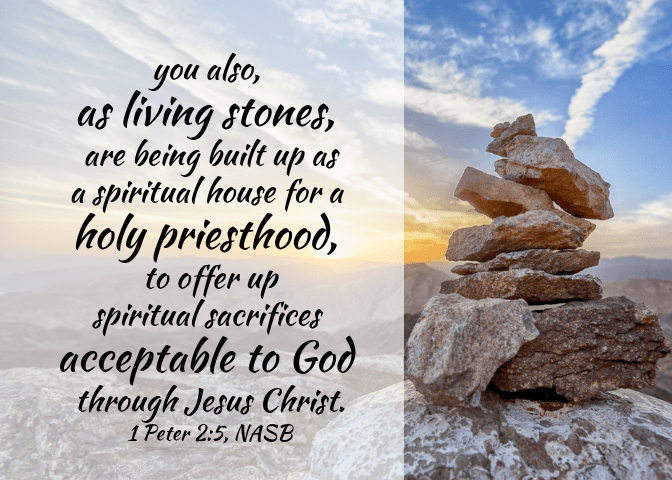
“Come to him, a living stone, though rejected by mortals yet chosen and precious in God’s sight, and like living stones, let yourselves be built into a spiritual house, to be a holy priesthood, to offer spiritual sacrifices acceptable to God through Jesus Christ.” (1 Peter 2:4-5 NRSV)

Now that we’ve heard and accepted the good news (remember yesterday’s reading?), we’ve become “living stones” to God. The world will look at us and scoff because we’re weirdly shaped and of no use to them, but God has a special use for all of us. He especially chose each of us for his project.

God is building us together into what Peter calls a “spiritual house” to be a “royal priesthood” to “offer spiritual sacrifices.” Peter is using this imagery to prompt us to imagine ourselves as the temple of God. The temple is a sacred space where the divine lives, just as we are to be sacred spaces where God’s spirit dwells. 

The priests are like mediators between the divine realm and the world, helping to make connections between the two. For us to be a royal priesthood means that we have access to God that we are to share with others. We are to connect God and people. We are to bring people into the experience of who God is.

The last part of that is that we are to make “spiritual sacrifices.” Naturally, when we think of sacrifices in the context of a temple, images of bloody animals appear in our head. If not, then I just made you think of bloody animals, and you’re welcome. Peter’s not suggesting that we do the kind of sacrifice that requires killing animals, but the kind that requires doing the right thing even if (or especially if) it costs us something.

The perfect example we have of this, of course, is Jesus. In the face of suffering and rejection, he chose to do the right thing and offer his life on our behalf. Doing the right thing didn’t just cost him something—it cost him everything. God notices and responds to our sacrifices. In Jesus’ case, he was resurrected and exalted to God’s right hand. He was rejected by the world but made into the stone holding the whole house together.

We’re to follow Jesus’ example and be willing to put ourselves in God’s hands as we do the right things, knowing we could very well lose something in the process. Just as God saw Jesus’ sacrifices, he will acknowledge and respond to ours. That doesn’t mean that we should do good things expecting a reward, but that God is just, and will remember the trouble we went through while pursuing His purposes.

We know the world is going to be skeptical of our stone house. One hope is that through being God’s servants and living blamelessly (doing the right thing), the world may look at us and see honor in what we do. We are witnesses and priests to them, representing God to them as Christ did to us. We can hope that the fruit of our sacrifice is that God can gather even more living stones to make the stone house bigger and stronger.

Thanks for coming along with me this week on our journey through the book of James and the beginning of 1 Peter.

-Jay Laurent

Internal Inquiries

1. How does it make you feel knowing that God chose you to be one of his living stones?

2. What kinds of spiritual sacrifices have you made? What did it cost you?

Things that Fade, and Things that Don’t

1 Peter 1

Friday, October 7, 2022

Everything is dying. Your phone’s battery is draining and will need to be recharged. Your phone itself will someday give out or become so slow or outdated that you’ll need a new and shiny one. But that one will die too. Your car will get you places…until it doesn’t. Your body itself will eventually lose its ability to sustain the delicate balance known as life, and will stop functioning altogether. This will happen to you, everyone you know, and everyone you don’t know.

The human race and life on earth are in deep trouble if the wrong supervolcano decides to erupt or if a very large random rock hurtling through space collides with earth. Our existence is a very delicate thing.

Even the sun as we know it is dying. It’s said that in somewhere around 4 to 5 billion years, our sun will eventually begin to die as its hydrogen fuel runs out. It will swell to a red giant and swallow at least Mercury, Venus, and our own planet before becoming a white dwarf.

It’s predicted that eventually the universe itself will expand hopelessly into a cold and dark nothingness of no usable energy. It’s called “heat death” and is a lot like winter, but much worse.

That’s a lot to take in all at once. The realization that everything we know is fading away can lead us to a dark place. It may remind you of Nietzsche’s caution that “if you gaze long enough into an abyss, the abyss will gaze back into you.” What gives? Is there anything that lasts?

“For ‘All flesh is like grass and all its glory like the flower of grass. The grass withers, and the flower falls, but the word of the Lord endures forever.’ That word is the good news that was announced to you.” (1 Peter 1:24-25 NRSV)

Not everything dies and fades away. Peter is telling us that the good news you were given—the word of God—endures forever. To us, the phrase “word of God” can often mean the Bible, but the way the Bible uses it is so much more broad and rich. I tend to think of it as something like God’s life-giving wisdom, through which he created everything. In John 1 we can read about how Jesus, through his life and ministry, became the perfect embodiment of that word among us, carrying on another chapter of something that was always there.

That chapter seemed to come to a close when Jesus was executed. To his followers, it must have felt like all hope was lost. But we know how that story ends up! We are shown there is more to come when Jesus is resurrected. It’s another chapter of this everlasting word. 

As there was more to come for Jesus, there will be more to come for us. Because of Jesus’ resurrection, we are given hope and an inheritance that won’t fade away. Jesus is said to be the “firstfruits” of the resurrection, meaning his was the first resurrection, and we’re given confidence ours will be yet to come.

Paul tells us in 1 Corinthians 15 that through resurrection, the dead are “sown” perishable, but raised imperishable. Resurrection transforms things that have perished (or would perish) into things that can’t perish. It transforms the dust of the ground into something new and alive and beautiful. Remembering that Jesus was transformed from a dead man into some kind of mysterious, eternal, resurrected being, we embrace the living hope that someday we’ll experience the same transformation.

As we reflect on how resurrection will transform us, there are hopeful rumblings that it will transform all of creation into a new heaven and a new earth. How mind-blowing is it to think of an entire universe raised imperishable? What does that even look like? That’s such an amazing mystery to think about!

There’s no way for me to know how long I’m going to live, or how long there will be an earth or sun or universe. I do, however, know that God outlives all of those things! If God is around, there is always more to come. There is always another chapter of the word.

So let’s not grasp at the things that are going to die and fade away. Instead, let’s keep our hope in what will last forever—what Peter calls “the living and enduring word of God.”

-Jay Laurent

Questions to ponder

1. What might Peter say our response should be now that we’ve heard the good news (hint: verses 13-16 might offer a good start)?

2. What other things besides the word of God do you think are “imperishable”?

“That’ll do, Pig.”

Daily reading: 1 Peter 1-5

When Jesus told Peter to ‘Feed my sheep,’ he was commissioning him as a shepherd. And in the book of First Peter, we see a part of the fulfillment of that commission.

There are believers (the Lord’s sheep) scattered throughout Roman provinces in Asia Minor, and Peter is writing a letter to be routed amongst them.

There was a movie out in the 90’s about a pig that herded sheep. When the sheep dogs on the farm did their job, they demeaned and scared the sheep into submission. But sweet little Babe the piglet just asked them nicely and off they marched in lines for him.

Sheep of a different flock, however, didn’t know this sweet pig, and saw no reason to listen to him. That is, until, Babe received word from his pasture back home of the secret words to tell these new sheep that he was on their side. ‘Baa, Ram, Ewe’

We are an individualistic bunch of sheep, I think. 

Maybe it’s just me. Reading the book of First Peter with the eyes of a flock, a group, instead of reading it just for me, I see it somewhat differently.  There’s a definite theme coming through it all that it seems Peter wanted these sheep in his scattered pasture to remember:

There’s more than this.

  • Seek the holiness of sincere love for each other, because you’re like perishing blades of grass and God’s ways endure. There’s more than this way of loving.
  • You might feel rejected, but you are chosen. There’s more than this world’s acceptance.
  • Live to please God not the society you live in. There’s more than this wisdom.
  • God cares about how you treat your family. There’s more than your own perspective.
  • Compassion and humility never go out of style. There’s more to be gained through suffering than we can often see.
  • Wake up, pay attention, Jesus is coming back and you need to be ready. There’s literally more than this world coming one day.

Peter may not have needed to say ‘Baa, Ram, Ewe’ to unite the scattered sheep of his day, but perhaps we need a reminder that we, too, are a scattered flock.

Friends, there’s more than this.

Do you feel the sincere love of the body of Christ? No? Don’t wait for someone else to ‘do something’ about it. Everyone else is a perishing blade of grass just like you. Authentic love doesn’t start with a social media campaign; and it doesn’t start with the whole church, it starts with a few individuals. Be those few.

There’s more than this way of loving.

Have you felt rejected? Alone? Broken? Empty? Peter’s response to the scattered flock on this issue was to remind them about Jesus, and of this: “Once you were not a people, but now you are the people of God; once you had not received mercy, but now you have received mercy.”

It seems that acceptance begins with mercy. Mercy comes after repentance. Repentance comes after we own up to our sin. This world tells us to own our sin. Big difference.

There’s more than this world’s acceptance.

Along those lines, if the wisdom of this world affirms all of your choices, you might want to question if God would. Living to please God rarely aligns with the wisdom of this world.

There’s more than this wisdom.

Perspective is a powerful influencer, and seeing our family solely from the lens of our own perspective is not only selfish, but dangerous. We can fall into the trap of living for ourselves even while fooling ourself into thinking we are part of a team. How lonely. How unfulfilling. And definitely not God’s best for us.

There’s more than your own perspective.

Suffering is difficult and hard and it stinks. Anyone who says to say ‘Praise God!’ for suffering is a liar or a robot (or a lying robot, perhaps?). Jesus didn’t even want to suffer, he asked his Father if he could avoid it if possible.

Finding peace in the midst of suffering, finding joy in God’s provision during times of suffering, and praising God during suffering are all very different than praising him FOR the suffering.

There’s more to be gained through suffering than we can often see.

Peter quotes a Psalm and tells these scattered sheep that they must seek peace and pursue it.”  Compassion, humility, gentleness, sympathy, blessing… these are all active. A person who is actively pursuing peace, especially when suffering abounds, will stand out. Maybe that’s why Peter suggests it?

People loving differently, repenting of sin, showing mercy, treating their families differently, being the most kind, compassionate, gentle, humble, easy to get along with group of people anyone ever met…yet not compromising God’s standards, not backing down, standing strong against the roar of evil around them, refusing to be devoured — Those people would garner attention.

There’s literally more than this world coming one day.

Wake up, pay attention, Jesus is coming back and we need to be ready.

-Susan Landry

Today’s Bible passage can be read or listened to at BibleGateway here – 1 Peter

Tomorrow we begin the book of Hebrews (chapters 1-6)

Serve God With a Good Attitude

I Peter 5

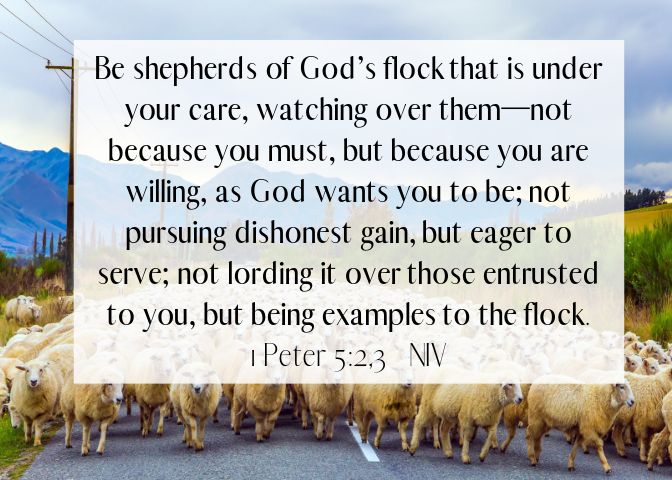
1 Peter 5 2 3 NIV

There is an old Amish proverb that goes something like this:  There are two kinds of leaders: those who are interested in the flock, and those who are interested in the fleece.  In the first part of I Peter 5 there is an admonition given to pastors but it is applicable to all those  who hold leadership roles anywhere.  Leaders are to lead by example.  They are not to be dictators with an accompanying attitude but rather directors who are always directing people in the case of pastors toward Christ, and for other leaders directing people toward the greater vision with a humble attitude.

Peter encourages us and the early believers to honor one another and treat each other respectfully.  Have you ever been around someone who frequently ‘tooted their own horn’?   How annoying is that?  Does it make you want to follow that person’s lead or make you like that person very much?  Think about social media posts you have seen  like this, or maybe even posted yourself.  One Christian leader appropriately called out some posts  as the ‘humble brag’ and targeted how annoying and self-serving  they are.  As Christian brothers and sisters no one should toot their own horn but rather let others give them any due recognition.  Peter reminds us in verse 5 that God hates pride but appreciates true humility.

In serving God with a humble attitude and living a righteous life we can expect to have some opposition.  Opposition can have two effects: either failure, or strength and growth.  In the end of the chapter Peter points out that our adversary the devil  would like to see us fail, and is just waiting to help us to our demise –  but by staying the course God will give us victory.  The admonition for us is to stand firm in our faith and righteousness so that we may glorify God in this life and thus overcome the evil one.

-Merry Peterson


Stay True to Righteousness

I Peter 4

1 Peter 4 7 8 NIV

When I graduated high-school  and went to my Prom I was invited to several ‘after-prom’ parties.  I knew that there would be drinking and other activities at these parties that I didn’t care to participate in.  I declined several invitations and have never been sorry for that decision.  What I did instead , was go with a few friends after prom to Dairy Queen and have ice cream sundaes and then back to my house where we  watched a movie until the wee hours of the morning.  My classmates all knew that I was a Christian and I most of all wanted to stay true to my Christian values as would be pleasing to Christ.  In 1 Peter 4 the apostle Peter reminds the early Christians to stay true to their righteous values in a world that did not promote those values, amongst a people who would not understand or value their decision to behave righteously.

Our culture today is filled with sensuality (notice how little clothing some people and models wear), lust (always wanting more), and a constant appeal to the senses that drinking alcohol will make you popular, relaxed,  fun to be around, etc.  Now I’m not proposing that everyone go around in turtlenecks and never have a glass of wine here –  But by being sensuous , lusty, or intoxicated we dishonor God and his good desires for our lives.  People and friends may make fun of you for not choosing to participate in these activities but the apostle Peter reminds us in verse 5 that everyone will have to give an account before the Lord about what they chose to do, and how they conducted themselves in this life.

He goes on to encourage the early believers and us to lead lives of righteousness exercising  good judgment, being diligent in prayer, loving others, being hospitable and doing what God has gifted us to do by His spirit for the encouragement and uplifting of others.  In verse 11 he reminds us that God will give us the strength to do these things so that He will be glorified through our lives of righteousness.

We all one day will stand before the Lord to be judged for our actions.  In the last part of the chapter we are told that we should not be found suffering for sins committed but rather that if we are found suffering it should be for the cause of following Christ in an ungodly world.  We can trust God to be the righteous judge, for He is our creator and we can entrust our souls to Him.

-Merry Peterson


It’s All In The Attitude

I Peter 3

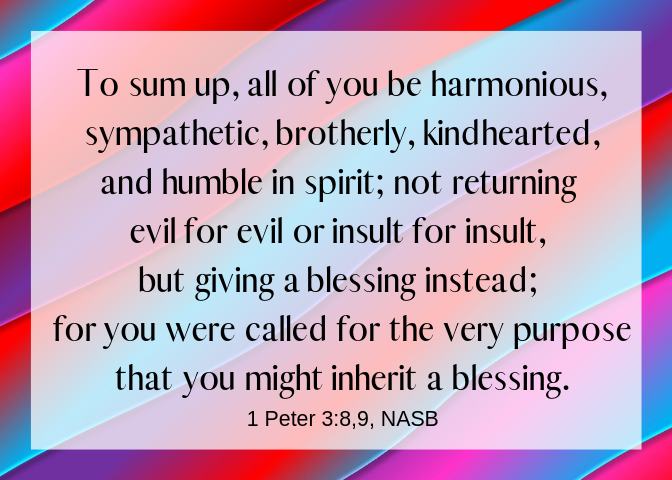
1 Peter 3 8 9

Aretha Franklin said it best in her hit song:   RESPECT – all she needed and wanted  was to be given a little bit of respect.   Are we not the same?  In I Peter 3 the apostle starts off by reminding the readers that they are to give respect and behave respectfully so that others will be won to Christ through their exemplary conduct.    What it all boils down to; summarizing his words is that;  in relationships mutual respect is key for both individuals, having the attitude of  honoring  the other person above themselves.  Imagine if everyone in our world today adopted this same kind of respectful attitude.  What a different world we would live in.

Have you ever seen someone who was dressed beautifully but then opened their mouth to display an ugly attitude?  Isn’t  it always disappointing to see?  In this chapter the apostle Peter reminds us that true beauty is found on the inside.  Our attitudes and  actions towards others speak louder than the clothing or jewelry we wear or the hairstyle we choose.  God desires for us to be beautiful on the inside and shine that outwardly.  In our world today we seem to be bombarded with the notion that beauty can be bought or acquired through purchasing – however true beauty is a quality that cannot be bought or sold.

Further on in verse 7 and 8 He points out that answers to prayer can be hindered by actions and attitudes of not being respectful toward one another.  We are not to be quarrelsome, we are to seek peace and pursue it.  This is the righteous expectation that believers are called to.  In verse 12 we are reminded that the eyes of the Lord are toward the righteous and his ears attend to their prayers.

We are to live righteous lives being sure of the hope we have in Christ.  In the final section of I Peter 3 the apostle Peter reminds the believers that they are to be sure of the hope they have.  This hope is believing  that Jesus is the only begotten son of God, that his death provides forgiveness and salvation from sin, and that his resurrection gives us the hope of eternal life.  Belief in these things and the outward symbol of baptism is the indicator of the believer’s new life with Christ.   With this new life in Christ, the believer is then called to live a life of righteousness that pleases God our Father.

-Merry Peterson


Living Stones

1 Peter 2

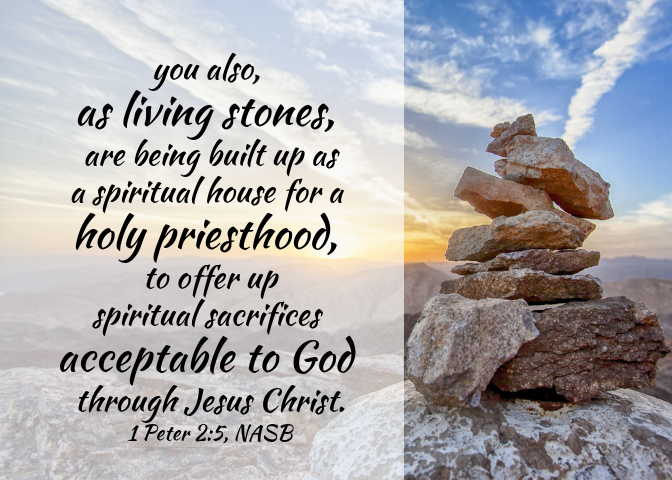
1 Peter 2 5 NASB

Often, we think of our life as our own; and it is to a point. We think we just go and do what we want, when we want and no one else has any right to say anything about it. The thing we need to remember as Christians is that we have given our lives to another. We have devoted ourselves to service. As such the master to which we are devoted is constantly guiding us … Are we following?

Peter tells us to put aside ALL malice, guile, hypocrisy, envy, and slander. He suggests this will come naturally as we long for the pure word of God. This will cause us to grow in salvation and kindness. One of the best ways we can show love to one another is to show kindness to others. He says that as we have seen the kindness of God we will show kindness to others.

As His servants we are constantly being built up into a priesthood for Him. That does not mean we are going around in black shirts with white collars but it does mean we are to be serving Him with our entire being. We are called to offer sacrifices to God. Verse five of this chapter reminds me of Romans 12:1

Therefore I urge you, brethren, by the mercies of God, to present your bodies a living and holy sacrifice, acceptable to God, which is your spiritual service of worship. Romans 12:1 (NASB)

The sacrifice we offer is one of ourselves, not merely something of value to us but our entirety. We are chosen to serve Him as capable in His power, we are His possessions to serve as His people, for His glory and purposes. Peter continues to tell us that as we do what is right we may turn others to serve God as they see our actions. Also in doing right we will silence false accusations as all have seen us doing right by Him.

We are also called to respond differently than those around us. Many people are vicious toward others, especially when wronged. God is calling us, through Peter, to a better way. He has called us to be true to Him and to turn the other cheek as Jesus gave example. He reminds us that sin is no longer our master but we are now servants of Christ and his Father, our Father.

-Bill Dunn

Following the Alien Way

1 Peter 1

1 Peter 1 15 nasb

As we open the first letter from Peter, we find that he identifies himself as an apostle. This is a word that is rarely used outside of the church today. It translates to one who is sent. Peter says of himself, “I am one who is sent of Jesus Christ, I am his ambassador, his representative to you.” The you he refers to are all of those “living as aliens” across the region. I remember when I was a child, I would think of Marvin the Martian or some other made-up extra-terrestrial when I though of the word alien. Now I understand that an alien is simply one who is living in a place that is not their own. I now know that we, as servants of Christ, are living as aliens in a world that has turned itself over to follow evil. So, Peter is actually writing to us as well.

He continues by saying that we are chosen according to God’s foreknowledge. So, God knew the future enough to chose us as His servants for this time and to guide us to believe in His Son so we can enjoy life everlasting in His amazing Kingdom at the appointed time! WOW!!! It is incredible to think of the ways that God sets so many things in motion for our good, even when we have no idea of what He is setting up. We are set aside to obey Jesus and be cleansed by his blood. As if that was not enough Peter then asks that grace and peace be ours in the fullest! This is quite the blessing … and that is just the first 2 verses!

In the next three verses he reminds us that our inheritance is stored up where moth and rust cannot destroy. He says our hope is in resurrection and salvation is to be revealed in the last time. This is a beautiful reminder that the dead sleep and we will receive the promise together. In verse six Peter reminds us that the troubles of this time will pale in comparison to the blessings of the Kingdom of God, and this is where we draw our rejoicing from.

Verse thirteen says because of the gospel that has been preached to us we must be ready for action, with our hope fixed, because the world will continue to resist us for a time. Therefore, we must be obedient. We are called to be like Him.

As obedient children, do not be conformed to the former lusts which were yours in your ignorance, 15 but like the Holy One who called you, be holy yourselves also in all your behavior; 16 because it is written, “You shall be holy, for I am holy.”     1 Peter 1:14-16 (NASB)

In the last parts of this chapter Peter again writes of what is imperishable. This time he is telling us that we were not saved by what is perishable, such as gold and silver (these even vary in worth today), but by what is eternal, the blood of Christ. “You have been born again not of seed which is perishable but imperishable, that is, through the living and abiding word of God.” (1 Peter 1:23)

-Bill Dunn

Pearls from Peter

I Peter 1-5

1-peter-3-10-11

Thursday, July 13


The Christian lifestyle can be hard to follow for a variety of reasons- worldly desires,  living in ignorance, not submitting ourselves to authority, or going through tough times. Thankfully, Peter gives us advice on how to live a life that is pleasing to God and, also, explains how to endure the struggles and hardship we may be facing in our daily lives.

Peter tells us that as God’s chosen people, we need to live holy lives by loving the brotherhood of believers, fearing God, honoring the king, and showing proper respect to everyone. 1 Peter 3:8-9 states: “Finally, all of you, live in harmony with one another; be sympathetic, love as brothers, be compassionate and humble. Do not repay evil with evil or insult with insult, but with blessing, because to this you were called so that you may inherit a blessing.” Our lives may become more manageable and less stressful once we dedicate our lives to Jesus.
Suffering from major depression, anxiety, or any other hindrance can be hard to live with. “Humble yourselves, therefore, under God’s mighty hand, that he may lift you up in due time. Cast all your anxiety on him because he cares for you” (1 Peter 5:6-7 NIV). It is nice to know that all we have to do is ask God to take our pain and suffering away because he loves us.
According to 1 Peter 3:17-18, “it is better, if it is God’s will, to suffer for doing good than for doing evil. For Christ died for sins once for all, the righteous for the unrighteous, to bring you to God…”  We are taught to depend on Christ more when we suffer and we shouldn’t feel ashamed for suffering as a Christian. Luckily, we know that we aren’t the only ones suffering in the world and can help each other when things seem to get out of control.
Whatever you may be doing this week, next month, or a year from now, remember 1 Peter 4:7-11: “The end of all things is near. Therefore be clear minded and self-controlled so that you can pray. Above all, love each other deeply, because love covers a multitude of sins. Offer hospitality to one another without grumbling. Each one should use whatever gift he has received to serve others, faithfully administering God’s grace in its various forms. If anyone speaks, he should do it as one speaking the very words of God. If anyone serves, he should do it with the strength God provides, so that in all things God may be praised through Jesus Christ.” I pray that we all learn how to live the correct way that is pleasing to our Lord and serve Him in whatever capacity we can with the gifts He gave us. God bless you. Amen.
-Cynthia Fyfe
(Photo Credit: https://dailyverses.net/1-peter/3/10-11)