Called, Changed, Qualified

1 Samuel 9-12

Have you ever found yourself in a position totally unprepared or unqualified? When I was in college for my bachelor’s degree, I took Cellular & Molecular Biology as part of my program to become a secondary science teacher. It just so happened that this was the same course that was required for pre-med students. Somehow, I ended up getting an invitation to join a study group with these pre-med students. After 5 minutes with these people, I realized that they were a completely different caliber of student – I was so out of my depth.

There have been other times in my life when my own inexperience and inadequacies seemed to cast a blinding glare onto the responsibilities that I had to carry out. Even now, after 23 years of experience in education, there are times when I have no clue on how to handle a given situation.

This is how I relate to Saul being approached by Samuel to become king of Israel. His response is that he’s a nobody, from the smallest tribe and his clan is the least of all. How is it that he has been selected to rule over an entire nation?

But isn’t that just like God to do something like that? God seems to select those who are the most unlikely to be successful. Why does He do this? What I have learned, is that it makes me more dependent on God and less likely to take the credit.

Being part of the FUEL leadership team for many years, I have seen time and time again when a situation developed that was bigger than our resources and everything ended up working out because we depended on God. Anyone out there remember the year that we stopped going to Taylor University and started going to Manchester University? Yeah, we weren’t sure if FUEL was going to happen that year. But with a lot of prayer (and hard work by the directors) we were able to gather again because God pointed us in the direction we needed to go. God provided us with exactly the right site, to work with the best conference staff, to continue to return for many years.

I recently read a phrase that I think is appropriate here: “God doesn’t call the qualified; God qualifies the called.” If you’re willing to be used by God, you will find yourself in circumstances that seem way out of your league. While you may not be so confident in your abilities, know that God is more than able to see you through. After all, it’s His reputation on the line and God never fails.

Bethany Ligon

(originally posted for SeekGrowLove on April 9. 2020)

Reflection Questions

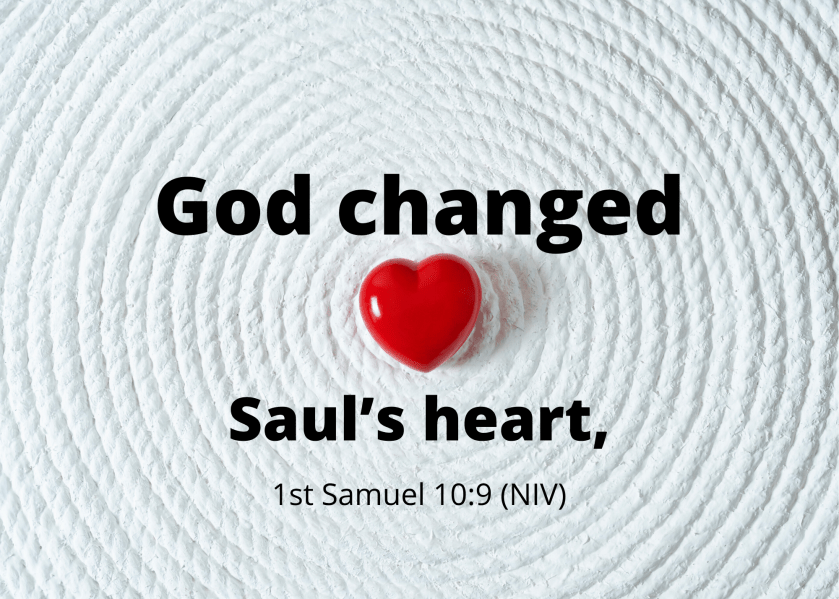
  1. How did God prepare and qualify Saul? What do you think was included in God’s “heart change” for Saul (10:9) and the role of the Spirit of the Lord?
  2. From above: “God seems to select those who are the most unlikely to be successful. Why does He do this?”
  3. When have you felt unqualified for a job God sent you to? Did you do it? Did you have a “Samuel” who spoke God’s word to you? How did God change/prepare/qualify you for the job?
  4. How can you be a Samuel for someone else?

Why You Want What You Want

1 Samuel 4-8

Key verse: 1 Samuel 8:6-7

Somewhere between 2013-2014 my middle school classmates and I saw the appeal of smartphones. We weren’t familiar with all the “modern technology” or the iPhone 5. All we desired was a way to have something everyone else had, play games online with our friends anywhere we went (even though the cellphone towers were much less effective “back then”), access the internet, and message our friends with a few clicks. Unlike many friends and classmates, I didn’t receive a smartphone until I was a junior in 2018. Thanks to modern technology, I had a few other devices to keep me updated and occupied, but it was a blessing in disguise to not have a phone till later on in my life. 

While I witnessed my classmates retract from social situations and face-to-face conversations, I could participate more frequently in social circles and conversations (thanks to what I and many others would’ve called “being bored”). When I finally received my own smartphone, I had been so accustomed to a life without it that I felt like I almost didn’t need it. It didn’t feel necessary to have something everyone else had but I felt the social pressures of my friends and everyone around me. I wanted a smartphone because everyone had one and this wasn’t the only thing I wanted. New shoes, new cleats and spikes for soccer and track, new clothes, a better-looking physique, and more were just a few things I desired because I felt like everyone else had them. However, I’ve learned that what I want (especially because everyone else seemed to have them) is not necessarily what I need. I didn’t need the things I wanted and I’m glad my parents and God didn’t give me everything I wanted.

The LORD had provided for Israel time and time again. However, Israel (like many other people in today’s world and in my school environment) wanted more. The Israelites wanted a king and wouldn’t listen to the warnings from Samuel and the LORD (8:19). Why? Why would they desire someone other than God to lead them, go before them, and fight their battles? The answer is simple, they were trying to compare themselves and “keep up with the Joneses.” It was difficult to avoid comparisons back then, and thanks to social media and smartphones I think it’s even more difficult today. Samuel knew the cost of this decision, but the Israelites wanted a king and they wanted one NOW! So, Samuel went back to the LORD, repeated their wish and desire to the LORD, and the LORD told him to listen to them (v.22). Samuel was given a taste of what God experienced when they asked for a king (v.8). He was displeased and I’m sure he had some questions. Was he not good enough to keep them satisfied? Was he not doing enough to serve on Israel’s behalf (7:9)? However, when Samuel prayed to God, God allowed him to see that it wasn’t him they were rejecting (8:7). The Israelites had everything they needed, but they didn’t have everything they thought they needed. Looking back at my situation, the LORD blessed me and my family with everything we needed, but He also blessed us by not providing everything we thought we needed. They had God, but they wanted a king too. The LORD will provide, but be careful what you wish, pray, and ask for.

-Jeffrey Seiders

REFLECTION Q’s

  1. The Israelites wanted more and desired something other than God. Is there a past or present situation where you want more and desire something other than God? If so, how can you work to return God to His rightful place?
  2. Samuel felt rejected because Israel rejected God. Have you ever felt rejected because someone rejected your faith or beliefs? 
  3. Samuel went to God and prayed when he was displeased with their desires. How do you respond when you feel displeased with the decisions and desires of others? Is that the way you should react? Why or why not?
  4. Unlike many of my friends and classmates, I felt my first smartphone was delayed and withheld from me. How has God delayed/withheld your wants, and why might He keep you from receiving them? What blessing(s) might He be providing to you instead?

A Parent’s Job

1 Samuel 1-3

The decisions of our family members affect us. Growing up, I attended a public school where many teachers and staff knew my dad. Whether it was because he was working as a substitute, looking for a teaching position, or something else, they knew him and often told me something along the lines of, “You better be on your best behavior because I know your dad.” I’m sure my older brother heard this many times, and I’m not sure about my younger siblings. Regardless of that detail, my younger brother has been called by my older brother’s name before (maybe because of their similar competitive spirit or fast mile times in P.E.). Yet, my siblings and I know very well that if something bad were to happen at school, somehow or someway it would find its way back to our parents (even if it had to be via carrier pigeon). My siblings and I did/do very well at staying out of trouble, but we weren’t/aren’t perfect (and I’ll spare you from those details). 

When my older brother signed up for the morning choir, it changed my school life and routine. I didn’t want to ride the bus, and I couldn’t drive, so the best option was to get up earlier and ride with my brother (and wait until the rest of my friends arrived). At that time, I disliked my brother’s decision very much. However, this eventually led me to become interested in morning choir, learn all the musical parts I could, somehow end up singing in the choir for the last two years of high school and being involved in two musicals/plays. After looking back at my older brother’s decision, I am grateful for it (even though I lost some sleep here or there). Our actions can dissipate and impact the lives of those around us (for better or for worse), and in today’s reading Eli’s actions are no different. 

My parents taught us that our decisions and indecisiveness have consequences. As Laurie Buchanan said, “Whatever we are not changing, we are choosing.” Eli made a few poor decisions that resulted in the downfall of his family before God. We might think that Eli was innocent when we read 1 Samuel Chapter 2, but 1 Samuel Chapter 3 tells us the reality of his situation. He didn’t do anything about his son’s sins nor restrained them from sinning (3:13). He needed to hear from God, a friend, or his wife something along the lines of Proverbs 13:24 which states, “Whoever spares the rod hates his son, but he who loves him is diligent to discipline him.” Or, perhaps he knew this concept and simply continued his daily practices disregarding this information (though I think this is more unlikely). Whatever the case may be, Samuel (Hannah and Elkanah’s son) was dedicated to the LORD (1:28) and grew in stature and favor with the LORD and people (2:26). He was the result of his parents’ good decision(s) and didn’t follow in the ways Eli and his sons acted. His parents understood Proverbs 22:6 which states, “Train up a child in the way he should go; even when he is old he will not depart from it,” likely before it was written. It is important to know the words of God, obey them, and be an example to those around us (even when we think others aren’t looking or paying attention).

-Jeffrey Seiders

REFLECTION Q’s

  1. Eli knew the words of the LORD and yet acted disobediently. Are there times when you’ve acted disobediently even though you knew what God’s word says? What happened as a result of your disobedience? How can you get “back on track?”
  2. Eli’s sons acted as if their father wouldn’t correct them. How have you acted in a way that you thought God and/or your parents wouldn’t correct you? What are the consequences of your actions? In what ways can God teach you through your consequences?
  3. Samuel grew in favor with the LORD and with people. How can you change your actions and mindset to grow in favor with the LORD and bring people closer to Him?

The Unfortunate Separation of Books

Old Testament: 1 Samuel 29-31

Poetry: Psalm 69

New Testament: Galatians 5:1-15

1 Samuel and 2 Samuel are, in your Bible and maybe in your mind, two different books. 

However, they are one story. We should not really end 1 Samuel without going on to 2 Samuel, the same way ending your movie marathon of the Lord of the Rings after just watching “The Fellowship” is lacking. 

1 Samuel ends with Saul and Jonathan and the other sons of Saul dead on Mount Gilboa, their bodies first desecrated and then given a proper burial by the men of Jabesh-gilead. 

But it is David’s response that is striking, and that comes in 2 Samuel. Forgive me for reading ahead, but look at what David does in 2 Samuel 1. 

He kills the man who claimed to kill Saul (even though we know Saul killed himself) because this man did not respect the Lord’s anointed. 

He laments, not only over Jonathan, but over Saul his enemy. 

His heart is broken because of this man who really and truly hated him. 

1 Samuel has been a journey, and I am glad you have allowed me to go on it with you over the last two weeks. Here has been my take-away:

Be David and do not be Saul. 

Saul did not start off wrong. He began as a shy, possibly humble, man who was given the gift of kingship. But instead of living up to that role, he first consistently and then later constantly rejected the will of God. He offered sacrifices on his own, he directly disobeyed the commands of God so the people would be impressed by his power. He lifted his hands against the Lord’s anointed constantly. When he couldn’t get an answer from God, he turned to demons. As a friend of mine said, Saul is the cautionary tale. 

David started off right. A humble young man who worked the field, he was also given kingship. He was found to be a man after God’s heart, who obeyed God. He made mistakes, but he sought God’s forgiveness. He sought to do God’s will, to bless those who blessed him, but to let God give justice to those who cursed him. He gave compassion to the Lord’s anointed, but fought against the enemies of God. At his best, he is a model king, a model disciple, and a model man. Even in his failings, he repents and turns towards God. 

My brothers and sisters, 

May you start off from this moment right. God can and will forgive you for everything in your past and start you off with the salvation offered through the death of Christ. By “putting on” Christ in baptism, you become a son or daughter of God, a child of the King of the Universe. You are given a type of kingship, and the power of God, the spirit of God, to do all that this kingship requires. You are training to reign with Christ in his Kingdom, and so you are to show love to all people, to show justice to sinners (telling them of God’s justice), to show compassion to all repentant (expressing God’s mercy), and to show honor to God’s anointed, the Lord Jesus Christ. 

Bless you as you become “Davids”, following the son of David. Amen

-Jake Ballard

Reflection Questions

  1. In what ways or times have you had a touch of Saul in you? What did it look like? What did God want to see instead? Have you confessed and repented?
  2. How do you treat God’s anointed?
  3. What does it take to become a David? What will you do today to make is so?

——————————

Jake Ballard is pastor at Timberland Bible Church. If you’d like to hear more from him, you can find Timberland on Facebook (https://www.facebook.com/TimberlandBibleChurch/ ) and on Instagram (https://instagram.com/timberlandbiblechurch?igshid=t52xoq9esc7e). The church streams the Worship Gathering every Sunday at 10:30. Besides studying and teaching God’s word, he is raising three beautiful children with the love of his life, plays board games and RPGs, and believes it was fine that Tom Bombadil was not in the LotR movies. If you’d like to reach out to talk Bible, talk faith, or talk about how the LotR movies might be an improvement on the books, look Jacob Ballard up on Facebook (https://www.facebook.com/jacob.ballard.336) or email him at jakea.ballard@yahoo.com
God bless you all!

“Marley was dead: to begin with.”

Old Testament: 1 Samuel 26-28

Poetry: Psalm 69

New Testament: Galatians 4

“Marley was dead: to begin with.”

Sometime in the Advent season, my family gathers round and we read out these words. There is a familiarity to this “scary ghost story”; who hasn’t seen, or watched, or read, or heard some version of *A Christmas Carol*. There are dozens, scores, of different versions: stages plays, to ballets, to movies, to the MUPPETS. Seriously, if you haven’t seen a Muppet’s Christmas Carol, what are you doing in the Holiday season?

As I was saying, my family reads these words every year, and I particularly love Dickens’s dry humor and wit, which is somewhat lessened by the theatrical productions of his creation. 

But he also makes very clear why he begins his illustrious novel with a death of a character we know nothing about : “The mention of Marley’s Funeral brings me back to the point I started from. There is no doubt that Marley was dead. This must be distinctly understood, or nothing wonderful can come of the story I am going to relate.”

It is in the exact same vein that the author of 1 Samuel 28 reminds us, “Now Samuel was dead, and all Israel had mourned for him and buried him in his own town of Ramah.” We already knew that from 25:1, but the author wants to be really sure. Absolutely positive that we get it. 

Saul is going to attack the Philistines but the Lord doesn’t answer him. And so Saul, in stupidity and desperation, decides to go to Endor, looking for a witch. The witch, in fear and trepidation, speaks as and for Samuel whom she “brought up”. Up from the dead, speaking to Saul. “Samuel was dead to begin with.” This was a big deal. This was massive. We are expecting something wonderful, or maybe in this case, something awful to come of the story which the author is going to relate.

There are some great questions that come to mind when we read this story (see below), but I want us to pick up on what Samuel says to Saul : “Why do you consult me, now that the Lord has departed from you and become your enemy?” 

When Saul drags him up, Samuel says “What do you want me to do about it?” Like I said, I expected wonderful or awful; I did not expect grumpy and sassy. 

Sometimes, when we find ourselves in sin, and our lives start going poorly, we think, in stupidity and desperation, “more sin will fix this.” Of course, we never say those exact words. Saul didn’t either, but he also didn’t listen to the commands of the Lord. A little compromise here, a little not following the will of God there. “I didn’t kill the sheep so they could be sacrificed!” God stops listening to his prayers, and so he turns his inward sin of rebellion into the outward sin of divination. He does fulfill the prophecy of Samuel in 1 Samuel 15:23. 

We tend to do the same. We tell a lie, and to cover up that lie we have to tell more. (Like Junior Asparagus covering up breaking the Art Bigotti Plate.) Instead of dealing with our lust and desires of the flesh head on, we heap false prophecy onto it and say “God told me we should be together.” We lump pride onto sloth: “Sure I was mentally checked out when I was physically clocked in on the job, but I just need some self care. I deserve it! Treat yo self!” 

You might think the words used (pride, sloth, lust) in those examples (“stuff that everybody does”) is a bit extreme. Maybe, but sin is usually insidious. Saul didn’t start off thinking he was going to be cavorting with witches in the middle of the night. David didn’t think that avoiding his duty of going to war would end up with him murdering his companion. 

Maybe, through you reading the story, you can begin to see that nothing good comes from heaping one sin on top of another. If you find yourself walking down the road of sin, I know how hard it is to change; still, confess your sins, seek the help of pastors and friends who want the best for you, change your ways. Only in turning from sin to the God who wants the best for us will we be able to seek his forgiveness, and not find him as an enemy, but relate to him as a Father who loves his children. Christ will empower us, advocate for us, give us his spirit and put us in a place where God can change us and bless us. 

“And so, as Tiny Tim observed, God Bless Us, Every One!”

-Jake Ballard

Reflection Questions

  1. Do you need to confess and stop sinning?: Start off by focusing on the thrust of the devotion; are there any sins in your life that need confession? Where you need help to get out of addictive patterns or habits that are hard to break? Stop the sin as soon as possible so the healing can begin. Only then should we think about the rest of these questions.
  2. Did the magic work?: I have heard some people say the witch was scared *because the magic worked.* As in, she wasn’t expecting a real appearing. But the text indicates that she was scared because she recognized Saul while doing her magic. Saul had killed all the diviners. Why was she scared? The ancient people believed magic worked : The witch in Endor, like the slave girl of Acts 16, make us ask do *we* believe that magic works? Should we be more afraid of participating in the occult and magic than merely saying “that’s make believe”? 
  3. Are ghosts real?: Samuel seems to be a ghost. Are ghosts real? What is the Biblical picture of the afterlife? Jesus compared it to sleep, Ecclesiastes talks about the dead knowing nothing and not praising God, but the disciples thought Jesus was a ghost. Does the Bible teach that people can become ghosts? If it doesn’t (and I think it doesn’t), then why did the disciples think people could become ghosts?
  4. Coming *up*?: Where was Samuel coming from? It says Samuel was coming up? If the dead keep on living, we should expect him coming down out of heaven; Samuel seems grumpy, like a man awoken untimely from his sleep. What did the Israelites believe about Sheol?

Preaching about the Privy

Old Testament: 1 Samuel 23-25

Poetry: Psalm 69

New Testament: Galatians 3

1 Samuel 24 contains one of my most favorite stories in all of scripture. 

David, the prophesied King of Israel, the chosen, warrior king whom Saul rejected but whom a number of people adored, is living in a cave. And, speak of the devil, Saul walks right into that self-same cave to relieve himself. 

… Saul goes out to hunt David and goes into a cave to sit upon his “throne”.

David had Saul dead to rights.

He had caught Saul with his pants down (or his robe up) and was close enough and stealthy enough to cut his robe.

Is there any more humiliating, powerless position to be in?

So the question is : why didn’t he kill Saul and end it?

Saul has tried to pin David to the wall. 

Saul is currently tracking David’s whereabouts with 3000 men. 

Saul is doing this though all David ever did was to honor his king. 

Still, David does not end the pursuit; he allows God to be the one who brings justice. 

“May the Lord judge between you and me, and may the Lord avenge me on you; but my hand shall not be against you.” (1 Sam. 24:12)

David did not rebel against Saul, David did not hate Saul. 

David gave Saul pity on the potty,

Mercy in the men’s room,

Compassion on the commode.

You probably won’t have a king chasing you through the wilderness, but you may have enemies. People who hate you. People who want the worst for you. 

Jesus, however, teaches us to be compassionate in the way David is compassionate. 

“You have heard that it was said, ‘An eye for an eye and a tooth for a tooth.’ But I say to you, Do not resist the one who is evil. But if anyone slaps you on the right cheek, turn to him the other also. And if anyone would sue you and take your tunic, let him have your cloak as well. And if anyone forces you to go one mile, go with him two miles. Give to the one who begs from you, and do not refuse the one who would borrow from you.” (Matt. 5:38-42)

Jesus gives us this command because there are times when we are being chased and we need to cut the robe… and there are times when we are the ones on the toilet. 

The times when we are the hero doing right by another and the times where we are the villain who looks like a madman. 

Jesus forgives us in all of these situations and desires that we live and love better. 

We are called to do to others what we desire done for us. (Matt. 7:12)

We are called to desire *and work for* the good, even the best, of the other. (Matt. 5:43-48) 

“Be perfect,” Jesus says after speaking of loving your enemies, “as your Heavenly Father is perfect.”

God has spared us, even as we were his enemies.  

God gave us pity, mercy, and compassion. 

God, through Jesus, teaches us to forgive ostentatiously and go beyond what is “necessary,” to not just show love but be love to our enemies. 

So the next time you find your enemy in the cave where you are hiding and they are in your hands, 

Give them the love of God… while they are in the loo. 

-Jake Ballard

Reflection Questions

  1. Grace, Grace, God’s Grace: Have you given your heart to the Lord, to trust in his grace, mercy, and love? God loves you, he wants to forgive your sins, and give you eternal life in his presence. However, his love calls to us rather than demanding from us. Will you trust in the God who desires the best for you, even when you were his enemy?
  2. Your own Saul: Do you have an enemy chasing you down? What does that look like in your life? Jesus asked for forgiveness for the people currently involved in killing him (Lk. 23:34); so he calls you to forgive those who are “seeking your life”. If that feels impossible, ask for the strength of the God who does the “impossible,” and he will make the impossible possible. 
  3. Be David, Not Saul: Are *you* chasing someone else down? Are you seeking someone’s life; bent on revenge, or “justice”, or “fairness”, or “making them feel like I felt”? You are called to let it go. Saul is the bad guy, the madman, and God judges against him because he is so focused on his own glory, rather than focused on what God was doing through his people and his anointed. Be David, not Saul, and let the Lord bring about his will. 

“I’ll be there for you”

Old Testament: 1 Samuel 19 & 20

Poetry: Psalm 68

New Testament: Galatians 1

David was successful.

A consummate warrior (1 Sam. 18:7), 

a decisive leader (1 Sam. 30:21-25),

handsome enough to make the ladies swoon (1 Sam. 18:20, 25:39-42). 

But is that what makes a man successful? 

Strong arms, incisive wit, a good frame?

David would never say that those things made him great. I’m not even speaking of the most obvious reason he was successful; clearly that is because he honored the Lord his God, he worshipped God and was a man after God’s heart. The power, wisdom, and beauty of the Lord far outstrip anything David had “naturally”. 

Beyond worship, David did not live his life *alone*. It is very Western and American to think of a successful man or woman and assume they succeeded on their own, against all odds, versus the world, pulling themselves up by their own bootstraps. But the world doesn’t work this way. 

Success doesn’t work this way. 

Faith doesn’t work this way. 

David was surrounded by people he admired and who admired him, men who believed in his cause and who would follow him. 1 Chronicles 11 is a list of David’s valiant warriors, his mighty men, thirty guys whose names are immortalized as warriors who went to battle with David as his greatest compatriots. 

In our reading today, what we see is the love David had for Jonathan and that Jonathan had for David. In chapter 18, Jonathan loved David as he loved himself, and gave him gifts to prove his love. The entirety of chapter 20 consists in David knowing Saul wants to kill him but wanting proof from Jonathan, and Jonathan learning that his father was murderously insane. Jonathan and David weep when they know they are going to be separated so that David is not killed by Saul in a jealous rage. They weep knowing that they may never meet again in this life. 

Jonathan is the example of the proverb:  “A friend loves at all times, and a brother is born for adversity.” (Prov. 17:17)

David, to be the man God wanted him to be, needed people, especially peers he respected, to push him and to support him. David needed Jonathan. 

Jesus chose to surround himself with guys he trusted, even if they were super frustrating (“you little-faiths” is somewhere between an insult and a term of endearment). Jesus loved his disciples. He didn’t start the church as a solo act. Moreover, the disciples needed each other! Jesus didn’t just teach one disciple or 2, but had twelve close disciples/apostles and seventy-two who he sent out to teach in pairs. (Luke 10:1ff)

This message is intended for everyone (boys and girls, men and women), but I want to speak directly to the guys for a second: Fellas, you need someone to support and who supports you, a real friend. It doesn’t need to look like the loving, hugging, (kissing? gross) friendship of David and Jonathan. But in our culture, men are marked by loneliness and without real connections to other guys. Young guys especially are socially disconnected, which leads to pessimistic views about the future. In trying to find communities, we naturally turn to the internet, which can connect us superficially with people who think like us, but also is a place ripe for shallow “personal relationships,” unrealistic para-social relationships, and a possibility for bad actors to try and warp pain and loneliness into anger and resentment. 

In other words, we need to go outside, touch grass, and make some real friends. Go to church and talk to people. 

David needed it.

Jesus modeled it. 

The Disciples lived it. 

May you find your Jonathans and Davids soon. 

-Jake Ballard

Reflection Questions

  1. You’ve got a friend in me?: Do you have friends outside of digital spaces? Online friends are nice, but as embodied creatures, the digital cannot substitute for the reality of physical friends who are in the same room, space, worship gathering, concert hall, wherever you and your friends gather. How can you bring your digital friends together in physical spaces? How can you eliminate the nagging, lazy voice of “just stay home tonight” when your friends want to gather together? 
  2. Jesus’s Besties: Jesus, because he is the empowered son of God, could have theoretically, maybe gone through life without friends. However, his life shows us why he wouldn’t want to! Friends were necessary for his movement, and friends gave him joy. Five hundred gathered together after his death, the seventy two were sent by him, and the twelve knew him for three years or more. But closer than that were Jesus’s besties; Peter, James, and John. John himself was probably the disciple whom Jesus loved. More than many friends, do you have deep friendships? Is there anyone you would trust to hear your secrets, with whom you could share doubts, or to whom you could confess? These deep friendships are not quick choices or made overnight, but having them is essential for the kind of success Jesus wants for his disciples.

Shocking Stories from Sunday School

Old Testament: 1 Samuel 17 & 18

Poetry: Psalm 68 (day 2 of 4)

New Testament: 2 Corinthians 13

What are the stories you remember from Sunday School lessons? What videos did you watch or what murals were painted on the wall?

Jonah.

Noah. 

Zacchaeus. 

If you take away the cartoon animals, the talking vegetables (as much as I love them), and the flannelgraph, and describe the story as experienced by the people in the moment, they become traumatizing. Horrifying. Or, at the very least, shocking. 

A man devoured by a great water beast that digests him for three days. 

The world is covered in a flood that wipes out all life, causing them to drown as torrential rain falls from blackened skies and geysers shoot from the ground in every direction. 

You have been living your whole life obeying God’s law and waiting for the coming of his Messiah, and instead of him coming to your home, he chooses to spend his time with the short, traitorous Zacchaeus and his rag-tag group of ne’er-do-wells. 

Traumatizing. Horrifying. Shocking. 

The story of Goliath is similar. It’s not about a piece of broccoli with gourd brothers who sings to an asparagus and a giant pickle; it is about a young man who is ready to kill an enemy because he dares defy the army of the living God. 

The story is not funny or fun; it is awe-inspiring. 

David looks into the eyes of his enemy and says “This day the Lord will deliver you up into my hands, and I will strike you down and remove your head from you.” (17:46)

What strikes me is this: we should be careful before we sanitize the Bible. 

The Bible is not a list of propositions to believe, they are stories about the past of a nation and their encounter with the living God. 

Bible stories, moreover, are not nice, or clean, or simple. 

Characters are rarely one dimensional. 

Good characters do bad things and bad characters can do good things. 

Rarely do those good or bad things fit nicely into our models of morality; David was a man of bloodshed and war and a man after God’s heart. And Jesus said “love your enemies.” That’s not clean or simple.

The Bible, this amazing library of sixty-six books that teach us about the God of the universe and his amazing interaction with people who are looking for him, is not a book that is *given* to children. Jesus does love the little children of the world, but the stories of scripture are meant to be read, understood, questioned, and applied by mature, wise disciples of Jesus. 

The Bible is a big book, and the stories of the Bible grow as we grow.

We shouldn’t lose sight of what we learned in Sunday School; but the stories of the Bible go far beyond Sunday School, and can impact all aspects of our lives. 

-Jake Ballard

Reflection Questions

  1. Sunday School Stories: As you read the stories of David and Saul, how often are you thinking of the “sanitized” versions from Sunday School? Of course, we shouldn’t tell toddlers about the slaughter of the Philistines, but the story of Goliath is grim; God isn’t pleased with Goliath or the Philistines. Should we shy away from the judgement of God because it makes us uncomfortable?
  2. Encountering God: When you are being honest with yourself, do you want the Bible to be simple, clean, or nice? Do you *want* the Bible simplified, or do you *want* the Bible to be the complicated, holy, challenging collection of books that it is? 
  3. A final thought: The Bible can be understood by someone who knows nothing about it. However, someone who knows nothing about the Bible also wouldn’t have WRONG ideas when reading it for the first time. Are we OK admitting that we might be bringing wrong ideas to the text when we read?

Two Kings among the Sheep

Old Testament: 1 Samuel 15 & 16

Poetry: Psalm 68 (day 1 of 4)

New Testament: 2 Corinthians 12

We read it yesterday: “If you had obeyed…” 

Saul committed disobedience. But was the kingdom taken from Saul because of one act of disobedience? 

In 1 Samuel 15, God commands Saul, through Samuel, to kill and destroy everything of King Amalek. That is gruesome, but it is the command of God; you will kill all the people and destroy all their stuff. In warfare of the ancient world, after an enemy army was defeated you would take their survivors as slaves, their flocks as property, and their land as your own. To win a war was to become wealthy. But that is not the reason God desires the Israelites to go to war; they go to war because they are listening to the Lord, because he is creating a people for himself, not for their gain and profit. 

Saul disobeys God because he spares a man and the best animals. What our world, our culture might consider “mercy” is considered an act of disobedience. Samuel comes to Saul at Gilgal, and after the Lord told Saul to explicitly kill the sheep, the bleating carries across the hills of the region. After the Lord told Saul to explicitly kill the oxen, their lowing can be heard. Saul had set up a monument for himself (15:12) and even declares that he had completed the will of the Lord! Samuel has to clue him in that in declaring that he intended to sacrifice these animals, he was in fact disobeying God’s direct orders.  

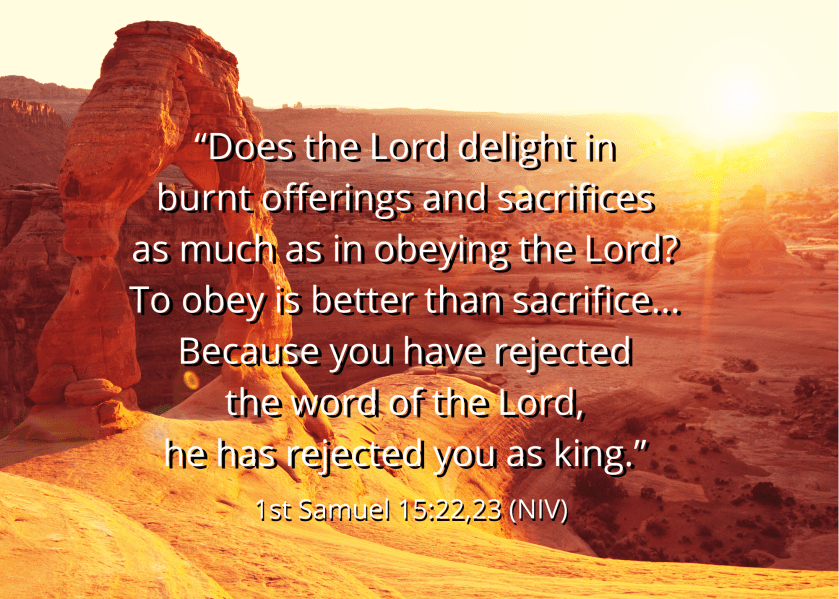
To obey is better than sacrifice. 

To heed is better than the fat of rams. 

The Lord regretted he had made Saul king over Israel. 

However, in the town of Bethlehem, a young boy, ruddy, beautiful, and handsome, also stands among sheep. A young boy who has been slinging stones at predators, not knowing he would need to fell giants. A young boy who is learning obedience, learning hearing and obeying the word of the Lord. A boy, a man, after God’s own heart. 

David. 

Imagine you are Samuel. The last time you smelled lanolin, you had a king crying at your feet, ripping your robes, and it breaks your heart. You had anointed this tall man while he was chasing donkeys, through the desert, but he never truly learned how to be king, how to follow the commands of God. And you grieve.

And now, the boy covered in the smell of sheep walks in through the front door and the Lord speaks to your spirit “Arise, anoint him; for this is he.”

With a sense of irony you realize that you have seen the Lord change the times and the ages. 

He took the kingdom of a king, and he gave the kingdom to another. 

Two Kings among the sheep…

-Jake Ballard

Reflection Questions

  1. Worship and Obedience: Because it is Sunday, there is just one difficult question for you. Today will be or was a day of worship. In Christ, our sacrifice is our heart and our praise to God. (Romans 12, Hebrews 13) However, have you been obedient to God? Have you done all that he has commanded? Are there any broken relationships that need to be mended? Are there any hurts for which you should ask for forgiveness? How can you be obedient to the prompting of the spirit, or to the commands of scripture? Or are you simply “worshipping” God, content that you are giving him something subpar, something less than the obedience he demands? 

Your Kingdom Forever

Old Testament: 1 Samuel 13 & 14

Poetry: Psalm 67

New Testament: 2 Corinthians 11

Saul fails as a King. 

Sorry for the lack of “spoiler warnings”. He doesn’t make it. 

What’s more sad and more of a shocker, is that he *could* have succeeded at being king. At building a dynasty for himself and his children. The language of 1 Samuel 13:13-14 is pretty clear. 

“You have done foolishly. You have not kept the command of the Lord your God, with which he commanded you. For then the Lord would have established your kingdom over Israel forever. But now your kingdom shall not continue. The Lord has sought out a man after his own heart, and the Lord has commanded him to be prince over his people, because you have not kept what the Lord commanded you.” (ESV)

The foolish action of Saul was… sacrifice. Worship. How can that be wrong? Because it was not in accord with the commands of God. Saul was not supposed to do the sacrifice; he was supposed to wait for Samuel. Saul’s impatience and his presumptuous attitude caused him to fall into sin, because he did not obey the word of the Lord. He was keeping the “outward” signs of the law (the sacrifice) but not the details (who, how, when). He wanted the armies to see the sacrifice, rather than keeping it the way God wanted. This impatience and presumption becomes worse later in the story (chapter 15). 

Saul is told that another is rising up in his kingdom. A man after God’s own heart, who would obey the word of the Lord. That is who will replace Saul. 

But notice the end of verse 13 : “For then (if you had kept his commands), the Lord would have established your kingdom over Israel forever.” I don’t think Samuel is stating his own personal opinion here nor do I think he is speaking falsely. God was willing to allow Saul to have a kingdom dynasty. He would have allowed him and his children to sit upon the throne… if Saul had obeyed. 

Far too often, we think all things are set in stone, that our days are done, that the story of our life is written. Before all time, before all actions, either God has claimed us or rejected us. 

In glorious praise and holy fear, that is not true. 

God would like to allow you to reign with Christ in God’s Kingdom. However, you have choices to make. Will you obey? Will you heed the word of the Lord? 

If you do, then all your sins can be forgiven. God will forgive, God will restore, God will empower. 

But, if you do not obey… “he would have established your kingdom”? More “he would have established you in his kingdom.”

You have choices to make. Rather a choice: will you obey the Word of the Lord.

-Jake Ballard

Reflection Questions

  1. The Law We Obey: 1 John 3:23 tells us the commandment that we are called to obey now. What is new about this commandment? What is ancient about this commandment? How can you live out the commandment today?
  2. The Perseverance We Have: In John 10:29, we are promised protection by the Father and that we, as sheep, are not going to be stolen away. How does this promise of protection relate to the story of Saul and the removal of his Kingdom? How does it relate to the choices we are called to make and the salvation we are called to have?
  3. Once Saved, Always Saved?: While some people find comfort in phrases like “there is nothing you did to earn your salvation, so there is nothing you could do to lose it,” is that phrase true? Can people who have “seen the light” reject the salvation of God? (Check out  Hebrews 6:4-6.) It seems obedient relationship with Christ through the power of the spirit is necessary for salvation! (1 John 5:2) Have you asked God to give you his spirit, so that you can obey the commands of Jesus?