To God be the Glory

Acts 3

April 21

At the beginning of Acts 3, we find two disciples (Peter and John) endowed with the Holy Spirit perform a miracle. John and Peter told a lame man (Acts 3:2-8), who had been unable to walk since birth, to get up and walk…and the man did! Unused and weak legs were instantly transformed, and the man was healed. Not only was he able to walk, but his gratefulness could not be contained, and he leaped into the air and praised the LORD. That is why most miracles are performed so that God will get the glory.

Soon, however, the word of the supernatural occurrence got around. According to what Peter said, the crowd gave the two men credit for the healing. Instantly Peter corrected their error, “… When Peter saw this, he said to them: “Fellow Israelites, why does this surprise you? Why do you stare at us as if by our own power or godliness we had made this man walk?”

God is still in the miracle performing business. While we no longer have apostles with us today (those who physically walked with and were taught by Christ) we do have followers of Christ. Righteous men and women who believe God works miracles even today. When God does the impossible, it is always He that should be honored, never a man. The person used to do God’s will is simply that, one that God used.

Unfortunately, the Healer and the Changer of the impossible often gets forgotten. God seldom gets the glory for doing the incredible. People pray for healing or a bad situation to change.  It is changed, but God does not get the credit. Others believe that a certain “man of God” can change the situation. The preacher’s prayers are honored, and the man is sometimes revered as being responsible. Often little credit is given to God. The man, medicine, or objects are just the vehicles God uses. God is the only one that can change anything.

“When in doubt, give God the glory.”

-Andy Cisneros

Questions for Reflection and Discussion

  1. Does God do miracles today? How do you know?
  2. Do we still pray to Him expecting to be heard? Has God answered prayer in your life? As little as the answer to a prayer or request may be, it still is a miracle. Did you thank God for answering your request?
  3. How will you give God the glory?

Devote Yourselves

Acts 2

April 20

“They devoted themselves to the apostles’ teaching and to fellowship, to the breaking of bread and to prayer.” Acts 2:42

One of the things the very first churches did was devote themselves to fellowship. Fellowship means holding all things in common. They would share everything. They began to know and to love one another. Here are 3,000 people suddenly added to a little band of twenty. Most of them probably were strangers before this time. Many of them had come from other parts of the world into Jerusalem for that occasion. They did not know each other. But now they are one in Christ, and they begin to love each other and start to talk to each other, to find out what each other has been thinking and how each has been reacting, and to share their problems and burdens and needs, to talk about these together and pray together about them. There was a wonderful sense of community, of commonality, of belonging to each other. That is the fellowship which is the intended life for the body of Christ.

If the body is not operating, then the life is not manifest. That means there is no power because the life of God is always power. The reason the church has been so powerless lately is that it has been so fragmented and broken. We have estranged ourselves from each other. In Ephesians, the Apostle Paul says, and do not grieve the Holy Spirit of God… (Ephesians 4:30). Then he lists the things that grieve the Holy Spirit: Get rid of all bitterness, rage and anger, brawling and slander, along with every form of malice. Be kind and compassionate to one another, forgiving each other, just as in Christ God forgave you. (Ephesians 4:31-32)

If that is not happening, then the Spirit of God is grieved. When the Holy Spirit is grieved, it does not act. There is no life. The church becomes dull and dead and sterile and mediocre. All this is manifest in an empty ritual, with no vitality in it. God intends that Christians should have fellowship, should share one another’s lives and thoughts and problems — bear one another’s burdens and so fulfill the law of Christ. It is not an option; it is an essential. Therefore, when the Holy Spirit of God begins to move in any congregation, or in any assembly of believers, he starts at this point. He begins to heal the brokenness of their lives and their relationships one with another, to get them to admit to each other their malice and their anger and their frustration and their grudges, and to forgive one another. This is when life begins to flow once again through the body of the Lord Jesus Christ.

What can you do to have more fellowship with fellow believers?

-Andy Cisneros

Questions for Reflection and Discussion

  1. Look again at the list of things that grieve the Holy Spirit, as well as the positives we are to do instead. Slow down and prayerfully consider each one, searching your own heart, words, attitudes and actions. What do you need to ask forgiveness for? Who do you need to forgive?
  2. How can you use fellowship to then bear one another’s burdens?
  3. How devoted are you to fellowship with the body of believers? What can you do to have more? With whom? When? Where? How? And, of course, remind yourself why?

What is Your Act?

Acts 1

April 19

The first few verses of chapter one constitutes an introduction to the book of Acts, giving us the key to the book. Here we have revealed the essential strategy by which Jesus Christ proposes to change the world, a strategy which is the secret of the character of the church when it is operating as it was intended to operate. I strongly suspect that most Christians suffer from a terrible inferiority complex when we confront the world around us. We have bought the idea of many around that the church is quite irrelevant, an archaic group that is irrelevant today. That view is false. The church is the most important body in the world today because whatever happens in the world happens because of something that is, or is not, happening in the church.

Now, in his first statement here, Luke gives us the great strategy by which the Lord works among mankind. He says, “In my former book…I wrote about all that Jesus began to do and to teach… ” The Gospel of Luke is the record of the Son of God. Jesus, the man, came to begin something, to do and to teach, and the record of that beginning is in the Gospels. But this second book is the continuation of what Jesus began to do. In a very real sense, Acts is not the acts of believers, but the continuing acts of Jesus. It is an account of what Jesus continues to do and to teach. In the Gospels he did it in his physical body of flesh. In the book of Acts he is doing it through the bodies of men and women who are followers of him and endowed by the power of the Holy Spirit.

Whenever God wants to get a message across to men, he does not simply send someone to announce it; his final way of driving it home is to express the message in flesh and blood. He takes a life and aims it in a certain direction and, by the manifestation of his own life through the blood and flesh of a human being, he makes clear what he has to say. That is the strategy of the book of Acts. It is the record of followers of Christ endowed in the Holy Spirit; men and women,  owned by him, and thus manifesting his life. That is the secret of authentic Christianity. Anytime you find a Christianity that is not doing that, it is false Christianity. No matter how much it may adapt the garb and language of Christianity, if it is not the activity of human beings possessed and indwelt by the life of Jesus Christ it is not authentic Christianity. That is the true power of the church, as we shall see in this book.

The book of Acts therefore is an unfinished book. It is not finished but is still being written. The book abruptly closes with an account of Paul in the city of Rome, living in his own hired house. It just ends there as though you might turn over the next page and begin the next adventure. What is your act?

-Andy Cisneros

Questions for Reflection and Discussion

  1. What is your act?
  2. How would you rate yourself as a follower of Christ? What role does the Holy Spirit have in your life?
  3. Looking at Acts 1 what do you find the disciples of Jesus doing? What is their mission? What is their hope? Is this an appealing group to be a part of? Explain.

Unexpected Places

Unexpected Purposes

Acts 28

Have there been times in your life where you’ve been taken somewhere you didn’t expect? Last spring, I was taking a drive when I became lost on some of the backroads. I was filled with uncertainty about my location and starting to get anxious about finding my way back. As I found myself where I didn’t expect to be, a lost lamb appeared on the road. It was nearly hit by oncoming traffic as it frantically sprinted down the pavement. The cream and brown spotted lamb was panting from exhaustion. It was scared and confused. Because I was at this unexpected intersection, I was able to get the lamb off the road and put it in my truck. After searching for its farm and calling the sheriff, eventually it was reunited with its home. Sometimes it is the places that we don’t see coming, where we prove to be the most useful.

In Acts 28 we learn about Paul’s experiences on the island where he and the rest of the people on his ship came to be shipwrecked. As we read yesterday, Paul’s journey was quite wild. But God had delivered them safely to this Island called Malta. When Paul left for Rome, he probably never expected to make a pit stop, let alone be shipwrecked at this place. Yet, this was where he was taken, and it was not without purpose.

            On this island, in the middle of the Mediterranean, Paul was able to interact with the people. These inhabitants of Malta saw something different about Paul as they had witnessed him being delivered from the sea and from a snake bite. And then Paul was able to pray for and heal their sick. An island that might not have been a priority for people of that time to take the gospel to had nonetheless witnessed it through Paul’s unexpected stay there.

So, although this time and stay in Malta had been unexpected, it proved useful and it exposed others to the One True God. So, while you may at times find yourself in an unexpected place, do not be discouraged. Sometimes it is the most unexpected places in our lives that God uses us for an unexpected purpose.

-Hannah Deane

Today’s Bible reading passages can be read or listened to at BibleGateway here – 1 Kings 13-14 and Acts 28

Believing God in Tough Times

Acts 27

Paul’s journey to Rome in this passage is anything but simple. When those with Paul on the ship to Rome went days without seeing the guiding light of stars or the sun, they gave up hope of ever being saved. But then Paul spoke. He shared with them what the angel of God had told him. He assured them that although their situation seemed dire, they would be delivered. It was God’s plan for Paul to appear before Caesar and Paul, neither Paul nor those with him, were to be lost at sea before that could happen.

Although this situation and the knowledge that he was to be tried by Caesar when he reached Rome must have been difficult, Paul kept trusting God. When God sent word to him, Paul did not look at the situation and doubt what God was saying. He believed God’s word, and so much so that he shared what God had planned. From the passage we can see that Paul did not even question the way in which they were to be saved- a shipwreck! Here Paul is lost at sea, facing trial by the ruler of the Roman empire and now finds out he is to be preserved for that by being saved through a shipwreck. That is a lot to take in and yet, Paul remained faithful.

This made me think of a time in my own life when I was being driven to an airport on a major highway. A car sideswiped us, and we went across several lanes of traffic, nearly hit a concrete barrier and then swerved back over a few lanes. In that moment, it seemed the vehicle I was in was going to be hit again. The situation seemed taut and like there could be no good outcome. However, miraculously the vehicle I was in and the vehicle that had hit us suffered no injuries and were not hit a second time in the busy traffic. Even in a situation that seemed hopeless, God preserved us, and we even got to the airport on time.

Sometimes, though, in these moments it is easier to think of what could happen, like getting hit a second time or being lost at sea and not on what we should be thinking about- God. But we must look to Paul as an example and trust God in tough circumstances as he did.

-Hannah Deane

Today’s Bible reading passages can be read or listened to at BibleGateway here – 1 Kings 11-12 and Acts 27

Conflict

Acts 25

Conflict within the church weakens community, and ultimately destroys the credibility of the church. In the eyes of the Romans, Paul’s arrest was just another Jewish squabble that needed to be controlled and contained. Arguments in the church make the world look down on us, instead of how God intended the church to be; a light to unbelievers, pointing others to God. Certainly God can still bring good out of conflict but the purpose of the church is to be Christ’s hands and feet doing God’s work.

It is hard to be doing God’s work while you are fighting with your brothers and sisters in Christ. Paul was following God’s direction for his life by going to Jerusalem where he knew he would be imprisoned by the Jewish leaders. From the time Jesus called him on the road to Damascus Paul had been obeying God’s instruction to preach the gospel to the Gentiles. Paul and the Jewish leaders had a lot in common. They both believed in God, and followed all the Jewish teachings and traditions. The difference between Paul and the Jewish leaders is that the Jewish leaders were not listening to God like Paul was and it was creating conflict that affected everyone within the church, the Jewish leaders, and the Romans and Gentiles.

-Makayla Railton

Today’s Bible reading passages can be read or listened to at BibleGateway here – 1 Kings 7-8 and Acts 25

The Money Trail

Acts 19

There is a saying with some truth to it that if you want to know about a matter – ‘follow the money’. This means if you look at the funding sources of a matter then you get a picture of who is pushing what (aka agenda) and who has financial gain or interest or conflict of interest in the matter. This is not a new concept, but rather, an old one. It is even present in Biblical times. The incident with Demetrius in Acts 19 is the perfect example.

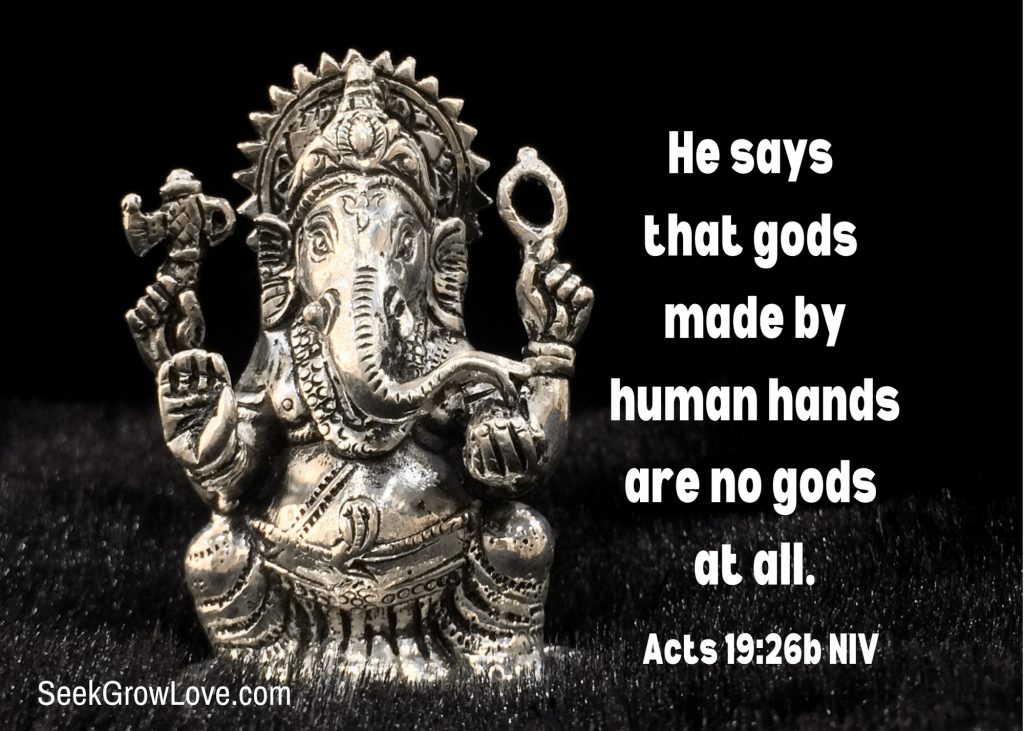
Demetrius is a silversmith idol maker and has a good business going making a lot of money in Ephesus. He is afraid that the message that Paul is sharing that there is only one true God and that Jesus Christ is His son will plummet his sales in idols of Diana. Ephesus was known for its worship of the goddess Diana and the god Zeus. So he incited his fellow idol makers towards anger and malice towards Paul and the disciples in Ephesus. This snowballed into a riot where half the people didn’t even know what the issue was and just joined in rioting just because. (Sound familiar?) The authorities of the city knew that Paul and the disciples had done nothing wrong and had not stirred up this great rioting mob by anything they had done so they refused to bring them to court to try them. Ultimately Paul and the disciples decided to leave town and go somewhere else where they could share the gospel.

All of this is due to Demetrius and his fellow silversmiths being concerned that they would lose their livelihoods making shrines that they made a great profit from selling to the people. They were not interested in hearing or considering the truth – they were only concerned with the almighty dollar as we might say today. It is sad that the truth of the gospel couldn’t be openly shared in Ephesus because of a handful of greedy men. Does this happen today? In our time? You bet. The names and the livelihoods may be different but the situation still rears its ugly head. So …if you want to know about a matter ‘follow the money’ and you will find out a lot. More importantly follow Jesus and gain discernment about situations that arise. One will never go wrong when truly following Jesus.

-Pastor Merry Peterson

Today’s Bible reading passages can be read or listened to at BibleGateway here – 2 Samuel 19-20 and Acts 19

Going with the Gospel

Around the World or Across the Street

Acts 18

It is interesting how some people basically stay in one place all their lives and others seem to travel about quite frequently. No one can accuse the apostle Paul of being a homebody! In Acts 18 we notice that Paul travels quite extensively staying in one place for a little while, and then traveling to another place. Sometimes the places he traveled to received the gospel message with readiness and welcomed him, and at other times he received more hostile treatment. Everywhere he went he shared the gospel message. About the first thing he would do each place he went was to go to the synagogue and teach there about Jesus being the promised Messiah and way to salvation.

Among his travels he met Priscilla and Aquila and they were strengthened in the faith. So much so that later when Paul travelled on to a new location without them they were able to teach another man named Apollos more clearly about the gospel. It seems whether near to home or far away these early Christians were ready and willing to share the message with whoever would listen and believe. They were truly ready to give an answer in season for the hope they held within them.

We should be ready and willing just as they were to give an answer for the hope that we hold within us. Whether God gives us the opportunity to travel from place to place, or whether He asks us to be the light within our own community. Our willingness should always be present, just as it was with the early Christians, to share the hope we have in Christ.

-Pastor Merry Peterson

Today’s Bible reading passages can be read or listened to at BibleGateway here – 2 Samuel 17-18 and Acts 18

Do Your Homework

Eagerly Examine Every Day

Acts 17

Do you do your homework? This may seem like an odd question to be asking but that’s exactly what the people in Acts 17 were commended for doing. When Paul and Silas went to a place called Berea they were teaching the word of God to people in the synagogues. The people had never seen the scriptures in the light that Paul and Silas were teaching it to them, they had never recognized the truths that were being shared. So rather than just believe what they heard they went ahead and studied it in the scriptures for themselves to see if what Paul and Silas were saying was true. Essentially they were ‘doing their homework’. They found that what was being taught was true and so came to salvation. We refer to them as the Bereans. The term may sound familiar to you as many church youth groups have held the name Berean in their names. This is a reference to that noble group that studied the scriptures for themselves to see if what they were being taught was true.

In our society today there do not seem to be enough people who display Berean like qualities of ‘doing their homework’. Why were the Bereans noble – because they searched for the truth and they found it! Truth is important to us, but today the truth seems more, and more difficult to unearth. There are many newscasters, commentators, teachers, and yes preachers too who would all benefit from doing a little more homework before presenting information to the public. This would prevent a whole host of misinformation from circulating about. Many people would be better able to discern the truth if they did their homework. If you know the truth of a matter then you will less likely fall for anything false. We should all strive to be like the Bereans and desire to know the truth for ourselves, through diligent research especially when it comes to the word of God!

-Pastor Merry Peterson

Today’s Bible reading passages can be read or listened to at BibleGateway here – 2 Samuel 15-16 and Acts 17

God Focused Response

Acts 16

There are so many things that I find interesting in Acts 16. Paul has a vision of a man from Macedonia asking for him to come share the gospel with him. When they get to Macedonia to the region of Philippi they meet a woman who comes to belief along with her whole household. But what unfolds next is really fascinating. Paul and Silas get into a situation and end up being severely beaten and thrown into the inner holding rooms of the prison. But what I want us to notice is their reaction – they aren’t crying, they aren’t in there feeling sorry for themselves or busy being angry or muttering threats – they are Praying and Singing Hymns to God! What a contrary reaction to what everyone would expect!

If we were in that situation, sore, and bleeding, in a dark, inner, dingy room with criminals around us would we be that confident and flat out bold? We would more likely be in there feeling sorry for ourselves, scared out of our wits, and wanting desperately to call our lawyer or mom or anybody that could help us get out of there! But Paul & Silas’ response was God focused. By praying and singing hymns to God they were communicating with the one who has all power and authority to change and alter any and every situation. Who needs a lawyer when you have God on your side? God used the situation to open the hearts of the Philippian jailer and his household to hear and accept the gospel message. Paul and Silas were also released to go free from the prison where they were being held. When Paul and Silas exhibited the right response to their unfair situation God turned their situation around for His glory.

If we were to be bold and confident in the Lord and say within ourselves as the Psalmist did in Psalm 121:2 “My help comes from the LORD, who made heaven and earth.” And keep an attitude of worship, praise, and open communication with God in our trials; maybe we would stand in the same place of victory as Paul and Silas did. One of the biggest challenges that we face in our Christian walk is keeping the right attitudes when things don’t go our way or get difficult for us. I hope we are inspired by the actions of Paul and Silas and remember to communicate with the author of life and outcomes when we face our next difficult situation.

-Pastor Merry Peterson

Today’s Bible reading passages can be read or listened to at BibleGateway here – 2 Samuel 13-14 and Acts 16