Nothing New

Old Testament: 1 Chronicles 1 & 2

Poetry: Ecclesiastes 1

New Testament: Philippians 3

1.   Ecclesiastes is wisdom literature

Ecclesiastes is unlike any other book in the OT canon. It is part of the wisdom literature genre, but it is presented in a unique fashion with a different approach than the other wisdom books. Each of the wisdom books in the OT are unique in their style and approach (Job, Psalms, Proverbs, Ecclesiastes, Song of Songs). Nevertheless, there are definitely some aspects of Ecclesiastes that are akin to what is found in the Book of Proverbs.

2.  The approach of Ecclesiastes

Ecclesiastes can be likened to a journal that contains the reflections of one man’s journey through life.

  • It conveys the author’s observations on life.
  • It records his attitudes and feelings as he searches for meaning in life.
  • It sets forth his conclusions after a lifetime of searching.

We could also think of Ecclesiastes as like a travel log or guidebook that was left after a traveler had completed his trip, and he wanted the next traveler to see what lies ahead of them if they follow his path. Thus, it contains all the uncensored observations and learnings of a man along the journey of life that was fully lived with no avenue or pursuit left unexplored. He’s done it all, and he simply tells it like he sees it because he has lived it and knows it.

3. Why is the book called “Ecclesiastes”?

The title “Ecclesiastes” is actually the Greek title given to the book in the LXX (Greek translation of the Hebrew OT done around the 3rd cent. BC). Actually, most of the book names in the OT that we have in our English Bibles today come from the LXX rendering of the Hebrew.

Before we talk about the word “Ecclesiastes,” let’s take one more step back in time to the Hebrew Bible. The title “Ecclesiastes” is translated from the Hebrew word Qohelet, which roughly means “one who calls the assembly” or “one who addresses the assembly.”

And thus, an “ecclesiastes” was a person who sat in or spoke to an ekklēsia (“assembly”). Ekklēsia is the NT word for “church” and the OT word used in the LXX for the “assembly” (i.e., “the congregation”) of Israel.

4. Who is the author?

There is no specific identified author of Ecclesiastes, but it has traditionally been ascribed to King Solomon, the 3rd king of Israel. All we know is that the author identifies himself as the Qohelet (“the Ecclesiastes”) in v. 1. But there are other clues in the book that lead us to conclude that the author is likely King Solomon.

  1. He was a king in Jerusalem (1:1)
  2. He was a/the son of David (1:1)
  3. He considered himself to be the wisest man (1:16)
  4. He was a great builder (2:4-6)
  5. He was extremely wealthy (2:8)
  6. He had a large harem (2:8)

But some scholars have noted that there are a couple of factors that militate against concluding that Solomon was the author, or at least that Solomon wasn’t the one to compose the book.

There are shifts from 1st person to 3rd person, suggesting the possibility of a narrator as the composer of the book, much like the way Gospel writers composed their re-telling of the life and ministry of Jesus by recording his teachings and activity, but Jesus was not technically the author.

But whether Solomon was the direct author, or a later editor compiled his writings into their final form, it seems best to still identify the “Sage” as being Solomon.

5. The Main Theme

Ecclesiastes 1:2-3

“Utterly pointless!” says the Sage;

 “Utterly pointless! Everything is pointless.” 

 3What does a person gain from all his toil

 at which he toils under the sun?

Solomon’s basic premise → “When all is said and done in life, there is nothing that can give a true sense of accomplishment and gratification.” True, it is a very pessimistic outlook on life. Solomon is basically saying that nothing can actually satisfy and provide what we want. Life on a purely human level, no matter how great it is lived, will be pointless. Why is that? Because activity, in and of itself, doesn’t produce anything of lasting and ultimate value.

Have you ever worked really hard and then thought to yourself, “Am I even getting anywhere?” We can work really hard, and yet not feel like what we do is really going to matter. In one sense, this is correct. We can work ourselves to the bone, but all that effort is really not going to produce something that truly lasts or has an enduring value.

One of Solomon’s other points in this opening section is: Nothing is every truly “new.”

Solomon has observed that there really is nothing ever truly new in life. Either people have forgotten what has gone by in the past, and then later rediscovered it, or people were never aware of it in the first place and then think their eventual perception of it is somehow a profound and novel occurrence.

All that life consists of, all the complexities and frustrations it brings, and all the incredible advancements in human knowledge don’t change the fact that life as we know it is basically the same. We may use different tools, be involved in different activities, or use various other means by which we accomplish the tasks of life, but everyone is still occupied with the same basic needs and desires as they always have been. Nothing in the centuries and millennia of human existence has ever really deviated from the original pattern.

-Jerry Wierwille

Reflection Questions

  1. Who do you know who has passed along wisdom after they have “travelled the road”? What did you learn from them?
  2. Are you generally a pessimistic or optimistic person? What do you think of Ecclesiastes 1? What wisdom do you find in this chapter?
  3. Why do you think God wanted Ecclesiastes 1 included in the Scriptures?

The Big Reveal on the Meaning of Life

Ecclesiastes 12

Thursday, July 21, 2022

After plodding through Ecclesiastes 1 and 3 over the last two day’s devotions, we are finally at Ecclesiastes 12, where Solomon has his reveal about the meaning of life.  Verse 1 starts out the chapter with, “Remember your Creator in the days of your youth, before the days of trouble come and the years approach when you will say, I find no pleasure in them.”  

The next 7 verses highlight why the elderly may not find pleasure in their old age – because they experience things like fading eyesight, losing hearing, developing tremors, stooping because of osteoporosis, losing teeth, unable to sleep – and then die.

So what does it mean to “remember your Creator?”  Is this like “remember to take out the trash?”  No.  And it entails a lot more than just thinking about Him once in a while. When you’re tempted to enjoy the pleasures of sin, remember your Creator.  When you’re tempted to live your life in rebellion against God, remember your Creator.  When your peers are doing something you know is wrong and you’re tempted to join in, remember your Creator.  It means putting God at the forefront of your thoughts, dedicating your life to Him, and living for Him.

I think there are several practical reasons to start serving the Lord while you are young.   Here is a partial list:

  • Life in a close relationship with God is satisfying and fulfilling, so the earlier you start that relationship with Him, the longer you’ll experience meaning in your life.
  • By accepting God while you are young, you will spare yourself a lot of pain and problems that you would experience in a life of rebellion against God.
  • You may want to live it up while you are young and plan on a “death bed confession” (giving your life to the Lord just before you die).  But we never know when we may die.  Accidents happen.  And you don’t want to suffer the eternal consequences of not devoting your life to the Lord.
  • You may get dementia as you age, and won’t be able to make a decision for the Lord late in life.
  • As people age, they get more set in their ways and find it more difficult to change.

I think Solomon is giving good advice, “remember your Creator in the days of your youth.”  

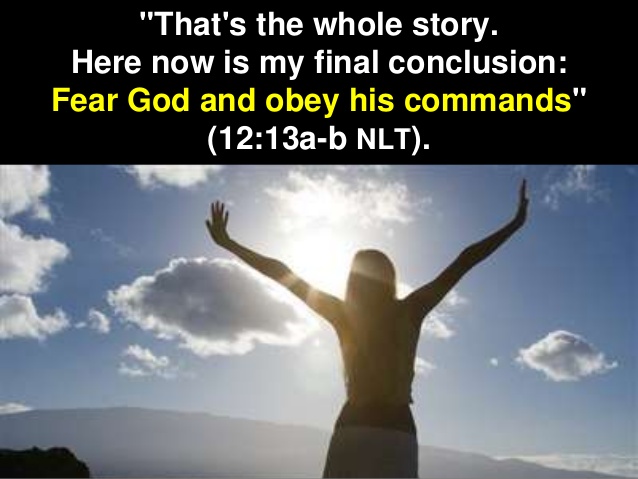
At the end of Ecclesiastes 12, we finally come to Solomon’s conclusion when seeking the meaning of life.  Ecclesiastes 12: 13-14 read, “Now all has been heard; here is the conclusion of the matter:  Fear God and keep his commandments, for this is the whole duty of man.  For God will bring every deed into judgment, including every hidden thing, whether it is good or evil.”

Fear includes a lot more than being scared of God.  It includes being in awe of Him.  Giving Him reverence.  Giving him glory.  Giving Him your life (living for Him).

To paraphrase Solomon, the bottom line is this:  

You can live your life your own way, and experience a life that is meaningless and unfulfilling, then die.  Or you can live your life God’s way, and experience a life that is meaningful and fulfilling, and then die.

Either way, you will die.  And when Jesus returns, you will face judgment.  If you have lived your life your own way, you will face condemnation and the second death.  If you have lived your life for God, you will receive commendation and will enjoy eternal life.

The only rational choice is to “fear God and keep his commandments.”

You don’t have to be rational.  But you do have to choose.  Choose wisely.

–Steve Mattison

Application Questions

  1. Look again at the list of reasons to start serving the Lord while you are young. Is there anything else you would add to it?
  2. If you have started serving the Lord, when did you start? Why was that a great time to do it? If you haven’t yet, what are you waiting for?

What to do with the Difficult Times

Ecclesiastes 3

Wednesday, July 20, 2022

Whether you know it or not, you’re probably familiar with the first few verses of Ecclesiastes 3:

1 There is a time for everything, and a season for every activity under the heavens:

2  a time to be born and a time to die, a time to plant and a time to uproot,

3  a time to kill and a time to heal, a time to tear down and a time to build,

4  a time to weep and a time to laugh, a time to mourn and a time to dance,

5  a time to scatter stones and a time to gather them, a time to embrace and a time to refrain from embracing,

6  a time to search and a time to give up, a time to keep and a time to throw away,

7  a time to tear and a time to mend, a time to be silent and a time to speak,

8  a time to love and a time to hate, a time for war and a time for peace.

I like about half the things listed, and would rather not have the other half, but life just doesn’t work that way.  We have to take the bad with the good.

I was at a funeral last Saturday when these verses were read.  It seems like this passage is mostly referenced during difficult times – because we don’t need to be reminded about these things during happy times.  When someone is born, we don’t want to be reminded that they will eventually die.  But when someone dies, we need to be reminded that this world has both good and bad, and we can’t just pick and choose what happens in life.

Verse 11 goes on to say, “He has made everything beautiful in its time.  He has also set eternity in the hearts of men…”.  

Does this mean that death is beautiful?; that cancer is beautiful?; that problems are beautiful?  No, not in themselves.  But the rest of the verse goes on to say that God has set eternity in the hearts of men.  I think that means these experiences make us long for the time when these problems will be a thing of the past.  When there will be no more death, or mourning, or crying, or pain – in the Kingdom of God. 

We mentioned Romans 8:22-23 a couple of days ago, which says, “We know that the whole creation has been groaning as in the pains of childbirth right up to the present time. Not only so, but we ourselves, who have the first fruits of the Spirit, groan inwardly as we wait eagerly for our adoption to sonship, the redemption of our bodies.”

In addition to pain and suffering being consequences of the Curse (Genesis 3) as a result of sin, I believe God uses these to help us long for His coming kingdom.  This longing helps us refocus our lives on following Him.  It also helps us not place too much importance on the temporary things this world has to offer.

James 1: 2-4 says, “Consider it pure joy, my brothers and sisters, whenever you face trials of many kinds, because you know that the testing of your faith produces perseverance. Let perseverance finish its work so that you may be mature and complete, not lacking anything.”

I believe this points out that difficulties we face in life can produce perseverance, helping us mature in our Christian walk, and helping us become more persistent in living for the Lord.  And if we finish strong – living our lives for the Lord – we will be in His kingdom, experiencing delight for eternity.  

So because difficulties can draw us closer to God, which will cause us to live more dedicated lives for Him, with the ultimate result of being in His kingdom, in this sense, everything works together for our ultimate good, and is therefore beautiful.  Even though it might seem like something stinks at the time, it can be beautiful – but only if it makes you long for the Kingdom of God and then live your life devoted to following Him.

If difficult times make us resent that God permitted these times, and if we reject God as a result of this, then we can look forward to Ecclesiastes 3:17 which says, “…God will bring to judgment both the righteous and the wicked…”

I’d like to challenge you to let the difficult times draw you closer to God.  But it’s entirely up to you how you respond.

–Steve Mattison

Application Questions

  1. What difficult times have you been through? What good times have you enjoyed?
  2. What can be learned through the good times? What can be learned through the difficult days (and seasons)?
  3. Looking back on your own life (or the example of someone else) can you see times when the trials and hardships have prompted spiritual growth and perseverance and a re-focusing on what truly matters, including of course eternal life with God and Jesus in the coming Kingdom of God?

Chasing after the Wind

Ecclesiastes 1

Solomon was the wisest person who ever lived (see 1 Kings 3:10-12). He wrote the book of Ecclesiastes to probe the meaning of life.  It’s widely believed that he wrote this toward the end of his life, after he had experienced much of what life had to offer.

Let’s look at some of the treasures of wisdom Solomon wrote down:

  • Ecc 1:2, “Meaningless! Meaningless! says the teacher.  Utterly meaningless!  Everything is meaningless.”
  • Ecc 1:11, “There is no remembrance of men of old, and even those who are yet to come will not be remembered by those who follow.”
  • Ecc 1:14, “I have seen all the things that are done under the sun; all of them are meaningless, a chasing after the wind.”
  • Ecc 1:17, “Then I applied myself to the understanding of wisdom, and also of madness and folly, but I learned that this too is a chasing after the wind.”
  • Ecc 1:18, “For with much wisdom comes much sorrow; the more knowledge, the more grief.”

We’re only covering chapter 1 here, but chapter 2 goes on to point out the uselessness of pursuing wealth or pleasure or accomplishing great things.

What’s going on here?  Does life just stink?  

Solomon is pointing out the futility of living this mortal life to the fullest – apart from God.  If all we have to look forward to is death, life is indeed meaningless.  It doesn’t matter how much we pursue pleasure, wealth, or anything else that our hearts desire – our life will be unfulfilled, without satisfaction, without joy, without purpose, and without hope.

When my wife was dying after a four-year battle with cancer, we could both take comfort in the fact that we have the hope of the resurrection, and eternal life to look forward to.  Even in death, we have hope of future joy.  Living a life for God gives us hope.  Our life can be fulfilling, with satisfaction, purpose, and joy.

It takes a lot of people a very long time to figure this out.  My challenge to you is to carefully consider the meaning of your life today.  Choose a life of submission and service to God, and your life won’t be meaningless.  Or go your own way, and identify with Solomon’s Ecclesiastes.

–Steve Mattison

Question Application

  1. What do you spend a lot of time (effort, or money) on that Solomon, or God, might consider “Meaningless”?
  2. Have you found anything that gives life satisfaction, purpose and joy? Where would you look?
  3. What will last?

Untitled Thoughts About Galatians 4 – or – If Jesus hands you a burger

Galatians 4 (& Ecclesiastes 7-8)

“All this I observed, applying my mind to all that is done under the sun, while one person exercises authority over another to the other’s hurt.” (Ecc 8:9)

As you are all aware, the United States has a deep and dark history with slavery. Generations of family wealth were built on the blood, sweat, and tears of slaves. We abused our power and took advantage of others for our own gain. Thankfully, although through great struggle, we abandoned the practice.

But we still feel the ripples of our past today. Slavery ended, but it took many, many years before everyone could say they had the same fundamental rights. It takes a long time to recover from being held down as a people for so many years, especially as those in power do everything they can to stay in power. It is painful to see that senseless acts of racism and hate still happen, and that the systems and powers still propagate forms of racism. I do not claim to know what the solutions are, but there is still a lot of work to be done to correct our great wrongs.

The United States wasn’t the first nation to have a practice of slavery. For an example, let’s go back in time to the exodus. You probably remember the story, but if not, it’s… in Exodus. Moses and the Israelites were miraculously delivered from slavery in Egypt. This was an important memory for the Israelites and was commemorated by the Passover meal. In fact, we trace our tradition of communion back to one particular Passover meal that Jesus had with his disciples.

If we move forward to the time when Paul was writing to the Galatians, slavery was a thing then too. It was a normal part of the culture. Although, compared to what the United States did, it was milder. Think more along the lines of indentured servitude. It was not a good situation to be in, but it was not to the level of horror that we took it.

Unfortunately, the practice of slavery is still alive and well in our world. There are more slaves in the world than ever before. Usually we call it “human trafficking” now, but the concepts are not that different. It is about owning people. The mindset that you can own a person and profit from them is big business, and it’s terrifying to think about.

We come to Galatians 4 and see that Paul is drawing a strong connection between following the Jewish law and being under slavery. This seems to fly in the face of what we have seen elsewhere in scripture about the law. The law is supposed to be a good thing that was received from God. For the Israelites, it was an important pathway toward connecting with God. Jesus himself upheld it as something good (Matt 5:17 and surrounding verses). In Galatians 3, Paul seems to agree it was good, and even necessary for a time. But if we have a chance to corner Paul and ask if he thinks the law is good or bad, he’ll probably say “Yes!” There are two sides to this.

Usually you don’t think of things as absolutely good or bad. You compare them to other things or judge them in context. A burger is better than salad. It is savory with lots of protein and fat. The salad is better for providing micronutrients and some fiber, otherwise it is worthless. I would put a tomato slice and lettuce on the burger and call it a day. If you are hard pressed for finding food, then a salad is better than nothing. But if you had access to a burger, then you would not bother with a salad. I am the least picky eater I know. I can enjoy and see the value in a salad. They are a good thing. But there is just no comparison to a burger. A burger wins every single time.

The law is like the lettuce that the Jews had to live on until they had burgers. It was the best option for a long time, and it was a blessing from God. But now that we have grace, the promises of God, and the spirit through Jesus, the law looks pathetic in comparison. After a bite of that burger, you won’t go back. Taste and see!

“But when the fullness of time had come, God sent his Son, born of a woman, born under the law, in order to redeem those who were under the law, so that we might receive adoption as children. And because you are children, God has sent the Spirit of his Son into our hearts, crying, ‘Abba! Father!’ So you are no longer a slave but a child, and if a child then also an heir, through God.” (Gal 4:4-7)

Paul is saying it is better to be a child and heir than to be a slave. Because of what Jesus has done, your status has changed from a slave under the law to a child of God and an heir of his promises. If you’re a child and heir, with rights and a large inheritance, you wouldn’t think of going back to having nothing.

You can imagine that trying to follow the letter of the law would feel burdensome, like it owned you. And the law has a way of making you hyper-aware of your sin. And sin is all tangled up with death. Thankfully we are filled with and are influenced by the spirit of God to help guide us. If we keep in step with the spirit and make ourselves vessels of God’s love, we don’t have to worry about breaking God’s laws. It is like they take care of themselves.

Starting in Galatians 4:21, Paul gives us an allegory of the slave woman and the free woman. He’s presenting us with a crossroads of sorts, but the choice should be easy. Of course if Jesus hands you a burger, you take it, and don’t bother with the salad. Why be a child of the flesh when you can be a child of the promise? Why be a slave when you can be free?

With all of this influence from Ecclesiastes lately, I can’t help but think Paul would say being slaves to the law is like chasing after the wind.

-Jay Laurent

Read or listen to today’s Bible reading passages at Bible Gateway here – Ecclesiastes 7-8 and Galatians 4

The Part Where the Bible Flirts with Nihilism

Ecclesiastes 1-2 and Galatians 1

Often I think that mowing the lawn is pointless. Why do we mow lawns? Who decided for all of us that it is just something we have to do? Wouldn’t the grass and weeds exist happily without being cut down every week during the warmer months? How does it really benefit me or anyone to mow the lawn? Also, it’s time consuming, and costs money for gas and to maintain the mower.

Yet, I cave to societal expectations and take reasonable care of my lawn. It isn’t so bad. Often it is enjoyable, and can be therapeutic or meditative. It’s a chance to sort out my thoughts. But still, there are so many things on the list of things I’d rather be doing.

We could all come up with lists of what we think is pointless. It would be an easy project. The harder project would be to see what is left over. What actually matters? What has true significance?

This is the question brought to the table by the book of Ecclesiastes. Our Qoheleth (Hebrew for teacher) is beginning to let us know about all the things he thinks are pointless, and there are a lot of them. All the work we do is pointless, because you can’t take the results with you when you die. Someone else gets all of it (2:18). The pursuit of wisdom is pointless because “in much wisdom is much vexation, and those who increase knowledge increase sorrow” (1:18). The pursuit of pleasures is pointless too, like chasing after the wind. He tried all of them, and gained nothing from it.

Are these things bad? The teacher doesn’t say that. Surely working is something we have to do, otherwise we can’t provide for ourselves or our families. Wisdom and knowledge are positive things. Isn’t it beneficial to understand things? Pleasure is a good thing given a few healthy boundaries. We all need opportunities to appreciate and enjoy the good things in life.

The teacher does mention a few things that might be worthwhile: eating, drinking, and enjoying your work. They are from the hand of God, he says. Also on the list of not-so-pointless things is pleasing God. This is a good start. If we think about it long enough, maybe we can figure out what the essence of something meaningful is. Could we decide what is meaningful or not based on a set of criteria? I currently don’t have a good method of deciding this, but I’d like to get better at recognizing what is meaningful and what is not.

What if we spent more time thinking about and pursuing things that are truly meaningful? Doesn’t that allow us to focus our efforts on things that will actually benefit us and others? If only it was easy to know what those things are. We constantly have to prioritize the many options for how we could spend our time, whether we consciously think about it or not. The teacher is not giving us a complete guide for what should take priority, but he is challenging us to think about it.

Looking at Galatians 1, we might be able to pick out a few things the apostle Paul thinks are pointless. Perverting the gospel, being a people-pleaser, persecuting the church, and climbing up the ladder of Judaism all could make his list. What does Paul think is worthwhile? Serving and proclaiming Christ! As we continue on through Ecclesiastes and Galatians, maybe we will get more insights into what these authors think is important, and by doing so, improve our understanding of what God thinks is important.

Seek ye first…

Jay Laurent

Today’s Bible reading passages can be read or listened to at BibleGateway here – Ecclesiastes 1-2 and Galatians 1

Your Life is Not Meaningless

But it is Fleeting – so Live Wisely!

Ecclesiastes 12 13 NIV sgl

Ecclesiastes 7-12

In Ecclesiastes 7-12 the author, the Teacher, continues to discuss things that are “havel”, vain, futile, fleeting and temporary. (If you haven’t yet, go ahead and read yesterday’s devotion on Ecclesiastes 1-6 for a deeper understanding of “havel”.)
The author accepts that death is the end of every person and it is important to accept that fate and live with one’s face toward death. Much of the last half of this book is the reality righteous and wise people suffer the same fate as those who are wicked and foolish. However, we must not let this reality change how we read the entire book of Ecclesiastes. The author writes in 8:12-13 “Although a sinner does evil a hundred times and may lengthen his life, still I know that it will be well for those who fear God, who fear Him openly. But it will not be well for the evil man and he will not lengthen his days like a shadow, because he does not fear God.” While it is TRUE that the wicked and the righteous both end their lives in death, the author holds that there is good for a righteous person. Still, seek righteousness and wisdom because even a little foolishness can ruin one’s life. (10:1)
For you younger readers, the author commends that you seek out wisdom and that you remember God today! At this point in your life (12:1) There will be days of difficulty as life goes on, but in our days of joy, remember God. God is the one who gives comfort, joy, happiness, and strength on the days when the world is dark, the clouds are gray, and the pains of life are crowding in. Because the childhood and the prime of life are fleeting, temporary and transitory, enjoy them now. (11:10)
We are nearing the end of the book. We have been asking the question : “what lasts? What do people REALLY gain for all they do?” The last two verses of the book tell us what lasts : How we have lived, whether we kept the commands of God and feared him. All this in our life will be judged. Of course, this has been hinted before; now it is explicitly and clearly stated. If we believe, as some have, that the Teacher is a cynical, morose, or even godless man, then the last two verses are a radical departure. However, if this is a man who loves God and understands the futility, vanity, temporariness, FLEETING nature of life, then the final verses in Ecclesiastes are an understandable conclusion.
This of course effects how we read many passages. The author says “eat, drink, enjoy your labor, be merry!” (5:18, 8:15, 9:7) These passage show us that our labor, what we do, are not meaningless, but they are precious because of their very fleeting nature. The teacher says in 9:9, “Enjoy life with the woman you love all the days of your fleeting life…” You know you are precious to God. Your life is not meaningless, but it is havel, transitory, temporary. What we have in this life is not meaningless drudgery of existence, but the temporary good things are to be enjoyed, and to seek the eternal good things, doing the will of God and fearing him.
In the short time of our discussion we missed many interesting passages, some that are difficult (about death and sorrow) and some that are encouraging (about enjoying pleasure on the earth). But, my friends, remember : The entire duty for all people is to do the commands of God. We know that since Christ has come into the world “This is His commandment, that we believe in the name of His Son Jesus Christ, and love one another, just as He commanded us.” (1 John 3:23) As you continue to believe in the name of Jesus, may you love one another as you seek how to live wisely today!
Jake Ballard
Today’s Bible passage can be read or listened to at https://www.biblegateway.com/passage/?search=Ecclesiastes+7-12&version=NIV
Tomorrow’s reading will be 1 Kings 10-11 and 2 Chronicles 9 as we continue the 2020 Chronological Bible Reading Plan

Ecclesiastes gets a bad wrap. 

Ecclesiastes 1 3 NIV sgl
It shouldn’t but it does. Most people think it is a depressed Old Man Solomon sitting down at the end of his life saying “EVERYTHING IS MEANINGLESS.” Therefore, most of the book is about how everything is meaningless, life is not valuable, and it would be better to be dead.
But that’s a bad interpretation.
First, let’s look at 1:2. This is the key phrase of the book. Everything hinges on understanding this phrase correctly. And most of our translations do a poor job. That may seem arrogant, but let’s look at the word in Hebrew. The word, (transliterated) is “havel” or “habel”. Literally, it means “mist” or “vapor.” Very rarely is it used in this sense. Many more times it is used of idols, which are “mists” as opposed to God’s “concreteness.”  In its more poetic context, which the passage warrants, it means “temporary”, “fleeting”, “transitory”. The author is declaring “Passing! Fleeting! Un-lasting! Everything changes and nothing remains!” See how VASTLY different that sounds from the usual “eVeRyThInG iS mEaNiNgLeSs!” we normally read?
We need to understand that the central call of the book is about how nothing lasts because it makes the question in 1:3 make SO MUCH MORE SENSE! The author (Qohelet, the teacher, most likely meant to be Solomon, but not for sure) is not simply lamenting that work is hard and not much can be gained. Instead, the author is asking a very pointed question : “In everything I do, WHAT DO I HAVE THAT LASTS? What remains? What is not ‘havel’, not a temporary, fleeting, striving after the wind?”
Now THAT is a question we want an answer to!
This isn’t a depressed teacher moaning about how everything is terrible and nothing matters and that all the stuff we do is unimportant. He is asking (and implicitly promising to answer), “What will be the thing that will last when all the other futilities of life fade?”
He goes on in these first 6 chapters and tells us that it’s not wisdom (1:12-18)[though it is better than folly (2:12-17)], it’s not pleasure (2:1-3) or possessions (2:4-11), it’s not labor (2:18-23) [though labor is a good thing (2:24-26, 3:12-15)]. The justice and oppression of men is havel, those who seek after money will realize it is havel.
Look at what the author says in 3:14 “I know that everything God does will remain forever; there is nothing to add to it and there is nothing to take from it.” The eternal, so far as we know now, the thing that is not havel, temporary, fleeting or futile, is the work of God.
We leave this section of Ecclesiastes without the answer. There are some depressing things the author says, but once we have the answer for “what does a man gain? what LASTS?” we can reevaluate those passages in light of the answer.
Jake Ballard
Tomorrow we will finish the book of Ecclesiastes to find yet another wise answer to the questions of life on our walk through God’s powerful word – 2020 Chronological Bible Reading Plan

DO it ANYWAY

Ecclesiastes 9-12

ecclesiastes-12814-37-638

Thursday, February 2

So you’ve read today’s reading and are thinking, “Maria, you said King Solomon was going to give us uplifting counsel!”  On the face of it, these last four chapters do not seem very uplifting.  But I read a couple of things along with these scriptures that made me realize that what he is saying is in fact, very uplifting, practical, and real.

The first thing I read, you may have read before.  It is a version of a poem that was originally written by Dr. Kent M. Keith but was rewritten as a spiritual poem, presumably by Mother Teresa.

Do It Anyway
People are often unreasonable, irrational, and self-centered.
Forgive them anyway.
If you are kind, people may accuse you of selfish, ulterior motives.
Be kind anyway.
If you are successful, you will win some unfaithful friends and genuine enemies.       Succeed anyway.
If you are honest and sincere, people may deceive you.
Be honest and sincere anyway.
What you spend years creating, others could destroy overnight.
Create anyway.
If you find serenity and happiness, some may be jealous.
Be happy anyway.
The good you do today, will often be forgotten.
Do good anyway.
Give the best you have, and it will never be enough.
Give your best anyway.
In the final analysis, it is between you and God.
It was never between you and them anyway.

This poem sums up exactly what King Solomon was saying! Verse 9:11 is a prime example of this idea that life isn’t fair.  You may work hard but not receive any rewards but verse 12: 13-14 says do it anyway!  God knows your works.
The second thing I read was the commentary in my study Bible, which I thought, wrapped up the book of Ecclesiastes quite well.

“God has not told man how to comprehend all the frustrating futilities of life, but He has instructed man to enjoy life as His gift (2:24), to make the most of every opportunity (9:10), and to live life with reverence toward God (12:13), accompanied by an awareness of future judgment (12:14), Solomon learned to live with life’s paradoxes by maintaining a proper attitude toward life and God.”

Solomon is saying life is rough and it doesn’t always go the way we think it should, but we need to do the best we can anyway and everything in this life is in God’s hands.
That sounds like pretty uplifting and practical counsel for all of us!
Tomorrow we will delve into Song of Songs, Song of Solomon, or Canticles. No matter what you call it, Solomon is clearly in a better mood in this book!
See you tomorrow!
Maria Knowlton

(Photo credit: http://www.slideshare.net/drrickgriffith/eccl-12v8-14-finishing-well62)

Wisdom from The Princess Bride – And Solomon, Of Course.

Ecclesiastes 5-8

ecclesiastes-5-10

Wednesday, February 1

I promise, King Solomon is going to offer us wise, uplifting counsel.  It’s just not going to be in today’s reading. Today’s themes are the futility of work ( we’ve heard that before), the wisdom of solemn considerations, the overall unfairness of life.
Chapter 5 opens with a warning to not pretend to please God with foolish words or hasty vows.  Solomon then warns against hoarding riches.  In verse 10 basically Solomon is saying, Mo’ money, Mo’ problems.
He does end the chapter with the positive observation that finding joy in one’s work and activities is a gift from God. If we are occupied with gladness of heart from God, we don’t have time to reflect, sadly I suspect, on the days of our lives.
Chapter 6 restates what Solomon said in chapter 4. In fact, in both he states that it would have been better to never have been born (verse 3 in chapter 4 and verse 3 in chapter 6) than to live a futile life.
I love verse 7:1.  We always celebrate the birth of a baby, in part, for all the hope the baby represents.  We celebrate not the death at the end of a person’s life, but rather the fulfillment of that hope.  Solomon is saying this celebration is better than the one at birth. In addition to celebrating that person, it reminds us of our own mortality and the need to make our time matter.  The following verses add to this thought.
When I was at Ball State for a whole semester, I was terribly homesick.  I found verse 7: 8, “The end of the matter is better than its beginning, and patience is better than pride.”  I wrote it on a piece of paper and pinned it to the wall.  It reminded me to be patient, the semester would end soon and it would certainly be better than the beginning. I would learn something from this awful experience.  I don’t remember where I thought the pride  part fit in, but it made sense to me at the time! This verse meant a lot to me and got me through that semester.
Most of Chapter 8 seems to suggest that King Solomon believed that if you do good, you will be rewarded.  But some of the verses (10 and 14) point to the fact that sometimes the wicked are rewarded and the good are punished.  I have several friends who go to tanning beds.  I have several friends who do not.  Would you believe two of my friends and I, who have never seen the inside of a tanning bed, are the ones who got skin cancer!!!! Talk about not fair! I am not saying tanning is wicked or that I want my tanning friends to get skin cancer, but it is frustrating to do all the “right” things and still suffer.  I think King Solomon understands my frustration. : )
I suspect Solomon would agree with the grandfather in The Princess Bride.  “Who says life is fair, where is that written?”  It certainly isn’t written in this chapter (or any scripture for that matter)!  God has never promised His children an easy or “fair” life.  Solomon knew that.  But he also knew that serving God is the only way to give meaning to life.  He will reassure us of this in tomorrow’s reading.
Until then, Maria Knowlton

When asked to give a short bio of herself Maria said, “I have one great husband, two wonderful kiddos, and will be a nurse in 12 months!”.  Those who know Maria would also add that she brings joy and life to every project she attacks (be it heading up the school science fair, providing first aid at Family Camp, being a spokesman for Indiana Donor Network, attending nursing school, or teaching at church in northern Indiana).  She is a model of faithfulness as she points others to her faithful God. 


(Photo credit: https://dailyverses.net/ecclesiastes/5/10/esv)