Relationship Inventory

Ephesians 4-6

Devotion by Jenn Haynes (OH)

Relationships are tricky things. They are a blessing to us, and yet they don’t come without thorns. God decided in the very beginning that we weren’t to be alone. We were created to be with others. The final three chapters of Ephesians center around how to be in relationships. From the bond found in church bodies and friendships,to slave/servant and master, to children and parents, to husband and wife, we see a wide array of relationships. And they all start in the same place: unity in Christ. 

What a tricky thing to do, being one in spirit and purpose when we aren’t always one in mind. For example, you could look at the political atmosphere in our country. I know Christians who are Democrat, and Christians who are Republican, and a vast array in between or beyond. They are definitely not of one mind, though I like to believe that most are of one spirit: they want our country to be a good, safe place to live. We just all have a different ideas of how that should happen, and we prioritize different ideals, right? 

The same goes in every relationship. In churches, I rarely see a lack of peace because someone desperately WANTS to go against Christ and destroy his church. Usually I just see different groups of people with different priorities and different ideas of how things should be done. One in spirit, but not one in mind. This holds true in every relationship. No matter how united we are in our goal, we will find differences that lead to conflict. 

So how do we handle relationships when we differ in mind? Paul gives us a lot of advice here, so I’ll list some highlights: 

1. Be humble, gentle, and patient in love. Show humility by admitting that maybe your way doesn’t have to be THE way. And of course be gentle and patient when you are disagreeing.

2. Seek God in determining your place in the body of Christ, as well as in your relationships. Many times our conflicts occur because we have stepped away from where God wants us. 

3. Deal with your anger in a Godly way. Don’t let it take root and stew in your bitterness. Evaluate what you’re actually angry about. Is it righteous anger? Is this anger God would have in the same situation, or is this YOUR anger – anger that things aren’t going the way YOU want them to. If it’s Godly anger, then you need to speak up in truth. If it’s your anger, then you need to stop letting it get in the way of the work God wants to do in you and through you. 

4. No unwholesome talk. This means you DON’T put others down. You don’t gossip, and you don’t say hurtful things about those who are one with you in the body of Christ. You don’t put down your children, you don’t put down your spouse, you don’t put down your friends, and you don’t put down your church body. You can’t be unified in mind and purpose if your speech is keeping you apart.

5. Ephesians 4:32 – Be kind and compassionate to one another, forgiving each other, just as in Christ God forgave you.  That verse is so important to good relationships that I put it to song and had my children memorize it when they were small. God forgave you for all your stupid, stupid mistakes, sins and words. So forgive others for theirs. 

6. Do not wait for others to follow Paul’s advice here. It starts with you. Paul didn’t say this, but we see it in every example of a good disciple. You can’t control others’ actions and emotions. But you can control yours. And good disciples take the first steps and live as an example to others. 

Paul goes on in the rest of Ephesians with more good advice, specifically pertaining to certain relationships. But these foundations he lays out in chapter four pave the way. You are called to be united in Christ. So it’s time for a relationship inventory. 

Reflection Questions:

 First, are you united in spirit in this relationship? (As in, do you have the same goal, and is that goal Godly?) If you aren’t, then maybe it’s time to place some safety distance in that relationship so that it doesn’t affect the work God would like to do in your life. If you ARE united in spirit, you can move on to further analysis. 

If you’re united in Spirit, are you currently not united in mind about an issue? 

Are there negative feelings attached to that issue? Are you angry, bitter, hurt, jealous, anxious, or something similar? You need to find out the root cause. Do those feelings stem from something that is ungodly, or do they come from a more personal place? If you look at it hard enough, is this really just a difference of opinion, or is this an issue of righteousness? Most of the time, it’s a difference of opinion. If that’s the case, it’s time to start looking at Paul’s suggestions there in chapter 4. Most of all, show love. Rather than saying, “I’m angry at this person because of….” start actively saying, “I love this person because…” and you will see a radical shift in your relationships with others. Even if you have to start small with, “I love this person because God told me to.” Doing what God asks is a wonderful place to start. 

Prayer Thoughts:

My prayer for you today is that you read through these passages and really try to apply them to your relationships. I pray that you are able to recognize a difference of opinion for what it is – a difference in how your beautiful brains think, not a reason to be angry and distrustful. I pray that you find unity in spirit and unity in mind in your relationships. I pray that when you don’t find that unity, you step up and be a good disciple by making the first move toward togetherness. I pray that you love and forgive others as Christ forgave you.
Destroying the Division

Ephesians 1-3

Devotion by Jenn Haynes (OH)

I will be the first to admit that I struggle to let go of hurt. I don’t like to hold grudges. Having bad feelings towards others eats away at me. It gives me an upset stomach. And yet, I still fixate on those feelings and my relationships with those that hurt me never seem to be the same. I cling to that hurt, and that hurt divides us. 

Hurt and grudges don’t seem to have much to do with our passages today, I know. But it’s where my heart went. What stood out to me the most in these scriptures was the idea of division. I don’t know many Jewish people and so I don’t think I can fully appreciate what it meant to be united in grace and salvation with a group of people who were so radically separate from me. But there are others who ARE radically separate from me. We are separated by pain and broken relationships.

Read Chapter 2:14-18:

 For he himself is our peace, who has made the two groups one and has destroyed the barrier, the dividing wall of hostility,by setting aside in his flesh the law with its commands and regulations. His purpose was to create in himself one new humanity out of the two, thus making peace,and in one body to reconcile both of them to God through the cross, by which he put to death their hostility.He came and preached peace to you who were far away and peace to those who were near. For through him we both have access to the Father by one Spirit.

Have you ever felt yourself so divided from another person or another group of people that you felt there was no fixing that gap? I have. But the divide wasn’t a matter of nationality or to what group of people I belong. The divide was pain, hurt, betrayal, pride, and heartache. 

I don’t know what your divide is, but I’m willing to bet that most of you have felt separated from others like I have. It’s painful, and it doesn’t feel like it could ever be mended. 

And yet, Jesus Christ destroyed the division. You are a sinner and you have done wrong and yet he died for you. The ones who hurt you? They are sinners and they have done wrong. And he died for them too. 

“He came and preached peace to you who were far away and peace to those who were near.” We all got the same message. We all got the same forgiveness. We all got the same grace. Yes, they hurt you. And you’ve probably hurt someone else. 

Verses 21-22 continue: 

In him the whole building is joined together and rises to become a holy temple in the Lord.  And in him you too are being built together to become a dwelling in which God lives by his Spirit.

In Jesus Christ, we are joined together with those on the other side of that wide divide of hurt. We are to rise as his holy temple. We are to be united as his church. The divide that was too wide for us to cross on our own has been made small by the grace freely offered to all of us sinners. The divide may be hurt or betrayal or a sin done against one side or another. But the people on each side of that divide are equally guilty of sin. And they are equally forgiven. 

Reflection Questions: 

From whom are you divided? Really examine your heart. Do you want to be a united family of God? Do you want to be the temple God wants you to be, or would you rather hang on to your hurt? 

What sins of yours did Christ die for? What sins against you did Christ die for? If Christ died for those sins, and they have been paid for and are no longer yours or theirs, why are you still holding on to them? 

Prayer: 

My prayer for you today is that you find healing. Pray that God softens your heart and fills it with love for him that is so great, there is no room for hurt and division. Pray that you recognize God’s children as your own family, and that you be united in Christ. Pray for peace to settle on you all. 

The Sword of the Spirit

Old Testament: 1 Kings 13-14

Poetry: Proverbs 15

New Testament: Ephesians 6:17b

Ephesians 6:17b – “…and the sword of the Spirit, which is the word of God.”

We have been given the most powerful weapon of all – God’s Word. It’s so powerful that Jesus used the Word of God as he engaged in battle during his forty days in the wilderness. Three times, the devil proposed a tempting offer to the Son of God. And three times, the Son of God used the Word to fight back. After strike three, the devil turned tail and left Jesus alone. 

Have you ever used the Word of God while experiencing a spiritual attack? There have been nights where I have been lying in bed consumed with wonders and worries not able to sleep. I laid my Bible open on the edge of my bed, placed my hand upon the written word and eventually drifted off to a peaceful sleep. 

One particular day, anxiety was getting the better of me and the only thing that kept my mind from spiraling out of control was reading aloud 2 Samuel 22. I must have read that chapter twenty-two times that day. That day wasn’t easy, I was emotionally exhausted by the time the sun went down. But with the help of God’s Word, I managed to fight back and extinguish the flaming arrows that bombarded my mind. 

The author of Hebrews declares that “the word of God is living and active”. This is not just any sword, it is a double-edged sword that does damage going in and coming out of its intended target. It’s not a sword that will go dull or become irrelevant, it’s a sword that has withstood the test of time. It’s not just a sword for the elite warrior, it’s a sword that someone on the front lines of battle would use for both defensive and offensive maneuvers. It’s not a sword that is meant to be a decorative display, it’s a sword that is meant to be used.

An experienced soldier isn’t someone who has just seen a lot of battles. A soldier of high caliber is one who took their “basic training” seriously and continues to practice and hone their skills, even when they are not on “active duty”. 

Any professional athlete knows that their off season is not a multi-month vacation. It’s an opportunity to recover from injuries, cross train in other physical activities, continue with proper nutrition, and work on the finer skills of their game. 

Likewise, when we find ourselves in a period of peace, it is not time to lay aside our swords and eat grapes all day long. We need to be preparing for the next attack. If the Word of God is living and active – then we must also be living and active. Daily engagement with the Word is crucial, but so is being part of a church fellowship. Staying involved in local ministry, putting your spiritual gifts to good use is a way to stay ‘living and active’. 

While I am thrilled that you are reading these words, have you opened up your Bible today? It is a powerful weapon, forged with priceless materials, intended to protect and defend against the enemy’s attacks. Use it in times of battle. Use it in times of peace. Know this weapon inside and out. And may you be victorious as “you stand your ground, and after you have done everything, to stand.”

-Bethany Ligon

Reflection Question

  1. How can you use the Sword of the Spirit during times of war? And in times of peace? What has God’s Word provided for you at different times?
  2. Can you tell of a time that God’s Word was exactly the weapon you needed? What did you find there? What did it provide for you? How did it change the battle? Who can you share this testimony with?
  3. Where do you tend to turn when you don’t turn to the Bible? How do those battles go?

Head Protection

Old Testament: 1 Kings 11-12

Poetry: Proverbs 14

New Testament: Ephesians 6:17a

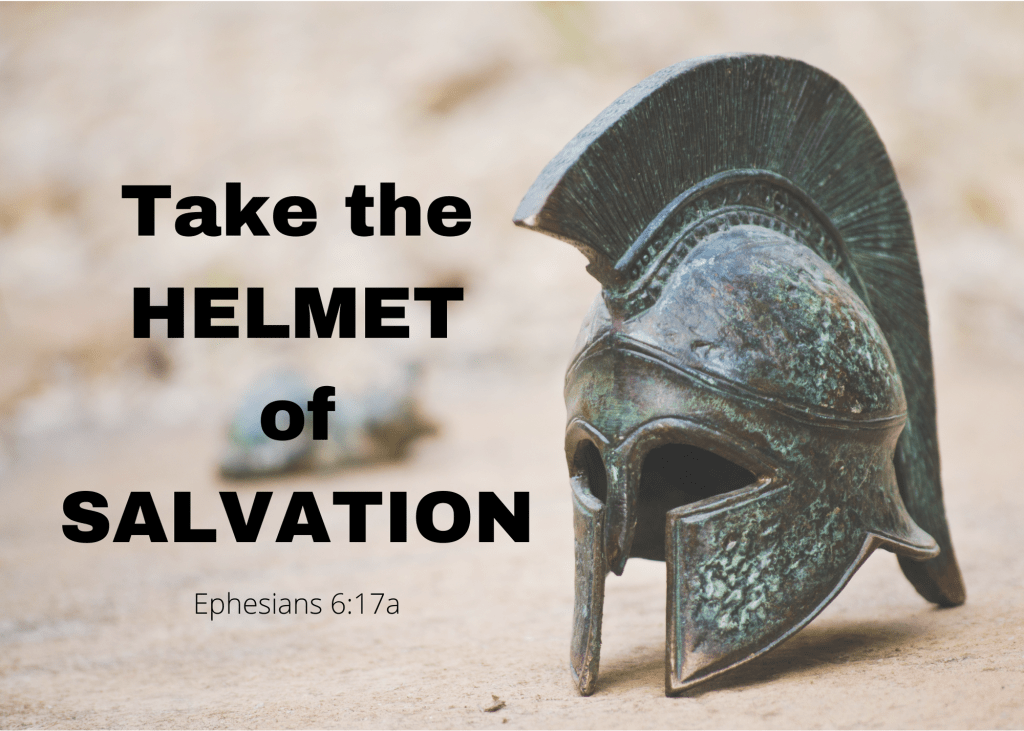
Ephesians 6:17a – “Take the helmet of salvation…”

Here’s a disquieting fact to start our devotion today: According to the International Brain Injury Association, 5.3 million Americans are living with some kind of disability due to a traumatic brain injury. 5.3 million is the population of South Carolina! Of course there are varying degrees of injury, but most are due to car accidents and sports-related incidents. 

And while 5.3 million is a staggering number, I’m willing to bet that there are so many more people living with spiritual battle scars in their minds. 

Our minds are such a vulnerable space and it’s one of the enemy’s favorite areas to attack. At least, that’s been my experience. Anyone else struggle with random thoughts popping up that obviously aren’t from God? 

But why attack the mind? Why not make the heart the primary target? Because our thoughts turn into words, which turn into actions, which turn into habits, which turn into our character. James, the half brother to Jesus, said it this way, “It is the evil that a person wants that tempts him. This desire causes sin. Then the sin grows and brings death.” (James 1:14-15, ICB) This is why it is imperative to protect this part of our body. 

For the apostle Paul, the author of this Epistle, the helmet was the perfect metaphor; after all, he was under house arrest when he wrote this letter. He probably had a lot of face time with a Roman guard who most likely wore some kind of helmet. Each piece of the helmet added another layer of protection against injury or death.

Paul calls this piece of the armor the helmet of salvation. The Greek form of the word for salvation is used only in this verse in all of the New Testament and it means “peace”. As we don this piece of armor, we can have the “peace of God that transcends all understanding will guard your hearts and your minds in Christ Jesus”. (Philippians 4:7)

Where does this salvation or peace come from? It comes from being in the Word of God daily: reading, studying, meditating, and memorizing it. We need to be intentional about the media that we consume and the conversations that we participate in. We need to be aware of entertaining the thoughts that seem to come out of nowhere. Protecting our minds against the thoughts that flow in and out should be something that is carefully monitored as we go about our daily living.

If you want to be in God’s Shalom peace while you engage in spiritual battle, be sure to wear the helmet of salvation.

-Bethany Ligon

Reflection Questions

  1. How do you think the enemy attacks minds? What about yours in particular?
  2. Describe the progression from thoughts to words to action to habits to character. Give an example that leads to ungodly character. Give an example that leads to godly character. Which type of thoughts do you work at thinking most?
  3. What protection is available to you against the thoughts that lead to ungodliness and death? In what ways can salvation and peace mean the same thing? What can you do (today) to strengthen your protection that God has made available to you?

Your Shield of Faith

Old Testament: 1 Kings 9-10

Poetry: Proverbs 13

New Testament: Ephesians 6:16

Do you ever feel like you’re being bombarded with issues, concerns, or worries? Have you ever heard yourself saying, “If it’s not one thing, it’s another”? Maybe you’re just having a typical ‘Monday’ even though it’s Thursday. Or maybe you find yourself clumsy dropping things, forgetting why you walked into a room, or having to deal with “that one person” more often than normal? It’s not so much one big thing, it’s just one little thing after another that really tests your patience. 

My friend, those big things, those small things, those things in quick succession, those repeated things…those very well could be “flaming arrows of the evil one”.

So why does the author of Ephesians, Paul, specifically use the term “flaming” arrows…why not just regular arrows? If a vulnerable soldier were hit by a normal arrow, it would likely only cause damage to himself. But if a flaming arrow hit him, the flame could catch onto nearby flammable material and cause significant damage.  

The comparison leads us to think about how these spiritual attacks affect us and those around us. When we’re experiencing trials and tribulations, how are we treating others? Are we still kind and compassionate or do we take our frustration out on others? When the challenges are mounting up all around us, do we hide out and disengage or do we press on with our commitments and ministries? When the attacks start coming from every angle, are we able to keep our head on straight and make responsible decisions, or are we tempted to act recklessly with our resources and health? 

You see, from the evil one’s perspective, the more damage that can be done with a single flaming arrow, the more successful the attack. It’s not just you and your personal faith; it’s your physical and spiritual health, your relationships and ministries that are under attack.

This is why taking up the shield of faith is so vital when engaging in spiritual warfare. A Roman soldier would have his wooden shield soaked in water so that when a flaming arrow hit its intended target, the flame would be extinguished and not cause collateral damage. 

Likewise, when we are soaked in the Word of God, those attacks become a little less hazardous to how we choose to carry on in the battle. 

In John 7:38, Jesus says, “Whoever believes in me as Scripture has said, rivers of living water will flow from within them.”

The more of the living water that we have flowing through us, the more protected we are from the enemy’s attacks on our faith. We need to stay spiritually hydrated by engaging in the Word of God on a regular and consistent basis. This will build up our faith and protect us from the flaming arrows that are pointed in our direction.

-Bethany Ligon

Reflection Questions

  1. What do you see and recognize as flaming arrows of the evil one? How can recognizing them as flaming arrows of the evil one improve your response to them? Which ones have attacked you or caught you off-guard most recently?
  2. Where/when have you seen a flaming arrow in action – with the potential of injuring or taking down more than just the one it hit? How can we guard against the effect of the flames of these arrows?
  3. How strong is your shield of faith? Does it have weak spots that make you more vulnerable? What can you do to strengthen your shield?

Fitted Feet

Old Testament: 1 Kings 7 & 8

Poetry: Proverbs 12

New Testament: Ephesians 6:15

When was the last time you regretted wearing a pair of shoes? I recently was on the hunt for a pair of gray sandals and I found some that I thought I might like from an online store. I ordered them and at first, they seemed to be very cushy and comfortable. As I wore them throughout the day, I noticed that the straps were rubbing the bottom of my ankle. It never caused a blister, thankfully, but it was just irritating. 

Anyone who is on their feet all day can tell you the value of having comfortable and supportive shoes. Whether it be someone in the medical field, law enforcement, military, food service industry, or in the classroom, having a good pair of shoes is a necessity. 

But what does having supportive footwear have to do with the Armor of God? A soldier’s boots (or sandals as ancient Roman soldiers would wear) are likely the one piece of their attire that they use for hours on end, every single day. They train with their weapons while wearing their boots. They go on marathon-long hikes while wearing their boots. They eat their meals while wearing their boots. And sometimes, they will even sleep while wearing their boots. If a soldier’s feet are sore or tired or have blisters, he or she becomes limited in what they can do – at least without any pain.  

Our verse today talks about being “fitted with readiness”. A soldier must be ready to go at any given moment. Likewise, as believers fighting in a spiritual battle, we must be prepared to take action at any point in time. 

And just what are we to take action with? The Gospel of Peace. This gospel includes the message of salvation and the Kingdom of God. As warriors in a spiritual battle, we need to remember whose army we fight for. When we are laser-focused on what we’re fighting for, we can be empowered and strengthened to fight against anyone or anything that is our opposition. So when temptation or persecution comes our way, we can make sure that we are in the ready position, set to take our Commander’s orders.

But also, the Gospel of Peace is something that we should be comfortable sharing with others who have not yet discovered it for themselves. Being ready to explain to others what we believe and why we believe it is another way to wield this piece of armor. Conversations with our friends, family, work buddies, and even random people you encounter in your day-to-day life can sometimes lead to discussions about our faith. When we are ready to share the Good News, we are showing ourselves to be prepared soldiers in the Lord’s army.

So let’s lace up our boots, and get ready to share the Good News of the Gospel of Peace!

-Bethany Ligon

Reflection Questions

  1. The gospel is only called the “gospel of peace” here in a passage about the spiritual war we are in. How would you describe the gospel of peace and why do you think this wording was chosen for this passage?
  2. Do you feel like you are ready to take action to follow your Commander’s orders today? What do you think could happen if you ARE ready? What could happen if you AREN’T ready for action? What could you do now to be more prepared? Do you think you have ever used an excuse of not being ready when God wanted you to do something?
  3. How can you share the gospel of peace with others this week?

the Breastplate of Righteousness

Old Testament: 1 Kings 5 & 6

Poetry: Proverbs 11

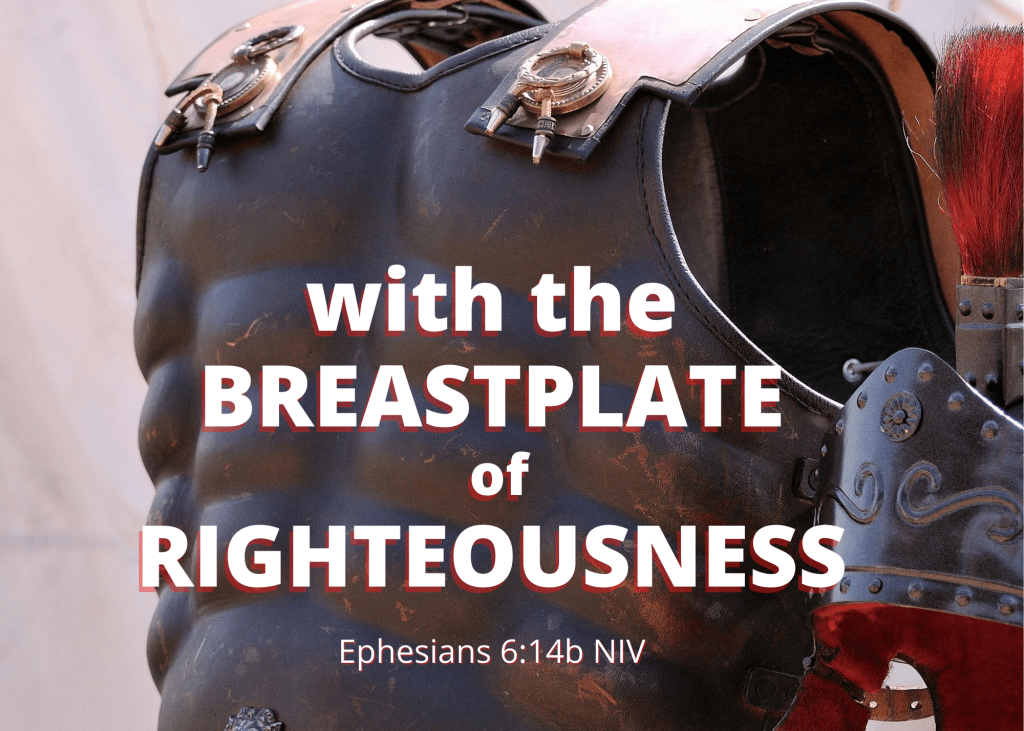
New Testament: Ephesians 6:14b

As we continue our study on the Armor of God, we come across two terms that are not frequently used in our day to day vernacular: breastplate and righteousness. So let’s dig a little deeper in order to come to a better understanding.

The breastplate is the piece of armor that goes directly on top of the chest, protecting the heart, lungs, spleen, liver, and even the stomach. Longer breastplates would also cover and protect the intestines. Without this vitally important piece of the armor, any direct impalement by a sword, spear, or arrow could prove to be fatal. 

In modern warfare protection, soldiers wear vests made of a material called Kevlar. Invented by Stephanie Kwolek in 1965, its usefulness is not limited to body armor, but extends to brake pads, space suits, and drum heads. It’s been tested to be ten times stronger than steel, is capable of absorbing high-velocity impacts, and withstand extreme hot and cold temperatures. (Thanks Google AI for the information!) Today’s warriors don it knowing that their life could depend on it!

Righteousness is a word that is typically limited to “churchy conversations”. (Unless you were in high school in the early 90’s and claimed that something thrilling was “totally righteous”.) But what does this word really mean? Basically, it means to be in right standing before God; morally and ethically sound; to do the right thing with a pure heart. 

So how does a person become righteous? Romans 3:22-24 says, “This righteousness from God comes through faith in Jesus Christ to all who believe. There is no difference for all have sinned and fall short of the glory of God, and are justified freely by his grace through the redemption that came by Christ Jesus.”

Let’s try to tie this together. When we wear the breastplate of righteousness, we are literally layering on spiritual protection upon our hearts. Without this gear, we are vulnerable to the attacks from the enemy that could prove to be fatal. When we wear this armor of righteousness, we are able to stand before God and be seen worthy and faithful. His Holy Spirit will protect us. 

Some may be tempted to try to shortcut the cost and find cheap substitutes for this level of protection. Whether it be trying to buy our own righteousness by being a “good person” or living an inauthentic lifestyle, where your words and actions cover up a deceitful heart, the Bible is clear that there is only ONE source for a legitimate breastplate of righteousness. We must have faith in Jesus. Faith that accepts Jesus as Savior and Lord. Faith that believes the Lord will fight for us. Faith that commits to standing firm when everything around us crumbles. Faith that submits everything, our hopes and dreams, our plans and purposes, our resources and relationships, our past, present and future to the One who is called Jesus, the Christ, the Son of the Living God. 

Yes, it is costly. But the protection and confidence that it provides is invaluable for the fight that we must fight. “For our struggle is not against flesh and blood, but against rulers, against the authorities, against the powers of this dark world and against the spiritual forces of evil in the heavenly realms.” (Eph 6:12)

-Bethany Ligon

Reflection Questions

  1. How would you rate your righteousness: “to be in right standing before God; morally and ethically sound; to do the right thing with a pure heart”?
  2. How would you rate your faith in Jesus? What happens if you try to have righteousness apart from faith in Jesus? What does faith in Jesus lead you to be and do?
  3. How does a breastplate of righteousness protect you from the powers of this dark world? What would Satan want you to believe about the breastplate of righteousness? Where do you see this attitude/belief in the world?

Belt of Truth Buckled

Old Testament: 1 Kings 3 & 4

Poetry: Proverbs 10

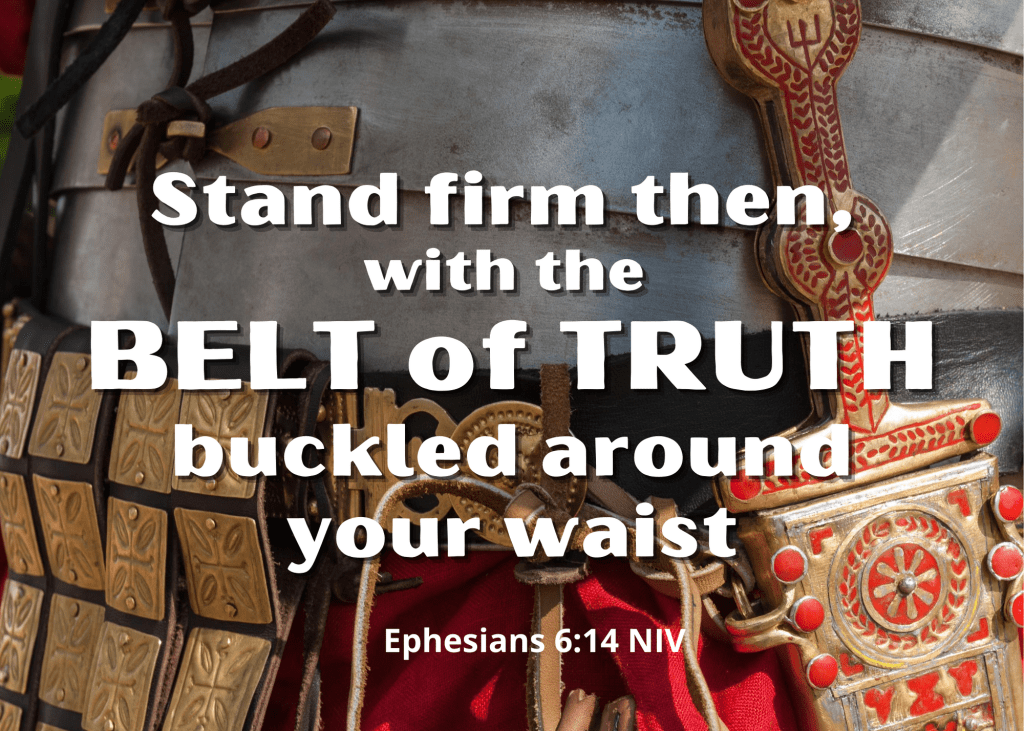
New Testament: Ephesians 6:14a

Heads up! This devotion is going to take you in a mini dive into the history of the buckle of all things! But first…

Many of us have read our key verse more than a handful of times in our lives. And we’ve even been taught about the belt of truth in our Sunday School lessons. It’s been explained that in ancient times, before a foot race or prior to battle, runners and warriors would tuck their long garments into their cloth belt, in order to provide free movement for the legs. 

As I considered this first half of this verse, the word buckle stuck out to me. My thoughts went a little something like this:

“Wait a minute…a buckle in ancient Roman times? This doesn’t make sense. The earliest I’ve ever seen buckles in history books is on the Pilgrims. Did Roman soldiers wear buckles?”

A few clicks in my web browser confirms that indeed, buckles were part of the Roman body armor. Depending on the type of armor, there could be one main buckle, or in segmented forms of armor, many mini buckles to hold all the pieces together. What’s more, the more elite soldiers had super fancy buckles, whereas those that served in the infantry had simpler and more practical buckles. 

Who knew???

With this new knowledge, our key verse today starts to take on an expanded meaning. Without the buckled belt of truth, the breastplate won’t stay in place and the protective plates on the shoulders wouldn’t be able to stay attached. Also, the tunic part of the armor which protected the groin wouldn’t have anything to attach to if it weren’t for the buckle. 

It all starts with the buckle on the belt. Just like it all starts with Truth. 

  • John 14:6 – “I am the way, the truth, and the life.”
  • John 8:32 – “Then you will know the truth, and the truth will set you free.”
  • 2 Timothy – “Do your best to present yourself to God as one approved, a worker who does not need to be ashamed and who correctly handles the word of truth.”
  • Psalm 25:5 – “Guide me in your truth and teach me, for you are God my Savior, and my hope is in you all day long.”
  • Ephesians 1:13 – “And you also were included in Christ when you heard the word of truth, the gospel of your salvation…”

The start of our key verse in Ephesians chapter 6 begins with “Stand firm then…”. If we are ignorant of the Truth, there is no way that we can stand firm. We must know the Truth of YAHWEH, and His Son, Jesus. We must know the Truth of salvation and the coming Kingdom. If we fail to know these truths, then our efforts to stand firm against the attacks of our opposition will be for nothing. 

So buckle up and stand firm in Truth.

-Bethany Ligon

Reflection Questions

  1. What would happen if you went into battle but couldn’t keep your pants up, or were restricted by your long garments? How important is truth? How do the other components of the armor rely on truth? What happens if we try to stand firm without truth?
  2. What truths do you believe about YAHWEH, His Son, Jesus, salvation and the coming Kingdom? Are there any that you are unsure about and need to study more? How do these specific truths affect other pieces of your armor: salvation, righteousness, faith, and gospel of peace?
  3. What can you do today to be better buckled into the truth?

Be STRONG in the LORD

Old Testament: 1 Kings 1-2

Poetry: Proverbs 9

New Testament: Ephesians 6:10-13

Ephesians 6:10-13 – “…Finally, be strong in the Lord and in his mighty power…”

If you were to look at the different video playlists I have curated in my Youtube profile, you’d see that a majority of them are workout exercise videos. I have playlists for upper body strength, lower body strength, pilates and barre workouts, HIIT and stretching videos. What can I say, I need variety in my life if I’m going to pursue a lifestyle that includes regular exercise. 

But physical strength and endurance is not what the apostle Paul is talking about in the sixth chapter in his letter to the Ephesian church.

Nor is Paul referring to mental toughness. The kind of fortitude that prisoners of war or persecuted believers must endure when they are held captive in inhumane environments. 

Paul writes the words, “be strong in the Lord and in his mighty power”. These words are almost identical to what we read in Joshua 1, verse 9, “Have I not commanded you? Be strong and courageous. Do not be terrified; do not be discouraged, for the LORD your God will be with you wherever you go.”

Joshua was preparing for a physical battle that had spiritual consequences. We probably are not preparing for a physical battle; however, if we are actively pursuing a life centered on the Gospel message, we are indeed engaging in a battle that has spiritual consequences. 

So what does it mean to be “strong in the Lord and in his mighty power”?   

First, I think it means that we must recognize that if we are going to do anything in the name of Jesus, we are stepping into battle against the devil’s schemes. We become a threat that must be neutralized. A soldier prepares for battle by donning on their tactical gear. We need to do likewise.

Second, “be(ing) strong in the Lord and in his mighty power” means that our own efforts, our intelligence, our will power, our connections, our resources are insufficient protection for what we are up against. If it were up to only us, then our efforts would be whooped before we even really got started.

Once we acknowledge that we are in a battle and we are without adequate protection, what are we left with? We will only be successful in spiritual warfare with our faith. A faith that says:

We believe that God is who He says He is.

We believe that nothing is impossible for God.

We believe that God is faithful to His people.

We believe that God will fight for us. 

We believe that God has already won the ultimate battle.

When we cling to these truths, we are “strong in the Lord and in his mighty power” and we can withstand any kind of opposition that we are tasked to face and endure. And we will be victorious. 

For whatever battle you might be facing today, remember that you are not alone. You serve a God who loves you and has empowered you with His Holy Spirit to stand firm and do great things. Keep the faith and believe.

-Bethany Ligon

Reflection Questions

  1. How strong are you – physically, mentally, and spiritually? Of these three areas in which do you spend more workout time developing? How does one go about strengthening spiritual muscles? Why are spiritual muscles important?
  2. What do you believe about God and His Son Jesus and how does believing each statement help prepare you for spiritual battle?
  3. What do the devil’s schemes look like? When does he win battles? What can you do to stand against him in God’s power?

Unity

Old Testament: 2 Samuel 20-21

Poetry: Proverbs 6

New Testament: Ephesians 4

After the attacks on September 11, 2001, President George W. Bush spoke to the emergency workers in Ground Zero through a megaphone, finding a response that resonated with the entire country and even more, the world, “I can hear you. The rest of the world hears you. And the people who knocked down these buildings will hear all of it soon.” A historical 92% of the country approved of the job he was doing, bringing together a country that was fraying at the seams in the previous election cycle. It is hard to imagine something similar happening today; no matter who is the president-elect in November, half of the country will be instantly dissatisfied with the results.  These are typical terms we accept in our government, but also this “majority rules” culture has historically found its way into boardrooms and even churches. Let me quickly lower the tension by stating that today’s devotion is not about politics or presidents.  It does not upend or chastise any church form of government. Its sole purpose is to examine the expectation of unity laid out for the church body, as it might be equally unimaginable. 

This spirit of unity was on the mind of Jesus before being arrested in the garden of Gethsemane. He prays for his disciples and all believers when he leaves us the following words, “Holy Father, protect them by the power of your name, the name you gave me, so that they may be one as we are one. (John 17:11b)” Jesus knew his departure to the cross would scatter His apostles, create infighting, and feed doubt. Fortunately, with the exception of Judas, each of them found their way back to a unified front. Having seen Jesus Christ raised to life, they each waited for the Holy Spirit at Pentecost.  They each dedicated their lives to sharing the Good News of the Kingdom of God. They each shared in martyrdom or exile for the sake of Christ.

In the same manner, I have seen churches unite during revival, when facing tragedy, or during persecution from the outside. It is easy for the dross to fall away when the metal is hot, but what about when the metal starts to cool? What does unity look like in maintenance mode? Within the day-to-day routine of uniting relationships, mulling through ministries, and discerning what is best for a body of believers? In Ephesians 4, Paul describes this as “walk[ing] in a manner worthy of the calling, with all humility and gentleness, with patience, bearing with one another in love, eager to maintain the unity of the Spirit in the bond of peace.”

While there could be a devotion on each of the elements of this verse, let’s quickly unpack the key points given to Ephesus. First, walking implies that it is not a quick process, but instead requires some dedication to go the distance (Eph 2:10). Next, humility is the acknowledgement that self-reflection should be the first step in the process, making adjustments and amendments when necessary (Matt 7:3-5; Phil 2:3), and gentleness is the grace that is extended to my brother and sisters during this same process, as imperfect people try to discern the will of God (Col 4:6). Additionally, we are required to commit to patience and love, easily spoken but in reality, conflict makes us more unbearable to one another (Col 3:12-14; Matt 18:15-20). In the body of believers, this is similar to taking the last rep of weight training, it burns the most, but it is the one that produces the result. Finally, eagerness to maintain unity means we stay focused on what unites us (Rom 14:19), defending against the six things the Lord hates (Prov. 6:16-19), and keep our mission far away from doctrinal nuances or extra-biblical preferences.

Unity takes far more work than building a majority.  It isn’t a compromise or consensus because there are no losers. We grow as one together. We move towards one another as we move towards our Heavenly Father. Today, let us be extra mindful in our prayer time to dwell on the topic of unity and ask God to reveal our vision and repair divisions that may exist.  May we live out the prayer of Jesus and the petitions of Paul to become one like our God and His Son, Jesus Christ.

-Aaron Winner

Reflection Questions

  1. Where and when have you experienced or seen the beauty of a united church body?
  2. Dedication, humility, gentleness/grace, patience, love, focused on what unites. How can you exhibit these qualities today? How can you use them to increase the unity of your church? What can happen when just one is missing?