I have noticed a common trend in people who have started their own business or way of life. One of the main motivations for them to begin was the ability to be their own boss. They can work at their own pace in their own way. They in a sense can excuse themselves from submitting to an authority above them. I am not accusing those who have done this of being sinful or doing the wrong thing. I am simply noting a human behavior that is core to us: we don’t always like to submit and sometimes our motivation to climb up in reputation or status is to excuse ourselves from the act of submission.
In light of this, I want to focus on something we see from Jesus in John chapter five. Jesus’ combination of position and attitude are profound and completely backwards to our way of operating. Who is Jesus? He is the one and only begotten son of God. He is the only man ever to live who never sinned in his life—he was quite literally perfect. He is the only man so far to have ever seen the full face of God. He is the only man who sits at the right hand of God. He is the man who is the dividing line between those who are in the kingdom of God and those who are not. So in light of this inconceivably high status and position, did he ever think he could excuse himself from submission to God? Well, let’s take a look at what he says in verse 19, “Truly, truly, I say to you, the Son can do nothing of his own accord, but only what he sees the Father doing. For whatever the Father does, that the Son does likewise.”
Here is the only man in existence who had every right to “excuse himself from submission” and do things his own way in our eyes. Yet, no one has ever submitted as completely and humbly as Jesus did. In fact, the only way he ever received that level of honor and power was through his act of submitting to Yahweh, God of the universe. Only through becoming lowly can you be raised on high!
Jesus is our Lord; what he does we must do. So, if he believes that he must submit himself completely to his Father and do only what he sees God doing, then we must submit ourselves completely to God too. Also, this act of submitting to God’s will in our life and dying to our own is not for God’s service at our expense. He is infinite, He has everything, there is nothing He could possibly gain from your service. So, what’s the point? Why submit and serve a God who doesn’t need serving? In all honesty, it is in your best interest. Submission to God is all about God but it is all for you. When a good and loving father tells his child to obey him, is it because he will benefit at the child’s expense, or is it because it’s in the best interest of the child? (I’ll give you a hint. It is in the best interest of the child.)
I encourage you to follow the example of our Lord Jesus today. He felt that he should submit himself completely to God, and we should too. Only through submission can we enter into God’s kingdom.
-Isaac Cain
Questions for Reflection and Discussion
Read John 5 looking for everything you can find out about Jesus. Who does he say he is? What does he do? What is his relationship with God and with men?
What is the danger in studying Scriptures but not accepting Jesus for who he says he is?
Jesus said he did not seek his own will, but the will of the one who sent him (vs.30). How will you follow his example and lay aside your own will to do the will of your Heavenly Father?
Choose a verse from John 5 to write out and post on your refrigerator or bathroom mirror. What does this verse mean to you?
Humanity has been battling social status and hierarchy since sin first ever entered the world. Humanity tends to do everything it can to climb to the top to be seen as great and to push others down. Unfortunately, this resulted in billions of people being put in a place of oppression, neglect, poverty, abuse, and all other kinds of horrors. This was also the case for the woman we read about in John 4. She was a woman, which unfortunately meant that she was a second class person in biblical times. On top of that, she was a Samaritan, which was a people who the Jews hated. As if that wasn’t enough, she wasn’t even allowed to associate with the other women due to her poor reputation. She was just about the lowest one could be in their culture.
Despite this, Jesus has a conversation with her at a well. Here is Jesus, who is culturally considered to be at the highest end of social status: male, Jew, teacher of God’s law, prophet, and even a miracle worker. Culturally, people would wonder why on earth would Jesus be around a Samaritan woman, let alone talk with her? As if that wasn’t strange enough, he even asks for a drink of water from her! He wanted to be around her, talk with her, and even ask a favor from her. This was unheard of in their day. She certainly felt this way when she asked, “How is it that you, a Jew, ask for a drink from me, a woman of Samaria?”
Jesus’ response was profound, powerful, and broke every single cultural understanding she ever had, “If you knew the gift of God, and who it is that is saying to you, ‘Give me a drink’, you would have asked him, and he would have given you living water.” Jesus was willing to “ruin his reputation” by talking with her, and he was even suggesting that he would give her the most precious gift of all. Jesus had no care and regard for social status, he knew it was a byproduct of a prideful, arrogant, and sinful world. He was much more interested in saving people to become God’s children.
I love the conditional phrase Jesus gives in his response, “If you knew.” If she truly understood she was talking to her Lord and Savior, she would have known it was completely okay and expected of her to humbly receive the undeserved gift of grace.
I think we would all do well to remember this story’s valuable lesson. Jesus’ love is not determined by your level of “goodness” you have achieved in the church. Jesus’ grace is not dependent on your social status in God’s kingdom. Jesus’ value for you will never change. Therefore, we ought to accept that we can’t climb up the social ladder to earn Jesus’ good graces. Instead, we need to humbly ask him for a drink of the “living water.”
-Isaac Cain
Questions for Reflection and Discussion
Do you know the gift of God? If so, how would you describe it to others – and specifically to whom will you share it? If not, who can you ask about it?
How does Jesus’ example challenge us to break social, ethnic and religious norms, prejudices and barriers? How can you follow his example?
Re-read the passage looking specifically at the Samaritan woman: what she does (and doesn’t do), the questions she asks and her replies. What do you think she is feeling as the story progresses? How is she an example for us?
What does Jesus reveal to her? How does this information change her? Has this information changed you? Should it?
What did Jesus mean when he told the disciples, “My food is to do the will of him who sent me and to finish his work.” (vs. 34)? How important is doing the will of God to you?
If you ever wondered what an authentic and calm discussion between a Pharisee and Jesus would have looked liked, you’re in luck. That is exactly what we see here in John chapter 3. This Pharisee, named Nicodemus, thought that perhaps there truly was something special about Jesus from Nazareth and wanted to sit down to chat with him. Nicodemus was still concerned about his reputation and status with others, so he made sure he did it at night so that no one else saw him speaking to Jesus.
Jesus had a particularly notable response when Nicodemus mentioned that he believed Jesus truly did come from God, “I say to you, unless one is born again he cannot see the kingdom of God.” This is a confusing statement to Nicodemus. Jesus clarifies, “Unless one is born of water and spirit, he cannot enter the kingdom of God. That which is born of the flesh is flesh, and that which is born of the spirit is spirit.” Jesus is making a hard line in dirt that distinguishes between those who are in God’s family and those who are not. What is that line? The status of your rebirth. Are you living the life of the “flesh” or are you living the life of the “spirit”? If you’re living in the ways of sin, there is no way you can receive the kingdom of the spirit and vice versa.
I want you to imagine with me for a moment. Let’s say you’re at a track and field event full of varying sports. As you might know, there is a 1st place medal, 2nd place medal, and 3rd place medal for each event. Would you be surprised to see the first place medalist for the 400 meter dash ended up being a discus thrower? It doesn’t make sense that someone would win the medal for a game they have never played would it? Wouldn’t they receive the reward given for their specific event?
The same goes for our eternal reward and destination. There are only two “games to play” in this event called life. We can either dedicate our lives to the ways of this world or we can dedicate our lives to the ways of God’s kingdom. Jesus gives us the warning here that we should not expect to receive the “1st place medal” of God’s kingdom if we are still playing the game “of the flesh.” Why would we ever expect for God to give his kingdom to those who reject it? He wouldn’t. We all sin and we all make mistakes, but the difference here is what game we are practicing. To be born of the spirit is to be playing a completely different game from those who are only born in the flesh.
So in these years that you have right here and right now, you have a choice to make—what game will I play and practice? Will I be born again in the spirit, pursue God, and in the end receive His kingdom? Or, will I stay in the flesh, pursue the enemy, and in the end receive eternal death? I encourage you to make the conscious and daily choice to die to yourself in order to be born of the spirit.
-Isaac Cain
Questions for Reflection and Discussion
Have you ever tried playing both the flesh and the spirit game at the same time? Explain what that might look like. What happens?
What is one way you can challenge yourself to die to the flesh today? And how will you replace that with following the spirit and pursuing God?
Also in this chapter, both Jesus and John say one must believe in whom to receive eternal life? What will happen to those who reject the Son? What might that look like?
When you happen to see paintings of Jesus, how is he typically depicted? Often, he is shown as a tender, gentle, and soft man holding children on his lap or reaching his hand out to grab Peter’s hand while drowning. This can give us the idea that Jesus didn’t have an intense and confrontational bone in his body. Boy is that far from the truth! There is a whole other side of Jesus we often don’t depict.
The chapter starts with his first miracle: turning water into wine at a wedding. After this, the scene shifts to an exciting interaction Jesus had while in Jerusalem during the Passover feast. When he entered the temple, which was THE place of worship for the Jews, he noticed something that bothered him greatly. There were people selling oxen, sheep, and pigeons in the temple courtyard. There was even a section of people who were money changers. An entire market and part of the Jewish economy was founded on deceiving and cheating people into getting the “better sacrifices” for temple service. If you wanted to be in the presence of God and worship, you had to have money. What is even worse was they were not even trying to hide, they were out in the open in the middle of the temple! You know how we tend to feel when we see those well known televangelists who spiritually abuse or deceive people to get material wealth? That is how we should feel about what these people were doing in verse 14.
What did Jesus do when he saw this happening? Before I answer that, I want to take a minute to depict what our culture might imagine Jesus’ answer to be based on all the soft and gentle paintings. “Oh guys, you know what, that is probably not the best course of action to take now is it? I’m not going to make you do anything, but I really hope you reflect on your actions and stop cheating people for personal wealth by means of spiritual abuse. What do you say, will you stop now? *proceeds to give them all hugs*” Sounds silly and ridiculous doesn’t it? Fortunately, we see Jesus respond quite differently:
“Making a whip of cords, he drove them all out of the temple, with the sheep and oxen. And he poured out the coins of the money changers and overturned their tables. And he told those who sold the pigeons, ‘Take these things away; do not make my Father’s house a house of trade.”
Way to go, Jesus! That’s my Lord and Savior! Jesus was not the kind of man who put up with injustices and evil. Like his father, he made sure righteousness was upheld and wickedness was put to an end—one way or another. There is something important to learn from Jesus’ actions here. This wasn’t shown for us to think “Oh wow, that was a bad moment when Jesus lost his cool.” No! There is important wisdom and teaching of who God is, how His kingdom is, and how we are to act like His kingdom’s citizens. The lesson from today talks about the side of love that is not focused on enough. This is the kind of love that is not afraid to turn over tables and drive out wickedness on behalf of the cheated. This is the kind of love that is willing to say the difficult truth to someone who so desperately needs to hear it. Jesus truly is the soft and gentle image that we so often see, but he is also the table turning, whip cracking, and bold image too.
If we are going to call Jesus our Lord, we have to note not only what he says, but what he does. In this case, we need to note that sometimes the best way to show love is to be willing to confront what is wrong. Sometimes the best way to show love is to tell someone the cold hard truth, even if it hurts in the moment. Sometimes the best way to show love is to protect those who are not able to protect themselves. This has to be done in love of course, otherwise we may become aggressive, domineering, or even violent! This type of love is a powerful fire, that if controlled by a master, is powerful; if it falls into the hands of a careless person, it can bring about disaster.
I encourage you all today to dwell and meditate on this unique account of Jesus. Think about how this was truly loving and a pursuit of justice. Then in your own life, pray for God’s wisdom to know how to appropriately handle the fire that is this bold and confrontational love.
-Isaac Cain
Questions for Reflection and Discussion
After this event, John records, “His disciples remembered that it is written: ‘Zeal for your house will consume me.'” (John 2:17 – from Psalm 69:9) Well-done disciples for knowing your Old Testament well, and finding Jesus there! What made the temple (God’s house) such a special place for Jesus? How do you rate your zeal for the Lord’s house? How do you show it? Room for any improvements?
Where else in Scripture do we find Jesus prepared to do battle? How might seeing this Jesus in the future surprise people?
If Jesus visited your church or community what might he see and hear that he would have to zealously act upon? What might he do?
As suggested earlier, pray for God’s wisdom to know how to appropriately handle the fire that is this bold and confrontational love. What wrong/injustice does God want you to see and be zealous about? How would he have you confront it in love – but not in weakness?
There is so much theology, hope, and amazing insight we could unpack from John chapter one, but I want to focus on a detail that is perhaps overlooked. At verses 35 and 36, we see that John the Baptist saw Jesus and shouted, I’m sure with plenty of excitement, “Behold, the Lamb of God!” There were two of John’s followers with him. One was Andrew, Peter’s brother. Out of joy and wonder, the disciples rushed toward Jesus and wanted to know where he was staying for the night. Jesus’ response was simple, inviting, even a little odd, “Come and you will see.” Keep that interesting response in mind.
Later in verse 45, we see a conversation between two of Jesus’ disciples, Philip and Nathanael. With excitement, Philip is breaking the news that the promised one that Moses spoke about long ago is actually here, his name is Jesus, and he comes from Nazareth! By the way, Nazareth was a very small village that was looked at as a run down place where nothing exciting or important happened. That is why Nathaneal responds the way he does: “Can anything good come out of Nazareth?” How does Philip respond? “Come and see.”
Now, I want to come back to both Jesus’ response earlier and Philip’s response to Nathanael. Jesus was just starting his ministry on earth. He knew that he needed to grow a following of people so that they could observe the things he taught and the way he lived. Jesus just met two strangers; he could have told them to stay somewhere else and come back and see him tomorrow. Instead, we see Jesus taking every opportunity he could to invite people into his life for one main purpose: so they could see what it truly means to be made in the image of God. We also get to see how Philip used this approach with Nathanael. Philip is evangelizing to his friend and he is met with skepticism. Rather than trying to make sure he had the right wording or seeing if he could win the debate about whether or not anything good can come from Nazareth, he decided to simply let the power of God, through Christ, speak for itself. “Come and see”.
That simple response speaks to the heart of how we should tell the gospel to those around us. We often are nervous when it comes to evangelism, because we too often try to sell the gospel to people rather than having the gospel sell itself! We need to remember that it is God who gives the increase, not ourselves. Rather than trying to come up with the perfect strategy, we simply need to bring people to the spot where they can “come and see” the incredible things God is already doing. I promise you whatever God has planned will be better than what you have planned. Do what Jesus did and invite people into your life in hopes they can see the Kingdom. Do what Philip did by pointing people towards the One who actually is worth seeing. The Kingdom seed’s growth is not dependent on you, but on God. All we need to do is ask others to “come and see.”
-Isaac Cain
Questions for Reflection and Discussion
How can Philip motivate you? Did he wait to introduce Nathaneal to Jesus until he knew all the details and could quote every sermon of Jesus’ backwards and forwards? How can you do the same as Philip with enthusiasm and urgency?
Who do you know who needs to meet Jesus?
Specifically how can you invite people into your life with the purpose of introducing them to Jesus and His Heavenly Father?
Don’t wait to make the introductions until you know everything there is to know about Jesus – but how can knowing more about who He is excite you into action and evangelism? What can we find out about Jesus in this chapter – what names and titles is he given? What is the meaning of each? Does this sound like a person the world (and our family, friends and neighbors) should get to know?
In John 21, Jesus has a number of more appearances to the disciples. After the disciples go fishing, Jesus shows up on a beach, and feeds them. Jesus takes the time to “restore” Peter. After asking him three times if Peter loved him, and hearing Peter’s three replies, he says in 18-19
“Truly, truly, I say to you, when you were younger, you used to gird yourself and walk wherever you wished; but when you grow old, you will stretch out your hands and someone else will gird you, and bring you where you do not wish to go.” Now this He said, signifying by what kind of death he would glorify God. And when He had spoken this, He said to him, “Follow Me!”
Very often, when we first start following Jesus, we may think “Well, now life will be good!” We may hear preachers say “just pray and believe” and then life will go really well. And Scripture itself says that “And we know that God causes all things to work together for good to those who love God, to those who are called according to His purpose.” (Rom. 8:28) But we need to be careful before thinking this means we won’t have troubles, pains, and even death in spite of, or even CAUSED BY, following Jesus. Jesus himself warned his followers that they would have trouble (See John 16:33; “you will have trouble”). And the early church, especially the lives of the disciples, prove that we will have trouble.
Most of our knowledge of the apostles come from church tradition; we don’t know the following, but it is generally accepted. Simon Peter, Andrew, Philip, Simon the Zealot, and Matthias were all crucified by Rome. James the son of Zebedee and James the son of Alpheus were both killed in Jerusalem by the ruling authorities. Matthew, Thomas, Thaddeus/Jude and Bartholomew/Nathanel were all killed while speaking of their faith. Paul, the thirteenth apostle “to the gentiles” was beheaded after a long time in prison. Only John, as Jesus prophesied, died of old age.
I don’t bring this up to scare you or to make you depressed. I want you to know that a bunch of hillbilly fisherman from the backwoods of a small nation oppressed by an Empire changed the world. The truth of Christianity is proved in these men. They gained no power, no prestige, no wealth, no control by dedicating their lives to the gospel message. They truly believed, to the point of death, that a man named Jesus lived, taught, died, and was raised again. They didn’t go out conquering with armies. They gave their lives so others may find life. They lived knowing that God would work everything out for the good of those who love him; because they were called according to his purpose, they would be raised according to his son.
That is the kind of passion and dedication I want to have for Jesus. I am asking myself “if Jesus sent me to speak his name, would I go? Would I be willing to die to make sure that others could find life?” I want my answer to be yes.
How about you? How would you answer that question? Jesus is turning to you and saying “Follow me!”
-Jacob Ballard
Today’s Bible reading passages can be read or listened to at BibleGateway here – 1 Samuel 11-12 and John 21
I love the book of John, and I am so glad I get to lead us in this week, because John 20 is one of my favorite chapters.
This week we are discussing the early church. We will be ending John and moving into Acts. While Luke shows us the crucifixion, resurrection, and later the coming of the Spirit at Pentecost as the beginning of the church, John shows us the beginning of the church here in chapter 20.
In the opening verses, Jesus is RISEN! Jesus, in John, clearly laid down his life of his own accord, and clearly takes it up again. There is no doubt in the mind of Jesus or the author about what he was doing. Jesus was saving humanity! Jesus was giving the final sign that he is the Messiah, and 8th sign, signifying that he is creating something new. The disciples sprint to see the empty tomb but go away. Mary stays. Jesus sends her to let them know that his words were true, he had been raised, just as he said. He sends her out.
This sending of Mary is mirrored in what Jesus does to the apostles is verse 19. They are sitting in fear, but Jesus shows up and gives them his peace. Then in verse 22-23 we get a weird picture. Jesus breathes on his disciples, post-CoViD, masks, and social distancing, we may feel like Jesus was in their personal space. But he says, “Receive the spirit”. The Holy Spirit, the power, presence, and promise of God to those who would believe in the Messiah, is the very breath of Jesus. What John is showing is that this powerful spirit that shows up in Acts and shakes the city and changes the world, is the breath of Christ. He gives his disciples spirit for power, for forgiveness, for judgement. This is John showing us the birth of the church.
However, the verses I want us to really see are the last three of the chapter. “Doubting” Thomas gets an unfair, if earned, nickname. Yes he doubted. But no one has ever brushed off a crucifixion before. No one gets executed and wakes up a couple days later. Jesus is the exception to the rule. But when Jesus shows up, Thomas believes, declaring “My Lord and My God.” Jesus recognizes the belief of Thomas and says “Because you have seen me, you believe. Blessed are those who did not see, and yet believed.”
My brothers and sisters, that is you. Jesus spoke of how YOU are blessed for having faith without sight. Jesus knows that it is a difficult thing to believe, to be the church. But, like Mary, like Peter, like Thomas, like John, we are called, in faith, to tell others the message of the early church, the message that is still true today. “These things (the book of John) are written so that you may believe that Jesus is the Christ, the Son of God and that by believing you may have life in His name.” (John 20:31) If you believe, have faith without sight, that Jesus is the Christ, as John has been showing, as Peter and Paul declared, as Jesus himself testified to for 40 days on earth, then YOU have life in his name. That is the message of the early church, it is the message of the medieval church, it is the message of the contemporary church, and it will be the message of the church until the end of the age. Jesus is the Christ, the Son of God, and we have life in his name.
Let us, his breath-filled, Spirit-empowered followers, be his witnesses to the world.
-Jake Ballard
Today’s Bible reading passages can be read or listened to at Bible Gateway here – 1 Samuel 9-10 and John 20
When I was a kid in public school back in the dark ages, we used to begin each school day by standing at our desks, placing our hand over our heart, facing the United States flag and pledging our allegiance to that flag. We did it day after day, year after year. I never thought much about it, it was just something you did. In music classes we sang “God bless America, land that I love…” Then in 6th grade we had a new kid in the class named John. I didn’t like John very much- as an early bloomer I had actually been the tallest kid in the class for the previous couple of years (with the exception of Linda, a freakishly tall girl). But among the boys I was the tallest which was a great help on the basketball court where I ruled during recess and after school. But tall, lanky John was a good 2-3 inches taller than me. Fortunately, his height did not translate into coordination and he wasn’t any good at basketball, so I still ruled supreme there, but it was still annoying that my height domination had been superceded. (Fun fact, I stopped growing after 6th grade, so while I was a massively tall presence on the basketball court at 5’10” in sixth grade, by the time I hit 9th grade, still 5’10” I was too short, not quick enough and didn’t have a good enough outside jump shot so I didn’t bother to try out for the high school team. Post-up skills don’t go very well with being NOT the tallest kid on the team).
But I digress, back to lanky, uncoordinated taller John who wore clothes that looked outdated and never seemed to comb his hair, and was just a weird kid. What really set this weird kid, John, apart was that when the rest of us stood by our desks to pledge allegiance to the flag every morning, John didn’t stand. What is with this strange outlier among us? Eventually, I discovered the reason for this. John said he didn’t stand for the pledge of allegiance because he was a Jehovah’s Witness and it was against his religion. His parent also didn’t vote, and they didn’t celebrate their birthdays or Christmas. I was quite relieved that I wasn’t a Jehovah’s Witness. I got to celebrate my birthday and Christmas, I didn’t have to be the odd-ball sitting during the pledge, and my parents got to vote for Richard Nixon as President. (that didn’t age well, now, did it?).
It was at that time that I first became aware that for some religious people there was a connection between their religious faith, how they worshipped God on Sunday, and other parts of their life like politics. It’s been nearly 50 years since I learned that Jehovah’s Witnesses like John didn’t pledge allegiance to the flag, but I still remember that day I learned it.
What do we mean by allegiance? Webster’s dictionary defines allegiance as:
That’s a lot to unpack but for our purposes look at some of those synonyms like commitment, devotion, faith etc… those are all clearly religious words. For many people their flag represents their nation, their family, their people, their way of life, all that matters to them. Particularly those who serve in the military often have a ferocious loyalty and allegiance. The Marine Core motto is Semper Fi, Latin for Always Faithful.
What does any of this have to do with today’s readings? In his books Salvation by Allegiance Alone and Gospel Allegiance, Matthew Bates makes the case that the Greek word “pistis”, which is often translated “faith” into most English translations of the Bible should more accurately be translated “allegiance.” Salvation, then is transformed from simply faith in Jesus Christ to Allegiance to Jesus as Christ, or more precisely, Allegiance to Jesus as God’s anointed King. What does it look like to place your allegiance in Jesus as God’s anointed King over the whole earth?
In today’s readings in 1 Samuel and John’s Gospel the concept of king and allegiance come to the forefront of both narratives. During the time of Samuel Israel transitioned from being led by various judges: Gideon, Deborah, Samson and others to a place where they demanded to be led by a king. Their stated reason for wanting a king was interesting as they wanted “to be like all of the other nations.” Think of the teenager who makes a request to a parent and when rebuked comes back with “but all the other kids are doing it.” Samuel took the people’s request for a king as a personal rejection of his leadership, but God pointed out that HE had been their king since they left Egypt and that this constituted a rejection of Him, not Samuel. God told Samuel to go ahead and give the people what they wanted, a king, along with a word of warning- kings require those in their kingdom to show them a high level of Allegiance, and if you get a narcissistic, proud man as king you will regret it as he will use his power to enrich and empower himself still more. “Yeah, but we still want to be like everybody else.”
So begins the next phase of Israel’s history in the time of the kings and in coming weeks you will read about those king’s like Saul, David, Solomon and many others. You will see how even the bravest and godliest, like David and the wisest, like Solomon, misused their power and privilege and eventually the kingdom split, then was taken into captivity and constantly battled the empires and kingdoms around them. Having a sinful king was no better than a judge. How much better it would have been if they had simply given their full allegiance to God as their king.
In the Gospel of John Israel gets a do over. God has given them His own son, Jesus, the sinless human representative of God to be their king. After Jesus is arrested and brought before Pilate to be judged and sentenced Pilate looks to persuade the Jewish people to change their minds about Jesus. “Here is your king,” Pilate said to the Jews. But they shouted, “Take him away! Take him away! Crucify him!” “Shall I crucify your king?” Pilate asked. “We have no king but Caesar” the chief priests answered. Finally Pilate handed him over to them to be crucified.”
In the account in Samuel, Israel rejects God as their king so that they can be like everybody else. He gives them that choice. In the Gospel of John, a thousand years after they rejected God as king, God’s son, Jesus, is presented to them as their king, and once again they decisively reject God’s anointed King. Instead, they demanded that he be crucified. They declared their allegiance that day to Caesar, I guess because they wanted to be like everybody else. Not much changed in 1000 years in Israel.
2000 years and half a world a way we still have the same choice. To whom will we give our allegiance? Will we give our allegiance to the principalities and powers of this age. Will we give our loyalty to trying to be like everybody else, going along with the crowd, whatever direction the crowd decides we should be going? Or will we give our allegiance to God’s anointed king, Jesus?
If you are a Christian living in this world you are a resident alien living in exile. Your body may be in Ohio or Indiana or Virginia or India, but your citizenship is in Heaven because that’s where your King is currently living. One day King Jesus will return from heaven to earth and reign right here on earth during the renewal of all things (See 1 Corinthians 15:20-24). But for now, you and I are living in exile and while living in exile we should strive to be respectful and law abiding in areas that don’t conflict with our primary allegiance to King Jesus (See Romans 13). You can be a good citizen in many ways, but never forget that if you are a follower of Jesus, your allegiance is to him first and foremost, not to your country, or your family, or your friends, or your culture or fashion or whatever seeks to define you. Your allegiance must be to Jesus.
Can you be a Christian and still pledge allegiance to the US flag? My childhood classmate John thought, “No, you can’t” and Christians may not always agree on these kinds of questions, but there should be no doubt in your mind as to whom your ultimate allegiance is due, Jesus Christ the King, and God our Father.
-Jeff Fletcher
Today’s Bible reading passages can be read or listened to at BibleGateway here –1 Samuel 7-8 and John 19.
I was a teenager when the movie Raiders of the Lost Ark first hit the theatres. It instantly became one of my all-time favorite movies. I love the Indiana Jones character and this particular adventure, searching for the Ark of the Covenant, was especially cool to me because it drew from Biblical themes. The Ark of the Covenant was a real thing containing real power. What would happen if it was found and fell into the wrong hands, like the Nazi’s? It was a great story. It got pretty intense toward the end when they tried to open the Ark. Spoiler alert: it doesn’t end well for the Nazi’s.
The Nazi’s in the story should have spent less time plotting the genocide of the Jews and global domination and more time reading their Bibles, because the story of the Ark in 1 Samuel 5-6 should have discouraged them from having anything to do with the Ark. (I know, Raiders of the Lost Ark is fiction- but what happens to the Philistines in today’s reading is True).
One thing we know from reading the Bible is that God doesn’t like to share His glory with idols. God is the one True God and He alone created everything, gives life, sends rain to produce crops and blesses people with fertility. God takes it very personally when people build statues for other “so called” gods and give them credit for sending rain or helping babies to be born.
I find the story of the Philistines stealing the Ark of the Covenant and bringing it in the temple of their “god” Dagon humorous. Dagon was the main god of the Philistines and they offered sacrifices to Dagon so that they could have fertility- their cattle, and their wives. They wanted lots of cattle to feed their bellies, and they wanted lots of sons to grow up and serve in the army to fight their enemies. So they prayed and offered sacrifices to Dagon so that Dagon would make their cows and their wives fertile.
We might excuse the ignorance of the Philistines because maybe they didn’t know any better, maybe no one told them the Truth about the True God. But God made it quite clear to His chosen people, Israel, that they were to worship and serve God alone. But they were often tempted to worship other gods. Several stories in the Old Testament show how God was superior and defeated other “so called” gods. Elijah called down fire from heaven and defeated the prophets of Baal. Samson’s last act after he had been captured and blinded was to push down the pillars of the temple to Dagon and kill a bunch of the Philistines. And here, when the Ark of the Covenant is brought into another temple of Dagon, The statue of Dagon falls down the first time, then falls down again breaking the idol into pieces. The Philistines of that town are afraid so they send the Ark to another town. There, everybody gets tumors and they end up in a panic. Everywhere the stolen Ark is taken trouble comes to the Philistines, so finally they bring the Ark back to Israel along with a guilt offering (golden tumors and rats, what a thoughtful gift).
The Philistines had trouble discerning fact from fiction- the true God, YHWH, the God of Israel, vs. Dagon, a statue that was quite brittle when it fell to the ground.
Truth matters. In today’s reading in John 18, after Jesus is arrested and brought to trial, he appears before Pilate, who is the highest representative of the Roman Empire in the region who ultimately decides all capital cases, who lives and who dies.
Pilate is a politician caught between his boss, Caesar, who has tasked him to keep the Jewish people in line and the Jewish people who can turn on him and cause trouble. He has to carefully consider the political implications of what he’s being asked to do. Like many politicians and people in charge, he is more of a pragmatist than anything else. What is going to work out to my best interests here? He asks Jesus some questions and Jesus gives an answer that he finds quaint. Jesus answered: “The reason I was born and came into the world is to testify to the truth. Everyone on the side of truth listens to me.”
Truth? How naïve. You might imagine the amusement (or scorn) in Pilate’s response when he asks Jesus: “What is Truth?”
If the idea of truth was a quaint notion to a first century Roman politician, it’s become reviled and scorned by 20th and 21st century intellectuals. We live in a time of Postmodernism. Absolute truth has been replaced by relativism. Truth is whatever the people who have the power to control government, the news, the arts and higher education say it is. Truth is what Facebook, or Twitter, or Google’s “fact checkers” say it is.
Whether you and I like it or not we are in the midst of a culture war. It’s the same one that’s been going on since the serpent tempted Eve to question God. It’s the same one that was going on in the temple of Dagon when the stolen Ark was brought in, it’s the same one that was going on when the Jewish leaders lied about Jesus and brought him to Rome to be condemned and executed, it’s the one that was going on when Pilate asked, “What is truth?” It’s going on today in a society where the things we’ve always believed about God and virtue, right and wrong, and pretty obvious things like basic human biology, are all being questioned and redefined. Gender isn’t about biology it is a social construct. If you start introducing facts or science or Truth, you will receive as much scorn as Jesus received from Pilate. But it is a culture war and Jesus told Pilate that there are two sides: one side is false and the other is true. Jesus said that if you are on the side of Truth you listen to Jesus. Pilate chose his side, and so he did what was politically correct and had Jesus crucified to appease the Jewish people. The question you and I must ask ourselves is whose side am I on? Am I on the side of Truth, that listens to the words of Jesus? Pick a side.
-Jeff Fletcher
Today’s Bible reading can be read or listened to at BibleGateway here – 1 Samuel 5-6 and John 18
When was the last time you were purposefully silent? No headphones on with iTunes or Netflix playing in your ears? No talking with someone else, just you in silence?
One respected Christian writer says: “Silence is a kind of substance in which we are able to experience eternity. It is a substance that enters into our souls and if we don’t have it, our souls become impoverished.”- Dallas Willard, Dmin. Lecture, Fuller Seminary 2012
We are constantly surrounded by noise, aren’t we? In actual fact, I think most of us like it that way. Having noise going on makes us feel less… alone. Of course, we don’t like too much noise all the time. We can also relate to The Grinch:
“For tomorrow, I know, all those Who girls and boys, will wake bright and early, they’ll rush for their toys, and then… Oh the noise! Oh the noise, noise, noise, noise! There’s one thing I hate: oh the noise, noise, noise, noise!”- The Grinch in How the Grinch Stole Christmas, Dr. Seuss.
We want enough noise to distract us but not so much noise as to irritate us.
My iPhone 12 now tells me when I’m being exposed to too much noise. Yesterday, I was mowing my grass and decided that I would listen to a book on my iPhone’s Audible program ( ironically the book I was listening to was about the spiritual disciplines including… silence) while I mowed with my headphones on. In order to hear it over the loud noise of my lawnmower I had to have the volume turned up to full. My iPhone didn’t like that and told me I needed to turn it down. (iPhones tell us when and how to do almost everything- when to wake up, how to get where we want to go, when it’s time get up and move around, and turn down that music- iPhones are now our nagging parent I guess).
I have eleven children, most are now adults, but when they were all small, noise was simply a fact in our house. If I wanted quiet I had to go someplace else. During that time I went to a monastery and spent several days in a silent retreat. There was no noise. None. We were not to speak to other people, not even a hello when you passed them in the hall, no chit chat at the dinner table. Just 5 days of silence. A strange thing happened to me during that time of silence. For the first time in my life I really heard God speak to me. Why did I hear God speak to me that week? Because I had turned off all of the other noise, and I was really listening for God’s voice.
Can you really hear God’s voice? A lot of people doubt that this is even possible because they’ve never experienced it.
“The fact that we do not hear does not mean that God is not speaking to us… We know that messages from radio and television programs are passing through our bodies and brains at all hours of the day: messages that an appropriately tuned receiver could pluck from the very air we breathe… We are not attuned to God’s voice. We have not been taught how to hear it sounding out in nature — for as we read in Psalm 19, ‘The heavens announce the glory of God” — or in special communication directed by God to the individual.” (Dallas Willard- Hearing God p. 68-69)
In today’s reading, young Samuel had to be taught how to listen for God’s voice. As we saw yesterday Samuel’s mother, Hannah, gave him to God in gratitude for God giving him to her. Samuel was brought to the House of God where he was being trained by Eli, the priest, to be a servant of God. It’s interesting to notice that it says that at that time the word of the Lord was rare (3:1). Apparently God wasn’t doing much talking, or, maybe the people weren’t doing much listening, you decide.
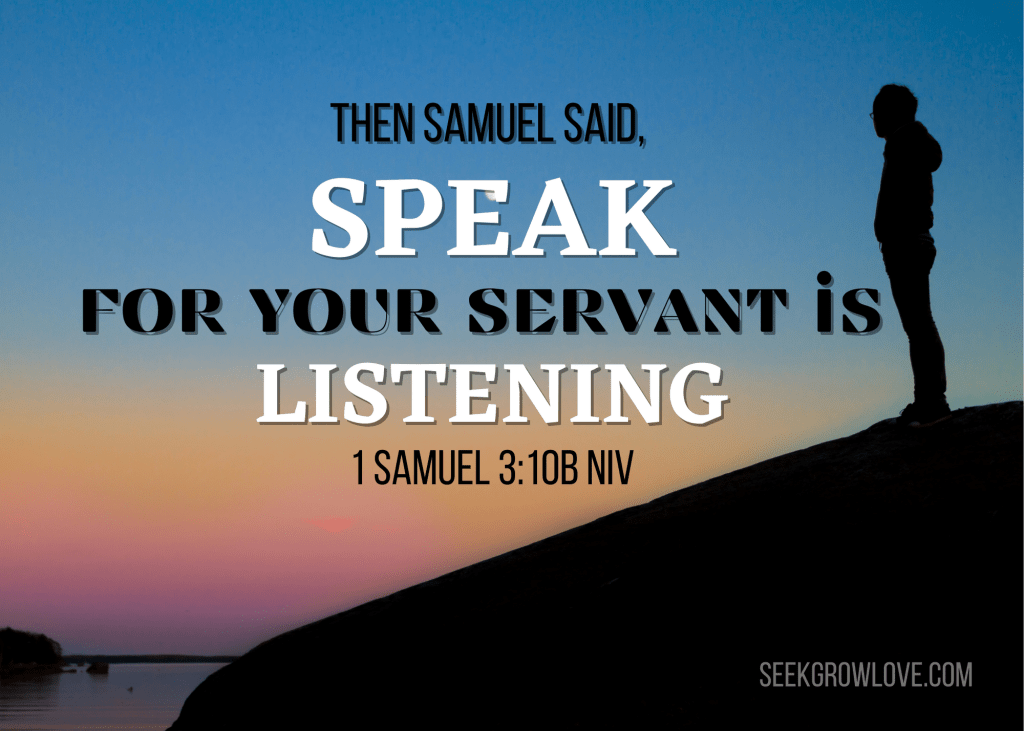
The priests at that time not only served in the temple they also slept in the temple. Picture the scene: Samuel is in bed, it’s quiet, and everyone is trying to go to sleep. Samuel hears a voice speaking in the silence. Samuel assumes it’s Eli calling for him so he comes to Eli’s bed. Eli says “It wasn’t me, go back to bed”. It happens a second time, Samuel gets up and goes to Eli who again says “It’s not me, go back to bed.” It happens a third time and Samuel again runs to Eli, who by now realizes that the boy isn’t trying to stall going to bed but someone really is calling him, and it must be the LORD. So Eli trains Samuel in how to listen for God’s word. Say, “Speak LORD, for your servant is listening.” Samuel does as he is told, and God speaks and Samuel responds, “Speak LORD, your servant is listening”, and then God tells Samuel what is about to happen. God is about to punish Eli and his family for their sin.
At breakfast the next morning Eli asks Samuel what God said and warns him to tell the truth. Samuel delivers the bad news to Eli and the priest accepts this as being a true word from the LORD. As the story unfolds, God backs up His word. The Philistines defeat Israel in battle, they take possession of the Ark of the Covenant, where’s God’s glory resides, and Eli’s two wicked sons are killed. When the report is given to Eli he falls out of his chair and breaks his neck and dies. From then on God keeps speaking to Samuel. Why? Because his servant was listening.
Samuel was faithful and took the words God gave them and shared them with the people. Jesus did the same thing. He listened for the voice of his father and he faithfully shared them with his people. In John 17 Jesus says: “I gave them the words you gave me and they accepted them.” (John 17:8) The words that Jesus spoke were the words that came from his Father. Jesus spent much of the first 30 years of his life studying the scriptures and committing them to memory. He began his ministry by spending 40 days in the wilderness in solitude and silence. His daily habit was to rise up early while it was still dark and pray- you can be sure that his prayers weren’t simply him telling God what he wanted, but included much careful listening.
The word of God was rare in the days of Samuel, was it because God wasn’t speaking, or was it because no one was listening for God’s voice until Samuel?
If it feels to you like the word of God is rare today ask yourself, is it because God isn’t speaking, or is it because we aren’t listening? Try this… turn off the noise, find a place to be silent and place yourself before God and say, “Speak LORD, your servant is listening”. God may speak to you through His written word, the Bible, or through His creation, or through a dream, or maybe even a still, small voice. But you won’t hear God if you don’t shut off the noise and listen for Him.
-Jeff Fletcher
Today’s Bible reading passages can be read or listened to at BibleGateway here – 1 Samuel 3-4 and John 17






 Seek Grow Love