Now ask yourself, do you believe that Jesus Christ has been raised from the dead (verse 6), and that all authority in heaven and on earth has been given to him (verse 18)? “Given” implies receiving authority — not possessing it inherently. This authority is the result of the Father’s exaltation of the Son after his obedience and resurrection (Philippians 2:9–11). God is the source of all authority; Jesus exercises that authority on God’s behalf.
Let’s continue. He will be with his disciples to the end of the age (verse 20)?
If this is true, then nothing is more important in our lives, nothing is more crucial or more urgent or more necessary than believing it and becoming a follower of Jesus. I know it’s a big if, if this is true, if this is real (you may believe it or not). If the premise is true, wouldn’t you agree with the conclusion? That nothing is more important for everyone in the world than to believe in him and be his follower.
Just think of it. Jesus says in verse 18, “All authority has been given to me in heaven and on earth.” If this is true, then today Jesus Christ is the Lord of the universe. Now it’s important to remember, God’s authority is absolute, eternal, and derived from no one. Jesus’ authority is delegated from the Father to accomplish redemption and judgment (John 5:19–30, Matthew 28:18). But his authority is absolute!
He has authority over politics and government; he has authority over all armies and military, even over the wars that are taking place today.
He has authority over all industry and business (NASDAQ and Dow Jones); farms, and chat GPT, even the industry you work in.
He has authority over science and education — all research and discovery and universities and colleges;
He has authority over all entertainment and media — radio, TV, Internet, social media, theater, art;
He has authority over all sports and activities — over your favorite team and every playoff game;
He has authority over all natural phenomena — all weather and floods and volcanoes and earthquakes and tornadoes and hurricanes and any other storm of life;
He has authority over all planets and moons and stars and light and energy and motion and time;
and therefore he has authority over our lives — health and disease and success and failure and life and death.
I don’t know where you are this morning. You may or may not believe the testimony of Jesus and his disciples. But I hope you see at least that if — if — it is true that Jesus rose from the dead as the Lord of the universe with all authority in heaven and on earth, then believing it and following Jesus as our Lord is the most important, most urgent, most crucial thing in our lives.
Reflection Questions
What do you imagine Jesus was thinking and feeling as he was speaking to the disciples on the mountain in Matthew 28? What do you imagine the eleven disciples were thinking and feeling?
What have you heard about Jesus? What does this passage teach you about Jesus? And about God?
What do you believe about Jesus? Does your life show what you believe? Is there anything that needs to be adjusted to better believe and reflect those beliefs in your daily decisions?
Prayer
Dear God and Giver of all authority, we praise You. And if we truly knew and recognized all there is to know about You, we would praise You even more. We thank You for revealing Yourself in Your Word. Help me to seek You more and more. Thank You for Your amazing son Jesus who is indeed worthy of all the authority You have given to him. I want to follow him well. Show me, Lord, where I need to change my beliefs and behaviors and priorities to better follow Jesus and be Your child now and in that beautiful age to come.
In today’s chapter, there are three parables: the Parable of the the Ten Virgins, the Parable of the Talents, and the Parable of the Sheep and the Goats.
It is important to note that parables are earthly stories that teach spiritual truths. Jesus creates images that his hearers would understand, and applies them to spiritual realities. The Parable of the Talents section will go into more detail about interpreting parables.
The Parable of the Ten Virgins
In the first parable, we see ten women who are waiting to guide a groom to his bride. Five of these virgins were wise and prepared for the coming of the groom by have enough oil to last all through the night. Five were foolish, unprepared, who have to run off and fill up their supply of oil while the groom is on the way. They weren’t ready for the bridegroom and his coming, and they were not allowed in because they were late.
Obviously, we can see the parallel with our faith. The point made by this story is simple and spelled out for us in verse 13: “Be on alert then, for you do not know the day nor the hour.” We must be prepared for the coming of Christ, ready for his return.
But what does it mean to be ready for his return?
Parable of the Talents
In the second parable, a master goes on a long journey, and gives talents to his slaves. When we read “talent,” remember that the word HERE means “an amount of money”. A talent is a VERY LARGE amount of money, about 6,000 denarii. A denarius is one days wage. 1 Talent would take a working person 16 years to save. (see note) Five talents, two talents, and one talent are all VAST sums of wealth, and the King gives them to his slaves and entrusts that money into their care according to their abilities. When the master returns, he rewards those who use his wealth to make more, but punishes the one who hides the money away and does not use it.
Again, we should start to see some connections to our own life. It is important to remember that this is a parable. Jesus is using images from the world around him to teach a spiritual point. The talents given by Jesus, the King, to us, his slaves, are decidedly not always money. There may be people who follow Christ who are dirt poor. Moreover, it should not be considered specific abilities or spiritual gifts. Because this story is a parable, one-to-one relations don’t always work. For example, what is the oil and who are the oil sellers in the parable of the ten virgins? Don’t think too hard on it, because those are silly questions. The parable is about being ready for the return of Christ. I’m making a similar point for this parable: don’t try to define what the talents are (spiritual gifts, or natural abilities, or other) but think of them as the blessings of God in our life generally. And that makes the point clear: We can either use the blessings God has given us to produce more blessings for ourselves and others while risking and sharing, or we can bury our blessings and avoid the risk of interacting with others.
If you use the talents with which you are gifted, you will receive the reward the master gives. He says to both the one with five talents as well as the one with two : “Well done, good and faithful slave. You were faithful with a few things, I will put you in charge of many things; enter into the joy of your master.” (21, 23). Note the words aren’t different, though the blessings are. We are to use our blessings that we have been given. We are not to worry about not having as much as the next person or whether we can see the fruit of them using their blessings. It is for the master to judge them, not another slave.
Finally, Jesus, our master, EXPECTS us, his slaves, to gain on the blessings given. For the slave given one talent, even if the talent was just “put in the bank”, then it would have been better. Instead, the slave played it safe, and is punished for his unfaithfulness. The one who is was unfaithful has their blessings revoked and the blessings were given to the faithful. (Another reason we don’t think of talents as specific spiritual gifts or natural abilities. It seems doubtful that God would take the spiritual gift or natural talent from one and give it to another.)
We need to be ready at all times for the return, and that is by using our blessings to bless others. Jesus puts a fine point on this teaching by saying the final parable of the chapter.
The Parable of the Sheep and the Goats
In the final parable, all humanity is imagined as a herd of animals, sheep and goats. The final judgement, that comes at Christ’s return, has him separating sheep and goats. Jesus tells the sheep that they fed, watered, invited, clothed, and visited the great king by doing it for the “least of the brothers of mine.” When we care for other Christians, we are caring for Jesus, the great king Himself. Moreover, many Christians have understood a greater implication. Because Jesus is human, he views all of humanity as brothers and sisters. This is why Paul says in Galatians 6:10 “Therefore, as we have opportunity, let us do good to all people, especially to those who belong to the family of believers.” Not ONLY believers, but especially believers. It starts in the family and radiates outward. However, the goats did not feed, water, invite, clothe, or visit the great king. When they did not care for their brothers and sisters in Christ and for their human family, they were not caring for the king.
And what happens to each group is shocking. One is given eternal life, life in the age to come, life that lasts forever because it is in the presence of the One who is Life. And the other is punished, and the punishment, death, will be eternal and final.
These three stories teach us what it means to be ready for the return of Christ which is promised in chapter 24. To be serving the least of these, both in and out of the family of believers, with any and all blessings that God has given us, actively waiting and expectantly watching for the coming of Christ. It is not staring at the sky while twiddling our thumbs nor is it quietly serving with no Kingdom messages. It is serving the least, blessing them, and sharing with them the Gospel of the Kingdom. That’s the message of the parables.
(Originally posted for SeekGrowLove January 25, 2022)
Questions for Reflection and Discussion
Are we the wise or the foolish virgins? Will we be found prepared, without knowing the day or the hour? Will we be running around when he comes, hoping to be found ready?
Are we faithful with the blessings of God we have been given? Are you using the gifts God has given in an effective way?
The sheep seem to be surprised that they were serving the King, and the goats are surprised they weren’t serving him. Are you taking care of the least, the last, the little and the lost? When have you fed or given water to the poorest in your community? When have you given clothes to those who have none or invited them into your homes? It is tempting to say “I give to charities that do that” but Jesus won’t be asking the charity if THEY cared for the least of these, he will be asking you and me. Will we be in surprise that we served or in surprise that we did not?
Prayer:
Dear God, You are amazing and so is Your love! Thank you for giving us Your Son and these powerful parables to prepare us for the perfect unfolding of Your plan of salvation and eternal life in Your presence. Help us listen well and respond wisely so we are not caught unaware. Forgive me, Lord, for the times I fail: when I am too distracted to be prepared, when I bury the talents, gifts, blessings and resources you have generously given, and when I haven’t recognized Jesus and the opportunities to serve him through caring for the least. Open my eyes to see and live these parables every day in my own life, that I might be wise, generous, prepared and serving til Your Son returns.
Does anyone remember the “cold war”? It was a time in our history where we publicly acknowledged that even though we weren’t “weapons hot” in direct combat with an opponent, we were still actually fighting in a secret war. The term was a little misleading because while there was all sorts of nefarious activity going on, it was mostly kept out of the public eye, or fought in other places. The exact number of men who died during the Cold War is not definitively known, as the conflict was primarily geopolitical and indirect, involving proxy wars, political repression, and nuclear threats rather than direct large-scale battles … However, estimates of total deaths linked to Cold War-related conflicts range from (according to a Quora analysis) 10.8 million to 25 million. Stop for a moment and think about that.
We are similarly involved in a spiritual “cold war” right now. People are dying as you read this, because most of us are too scared to acknowledge that it is going on, and those who understand that it’s going on are too scared to get directly involved. Fear is one of the greatest tools used by our enemy(ies) to keep us in line, and from becoming a threat. We’ve been divided into different “denominations”, and told that we should only socialize with folks who think exactly like we do, because we (insert your denomination here) are the only ones who have rightly understood scripture and everyone else is wrong, and therefore, the enemy. Even though we are told repeatedly in scripture that our standard of measure is our love and unity, not necessarily agreement mind you, but love and unity. We never even stop to think about the hard, cold fact that the first tactic in almost any military incursion is to isolate, misinform, divide, and conquer.
Our reading today of Psalms 10 lets us know that this isn’t a new problem. This has been going on since just after the creation, but if you pay attention, you can see that it’s ramping up now. Our reading of Matthew 24 gives us an idea of what more is coming, and how it all ends. Whenever my wife sees something on the news that is shocking and appalling, and gasps “Can you believe that?” to me, I always respond by saying “It’s going to get worse before it gets better.”. We know that when our King returns, it will get better…but it’s going to be tough until then.
“Why do You stand afar off, O Yahweh?…” (Ps 10:1, LSB). Sometimes it seems that way, but know that He does not. That is a deception by the enemy. If you are alive, right now, it is because the breath of your God is in your lungs. He is with you, and beside you, all around you, and within you. God tells us directly (through Jesus) that the tares must be allowed to grow alongside the wheat (Matt 13:24-30), and also that it is through many trials and tribulations that we must enter the kingdom of God (Acts 14:22). We’re at war, did you expect a cake walk? Toughen up, soldier. We have a mission.
“For the wicked boasts…and the greedy man curses and spurns Yahweh. The wicked…does not seek Him. All his thoughts are ‘There is no God.‘” (Ps 10 3-4, LSB). It becomes easier to do what you know is wrong if you deny the fact that there is a Creator, and that this Creator will one day bring forth His justice, His salvation…His Yeshua (seriously, look it up. The name Yeshua, or “Jesus”, means the “Salvation of God”). Many people turn to alcohol or drugs to help them forget this, even if it only works for a little while, and then you need more. Foolishness. God will judge the earth, so every action you take in your lifetime should be to offer a good accounting of yourself during that judgment, if you are wise. We will be judged by our fruits, we need to get to planting.
“He sits in the places…where one lies in wait; In the hiding places he kills the innocent; His eyes stealthily watch for the unfortunate. He lies in wait…to catch the afflicted…and the unfortunate fall by his mighty ones. He says in his heart, “God has forgotten; He has hidden His face; He will never see it.” (Ps 10:9-11, LSB). Folks, this is still going on right now. I knew some of those guys. They’re bad guys. 1 Peter 5:8 depicts the devil as a roaring lion seeking whom he may devour. Whether or not you believe in a personal Adversary, understand that there are bands of men doing this right now for a livelihood, in your town. Stay alert, and live a righteous life. Shema! If you succumb to your vices, they will consume you.
“O Yahweh, You have heard the desire of the humble; You will strengthen their heart, You will cause Your ear to give heed. To give justice to the orphan and the oppressed, so that man who is of the earth will no longer cause terror” (Ps 10:17-18 LSB). If you have read and believe in the scriptures, you know how this story will end. No matter how bad it looks right now, we know that we have a hope. We await the salvation of God, His Yeshua, to come and judge this earth in righteousness and equity, to “break the arm of the wicked (Ps 10:15) and to seek out his wickedness until none is found”.
“Then they will deliver you to tribulation, and will kill you, and you will be hated…and at that time many will fall away and will betray one another and hate one another. Many false prophets will arise and will deceive man. And because lawlessness is multiplied, most peoples love will grow cold.” (Matt 24 9-12, LSB). God have mercy, it’s going to get worse. If we are hating each other, or betraying each other, or our love grows cold…we will have lost the battle, and we will die forever.Guard your heart above all else, because when your love grows cold, so will your life, and your hope for a life in the kingdom. Do all that is within your power to prevent this, seek ye first the kingdom of God, love Yahweh God with all your heart, and love your neighbor as yourself. Don’t you see that your enemy is trying to kill you right now? Wake up, and FIGHT!
We have some specific signs and indications that tell us of the coming of the Son of Man in Matthew 24:29-31. There is a reason that at this time “the tribes of the earth will mourn” (Matt 24:30), because the time has come, there is a God, and the judgment of the wicked has come upon them. No man knows the time or the hour (not even Jesus at the time), but only the Father (Matt 24:36); but we see in the parable of the fig tree in Matt 24: 32-39 that when we see these things, we should understand that the time near.
My friends, look around you. The time is near. Now is not the time for distractions and diversions, but for a redoubling of focus and effort. Our king is returning, and soon! Do not think proudly that you have already attained admittance into the kingdom, but humble yourself before God, ask God for wisdom, pray, fast, read scripture, do all that you can do to restore and renew your relationship with your God. If you do, who knows? Seek Yahweh, all you humble of the earth who have worked His justice, Seek righteousness, Seek humility. Perhaps you will be hidden in the day of Yahweh’s anger (Zeph 2:3, LSB).
REFLECTION QUESTIONS
As Christians, how can we fight in this war?
What are some of our offensive weapons?
What are some of our defensive weapons?
Are we utilizing them effectively, and why or why not?
PRAYER
Father God, thank you. You have given us life, breath, and all things. Our enemy seeks to destroy us, Father protect us. Lord God, may your will be done in my life. When you return to judge the earth, have mercy on me on that day, and let me humbly seek to please you until I go to rest in the ground to await You. Please grant me wisdom, and grant me Your spirit to guide me and protect me. May the lips of all of Your creation offer you up the praise that you deserve, in Jesus’ name, Amen.
Religious practice is exactly what is said. It is our habitual practices that we bring to our walk with God and make rules for our lives. These practices are not necessarily good or evil but become the habits that we follow as people in our daily life. We also build habits that govern our time together as the body of Christ at church or fellowship. Once again, these practices are neither good or evil but are the way that we have decided to fellowship together.
The law of Moses covered almost every aspect of life for the nation of Israel and gave instruction in how to do righteous actions and have righteous thoughts. As we read in Leviticus these instructions can be very complex and to our culture maybe not very understandable.
In our reading in Matthew, we are at almost the end of Jesus’ life here on earth and he is at the temple. He has many debates with the leaders there and also spends time teaching the people. He throws out the moneychangers and vendors and then has many interactions with them that are maybe not the most decorous from their viewpoint.
Matthew 23:1-13(NLT) Then Jesus said to the crowds and to his disciples, 2 “The teachers of religious law and the Pharisees are the official interpreters of the law of Moses. 3 So practice and obey whatever they tell you, but don’t follow their example. For they don’t practice what they teach. 4 They crush people with unbearable religious demands and never lift a finger to ease the burden. 5 “Everything they do is for show. On their arms they wear extra wide prayer boxes with Scripture verses inside, and they wear robes with extra long tassels. 6 And they love to sit at the head table at banquets and in the seats of honor in the synagogues. 7 They love to receive respectful greetings as they walk in the marketplaces, and to be called ‘Rabbi.’ 8 “Don’t let anyone call you ‘Rabbi,’ for you have only one teacher, and all of you are equal as brothers and sisters. 9 And don’t address anyone here on earth as ‘Father,’ for only God in heaven is your Father. 10 And don’t let anyone call you ‘Teacher,’ for you have only one teacher, the Messiah. 11 The greatest among you must be a servant. 12 But those who exalt themselves will be humbled, and those who humble themselves will be exalted. 13 “What sorrow awaits you teachers of religious law and you Pharisees. Hypocrites! For you shut the door of the Kingdom of Heaven in people’s faces. You won’t go in yourselves, and you don’t let others enter either.
Jesus gives us a compact instruction on how we are to practice our religious life in these short verses.
We are to obey the true Word of God which does not fall
We should not add rules and conditions of man to the Word of God
We need to worship and practice with humility to God and His instructions to us.
Bring people into the kingdom of God not draw lines to exclude them
In Micah God reminds us of what is important to Him and what we really need to do to live out the life of compassion and grace that He has called us to.
Micah 6:6-8)NLT) What can we bring to the LORD? Should we bring him burnt offerings? Should we bow before God Most High with offerings of yearling calves? 7 Should we offer him thousands of rams and ten thousand rivers of olive oil? Should we sacrifice our firstborn children to pay for our sins? 8 No, O people, the LORD has told you what is good, and this is what he requires of you: to do what is right, to love mercy, and to walk humbly with your God.
Why does this judge our hearts so well?
We must be careful every day not to start to exalt our minds against God by patting ourselves on our backs for the great works of righteousness for Him that we do. Just doing religious practices and ignoring the grace that God has given us is the way to go down the wrong road (that’s when the pat on the back needs to be down lower). If our religious practices bring us closer to God through prayer, praise, love for others, and Christian service then we are building our relationship with God.
This is what He truly desires from us, not a showy religious practice. Contrast this with what so much of Christianity does today and the consequences of religious practice become immediately evident. Our God wants us to have the heart of grace and mercy towards this fallen world and people that He has. He has built the way to life through His Son Jesus Christ, and he is who we are to become like.
Galatians 2:16(NLT) Yet we know that a person is made right with God by faith in Jesus Christ, not by obeying the law. And we have believed in Christ Jesus, so that we might be made right with God because of our faith in Christ, not because we have obeyed the law. For no one will ever be made right with God by obeying the law.”
God’s grace is the important thing to bring to every part of life and practice. It is so human and wrong to be judgmental of people based on how I think they should act or think. I am offended in my mind by their lack of doing of the things that I think they ought to be doing.
Is this the mind of Christ towards others?
Titus 2:11-15a (NLT) For the grace of God has been revealed, bringing salvation to all people. 12 And we are instructed to turn from godless living and sinful pleasures. We should live in this evil world with wisdom, righteousness, and devotion to God, 13 while we look forward with hope to that wonderful day when the glory of our great God and Savior, Jesus Christ, will be revealed. 14 He gave his life to free us from every kind of sin, to cleanse us, and to make us his very own people, totally committed to doing good deeds. 15 You must teach these things and encourage the believers to do them
Hope of life with God and Christ in the kingdom to come is the guiding light for everything that we should be doing. When our motivations and intents of our hearts towards others is right with God then our actions will be godly and good. Our religious practices will become pleasing to God.
How can we examine our hearts in light of this understanding?
Romans 14:10-11(NLT) So why do you condemn another believer? Why do you look down on another believer? Remember, we will all stand before the judgment seat of God. 11 For the Scriptures say, “‘As surely as I live,’ says the LORD, ‘every knee will bend to me, and every tongue will declare allegiance to God.’”
Ultimately the motives of our hearts will be examined before all the creation and we will be judged at the “bema” for our actions and thoughts. It is not in the actions but our hearts that God sees as important to Him. To renew our minds is to change to become like Christ and do the true instruction of God in this world.
Matthew 23:37-39(NLT) “O Jerusalem, Jerusalem, the city that kills the prophets and stones God’s messengers! How often I have wanted to gather your children together as a hen protects her chicks beneath her wings, but you wouldn’t let me. 38 And now, look, your house is abandoned and desolate. 39 For I tell you this, you will never see me again until you say, ‘Blessings on the one who comes in the name of the LORD!’”
Reflection Questions
See questions in bold above.
Prayer:
Dear God, Thank you for the gifts of Your Word and Your Son where we see what You desire and the perfect example of loving and pleasing You. Forgive me for the times I have had a Pharisee’s heart. I want instead the mind of Christ. Help me see myself and others with Your eyes and remembering Your grace humbly respond as You want me to.
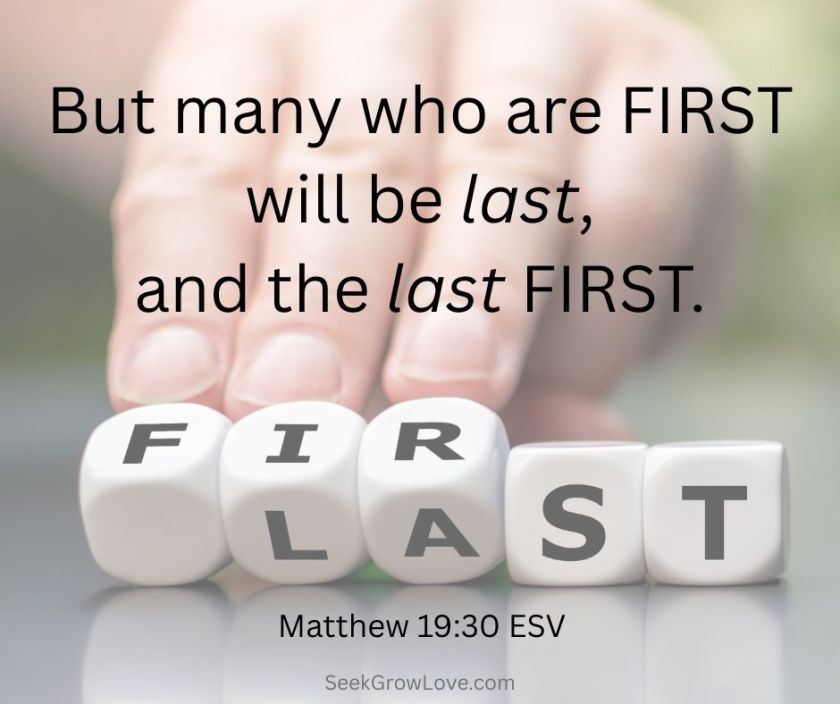
In Matthew 18 we learned that Jesus cares for the lost sheep. In Matthew 19 – we see him calling his disciples to be more like children and making the statement “many who are first will be last and many who are last will be first.” It seems like throughout his teachings, this chapter included, Jesus defines success and portrays the goal of life to be different than what the world is feeding us. Sometimes what the world is forcing upon us.
Psychology Today released an article in 2024 revealing that over the last decade, more Americans polled wanted to be rich than before, more believed that they would be wealthy in their lifetime, and 6 out of 10 interviewed thought they would like to be a billionaire. Granted, the study was also saying wealth does not increase psychological well-being or happiness, but most people still want to be rich. So, that’s us. Then there is Jesus who tells us in such a vivid metaphor that it will be easier for a camel to go through the eye of a needle than a rich man to enter the kingdom of God. So, it will be really really really hard for a rich person to be on the path for eternal life, and that is the only thing that truly matters if we obtain or not. With the vast amount of wealth and material possessions our country has, I think Jesus’ words should make us consider things.
In the opening to Matthew 19, I was struck by some other teachings that are in contrast to what the world teaches us. While reminding the Pharisees that the only reason there even were these “permits to divorce” was because of the hardness of human hearts, Jesus also mentions some significant truths. A man will marry a woman. Period. And “at the beginning, the Creator made them male and female.” (Matthew 19:4). Period. Immediately following these verses Jesus is laying hands on and praying for the children (no thanks to his disciples!). If I ever need reminded to pray for youth, five minutes in a library children’s department (don’t even get me started on the adult or teen!), looking at TV programming targeting youth, social media, the news, literally anything involving technology or a screen, and reading any statistical research on professed Christians and trending beliefs along these subject lines. . . and I am easily reminded to pray. Children are being targeted with agendas of sexualization from a very young age, and it matters. It matters for our churches, our families, our schools, our society, our mental and physical health, and so much more. Unfortunately, I have worked with teen and young adult patients dealing with side effects of interventions associated with this confusion that modern society has allowed. I pray that as we all make decisions on use of time, what we read, watch, laugh at, support, ignore, and how we navigate a very broken world while loving those around us the way Jesus loves. . . that we would continue to seek God’s wisdom and His word for our decisions and how we interact with others.
Jesus assumes the Pharisees were familiar with God’s word, and challenged them saying “Haven’t you read. . .” Today, we live in a world with access to the Bible easier than ever before, but many people simply have not read enough to have conceptualized what God says on topics. Beyond discerning truth, the Bible is so helpful in softening and penetrating our hearts, teaching, encouraging, and enlightening. Before we spout opinions or get riled up by others, before we like, snap, tweet, chat, tick, tock or whatever we do on any of the abundant divisive and confusing subjects in the world. . . let’s make sure we’ve read the words from the author who knows it all and loves us most.
Reflection Questions:
Have you ever felt like a camel trying to get your hump through the eye of a needle? Consider Jesus’s words about what is harder than that.
Why is it hard to be last now even with the hope of being first later? What can help us through those difficulties?
Have you read?. . .
Prayer:
Dear God, thank you for providing easy access to the Bible and the truth written in Your Word. Help us to learn from the teachings of the Bible and practice it daily. Thank you for all you have given us and let us be content with what we have and seek You first above anything else the world offers. Amen.
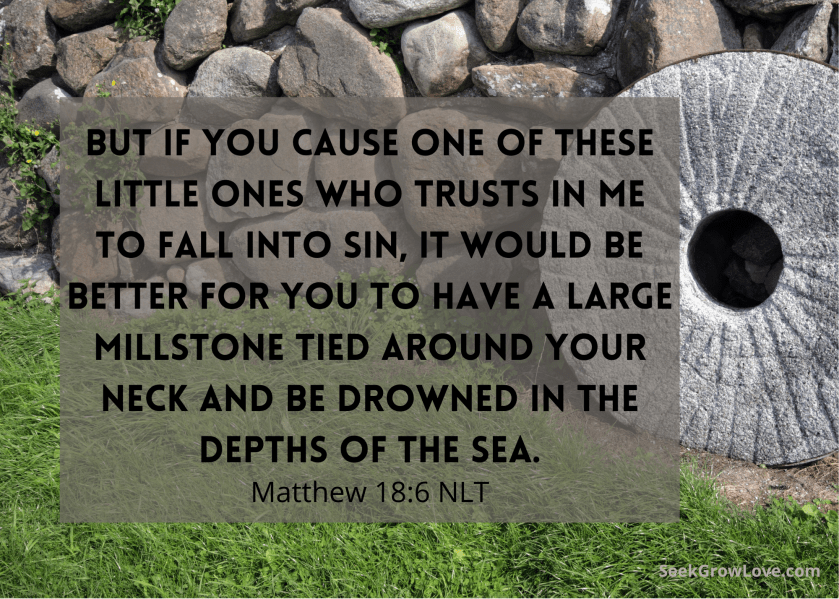
At my house, if I want to do something crazy like grind wheat or coffee beans, I turn on the Vitamix. The cat doesn’t appreciate the noise, but within about 60 seconds, the work is done. In Jesus’ day, the appliance for the same was a millstone. Extremely hard and heavy, millstones are referenced in the Bible a number of times as an illustration that would have been a familiar common item for the readers of the time. First mentioned in the Mosaic law (don’t take someone’s daily sustenance-grinder away in a pledge!), then a deadly weapon being dropped on someone’s head in Judges 9, and even a comparison to the strong chest of the Leviathan in Job…by the time Jesus is talking in Matthew 18, we get the idea that these millstones used for grinding grain were massive. So, when Jesus says it would be better to have one tied around your neck and thrown into the sea than to cause someone who believes in him to stumble…we know that is a big deal to him.
In Matthew 18:7 we are told that things that cause people to stumble are going to come, but we must guard against them. And not just casually. At an intentional, life-altering level at times. There are things that will cause us to sin. And there are people through whom they come. Woe to them per Jesus! The word for “things” used in these verses is also referenced as a stumbling block, offense, or thing that causes people to sin. Many things cause people to stumble, and the conviction or application of this passage to our individual lives is personal. But, some things are pretty common for most of us. In the New Testament time, millstones were common things apparently. In 2026, phones, social media, 24/7 internet access, and artificial intelligence are ordinary. Unfortunately, so are mental health crises, hostile and divisive spirits, unforgiveness, and addictions. Not just to chemical substances. But, also to feeds, constant information, visual input, likes, shares, and the next harder and heavier millstone than “they” have. Or maybe don’t have yet.
I say this not to suggest we should gouge out all electronic devices from our homes/cars/watches and who knows what else and throw them into the sea….. but to recognize that through them, there seems to be a profound struggle going on for our minds, our attention, and the very cognitive abilities God has created us with and given us for this type of self-reflection and sound reasoning. And through them, stumbling blocks are now available far more privately and abundantly than in the millstone days…..they are reading our eye gaze, knowing our weaknesses, designed to addict us, divide us, and distract us. All. The. Time.
However, when we stumble, and when other believers stumble, Matthew 18 showers on us a message that we all need. The shepherd looks for the lost sheep and rejoices when found. The Messiah wants the humble children who don’t know everything. We are called to welcome the lowly. The church has sinners and Jesus tell us how to deal with it. And the last 14 verses of the chapter give a vivid picture of the abundant forgiveness Jesus expects and gives.
As heavy as the millstones were, the weight of sin Jesus lifts is far greater. As we seek to purge the stumbling blocks from our lives, pray to have discernment to even recognize them in a sneaky world, and strive to not lead others astray . . . let us also forgive abundantly and return to the shepherd when we find ourselves lost.
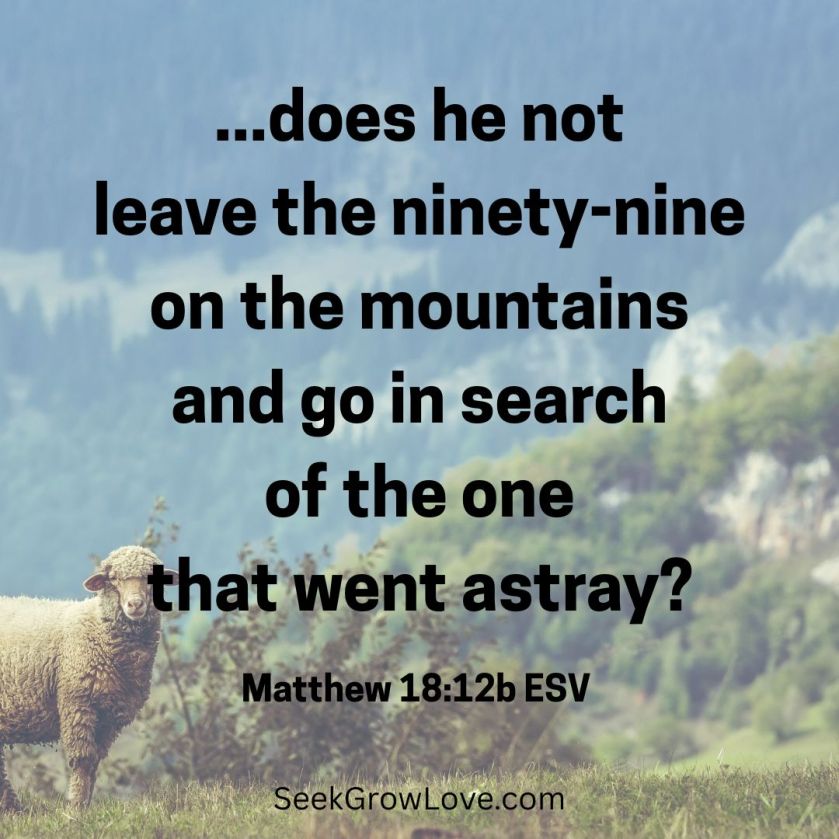
“What do you think? If a man owns a hundred sheep, and one of them wanders away, will he not leave the ninety-nine on the hills and go to look for the one that wandered off? 13 And if he finds it, truly I tell you, he is happier about that one sheep than about the ninety-nine that did not wander off. 14 In the same way your Father in heaven is not willing that any of these little ones should perish.” (Matthew 18:12-14)
Reflection Questions:
Have you ever had someone in your life who helped you from stumbling?
What millstones or stumbling blocks might you need to be freed from today?
Prayer:
Dear God, thank you for providing us a direction to live our lives for You, and for the many teachings of Jesus which infuse wisdom and guidance. Please give us the discernment to recognize possible distractions and stumbling blocks in our lives and the strength to keep our eyes towards You. When we fail, thank you for being our deliverer in our times of trouble and for continually seeking us out. In Jesus’ name, amen.
Ps 4: 3a “But know that Yahweh has set apart the holy one for Himself;…” (LSB)
In Hebrew, the word for “holy” is “qodesh”. Like many of the words that we translate over into English, the original word in Hebrew has a number of meanings and we try to summarize it nicely to the word that most closely matches in our language, but in doing so we also sometimes lose a lot of the “flavor” that the original word encompasses. We translate “qodesh” as “holy”, but it also means “seperated”, “set aside”, and “set apart”. When we read the above verse with that in mind, you can also read it as “Yahweh has set apart the set apart one for Himself” entirely accurately. It’s a clever word play.
But what does that mean? It’s simple, look around you at our society. We live in a world that is rife with sin, carnal images, narcissistic encouragements, pride, immorality, etc. It’s everywhere. We are a people that has largely forgotten about our God, it’s painfully apparent in almost every aspect of our society. God wants us to set ourselves apart from all of this, to remember and honor Him, and to obey His will. In return, He promises that He will set apart for Himself those who set themselves apart. But how are we to do that?
Ps 4:4-5 “Tremble, and do not sin. Ponder in your heart upon your bed, and be still. Offer the sacrifices of righteousness, And trust in Yahweh.” (LSB)
The fear of Yahweh is the beginning of wisdom (Pr 9:10). Fear, and do not sin. Think about God as you’re laying in your bed, and be still. Another translation of “be still” is “quit kicking”, which I’m personally a fan of. This is all about attitude and understanding your place. Acknowledge God as not only your creator, but the creator and master of ALL THINGS, He’s in charge and you’re not. A roommate of mine in college had a fantastic poster that read “2 Foundation Facts for Human Englightment: 1 There is a God, 2 You are not Him.”.
Are you living a righteous life? That is the sacrifice that God requires, not the cattle on a thousand hills, not a specific percentage of your income, not writing the big checks you see on TV that take 2 people to even hold up, but righteousness. It’s a sacrifice, you put aside some of the things you think you’d like to do to set yourself apart and obey God.
Do you trust God? Our society has taught us to trust in ourselves, to trust in the system, to trust authorities, and to trust in our abilities but has largely obscured this critical aspect of trusting in our creator. There are a thousand and one things to distract us, to divert us, to capture our attention and take it away from this critical foundational concept of trusting the God that made us. I will put forth for your consideration that anything you trust in more than God has become an idol to you. Anything that you delight in more than God can become an idol to you, and cause you to focus on things aside from our heavenly Father.
God specifically and repeatedly tells us not to have idols, not to focus on things that are worthless, and remember Him. We look back in history at some of the false gods that the Israelites worshipped and just shake our heads. Then we go back to watching TV, getting on social media, watching movies, trying to get ahead at work, playing video games, reading books, getting a better car/house/mate…anything that diverts and distracts us from what our real job should be; setting ourselves apart and offering up to God the sacrifice of our righteousness and trust. If any of those things is taking more of your focus than you are giving to God, it has become an idol to you. I will tell you a painful reality: if you swim for too long in the sewer, you’re going to smell like poop. Everything that takes your attention away from God is the sewer.
I do trust God, because do you remember the story of the prodigal son? That was me. My Father came running down the road to greet me when I started coming back to Him. I am ashamed that I ever turned aside, and humbled that despite my vast unworthiness, my God came running to me the moment I started back towards Him. I promise, if you have veered off the path, return to God. He will come running to meet you.
In our Matt 18 reading today, in 18:12-14 is the parable of that lost sheep. That was me, too. God came looking for me when I was lost, and found me. Notably, He found me when I pointed my head back in His direction because I heard Him calling; if I would have kept wandering away, who knows what would have happened? In Luke 15:7 it says that when that lost sheep is found, there is rejoicing in heaven. I get a little choked up just thinking about it, God cares so much about me, about you, about all of us, that He is actively seeking us to find ways to bring us home. There is rejoicing in heaven when we start heading back towards God. This should melt your heart, when you realize the depth of love and compassion that our creator has towards us.
So what about you? Are you trusting in the God that loves you and offering up the sacrifice of righteousness to Him? Have the idols of this present evil age distracted you? Are you playing on the field, and not spectating from the seats in the game of life? Here are a few practical daily tips to help you focus on and trust God.
Pray. Not just at meals, but when you wake up, when you shower, before you go to bed, while you’re driving. Let your heart be melted by the love God has shown to you, and reciprocate it back towards God.
READ SCRIPTURE! Daily.
Fast occasionally. It doesn’t even have to be food, take a break from some of the things that distract you from God and spend that time seeking God instead. Man does not live by bread alone, but he also doesn’t live by TV, social media, or anything else that isn’t something that comes out of God’s mouth.
Love others. God doesn’t just want us to love Him, He says that one of the ways that we can show Him that love is to love the rest of His creation. This includes jerks, hostile enemies, addicts, ugly people, people with different cultures and colors, that person who uses weird pronouns, that guy who took your parking spot, the lady who was gossiping about you at work…every other living being is a creation of God, and by loving them (whether we agree with them or not), we honor God.
Do you want to find Jesus? He’s probably in the parking lot at Walmart, and he’s probably hungry. Go buy him a sandwich. (Matt 25:40). Or maybe he’s lonely, in a nursing home, and wants a visit. Or maybe he’s doing time in prison and needs to talk. Or maybe, he’s a lonely widow who can’t mow their own lawn because they’re feeble. Maybe he just needs a ride. Go find him.
REFLECTION QUESTIONS:
What are your idols?
How can you do better at “setting yourself apart”?
What is your biggest obstacle to living a righteous life? How can you change that?
Do you trust God more than yourself? Why, or why not?
PRAYER:
Father God, you have been faithful and kind to me throughout my entire life. Thank you. Please help me to focus on you, to remove the things that distract my focus, and to live a life that pleases you. Help me to be a servant who pleases his master. Lord, look deep in my heart and show me my flaws, and help me to remove them so that I can love you fully. Thank you for sending us your son. Please forgive me of my flaws, and lead me to You, in Jesus name, amen.
What a powerful moment in history. God has redeemed and claimed His chosen people the Israelites, and is laying down a few ground rules for their behavior towards Him and towards each other. The 10 commandments have just been given a few chapters back, and Ex 23 begins with a continuation of some guidelines for interaction. Read through these carefully, do you see a common theme? These rules that God is giving really highlight His character. When I read through these (Ex 23:1-19) what stands out to me isn’t that God wants a bunch of rules followed, but that the character of God is shining through. Look closely.
God is just. God is merciful. God is forgiving. God is loving. God wants us to respect each other, and Him. God will punish the guilty. These characteristics are easily seen by the rules he asks us to follow. When I read these verses, 23:19 really stands out to me: “You shall not boil a young goat in the milk of his mother.”. Why? Because that would be unjust, and not fair. God is so full of love for all of his creation, that he’s concerned with even a baby goat, and is concerned about justice for it. Which makes sense, when you consider that the earth and all that is in it belong to God (Ps 24:1), and you consider the beauty of God’s character.
If we turn ahead a few chapters to Ex 34, God actually tells Moses (1) who He is and (2) what His character is like. This is one of my dad’s favorite verses: “…Yahweh, Yahweh God, compassionate and gracious, slow to anger, and abounding in loving-kindness (or, mercy) and truth; who keeps lovingkindness for thousands, who forgives iniquity, transgression, and sin; yet He will by no means leave the guilty unpunished…” (LSB translation, Ex 34: 6-7). All of the “Children of the Book” agree on the nature of God, because He has revealed it to us. In the Quran 1:3 it describes God as “Most Gracious, Most Merciful.” (a loving nod to some of our Muslim brothers and sisters). I urge us all, let us exhibit God’s characteristics within ourselves, not only to our creator but to our fellow creation.
In Ex 23:20-23 we once again clearly see the concept of “shaliah” demonstrated, and it’s important to note that God actually clearly states “My name is in him”, granting the angel full authority. I suppose the American equivalent would be “active Power of Attorney”, but that doesn’t quite cover the fullness of the concept. We also see Jesus stating clearly in John 17:11 that he has been given this same name, the name of God, so he is acting with the full authority of the God who sent him. If you’d like a more detailed understanding of “shaliah” you can scroll back to the 1/27/2026 devotional, or just ask a jewish person.
In Ex 24, God cuts a covenant with Israel. The phrase “cuts a covenant” was at the time quite literal and involved animal sacrifice and blood, and was considered a binding promise. In this chapter we see a beautiful moment where God speaks to a large number of the priests and elders of Israel and makes a deal with them. In Ex 24:7 it states “Then he took the book of the covenant and read it in the hearing of the people; and they said, “all that Yahweh has spoken we will do, and we will be obedient!”” (LSB translation). Can you just feel the excited vibe amongst these people, who have witnessed an amazing and miraculous covenenat being formed, with the glory of Yahweh “like a consuming fire on the mountain top, in the eyes of the sons of Israel”?
What an amazing event! Never before had something like THIS happened, this was huge! This is what would be described by most folks as a life altering event, something that would change your outlook and destiny, something that would inspire you for a lifetime and change the very fiber of your being for the better. How long do you think something like this would stick in your memory?
40 days, that’s the answer. Moses disappears up the mountain, into the fiery glory of God and is gone for 40 days and nights before it all goes bad. While God and Moses are chatting, the sons of Israel are getting restless. Despite seeing miraculous signs and wonders, if you flip ahead to Ex 32: 1-2 it says “Then the people saw that Moses had delayed to come down from the mountain. So the people assembled about Aaron and said to him, “arise, make us gods who will go before us; as for this Moses, the man who brought us up from the land of Egypt, we do not know what has become of him.” (LSB translation). Forty days. It’s just embarrasing. It’s really a good thing that God is so forgiving and merciful, because that could very easily have been turned into what the scientific minded folk would call an “Extinction Level Event” for the Israelites.
God not only doesn’t wipe them out, but He continues to shelter them, to love them, and to keep them safe and fulfill the promises he’d made both to them and to their ancestors Abraham, Isaac, and Jacob. WHY? Because God always keeps His promises. Because he is the Most Merciful, the Most Gracious.
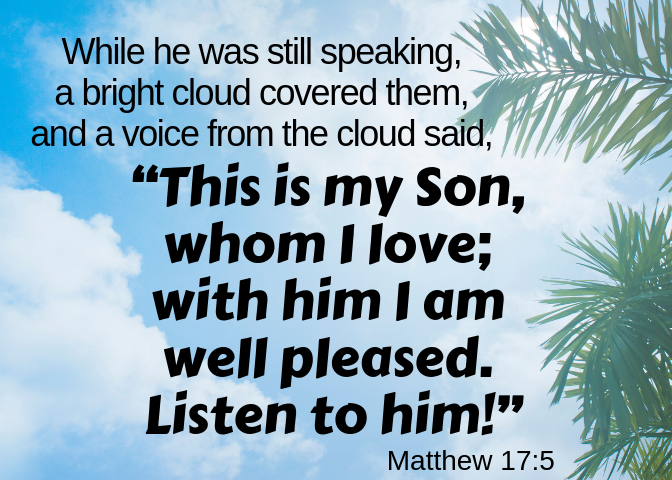
Do you need further proof? Flip over to our NT reading today. In Matt 17:5 God states audibly (for the second time) “This is my beloved son, with whom I am well pleased; listen to him!” (LSB Translation). Then later on, he offers up this man Jesus, His own beloved obedient son, as a sacrifice to grant redemption to humanity and to cut a covenant of salvation. Folks, let me tell you something; I’m a father, and although I absolutely do love a lot of you people out there that I know, if it came to a choice between you and my son…well, let’s just say you would not come out ahead in the equation, I’m sorry. “But God…” (I love that phrase) is the perfection of character, the perfection of love, the highest example of what our own character should be.
What a beautiful God we serve. I know that He is beautiful, because His creation is beautiful. The mist as it gathers at the tops of the mountains is beautiful. The sun arising through the clouds and shedding new light on the world every day is beautiful. YOU are beautiful, as is the entirety of the creation of God, and the voice that spoke all of this creation into being. It should humble and awe you, when you think about the utter depth of the love that God has towards all of His creation. We do not deserve it… “but God…” is the most compassionate, the most merciful, praise His holy name.
REFLECTION QUESTIONS:
Stop for a moment and think. How many times has God done something amazing and miraculous in your life?
How long did it take after that amazing and miraculous thing that God did for you before you “moved on” in your mind?
Why do you think that we, as humans, have this inclination, and what can we do better to hold on to that “awe and wonder” that is rightfully due our God?
Are WE gracious, compassionate, and merciful to our fellow creation? (Answer for all:) What about people of different denominations? Different cultures? Different faiths? Our “enemies”? Why, or why not? What can we do better?
PRAYER:
Father God, thank you.
You are the Most gracious, the Most merciful. Time and time again we have disappointed and failed You, we’ve broken the covenants that we’ve made with You, but You forgive us over and over. Father, help us to have Your character, to love our neighbor as ourself, and to never forget You who gave us life, breath, and all things. Thank You for Your never ending mercies, which are made new every morning. Help us to humbly seek Your face, to obey Your will, and to be servants who please You. Thank you Yahoveh God, in Jesus name, Amen.
In today’s reading, we find our heroes the Israelites 3 months out from escaping horribly oppressive slavery in Egypt and after being led through the harsh desert miraculously arriving safely at Mt Sinai. This is the first time in recorded history that anything like this had ever happened: God has redeemed His chosen people en masse and brought them to Him. This is a direct act of intercession from the hand of a loving God, because He had made promises and covenants with Abraham, and God always keeps His promises. Always, every time, and forever, God keeps His promises. If you remember nothing else from this devotion, remember that.
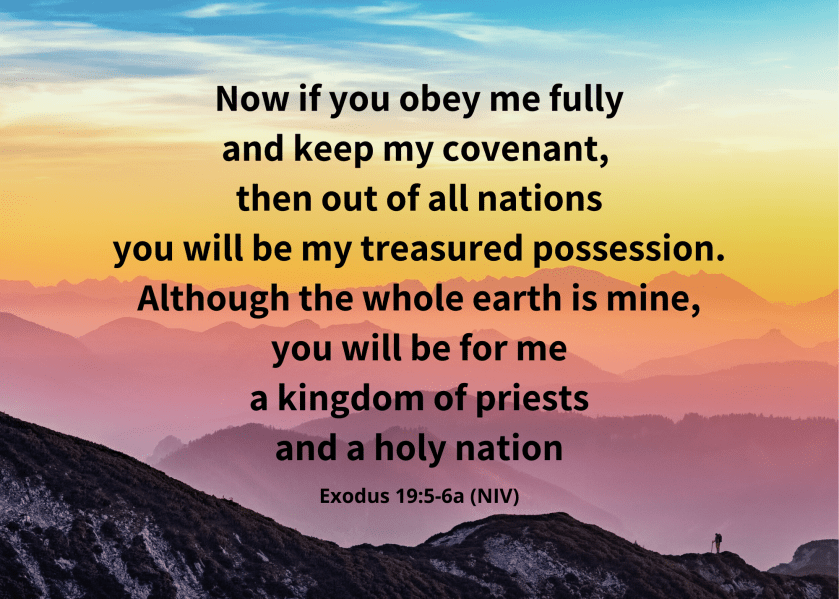
God tells Moses (Ex 19:4-6): “You yourselves have seen what I did to the Egyptians, and how I lifted you up on eagles’ wings and brought you to Myself...”(LSB). That is just beautiful. Pay special attention to 19:5, wherein God clearly states “…for all the earth is mine…” (See also Psalm 24:1). What beautiful imagery! You really need to imagine the setting of Ex. 19; there are most likely millions of people waiting expectantly at the base of the mountain, who all answer together “All that Yahweh has spoken we will do!”, after which God gives them very specific instructions to purify themselves, and then much like to Lt. Dan in the movie Forrest Gump, “…right then God showed up.” Never before had anything like this happened that we are aware of, God speaks to an entire people and gives them the “House Rules”.
This may shock some of you, but I was a rather rebellious child. I remember that the day I turned 18, I thought I had complete autonomy and authority because now I was an adult, and nobody could tell me what to do. Keep in mind that at the time, being a ripe 18 years of age, I already knew everything (most of which I have sadly since forgotten), so I was pretty certain I could just do anything I wanted. I made the mistake of mentioning this to my father at the time to justify a series of extremely poor decisions on my part, in what became a rather fervent discussion. In retrospect, perhaps I was not as smart as I thought I was.
Keep in mind that all of this took place while I was staying rent free in my parents house, the one they’d paid for, paid the bills for monthly, and stocked up with food for my consumption on a regular basis, without any contributions at all from me (aside from my stunning insights and wisdom about my own autonomy, of course). My parents at the time were also paying all of my bills, feeding me regularly, buying me clothes, had bought me a car, etc. So, you know, I was an adult taking care of myself… *ahem* . During this highly needed and educational discussion, my father made the statement “Well, you can absolutely make your own decisions since you’re technically an adult now, but as long as you’re living in my house, you will abide by my rules.”
The conversation that God has with the Israelites in Exodus 20 really strongly reminds me of that conversation, without the fervency perhaps, but with more clarity. Note that God has already defined “My house” in Ex 19:5, so when God is giving us the 10 commandments in Ex. 20 He is basically telling us “when you are living in my house, this is how I expect you to behave,” in advance.
“But…” some folks will say, “these commands were given to the Israelites, they don’t apply to us today as Christians..”. Fair enough, let’s look at what Jesus says about them. Turn over to Matt 19:16-29. In this passage, Jesus first humbly points out that the man shouldn’t call him good because only God is good (which is a bit confusing if you’ve accepted a confusing post-biblical theory about Jesus’ identity), and then states very clearly “…if you wish to enter into life, keep the commandments.” (LSB). Then he goes on to refer to some of the actual commandments, so we know what he’s referring to: it’s right here in Ex 20.
So are we as Christians responsible to keep the commandments? Only if we listen to our Christ, I would say. If you are an adult now, and no one can tell you what to do, and you have full authority and autonomy over your own life, well…you probably, like me at 18, already know everything and you don’t have to listen to anyone, ever (if you didn’t dectect the irony and sarcasm there, read it again slowly).
If, however, you are a humble Christian, seeking to please both Jesus and his God (yes, Jesus has a God, see John 20:17) then you may want to rethink that. You are, after all, living in God’s house. You should probably abide by His rules; particularly if you want a room in the kingdom, on the new earth that has been promised (and God always keeps His promises). Trust me when I tell you, you do NOT want to get kicked out of His house.
I love how God clearly identifies himself to his people, this has been grossly altered in most modern bibles, but what God actually says to preface his commandments is; “I am Yahweh your God, who brought you out of the land of Egypt...” (Ex 20:2, LSB). So we know exactly who’s talking. Then he lists his expectations while we’re living in His house. The first 4 commandments have to do with us and our interactions towards God. The next 6 commandments have to do with us and our interactions towards our fellow man(kind). These are all neatly summed up by our king, the Christ, in Mark 12:29-34 when Jesus says that the greatest commandment is “Hear O Israel! The LORD our God is one LORD, and you shall love The LORD your God with all your heart…”, and the second is this, “you shall love your neighbor as yourself.” Please note that this does not REPLACE the original commandments given by God, but summarizes them nicely.
Praise God that we serve a God of clarity and not confusion, He tells us His expectations right up front, and then lets us make our own decisions about whether or not we will listen and obey. We serve a wonderful, powerful, and amazing God who has shown that He will intercede on behalf of His people in miraculous and powerful ways throughout the scriptures, which cannot be broken. The only real question is: are we going to listen and obey and thereby be God’s People? Choose now for yourself, but as for me and my household, we will serve Yahweh the living God, who has sent us our Christ in order to bring us to Himself.
REFLECTION QUESTIONS:
Do you keep all of the commandments? Why, or why not?
Read Gen 2:3.Do you believe the 4th commandment (the Sabbath) is just for the Jews? Why, or why not? When did it change, if it did?
When Jesus summarized the commandments in Mark 12, did it seem like commandment keeping alone was sufficient to enter the future Kingdom of God, or was there something else we should do? Summarize in your own words what else we should do, if you feel like there’s something else.
PRAYER:
Father God, you have created us and this place, and all things belong to you. Thank you for giving us life, and breath, and all things. You are beautiful. Every blessing that we have has come directly from your hand to us, an undeserving and rebellious people. Please forgive us, and teach us, and help us to follow your commandments. Lead us toward your kingdom, Father, and help us to enter into it. In Jesus name we pray, Amen.
In our Exodus reading this morning, we see once again that after a string of miracles and rescues, the Israelites are grumbling; to the point that Moses tells God he’s worried about them stoning him (17:4). God miraculously provides yet again for their provision, and then miraculously provides for their safety and security (17:11-13). Then, some of the in-laws decide to stop by for a visit (18).
Moses’ father-in-law Jethro comes to visit and sees an overwhelmed Moses, struggling from sunup to sundown daily taking care of the (very demanding) people he was leading. Keep in mind, this was not a small group, this was likely millions of people (Ex 12:37-38 “600,000 men, not counting the little ones (or women), and a foreign multitude also”) all clamoring for his attention at once. Can you even imagine the chaos? Jethro gives Moses some VERY good advice (18: 17-23) that applies to us today as well: organize and prioritize if you want to get results, delegate if you have to. I think we too many times take on more than we can reasonably accomplish, and don’t have a good plan to do it, and just end up getting frustrated and upset. Many times we just give up because we feel overwhelmed. But couldn’t we take Jethro’s advice, and plan better? If we organize ourselves, and approach our problems systematically, they become less overwhelming. This applies to every aspect of our lives: work, social, spiritual. We could actually have written the entire devotional on just this bit alone, but there are some other VERY important scriptures in today’s reading.
Moving on to our second portion of scripture today (Ps 2), we see some absolutely critical theological points that need to be highlighted (in your bible) and remembered . Do you remember what “Christ” or “Messiah” means? It ‘s a title, and means (literally) “The Anointed”. It represented a man who was chosen and anointed by God (usually through his agent, or “shaliah”…see Jan 27 devotional) to be his king, it’s all throughout the Old Testament, check and see. The Hebrew “Messiah” (or “Christos” in greek) means simply “the anointed one” and the term came to be one of prophetic expectation waiting for God to send his king to rule the earth (See 2nd Samuel 7 for the details of the prophecy, we’ll get deeper into that one in a later devotional). The New Testament continuously states that Jesus of Nazareth was this man anointed by God to be His king on earth by reiterating it over and over when describing him as “Jesus Christ”. That’s not his last name ya’ll, that’s a title (I’m Southern, I’m allowed to say “ya’ll”, it’s culturally appropriate). Most of the gospels directly state that the purpose for their writing was to show that Jesus was that Messiah, and that he had come, in their thesis statements.
In Psalm 2:2 it says “The kings of the earth take their stand, and the rulers take counsel together, against Yahweh and against his Anointed, saying…” (LSB Translation). We see clearly here that there are 2 individuals that the kings and rulers are taking a stand against. This does not match up with what some mainstream orthodoxy teachings relate, but this is stated explicitly and repeatedly in scripture and we know from Jesus that “scripture cannot be broken”. This is one of the many reasons why it is so absolutely critical to study for yourself, and not rely on people to tell you what you should believe. Men are just human, and can fail, but scripture cannot be broken(John 10:35), so read it for yourself (and show your work). Be a good Berean, and test everything that you hear against the scriptures. Our God is a God of truth and not deception, so if something you are hearing from men confuses you, study scriptures! If you can read Deut 6:4 and Mark 12:29-34 and not be fiercely monotheistic, like the ancient Jews, then you have learned mental gymnastics worthy of an olympic level athlete…but why change it? Man was made simple, his complex problems are of his own devising (Ecc 7:29).
Ps 2: 11-12 states “Serve Yahweh with fear and rejoice with trembling. Kiss the Son, lest He become angry, and you perish in the way…”(LSB), another clear delineation between our creator and our king. It is terrible and sad that we have confused this simple message through the centuries, whenever possible I suggest we should with love, patience, and respect suggest the simpler reading to our brothers and sisters who have reached a different, more “complex”, understanding. In instances that opportunities present themselves for you to do this, may I humbly suggest that “love” is far more important for you to convey than truth. The truth will come in time, if presented deeply with love, according to God’s will.
To wrap this up in a nice tidy bow, we can then turn over to Matt 16, where one of the clearest statements of Jesus identity is made by his guy, Peter. First let me pose you this question, what is a son of man? I would respectfully answer this with the very common sensical answer of “a man”. What if you capitalized that, and said a Son of Man? Well, I’d have to say, still a man: although this does have prophetic overtones (See Daniel 7, and note again the clear delineation between God and his anointed). Did you know that in addition to God using his name (YHVH) almost 7000 times in the Old Testament, Jesus is referred to as the “son of man” (add capitilization however you like, the NT translators did…) 81 times, and 80 of those times were by Jesus himself in the gospels. A “son of man” was how Jesus self-identified. It’s pretty important to remember that.
In a conversation about identity, Jesus asks Peter who people were saying that he was (Matt 16: 13-14). To further clarify who he was, Jesus asked Peter “but who do you say that I am?”. Peter replies, “You are the Christ, the son of the Living God.” Remember that Christ and Messiah mean the same thing, anointed one. I would like to point out the obvious at this point and say that God has no need to anoint himself. By his statement Peter is clearly stating “You are the one that was anointed by God, and the son of the Living God”. This is in a direct fulfillment of the prophecy in 2 Sam: 7 wherein the Messiah MUST BE: 1-the son of David (a human descendant of King David), 2-the son of God, 3-the king who will rule forever. Note Jesus response to this answer in v17: “Blessed are you Simon Bar-Jonah, because flesh and blood did not reveal this to you, but my Father who is in heaven” (LSB). If Peter was mistaken about Jesus’ identity as the Christ, this would have been an excellent opportunity for Jesus to correct him don’t you think? Just some things to think about, may God bless you as you study his word.
REFLECTION QUESTIONS:
What can you change in your approach, like Jethro suggested to Moses, to more effectively govern your own life? Your own work? Your own spirituality?
When Jesus says that scripture cannot be broken, he is referring to the scripture they had at the time, the Old Testament. How often do you take time to “stand by the ancient ways” and read the Old Testament deeply? Why?
Do you check everything the pastor tells you from the pulpit against scripture? Why, or why not? Now think of the same question, but instead of your pastor insert “anyone”, and instead of the pulpit insert “youtube”, “social media”, or “friends”. Is your answer different? Why, or why not?
Who do you say that Jesus is? Is it different than Peter, and if so, why?
PRAYER:
Lord God Most High, please open my eyes so that I can see clearly. Please open my ears so that I can hear clearly. Circumcise my heart, so that I can walk humbly before you. Thank you for sending your son with your words to teach and redeem us all, please help us to listen and to obey. Forgive us our pride, and grant us humility and understanding. Thank you, in Jesus’ name, Amen.


 Seek Grow Love