The Overwhelming Compassions of God

Nehemiah 9-10

Everyone needs compassion. Our gracious God, the ultimate source of love and mercy, readily extends compassion to us when we face the great challenges in our life.  But it doesn’t stop there.  God is not “deservingly” showing compassion to us because we have made sacrifices for his namesake.  He overwhelms us with compassion when we deserve it the least.  When our ears have been deaf to his calling, when our back has been turned, when our eyes are glistening with selfish pride, that is when he is most compassionate.  It is pretty simple:  life is best lived in and by the design of God.  Anything else is to be pitied.  But we do not serve a God of overwhelming pity.  He doesn’t stop at, “man, that stinks, wish you would have made some better choices there, bud.” He picks us up in our filth, gives us the full concentration of his blessings, and turns our feet back on the path that leads to him.  Over and over again. Undeservedly. In today’s reading, we get a quick lesson in the history of compassion of Israel from Abraham to Nehemiah.  Draw some (rather easy) parallels to your own life as your study this account of the rich mercies of God.

“But they, our ancestors, were arrogant;  bullheaded, they wouldn’t obey your commands. They turned a deaf ear, they refused to remember the miracles you had done for them;…And you, a forgiving God, gracious and compassionate, Incredibly patient, with tons of love – you didn’t dump them.” – Nehemiah 9:16 MSG

  1. God still has compassion for you, even after you have been arrogant.  You can attempt to go it alone.  God doesn’t give up that easily.  When the miracles no longer come, when the blessing subside, and you decide to turn back, he doesn’t merely say, “told you so.” He says “turn around, I’m still here.”

“Yes, even when they cast a sculpted calf and said, “This is your god Who brought you out of Egypt,” and continued from bad to worse,  You in your amazing compassion didn’t walk off and leave them in the desert.”  – Nehemiah 9:18 MSG

  1. God still has compassion for you, even when you don’t give him credit.  Oh, how we like to take credit. How scorned are we when we don’t get the little credit due to us?  And we haven’t really done anything.  It would be simple enough to say, “Good luck in the desert by yourself,” yet God hears the cries of his people and comes rushing in to, again, fight the battles.

But then they mutinied, rebelled against you, threw out your laws and killed your prophets, the very prophets who tried to get them back on your side— and then things went from bad to worse.  And in keeping with your bottomless compassion you gave them saviors: saviors who saved them from the cruel abuse of their enemies.  – Nehemiah 9:27

  1. God still has compassion for you, even when you stab him in the back.  That’s right, literal stabbing of prophets delivering the word of God.  Maybe you are not guilty of such a crime, but openly denying the word of God delivered to you in your life is an equal abuse of the Word of God.  That’s pretty much what sin is.  But guess what?  Those who openly and defiantly deny the gospel, receive sanctification and redemption through Jesus Christ if they make him the Lord and Savior of their life.  Your confession is never rejected, if done so from the heart.

But as soon as they had it easy again they were right back at it—more evil. So you turned away and left them again to their fate, to the enemies who came right back. They cried out to you again; in your great compassion you heard and helped them again.

This went on over and over and over. They turned their backs on you and didn’t listen. – Nehemiah 9: 28, 29 MSG

  1. God still has compassion for you when you return right back to your sin.  That’s right, we are almost cartoonish in our behavior sometimes.  Do the sin.  Ask for forgiveness. <5 min later> Do the sin.  Ask forgiveness.  Thankfully, we have a God of infinite mercies, BUT as Paul says our goal is not to exhaust the grace of God.  If you haven’t figured it out, somewhere in our sinful nature is the habit to turn back to sin, but we must try to actively stop or flee from it.  God is unfatigued with extending his compassions if we truly seek him through repentance.

You put up with them year after year and warned them by your spirit through your prophets; But when they refused to listen you abandoned them to foreigners. Still, because of your great compassion, you didn’t make a total end to them. You didn’t walk out and leave them for good; yes, you are a God of grace and compassion.  – Nehemiah 9:30,31 MSG

  1. If you’re reading this, God still has compassion for you.  You are not abandoned.  It may feel foreign because you have pitched a tent outside the wall, but there is NOTHING that can separate us from the love of God in Christ Jesus.  Maybe you’re seemingly satisfied to be out there for now.  Man, that’s awful.  You will not receive even the pity of men if this is where you stand.  But God looks compassionately upon you, and leaves the gate open, giving every opportunity to be a part of his grace, love, forgiveness and hope.  There is a time limit though, an end game. Once you stop breathing, it’s over.  There are no guarantees when this will be.  An even more compelling argument than “no guarantees” is every moment you are not living in the presence of God, you walk around heavily burdened with sin, guilt, doubt, and shame because you don’t know His compassion.  He will take it all from you and cast it as far as the east is from the west.  Stop. Turn. Cry. Listen. Let go. It is time to let His compassion overwhelm you.

–Aaron Winner

Today’s Bible reading passages can be read or listened to at Bible Gateway – Nehemiah 9-10 NIV or – from The Message Nehemiah 9-10 and 1 Corinthians 11
The Shack of Your Choice

Nehemiah 7-8

Nehemiah’s vision is complete.  The wall of Jerusalem has been repaired and the Jews reestablished their home, yet there is much to contemplate.  It would be easy to focus on what isn’t present at this moment.  Generations have passed away in captivity and exile, to close their eyes in death as slaves.  The present state of a skeletal city is a reminder that there is still so much work left to do to bring Israel to its former glory.  There are fears of the future and the foes taking camp around a city that is trying to put itself back on the map.  Instead of being driven by doubt, regret, or worry, Nehemiah and the priest of Israel establish the completion of the wall as a time to celebrate the return of God’s people.

Nehemiah said, “Go and enjoy choice food and sweet drinks, and send some to those who have nothing prepared. This day is holy to our Lord. Do not grieve, for the joy of the Lord is your strength.” – Nehemiah 8:10

As God’s timing would have it, the completion of the wall shared a seam with the Festival of Tabernacles of the Feast of Booths and the words shared from the Laws of Moses.  You may be familiar with this week-long celebration from your earlier reading this year, but this might be a good time to summarize the origin and purpose of this festival.  God had redeemed his people, the Hebrews, out of enslavement in Egypt.  He did this through sending a series of plagues to Egypt, parting the Red Sea, and giving his commandments.  There were a few bumps in the road.  The Jews spent a great deal of time wandering in the desert because of their lack of faith and disobedience, yet he remained with them wherever they were, and he still blessed them with receiving the Promised Land, the very place where Nehemiah and those who followed him out of exile had returned.

We don’t serve a God who is solely responsible for the harvest.  We don’t serve a God who is solely responsible for the rain. We serve a God who works in the harvest, and works in the rain, but also works on the days that are in between. We may endure a great deal of prosperity or adversity, but ultimately, we take count of the blessings and realize that compared to eternity and the Kingdom of God, we are just living in booths, moving, temporary structures built from our feeble attempts to gather a few sticks or a few bricks.  After a long journey, we may seek to call it home, but it won’t be, right?  It is only a place to eat a few meals and get some rest until we no longer want it, it is destroyed by the elements, or someone else is enjoying it because we are pushing up daisies. 

The whole company that had returned from exile built temporary shelters and lived in them. From the days of Joshua son of Nun until that day, the Israelites had not celebrated it like this. And their joy was very great. Day after day, from the first day to the last, Ezra read from the Book of the Law of God. – Nehemiah 8:17,18a

Therefore our home as we wait is not established in a certain location, but is rooted in the Word of God – in our Savior Christ Jesus, The Word and Cornerstone. Additionally, His Word, is the saving knowledge of the Gospel testified to by the Living Word, that is meant to be shared with all, especially those who have not prepared (v.10).  The harvest has not yet come, so we could be freshly stepping out of captivity, like the Hebrew or those returning from Babylon.  If this be the case, there is a lot to do to ensure our initial success – like create some solid boundaries.  Maybe we feel as though we are in exile, we are a far cry from the person who was once called Christian. Listen to God’s calling.  Recognize his blessings.  There is a promised land, even for those who wander (and truly, only for those who wander).  No matter the season, God is there, and the greatest of harvest is coming soon.  Enjoy this spectacular vista from the shack of your (but really, God’s) choice.

-Aaron Winner


Today’s Bible reading passages can be read or listened to at BibleGateway here – Nehemiah 7-8 and 1 Corinthians 10

Crumbling Walls and Stumbling Blocks

Nehemiah 3-4 and 1 Corinthians 8

It was just a week ago, at the close of summer school, when a student poignantly asked me if I had ever been a bully. Hmm.  My gut answer was immediately, “No.”  Well, at least I don’t think so.  Right?  Then he referenced a sheet of paper he read outside the door to my classroom that stated “Mr. Winner is a bully, but in a good way.”  Truth. I remember seeing this phrase as I freshly hung up papers from my former students to my incoming classes.  The forms they filled out were entitled “10 Things to Know about Mr. Winner’s Classroom.” While the more consistent items were “Mr. Winner will throw things at you,” or “Mr. Winner will make sure you won’t go hungry,” or “Mr. Winner really cares,” there were two people who listed “Mr. Winner is a bully” but with the comforting caveat “in a good way.”  I literally scratched my head as I tried to dissect the information in front of me for a moment.  Maybe I am a pusher? Or do I tease the students too much?  Or bully the bullies creating some ironic form of verbal justice? I didn’t come to a clear conclusion, but I reflected a bit more on my past and present.  I responded, “I think I’ve been a bully before, but I am doing my best not to be.”

Like all of us, I often think before I speak.  This happens significantly less at 36 than a half of a lifetime ago at 18, but my words can be quite cutting when my pride is wounded.  I have a rapier wit sharpened through the first-world sufferings of low self-esteem and some extra weight in high school (and at other points in my life too).  While some mighty say that my rebuttals to ridicule were simply justified self-defense, I know I have often lost control and engineered shock-and-awe offensive assaults.  At several points in my life, my tongue has been an unbridled mess (James 3).  While there is more restraint over words today, neither can I stop craving the attention they give, nor can I shake the overwhelming urge to be right.

Now out of the dark recesses of psyche and into today’s reading.  In the Old Testament (Nehemiah 3,4), we get a detailed look at the many groups who return to rebuild the walls of Jerusalem under the direction of Nehemiah.  They are faced with two named nemeses, Sanballat and Tobiah, who openly criticize what they deem as futile work.  In the New Testament (1 Corinthians 8) Paul deals with the issue of food, specifically food that isn’t deemed clean by the conditions of the Law, and speaks to the nuance between licensed actions and actions of the conscience.  Both beg the question of what our response should be when faced with open criticism to what we know is correct.

“Tobiah the Ammonite, who was at <Sanballat’s> side, said, “What they are building—even a fox climbing up on it would break down their wall of stones” – Nehemiah 4:3

“Hear us, our God, for we are despised. Turn their insults back on their own heads. Give them over as plunder in a land of captivity. Do not cover up their guilt or blot out their sins from your sight, for they have thrown insults in the face of the builders.  So we rebuilt the wall till all of it reached half its height, for the people worked with all their heart.” – Nehemiah 4:4-6

It is easy to be distracted from an important purpose to respond to bullies who are critical because of their own malice, jealousy, or ignorant nay-saying.  If you are shaken by their words, then your next step should be to consult God through his Word and in prayer before continuing.  If he approves, then being despised by the right people can truly be a wonderful thing (James 1:2-4 — said by someone who also loves to be liked).  What arrows will find their mark if God is on your side? Let God handle the frustrations (v.15) and land the blows. Save your wit.  Hold your tongue. You won’t cross the finish line running your mouth; you must use your feet to run his race.  “Yes” and “no” are sufficient replies, (Matt 5:37), and it’s okay to be on your guard, (v.22), but you must continue your efforts to build His kingdom.

“Be careful, however, that the exercise of your rights does not become a stumbling block to the weak.” – 1 Corinthians 8:9

But should we ever care about what others think?  Paul, inspired by God, says we MUST consider the feelings of our brothers and sisters in Christ (and those who we are speaking the words of God to).  Culture and maturity play roles in what is and what is not perceived as permissible. While we may have license or liberty to enjoy certain things, like dancing, indulgent foods, clothing trends, worship music styles, or maybe a glass of wine, not everyone is on the same page about all of these things.  You may very well have the scriptural support that gives you the greatest of freedoms, but if they are not requirements to be a follower of Jesus, they are discrections NOT worth causing a divide in the body of Christ.  You are not justified in bullying someone into your belief or preferences (again, if it is a permission and not prescription). In fact, Paul adds , “(12)When you sin against them in this way and wound their weak conscience, you sin against Christ.” So being “right” by the law, but wrong by the heart is the most ironic form of sin. See: legalism.


Circling back, in the context of my classroom, I hope the words “bully in a good way” are just a lack of expression of some more positive quality that I possess that is a little more like Jesus and a little less like the man I am trying to flee from. However, in the context of our reading, being a bully, even if it is in a good way, doesn’t get a ringing endorsement.  God wants us to work diligently to fulfill his calling.  Some days it is as simple as denying ourselves a certain privilege for the sake of unity. Other days it can be a bit more difficult, carrying on big callings while being openly criticized and attacked.  In either instance, God wants others to see more of him and less of us as he works to rebuild the biggest of crumbling walls and remove the smallest stumbling blocks.

–Aaron Winner

Today’s Bible reading passages can be read or listened to at BibleGateway here – Nehemiah 3-4 and 1 Corinthians 8

Overcoming Apathy

Reading for Today:

Nehemiah 1-2 … 1 Corinthians 7

The story of Nehemiah begins in about 445 B.C.  The same ruler of Persia, Artaxerxes I who had sent Ezra to Judah thirteen years prior, was still emperor of Persia. We don’t know a lot about Nehemiah, but we do know that he was a Jew who had risen to be the cupbearer to the king (1:11).

The cupbearer’s job was a position of considerable importance. That Nehemiah was in such a position shows that some of the Jews who had been exiled rose quite high in the ranks of the governments where they had been resettled.

Living in the lap of luxury, Nehemiah may never have even known of the plight of his fellow Jews. And once he found out, he could have easily ignored it. But we will see that he did hear of it and he did act on what he heard…even being willing to leave his high position in order to serve.

Some people prefer not to know what’s going on in the world because information might bring obligation. There’s an old adage that says, “What you don’t know can’t hurt you,” but I think we all know that’s not true.

Nehemiah knew what was going on in Jerusalem because he asked.

“And I asked them concerning the Jews who escaped, who had survived the exile, and concerning Jerusalem…” (1:2)

When we truly care, we want to know the truth, no matter how difficult it may be. Aldous Huxley said, ‘Facts do not cease to exist because they are ignored.’  Closing our eyes and ears to the truth could be the first step toward tragedy for ourselves as well as for others.

Are we like Nehemiah, anxious to know the truth even about the worst situations? Are we the kind of people who care enough to ask?

“Each of you should look not only to your own interests, but also to the interests of others” (Phil. 2:4)

Once Nehemiah heard of the plight of the Jews in Jerusalem, he was burdened.

As soon as I heard these words I sat down and wept and mourned for days, and I continued fasting and praying before the God of heaven.” (1:4)

He heard of the condition of Jerusalem’s wall and knew the situation was desperate. Without a wall, people returning to Jerusalem after years in captivity would be unprotected and vulnerable to attack.

Nehemiah was brokenhearted, but he didn’t tackle that problem immediately. This is something I love about the book of Nehemiah. He prays. A lot.

The state of Jerusalem’s wall reflected the condition of the people’s relationship with God. Disobedience had left their city and their lives in disarray. So, before Nehemiah could fix the brokenness surrounding the city, he asked God to fix the brokenness inside the people of the city. This was the foundation everything else would be built on.

Then he took action on the wall.

This is a pattern that would be wise for all of us to copy, I think.

  • Actively seek out need.
  • Feel the burden.
  • Pray. A lot.
  • Take action.

We’ve had a couple of different people present at our church in the past year on the travesty of child sex trafficking. The latest statistics show that around 2 million children are currently being trafficked into sex slavery. Every 26 seconds a child is trafficked.

According to one perspective, child sex trafficking is the worst atrocity we’re facing today.

While looking simply at sheer numbers, abortion may affect more children, but as I heard it aptly stated, “There are worse things than death.” In fact, one of the draws of human trafficking is that people (unlike drugs) can be sold and resold–used and reused. Every 26 seconds.

You’ve heard.

Do you feel the burden?

If you would like some specific ways to pray and perhaps take action, here are a couple of resources you can check out:

Operation Underground Railroad
https://ourrescue.org/

Destiny Rescue

The Storyteller Café (this local project is in my community, just 5 minutes from our home!)

https://www.storytellercafemn.org/

You can also check out the online shop here:

https://www.storiesfoundation.org/store

-Susan Landry

Today’s Bible passages can be read or listened to at BibleGateway here – Nehemiah 1-2 and 1 Corinthians 7

With Great Joy

Nehemiah 11-13 & Psalm 126

Now that the wall’s been built, the city secured, and they’ve read from the Book of the Law to relearn God’s ways, it’s time to dwell in Jerusalem and the

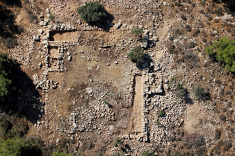
cities.  The leaders were designated to live in Jerusalem and the people cast lots to see which one out of every 10 would dwell in Jerusalem.  The rest would dwell in cities surrounding Jerusalem.  I lived in Israel 25 years and for most of the time we lived in a little village 10 miles west of Jerusalem.  It’s a mountainy and rocky area forested with some trees.  Most villages and Jerusalem were built around a water source, perhaps some type of spring.  Pictured is a photo of ruins of a Nehemiah period fortress in the hills of Judah near Jerusalem. (This photo courtesy of Israel Department of Antiquities.)

            It was a time of rejoicing.  Singers had built themselves villages all around Jerusalem (12:29). Also, two large Thanksgiving choirs with specific names and place locations are listed.  It’s amazing the record we still have today of the detailed descriptions of their locations. Also, great sacrifices were offered for God had made them rejoice with great joy.  The joy of Jerusalem could be heard from afar.  It’s amazing on the quiet of a shabbat or holiday when places are closed the noise that can be heard from a greater distance.  Psalm 126 says with singing they returned from captivity.  There must have been a joy to be back in the land of Israel again after being exiled. Though they “sow in tears, they’ll reap in joy.” At our oldest daughter’s wedding I told this to people as I wept, that I sowed in tears (such hard work raising kids overseas) and now I was reaping and weeping in joy, not out of sorrow but gladness that we made it to that day!! 😊


        Nehemiah returned after some time to Jerusalem and like a good parent had three firm corrections to make.  First, Eliashib, the priest, allowed Tobiah (Ammonite official) to have a large storeroom for himself, where articles and supplies for the Levites, singers, gatekeepers, were to be kept.  Thus, he threw out Tobiah’s things and cleansed the storeroom for proper use.  Then he asked God to remember him. (13:14) Secondly, he contended with the people for buying and selling on Shabbat and commanded the gates be shut and not open until after the Shabbat.  In current the state of Israel, every Friday afternoon stores, including all the malls shut down all over the country and remain closed until after sundown on Shabbat (Saturday), once two stars are visible.  Some weeks with holidays, the malls are closed for THREE full days!… Nehemiah prayed that God remember him. (13:22) Lastly, he contended with some of them, cursed them, struck some of them, and pulled out their hair, and made them swear not to give their children to foreigners!  That’s quite aggressive and zealous. Imagine the uproar he’d receive from all kinds of people and media today for those actions! But he prayed and asked God remember him for good. (13:29,30)

-Stephanie Schlegel

Today’s Bible passage can be read or listened to at BibleGateway here – Nehemiah 11-13 & Psalm 126

Tomorrow’s reading will be our last book of the Old Testament – Malachi – as we continue on our 2020 Reading Plan. God has great things in store! Come follow along!

Feasting on His Word

Nehemiah 8-10

Now that the wall of Jerusalem was completed the people gathered together at the Water Gate to have Ezra read from the Book of the Law of Moses on the first day of the seventh month (which was actually last weekend on the Jewish calendar and the Feast of Trumpets. It’s not really the Jewish New Year, that was adapted from a later time in exile. The first month of the Jewish year is Passover). It states NINE times that “all the people” are included in the events happening in chapter 8.  The priests even helped the people to understand the readings, (8:8) and the people responded with WEEPING (8:9). Nehemiah encouraged them to go and “eat fat and drink sweet” for this day is holy to the Lord. They weren’t to be sad, for “the joy of the LORD is your strength.” (8:10) They knew the words were declared to them.

 The second day they gathered again to hear the Law and learned that in the seventh month they were to dwell in booths for a week.  They were to go to the mountains and gather olive branches, myrtle, palm, and leafy branches to make a booth.  The other day on my fast walk in the neighborhood I plucked various leafy bushes to add to the pop-up booth card I’m making to send to our grandson next week. 😊   I’m going to also include some fruit snacks he can enjoy by his “booth” as a celebration of the end of the harvest season. In Israel today, where we lived for many years, they still make and “dwell” in booths during this weeklong holiday.  They’re on rooftops, balconies, and yards.  They’re decorated with paper chains, lights, and pictures. Our kids liked to sleep in them some nights with their friends.  The people in Nehemiah’s time hadn’t celebrated the Feast of Booths/Tabernacles since the time of Joshua, so it was a time of “great gladness” (8:17), and still is to this day. Although, this year might be different as they’re on a full lockdown in Israel during these holiday times because of Covid.   

            They continued to read the Book of the Law for a ¼ of the day and for another ¼ of the day they confessed their sins and worshipped the LORD their God. (9:3) Some of the Levites stood up and recalled God’s work through Moses, Egypt, Wilderness, and how He brought them into a good land.  However, they “cast His Law behind their backs and killed prophets sent to them.” (9:26) So God “gave them saviors” when they cried out for help and many times delivered them. (9:27) “For many years You had patience with them and testified against them by Your Spirit in Your prophets, yet they would not listen.” (9:30)

Now therefore, our God, the great, the mighty, and awesome God, who keeps covenants and mercy… (9:32) You are just in all that has befallen us.” (9:33) How patient God was and is with His peopleIt says not the kings, princes, priests, or fathers have kept God’s Law.( 9:34)  How important it was for all the people to gather together and recall God’s work over time and their own lack of commitment, and thus to refocus their love and service for the LORD their God for the future.  Now that the wall of Jerusalem had been rebuilt, they needed God’s protection over them. Instead of blaming God for failures, it’s good they acknowledged they were wrong and refocus on Him as they move forward.  We too, can learn from their example in our lives today.

Stephanie Schlegel

Today’s Bible passage can be read or listened to at BibleGateway here – Nehemiah 8-10

Tomorrow we will finish the book of Nehemiah and read Psalm 126 as we continue seeing God’s faithfulness in our

Overcoming the Opposition

Nehemiah 6-7

So much work had already been done – the walls of Jerusalem had been rebuilt – now they just needed to finish the gates. Surely this project was God-ordained and he picked the right leader for the job – Nehemiah. He was able to get everyone motivated and working together, and despite the opposition they were able to finish their job on the 25th of Elul (which appears to correspond to somewhere between Sept 15 and October 2). So, this week is a super time to celebrate the work that is accomplished when working for God.

So much good had been done already – but the work did not end and neither did the opposition!

Nehemiah was under attack. Satan (along with Tobia, Sanballat, Geshem and the rest of those fighting against God) were using every weapon at their disposal to bring this righteous leader down: lies, fear, wolves in sheep’s clothing, attempting to distract him from his work with other business, spreading gossip and accusations of sedition to either silence him or get him in serious trouble with the authorities, even hiring a false “prophet” to scare him into sinning.

But Nehemiah stood strong. We continue to see him turn to God in prayer. Asking for strong hands and asking for God to take care of those getting in the way of the Lord’s work. He obviously had a strong knowledge of God’s law to not be tricked into sinning. This gave him wise discernment in knowing who to listen to and what to do, and not do. And, he knew to fear God not men.

We can learn a lot from Nehemiah today because Satan keeps using the same ploys. Adolf Hitler wrote, “Mental confusion, contradiction of feeling, indecisiveness, panic; these are our weapons.” Evil men seeking to destroy God’s work have come and gone and yet remain today. It is indeed a vivid reminder that, “Our struggle is not against flesh and blood, but against the rulers, against the authorities, against the powers of this dark world and against the spiritual forces of evil in the heavenly realms.” (Ephesians 6:12 NIV). They love nothing more than trying to interrupt God’s work and if they can bring down a godly leader at the same time they probably get bonus points.

We see so much of this evil and oppression today. But like Nehemiah, we must not give up! We must turn to God again and again when faced with the lies and fears and Satan’s strong man tactics that would love to have us throw in the towel and take the easy way instead. Pray, fast, seek His word and His way, don’t fear man, resist sin, use discernment in knowing who to trust, what to say and do. Pray, too, for our leaders that they will have the wisdom and strong hands of Nehemiah

Satan has been running rampant and the result is a broken world. Keep at God’s rebuilding work – one brick at a time.

Marcia Railton

Speaking of our opposition, mental confusion, lies, panic, and pleasing man not God, reminds me of the life and death fight for the most innocent of God’s creations. Tonight would be a great time to watch See Life 2020 and #LoveEveryHeartbeat. And pray for strong hands – and hearts – to do the work God wants you to do.

Today’s Bible passage can be read or listened to at BibleGateway here – Nehemiah 6-7

Tomorrow we will read Nehemiah 8-10 as we continue seeking God on our

Response to a Broken World

Nehemiah 1-5

I love the man Nehemiah! I love his passion, his prayers and his “get ‘er done” action. At the start of our story he holds the position of royal cupbearer to King Artaxerxes, so we can assume he is no slacker but is quite driven, reliable and trustworthy. He has spent his whole life in Babylon/Persia, and done very well in this “foreign” environment. But kudos to those who raised and influenced him, for his Jewish heart was still steadfast in serving the God of Abraham, Isaac and Jacob and his ancestors.

It had been 90 years since the first group of Jewish exiles had returned to Jerusalem. And just 13 years ago Artaxerxes had allowed Ezra to return to rebuild the temple. Nehemiah learns some have just come from Judah and he asks them how his “homeland” is doing. And what he hears breaks his heart. It is natural to be heartbroken at bad news. But for a lot of people the heartbreak is soon replaced with other feelings – perhaps relief that it didn’t happen to you, perhaps just busy-ness with other daily activities. But Nehemiah mourned, fasted and prayed (with confession) for several days when he heard that the people of Judah were still in distress and the walls of Jerusalem were still torn down. Just as this was breaking God’s heart, Nehemiah allowed his heart to be broken, too. And as he prays and fasts he listens for God’s answer, and just like Esther he too uses the position God has placed him in to be a part of the solution. If you find yourself mourning what God mourns, and you don’t know what to do…follow Nehemiah’s example with prayer and fasting and watch for God’s plan to develop – and then do it!

I won’t retell the rest of the story that Nehemiah tells so well – but make sure you catch some of the neat details that we would do well to remember when we seek to do God’s work.

Nehemiah was scared to death going before the king – this was not an easy thing to do, and it could even cost him his life – but doing God’s work is always worth it.

Even as the king was asking Nehemiah what he wanted, Nehemiah was praying away! He knew he wasn’t doing this on his own – and he would continue to give God the credit for the king’s generosity and for the work that would be done.

Nehemiah didn’t try to build the wall on his own. There was something for everyone to do – and Nehemiah got them going. The city officials, the temple servants, the families, the daughters, even the goldsmiths and the perfumers were out there working. Certainly most of them would never have said their spiritual gift was rebuilding walls – but Nehemiah provided the leadership, the need was presented to them and, most of them, were ready to roll up their sleeves and get to work. What job is God calling you to do with your brothers and sisters?

I would have loved to see Baruch the son of Zabbai complete his section of the wall – Nehemiah reports he “zealously” did his work. This wasn’t a half-hearted effort for him. Will you be known as one who zealously does the work of the Lord?

The world didn’t stop to applaud God’s construction team – in fact, God’s people faced much opposition, ridicule, anger, threats and violence from many sides. It would have been easy to give in to their fears and give up. But instead, they responded FIRST with prayer and then they kept at it – with one hand to do the work and one hand to carry the weapon to defend themselves if needed. They meant business. They looked after one another and once again commited themselves to finishing the job God gave them.

Nehemiah also stood up for those who had been taken advantage of and he corrected those who had performed acts of injustice for their own selfish gain.

The world could sure use more leaders like Nehemiah. How will you step up? There is much broken in our world today. What is breaking your heart and God’s? Begin with prayer and fasting. And then continue with prayer as you attack God’s work with wisdom and action even in the face of opposition. His work is always worth it.

-Marcia Railton

Today’s Bible passage can be read or listened to at BibleGateway here – Nehemiah 1-5

Tomorrow we will read the next two chapters in Nehemiah’s story as we continue on our journey through the

Can you believe next week we start the New Testament!

Hallelujah – Praise God – Amen

Nehemiah 11-13

picture1

picture2

Sunday, December 11, 2016              

Today’s Bible reading wraps up some of the bleakest days in Israel’s Old Testament history due to the exile of God’s chosen people. Nehemiah’s courageous leadership prompted walls being restored and repaired to fortify Jerusalem. The precious contents of the temple could now be protected and temple service could begin again. A re-population of the Holy City was beginning to take place and the ancient promises of Yahweh were again being demonstrated to His people when they worshiped Him only.

The bulk of chapters 11 & 12 basically read as a holy “roll call.” While the inclusion of the long list of names do not make for much intriguing reading, (comparable to phone book reading for pleasure perhaps), it should prompt the reader to understand how a God of detail fondly remembers those who have been faithful to the cause, working to restore and revive His name.  These were brave families returning to a city in ruins, desperate to see God’s glory shine again in their land.

The end of chapter 12 sets the scene for one of the greatest days in the history of this holy community – a party of all parties! Imagine the pageantry of a redeemed people taking back their rightful place as they occupied the strategic places of Jerusalem and dedicated the walls. The atmosphere must have been electric and how the people must have rejoiced.

In chapter 13 it is apparent that Nehemiah returned to the king of Babylon for an undisclosed amount of time. Upon return to Jerusalem he finds that some of Israel’s enemies are residing and thriving within the city once again. He is outraged and leads a purging once again of foreign worship and mixed marriages. He institutes financial support of the temple and demands observance of the Sabbath.

He concludes the chapter and book by asking God to fondly remember him with favor for the work he has done there.

Reflecting over today’s reading this entire account reminds me of an upcoming event where new residents will move in, dedication and reforms will begin to unfold, and great service will be remembered in celebration. A “changing of the guard” of our own Church of God of the Abrahamic Faith headquarters will soon be taking place. Slated for the second week of January 2017, a new CEO, Chief Executive Officer, will begin to learn and assume duties as the leader of our General Conference and Bible College in Atlanta, Georgia. I am diligently praying for Seth Ross as he takes the baton from Dr. Joe Martin to lead our organization. I hope you are too.

The Book of Nehemiah provides a great illustration of how prayer and hard work can accomplish seemingly impossible things when a person determines to trust and obey God. Nehemiah was a man of responsibility, vision, prayer, action, cooperation, and compassion. Thank you, Dr. Joe, for displaying those same qualities over the years. We are excited about the future as Seth Ross, another dedicated leader, takes the reins to rightly divide the Word of Truth and the work of God in our conference. May it be our prayer that just as in Nehemiah’s day, many will hear and answer the call to follow as well. May you remember us all with favor, O God, as we long for your Son’s return and work for Your renown!

Julie Driskill


Julie Driskill is an encourager who celebrates the process of Divine pilgrimage wide open.  She’s never met a stranger and her distinguishable laugh is a dead give away in a crowded room.   

Receiving a B.A. in Education from the Clayton State University, Morrow, GA, she jointly attended Atlanta Bible College where she studied and worked for several years.  Julie’s philosophy of life revolves around service.  One of her favorite life quotes is “Service is the rent we pay to be living.  It is the very purpose of life….and not something you do in your spare time.” – Edelman

With the steadfast support of friends and family over the past twenty years she has pursued this goal of service by developing and implementing the work of Higher Ground Camp, an Ohio based 501 (c) (3).    

For the past two years Julie has expanded her duties to collaborate with Family & Youth Initiatives, of New Carlisle, Ohio, as an in-school educator for the Real Life Teen Choices Program. She teaches sexual risk avoidance curriculum to students in grades 6-12 in public and private schools in eight counties. Developing after-school leadership programs and peer to peer mentoring networks for at-risk youth has become her specialty.


Maybe I Should Apologize

Nehemiah 8-10

nehemiah-8-10

Saturday, December 10

After the wall was completed the people gathered at the square which was in front of the Water Gate and they had Ezra read the books of the law to them and had them explained to them.  The people were so moved that they bowed down low and worshipped the LORD with their faces to the ground.  Nehemiah and Ezra told the people not to mourn but to keep the day as holy to the LORD, to go and feast and be filled with joy because the LORD is their strength.  They were encouraged to make shelters of branches to help celebrate.  This was the custom that was known as the feast of booths or tabernacles that is celebrated to this day by the Jews.  Ezra read the law daily for the entire celebration lasting 7 days, and then there was a solemn service held on the eighth day.

After the reading of the scriptures something very interesting and dramatic happens.  The Jews separate themselves from any foreign people in their city and they fasted and smeared ashes and dirt upon themselves, wore itchy sackcloth, and confessed their sins and the iniquities of their fathers.  Then in the hearing of the people the leaders told of the goodness of the LORD to the people throughout generations past.   Telling of all His mighty deeds.  Then the people all sign an agreement to follow the commands as God laid them out in His law, and to live holy and pleasing lives to the LORD from that time onward.  This national repentance and reconciliation was done in order to please the LORD.  Whenever God’s people do what pleases Him, His blessings are soon to follow.

What catches my eye about this is that the people hold a national time of repentance.  Could you imagine what would happen if we tried to do this today?  I’m sure the news stations would be all over it in an instant.  Watch out CNN!  The interviews could be quite interesting , and could lead to some very juicy gossip to be sure.    The point is that people today rarely apologize for anything.  They  find it even more hard to change their ways .  You may have some examples of  people you know who don’t apologize when it would be appropriate to do so.  You might also know people who say they are going to change their ways but find it difficult to set any new pattern in their behavior.  Personally, if I had a dime for every time I’ve heard a person struggling with addiction say they are going to quit – I would be very rich indeed!  I’m not saying that it is impossible for a person to change but it is in reality quite difficult for people to change their attitudes which are then reflected in their actions.

The Jews had this same difficulty.  They had a national time of repentance and even signed the document but as history unfolds we can see that they were not very good at keeping their promise to God.  It’s important to keep your promises to God.  Repentance is all about changing your ways.  It’s good to apologize to God when appropriate but even better is to change your behavior so that you don’t have to be in the situation where you need to apologize!  God wants us to be sincere in our words and our deeds.  Are there any of your actions that you need to apologize to God for, and change?  What do you think is the first step you can take to help change your ways so that they are pleasing to God?  God’s blessing follows true repentance.  What blessings do you think God might have in store for you when you are in right standing with Him?

-Merry Peterson