How to Discipline

Proverbs 19

My last devotional for this week comes out of Proverbs 19:18. It says, “Discipline your son while there is hope, and do not desire his death.” After doing this for a week now, the first portion of this passage made me immediately think about Amon. Remember him? He was that king of Judah that was murdered by his servants after reigning for only 2 years. He did evil in the sight of Yahweh. His father, Manasseh, also did evil in the sight of Yahweh but eventually repented and renewed his status with God. I had commented to myself on paper, thanking God for repentance – as there’s still time for it. What if you don’t have the time like Amon? What if you don’t even know that repentance is an option? This is why we are commissioned! Find those Josiahs and let them know the good news!

Discipline your son while there is hope, and do not desire his death… Why would any good parent desire their child’s death? My studies this week have also led me to some wisdom, I think, regarding the latter portion of this verse in Proverbs. I don’t think I would have understood the latter part if I hadn’t immersed myself in the word for a week. Words mean something. This is a wise, powerful statement that lets us know we DO desire our children’s death if we don’t take action to discipline them. We’ve got a great commission in our own homes if we are parents.

I have been wanting to do a study on child-rearing for a while now. Since I desire that my children live, I started by looking into discipline as it is demonstrated in the word. I found that my idea of discipline was nothing like what discipline actually meant in the bible.

Look at the Old Testament and how God, through Moses, disciplined the children of Israel in comparison to the New Testament and how God, through Jesus disciplined.

Deuteronomy 11:1-13 (NIV)

11 Love the Lord your God and keep his requirements, his decrees, his laws and his commands always. Remember today that your children were not the ones who saw and experienced the discipline of the Lord your God: his majesty, his mighty hand, his outstretched arm; the signs he performed and the things he did in the heart of Egypt, both to Pharaoh king of Egypt and to his whole country; what he did to the Egyptian army, to its horses and chariots, how he overwhelmed them with the waters of the Red Sea[a] as they were pursuing you, and how the Lord brought lasting ruin on them. It was not your children who saw what he did for you in the wilderness until you arrived at this place, and what he did to Dathan and Abiram, sons of Eliab the Reubenite, when the earth opened its mouth right in the middle of all Israel and swallowed them up with their households, their tents and every living thing that belonged to them. But it was your own eyes that saw all these great things the Lord has done.

Observe therefore all the commands I am giving you today, so that you may have the strength to go in and take over the land that you are crossing the Jordan to possess, and so that you may live long in the land the Lord swore to your ancestors to give to them and their descendants, a land flowing with milk and honey. 10 The land you are entering to take over is not like the land of Egypt, from which you have come, where you planted your seed and irrigated it by foot as in a vegetable garden. 11 But the land you are crossing the Jordan to take possession of is a land of mountains and valleys that drinks rain from heaven. 12 It is a land the Lord your God cares for; the eyes of the Lord your God are continually on it from the beginning of the year to its end.

13 So if you faithfully obey the commands I am giving you today—to love the Lord your God and to serve him with all your heart and with all your soul—

Let’s go through this passage carefully. Through Moses, God disciplined the 12 tribes of Israel (the children of Israel). He disciplined them by first showing them his majesty, or who he was (Yahweh God!). Who he was could be recognized by the works he did (e.g., signs, miracles, plagues). He rescued them (from Egypt) and defeated their enemies (Egypt in the red sea). Along their journey to the promised land, he performed miracles to sustain them in the wilderness (e.g., manna, water from a rock). He got rid of the people among them who were insolent and tried to usurp Moses (i.e., Dathan and Abiram; Korah).

He then disciplines the children of Israel by telling them to obey the commandments they were given (i.e., obey the law of Moses) so that they would have strength to enter the promised land. He entices them to obey the law of Moses by describing how wonderful their hope is. In it, they will have long life and it will be well with them. In it, they will have good things (flowing with milk and honey). It is a land they won’t have to tend themselves (like they did in Egypt) to receive the good things in it. The good things will be sustained through heaven. To me, the last verse shows God’s heart. He cares so much about that land that he desires to give to his children.

Now let’s look at the New Testament and the discipline of God through Jesus. He pretty much does the same thing but gives greater honor and authority to Jesus since Jesus literally is the one who rescues the people.  

In the New Testament, Jesus disciplined the 12 disciples by showing them who he was (is) (The Son of God! The Messiah – pretty much described throughout the whole book of John). Who he was (the Messiah) could be recognized by the works he did in their presence. There were some pretty distinctive works he did that pointed to himself as the Messiah (i.e., Isaiah 35:5-6a “Then the eyes of the blind will be opened and the ears of the deaf will be unstopped. Then the lame will leap like a deer, and the tongue of the mute will shout for joy.).

It is Jesus himself who rescued them from their enemy (sin and death) by his death on the cross. Once seated at the right hand of God in heaven, it is Jesus who sustains them along their journey to the Kingdom of God (KOG). Post resurrection, it’s up to them (and us) to do these final things to enter into the KOG through Jesus. Jesus is the bread of life and he is the rock of our salvation who provides living water. He chastens us by pruning us along our journey (e.g., If your right hand offends you, cut it off – get rid of the people and things in your life that try to usurp Jesus as Lord of your life because they’ll prevent you from entering the KOG).

Jesus disciplines us by telling us to obey the Law of Christ (i.e., Love God and love people like Jesus loved). We need to obey these commandments so that we will have strength (through the receiving of the holy spirit) to enter the KOG.

The love of Christ compels us to obey by enticing us with the good things in the KOG, our hope. In the KOG, we will live forever with Jesus (and eventually with God himself). God will wipe away every tear from our eye; sin and death will be no more (the incorruptible crown; the crown of life). In it, we will be rewarded with good things, positional rewards based on how we built upon the foundation that was laid for us (built upon Jesus) (the crown of rejoicing; the crown of righteousness). If you’re an elder in your church, you’ll receive a crown of glory!

Once there, we won’t have to labor like we do now to enjoy the KOG. There will be a river of the water of life flowing from the throne of God and from the lamb. In it will be the tree of life on either side of the street with 12 kinds of fruit. The leaves of the tree will be for the healing of the nations. I realize that this may not all be literal. All I really know is that it will be unimaginably good and that God and my Lord Jesus will be there, so I’d like to be there too.

And then for my correlation of the last verse. I can only imagine the joy Jesus must have when he thinks about the coming KOG. It is his reward. He’ll be ruling the whole world from the new Jerusalem. I think this was God’s plan all along, with Jesus in mind as the king of his kingdom before the foundation of the world, to a people whose desire is for them whom they love.        

Going back to the Old Testament passage, we see that not all of the children of Israel were witnesses to God through Moses. Therefore, he instructs them to discipline their children who were not witnesses. An example of discipling for the children of the children of Israel who were not direct witnesses was laid out for us in Deuteronomy 11.  

Similarly, not many of us were direct witnesses to Jesus’ ministry on earth. Therefore, he instructs his disciples to discipline the rest of us who were not direct witnesses. I believe that through the power of the holy spirit however, we too can be called witnesses of Jesus, and are therefore also commissioned to discipline our children and others (the Josiahs). An example of discipling for us is laid out in the new testament, beginning with the gospels.

Can you say amen?

-Juliet Taylor

Today’s Bible reading passages can be read or listened to at BibleGateway here – 1 Chronicles 5-6 and Proverbs 19
The mouth speaks out of that which fills the heart

Proverbs 17-18

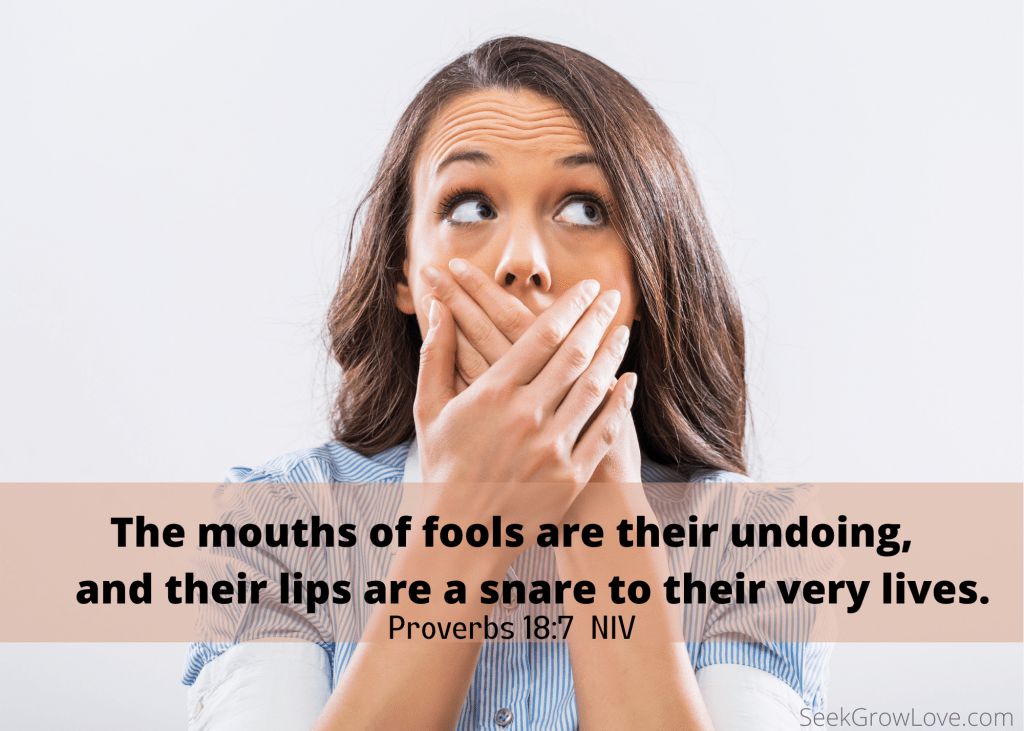
The book of wisdom says, “Death and life are in the power of the tongue, and those who love it will eat its fruit.” (Proverbs 18:21). I understand this scripture to mean that we have the power to speak words to others unto life or words unto death, so we should choose our words carefully. If we love to talk, we better make sure our speech represents who we are because we become what we speak (eat your words). Our words are death and life to our own bodies.

I keep coming back to the issue of the heart. I know we need to have a heart for God if we desire to be with him and his son in the Kingdom of God. But how do we really know if we have a heart for God? The heart can be seen in the things we do that correspond with Jesus’ commandments (love) that we must do to enter in. Works are fruit but works can be deceiving if the heart behind the works is not motivated by love. Mathew 7:15 – 23 says:

15 “Beware of the false prophets, who come to you in sheep’s clothing, but inwardly are ravenous wolves. 16 You will know them by their fruits. Grapes are not gathered from thorn bushes nor figs from thistles, are they? 17 So every good tree bears good fruit, but the bad tree bears bad fruit. 18 A good tree cannot produce bad fruit, nor can a bad tree produce good fruit. 19 Every tree that does not bear good fruit is cut down and thrown into the fire. 20 So then, you will know them by their fruits.

21 “Not everyone who says to Me, ‘Lord, Lord,’ will enter the kingdom of heaven, but he who does the will of My Father who is in heaven will enter22 Many will say to Me on that day, ‘Lord, Lord, did we not prophesy in Your name, and in Your name cast out demons, and in Your name perform many miracles?’ 23 And then I will declare to them, ‘I never knew you; depart from Me, you who practice lawlessness.’

The people speaking to Jesus in this passage are shocked that Jesus doesn’t know them. The works mentioned in this passage do outwardly appear to be good fruit. Fruit can look good on the outside but can be rotten on the inside.

It can be difficult to identify bad fruit sometimes. If you really want to know if you’re producing good fruit or not, there is one particular fruit that’s pretty transparent, at least to the people we’re around the most. Our words are a good indication of what’s in our hearts.

Here’s a similar passage from Luke’s perspective in Luke 6:43-47:

43 For there is no good tree which produces bad fruit, nor, on the other hand, a bad tree which produces good fruit. 44 For each tree is known by its own fruit. For men do not gather figs from thorns, nor do they pick grapes from a briar bush. 45 The good man out of the good treasure of his heart brings forth what is good; and the evil man out of the evil treasure brings forth what is evil; for his mouth speaks from that which fills his heart.

46 “Why do you call Me, ‘Lord, Lord,’ and do not do what I say? 47 Everyone who comes to Me and hears My words and acts on them, I will show you whom he is like: 

Jesus has a little more to say about the mouth in Mathew 12:30-37:

  30“He who is not with Me is against Me; and he who does not gather with Me scatters.

      31“Therefore I say to you, any sin and blasphemy shall be forgiven people, but blasphemy against the Spirit shall not be forgiven. 32“Whoever speaks a word against the Son of Man, it shall be forgiven him; but whoever speaks against the Holy Spirit, it shall not be forgiven him, either in this age or in the age to come.

      33“Either make the tree good and its fruit good, or make the tree bad and its fruit bad; for the tree is known by its fruit. 34“You brood of vipers, how can you, being evil, speak what is good? For the mouth speaks out of that which fills the heart35“The good man brings out of his good treasure what is good; and the evil man brings out of his evil treasure what is evil. 36“But I tell you that every careless word that people speak, they shall give an accounting for it in the day of judgment. 37For by your words you will be justified, and by your words you will be condemned.”

James gives us even more clarity about the power of our speech in chapter 3:5-12:

So also the tongue is a small part of the body, and yet it boasts of great things. See how great a forest is set aflame by such a small fire! And the tongue is a fire, the very world of unrighteousness; the tongue is set among our body’s parts as that which defiles the whole body and sets on fire the course of our life, and is set on fire by hell. For every species of beasts and birds, of reptiles and creatures of the sea, is tamed and has been tamed by the human race. But no one among mankind can tame the tongue; it is a restless evil, full of deadly poison. With it we bless our Lord and Father, and with it we curse people, who have been made in the likeness of God; 10 from the same mouth come both blessing and cursing. My brothers and sisters, these things should not be this way. 11 Does a spring send out from the same opening both fresh and bitter water12 Can a fig tree, my brothers and sisters, bear olives, or a vine bear figs? Nor can salt water produce fresh.

Are you noticing as I am that some of the scariest, most convicting verses in the bible for a supposed Christian regard our speech? We must tame our tongue. To tame the tongue we must change our hearts.

By examining our own words, we can tell if we have a heart for God or not. I think it’s a really good indication about our destiny too. If you really want to know if you are producing good fruity speech, ask those who are closest to you how they perceive your speech towards them. If they aren’t on the receiving end of your good fruity speech, that’s not good. Be prepared with your response. If you don’t like what you hear, how will you respond? Choose your words wisely.

If you know you will have trouble responding with good fruit, prune your speech! You might find it helpful to practice not saying anything at all. Proverbs is chock-full of verses that tell us that there is wisdom in keeping our mouths closed. Even a silent fool is considered wise if he keeps his mouth shut. We can use that silent time to pray for wisdom and words of life and in the meantime, practice our sacrifice of praise to God, which is the fruit of our lips that give thanks to his name.

-Juliet Taylor

Today’s Bible reading passages can be read or listened to at BibleGateway here – 1 Chronicles 3-4 and Proverbs 18

Led Astray by the Sweet Aroma

Proverbs 5

Have you ever tasted vanilla extract? Vanilla extract is a kitchen ingredient that has a decadent scent. Whenever I use it in recipes, I am always tempted by its sweet vanilla aroma. However, I know better because of giving into this temptation when I was a young child. I remember when helping my grandma make cookies, I smelled the extract. It smelled so nice. So, I tried a bit and quickly spit it out as it was very bitter. Did you have the same reaction?

Vanilla extract smells as though it should be pleasing to the taste buds, but it leads us astray. It is, in fact, not delicious as its scent would make us believe. It instead leaves us with the desire to wash our mouths out.

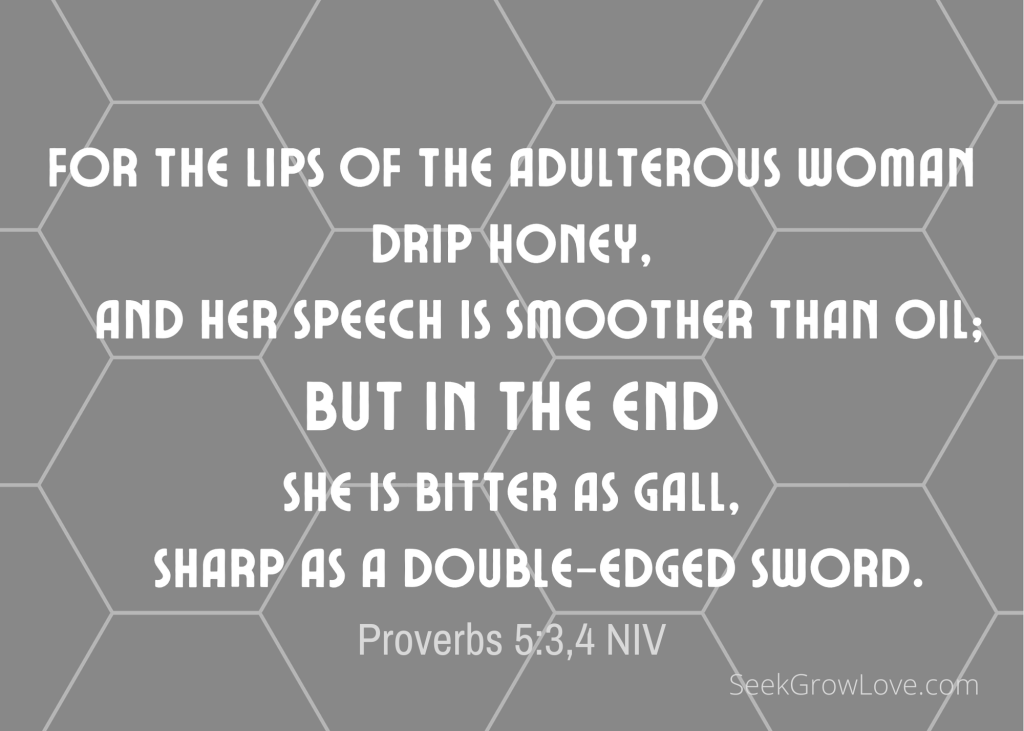
In Proverbs 5 an adulteress in mentioned. The adulteress, it reads, has lips that drip honey, but in the end are actually bitter. Much like the seductive nature of the adulteress, so is sin in our lives. The things that tempt us may look good at first. But in the end will only be bitter to us. What looks pleasing to us in the moment, may not be so pleasing if we fall into the temptation.

The book of Proverbs time and time again tells us to listen to instruction so that we may be able to stay away from temptation. My grandma had told me that the vanilla extract was bitter and that I would not like it. But I didn’t listen. I could have avoided the bitter taste, but I was led astray by the sweet aroma. I forsook her instruction for the vanilla extract that looked pleasing in the moment.

-Hannah Deane

Today’s Bible reading passages can be read or listened to at BibleGateway here – 2 Kings 1-2 and Proverbs 5

Watch Your Step

Proverbs 4

Have you ever seen the videos of people walking down a street when suddenly they fall in a construction hole? They were too busy watching their phone screen that they did not look where they were going. Because they were not watching, they stumbled and fell into something that was well marked as being dangerous. Maybe you have experienced something like this yourself.

Sometimes in life we can be like this. In our walk of faith, we don’t pay attention like we should. Something other than the path draws our attention and we stumble. In those videos, the person usually walks right into a construction zone that is marked with bright orange cones and construction tape. It is not a secret that what they are walking into is dangerous. However, they refuse to look at their path and keep walking regardless.

Proverbs 4:25-27 tells us to look ahead and to keep our eyes fixed on the path ahead. When we allow our eyes and our thoughts to be distracted by other things, we are more likely to fall into the pit. We need to instead put our eyes away from such distraction and turn to the LORD. We need to keep our eyes on Him and His Word so that when temptation comes our way, we can see it and turn from it. Just as Proverbs reiterates, we need to listen to instruction. Instead of ignoring the warning signs, we need to avert our path away from them. We need to follow the directions that guide us away from the hole. We need to keep our eyes on the path.

-Hannah Deane

Today’s Bible reading passages can be read or listened to at BibleGateway here – 1 Kings 21-22 and Proverbs 4

The Instruction Booklet

Proverbs 1

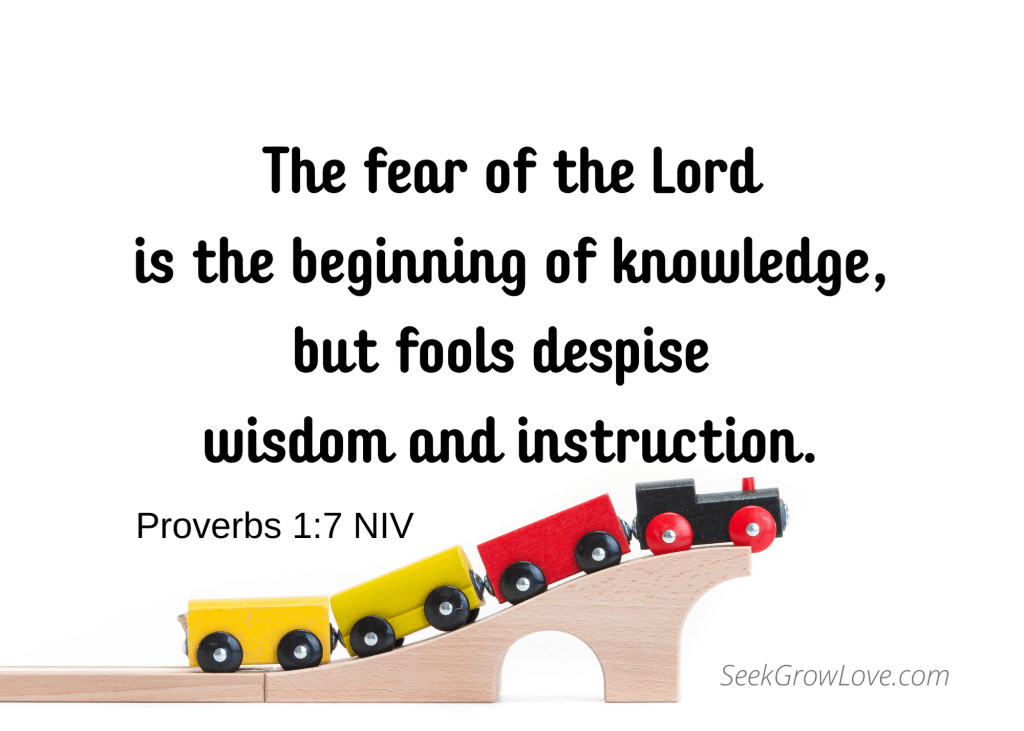
Have you ever tried to help a child put together a toy train track? There are so many pieces and in the end they are supposed to make a complete track. Some of the pieces make sense and, well, others are like that onion ring you find in an order of fries. No instruction booklet is included, so you are on your own. You attempt to put the train track together yourself based off of what you think it looks right. If you are like me, the end result is a train track with very strange turns and a dead end. It is not the complete figure eight as pictured on the box. If only the factory had sent some sort of instructions, then perhaps you wouldn’t be in this fix.

In Proverbs 1, we learn from that, “the beginning of knowledge is the fear of the LORD”. It tells us that only fools despise the wisdom and instruction that they receive. The Bible offers us so much instruction on how to live our lives. Proverbs tells us to walk in the way of wisdom and here we are told that to be knowledgeable we must look to God. He is the foundation of knowledge and only through Him and the heeding of His word can we hope to access true wisdom.

It is encouraging to know that, unlike the factory and the toy train, God gave us an instruction booklet. He didn’t expect us to just figure it out, but God gave us His word so that we may have wisdom and know Him. Sometimes, though, when we are going through hard times, it can be difficult to remember to go to Him and His word for guidance. Like with the train, the instruction booklet may not have been included, but I could have Googled it. Sometimes we get so caught up in the moment that we forget to look for wisdom and instruction.

-Hannah Deane

Today’s Bible reading passages can be read or listened to at BibleGateway here – 1 Kings 15-16 and Proverbs 1

Dad!

Proverbs 30-31

Proverbs 30 4c NIV sgl

I doubt there are too many devotions over the last two chapters of Proverbs that are mostly aimed at the topic of Fathers, but for whatever reason or coincidence, here we are on Father’s Day – and our assigned Bible reading includes the Proverbs 31 superhero – the Wife of Noble Character.  But, I was surprised to see how many passages popped out to me regarding dear old dad and our relationship with him.

First of all, we run into an interesting passage of rhetorical questions about who can control the wind and water and established the ends of the earth?  “What is his name, and the name of his son?  Tell me if you know!”  (Proverbs 30:4 NIV)  I read some very differing commentaries on this passage and I feel a lot like the writer of this proverb, Agur, who confessed, “I am the most ignorant of men,” (Proverbs 30:2 NIV).  I do not have a full understanding of the Almighty God.  I can’t grasp His eternal greatness and power and all the deeds He has done  – and will do.  But, I am thankful that I DO know who created this spinning world we call home, the sun that warms it just right, the water cycle that refreshes it, the plants and animals that provide beauty, nourishment, and joy, and the families that inhabit it.  I marvel at the power, ingenuity and love of my Heavenly Father and the chance to be called His child.  And, I love, love, love, that He has a Son and I know his name is Jesus.  And this son Jesus would display his family resemblance to His dad by exerting power over the wind and the waves.  He would be given the most difficult but beautiful task of drawing us sinful creatures to His perfect Dad.

Poor Agur lived at a time when this plan of God was not yet revealed, but only hinted at here and there.  So, he was left asking – “Tell me if you know?”  If you know your Heavenly Father and what His Son has done so that YOU can be called a Child of God – who will you tell today?  Make it a Father’s Day that counts by telling someone about your Heavenly Father and His Only Begotten Son and the opportunity opened for them to have a perfect Dad, too.

I am so blessed that my father (and mother and grandparents and church family) on Earth did tell me – and many others.   Thanks, Dad!  It has been an honor to respect and try to live up to my dad.  I had a good one (and doubly blessed with a good father-in-law, too!).

There is a depressing passage of those who are haughty, disdainful, teeth for swords (heard any of that lately), devouring the poor.  And the FIRST description of these evil and hurtful people are, “There are those who curse their fathers…” (Proverbs 30:11 NIV) Can you think of any ways our society may have unknowingly become quite expert in cursing our fathers.  In so many sitcoms the father figure is stripped of all respect and is a bumbling goofball.  In giving women their “rights” we have neglected the responsibility and rights of dad.  And, then it sadly happens on a personal level, too.  Even in good Christian homes, sometimes.  How can we guard against cursing our fathers?  How will we show dad the respect God designed them to receive?  (Notice I did not say the respect that they have earned).

It appears there is even punishment in store for those who mock dad.  Oh be careful little tongue what you say.  AND – Agur seems to take it even a step further – be careful little eyes how you roll.  You know, the classic eye roll when you don’t agree with dad?  Guilty.  Proverbs 30:17 says “The eye that mocks a father, that scorns obedience to a mother, will be pecked out by the ravens of the valley, will be eaten by the vultures.”  Ouch.  This is serious stuff – regardless of what the “funny” sitcoms would have you believe.

Look at your own attitudes, words, actions, and eye rolls.  How are you showing respect for your father (and Christian father figures) not cursing or mocking?  Thankfulness not disdain?

Thanks Agur for the Father’s Day devotion.

Marcia Railton


Today’s passage can be read or listened to at https://www.biblegateway.com/passage/?search=Proverbs+30-31&version=NIV

Tomorrow’s reading will be 1 Kings 12-14 as we continue the 2020 Chronological Bible Reading Plan (1) (1)


Counterintuitive Wisdom

Proverbs 27-29

Proverbs 27 6 NIV sgl

The Proverbs are, in many cases, fairly self explanatory. Don’t be lazy, don’t be a wicked ruler, don’t be foolish but be wise, be a righteous ruler, be diligent in your work. Each Proverb has it’s own meaning but they go along those lines. But some are not so self explanatory. They are counterintuitive.
A short example is found in 28:27. If you want to be prosperous and blessed, to never be in want, then we give our money to the poor. The world, our own sinful heads, and many economists believe that the way to grow our wealth and not be in want is to hoard our money. But that’s not the way God works. It is only in generosity and giving that we will be blessed. This comes from the fact that God will bless and many times he blesses us through the care of others in our time of struggle and hardship.
Also, 27:5-6 doesn’t seem to be true in the moment. I don’t like to be rebuked. I don’t like it when a friend calls me out on the garbage way I am acting. But the Proverb teaches us that we should delight when a friend rebukes us because their correction comes form a place of love and they want our life to be one of wisdom and righteousness. This is especially true for  our brothers and sisters in our local church. Many times, we may feel judged by the people of our church, but more often than not, they are wanting the BEST for us. The “wounds” they give are better than any kisses of those who tell us we have nothing wrong with us. There could be people who act like a friend and hurt you in terrible ways, but here we mean TRUE friendship, TRUE companionship, TRUE love from a brother or sister in Christ. That true love is shown in forgiveness and compassion, especially in our moments of weakness and humility. Many times, when we are sinning and are fearing the rebuke of those people, we hide our sin away, like 28:13 says. But counterintuitively, by hiding our sins, we only hurt ourselves more when they are brought to light in some other way. We need to confess our sins and turn away from them. When we do, compassion and forgiveness are waiting for us from the people of God and from God himself.
Jake Ballard
Today’s Bible reading can be read or listened to at https://www.biblegateway.com/passage/?search=proverbs+27-29&version=NIV
Tomorrow’s reading will be Ecclesiastes 1-6 as we continue on our 2020 Chronological Bible Reading Plan

To Answer a Fool – or Not?

Disagree – Wisely

Proverbs 26 4 5 NIV

Proverbs 25 & 26
Proverbs is hard to write ONE devotion about. From chapter 10 forward, nearly the entire book is a collection of pithy quick sayings that were meant to produce wisdom in those who learned them. (Only chapter 31 is different, but that will be for another author to work through!) Today, for chapters 25 and 26, I want to focus on just one set of verses.
There are two authors to every word of the Bible. The first is the human author, a person who lived in a specific place and time, thought and wrote in a specific language and who was fallible and failing just like the rest of humanity. Also, Christians believe the Bible is inspired by God. This means that God directed the author so that the words, ideas, and stories are those by which God wanted people to live and that everything in the Bible is true. Short and simple, the Bible is not full of lies and misinformation, and it doesn’t contradict itself. (1)
That seems like a hard standard to hold when we read Proverbs 26:4 and 26:5.
26:4 Do not answer a fool according to his folly,
Or you will also be like him.
5 Answer a fool as his folly deserves,
That he not be wise in his own eyes.
DO NOT X & DO X. That is a pretty clear contradiction, right?
Well, yes and no; let me explain. It is clearly contradiction if we believe that all the Proverbs must be followed all the time, like the laws of the Torah. But this is not how the Proverbs were intended to be used.
Proverbs were meant to make people wise, and therefore were to build wisdom AND BE USED WITH WISDOM. Every Proverb doesn’t always give what must be done in every situation always, but instead tells you a general way of living that should guide you in the moment to make a wise decision.
The question we are hard-wired to ask is : Is it right or wrong to answer a fool? But,  THAT’S A BAD QUESTION! Instead we should be asking : Is it wise or foolish to answer this fool right now? Sometimes you debate with a person in private who will never change his or her mind, and you have to throw up your hands and say, “Not worth it” or you could be dragged into the mud and muck of folly and error. Sometimes, you need to correct someone for the foolish thing he or she has said or done, or they go on being foolish forever. Either approach could be wise or foolish; it is the wisdom of God that will sort out which way we should go.
Thus, God’s word is kept from our bad interpretation and we recognize that there is no contradiction!
Jake Ballard
(1) Rarely, if ever, is something truly “short and simple.” There are lots of implications and theological, historical and scientific questions that come up, but sadly, we don’t have time for that at the moment.
Today’s Bible reading can be read or listened to at

Tomorrow’s reading will be Proverbs 27-29 as we continue the 2020 Chronological Bible Reading Plan

God’s Way Wins

Proverbs 19-21

Proverbs 21 30 NIV sgl

I encourage you to read these chapters focusing again on what stands out to you.  Depending on where you are at in life right now, different words of wisdom might stick.  Here are some that stuck out to me:

19:11 – A person’s wisdom yields patience; it is to one’s glory to overlook an offense.

I’m someone who tends to hold grudges.  Especially if I wasn’t asked for forgiveness.  When someone asks, I am usually willing to offer it, but the thing is, people don’t always ask.  And sometimes I perceived I was wronged when the other person doesn’t see it that way.  This proverb reminds me that it is better to forgive and move past an offense than to let it sit and weigh me down.

19:20 Listen to advice and accept discipline, and at the end you will be counted among the wise.

Accepting correction isn’t easy.  I tend to bristle at it (especially when I know it is something I did wrong, or need to change).  It puts my defenses up, and I imagine many others feel the same.  But when we accept proper discipline, we come out better.  We learn and grow, and don’t continue to make the same mistakes.  It is an important part of life to heed Godly advice and discipline, even when we don’t like it.

21:30 There is no wisdom, no insight, no plan that can succeed against the Lord.

This one is an encouraging one to end today’s thoughts.  Sometimes it can feel like in this world, evil is winning.  That people have made their plans, and they are succeeding despite it being contrary to God’s ways.  So here is your reminder: they won’t win out in the end.  Nothing can succeed if it is against the LORD.  We might feel weighed down and defeated when we see evil prevail, but we know how it ends.  We know who wins.  And it isn’t evil.

I’m writing this while life is weird.  We are stuck at home, not going to church (I don’t think I have ever not been to church on Easter Sunday), many people not going to jobs, not having dinner with families, not enjoying a dinner out.  But we can have peace when we remember that no matter what is happening now, God has a plan, it will come to be, and we can look forward to eternal life.

~Stephanie Fletcher


Today’s Bible passage can be read or listened to at https://www.biblegateway.com/passage/?search=Proverbs+19-21&version=NIV

Tomorrow’s reading will be Proverbs 22-24 as we continue seeking and growing in God’s way during our 2020 Chronological Bible Reading Plan


Follow Your Heart – or Not?

Proverbs 16-18

Proverbs 16 3 4 NIV

For those of you that don’t know, I love Disney.  Like, a lot.  But one thing that often bothers me about many of the movies is the message to follow your heart.  It sounds nice, but I know if I always followed my heart, I would not be in a good place.  The beginning of Proverbs 16 reminds me of this.

If we just follow our hearts, we are likely to go the wrong way.  We need to seek the LORD, and He will establish our steps (16:9).  When we set our hearts on the LORD, then we become the wise.  When we are the wise, then we become the discerning (16:21), the ones who say what is right (16:23).  There are examples of many kinds of people in these chapters, but one thing is clear – all of the good things come from God.

A couple other of the lines of these proverbs stood out to me:

17:6 Children’s children are a crown to the aged, and parents are the pride of their children.

I have a daughter, and I know how much she is loved by her grandparents.  I may have even heard them say something like grandkids are better than kids.  What really struck me in this one is that parents are the pride of their children.  Am I living a life that my child would be proud of?  I mean, she is almost 2 right now – she loves everything I do.  But give it a few years – are my actions worthy of her pride?  Maybe some of you reading are parents and can ask yourselves this.  Maybe some of you are younger – direct yourselves to that first part – are you living a life that makes you a crown to your grandparents?

18:21 The tongue has the power of life and death, and those who love it will eat its fruit.

When we talk, do we think about this big of an impact in what we say?  The power of life and death.  Sometimes we (or at least I) say the first thing that comes to my mind, and it is not always the best thing.  If I could remember this proverb, would it make me take the time to think about what I am going to say before I say it?  I hope so.

As you read through these chapters, spend some time focusing on the lines that stand out to you.  Take time to examine the parts of your life that might be calling out as you read these Proverbs.


~Stephanie Fletcher


Today’s Bible reading can be read or listened to at https://www.biblegateway.com/passage/?search=Proverbs+16-18&version=NIV

Tomorrow’s reading will be Proverbs 19-21 as we continue the 2020 Chronological Bible Reading Plan