My husband used to be in sales and sometimes the leads he had were in the evening and a fair distance from home. To stay awake while driving, in addition to opening his windows and turning the radio way up, he sometimes made up songs. He’s quite clever and I thought some were pretty good. Creativity can be fun.
Psalms are poems. Songs are poems put to music. They are often used to help the Israelites remember their content. Only one of these Psalms is directly attributed to David. We don’t know who wrote the others, but they are all titled A Song of Ascents and were sung by travelers, likely on their way to Jerusalem for one of the yearly feasts. These musical poems prompted the Israelites to look at God from many perspectives.
121 – God is their helper and creator. He doesn’t sleep, so He is always watching out for them.
123 – They recognize God is in heaven and they look to Him for mercy.
124 – They acknowledge God as their protector.
125 – They see that God surrounds them – he sees everything, all the time. He brings peace to Israel.
128 – They understand that they need to fear the Lord, and that blessings come from His hand.
129 – They speak of God’s righteousness. They speak of those who hate Zion (are against Israel) that they will be put to shame.
130 – They talk of His forgiveness and the hope Israel has through God’s love. They know He will redeem them.
As they traveled, their focus was on God, whom they were going to worship. These songs would have prepared their hearts, minds and attitudes to come before God.
Get creative, and consider making up your own poem, set to music or not, to tell of what God means to you. Which of His characteristics do you want to tell about? Here’s an easy way to start – borrowing some of what we read today.
To you I lift up my eyes, O you who __________. As __________ surrounds my home, so the Lord surrounds me. Blessed is everyone who fears the Lord. Lord, bless me with __________ and __________. The Lord is righteous. May all who harm your people, Lord, be __________. O Lord, hear my voice; listen to my pleas for __________. I wait for the Lord; I wait for _________. My hope is in you, Lord!
Amy Blanchard
Reflection Questions
Before you head off to church, take some time to prepare your heart, mind and attitude to come before your amazing God. What will it look like for you to do that? Spend some time in God’s word, or in prayer? Sing some praise songs?
Which of God’s traits are you clinging to right now? Is there someone you can reach out to who can offer support?
Do you have good days? Days when you feel God’s hand moving in your life. Days when you feel protected. Days when you feel good about doing what is right.
David wrote this Psalm on a good day. On a day that God delivered him from his enemies. Here is a small sample of what David faced:
Vs 4 – the cords of death encompassed me
Vs 16 – he drew me out of many waters
Vs 17 – rescued me from my strong enemy, from those who hated me
Vs 18 – they confronted me in the day of my calamity
Vs 48 – my enemies, the man of violence
I’m guessing most of us don’t face literal enemies who are trying to kill us. However, we do face the enemy every day. Does that sound crazy to you? Do you consider that Satan is attacking you on every front every day?
Here are some ways Satan attacks each one of us: temptations, deception & lies, discouragement, fear, doubt, and the list goes on. But, as I often ask, what does that look/sound like? I believe it’s different, specifically, for each of us. What tempts me might not tempt you at all. Here are some examples:
A group of friends or co-workers are talking about someone you know. They are suggesting this person is doing some really bad things. You feel included when you are part of the conversation and you like that feeling. You feel important being “in the know” when you see others later and share the details discussed. Information is power and you like holding that power.
Things haven’t been going well for you. Maybe it’s being overlooked for a job promotion. Maybe it’s relationships falling apart. Maybe it’s an illness. You begin to be discouraged. You start to doubt God’s goodness and love for you. You listen to the voice telling you that you will always be a failure, you won’t ever get well, God doesn’t care, nobody cares….
So what did David do when he faced all of these enemies? He called out to God (vs 6 “In my distress I called upon the Lord; to my God I cried for help”). That should be our first response to any attack by the enemy.
In verses 20-24 David tells us how he made the right choices, followed God’s rules, and was blameless before him. I know I can’t say that about myself. But, looking at what we know of all people, and what we know about David later in his life, we know no one always does what is right (except Jesus, but this was long before his time…). David wanted to do what was right. I want to do what is right. David expresses in this Psalm that his strength to be blameless (forgiven?) comes from God; that his support comes from God; that God rescues him from his enemies. We, having the same God as David, can trust in God’s strength, in His support and in His deliverance.
Amy Blanchard
Reflection Questions
Do you call out to God FIRST when your enemies attack? Think of a time you called out to God for his help (even if it was as a last resort) and you saw His deliverance. Share that with someone who is struggling (maybe that’s you).
Cross check your thoughts against God’s Word. We often “hear” what we want to hear when it is really the enemy speaking, not God. God will never tell you something or lead you somewhere that contradicts Scripture.
On your good days, don’t forget to thank God. Did you call out to God for help, clarity, protection, strength, etc. today? What can you thank Him for, even while you wait for other answers?
We all think that what we want, the way we think something should be, is a just cause. But is it, really? Lots of things can sound like noble causes, but would they be in God’s eyes? I have been known to think I’m right about something when I’m actually wrong. For example, because texts & emails don’t allow for any verbal cues or body language to help with interpreting the message, they are often misunderstood. I have made the mistake of assuming someone’s intent based on a few words I read on my phone. I have made the mistake of responding unbecomingly – by responding directly to the person with a bad attitude, or worse yet, talking to others about what they sent to me, pleading my “just cause”. I have found myself in the position of having to humble myself and apologize. Maybe you’ve been there, too.
David considered his cause to be just and he wanted God to be the one to vindicate him.
In Psalm 17, David calls on God
To hear him – verse 6b: incline your ear to me; hear my words.”
To show him His love – verse 7a: “Wondrously show your steadfast love,”
To protect him – verse 8: “Keep me as the apple of your eye; hide me in the shadow of your wings,”
David also takes a look at himself
Verse 3b: I have purposed that my mouth will not transgress.”
Verse 4b: “I have avoided the ways of the violent.”
Verse 5: My steps have held fast to your paths; my feet have not slipped.”
David tells God what his enemies are doing
Verse 9a: “the wicked who do me violence”
Verse 10: “they close their hearts to pity; with their mouths they speak arrogantly.”
Verse 12: “…like a lion eager to tear”
David asks God to stop the wicked
Verses 13: “Arise, O Lord! Confront him, subdue him! Deliver my soul from the wicked by your sword,”
David raises his just cause before God. He fully trusts God will see the good and right as well as the ugly and evil. He believes God will respond justly, because that is His character.
Amy Blanchard
Reflection Questions
Taking time to do a self-evaluation can help us see our “causes” (desires) in a more accurate light. When faced with a negative situation, before responding or reacting ask yourself some important questions:
Are my priorities what I want them to be?
Am I being self-centered?
Do I need to right a wrong?
Are you confident in your choices to welcome God’s testing of your heart? If not, what can you do to move in that direction?
Like Psalm 34, which we highlighted yesterday, Psalm 56 for today was also written when the Philistines had seized David in Gath. And just like yesterday’s psalm, this one starts with David begging God for help.
Then, in verses 3 and 4, David says this, “When I am afraid, I will trust in you. In God, whose word I praise, in God I trust; I will not be afraid. What can mortal man do to me?”
I see a pattern here that David liked to repeat:
He acknowledged his fear, “When I am afraid.” Fear is a natural reaction when in danger – either real or perceived.
David then made a deliberate decision to trust God. This is not a normal reaction, it is an intentional decision, flying in the face of the natural fear.
David praised God for delivering him – before he had been delivered. (In this case, David praised God’s word, but often, he just praised God.) When David did this, he was stepping out on faith, believing God would answer his prayers.
Finally, in the assurance God would help him, David banished his fear, “I will not be afraid.”. Notice he chose to not fear what mortal man could do to him.
This reminds me of Jesus’ words in Matthew 10:28, “Don’t be afraid of those who want to kill your body; they cannot touch your soul. Fear only God, who can destroy both soul and body in hell.”
This is a pattern I have also tried to follow in my own life. Many times, I have cried out to God, confessing my fear. I have then made a deliberate decision to trust that whatever God has for me is best, whether I know it (or like it) or not. Then praise God for his promise that all things work together for my good – because I love God. Finally, with God’s help, I let Him lift my burden off my shoulders, whether it is fear, or whatever else it is.
With the fears swirling around now, whether Covid-19, or unemployment, or difficulty finding what you want at the grocery store, or … You have a choice. You can succumb to fear, or you can follow David’s example.
I challenge you to try this pattern with whatever makes you fearful today. Then you can say, like David wrote in yesterday’s reading from Psalm 34:8, “Taste and see that the Lord is good; blessed is the man who takes refuge in him.” And from today’s reading in 56:11, “In God I trust; I will not be afraid. What can man do to me?”
–Steve Mattison
(originally posted April 15, 2020 for SeekGrowLove)
Reflection Questions
What have you been afraid about in the past? What has God already successfully brought you through?
When is fear helpful? Do you have a healthy fear of God? Do you fear only God?
What makes you fearful today (besides God)? Would you like to conquer this fear? Write out David’s steps to replace fear with faith and keep them in a place you will see often and practice working through the steps – over and over again.
This week we are choosing past devotions to repost, but I had a hard time choosing just one – so here are 3 for you! SeekGrowLove today!
ON PSALM 27 –
(from 2021) You may have noticed that the SeekGrowLove blog features a key verse: “You will seek me and find me when you seek me with all your heart” from Jeremiah 29:13. The LORD confirms that our seeking is worth it, because ultimately, we will find Him. However, there is an important requirement; we need to seek with all our heart. What does this phrase “with all our heart” really look like? How can we seek “with all our heart”? Perhaps “with all our heart” seeking is completely and sincerely devoted. Maybe determined and enthusiastic. This type of seeking is relentless, full of passion for what is right. It can’t be stopped. Psalm 27:4 states, “The one thing I ask from the Lord, this only do I seek: that I may dwell in the house of the Lord all the days of my life, to gaze on the beauty of the Lord and to seek him in his temple.” Verse 8 continues, “My heart says of you, ‘Seek His face!’ Your face, Lord, I will seek.’” You can hear the determination in that statement. The writer wants to be in the presence of the LORD. They are completely and sincerely devoted. Enthusiastic for the presence of the LORD. They are pursuing him ‘with all their heart.’
This is what the LORD desires for us. “The Lord looks down from heaven on all mankind to see if there are any who understand, any who seek God.” (Psalm 14:2) He wants us to seek him wholeheartedly. Passionately. Relentlessly. In life, we can be distracted with many pursuits, desires, and distractions. However, we can choose to refocus on the one who matters. We can choose to seek “with all our heart.” The benefits of this type of “with all our heart” seeking is great. Matthew 6:33 says, “Seek first the kingdom of God and His righteousness.” This desire to be close to God will be rewarded. We are rewarded today with our close loving relationship with God and later when we see Him face to face. So, if you start to feel discouraged or distracted, remember who our seeking will lead to: “Look! God’s dwelling place is now among the people, and he will dwell with them. They will be his people, and God himself will be with them and be their God. He will wipe every tear from their eyes. There will be no more death or mourning or crying or pain, for the old order of things has passed away.” (Revelation 21:3,4)
-Rebecca Dauksas (originally posted February 25, 2021 for SeekGrowLove)
ON PSALM 34 –
In yesterday’s lesson, I neglected to point out a story from 1 Samuel 21 that is relevant to today’s reading. When David ran away from Saul, he escaped to Gath (enemy territory) so Saul wouldn’t keep chasing him. The king’s servants pointed out that David was the man about which they sang, “Saul has slain his thousands, and David his tens of thousands.”
David took these words to heart and was very much afraid, so he pretended he was insane – scratching on the doors, and letting his saliva run down his beard. When the king saw this, he thought David was crazy, and sent him away.
David wrote Psalm 34 after this experience. Here are some verses that stand out to me.
V 3, “Glorify the Lord with me; let us exalt his name together.”
V 4, “I sought the Lord, and he answered me; he delivered me from all my fears.”
V 6, “This poor man called, and the Lord heard him; he saved him out of all his troubles.”
V 7, “The angel of the Lord encamps around those who fear him, and he delivers them.”
V 8, “Taste and see that the Lord is good; blessed is the man who takes refuge in him.”
V 12-14, “Whoever of you loves life and desires to see many good days, keep your tongue from evil and your lips from speaking lies. Turn from evil and do good; seek peace and pursue it.”
V 15, “The eyes of the Lord are on the righteous and his ears are attentive to their cry;”
V 19, “A righteous man may have many troubles, but the Lord delivers him from them all’
We need to be quick to praise God for whatever he does for us, just like David did. It’s easy to cry out to God when times are tough, but sometimes it’s harder to remember to praise Him and let others know what He has done for us. This is important too.
What I really like about this chapter are the multiple times that David points out that we will experience difficult times, but God sees us through those times. I like the image conveyed by verse 7. When I’m going through a hard time, it’s comforting to imagine God sending an angel to protect me. This doesn’t mean I won’t have difficulties, but God sees me through. God is attentive to the righteous.
In verse 8, I picture David saying, “I’ve been through some hard times, but I’ve remained faithful to God, and God has pulled me through. I want to encourage you to develop a close relationship with the Lord. Once you experience that relationship and experience His helping you through those difficulties, then you too can understand how good God is.”
I have to echo David’s words, because I’ve been there. So I encourage you too, “Taste and see that the Lord is good; blessed is the man who takes refuge in him.”
–Steve Mattison (originally posted April 14, 2020 for SeekGrowLove)
ON PSALM 52 –
For the Christian it is considered a “no brainer” that our trust is supposed to be found in God. But so often the stresses and worries of the world come against us, and we may forget that we serve a mighty God who cares deeply for us.
Here in Psalm 52 we are shown a great contrast between David here and his enemy. David wrote this Psalm during the time when he was constantly on the run from Saul, who was chasing him down to kill him, out of jealousy. David lost many years of his life running from Saul but he never lost his trust in God. At this time David had amassed a group of strong men who were ready to fight for him, but Saul, having the armies of Israel behind him, had the greater strength. David had support from people who gave him food and supplies as he ran from place to place, but Saul had all the riches of Israel behind him. But the important thing is that David had God with him, and God had promised him the throne of Israel that Saul currently sat on.
David was able to stay strong in his faith because he had seen God help him against overwhelming odds again and again, the most notable time was when he took on the nine foot tall giant, Goliath all on his own. There were actually two times during David’s years of running, that we are told about, where David had the chance to rely on his own strength to defeat Saul. Once was when Saul went to relieve himself in a cave, not knowing that David was hiding in the cave. The other time, the Bible says that God caused the entire army that was with Saul to go into a deep sleep and David was able to sneak right up next to Saul. Both times the man who was with David encouraged him to kill Saul and take the throne. But each time David refused, saying that he would not harm the Lord’s anointed. It would have been so easy for David to trust in his own strength in that moment, and no longer have to keep running for his life, but just like when David faced Goliath, David put his trust in God and not in himself. And because David did trust God, he never had to draw his sword against Saul or anyone in his family. In one single battle, Saul and all of his sons were taken out by the Philistines. God provided David the throne without David having to shed blood. David’s faith in what probably seemed like the hopeless situation of being relentlessly chased down by King Saul, paid off in the end. Years later after David had become king, he penned another Psalm, in which he said, “Some trust in chariots and some in horses but we trust in the name of the Lord our God.” I hope and pray each day to have the kind of faith and trust in God like David had, and I hope you do as well.
-Jonny Smith (originally posted February 22, 2023 for SeekGrowLove)
Reflection Questions
Is there a time you have trusted in God through a tough situation? What was the result? Who have you seen trust God through a tough situation and emerge with an even stronger faith in God?
What do you sometimes put your trust in instead? How does that work? Why?
What has God shown about Himself in your reading today?
Zechariah 14:4-9 4 On that day his feet will stand on the Mount of Olives, east of Jerusalem. And the Mount of Olives will split apart, making a wide valley running from east to west. Half the mountain will move toward the north and half toward the south. 5 You will flee through this valley, for it will reach across to Azal. Yes, you will flee as you did from the earthquake in the days of King Uzziah of Judah. Then the LORD my God will come, and all his holy ones with him. 6 On that day the sources of light will no longer shine, 7 yet there will be continuous day! Only the LORD knows how this could happen. There will be no normal day and night, for at evening time it will still be light. 8 On that day life-giving waters will flow out from Jerusalem, half toward the Dead Sea and half toward the Mediterranean, flowing continuously in both summer and winter. 9 And the LORD will be king over all the earth. On that day there will be one LORD—his name alone will be worshiped.
Psalm 146:5-10(NLT) But joyful are those who have the God of Israel as their helper, whose hope is in the LORD their God. 6 He made heaven and earth, the sea, and everything in them. He keeps every promise forever. 7 He gives justice to the oppressed and food to the hungry. The LORD frees the prisoners. 8 The LORD opens the eyes of the blind. The LORD lifts up those who are weighed down. The LORD loves the godly. 9 The LORD protects the foreigners among us. He cares for the orphans and widows, but he frustrates the plans of the wicked. 10 The LORD will reign forever. He will be your God, O Jerusalem, throughout the generations. Praise the LORD!
John 18:33-37(NLT) Then Pilate went back into his headquarters and called for Jesus to be brought to him. “Are you the king of the Jews?” he asked him. 34 Jesus replied, “Is this your own question, or did others tell you about me?” 35 “Am I a Jew?” Pilate retorted. “Your own people and their leading priests brought you to me for trial. Why? What have you done?” 36 Jesus answered, “My Kingdom is not an earthly kingdom. If it were, my followers would fight to keep me from being handed over to the Jewish leaders. But my Kingdom is not of this world.” 37 Pilate said, “So you are a king?” Jesus responded, “You say I am a king. Actually, I was born and came into the world to testify to the truth. All who love the truth recognize that what I say is true.”
The amount of prophecy and it’s meaning in these passages we read are amazing. We don’t begin to have the space and time here to do them any justice. The pictures of Jesus standing with the authority of the king and also the priest which intercedes for us is amazing. The picture of the water going over the earth is life giving and symbolic of God’s love. Jesus’ kingdom is one of worship of the God Yahweh and His love and light which comes to all the earth and it’s people.
Look also at the section of the Psalms from 146:7-9:
7 He gives justice to the oppressed and food to the hungry. The LORD frees the prisoners. 8 The LORD opens the eyes of the blind. The LORD lifts up those who are weighed down. The LORD loves the godly. 9 The LORD protects the foreigners among us. He cares for the orphans and widows, but he frustrates the plans of the wicked.
Where else in the Word do we see these wonderful words of promise of life in Christ Jesus?
Luke 4:16-19(NKJV) So He came to Nazareth, where He had been brought up. And as His custom was, He went into the synagogue on the Sabbath day, and stood up to read. 17 And He was handed the book of the prophet Isaiah. And when He had opened the book, He found the place where it was written: 18 “The Spirit of the LORD is upon Me, Because He has anointed Me To preach the gospel to the poor; He has sent Me to heal the brokenhearted, To proclaim liberty to the captives And recovery of sight to the blind, To set at liberty those who are oppressed; 19 To proclaim the acceptable year of the LORD.”
This is a quote from the scroll of Isaiah found in chapter 61 but also in chapter 49. Please read these today if you have time.
Our prayer today: Father God we thank you for your love and mercy bringing us to this time and place. Let the truth of your Word go out to all the earth today and always. Give us the bread of our need this day to keep us strong. Show us your paths of righteousness to give direction to all we do. In the wonderful name of Jesus Christ we pray.
-Tom Siderius
Reflection Questions:
Who are the blind, the captives or the broken hearted of today?
How does our gospel change the equation for those we witness to?
He is all around us, ready to be there for us no matter where we go.
He thinks precious thoughts of us.
I desire that God will slay the wicked because I hate them so deeply.
God will lead me in the everlasting way.
Yes, truly beautiful.
Wait a second, what was that part about slaying the wicked.
For 18 verses we are given a beautiful declaration about the wonder and majesty of God and his deep and unending love for his people. Then verse 19 comes along and the psalmist is declaring his homicidal thoughts for everyone God hates. Wait, that GOD hates? God hates people?! What’s going on?
Let’s remind ourselves what the Psalms *are*. The Psalms are collectively, the songbook of the people of Israel, composed by different men, women, and bands across hundreds of years and in different places. Each psalm is, individually, a poem, lyrics to the song composed.
The Bible is inspired, authoritative, and true, but the personality and desires of the author comes through. God’s inspiration is not so thorough as to remove the human element from the text. Here, we can see the way in which David, who either wrote the psalm or who inspired the psalm (see note below) considered his faithfulness to God displayed. While God cared for David, David loved God by, in this case, defending his honor. There are men, men who desire bloodshed, who speak wickedly against God, who are enemies of The Most High. David desires that they do not get away with their sinful lifestyle, but that they instead have their evil come back on their own head.
Here’s where this can make sense to us: God is not shocked by your anger, your revenge plots, your bitterness. He wants to hear it. He wants you to “put pen to paper” or, maybe more accurately, put word to thought, and express your feelings. Where they are justified (sin is evil and WILL be overthrown) he will allow those feelings to continue and where they are wrong (God desires all to be come to a knowledge of the truth, not hating his enemies) God will work to correct them. He knows what is on your heart, but he wants you to acknowledge that reality yourself.
When you acknowledge the dark part within yourself, not denying it but confessing it and repenting of it, then you will be able to say “see if there is any hurtful way in me.”
And God will lead you in the everlasting way.
(Note: “Of David” could mean either “by David” or “in the style of David.”)
__________
-Jake Ballard
Questions
Any where you go, God is already there. In theological terms, we call this God’s omnipresence. He is everywhere all at once. Is this comforting or terrifying? It is freedom or oppression? Why do you think that?
Each person is fearfully and wonderfully made by God, knit together in the womb of their mother. People are people in the womb, known and loved by God. How should that impact how we think about little humans in wombs in our world?
Are there any dark parts that you need to declare to God? Anger, bitterness and resentment you need to release, because he cares, as well as already knows your heart?
“Search me and try me” are bold statements. If you have had a blessed day, ask God this difficult question, expecting God to give you an answer. If you have not had a good day, pray that God would show up clearly and lead you clearly tomorrow.
Our psalm for today, Psalm 134, is one of the fifteen psalms labeled as “Psalm of Ascents” which in the Hebrew Bible are Psalms 120-134, so today’s reading finishes up this section of psalms. The author of this one is not known, but it is believed that these psalms were written during the 70 years of Judah being exiled in Babylon (same period from Ezekiel’s prophecies we are also reading right now).
Whether or not this was necessarily the intent of these psalms, they were used later by Jewish people who would sing them as they traveled to Jerusalem for the appointed “Pilgrimage festivals” according to the instructions they had been given in Deuteronomy 16. Looking back on this group of psalms, I can imagine they would be a wonderful source of encouragement on a long journey (heading uphill to Jerusalem!), and could also facilitate a spirit of giving praise and honor to the LORD.
I read some commentators noting how many phrases from these psalms were used in early/traditional hymns as well as how many continue to surface in contemporary worship songs. In fact, when I read today’s psalm, I had a song pop in my head using these words, and imagine others might have had the same happen but with completely different songs based on the many choices out there. Personally, I also had a scene surface from the Sound of Music when I read Psalm 121! These psalms are certainly jam-packed with lots of beautiful references, lyrics, and thoughts on which to meditate.
We do not have to make the pilgrimage to Jerusalem anymore, and we do not currently live in Babylonian captivity. But, we live in a world whose messages and words are far different than the ones we read in the Psalms of Ascent. Sometimes the messages are blatant screams, and sometimes they are subtle whispers, but as they bombard us, it is easy to forget who deserves our praise, honor, and obedience. It is also easy to mindlessly sing familiar songs, recite familiar psalms, or get caught up in the razzle dazzle displays of “worship music” sometimes. But, He deserves better.
“Come, bless the Lord, all you servants of the Lord. . .” (Psalm 134)
What does blessing the Lord mean though? Doesn’t He bless me? Ahh….well, to give us a picture of how we are to be blessing Him here…..this Hebrew word in this context means to “praise and adore”.
This week, I’m guessing many of us could likely amp it up in the praise and adoration of God and Jesus.
-Jennifer Hall
Questions:
How can psalms, hymns, verses, or worship songs encourage you on the difficult life journeys you face?
How did the Psalms of Ascents make you feel as you were reading them?
Consider some reasons God and His son Jesus are worthy of praise and adoration!
Blessed are all who fear the Lord, who walk in obedience to him.
2
You will eat the fruit of your labor; blessings and prosperity will be yours.
3
Your wife will be like a fruitful vine within your house; your children will be like olive shoots around your table.
4
Yes, this will be the blessing for the man who fears the Lord.
5
May the Lord bless you from Zion; may you see the prosperity of Jerusalem all the days of your life.
6
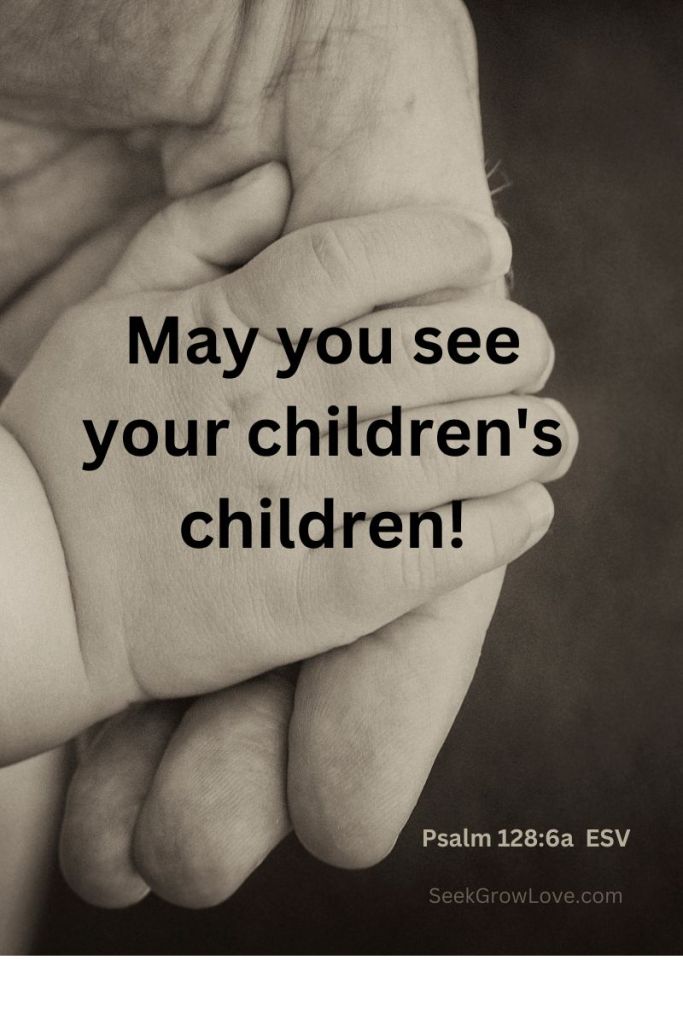
May you live to see your children’s children— peace be on Israel.
Today is a special day. It’s the birthday of my oldest grandchild, Scarlett. All of my grandchildren are precious and I love them all dearly. I can’t believe how blessed I am to have so many who call me Grandpa or Poppa or Poppy. Scarlett is the first to make me a grandparent. Psalm 128 names being able to see your children’s children a special blessing.
Reading this Psalm again touches me deeply and reminds me not to take things for granted like enjoying the fruit of your labor. Not everyone does enjoy the fruit of their labor due to war, disaster, or disease. We should not take the blessings we receive in life for granted. Life does not always go how we planned or wished. Not every man is blessed with a fruitful vine with a table surrounded by olive shoots. Not every parent is blessed to live long enough to enjoy their grandchildren. I’m currently battling some pretty serious diseases. One of my motivators to be healed is to enjoy my family… and honestly, I’d like to meet not only my grandchildren but also my great grandchildren in a few years.
I also want to see the prosperity of Jerusalem and peace in Jerusalem. That will happen when King Jesus returns. I’d like to be around to see that too. But if I should close my eyes in the sleep of death, I will see Jesus, and I hope my family, my church, and my friends at the first resurrection.
The blessings that await us at the coming of Jesus will be awesome. I want to see you there too. Don’t overlook both the promises or warnings in John 3:36 “Whoever believes in the Son has eternal life, but whoever rejects the Son will not see life, for God’s wrath remains on them.” Don’t miss out on the blessings that come through Jesus. May God bless you.
Pastor Jeff Fletcher
Reflection Questions
What are the blessings you have already seen? Thank God for them
What are the blessings you still hope to see before Jesus returns or you sleep in death?
What does Jesus’ return mean to you?
What is your greatest hope for the future? What do you need to do today to increase your chances of taking part in that future?
Most of the Psalms were written by David, but there are a few that were written by others. For example, Psalm 90 was written by Moses and Psalm 127 was written by David’s son, Solomon.
Today’s reading, Psalm 127 is what we will reflect upon. It offers wisdom about the wise raising of a family. I find some parts of Solomon’s teaching a bit paradoxical. Solomon’s father, King David, had 19 sons by his wives. The year before his father David died Solomon’s first wife Naamah gave birth to his one and only son, Rehoboam. She also gave birth to two daughters Taphath and Basemath. As far as we know from the Bible these are the only three children Solomon fathered. This is odd considering Solomon had 700 wives and 300 concubines. Solomon valued children and saw them as a reward from God.
A Song of Ascents. Of Solomon.
Psalm 127
Unless the Lord builds the house, those who build it labor in vain. Unless the Lord watches over the city, the watchman stays awake in vain.
2
It is in vain that you rise up early and go late to rest, eating the bread of anxious toil; for he gives to his beloved sleep.
3
Behold, children are a heritage from the Lord, the fruit of the womb a reward.
4
Like arrows in the hand of a warrior are the children of one’s youth.
5
Blessed is the man who fills his quiver with them! He shall not be put to shame when he speaks with his enemies in the gate.
If Solomon valued children so much why didn’t he have more? The most likely answer is that Solomon’s next wife was the daughter of the Pharoah of Egypt. She worshipped idols and brought them into the royal palace. Many Biblical scholars believe that Solomon had no more children as punishment for allowing idolatry to enter his family.
Psalm 127 begins “Unless the Lord builds the house, those who build it labor in vain.” The house referred to here is not a physical house or palace but a family or a household.
That strikes me as a very wise teaching. And yet Solomon’s actions weren’t very wise when he had 700 wives and 300 concubines. Another paradox is that in 1 Kings 3 Solomon asked God for the gift of wisdom. Because Solomon’s request of wisdom was very unselfish (he didn’t ask for riches or a long life, God agreed to give him what he asked for, wisdom and what he didn’t ask for: wealth, honor, and long life as long Solomon followed God’s commands.
This begs the question… how did God give him wisdom? Did he open up Solomon’s head and pour in wisdom, or was wisdom acquired over time? Perhaps Solomon grew in wisdom over time, when he realized that he missed out on the blessings of a large and fruitful family because he allowed idolatry to enter his home?
Solomon doesn’t quantify a number of children that qualify one as blessed. David had 19 sons. Solomon’s 1 son Rehoboam had 28 sons and 60 daughters (wow, that’s a lot of weddings to pay for).
My wife Karen and I have been blessed with 7 sons and 4 daughters (JJ, Jon, Joshua, Karee Anne (Gregory), Joel, Kailyn, Katie Beth (Mattison), Kass, Jordan, Josiah, and James). We also have been blessed with 16 grandchildren (soon to be 17). We are greatly blessed. My children (and their spouses) and grandchildren are precious gifts from God and I’ve always appreciated this Psalm. Of course, having a large family is not the only sign of blessing from God. However God chooses to bless you, receive it with gratitude and joy.
Peace, Grow, Love
-Jeff Fletcher
Reflection Questions
How would you put in your own words and explain Psalm 127 verse 1? Compare what a house/family built by the Lord looks like versus one built in vain. Consider the home you were raised in – which was it more like? Which do you want for a home/family you will/are or have raised?
What are some of the current views towards children that you have witnessed? Which ones would God agree with, which ones would he not?





 Seek Grow Love