The Love Chapter

1 John 4

i John 4 11

This chapter starts out with an admonition to “test the spirits to see whether they are of God.” Not every teaching or spirit is true. There is a very important test which can be used to know if a spirit is from God, or not. “By this you know the spirit of God: Every spirit that confesses that Jesus Christ has come in the flesh is of God” (4:2).  The test does NOT say:

  • that Jesus Christ has come in the flesh and yet is fully God
  • that God has come in the flesh as Jesus Christ, taking on a human nature
  • that Jesus Christ came from some pre-existent state into the flesh.

We must be very careful to read the text for what it says and not read into it what it doesn’t say! The phrase “come in the flesh” means that Jesus the Christ (Messiah) is a real human being, not just dressed up like one.

1 John 4 is actually the “love chapter” in the Bible as love is mentioned 26 times, almost three times as many times as in 1 Corinthians 13 (9 times). A friend once read this chapter as a devotional thought on Valentine’s Day, and it stuck with me as the “love chapter.” So much so that when I read it last February 14th, I thought that maybe the children’s song could also go “Yes, God loves me, yes, God loves me… the Bible tells me so.”  Ultimately, it’s God’s love that ignites our love for others through His Son, Jesus the Messiah. A key verse that summarizes this chapter of love showing how love is of God is verse 9.  “In this is love, not that we loved God, but that He loved us and sent His Son to be the propitiation for our sins.”

God took the initiative, motivated by love, to remedy our sin problem.

Knowing that “God is love” (4:8,16) should motivate us to love others. But the author is not calling for a hippie kind of “All you need is love, love”. He is admonishing us to a love of other “brothers” who believe that Jesus, the human Jesus, is the Messiah/Christ (5:1). This admonition to love is a call for unity among like-minded believers, because they are family as the children of God. The way we love other like-minded believers whom we can see demonstrates how much we love God, whom we can’t see. And this commandment we have from Him, that the one who loves God should love his brother also (4:21).

Beloved, let us love one another, for love is from God, and whoever loves has been born of God and knows God. (4:7)


Bill & Stephanie Schlegel

His Commandment

1 John 3

IMG_0009

The World’s Relation to God’s Children

This chapter mentions two ways in which the non-believing world reacts to the children of God:
1. The world does not know us (that we are God’s children) just as it did not know Jesus, that Jesus is God’s Son (3:1).
2. The world hates us (3:13). The world is like Cain, who hated and even murdered his brother.
Especially in 3:11-18, the author instructs us not to be like the world and hate our brothers, our fellow believers in Messiah Jesus.
Knowing what Love is, I John 3:16, the parallel to John 3:16

“By this we know love, because he laid down his life for us. And we also ought to lay down our lives for the brethren.”
This verse encouraged me (Stephanie), so much during the hardest time of my life, which was just after my husband came to the understanding of the one true God and His Messiah Jesus – and the mistreatment that followed in result of his faith. The verse really helped me to focus on what real love is – to think how Jesus humbled himself to death on a cross. He was mistreated and ill spoken of; they even took his clothes away from him. That is how I know what love is, and I could take courage because of what Jesus went through and lay down my life for the brethren, disregarding the shame.

Jesus didn’t come to give a license to sin, but to remove sin, 2:4-10
At first glance the author may seem to contradict himself. In 1:8-9 he says we sin, but in 3:6 he says “no one who abides in him (Jesus) sins”. I think what the author is saying is that believing in Jesus does not give people a license to sin. Believers may sin (and there is a way to forgiveness, 1:8-9) but a life characterized by continual sin is not one in step with abiding in Jesus. Jesus didn’t come to give a license to sin. On the contrary, the writer gives two reasons why Jesus “appeared”:
1. To take away sin.
2. To destroy the works of the devil
Jesus and a believers life in Jesus does not give license to sin, but rather removes and destroys sin.
Theme Verse
1 John 3:23 could perhaps be considered a good theme for the entire epistle:
“And this is his commandment, that we should believe in the name of his Son Jesus Christ and love one another, just as he has commanded us.”

Bill and Stephanie Schlegel

Some observations from 1 John, chapter 2

1 John 2 1

“From the beginning…”


The phrase “from the beginning” which was used in the first verse of the book (1 John 1:1), is used 5 more times in chapter 2. In John 1:1 “that which was from the beginning” was that which they had heard, seen and touched, “the word of life”. This “beginning” refers to Jesus the Messiah and his ministry on earth communicating God’s word, not to the beginning at creation. The occurrences of “from the beginning” in chapter 2 are verses 7, 13, 14, and 24 (two times). It is important to keep in mind that “from/in the beginning” in the Scriptures does not always refer to the Genesis creation.


Context must help determine which “beginning” is meant. For instance, in the Gospel of John, the phrase “from the beginning” does not usually refer to the creation, but to Jesus ministry on earth. Note these references:

  • “For Jesus knew from the beginning who those were who did not believe, and who it was who would betray him” (John 6:65)
  • “So they said to him, ‘Who are you?’ Jesus said to them, ‘Just what I have been telling you from the beginning’” (John 8:25).
  • “I did not say these things to you from the beginning, because I was with you” (John 16:24).
  • “And you also will bear witness, because you have been with me from the beginning” (15:27).

In each case mentioned above, from the beginning means the beginning of Jesus’ ministry.

With only two exceptions (John 8:44 and 1 John 3:8 which refer to the devil) “from the beginning” in the Gospel of John and in the Epistles of John (1 John 1:1; 2:7, 13, 14, 24; 3:11 and 2 John 1:5-6) refers to the beginning of Jesus’s ministry. This may help us understand “In the beginning…” of John 1:1. Some One God believers see John 1:1 as a reference to the beginning of Jesus’ ministry. Similarly, Luke mentioned “those who from the beginning were eyewitnesses and ministers of the word” (Luke 1:2). Mark 1:1 mentions “the beginning of the Gospel of Jesus the Messiah.”


“My little children”


Several times the writer refers to those whom he writes as “my little children” or “children” (2:1, 12, 18, 28). This should not be understood as if the writer is derogatorily chastising his listeners for being immature. Rather, these references should be understood as a terms of endearment and care, just as when he calls his listeners “beloved” (1 John 2:7, 3:2, 21, 4:1, 7, 11). As children of God (3:1-2), those that believe that Jesus is the Christ are a family, brothers and sisters, who must love one another (5:1).


An Advocate with the Father


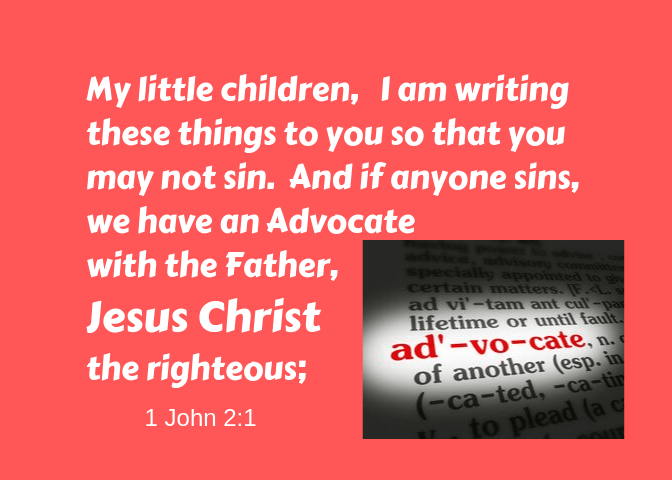
The writer explains that we do sin, but there is a path to forgiveness (1 John 1:8-10). He writes to us “so that we may not sin, but if anyone does sin, we have an advocate with the Father, Jesus Christ the righteous.” Jesus is our advocate, like a lawyer on our side. This should give us great encouragement. Jesus is the honest, righteous lawyer on our side. He is for us. As an expert lawyer, Jesus knows the rules. He knows how to take our case before the Father. He has access to the Father and successfully intercedes for us (cf. 1 Tim. 2:5 and Hebrews 8:1).


We lived in Israel and all our children were born there. Most countries do not grant citizenship to foreign children by virtue of being born in the country. Two of our young adult children applied to become citizens in Israel. They were denied several times over three years. However, not long ago a lawyer, an advocate, took up their case and presto, my children received their citizenship. The lawyer knew the rules, had the connections, authority and knowledge on how to present my children’s case, and succeeded. Jesus is our expert, righteous, successful advocate before the Father.


“Do not love the world…”


The author’s admonition to “not love the world or things of the world” are perhaps the best known verses of chapter 2 (vs. 15-17). He defines what “loving the world” is: the lust of the flesh, the lust of the eyes, the pride of life. It is a love of the way of the world, or of this world’s system. This doesn’t mean that we shouldn’t have an appreciation for the beauty and grandeur of God’s creation, the work of God’s hands, which is “very good” (Gen. 1:31). After all we wait for the regeneration of this world, and indeed the regeneration of this world’s system (Matt. 19:28, Heb. 2:5).


“The last hour”  and “anti-christs”

The author says it is the last hour. What a long hour it has been! He knows that it is the last hour since many anti-christs had already come. Specifically, here he says that the anti-Christ (anti-Messiah) is anyone who denies that Jesus is the Christ (the Messiah). The text does not say, as many traditional trinitarian Christians say, that the anti-Messiah is anyone who denies that God is the Messiah, or that the Messiah pre-existed as God. Rather, the text says that the anti-Messiah is anyone who denies that Jesus, the man Jesus, is the Messiah. “Christ” (Messiah) is never a title for God himself.


Of these anti-christs, the author says: “They went out from us, but they were not of us; for if they had been of us, they would have continued with us…” (1 John 2:19). It is easy to see how a text like this could be mis-interpreted and mis-applied. Especially as centuries passed, anyone could use the text to condemn any kind of a reformer. For instance, Catholics could apply it against Protestants.  Today it is leveled against anyone who denies that Jesus is God. But in its original context it was directed against anyone who denied that the man Jesus is the Christ (Messiah).


The promise of God – eternal life

1 John 2:25 says that God has promised us eternal life (immortal life in the age to come). We can take comfort and joy that God is pretty good at keeping His promises.


Having confidence, and not shrinking back in shame


1 John 2:28 says that if we abide in Jesus, that is, live according to knowledge of who he is, we can have confidence so that when he appears, at his coming, we won’t shrink back in shame. Since we know who Jesus is — the Messiah of God the Father, risen from the dead, exalted to God’s right hand, appointed to rule the world, we can look forward to his return. There is a similar admonition in Hebrews 10:39: “But we are not of those who shrink back and are destroyed, but of those who have faith and keep their souls.”

-Bill Schlegel

Filled With So Much Joy We Want to Share

1 John 1

1 John 1 2

There is an old gospel song called Wonderful Words of Life.  I have loved this song because of its lyrics:  Sing them over again to me –Wonderful words of life, let me more of their beauty see – Wonderful words of life.  Words of life and beauty, teach me faith and duty.  Beautiful words, wonderful words, wonderful words of life – Wonderful words of life!  In 1 John 1 the life – the eternal life – is a reference to Jesus.  The disciples knew Jesus personally and knew without a doubt that he was sent from God to be the savior and teacher of mankind.  The disciples knew  God through his word and knew personally Jesus Christ His son.  The only one – as one disciple described him in the gospels  as the one who had the words of life.  He actually said (when Jesus asked if he was going to turn away also as some nominal disciples had): to whom else shall we go? for you have the words of eternal life.(see John 6:68)

Having this relationship with Jesus gave them so much joy they wanted to share it with everyone.  Shouldn’t having a relationship with the one who has the words of eternal life fill us with so much joy that we want to share it too?

The joy comes from knowing the one who is eternal life and recognizing that all of God’s ways lead to light, and life, and truth.  Those people who walk in God’s ways must emanate this same light and life, and truth.  The darkness has no part in the light.  We must walk in ways of light and not in darkness.  We must want to share that light with others.

Let’s face it there is plenty of darkness out there.  Sin is everywhere, and everyone has sinned at some point in their life.  But the life giving, light bearing news is this:  God is willing to forgive all who confess their sin to Him and cleanse them from their sins.  Through the power of what Christ did on the cross we can all be put back into right relationship with our heavenly Father God.  These are definitely wonderful words of life!  And words worth sharing, and shining in our dark world.  So maybe you will find yourself singing the familiar words :  Words of life and beauty, teach me faith and duty, beautiful words, wonderful words, wonderful words of life!

Merry Peterson


Things That Are to Come

2 Peter 3

2 Peter 3 13

Have you ever wondered: when will Christ return?  That is a thought that I think every Christian who has read the Bible has thought at some point.  We look with hope towards the second coming of Christ. There are others though who have given up believing or never have believed in God’s promises or the return of Christ.  These are the mockers that Peter refers to in verses 3 & 4.  We hear it today – everywhere people mocking the promises or even existence of God.  But God is patiently waiting for people to recognize and honor Him.  He is waiting for just the right time to fulfill all that he has promised regarding Christ’s return and the establishment of a new system under Christ’s rule and reign.

In the last half of chapter 3 the apostle Peter talks about the need for Christians to live righteously and soberly in view of the destruction of the wicked so as not to be destroyed along with them.  He explains that our present heavens and earth will be destroyed in judgment – by fervent heat so hot it will destroy the elements.  Everything will be destroyed – fire will consume water, soil, air, and even will consume itself by burning out.  Environmentalists worst nightmares will come true at that point – the destruction of the earth by fervent heat.  HOWEVER – this is to make way the apostle Peter tells us for the new heavens and new earth that will be made.  This is a new heavens and earth where righteousness reigns.  This means the new heavens and earth will be a place of peace, and happiness, where those who have hungered and thirsted after righteousness dwell.  All those who have believed in the promises of God will be able to partake in this new heaven and earth.

I like to hike and have taken many hikes across the US and Canada.  Each time I enjoy the beauty that God has created around me in this natural environment and his amazing creatures I see along the way.  Although I enjoy the natural beauty of our current heavens and earth I am filled with anticipation of the new heavens and new earth that God has promised.  What new natural beauty will be there.   In our world today where unrighteousness and ungodliness seems to reign and wreak havoc in our lives won’t it be wonderful to inhabit a world where righteousness and godliness are the order of the day?  I am looking forward to the new heavens and the new earth – while I still try to take good care of the one we currently live in and do my part to shine the light of Christ in the dark world – I can’t help but think to myself; how wonderful that God has made this awesome promise of a new heavens and earth to us!

Merry Peterson


Don’t Be One of Those People

2 Peter 2

2 Peter 2 1

For every ounce of truth a lie is out there.  In 2 Peter 2 the apostle warns of those people who would distort the truth or add to it.  He warns in verse 1 from the beginning that false teachers and false prophets are out there twisting, distorting, and adding to the truth.  By truth here he is referring to the message of Jesus Christ.

Today it is not uncommon to hear people say things like – all roads lead to God, and regarding religion: I’m looking for what works best for me.  These are twisted and in some cases flat out lies about the truth.  The truth of the matter is that Jesus is the son of God and that he is the ONLY way to the Father, and the ONLY source of salvation and forgiveness, and the ONLY hope for eternal life. This is the message that Jesus taught and that God confirmed when he spoke from the heavens saying that Jesus was his beloved son in whom he was well-pleased as referred to in 2 Peter 1:17.  Jesus is the ONLY way!   Anyone who would persuade you otherwise may fall into the category of the false teachers and prophets of whom Peter warns.

This is why it is important for Christians to know what the word of God says – so they will not be deceived by these false teachers and prophets.  If something someone says is contrary to scripture or seeks to add to it in ways that do not agree with scripture then watch out!  And for goodness sakes – don’t be so foolish as to be one of those people who leads others astray!  We must know God’s word and be filled with His spirit to be able to discern what is true and what is false.

In concluding the chapter Peter reminds us that God has not turned a blind eye to those who lead others astray because of their acts of deception but rather that their destruction is sure.  So to sum up Peter’s words to us:  Don’t be one of those  people  who is either led astray or leads others astray from the truth!

Merry Peterson

Growing Christians

2 Peter 1

2 Peeter 1 5 7.png

The apostle Peter in his second letter to the churches encourages us and the early believers to exercise a life of righteousness  and to grow in those attributes on a continual basis.  The attributes or fruit that he refers to in verses 5-7 are the same fruits that are mentioned as the fruits of the spirit in Galatians 5:22-25.  God by His spirit produces fruit in true believers.  By producing this fruit Christians stand out in humanity and shine when they display these attributes.  Even non-believers stand up and take notice of those people who demonstrate an extra amount of patience, or loving kindness, or those who do not loose their joy even in the face of dire circumstances.

Recently my mother went through her second diagnosis and treatment of breast cancer.  I’ve seen the fruit of joy shine through her through this – even though she ended up losing a body part.  She has been a shining light to those around her – keeping her joy by not losing her sense of humor.  By being more concerned about others and their overall well-being rather than by wallowing in self-pity.  She has been continuing to bear fruit even in her circumstances.  Christians bear this kind of fruit and every good tree bears good fruit no matter what the circumstances.  Every tree is known by its fruit.  Peter is encouraging us and the early believers to continue to grow in bearing good fruit indicative of God’s spirit being multiplied within us.

In the last half of the chapter Peter fears that his time in instructing the believers will soon come to an end and he wants them to remember what is of most importance.  The important thing that he wants them to remember is that Jesus truly is the son of God  as was evidenced by him personally when the voice came from heaven declaring it so, and the importance of receiving Jesus as the promised Messiah.

In our walk with the Lord are we remembering what is most important and truly giving Christ first place in our hearts and minds as the son of God?  Are we allowing ourselves to be changed so that we continue to grow and produce good fruit by his spirit within us?  If we are not then we would do well to pay special attention to Peter’s words to the early church and apply them to our own hearts and lives as well.

-Merry Peterson


Serve God With a Good Attitude

I Peter 5

1 Peter 5 2 3 NIV

There is an old Amish proverb that goes something like this:  There are two kinds of leaders: those who are interested in the flock, and those who are interested in the fleece.  In the first part of I Peter 5 there is an admonition given to pastors but it is applicable to all those  who hold leadership roles anywhere.  Leaders are to lead by example.  They are not to be dictators with an accompanying attitude but rather directors who are always directing people in the case of pastors toward Christ, and for other leaders directing people toward the greater vision with a humble attitude.

Peter encourages us and the early believers to honor one another and treat each other respectfully.  Have you ever been around someone who frequently ‘tooted their own horn’?   How annoying is that?  Does it make you want to follow that person’s lead or make you like that person very much?  Think about social media posts you have seen  like this, or maybe even posted yourself.  One Christian leader appropriately called out some posts  as the ‘humble brag’ and targeted how annoying and self-serving  they are.  As Christian brothers and sisters no one should toot their own horn but rather let others give them any due recognition.  Peter reminds us in verse 5 that God hates pride but appreciates true humility.

In serving God with a humble attitude and living a righteous life we can expect to have some opposition.  Opposition can have two effects: either failure, or strength and growth.  In the end of the chapter Peter points out that our adversary the devil  would like to see us fail, and is just waiting to help us to our demise –  but by staying the course God will give us victory.  The admonition for us is to stand firm in our faith and righteousness so that we may glorify God in this life and thus overcome the evil one.

-Merry Peterson


Stay True to Righteousness

I Peter 4

1 Peter 4 7 8 NIV

When I graduated high-school  and went to my Prom I was invited to several ‘after-prom’ parties.  I knew that there would be drinking and other activities at these parties that I didn’t care to participate in.  I declined several invitations and have never been sorry for that decision.  What I did instead , was go with a few friends after prom to Dairy Queen and have ice cream sundaes and then back to my house where we  watched a movie until the wee hours of the morning.  My classmates all knew that I was a Christian and I most of all wanted to stay true to my Christian values as would be pleasing to Christ.  In 1 Peter 4 the apostle Peter reminds the early Christians to stay true to their righteous values in a world that did not promote those values, amongst a people who would not understand or value their decision to behave righteously.

Our culture today is filled with sensuality (notice how little clothing some people and models wear), lust (always wanting more), and a constant appeal to the senses that drinking alcohol will make you popular, relaxed,  fun to be around, etc.  Now I’m not proposing that everyone go around in turtlenecks and never have a glass of wine here –  But by being sensuous , lusty, or intoxicated we dishonor God and his good desires for our lives.  People and friends may make fun of you for not choosing to participate in these activities but the apostle Peter reminds us in verse 5 that everyone will have to give an account before the Lord about what they chose to do, and how they conducted themselves in this life.

He goes on to encourage the early believers and us to lead lives of righteousness exercising  good judgment, being diligent in prayer, loving others, being hospitable and doing what God has gifted us to do by His spirit for the encouragement and uplifting of others.  In verse 11 he reminds us that God will give us the strength to do these things so that He will be glorified through our lives of righteousness.

We all one day will stand before the Lord to be judged for our actions.  In the last part of the chapter we are told that we should not be found suffering for sins committed but rather that if we are found suffering it should be for the cause of following Christ in an ungodly world.  We can trust God to be the righteous judge, for He is our creator and we can entrust our souls to Him.

-Merry Peterson


It’s All In The Attitude

I Peter 3

1 Peter 3 8 9

Aretha Franklin said it best in her hit song:   RESPECT – all she needed and wanted  was to be given a little bit of respect.   Are we not the same?  In I Peter 3 the apostle starts off by reminding the readers that they are to give respect and behave respectfully so that others will be won to Christ through their exemplary conduct.    What it all boils down to; summarizing his words is that;  in relationships mutual respect is key for both individuals, having the attitude of  honoring  the other person above themselves.  Imagine if everyone in our world today adopted this same kind of respectful attitude.  What a different world we would live in.

Have you ever seen someone who was dressed beautifully but then opened their mouth to display an ugly attitude?  Isn’t  it always disappointing to see?  In this chapter the apostle Peter reminds us that true beauty is found on the inside.  Our attitudes and  actions towards others speak louder than the clothing or jewelry we wear or the hairstyle we choose.  God desires for us to be beautiful on the inside and shine that outwardly.  In our world today we seem to be bombarded with the notion that beauty can be bought or acquired through purchasing – however true beauty is a quality that cannot be bought or sold.

Further on in verse 7 and 8 He points out that answers to prayer can be hindered by actions and attitudes of not being respectful toward one another.  We are not to be quarrelsome, we are to seek peace and pursue it.  This is the righteous expectation that believers are called to.  In verse 12 we are reminded that the eyes of the Lord are toward the righteous and his ears attend to their prayers.

We are to live righteous lives being sure of the hope we have in Christ.  In the final section of I Peter 3 the apostle Peter reminds the believers that they are to be sure of the hope they have.  This hope is believing  that Jesus is the only begotten son of God, that his death provides forgiveness and salvation from sin, and that his resurrection gives us the hope of eternal life.  Belief in these things and the outward symbol of baptism is the indicator of the believer’s new life with Christ.   With this new life in Christ, the believer is then called to live a life of righteousness that pleases God our Father.

-Merry Peterson